
“Piumino” Club Chair by De Pas, D’Urbino & Lomazzi for Dell’Oca, Italy 1970s (sold)


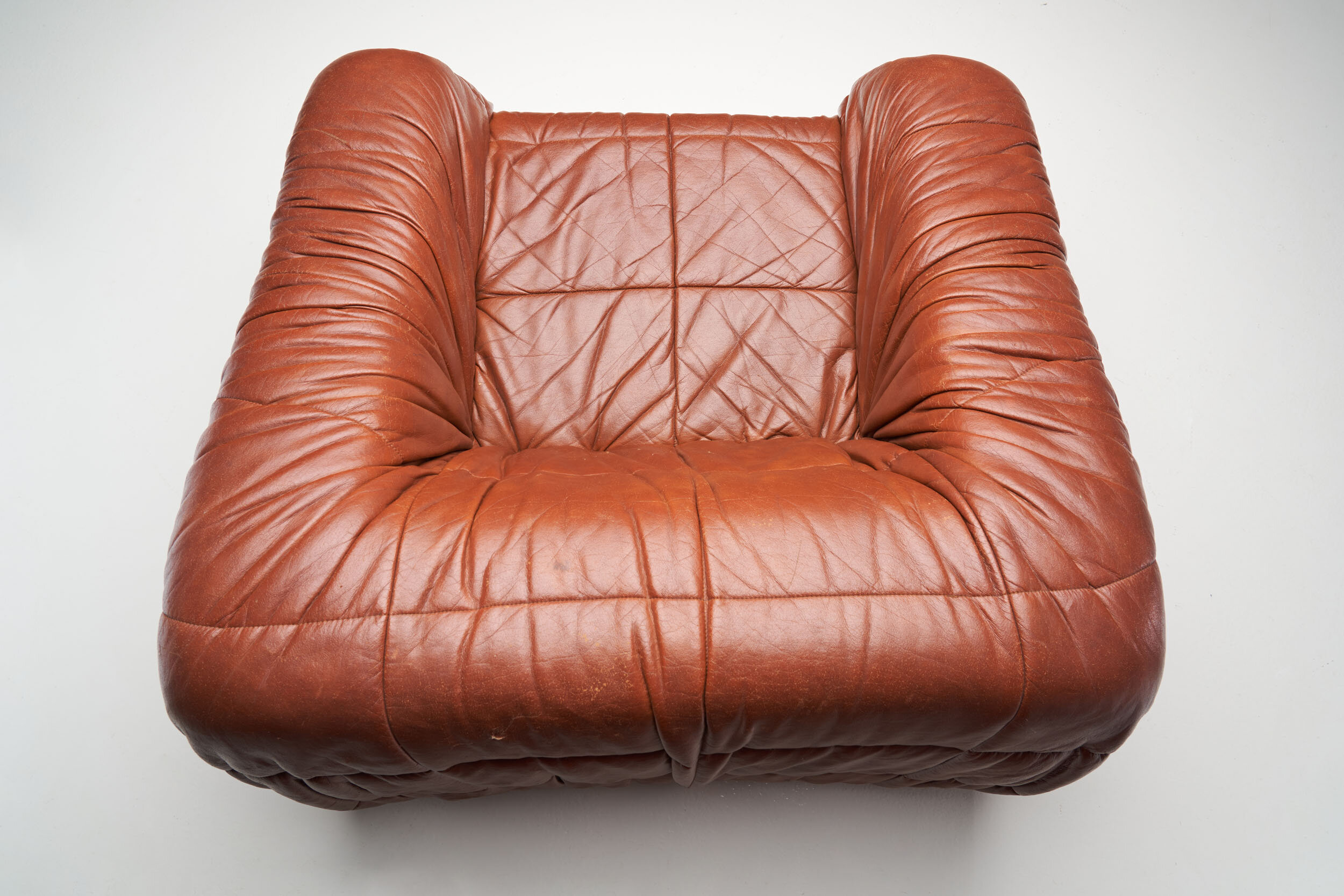


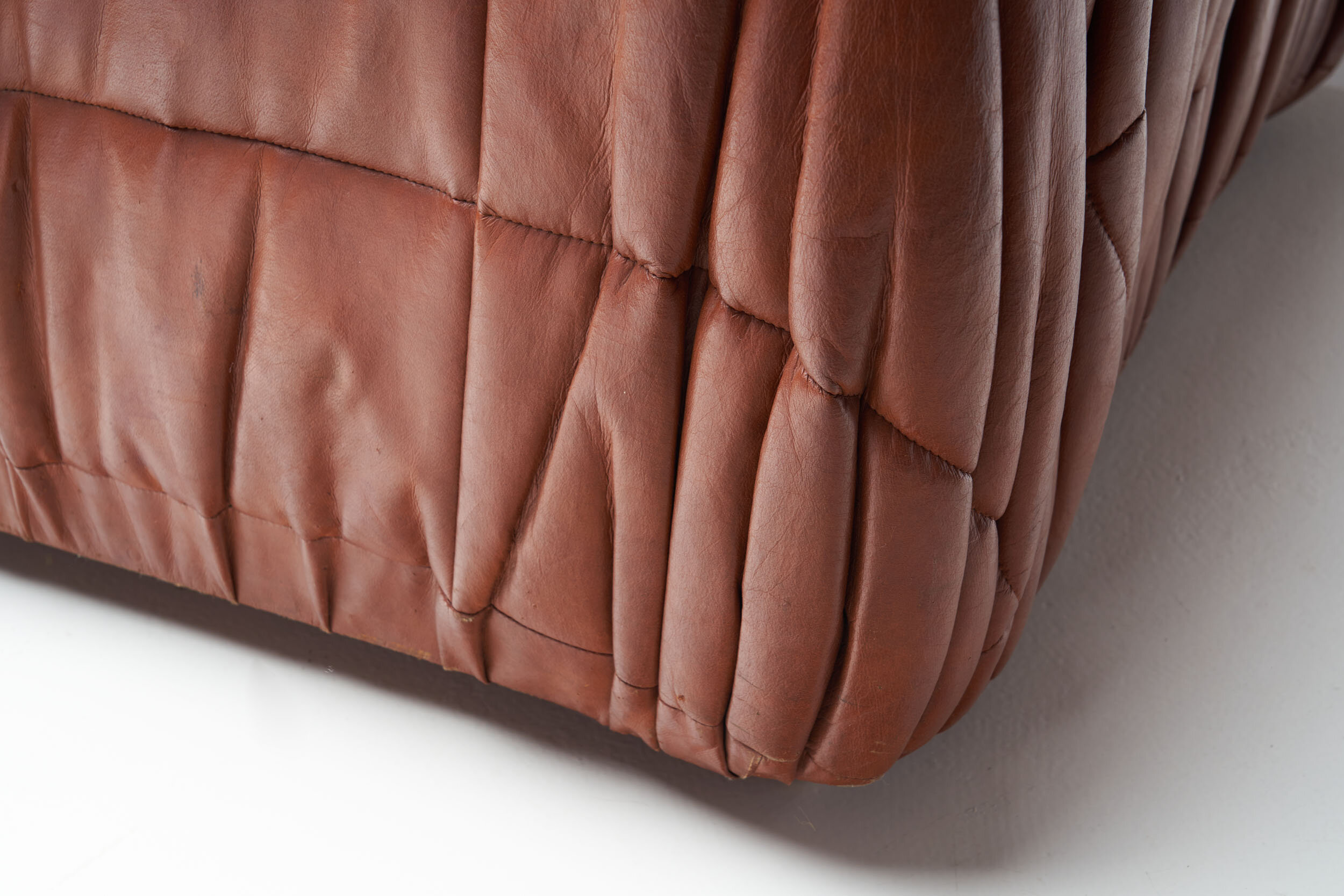


“Piumino” Club Chair by De Pas, D’Urbino & Lomazzi for Dell’Oca, Italy 1970s (sold)
This “Piumino” chair is an outstanding model by the Milanese architect trio, known world-wide for their enlarged ingenious works.
The shape and sheer size are the most eye-catching elements, but thanks to the architectural know-how of the designers, the construction of the chair does not fall short either. The chair is moulded out of foam and covered with folded, soft cognac leatherette. The foam and leatherette materials guarantee extreme sitting comfort. Unlike the trio’s iconic “Joe Sofa” (shaped like a baseball glove), the “Piumino” avoids looking kitschy despite its exaggerated size and design.
De Pas, D’Urbino and Lomazzi were part of the ‘Radical Design’ movement, which dominated Avant Garde Italian design and architecture in the late 1960s and early 1970s. This impressive club chair design was created in this period, which brought the long-lasting success of the designers. De Pas, D’Urbino & Lomazzi designed this cognac leatherette piece for the Italian manufacturer Dell'Oca in the 1970s.
SOLD
Condition:
In good vintage condition. Wear consistent with age and use. Item has some small marks and scratches, some small leatherette damage fitting with the age and the ‘rough’ appearance of the item. This chair comes with its original leatherette or has been reupholstered by a previous owner. Each of our items can be re-upholstered by our in-house atelier in a fabric of choice. Please reach out for more information.
Dimensions:
41.33 in W x 39.37 in D x 28.34 in H
105 cm W x 100 cm D x 72 cm H
About the designers:
Since 1966, Donato D’Urbino (b. 1935) and Paolo Lomazzi (b. 1936) have been working together designing architecture, objects, scenography, furnishings and urban projects. They worked with architect Jonathan De Pas (1932-1991) from the beginning of their careers until 1991 (the year of De Pas’ death). The three met while studying architecture at Milan’s Polytechnic University.
During the 1960s, they showed a particular interest in the activity of creating temporary furniture and architecture, featuring the use of materials and cutting-edge industrial techniques. Architect and design studio De Pas, D’Urbino & Lomazzi was founded by the trio and became known for its unconventional seating designs, including some pop-culture icons such as the inflatable “Blow” (1967) and the kitschy “Joe Sofa” (1968). Both designs are part of the MoMa’s collection. They took the views of a changing society in which furniture was no longer desired or required to last a lifetime and introduced a collection of furniture that represented precisely the opposite.
The group designed the entrance for Milan’s 14th Triennial (1968), which took the form of a long tunnel with port holes, as well as the Italian Pavilion at the Osaka World Expo (1970). In 1980, De Pas, D’Urbino & Lomazzi were instrumental in the exhibition “Italian Furniture Design 1950–1980” at the Cologne Municipal Museum. In 1987, there was an exhibition of the group’s work in Kyoto, and in the same year, the exhibition “De Pas, D’Urbino, Lomazzi” was inaugurated at the temple Daikaku-Ji, Kyoto, followed by a solo exhibition in 1992 titled “Un coro a tre voci” (A three voiced choir) at IZM Gallery Tokyo.
Over several decades, the trio was the recipient of numerous awards, including the Hannover’s Design Award Winner (1998), and in 2010, their archives were declared to be of “particularly important historical interest” by the Ministry of Cultural Activities and Heritage, and were donated to CASVA (Centre of Higher Learning for Visual Arts) in Milan for preservation and consultation. In addition to their work as designers, De Pas, D’Urbino and Lomazzi have also contributed to design theory through their work with the Industrial Design Association.
Their work is featured in museums and exhibitions world-wide including the Museum of Modern Art in New York, The Brooklyn Museum of Art in New York, the Victoria & Albert Museum in London, the Design Museum of London, the Centre Pompidou in Paris, and the Vitra Design Museum in Weil-am-Rhein, among others. The collective is remembered and still celebrated for its efforts to connect radical design with everyday life. ~H.
REQUEST PRICE HERE
Price category: 5,000 - 7,500 usd / eur
Illum Wikkelsø was a recognisable figure of Danish seating design in the post-war decades, known for creating furniture that combined sculptural silhouettes with a strong emphasis on comfort. Working throughout the 1950s and 1960s with manufacturers such as Søren Willadsen, Wikkelsø developed lounge chairs and sofas that softened the stricter geometry of earlier modernism through curved lines. His designs often relied on exposed wood, generous upholstery, and carefully balanced proportions, allowing seating to feel visually substantial without becoming heavy.
Model “110” reflects this approach through its dramatic winged silhouette and restrained material palette. The chair is upholstered in black leather that wraps continuously around the high back, seat, and armrests, emphasizing the sculptural quality of the form. The backrest rises upward into pronounced side panels that connect the wings to the armrests. The sides curve gently forward, creating a protective and enveloping shape around the sitter. These extended sides visually frame the head and shoulders. The leather surface contributes to the overall character of the piece: its subtle texture catches light differently across the curved sections, giving depth to the large upholstered planes. In contrast to the dark upholstery, the chair rests on a solid wooden base with angled legs that introduce warmth and visual lightness. The exposed wood creates a clear separation between the upholstered body and the floor.
The balance between softness and structure is central to the success of this design. The chair carries the commanding presence associated with high-back lounge seating, yet the flowing transitions between its elements prevent it from feeling rigid. Wikkelsø’s ability to merge comfort with sculptural clarity is especially evident here, making the model equally compelling as functional seating and as a statement piece within an interior.
Condition:
In good vintage condition. Wear consistent with age and use. The chair has recently been reconditioned. The chair comes with its original leather that has developed a natural patina over time. Due to the nature and age of the materials, the item may have some marks, scratches, and discolouration. Each of our items can be reupholstered by our in-house atelier in a fabric of choice. Please reach out for more information.
Dimensions:
29.93 in W x 35.04 in D x 35.44 in H; Seat height 14.57 in; Seat depth 21.26 in; Arm height 21.66 in
76 cm W x 89 cm D x 90 cm H; Seat height 37 cm; Seat depth 54 cm; Arm height 55 cm