
Leather and Lacquered Metal Armchair by Cees Braakman for Pastoe, the Netherlands 1960s
Leather and Lacquered Metal Armchair by Cees Braakman for Pastoe, the Netherlands 1960s
REQUEST PRICE HERE
Price category: 2,500 - 5,000 usd / eur
Born in Utrecht in 1917, Cees Braakman spent most of his career shaping the identity of the renowned furniture manufacturer, Pastoe. He joined the company at a young age and later became its central designer and manager. Following a formative trip to the United States in 1947, where he encountered the work of Charles and Ray Eames and the innovative production methods of Herman Miller, he began developing furniture that combined modern construction techniques with a distinctly Dutch sense of restraint.
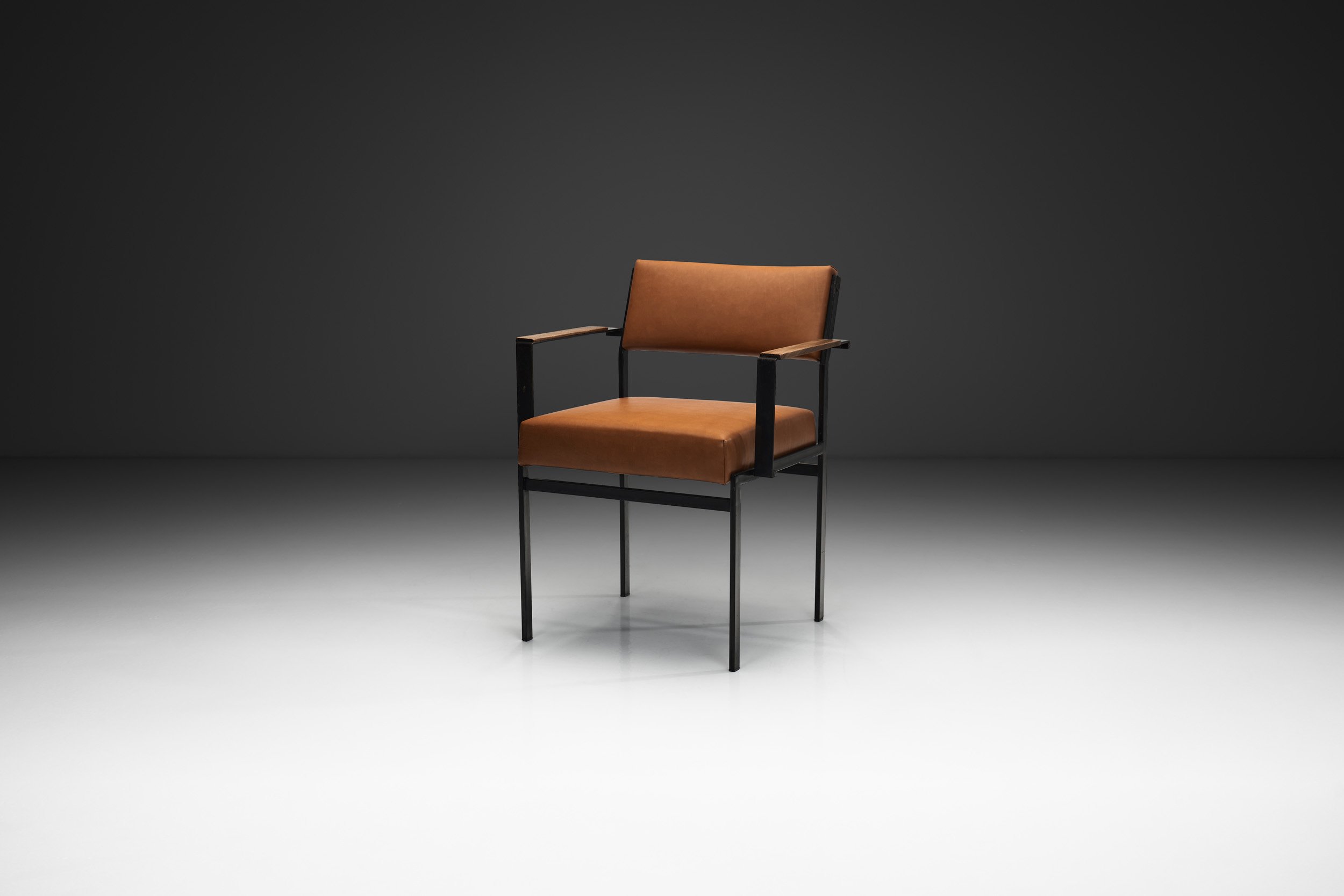
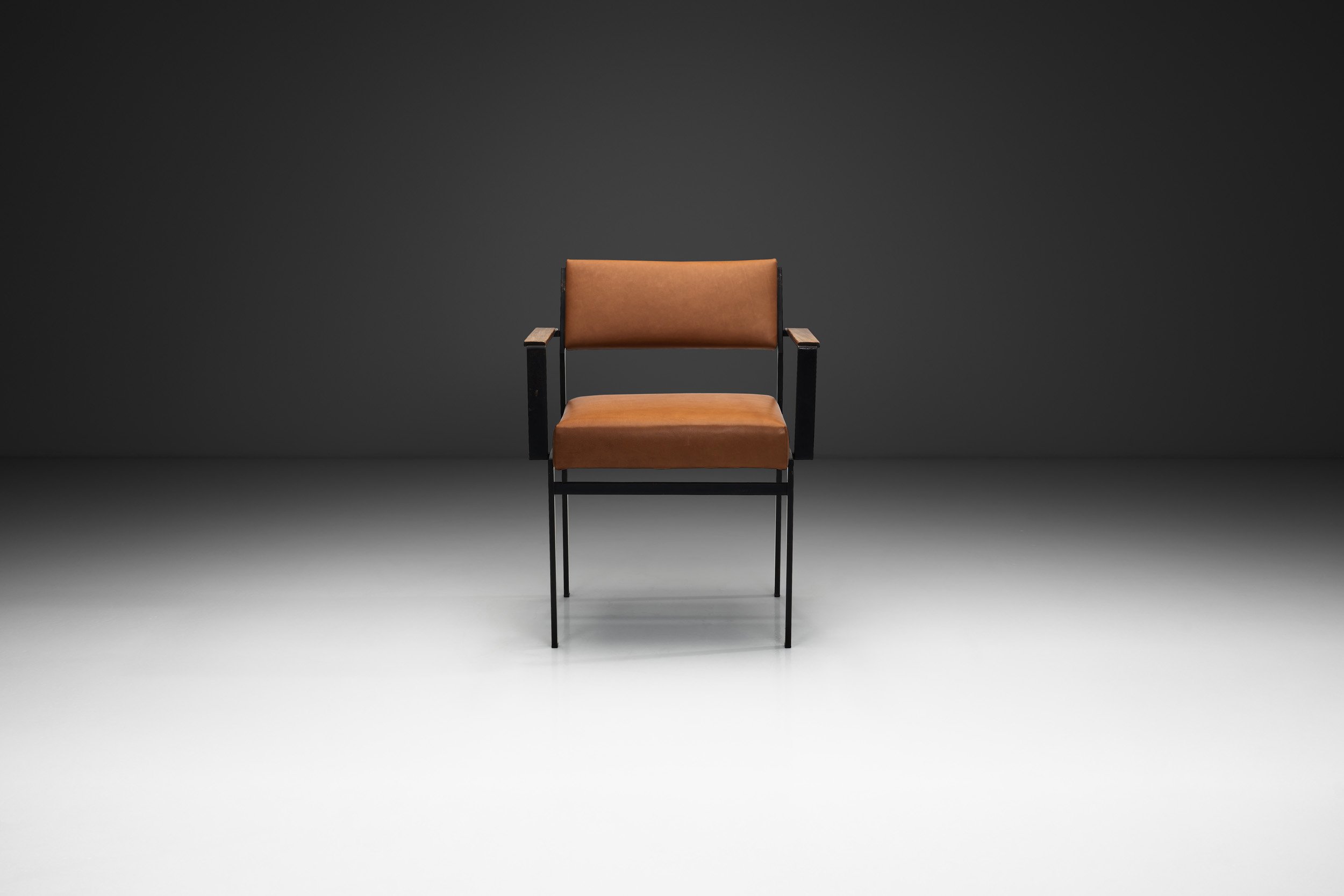
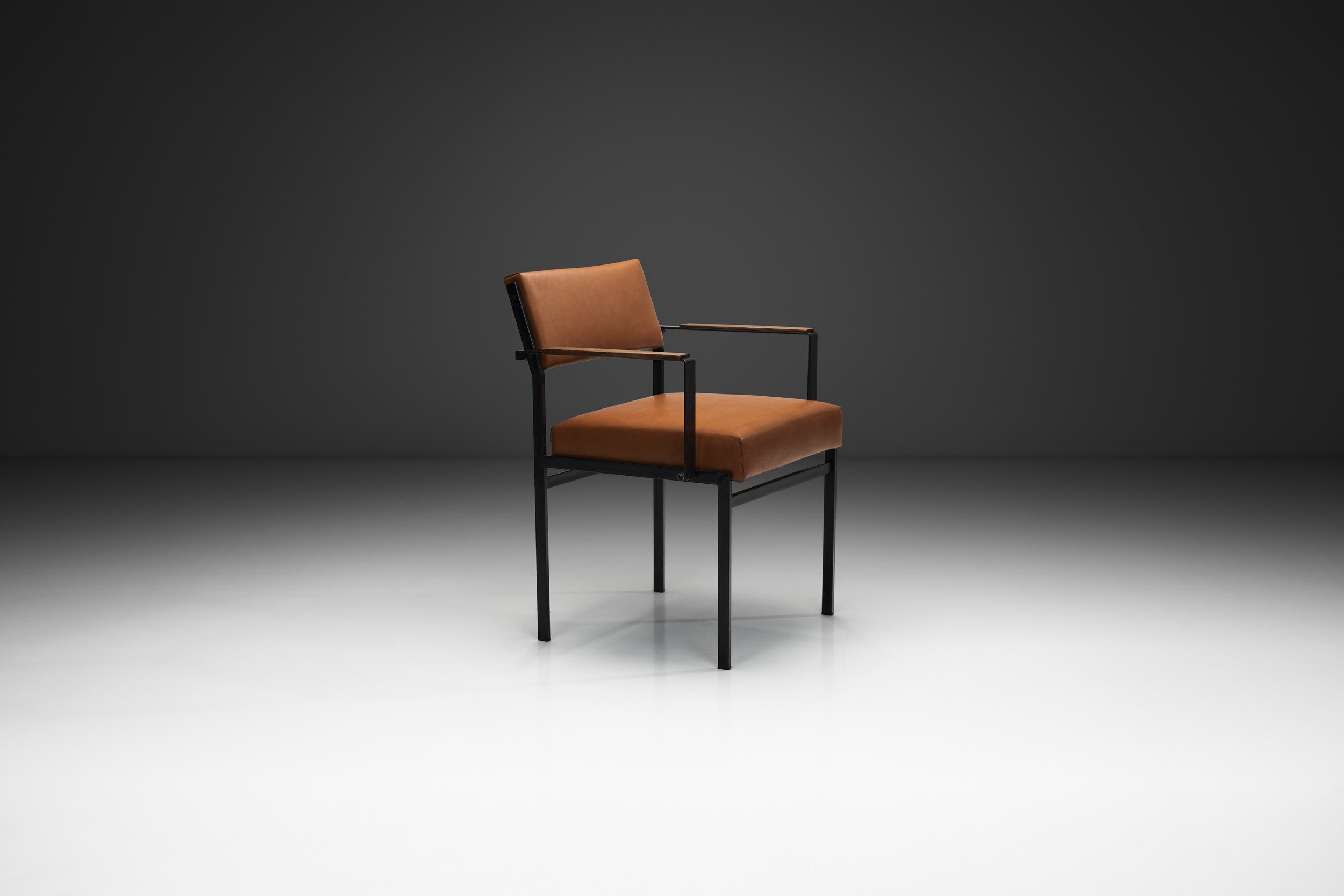
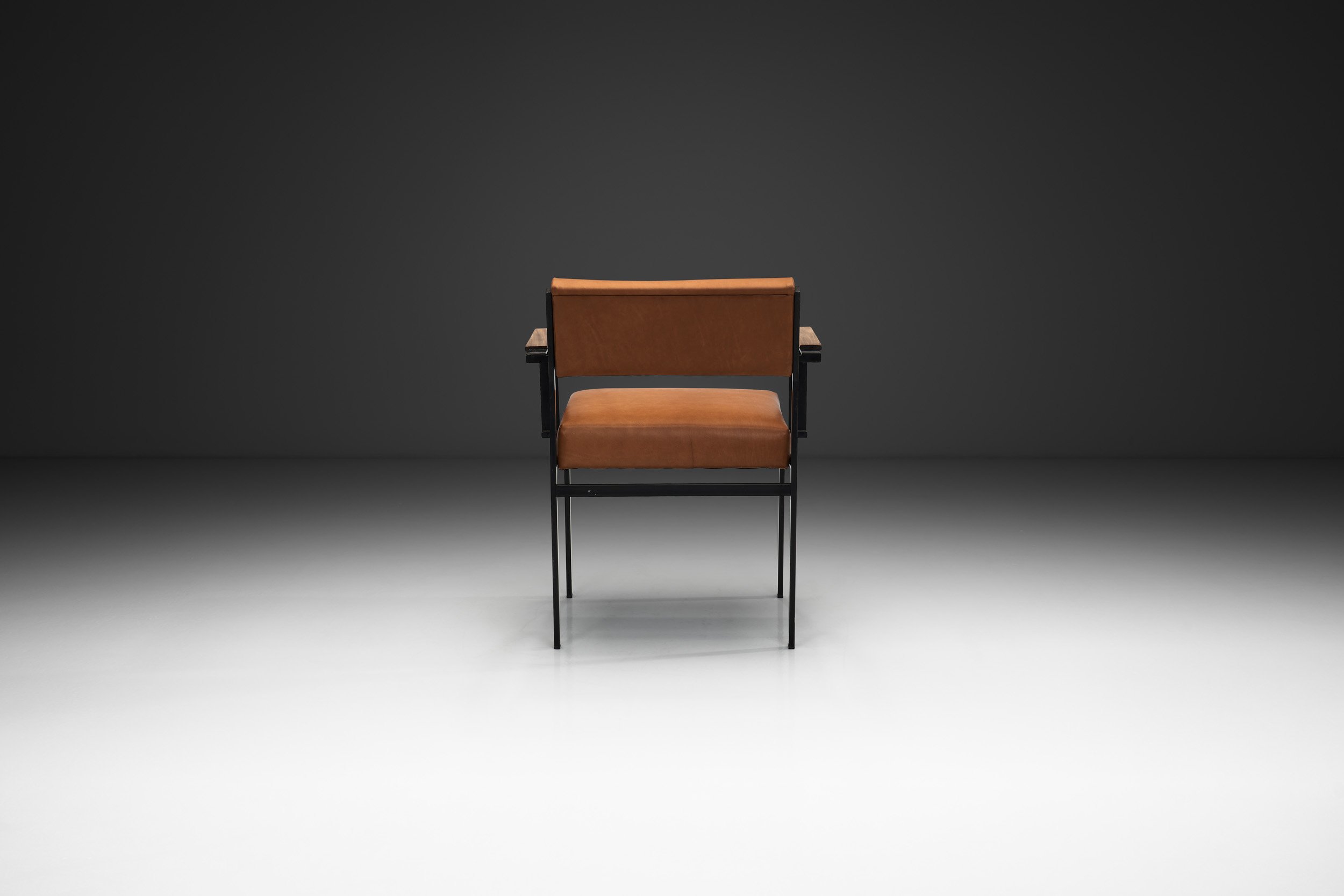
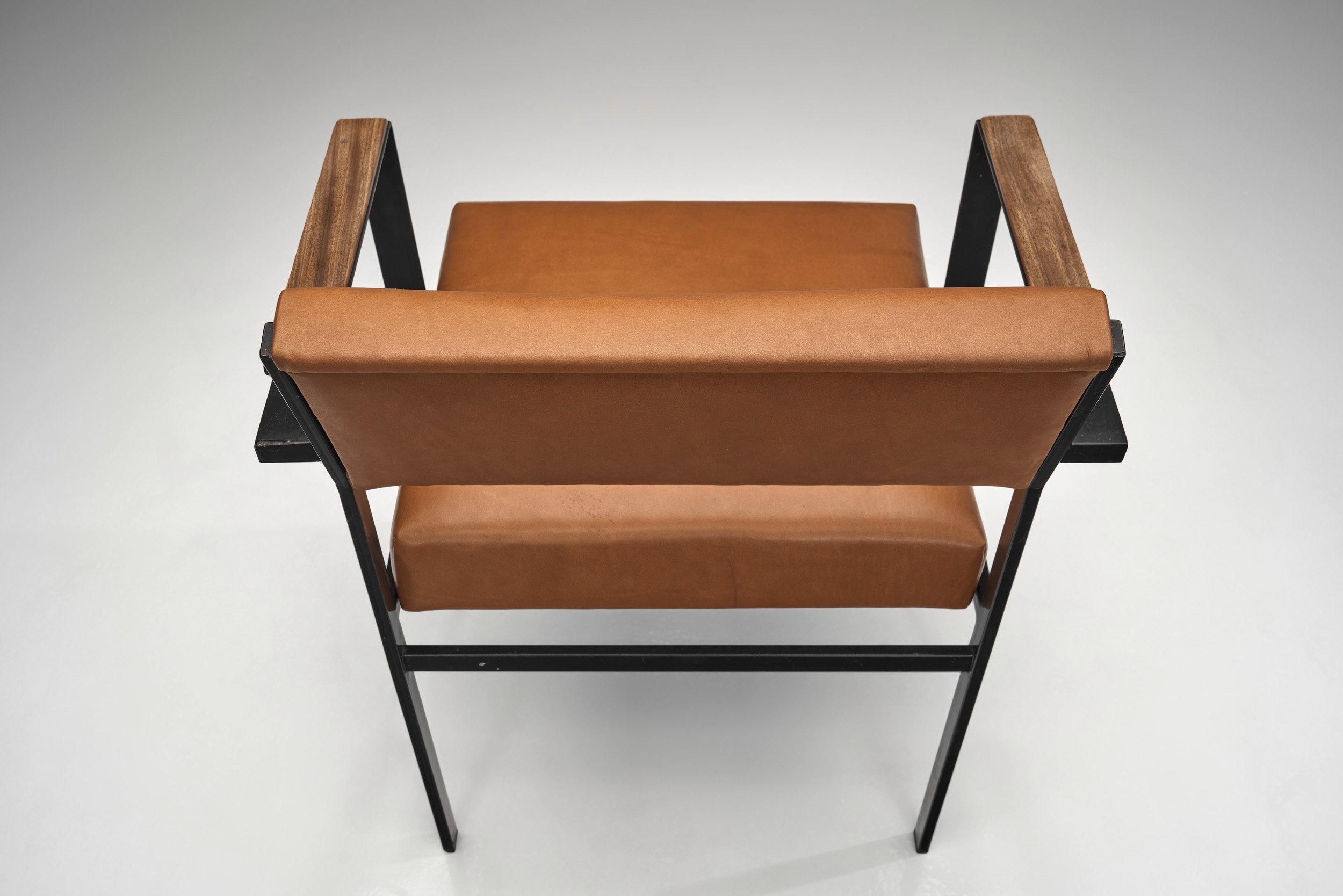
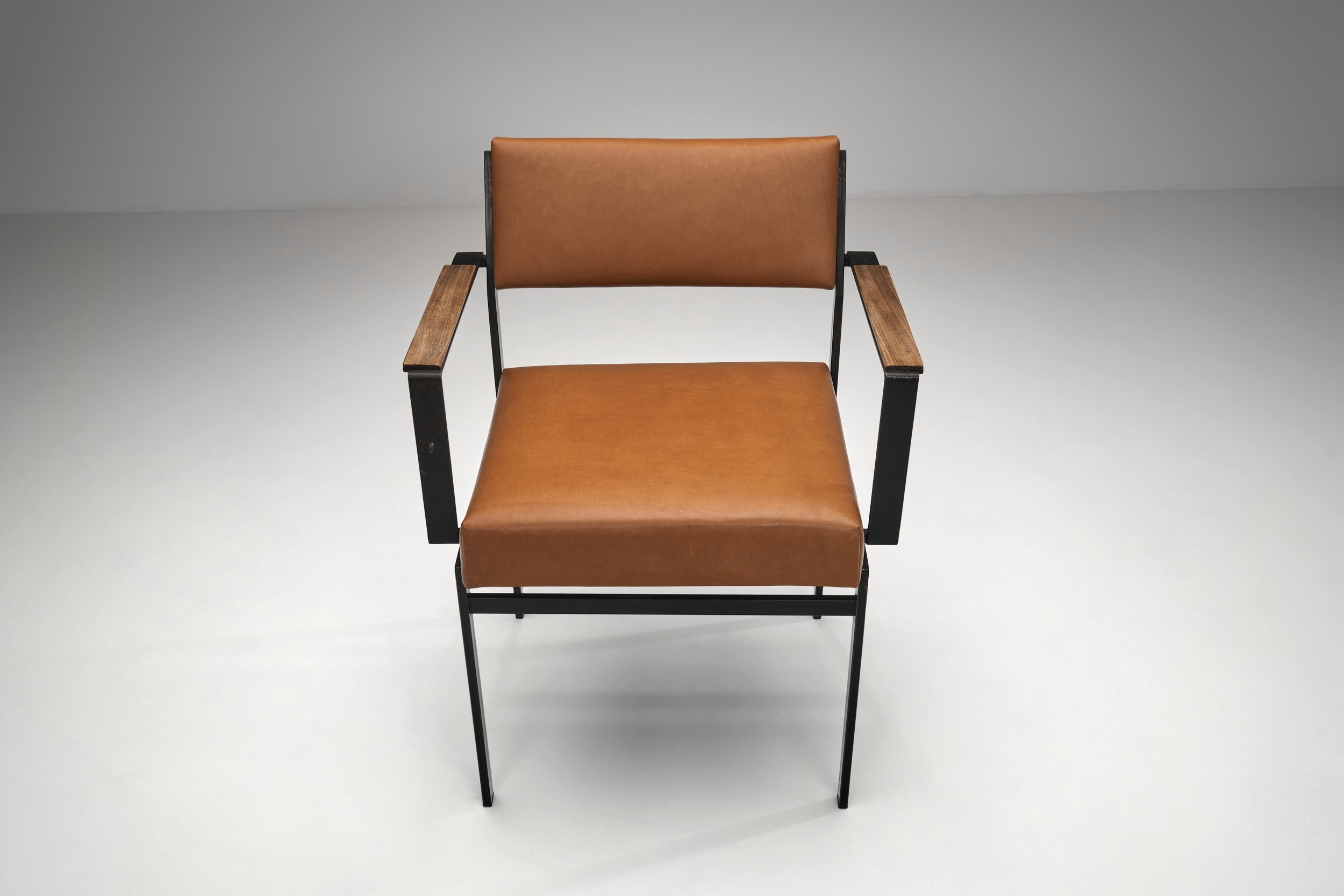
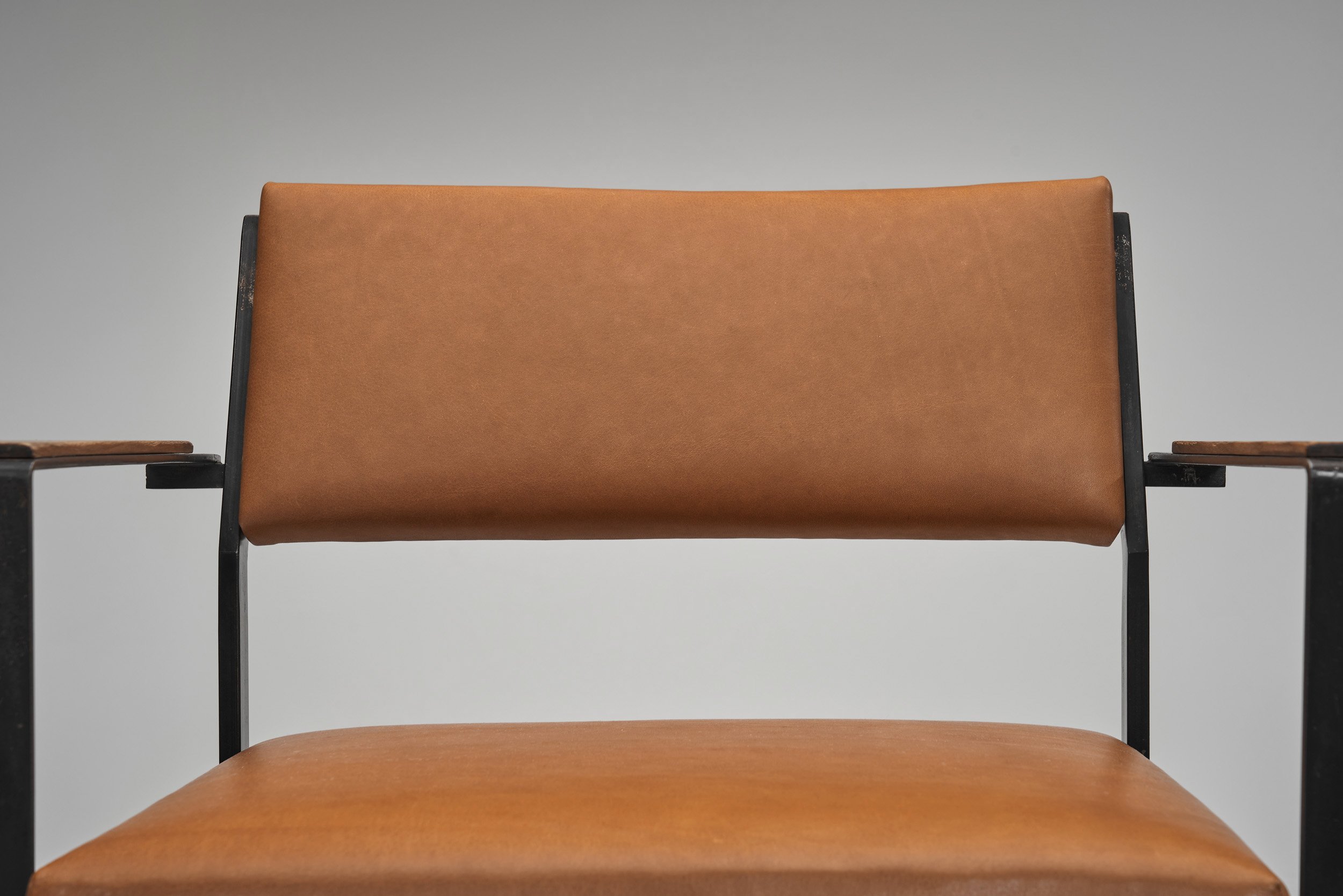
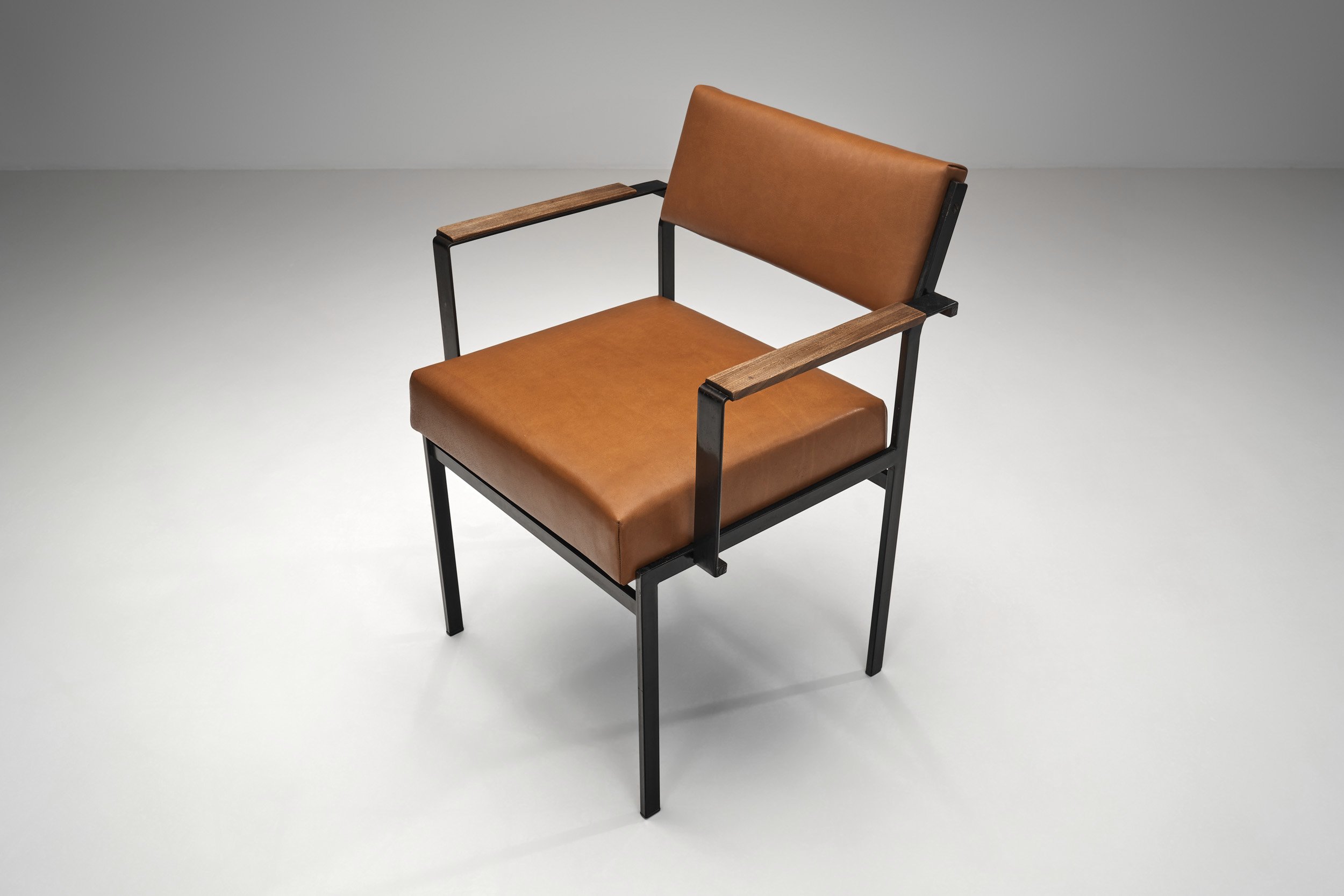
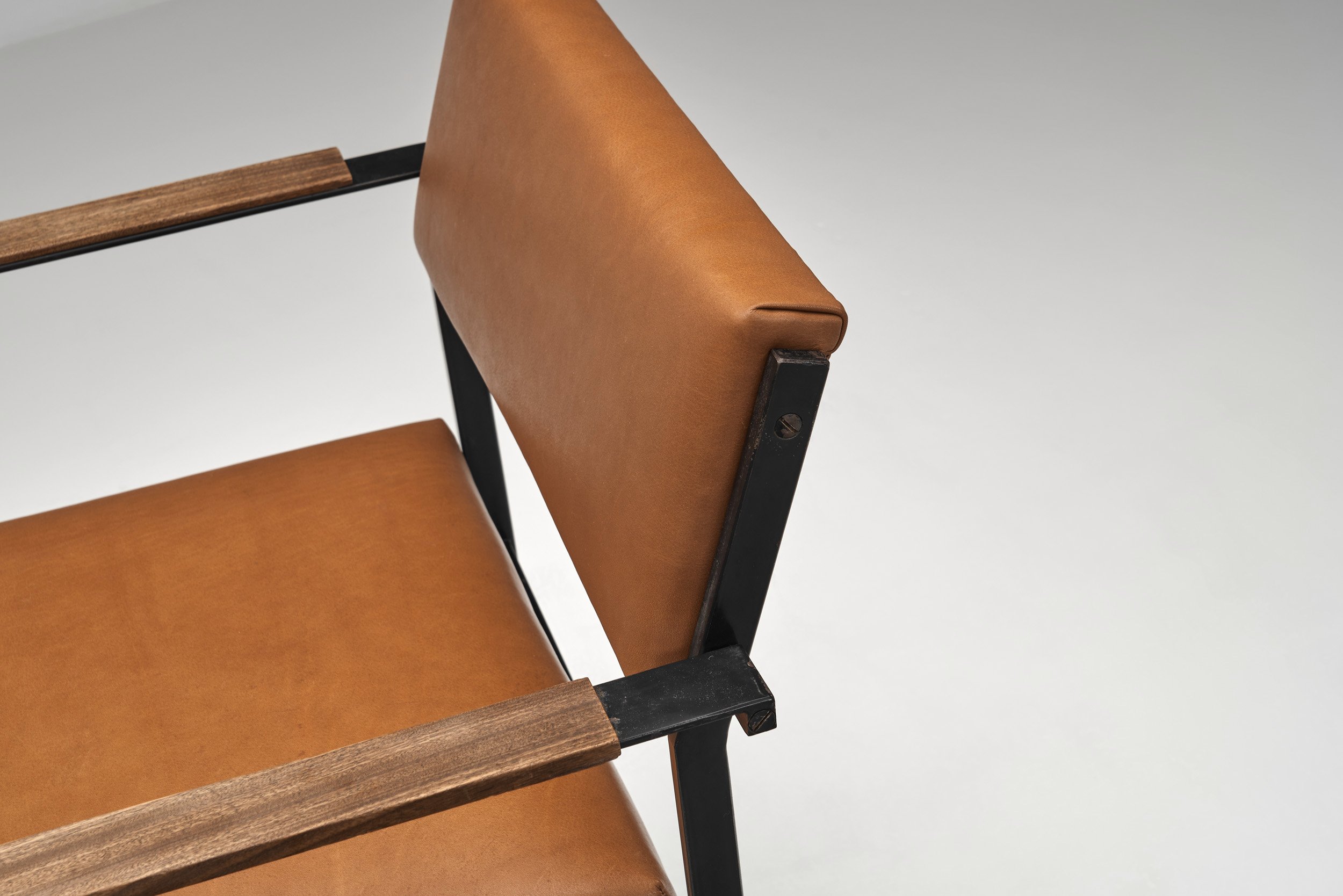
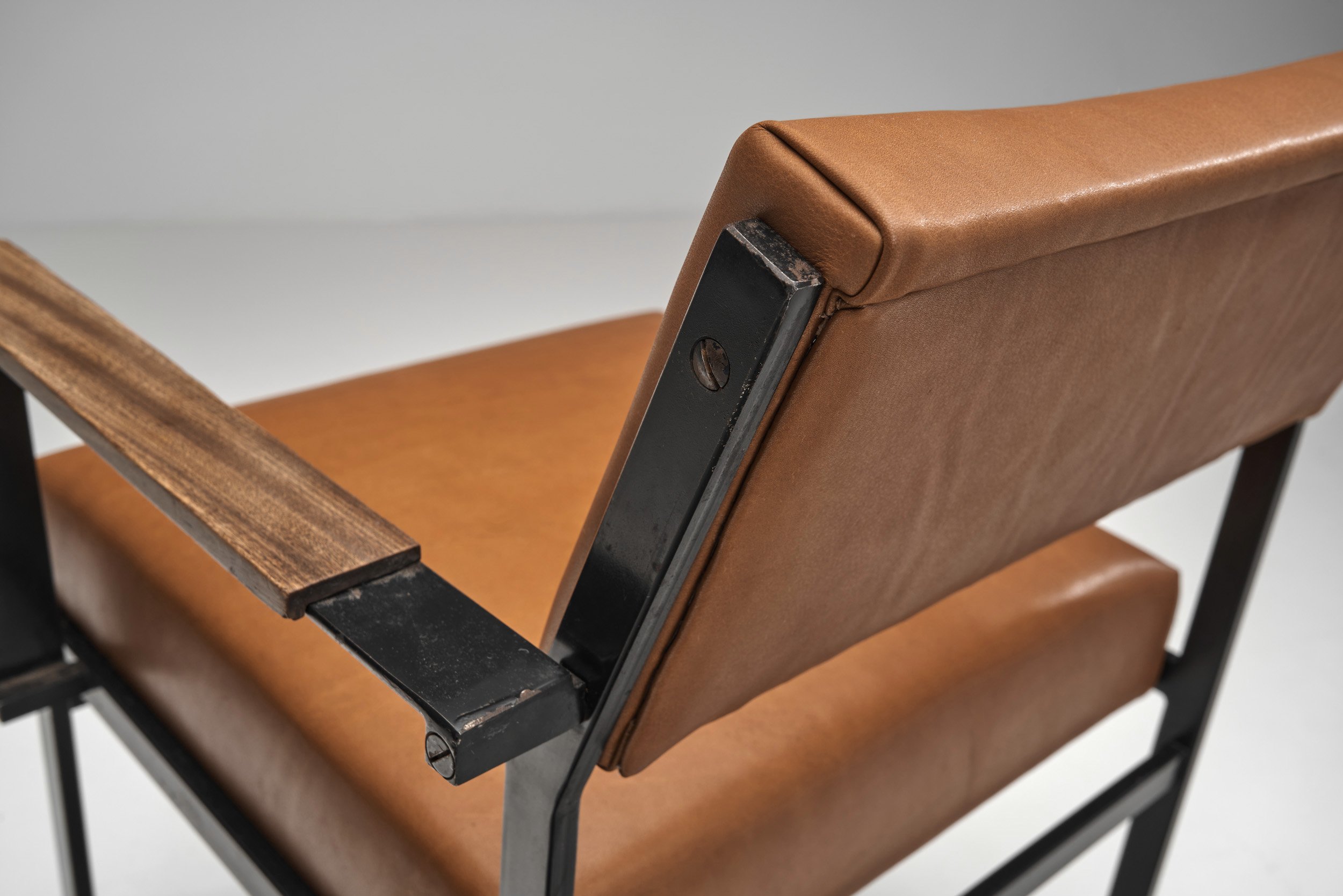
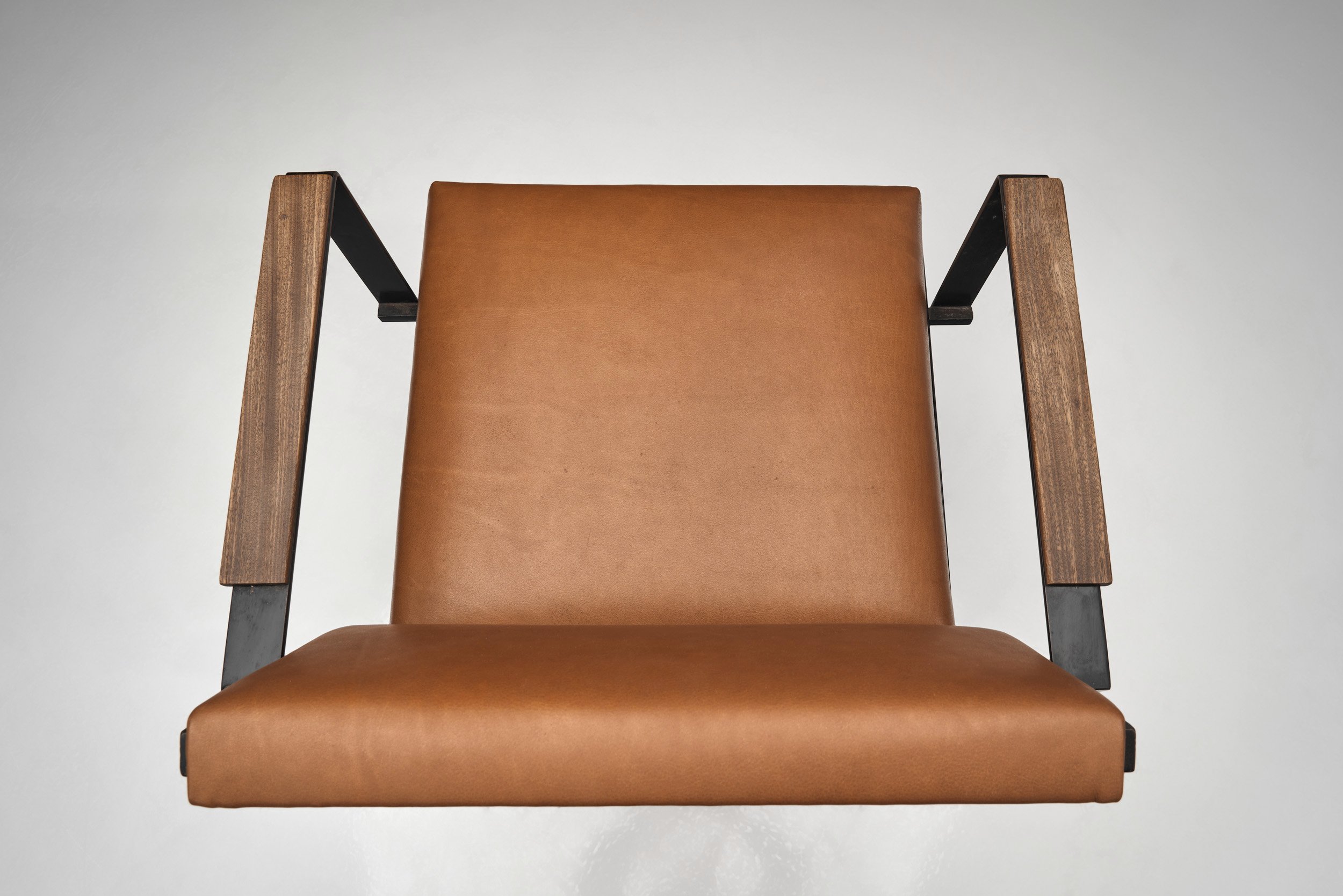
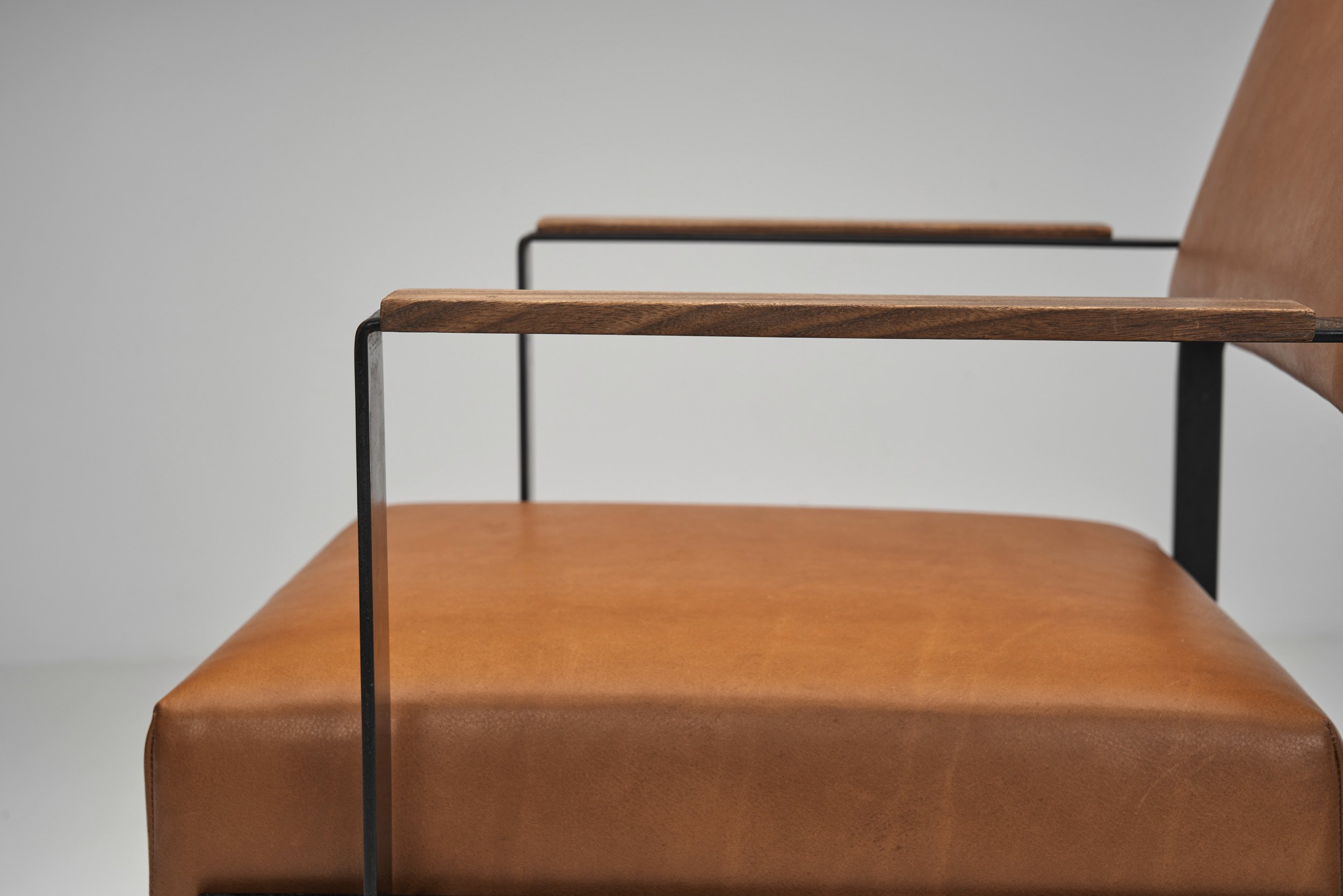
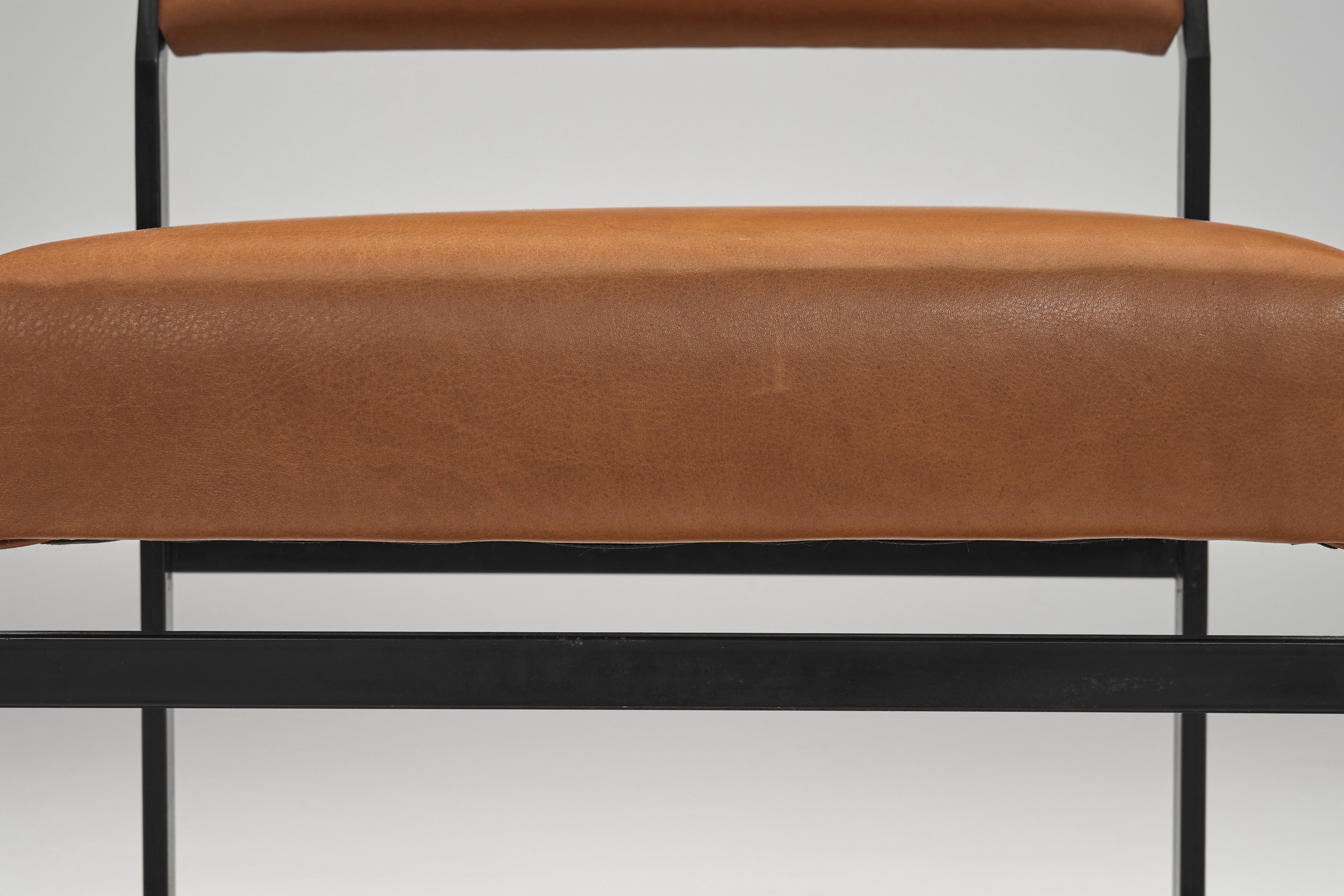
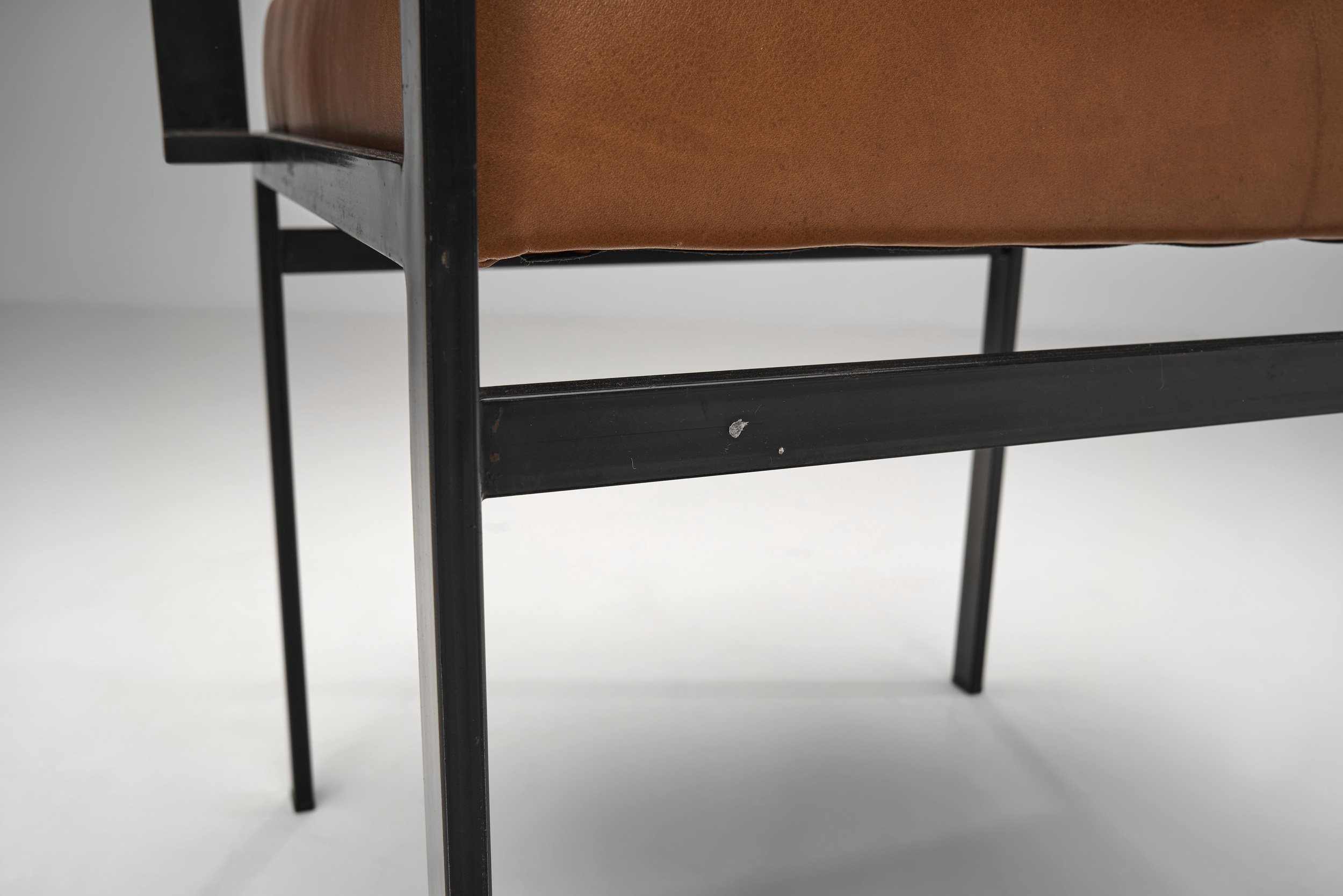
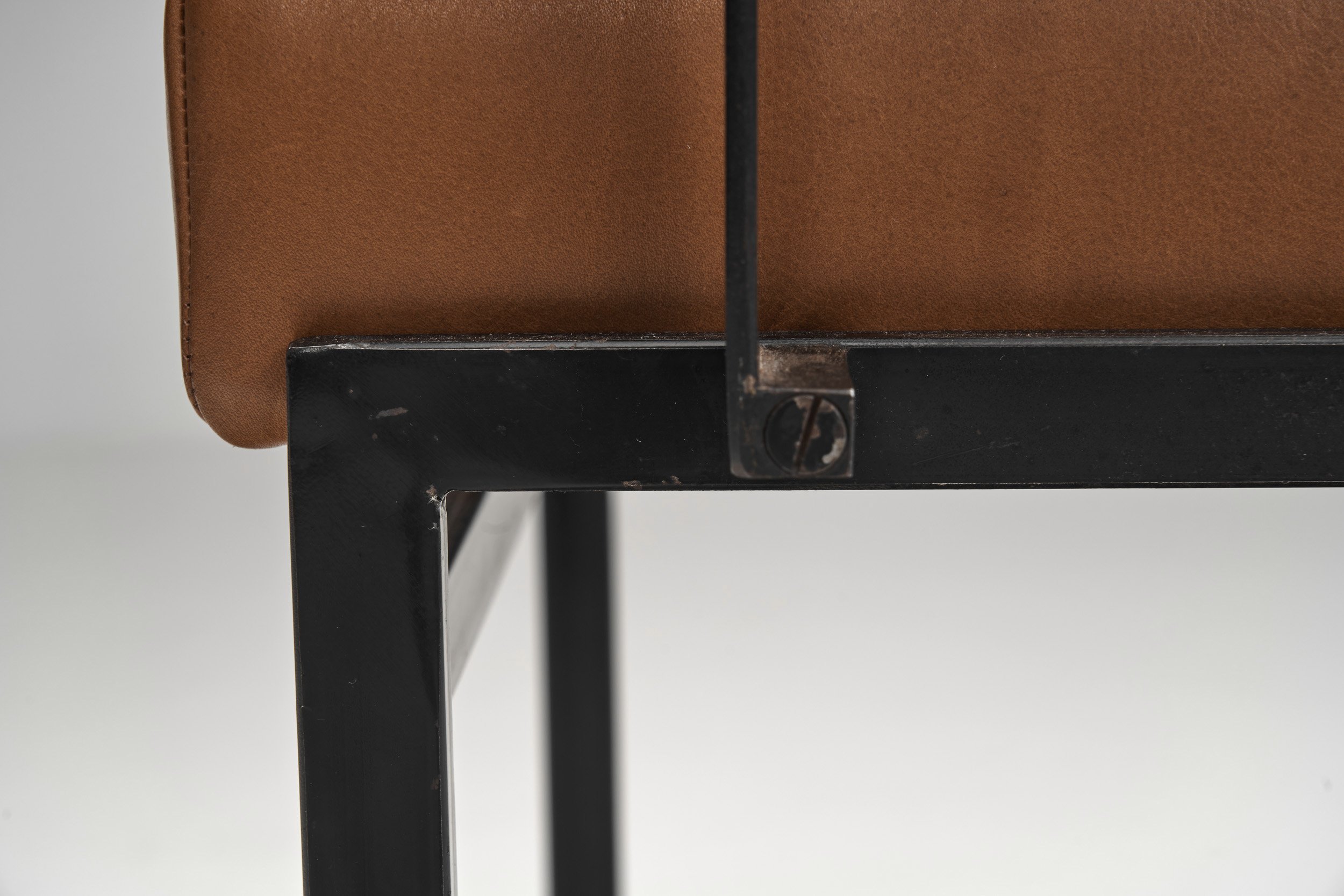
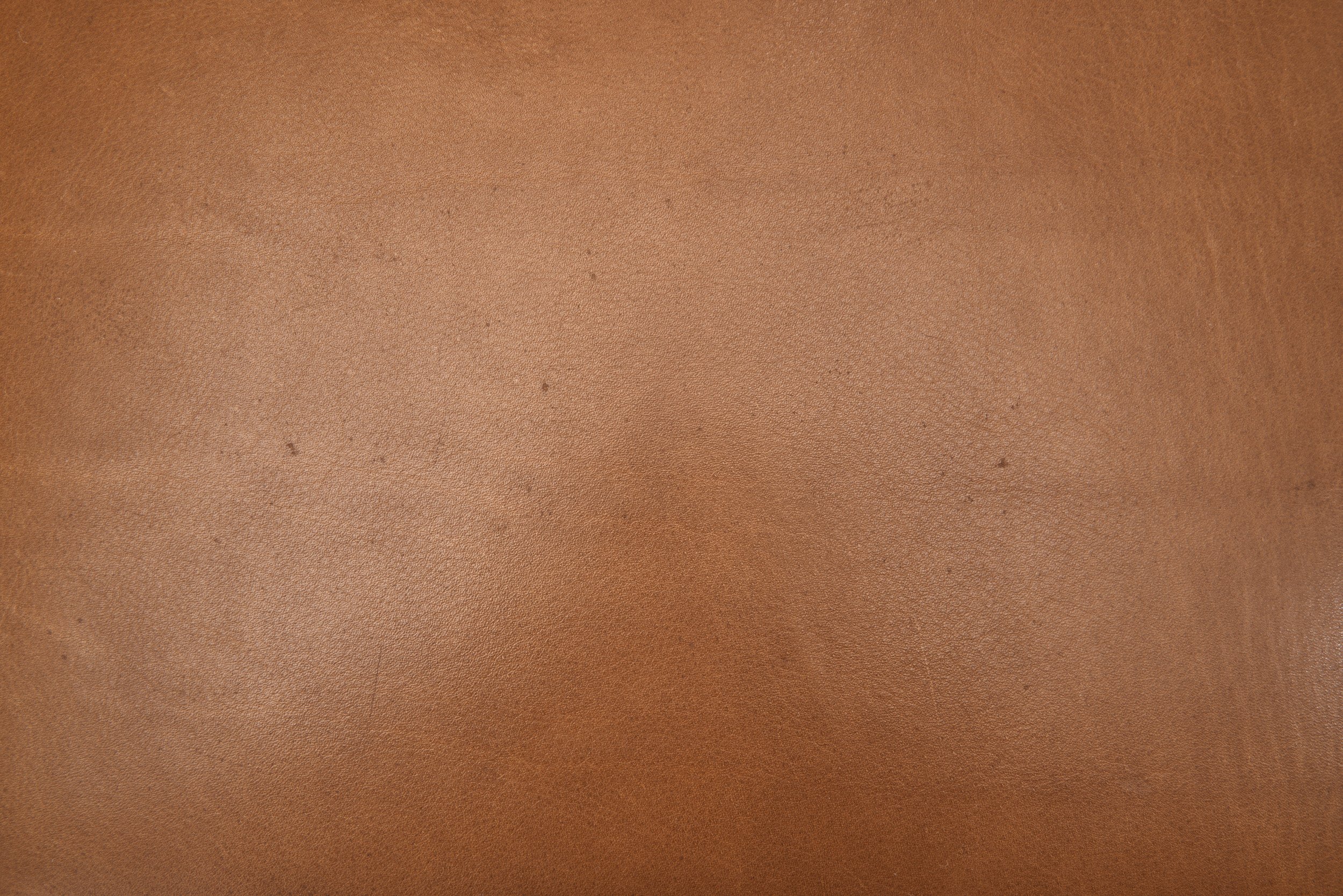
Braakman’s designs from the 1950s and 1960s are characterised by clean lines, functional clarity, and carefully balanced proportions, qualities clearly visible in this chair. The design showcases a beautiful interplay between the slender metal construction and natural materials. The black lacquered frame forms a precise architectural structure, outlining the chair with crisp lines. Rather than appearing overly industrial, however, the frame is softened by the introduction of rich cognac-coloured leather upholstery and wooden armrests. The seat and backrest are generously proportioned, creating a comfortable visual weight that contrasts beautifully with the lightness of the supporting structure. The warm tone of the leather introduces depth and character, while its smooth surface accentuates the chair’s geometry. Particularly striking is the way the wooden armrests are integrated within the metal frame, lending the design an added sense of refinement.
The balance between comfort and structural clarity lies at the heart of Braakman’s work, and this armchair demonstrates that philosophy exceptionally well. Its restrained palette and clean silhouette move it past a simple a seating piece, reflecting the Dutch modernist belief that thoughtful design can elevate everyday furniture into something practical, and visually compelling.
Condition:
In good vintage condition. Wear consistent with age and use. The armchair has recently been reconditioned. Due to the age and nature of the metal, the item may have marks, scratches, and discolouration. The chair has recently been reupholstered in a premium leather. Each of our items can be reupholstered by our in-house atelier in a fabric of choice. Please reach out for more information.
Dimensions:
24.21 in W x 22.44 in D x 30.71 in H; Seat height 19.29 in; Seat depth 17.72 in; Arm height 25.20 in
61.5 cm W x 57 cm D x 78 cm H; Seat height 49 cm; Seat depth 45 cm; Arm height 64 cm
REQUEST PRICE HERE
Price category: 2,500 - 5,000 usd / eur
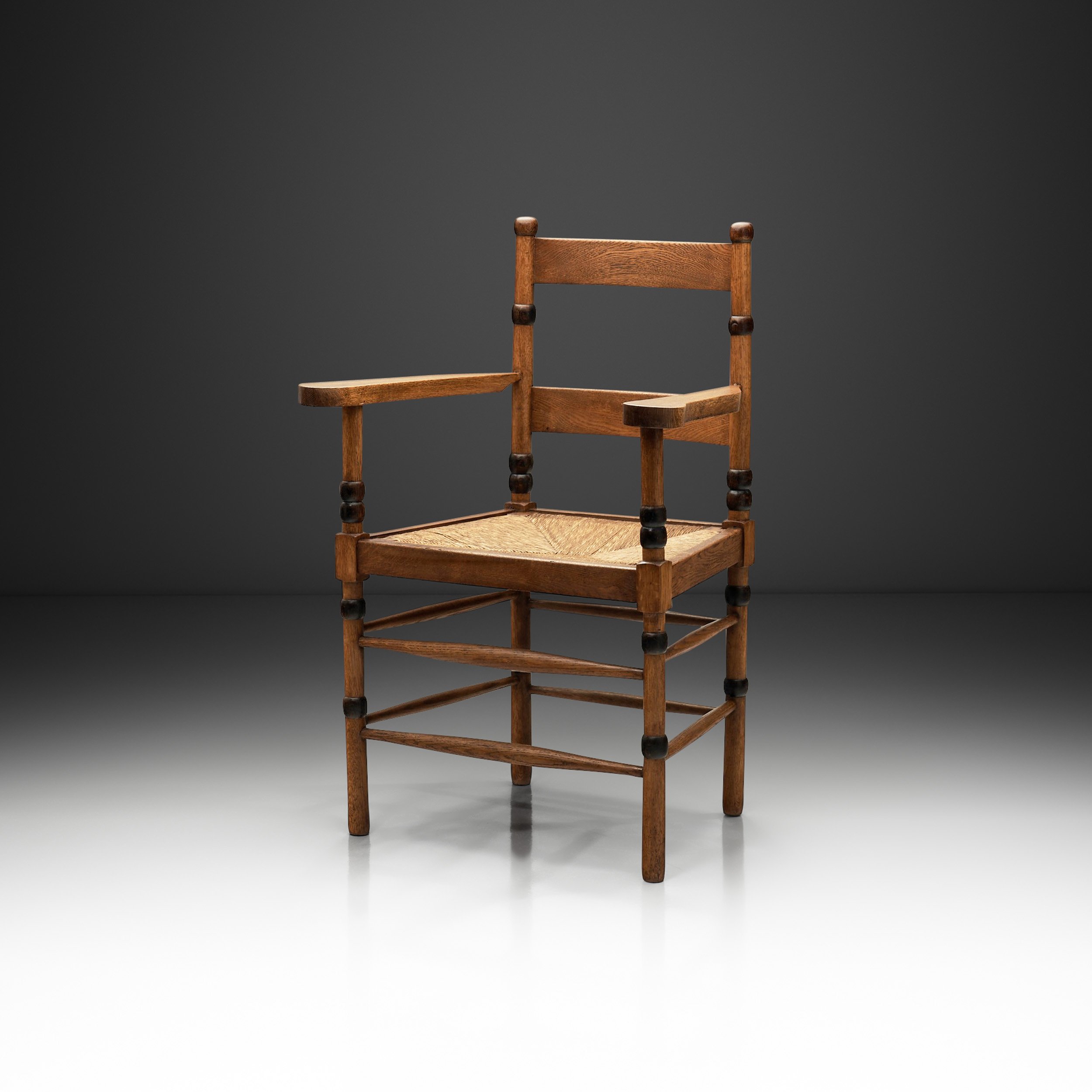
The Amsterdamse School movement arose in response to the influence of Art Nouveau and Jugendstil in the late 19th and early 20th centuries. This movement, which took root in Amsterdam, sought to create a uniquely Dutch style that embraced traditional craftsmanship and celebrated the spirit of the current times. The Amsterdamse School extended its influence across various artistic disciplines, including architecture, decorative arts, and furniture design.
The styles’ main characteristics are reflected in the design of this chair beautifully: expressive, art deco-reminiscent, and functional. Amsterdamse School furniture is renowned for its sculptural qualities. Designers like Jac Levee sought to integrate form and functionality seamlessly, resulting in furniture pieces that were not only visually striking but also practical. The craftsmanship of Amsterdamse School furniture is exemplified by its intricate woodwork and joinery. Pieces often showcased decorative detailing through carvings, inlays, and geometric patterns. These elements add a touch of individuality and artistry to a piece, setting them apart from the mass-produced furniture of the time. In this chair, the backrest’s clean, symmetrical lines reflect the simple, yet sophisticated aesthetics of the era. The use of black round accents not only adds an element of visual interest to the design, but also serve to reinforce the structure and enhance the overall strength. To further add to the charm of the piece, the woven seat, made from durable natural fibres, highlights the attention to both function and form, by creating visual and textural interest. The beautifully symmetrical pattern showcases the timeless artistry of artisanal furniture.
Whether placed in a farmhouse or used to add an organic element to a modern interior, this chair provides both history and utility. More than just functional seating, this chair represents a moment in design history where furniture was built to last, to be used daily, and to shape the atmosphere of a room.
Condition:
In good vintage condition. Wear consistent with age and use. The chair has recently been reconditioned. Minor scratches and discolouration. Due to the nature of the wood, the item may have some additional marks.
Dimensions:
25.59 in W x 20.86 in D x 37.40 in H; Seat height 18.50 in; Seat depth 16.92 in; Arm height 28.14 in
65 cm W x 53 cm D x 95 cm H; Seat height 47 cm; Seat depth 43 cm; Arm height 71.5 cm
REQUEST PRICE HERE
Price category: 5,000 - 7,500 usd / eur
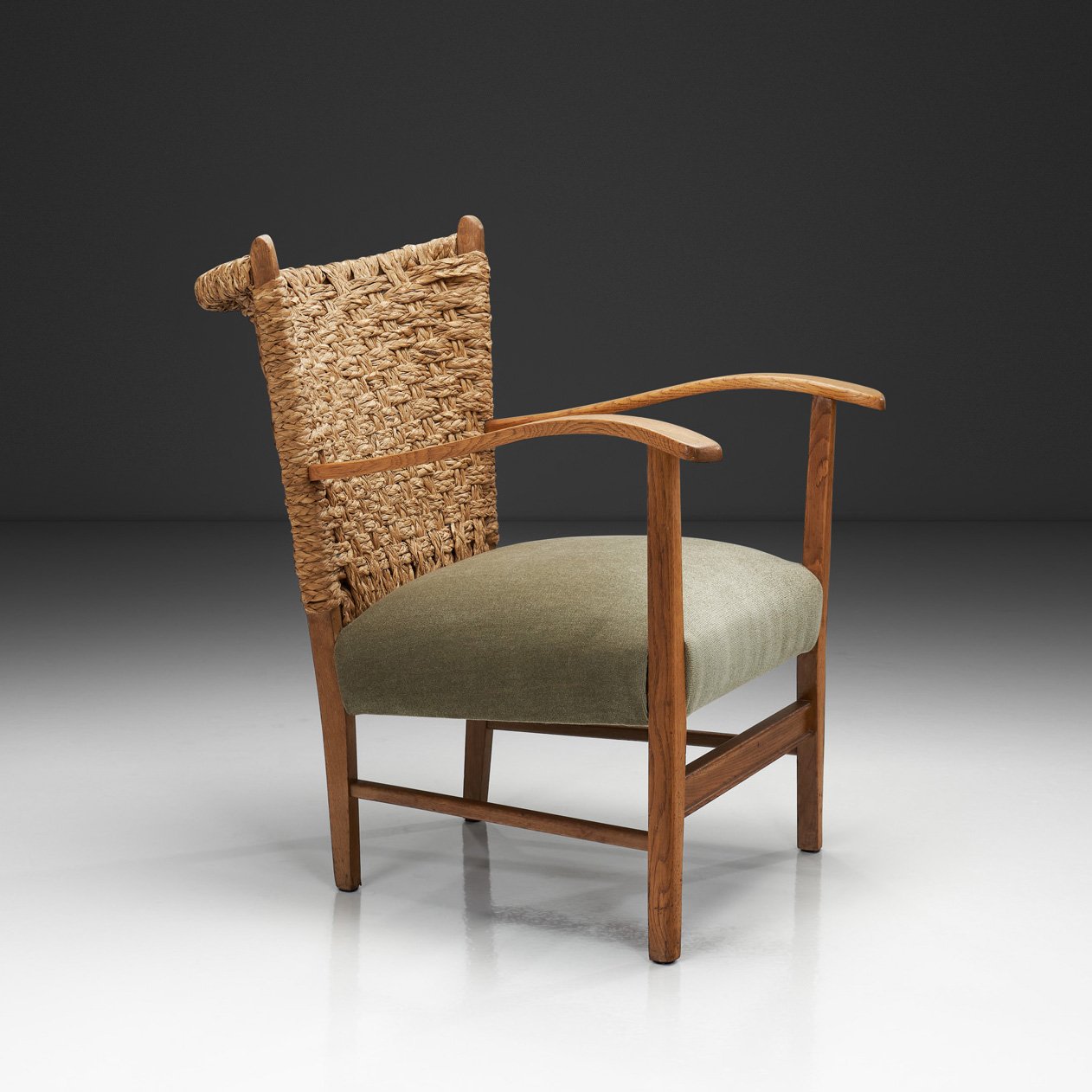
Bas van Pelt holds a distinctive place in Dutch design history; he is celebrated primarily for his furniture, yet was equally active as an interior designer whose broader spatial vision informed his work. Although his early designs reflected the straight lines associated with The Hague School of the 1920s, this armchair reflects a more assured phase of his career that coincides with the broader development of Dutch modernism. Here, geometric lines soften into gentle curves with a rich use of materials.
The weaved backrest pairs beautifully with the smooth wooden frame, curving to embrace the sitter. It is coupled with a sage green upholstered seat, creating an interplay of line and texture. The seat emphasises an added layer of comfort while still complementing the natural materials used for its construction. The armrests, with their subtle and flowing curves, are carefully shaped to give the chair a sense of movement - juxtaposed with the straight lines and right angles that make up the frame. The overall impression is that of a visually interesting piece full of contrasts, while simultaneously enhancing the comfort of the user at the crucial points of the back, arms, and seat. The legs remain simple in design, serving a primarily structural role, letting the back and seat stand out.
Bas van Pelt’s furniture models are quite rare, with a few preserved in the Stedelijk Museum in Amsterdam for modern art, contemporary art, and design. His progressive designs were, in many ways, ahead of his time. What makes this armchair especially compelling is the combination of materials and techniques that come together harmoniously to make a visually striking piece.
Condition:
In good vintage condition. Wear consistent with age and use. The chair has recently been reconditioned. Due to the nature of the wood, the item may have some marks, scratches, and discolouration. The chair comes with its original upholstery or has been reupholstered by a previous owner. Each of our items can be reupholstered by our in-house atelier in a fabric of choice. Please reach out for more information.
Dimensions:
29.52 in W x 24.01 in D x 31.29 in H; Seat height 17.12 in; Seat depth 18.11 in; Arm height 24.21 in
75 cm W x 61 cm D x 79.5 cm H; Seat height 43.5 cm; Seat depth 46 cm; Arm height 61.5 cm
REQUEST PRICE HERE
Price category: 5,000 - 7,500 usd / eur
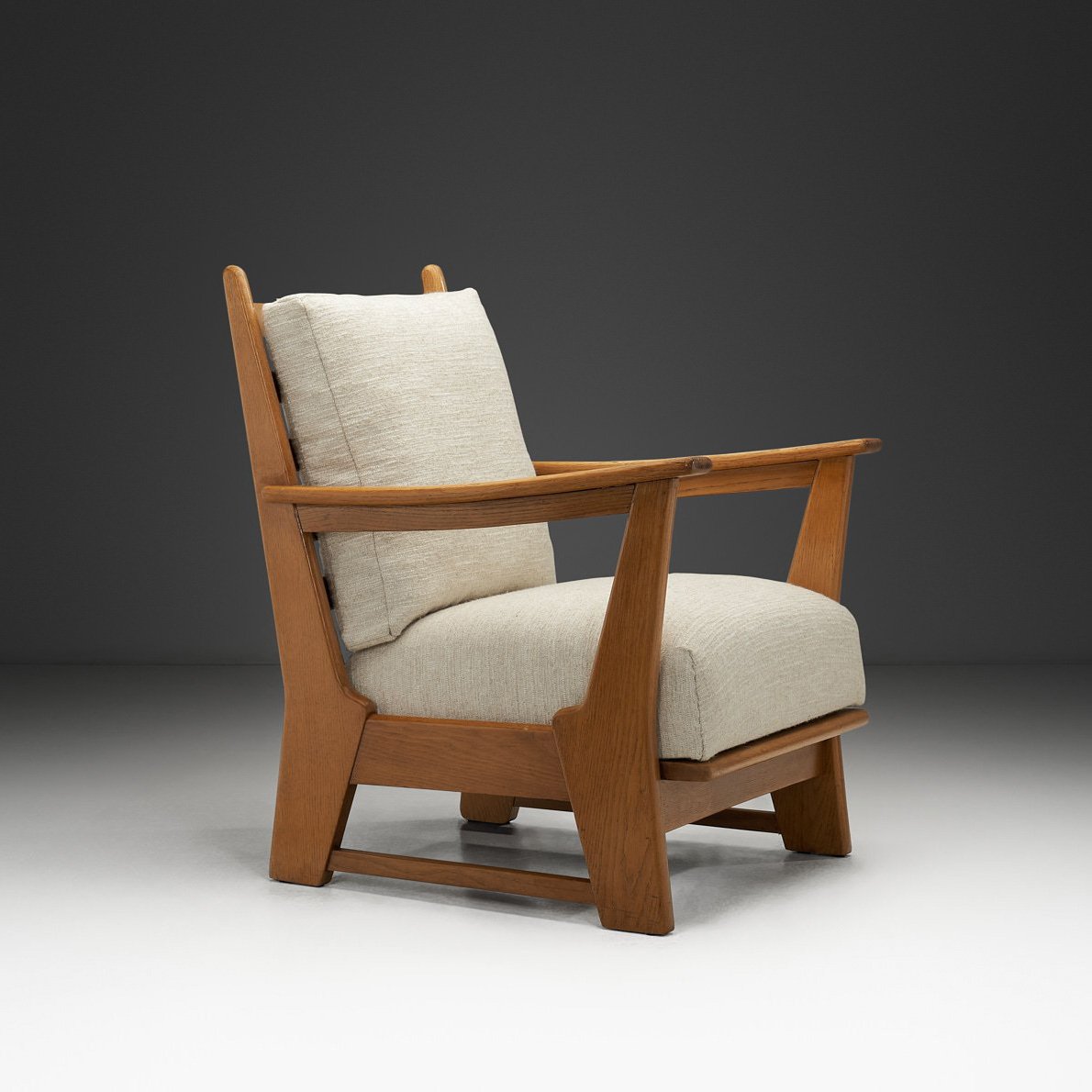
Bas Van Pelt (1900-1945) was a well-known Dutch interior and furniture designer, known for the clarity and quality of his designs. His works created in the 1930s are regarded for their progressive design and quality.
While Bas Van Pelt's creative work was primarily influenced by the 1920s’ straight lines dominated by The Hague School, this armchair is the result of his more mature design era, which was primarily dominated by natural materials and more curvature. While made of solid oak, this armchair has an open feel to it. The arms and backrests showcase a sense of airiness, highlighted by the slats on the back. This neat detail accentuates the high level of woodworking and creates an effortless look. The arms’ angles are slightly inclined, resulting in a harmonious look while also being ergonomic, with solid support for the spine. The sitting comfort is pleasant, aided by the upholstered cushions. The textured upholstery of the seat and back cushion beautifully complements the frame. The chair embodies comfort and cosiness through the mix of proportions and expertly selected materials. The rich shade of the wood pairs perfectly with the cream upholstery.
Haagse School furniture wasn’t flashy but instead focused on being well-made and to fit a warm, comfortable and welcoming home. As this chair exemplifies, blending functionality, good quality natural materials and organic colours with excellent craftsmanship is the key to the success of this design period.
Condition:
In good vintage condition. Wear consistent with age and use. Due to the nature and age of the wood, the chair may have minor marks, scratches, and discolouration. The chair has been reupholstered recently in a premium fabric. Each of our items can be reupholstered by our in-house atelier in a fabric of choice. Please reach out for more information.
Dimensions:
25.59 in W x 29.92 in D x 34.25 in H; Seat height 17.32 in; Seat depth 17.71 in; Arm height 24.40 in
65 cm W x 76 cm D x 87 cm H; Seat height 44 cm; Seat depth 45 cm; Arm height 62 cm
REQUEST PRICE HERE
Price category: 5,000 - 7,500 usd / eur
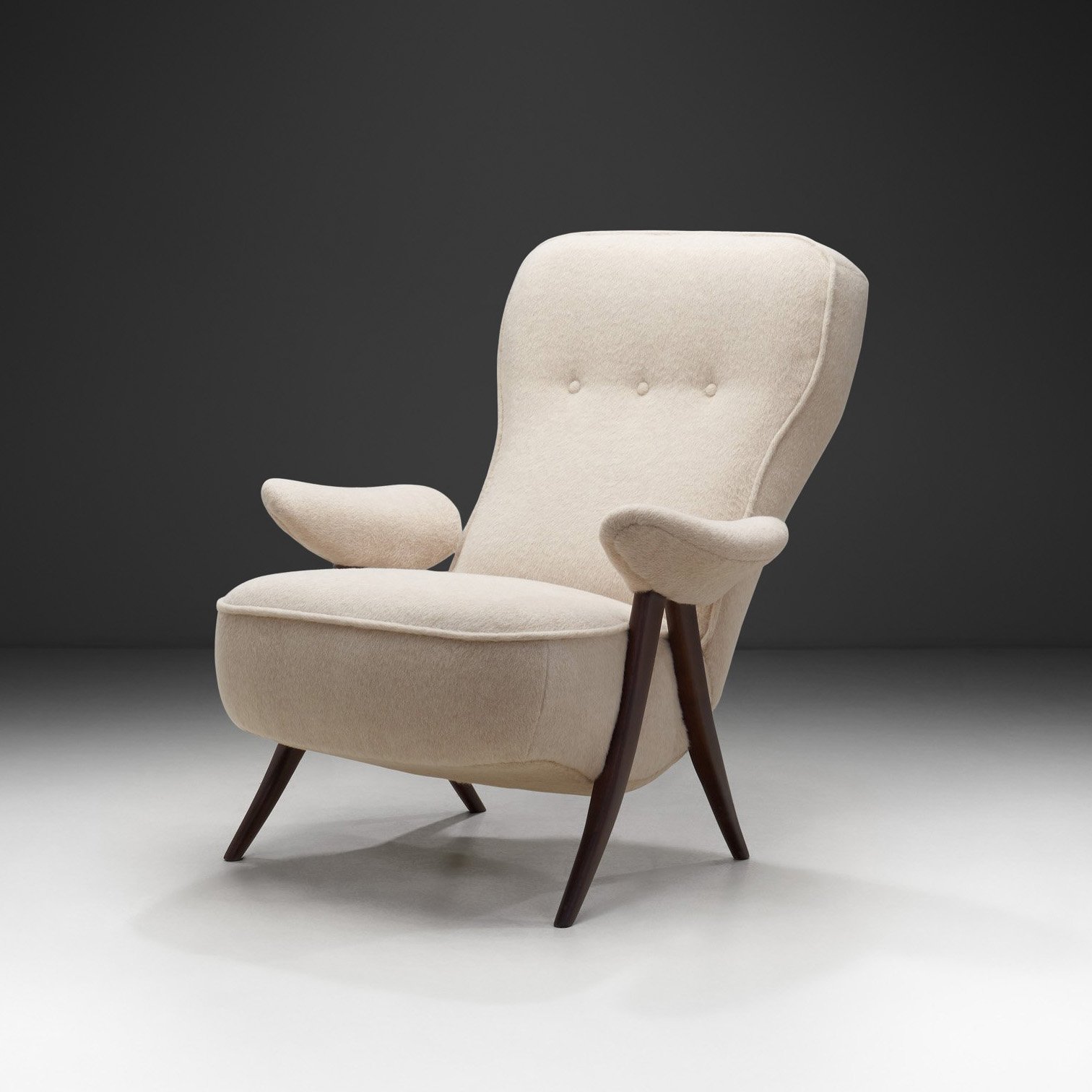
Among the pantheon of talented individuals who have worked for Artifort, Theo Ruth was the acclaimed Dutch furniture manufacturer’s first permanent designer. Ruth’s work significantly advanced Artifort’s laudable reputation, specifically through his designs for chairs. Thus, this 'Model 105' hairpin chair is a representative example of Ruth’s craftsmanship and talent.
This chair is full of exceptional features and details that make it a unique example of the creative overflow that defined mid-century modernism in The Netherlands and the rest of Europe. The flowing structure displays beautifully curved lines and rounded edges, ensuring extreme comfort and emphasizing its ergonomic design. The round edges of the upholstered body create a nice balance with the hairpin legs. As with most armchairs, this model is also built in a permanently reclined position, another lovely feature. The armrests are formed atop the wooden legs of the chair effortlessly, without any visible joinery as if just emerging from the wood naturally. The light colour of the textured upholstery in combination with the richly coloured, stained wood frame create warm elegance, perfect to bring a modern touch to any space. The duality of the two materials creates a flowing, self-supporting and enticingly functional design. The combination of solid wood and high-quality upholstery is traditional in mid-century design for a good reason, showcased with the simple elegance of this chair.
From every single angle this chair offers stunning lines and rich texture, and is a representative example of Ruth’s craftsmanship and talent
Condition:
In good vintage condition. Wear consistent with age and use. Some minor scratches and marks on the wood. The chair has been reupholstered recently in a premium fabric. Each of our items can be re-upholstered by our in-house atelier in a fabric of choice. Please reach out for more information.
Dimensions:
31.10 in W x 35.43 in D x 35.83 in H; Seat height 16.14 in; Seat depth 19.69 in; Arm height 19.69 in
79 cm W x 90 cm D x 91 cm H; Seat height 41 cm; Seat depth 50 cm; Arm height 50 cm
REQUEST PRICE HERE
Price category: 12,500 - 15,000 usd / eur
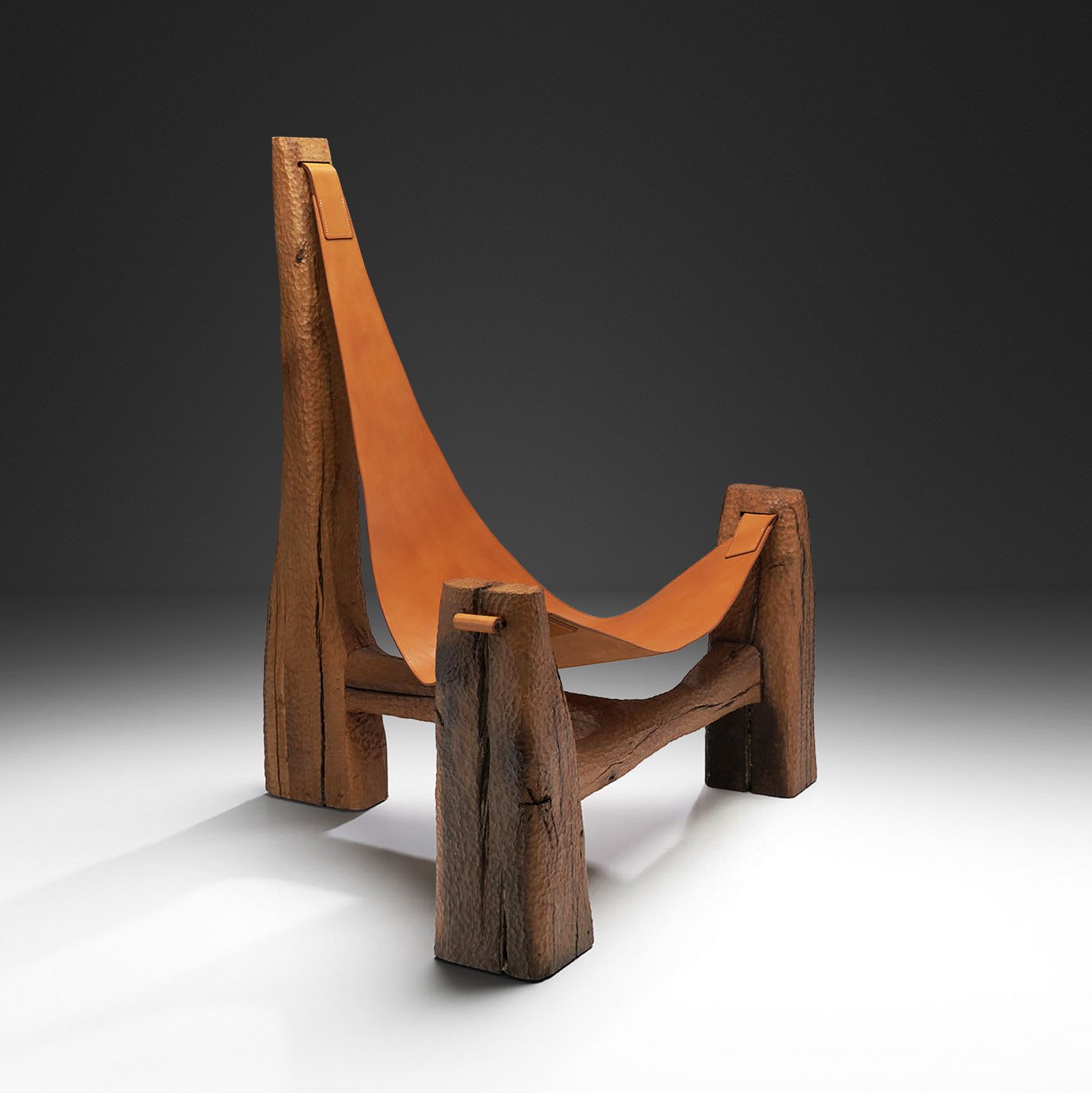
Generally, Czech mid-century modern designs tend to be more sober than their French, German, American, and even Scandinavian counterparts. However, works by Pavel Novak are an exception - as evidenced by chair. The Czech designer’s repertoire is finally starting to surface, and as this chair shows, we are lucky to witness it.
Novak often worked with a gouge, that originally never had any other vocation than to furnish his farm. This piece is made of hand gouged oak, which is in itself a time-consuming and rare woodcarving technique. While most woodworkers offer help with fixing gouges in wood, Novak used the technique to create this rustic looking body that can be considered to be a functional sculpture. Thanks to the unique, hand-carved texture, the lounge chair is one of a kind, with a unique pattern. The leather seat is suspended between the three legs, one of which is elongated to serve as a backrest. The joinery technique is seamless and shows the outstanding craftsmanship and vision of Novak. The leather straps are inset into the legs in a rough, yet sophisticated way.
In fact, rough yet sophisticated are the adjectives that best define the overall aesthetic of this chair, reflected in the pairing of the materials as well. The patinated leather’s smooth surface contrasts beautifully with the gouged, coarse look of the oak. With its straightforward design, this oiece is a seminal work of Pavel Novak.
Condition:
In good vintage condition. Wear consistent with age and use. Some minor cracks. Due to the nature and age of the materials, the chair may have some marks, scratches, and discolouration.
Dimensions:
40.94 in W x 30.71 in D x 48.82 in H; Seat depth 20.08 in
104 cm W x 78 cm D x 124 cm H; Seat height 51 cm
REQUEST PRICE HERE
Price category: 5,000 - 7,500 usd / eur
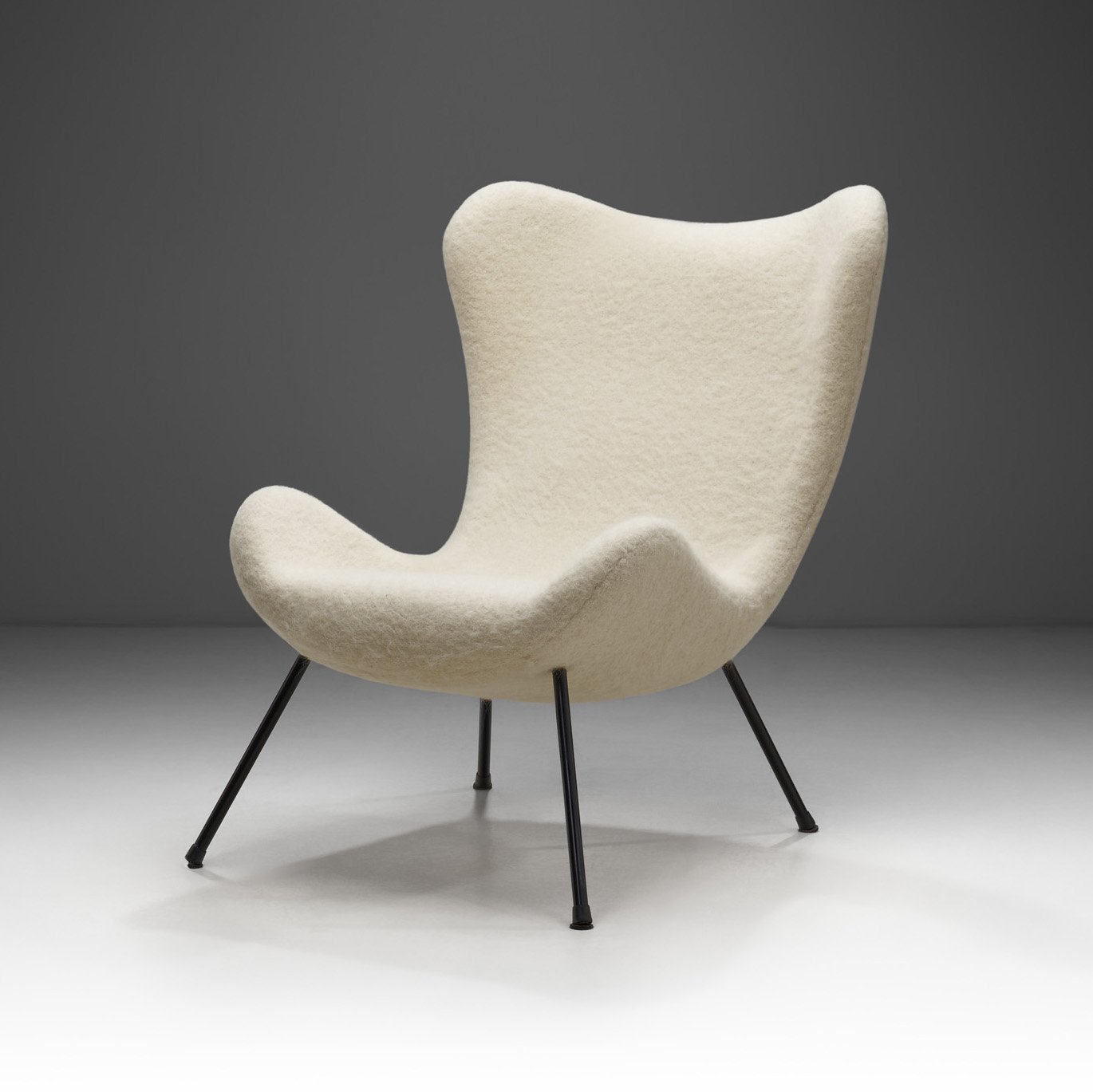
Although Fritz Neth was, and still is, one of the most sought-after designers of German post-war modernism, not much is known about him - but his designs speak for themselves.
The design language is entirely dedicated to the organic-modern style of the 1950s. Much like in Scandinavia, the mid-century in Germany gave form to furniture pieces defined by quality, functionality, and reliability. The curved seat gives this chair a sculptural and striking appearance. This lounge chair’s rounded lines and stylish selection of materials immediately stand out, and make the classic combination of black and white visually interesting. The body is formed like a nest, with smooth and flowing lines that hug the sitter. The wide seat and armrests are not separated, rather they are united and create an open and welcoming look. The black legs of thin tubular metal are very characteristic of the era. The legs are simplistic, which is a great design choice that contrast with the softness of the upholstery. Thanks to its well-thought-out construction and proportions, the sitting comfort is also outstanding.
The classic pairing of black and white further makes this unique model an elegant and stylish addition to any space. Through the design, materials, and degree of craftsmanship, it displays many of the qualities exemplifying why Fritz Neth remains one of the most sought after designers of Germany.
This lounge chair was produced by the Correcta Foams Company (Sitzformbau) in Kassel, Germany. Correcta produced Neth’s designs throughout the 1950s. The company used to produce foam rubber shoulder pads, and towards the 1950s, switched to the production of seating with the highest quality of foam.
Condition:
In good vintage condition. Wear consistent with age and use. Some marks and scratches on the metal legs. The chair has been reupholstered recently in a premium fabric. Each of our items can be re-upholstered by our in-house atelier in a fabric of choice. Please reach out for more information.
Dimensions:
28.35 in W x 34.25 in D x 35.83 in H; Seat height 15.75 in; Seat depth 17.72 in
72 cm W x 87 cm D x 91 cm H; Seat height 40 cm; Seat depth 45 cm
REQUEST PRICE HERE
Price category: 9,000 - 12,500 usd / eur
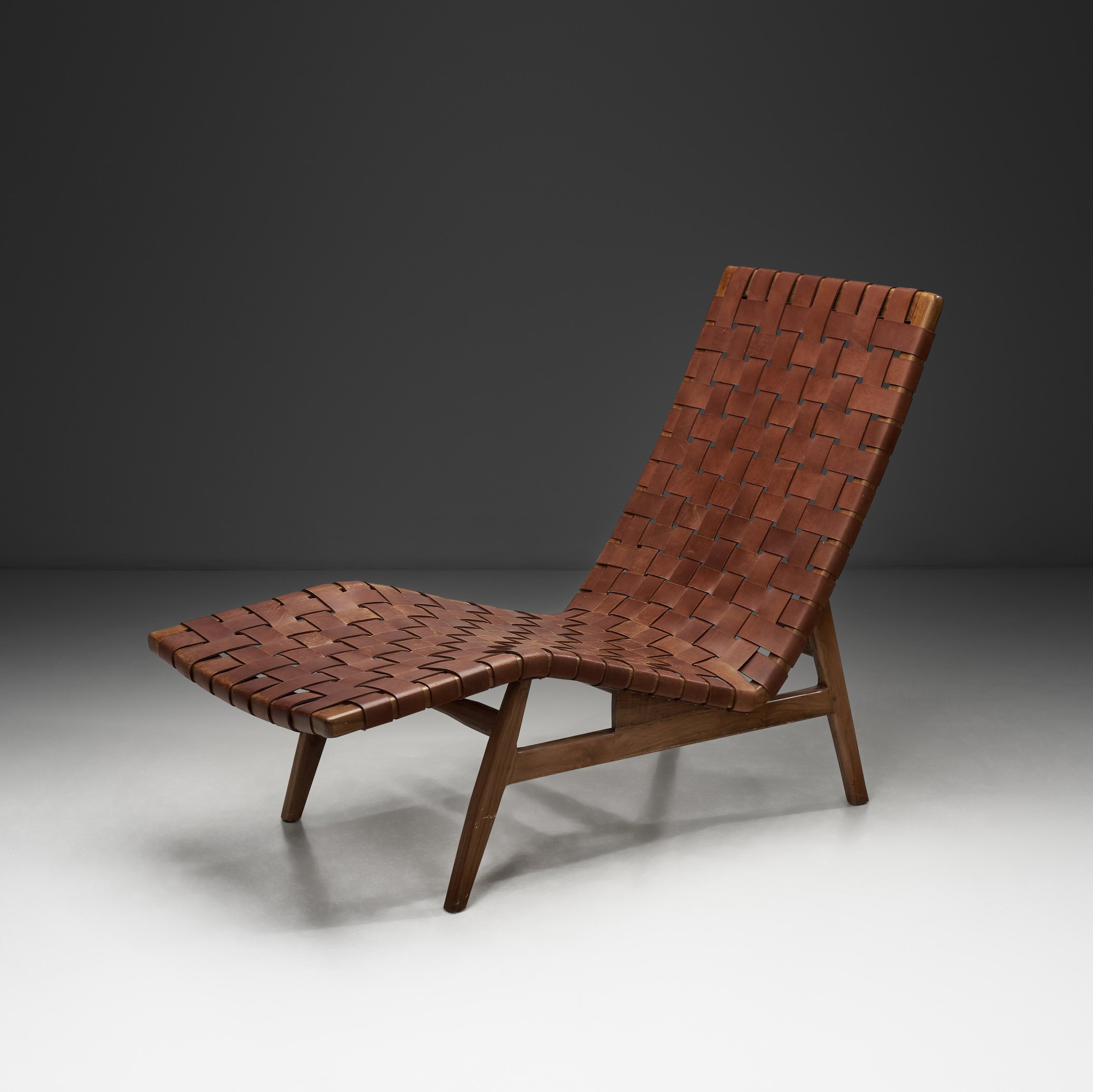
The mid-20th century saw brilliant designers working to create furniture of the highest quality that explored modern shapes and forms. These artists experimented with new materials and construction methods. This stunning chaise longue revolves around the use of high-quality materials, comfort, and craftsmanship. It’s clean lines and angular shape is reminiscent of works by Danish designer, Arne Vodder.
This chaise blends three main elements: craftsmanship, the clean lines of Modernism and the clear-eyed practicality of Functionalism. These elements combined with the use of exquisite materials creates a piece that is both historical and modern visually. The chaise is defined by its woven seat and the patinated leather. The seat is composed of leather straps woven in a so-called basket weave pattern and stretched over the solid wood frame. Thanks to the material’s qualities, the seat is very ergonomic, adapting to the sitter’s shape. This piece combines the beauty and innovation of its era’s design movement with the classic qualities of a chaise longue. With its rhythmic motion, it invites contemplation and relaxation. This piece has the power to transform a seat into a safe haven, a place to unwind and reflect.
This chaise longue is a prime example of mid-century modern’s design ideology. The maker of this model effortlessly transformed a historical archetype into a modern, yet timeless chair. It’s sophisticated, lightweight look is defined by its signature craftsmanship, well-conceived proportions, and remarkable material choices.
Condition:
In good vintage condition. Wear consistent with age and use. The item has recently been reconditioned. Due to the nature and age of the materials, the item may have some marks, scratches, and discolouration.
Dimensions:
52.55 in W x 23.22 in D x 37.40 in H; Seat height 16.92 in; Seat depth 34.64 in
133.5 cm W x 59 cm D x 95 cm H; Seat height 43 cm; Seat depth 88 cm
REQUEST PRICE HERE
Price category: 2,500 - 5,000 usd / eur
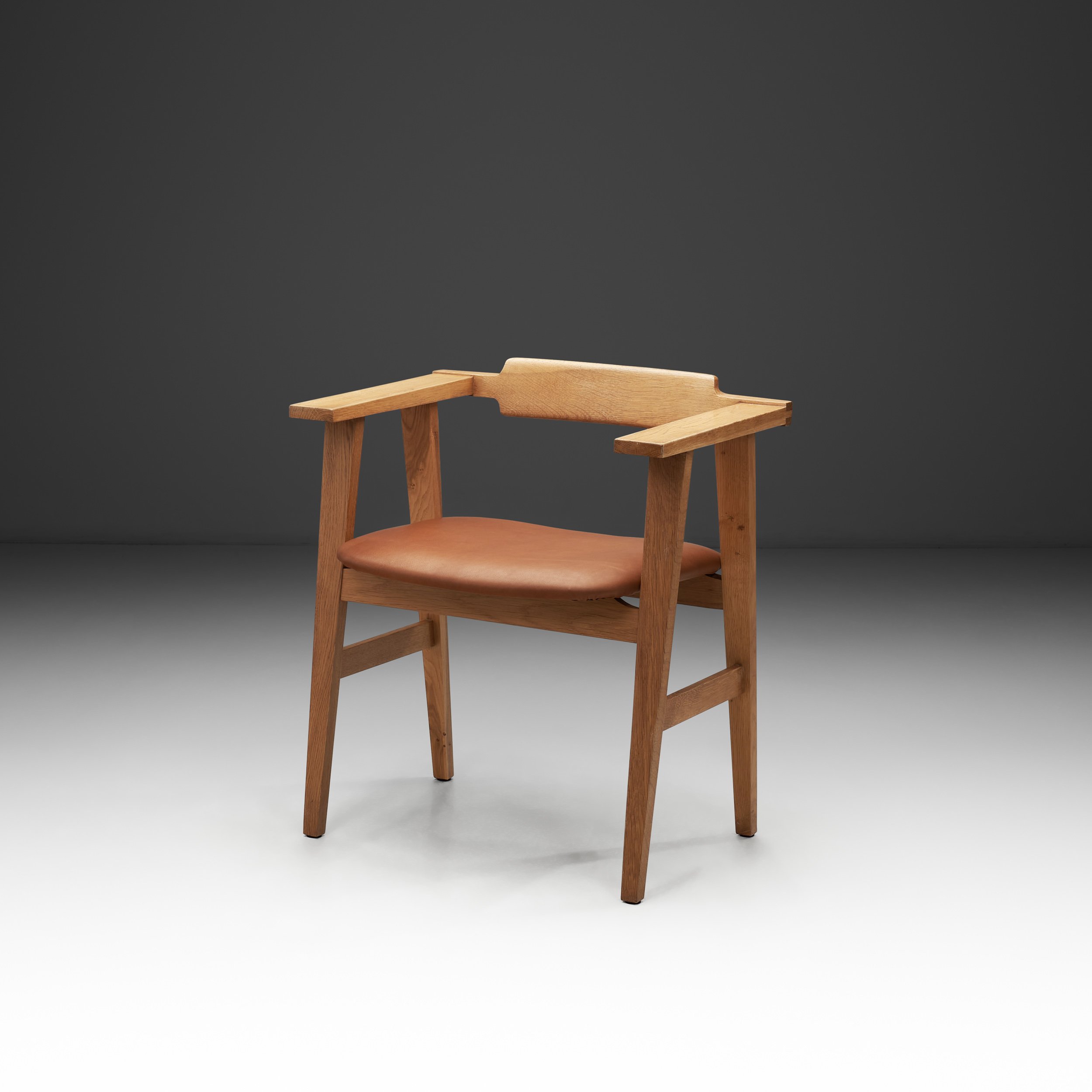
Saying mid-century modernism had a revival would be a serious understatement. In reality, the designs have never gone out of style completely, especially in Scandinavia. Danish cabinetmaker pieces are timeless thanks to their expert craftsmanship, their visual, and the material quality. This armchair showcases this timelessness with its modern form.
This elegantly constructed chair combines comfort with style. From as early as the 1920s, cabinetmakers and architects frequently collaborated to produce exceptional pieces like this. The chairs’ elegant curves, precise angles and structure all testify of this partnership’s success. Thanks to its low back the design appears very grounded. With straight and curving lines following each other, the model has a dynamism rooted in organicity. Unlike pieces from outside the continent, Danish designers’ products weren’t flashy but rather well-made to fit a warm, comfortable and welcoming home. As this armchair exemplifies, blending functionality, good quality natural materials and organic colours with excellent craftsmanship is the key to the success of mid-century modernism. As an object, the chair reflects the mid-20th century Danish pursuit of everyday beauty, objects designed not just to serve, but to enrich domestic environments.
The classic charm and versatility of this design allows it to be used as a desk chair, an occasional piece in a curated corner, or part of a formal dining set, this chair can bring quiet sophistication to any setting. It is an ideal choice for a range of interior styles thanks to its thoughtful materials, and subtle craftsmanship.
Condition:
In good vintage condition. Wear consistent with age and use. Due to the nature and age of the materials, the chair may have some marks, scratches, and discolouration. The chair has recently been reconditioned and reupholstered in premium leather. Each of our items can be reupholstered by our in-house atelier in a fabric of choice. Please reach out for more information.
Dimensions:
25.19 in W x 18.89 in D x 28.14 in H; Seat height 19.09 in; Seat depth 17.32 in; Arm height 26.57 in
64 cm W x 48 cm D x 71.5 cm H; Seat height 48.5 cm; Seat depth 44 cm; Arm height 67.5 cm
REQUEST PRICE HERE
Price category: 2,500 - 5,000 usd / eur
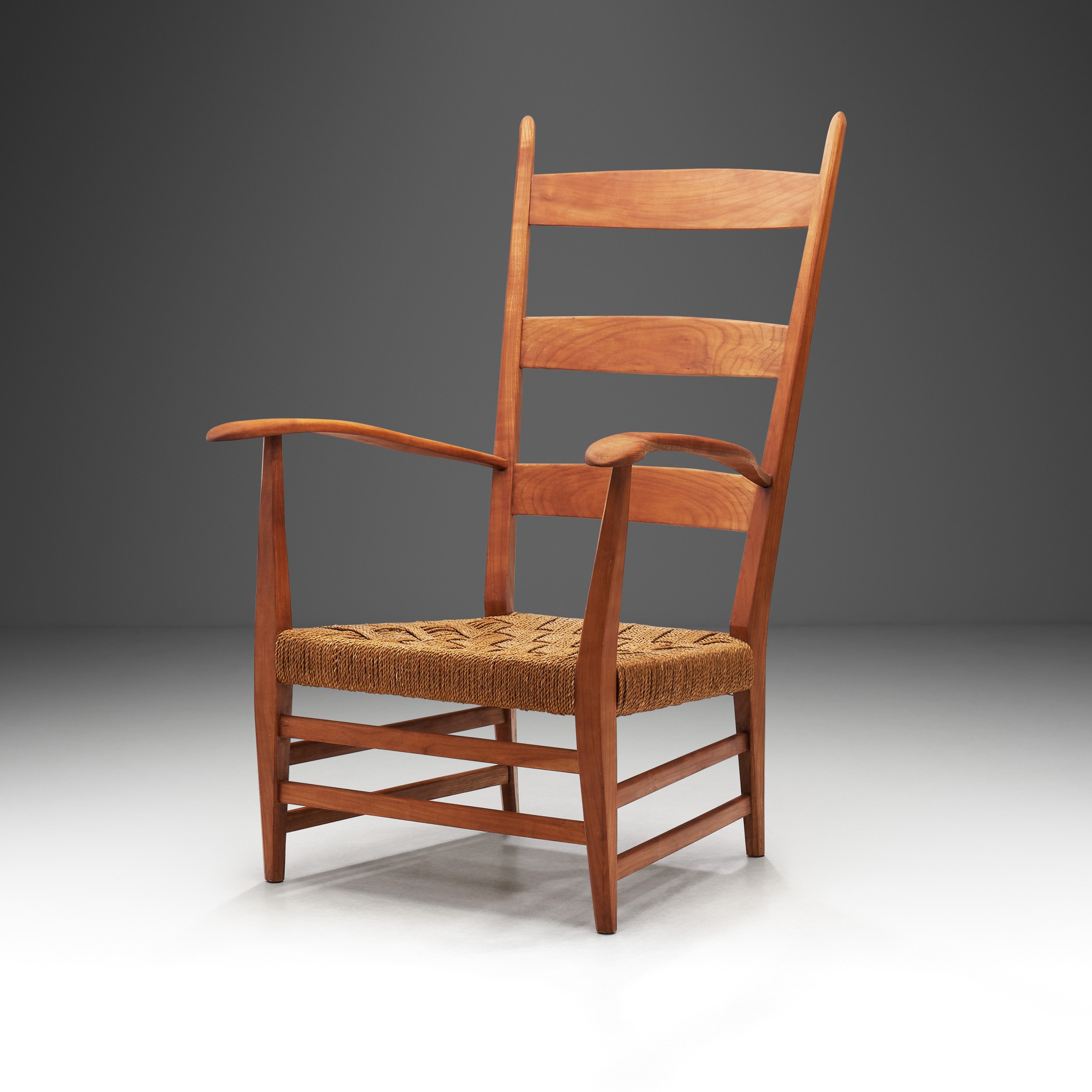
This organic armchair attributed to Dutch designer Bas Van Pelt is an elegant model with an exceptionally high level of craftsmanship. The construction of this rare 1940s design is simple at its core, but thanks to the details, it is a unique representation of early Dutch modernism.
While Bas Van Pelt's creative work was primarily influenced by the 1920s straight lines dominated by The Hague School, this armchair is the result of his more mature design era, which was dominated by natural materials and more curvature. While made of solid wood, this armchair has an open feel to it thanks to the three horizontal slats that compose and divide the back. The curved lines of the armrests are beautifully crafted and follow the raised seat’s angle. The curves nicely contrast with the straight lines of the frame, keeping it from appearing too strict. Apart from the expert woodwork, the paper cord seat stands out as well. The so-called “planflet” (flat-weave) pattern requires considerable expertise, as the warp is wrapped around the frame, and then the weave follows a checkerboard pattern. The seat adds textural interest and also serves a decorative role, not to mention how durable paper cord is. The tapered legs blend seamlessly into the back and arms, and are connected by double stretchers on all sides except the back where the back’s slats dominate. Thanks to the well-chosen proportions and the expert weaving technique on the seat, this armchair provides great comfort.
Bas van Pelt’s progressive designs were, in many ways, ahead of his era. The Dordrecht-born designer’s furniture models are quite rare, a few are preserved in the Stedelijk Museum Amsterdam for modern art, contemporary art, and design.
Condition:
In good vintage condition. Wear consistent with age and use. Some minor marks and scratches on the wood.
Dimensions:
25.59 in W x 28.74 in D x 40.16 in H; Seat height 13.39 in; Seat depth 20.28 in; Arm height 24.21 in
65 cm W x 73 cm D x 102 cm H; Seat height 34 cm; Seat depth 51.5 cm; Arm height 61.5 cm

REQUEST PRICE HERE
Price category: 2,500 - 5,000 usd / eur
In 1920, the term "Nieuwe Haagse School" was first mentioned by the architect C.J. Blaauw. And not in a positive way. Blaauw thought nothing of the latest developments in modern architecture. "Typical of The Hague" - that was how the designer spoke of the style. The movement blossomed between 1925 and 1940 and brought uniformity to the cityscape. The Hague School style is closely related to the Amsterdam School and the Bauhaus movement, but has more-so been influenced by Art Deco, and it drew a great deal of inspiration from Berlage's rationalism, the Arts and Crafts movement, and De Stijl.
Standing as evidence of the reason many Dutch architects succeeded at the craft of furniture design; the precision of the structure is evident at first glance, showing great geometric order. Driven by function, the maker’s focus was evidently on practicality, structural stability, and a design in favour of these principles. The construction of this chair is traditional and robust - it features a solid yet graceful frame, crafted from a warm, rich wood, which highlights the natural grain of the material. The arms and backrests showcase a sense of airiness. This neat detail accentuates the high level of woodworking and creates an effortless look. The arms’ angles are aligned with the seats and backs’ angles, resulting in a harmonious look while also being ergonomic, with solid support for the spine. The sitting comfort is pleasant, further aided by the stability the sturdy wooden legs provide. The frame is complemented by the elegant rope seat woven tightly in the wood, with the material of the seat giving the piece a warm and cosy feel all while staying very functional. The chair’s simplicity and honest elegance makes it an exceptional piece of furniture.
Haagse School furniture wasn’t flashy but instead focused on being well-made and to fit a warm, comfortable and welcoming home. As this chair exemplifies, blending functionality, good quality natural materials and organic colours with excellent craftsmanship is the key to the success of this design period.
Condition:
In good vintage condition. Wear consistent with age and use. Item may have some marks, scratches, and discolouration.
Dimensions:
22.04 in W x 21.85 in D x 33.66 in H; Seat height 17.12 in; Seat depth 19.48 in; Arm height 26.57 in
56 cm W x 55.5 cm D x 85.5 cm H; Seat height 43.5 cm; Seat depth 49.5 cm; Arm height 67.5 cm

REQUEST PRICE HERE
Price category: 2,500 - 5,000 usd / eur
Italian designer Giancarlo Piretti emerged as a leading figure in postwar furniture design, known for combining technical ingenuity with sculptural forms. A longtime collaborator with Anonima Castelli, Piretti developed several groundbreaking pieces in the 1960s and 70s, many of which explored modularity, and ergonomics. His works, such as the iconic Plia folding Chair and Plia Table won multiple international design awards, and still find their home in museums word-wide, from Austria to the Czech Republic, Slovenia and the United States.
The “Alky” lounge chair, first released in the early 1970s, is among his most celebrated works and reflects the experimental spirit of the period while maintaining a strong sense of comfort and approachability. The chair showcases its signature curvilinear form, expertly upholstered in a soft off-white bouclé that enhances the chair’s inviting charm. The piece is organic, almost reminiscent of a cloud, both thanks to its plushy shape and soft fabric. The design features a continuous silhouette from backrest to seat to base, all supported by a lightweight aluminium structure. The sled frame rests on two aluminium feet, ensuring the stability of the chair. Its organic shape hugs the body and provides a comfortable sitting experience, highlighting Piretti’s attention to ergonomics. The design is balanced, as the textile surface adds warmth, contrasting the modernist structure with a sense of softness.
This “Alky” chair remains an example of 1970s Italian design and a perfect illustration of how form and function can harmonise effortlessly. Ideal as a statement piece in a living room, lounge, or studio, it offers timeless comfort and a sculptural presence that continues to resonate in contemporary interiors.
Condition:
In good vintage condition. Wear consistent with age and use. The chair has been reupholstered recently in a premium bouclé fabric. Each of our items can be reupholstered by our in-house atelier in a fabric of choice. Please reach out for more information.
Dimensions:
26.38 in W x 32.28 in D x 27.56 in H; Seat height 16.14 in; Seat depth 22.05 in
67 cm W x 82 cm D x 70 cm H; Seat height 41 cm; Seat depth 56 cm
REQUEST PRICE HERE
Price category: 15,000 - 20,000 usd / eur
This beloved José Zanine Caldas lounge chair from the “Linha Z” or “Z Line” is an exceptional example of Brazilian design of the 1950s. The design dates to 1949, The woven leather straps and the organic shape is unmatched.
This chair model is made of plywood and features a distinctive shape, distinguished by its legs. The legs and arms are connected and form one unit and their shape inspired the name of the line, “Linea Z”. The edges are softly rounded, which matches the versatile curvature of the body, which enhances the organic feel of the chair. Besides the plywood frame, the original leather upholstery is the stand-out element of this chair both in terms of visual and technical terms. The leather strap seat and back are tightly secured to the plywood, completing the great graphic expression this is widely known for. The bolts of the joinery are left visible, a detail that adds to the rawness of the design. The bent seat is perfectly angled for lounging, supporting the sitter’s whole body.
The pioneering Brazilian designer, José Zanine Caldas’s present design was created by Mòveis Artisticos Z, the factory Zanine Caldas founded in São José dos Campos in 1948. Most of Zanine Caldas’s designs - especially this armchair - tap into the modernist aesthetic while bearing exceptionally unique shapes: form and function revisited with a twist.
Condition:
In good vintage condition. Wear consistent with age and use. Some scratches and discoloration on the wood. This chair comes with its original leather or has been reupholstered by a previous owner.
Dimensions:
24.21 in W x 40.94 in D x 32.48 in H; Seat height 12.4 in
61.5 cm W x 104 cm D x 82.5 cm H; Seat height 31.5 cm
Literature:
Movel Moderno Brasileiro, published by Olhares editores, São Paulo 2017 by Alberto Vicente and Marcelo Vasconcellos
Aric Chen, Brazil Modern, Monaclli Press, New York City 2016
Ruy Teixeira e Jayme Vargas, Desenho da Utopia, Olhares, São Paulo 2016
About the designer:
José Zanine Caldas was born in Belmonte, at the southern coast of Bahia, in 1919. Son of a doctor, Zanine was an autodidact who, from a young age, was fascinated with his environment, especially with trees.
While most architects of his generation studied extensively, Zanine developed his own style through doing and making, and at the age of 20 decided to exchange Bahia for Rio de Janeiro. There he opened up a workshop for architectural scale-models and had the chance to work with pioneering modern architects like Lucio Costa and Oscar Niemeyer.
Large scale furniture with modern design and affordable prices. This was the great advantage of the joinery Móveis Artístico Z founded in 1948 by the architect Zanine Caldas, in partnership with Sebastião Pontes and Paulo Mello, was a great success at the time. Headquartered in São José dos Campos (SP), it maintained its production for almost two decades. The form of creation, idealized by Zanine, was opposed to the market of the time, which was either based on the production of handmade furniture, in solid wood, or in pieces produced in series with an unattractive design. Breaking these paradigms, Móveis Artísticas Z revolutionized manufacturing pieces with improved design and great popular appeal.
Inspired by the local craftsmen who carved boats and furniture from fallen trees, Zanine began experimenting with chiselling and carving large, sculptural works, which became the focus of his later career. Zanine became a big advocate for preservation and in the 1980s, he established the Foundation Center for the Development of the Application of Brazilian Woods (DAM), in an effort to educate and attempt to reverse the rampant destruction of Brazilian rainforests.
Up until his death in 2001, Zanine kept his natural visions alive, and would plant a new tree in place of any tree that was taken down for one of his projects. ~H.