
Danish Rectangular Pine Coffee Table, Denmark ca 1970s (sold)


Danish Rectangular Pine Coffee Table, Denmark ca 1970s (sold)
Most of the stunning minimalist designs from the turn of the century to the 1970s, termed "mid-century", captured the imagination of the world, especially the work of Danish architect-designers, who set the high bars for design.
Danish designers’ ideal was to create furniture with a restrained aesthetic. They believed that furniture should create a sense of tranquillity and have a modest appearance that encourages people to live their lives unpretentiously. These designers and cabinetmakers were acclaimed for their masterful sense of materials and proportions, and for their ability to create beautiful and distinctive furniture all in an attempt to create aesthetic, clear designs that were in accordance with Scandinavian ideals. In this coffee table the horizontal and vertical lines and surfaces are emphasized with clear edges simple joinery. The absence of ornamentation is also in service of enhancing the organic, simple look that defined Danish design of the era. The pine is refined yet rustic thanks to the natural grain and pattern of the wood.
Mid-century Danish designers and craftsmen believed that furniture should be shorn of aesthetic detail and be an amalgam of form and function. This coffee table, while shorn of decoration but not aesthetic details, is a beautiful example of this mindset and the collaboration of designers and master craftsmen.
SOLD
Condition:
In good vintage condition. Wear consistent with age and use.
Dimensions:
53.74 in W x 35.82 in D x 18.70 in H
136.5 cm W x 91 cm D x 47.5 cm H

REQUEST PRICE HERE
Price category: 40,000 - 50,000 usd / eur
This peculiar “T22” table model is also referred to as the “Eye”. While the name needs no further explanation, the ingenious design certainly does. Pierre Chapo always paired his creative and elegant designs with impeccable craftsmanship that gained him worldwide fame and love.
The “T22” is formed by two arcs, each resting on three cylindrical leg and a central oval module attached to one of the arcs by a sliding system. Placed together, the design forms an “eye”. Not a lot of designs receive a nickname by which they are immediately recognised, but this table is one of those. With its distinctive structure, it epitomises Chapo's research for new systems of joinery, in which the material and the design would be the lead factors in achieving stability, durability, and of course, an aesthetically pleasing outcome. Here, the smaller middle module can be adjusted or removed freely, allowing the table’s modules to be arranged in a variety of ways, for example, it can also be arranged to form a long undulating console. The immense functionality is accompanied by Chapo’s precise joinery techniques and woodworking. Pierre Chapo worked largely in elm wood and has a couple of signature design elements like the visible spline joint and the cylindrical legs as seen here as well. The solid elm has a stunning grain and various patterns that especially stand out on the curvatures of the table.
Chapo’s organic approach to arts and crafts and both designers resisted the stark industrial look that was dominant in the post-war period under the influence of socialism. This coffee table is undoubtedly an emblematic model of post-war French decorative arts and design.
Condition:
In good vintage condition. Wear consistent with age and use. Some small marks. The elm wood has a beautiful patina. Due to the nature and age of the material, the item may have some additional scratches, and discolouration.
Dimensions:
69.48 in W x 51.18 in D x 12.99 in H
176.5 cm W x 130 cm D x 33 cm H
About the designer:
Pierre Chapo, born in Paris in July 1927, was initially interested in becoming a professional painter. However, after a chance meeting with a shipbuilder who introduced him to wood and wood crafts, Chapo changed his focus and decided to study architectural studies at the prestigious École Nationale Supérieure des Beaux-Arts in Paris.
After graduation, Chapo and his wife, the sculptor, and painter Nicole Lormier, started to travel extensively through Scandinavia and Central America. Among the many places the couple visited was the home and studio of Frank Lloyd Wright in Taliesin West. A visit that had a lasting influence on Chapo’s future work and designs. Read more about Pierre Chapo. ~H.
REQUEST PRICE HERE
Price category: 12,500 - 15,000 usd / eur
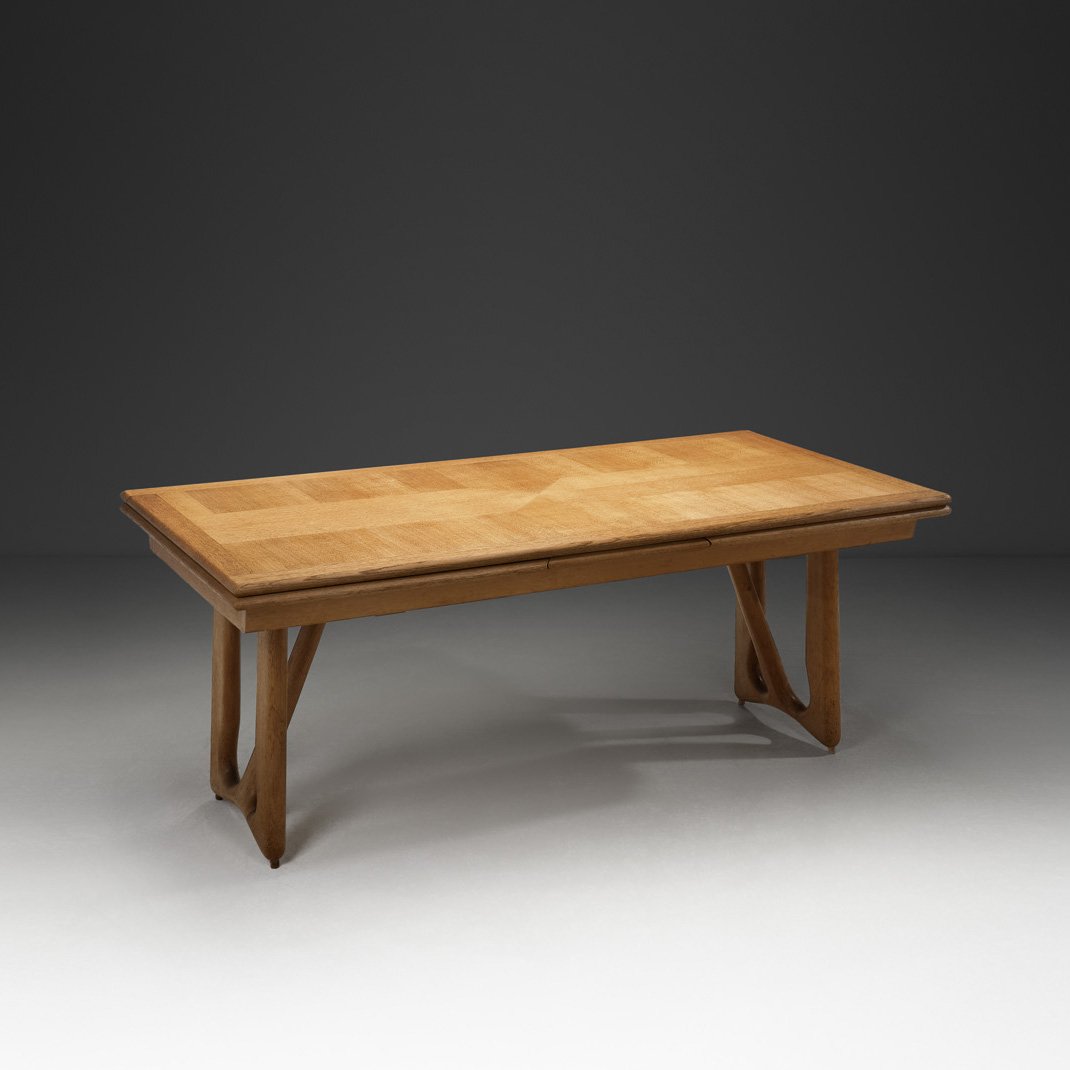
This stunning "L'Italienne" dining table, designed by the renowned French duo Guillerme et Chambron, showcases an exquisite blend of elegant aesthetics and rustic design elements. Crafted in the 1960s by Votre Maison, the table reminds us how form and elegance blend together in the duo's exceptional distinctive craftsmanship style.
At the heart of the construction of this model is the use of oak, a material renowned for its durability and timeless aesthetic qualities. Oak was the preferred material for Guillerme et Chambron, and this piece expertly showcases its rich and robust character, resulting in a solid, functional, and visually captivating work of art. Compared to the duo’s other models, this table is more pared down, relying mostly on the natural appeal of the oak, and its decorative legs. Unlike in most mid-century models, ornamentation was an important part of the duo’s creations, and while apparent, they were never overwhelming. This balance kept the pieces’ elegance, like in the case of this dining table. Furthermore, this piece is full of character and offers expressive and sculptural functionalism. Guillerme et Chambron’s table designs are well-known for their distinctive appearance and multi-functionality; this model is extendable and shows how decorative design and functionality were equally important for the designers, being as sensitive to the use of furniture in everyday life as to the creation of innovative design.
The table's form is clean, geometric, and is a testament to Guillerme et Chambron's dedication to modernism, while staying rooted in traditional craftsmanship and joinery techniques. Their work not only represents the fusion of function and form, but also exemplifies the mid-century modern aesthetic, which they played a pivotal role in actively shaping. Their emphasis on quality craftsmanship and the use of noble materials - like oak - has undeniably left a lasting imprint in the world of furniture making, solidifying their legacy in the French design landscape during the mid-century era.
Condition:
In good vintage condition. Wear consistent with age and use. The item has recently been reconditioned. Due to the nature and age of the wood, the item may have some marks, scratches, and discolouration.
Dimensions:
70.87 in W x 34.45 in D x 28.54 in H
180 cm W x 87.5 cm D x 72.5 cm H
REQUEST PRICE HERE
Price category: 12,500 - 15,000 usd / eur
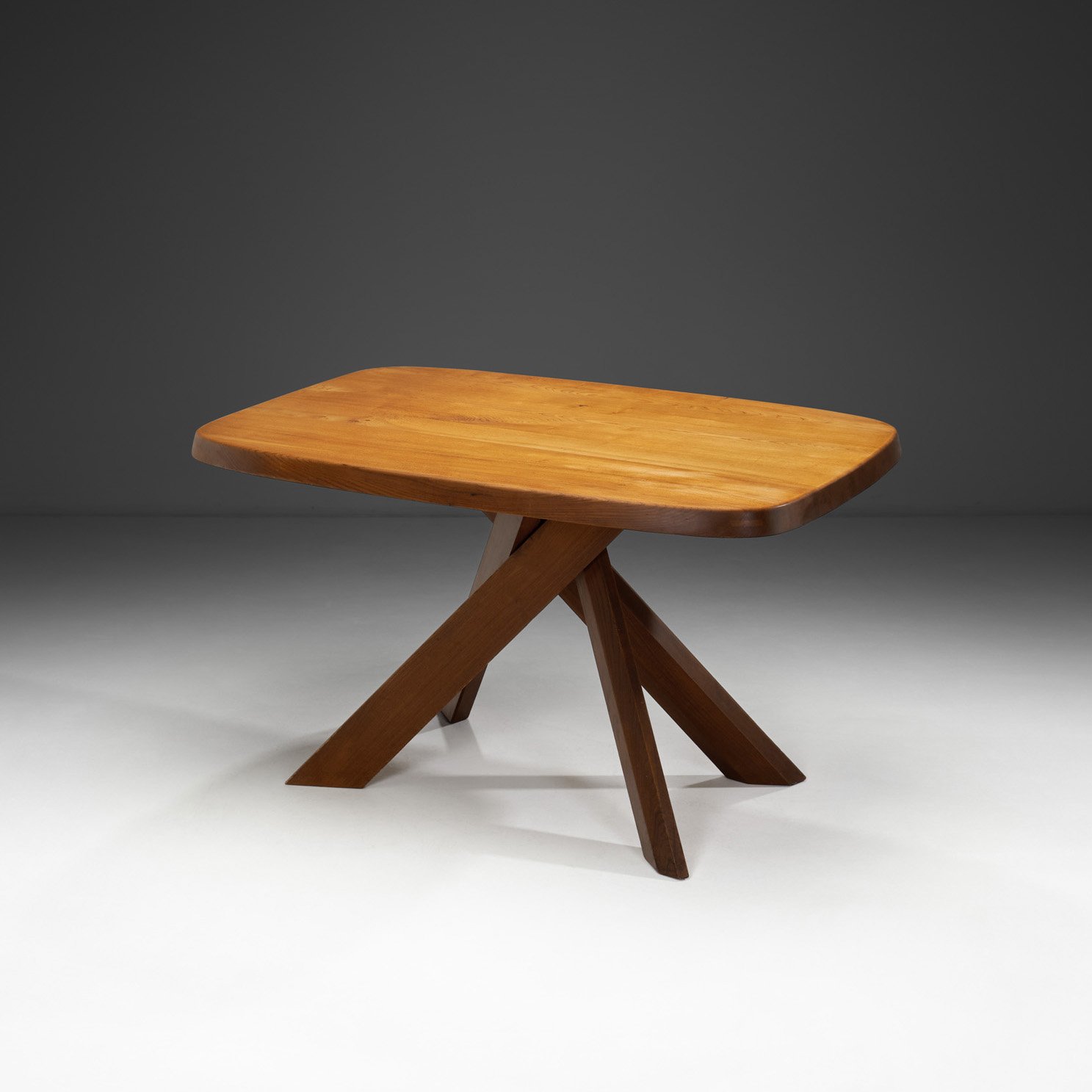
This dining table is a compelling embodiment of Pierre Chapo’s distinctive style. He always paired his creative and elegant designs with impeccable craftsmanship that gained him worldwide fame and love. This model “T35A” is a rare and beautiful example of Chapo’s designs, a piece that truly stands the test of time, bringing lasting form and quality to any interior.
Crafted entirely from solid elm, this dining table demonstrates exceptional craftsmanship and masterful joinery. Renowned for its striking grain patterns and long-lasting durability, elm is an ideal choice for larger pieces of furniture. This table’s vast flat surface, composed of carefully selected elm planks, beautifully highlights the wood's natural beauty, allowing the material to take center stage and speak for itself. The generous shape coupled with its warm honey tones, ensures that this table will be a focal point in any style of dining room or other large gathering area and is sure to be a conversation starter. The central quadripode base was designed with Chapo’s signature architectural legs, arranged in a dynamic way with the four pillars collapsing and balancing on each other at the same time, creating a striking visual rhythm.
Chapo’s designs reflect the architectural philosophies of Le Corbusier, as well as the commitment to the honest use of quality materials of Frank Lloyd Wright. His work is grounded in the simple harmony of form, function, and material, principles carried out in his works, enabling him to produce grand scale items, while preserving an underlying sense of warmth and simplicity. This dining table adds character to any interior with its uniquely structured leg composition, reflecting the influence of mid-century modernism.
Condition:
In good vintage condition. Wear consistent with age and use.
Dimensions:
50.19 in W x 32.67 in D x 28.74 in H
127.5 cm W x 83 cm D x 73 cm H
REQUEST PRICE HERE
Price category: 2,500 - 5,000 usd / eur
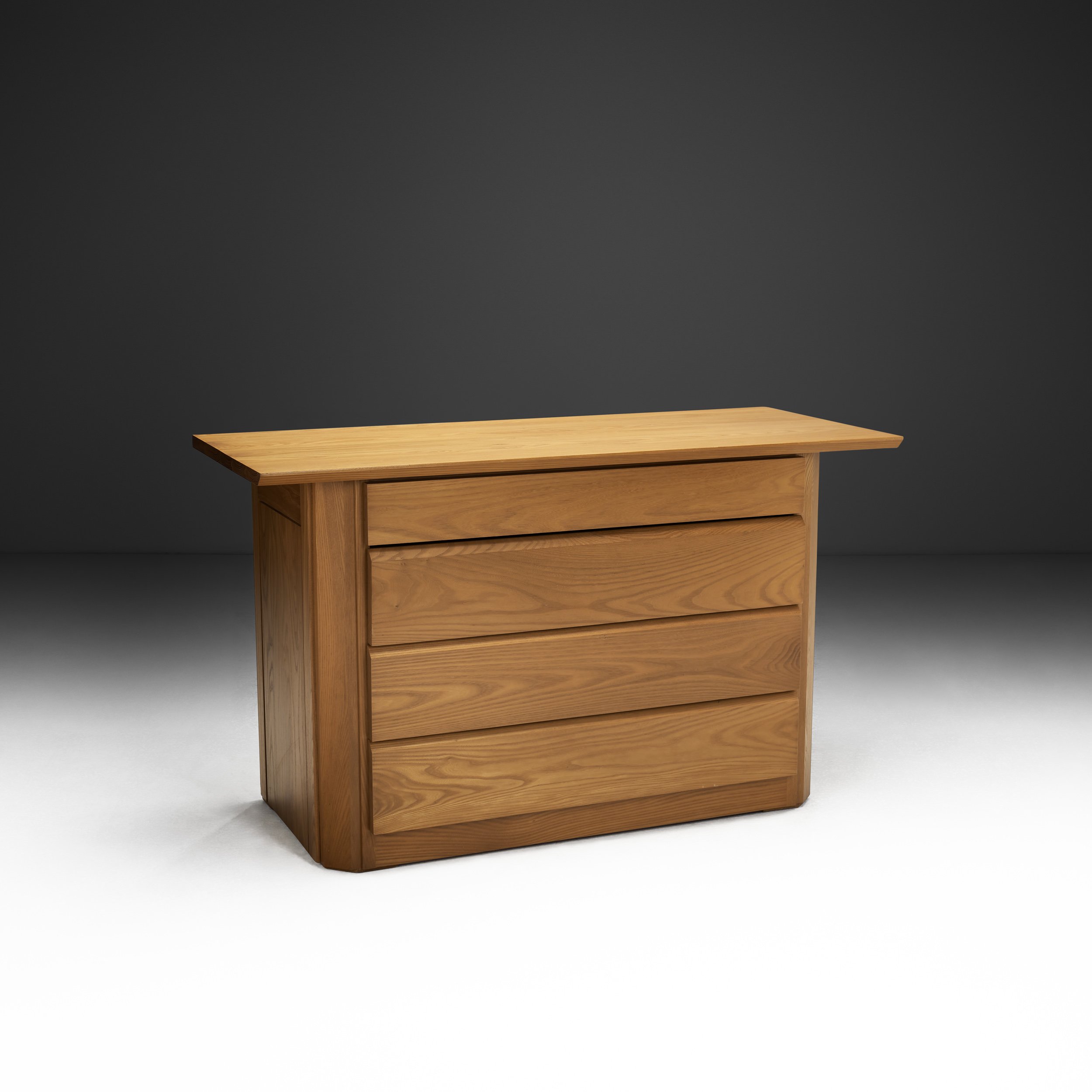
In mid-century modern design there was an emphasis on the use of wood, as it connected everyday objects - such as furniture - to nature. This chest of drawers is a perfect example of this practice, and of the visual benefits of an understated, organic design.
As with the UK and much of Europe, there was something of a design renaissance in France in the decades following the Second World War. In France, designers were often also architects, whose focus on functionality and quality resulted in sleek models, such as this dresser. Like with many pieces of furniture from Maison Regain, the light wood gives this piece its defining, striking look. The wide surfaces and the straight lines are perfect to showcase the artistry and workmanship. The design of this dresser isn’t loud, it leaves the focus on the wood and the details, yet, it has a stately appearance. The execution and high attention to detail of this dresser showcases the uncompromising craftsmanship and high-quality approach to furniture design in France in the mid-to-late 20th century.
With the major rise in popularity that mid-century modern experienced, it’s easy to see touches of 20th century French style in contemporary homes. The natural and unfading beauty of wood, and the simple, modern and elegant design is timeless of the era. This piece is sure to add style to any interior.
Condition:
In good vintage condition. Wear consistent with age and use. The item has recently been reconditioned. Due to the nature and age of the material, the item may have some marks, scratches, and discolouration.
Dimensions:
50.78 in W x 21.85 in D x 30.11 in H
129 cm W x 55.5 cm D x 76.5 cm H
REQUEST PRICE HERE
Price category: 2,500 - 5,000 usd / eur
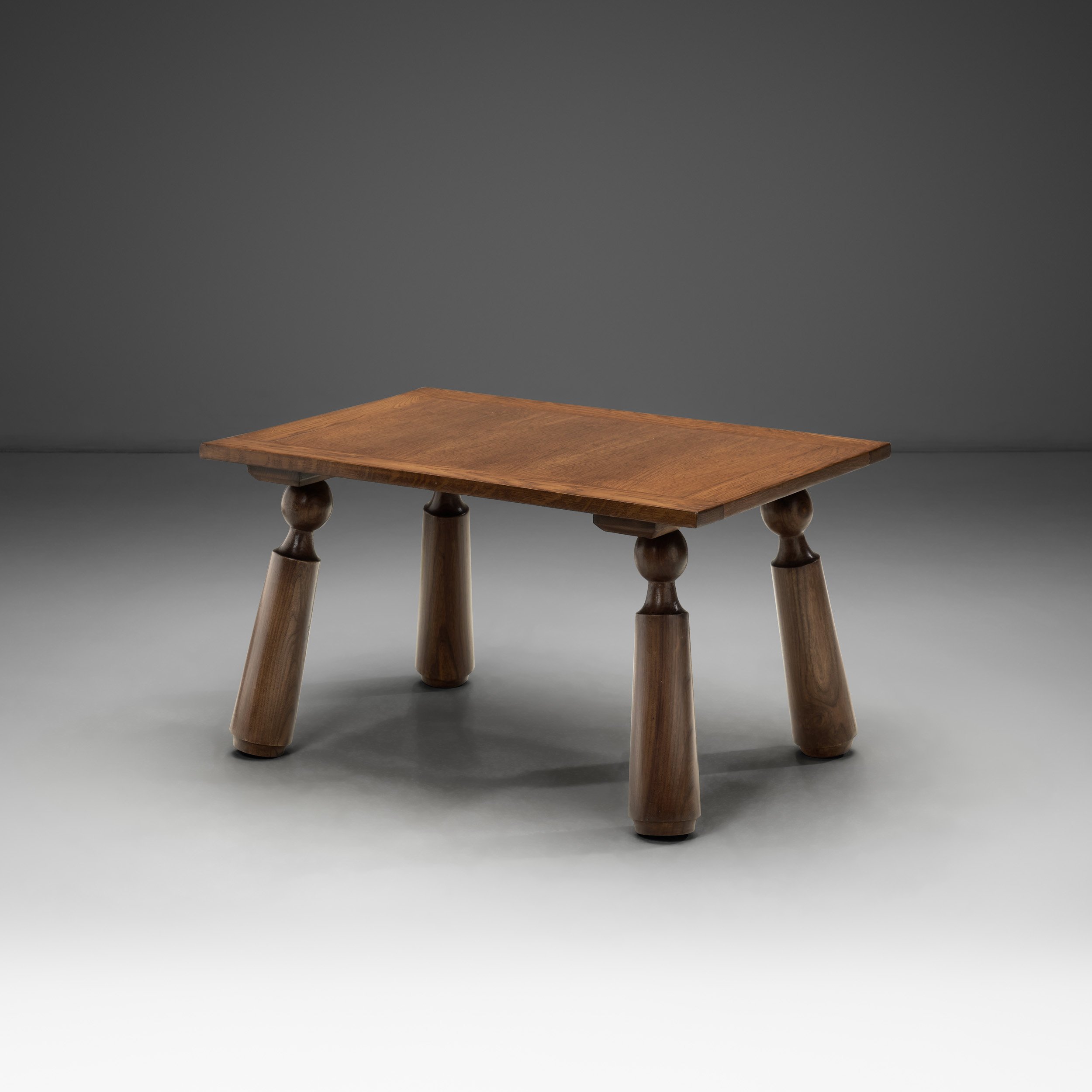
This wooden coffee table, crafted in France in the first half of the 20th century, is designed in the manner of Charles Dudouyt, one of the most distinctive figures in French decorative arts of the interwar period. Dudouyt’s work is often celebrated for its rustic charm, and masterful handling of wood, bridging tradition with the evolving aesthetics of Art Deco and modern design.
This table embodies those qualities through its sculptural presence and confident use of material. The piece is defined by its sturdy rectangular top and striking turned legs, which taper outward with bold, geometric proportions. Each leg features carved and rounded detailing, lending rhythm and visual weight to the structure. This play between solidity and ornamentation is characteristic of French designs of the era, where pieces were not only functional but also a statement of craftsmanship and artistic individuality. The warm stain of the wood enhances the visual richness of the table, highlighting its grain and natural imperfections. Its compact scale makes it ideal for daily use, while not overpowering a room. At the same time, the architectural quality of the legs gives it a charmingly unique character that anchors a space.
The essence of early 20th century French design is beautifully captured by this table. Functional yet sculptural, rustic yet refined, this piece stands as an enduring testament of the striking balance only master woodworkers are able to create.
Condition:
In good vintage condition. Wear consistent with age and use. The surface of the wood has been refurbished. Item may have some marks, scratches, and discolouration.
Dimensions:
31.29 in W x 21.45 in D x 17.71 in H
79.5 cm W x 54.5 cm D x 45 cm H

REQUEST PRICE HERE
Price category: 5,000 - 7,500 usd / eur
The period between 1950 and 1970 was characterised by some of the most stunning and well-executed furniture designs of the 20th century. As with the UK and much of Europe, there was something of a design renaissance in France in the 1950s, due to developments in materials and technology after the war. In France, designers were often also architects, whose focus on functionality and quality resulted in pieces such as this stunning dining table.
This model is all about the gorgeous wooden structure. The discreet joinery and seamless construction reflect the French emphasis on detail and quality, elevating the piece beyond just functional to an object of aesthetic value. The design is dominated by the rectangular tabletop; it features a rich, dark wood veneer that showcases the grain and deep tones of the wood, which can add a sense of warmth and sophistication to any dining space. To support the top are four legs with impeccable joinery that is visible under the tabletop. Since this piece was made in the heyday of mid-century design, the legs - and the table as a whole - lack heavy ornamentation, and instead the focus is on the beauty of the material. The mid-century pieces that appeal to most are the models that were designed with both nature and function in mind, which appear completely contemporary and undated, making this dark wood dining table an exceptional example of the ideals of the era. Overall, the clean lines and balanced proportions create a streamlined silhouette, while the dark finish lends a timeless quality that complements both classic and contemporary interiors.
Wood has never gone out of style, and interior design with an emphasis on natural materials is only gaining popularity today. This dining table will make a striking addition to a variety of interiors.
Condition:
In good vintage condition. Wear consistent with age and use.
Dimensions:
66.93 in W x 33.46 in D x 29.92 in H
170 cm W x 85 cm D x 76 cm H

REQUEST PRICE HERE
Price category: 2,500 - 5,000 usd / eur
Many associate the designs of French design duo, Guillerme and Chambron with the most recognizable French furniture pieces of the second half of the 20th century. Most often executed in blonde oak, their designs are elemental with subtle but immediately recognizable details and the highest level of craftsmanship.
Whether we look at the hand carved handles of the drawers or the flag-shaped legs, this cabinet has plenty to offer both visually and in terms of craftsmanship. As with every piece of furniture from Votre Maison, the solid oak gives this cabinet its defining, striking look. The wide surfaces and the straight lines are perfect to showcase the artistry and workmanship. The design of this cabinet isn’t loud, it leaves the focus on the wood and the details, yet, it has a stately appearance that is exemplary of the works created by Guillerme and Chambron. The designer duo’s sincere approach is evident in the material - solid light oak - and in the functional arrangement of the storage spaces. The storage areas utilize the full width and depth of the cabinet, offering plenty of space. Below the door are three wide drawers with round, carved handles on both sides, a detail that also serves as a decorative element. Guillerme et Chambron also made sure that their design is appealing from all angles, which is apparent on the sides and in the shape of the legs.
As with every piece of furniture from Votre Maison, the solid oak gives this cabinet its defining, striking look. Its natural qualities were only elevated under the hands of the French duo, creating a timelessly elegant design that is sure to stand out in any space.
Condition:
In good vintage condition. Wear consistent with age and use. Some minor scratches and marks on the wood.
Dimensions:
42.12 in W x 20.07 in D x 42.51 in H
107 cm W x 51 cm D x 108 cm H
About the designers:
Robert Guillerme graduated in 1934 from the École Boulle where he excelled in architecture and furniture design. After the Second World War he moved to Lille, in the north of France, where he decorated homes and designed furniture for the well regarded Rogier workshops.
In 1948, Guillerme was joined by his long-time friend, decorator Jacques Chambron in Lille. The following year Guillerme and Chambron met master cabinetmaker Émile Dariosecq, owner of a woodworking shop and the company Votre Maison was born. Together, they defined and imposed a new furniture concept. Thanks to their distinctive creativity, originality, and quality, the Votre Maison quickly became well-known.
The Votre Maison marked the history of French design. Guillerme drew the furniture designs while Chambron played the part of salesman, welcoming and advising clients. The power duo was complemented by Dariosecq, whose workshop took charge of the manufacturing. Together, they defined new furnishings concepts. Well-crafted chair back, polished wood and thick cushions make the reputation of their armchairs and sofas. Votre Maison continued to produce furniture right into the 20th century, with Jacques’s son Hervé Chambron, a designer and graduate of the École Boulle, having taken the over in 1983. ~H.

REQUEST PRICE HERE
Price category: 2,500 - 5,000 usd / eur
The materials and techniques used by mid-century French cabinetmakers were directly derived from the possibilities offered by industrial production at the time. Oak has never gone out of style, and pieces with an emphasis on the unfinished or natural look are once again gaining popularity today. This desk is an example of a piece that is equally striking standing alone, or as part of an interior with a medley of styles.
The design of this table model boasts an ingeniously functional and well-thought-out structure, crafted from quality limed oak. It holds a natural expression with its airy design, which is dominated by the beauty of the material. The use of liming was traditionally used to highlight the natural grain of the oak, while also creating a protective layer that would prevent the wood from absorbing dirt and moisture. Unlike traditional paint that leaves a topical plastic finish on top of wood, lime wash absorbs into the wood, leaving a natural contour. Limed oak furniture is often seen as a classic and timeless design element that can add a touch of elegance and sophistication to any space. The wide top is rectangular, with sharp edges, and showcases the limed oak’s beautiful pattern, reinforcing a modernistic look with a rustic feel. The legs are gently tapered and tilted to support stability. The design of this table recalls the works of French designer René Gabriel, whereby the sobriety of his furniture is still a source of inspiration today.
The imperfections of the wood and the simple, functional design makes this table stand out with a timeless appeal. Its light colour makes it easy to adapt to almost any interior, and the design is perfect to add that coveted mid-century flair.
Condition:
In good vintage condition. Wear consistent with age and use.
Dimensions:
51.18 in W x 28.35 in D x 30.32 in H
130 cm W x 72 cm D x 77 cm H

This stunning bleached oak cabinet attributed to French designer Charles Dudouyt is a historic piece showing the enduring influence of Art Deco on early mid-century pieces. This cabinet was most likely produced in Paris at La Gentilhommière, the manufacturing company Dudouyt established in 1933.
A favourite among Art Deco furniture collectors and enthusiasts, the work of Dudouyt is known for their rustic and modernist aesthetic. Accordingly, this cabinet has these sensibilities rather than the classicist design associated with French pieces of the early 20th century. Dudouyt is known for his way of embellishing chunky proportions with elegant carvings as seen on the sides of this cabinet as well. These signature carvings and the four wood panels on the door fronts stand out especially thanks to the sheer size of the oak surfaces. The French designer’s pieces generally show great balance between decorative and functional elements which is the case here as well. The design still primarily aims to serve as storage space. The doors on the front can be opened with the help of the two keys, a small and charming feature. The visible screws and the not too overworked oaken parts reinforce the rustic look letting the material stay in focus.
Dudouyt’s signature geometric inlays, pronounced shapes and raised carved motifs define this grand cabinet that makes an elemental impression. Today, the French designer’s pieces continue to be highly sought for their distinctive but timeless look.
SOLD
Condition:
In good vintage condition. Wear consistent with age and use. Some marks and scratches on the wood.
Dimensions:
84.25 in W x 19.48 in D x 35.03 in H
214 cm W x 49.5 cm D x 89 cm H
About the designer:
Born in 1885, Charles Dudouyt began his artistic career after studying at the Germain Pilon school. He paints, draws and earns his living by illustrating publications, notably for Calmann-Levy and the Assiette au Beurre.
In 1918, on his return from the war, he designed and had lampposts, lampshades and various decorative objects made with his wife. This led him to create in 1920, in Pontoise, a rustic style furniture factory in fashion at the time: L’Abeillée.
In 1933, he moved to Paris and, opting for a contemporary style, he founded the Gentilhommière, which included a workshop and a shop. After his death, his son Jacques Dudouyt continued the activity of the Gentilhommière until 1960.

Pierre Chapo designed his modular “R” series with practicality in mind. The individual pieces were constructed of French Elm, and are classics in all possible ways. Chapo’s designs are the result of reflection and elaborate work on achievements that strive to combine material, form, and function by favouring wood.
Combining tradition and modernity, Chapo created his pieces with a great consideration for functionality. Therefore, this elm sideboard is characterized by its streamlined aesthetic and impressive storage volume. By combining two modules on three pairs of legs, the chiselled edges and clean look of the “R40” model is further enhanced. With two doors and three drawers on each side, the storage space is indeed plentiful, and well divided. Behind each door are two shelves that allow items of different heights to be placed inside. Similarly, the drawers are different sizes, showing the consideration of the model’s functionality. The handles have a minimalistic shape, complementing the overall look and letting the material stay in focus. The use of the large pieces of solid elm give this sideboard a very calm, natural feeling. The wood has beautiful grain and patterns that stand out on the large surfaces on all sides. The slender, wide legs are unusual in their shape, but balance the design perfectly both visually and physically.
After travelling through Scandinavia, Central America and working for a year in the United States, Chapo returned to Paris and pursued his interest in wood, crafting furniture with a double concern for contemporary design and the traditional know-how. The “R40” is a model that showcases his skills in design and craftsmanship spectacularly.
SOLD
Condition:
In good vintage condition. Wear consistent with age and use.
Dimensions:
98.81 in W x 22.44 in D x 29.72 in H
251 cm W x 57 cm D x 75.5 cm H
About the designer:
Pierre Chapo, born in Paris in July 1927, was initially interested in becoming a professional painter. However, after a chance meeting with a shipbuilder who introduced him to wood and wood crafts, Chapo changed his focus and decided to study architectural studies at the prestigious École Nationale Supérieure des Beaux-Arts in Paris.
After graduation, Chapo and his wife, the sculptor, and painter Nicole Lormier, started to travel extensively through Scandinavia and Central America. Among the many places the couple visited was the home and studio of Frank Lloyd Wright in Taliesin West. A visit that had a lasting influence on Chapo’s future work and designs. Read more about Pierre Chapo. ~H.
REQUEST PRICE HERE
Price category: 7,500 - 10,000 usd / eur
A drafting table or architect's table is, in its antique form, a kind of multipurpose desk which can be used for any kind of drawing, writing or impromptu sketching or for drafting technical illustrations. Many designs from the mid-century period adopted an almost structural logic, reflecting a broader interest in honest materials and visible craftsmanship, where the making of the object was never concealed but instead highlighted as an integral part of the design.
This worktop desk was made in France around the 1960s. It embodies rustic modernism and brutalist aesthetics through the robust yet carefully considered construction. The solid oak top is thick and slightly contoured, with softened edges that introduce a subtle organic quality to an otherwise rectilinear form, and an ergonomic cutout. Beneath, the base is composed of vertical supports connected by horizontal stretchers, creating a grounded structure. The architectural portico base is connected by solid crossbeams, where the joinery is clearly expressed, each connection contributing to both the strength and the visual identity of the piece. This detail is a testament to the high level of craftsmanship and brutalist influences. At the same time, the open space between these elements ensures that the design does not feel heavy, despite the mass of the material. The natural grain of the oak remains visible across all surfaces, adding depth to the otherwise restrained composition.
This desk maintains a strong presence rooted in its quality, but most of all, it represents a deeply functional piece of furniture. It balance of weight and refinement makes it perfect to serve a practical but elegant workspace.
Condition:
In good vintage condition. Wear consistent with age and use. The desk has recently been reconditioned and showcases a beautiful grain pattern. Due to the nature and age of the wood, the item has minor marks and scratches, and may show slight discolouration.
Dimensions:
49.40 in W × 32.67 in D × 30.31 in H
125.5 cm W x 83 cm D x 77 cm H