
“Pele” Lounge Chair by Esko Pajamies for Lepokalusto, Finland 1970s (sold)




“Pele” Lounge Chair by Esko Pajamies for Lepokalusto, Finland 1970s (sold)
This rare “Pele” lounge chair by Finnish designer Esko Pajamies is, without a doubt, his most stunning chair design. It is seldom we see a chair model and immediately recognize it, but Pajamies managed to design such a piece. His unconventional design was strongly characterized by durability and functionality as well as insightful technical solutions.
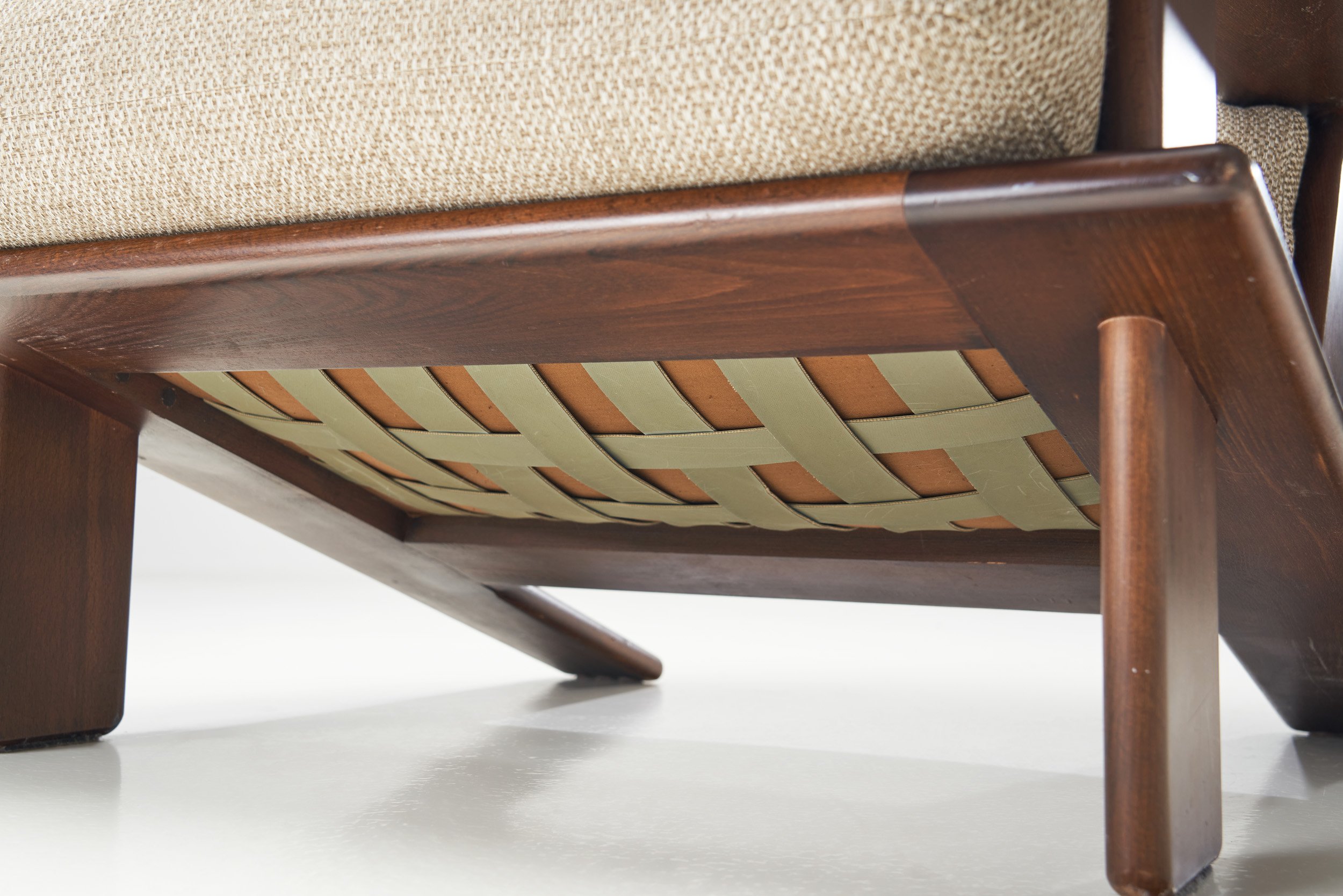
In Finland, the 1970s saw the use of new materials like plastic, synthetics, and fibreglass being combined with advances in manufacturing technologies, allowing designers in Finland to expand their range of colours and forms in mass production. However, this lounge chair model still gives preference to natural materials, primarily to its solid oak structure. The wooden frame provides a firm base with rounded edges. Undeniably, the most eye-catching and distinctive element of this Pele’s design is the way in which the seat and the back legs of the armchair are formed by one elongated piece of wood. The ergonomic design with the bent backrest, wide armrests, and upholstered cushions make this lounge chair an exceptionally comfortable piece. It therefore comes as no surprise, that this model first gained popularity as a TV chair for homes. Later it became a popular choice for fireplace rooms as well as public spaces, similarly to several other designs of Pajamies.
This lounge chair was manufactured by the Finnish furniture company, Lahden Lepokalusto Oy in the 1970s. The Lahti-based company has been furnishing public spaces for almost 70 years, and gained worldwide recognition through the iconic furniture designs of Professor Yrjö Kukkapuro and later, Esko Pajamies.
SOLD
Condition:
In good vintage condition. Some scratches and marks on the wood. This chair comes with its original upholstery or has been reupholstered by a previous owner. Each of our items can be re-upholstered by our in-house atelier in a fabric of choice. Please reach out for more information.
Dimensions:
35.24 in W x 37 in D x 34.65 in H, Seat Height 15.75 in
89.5 cm W x 94 cm D x 88 cm H, Seat Height 40 cm
About the designer:
Esko Lauri Alvari Pajamies (1931-1990) was a Finnish designer, primarily known for his upholstered furniture designs for both private and public spaces.
Pajamies graduated as an interior architect in 1954 and established his own design studio in 1961. Pajamies designed his first series of furniture for Lepokalusto in 1965, and their fruitful collaboration lasted well into the 1970s. Pajamies designed for a handful of other manufacturers and his designs proved to be lucrative throughout the 1960s and 1970s. Interestingly, Esko Pajamies was the first to design a sofa (Bonanza for Asko 1965) that had an exposed wooden frame. The sofa was named after the 1960s television series and had extra wide armrests to accommodate glasses and plates.
His “Polar 1001” and “1003” chairs could be found on luxury liners sailing the Black Sea, while some of his other designs furnished the Helsinki-Vantaa Airport's passenger terminal in 1975. The versatile designer also played trumpet in the jazz band Jaakko Salo Modern Band. He played with many famous singers in the 1960s.
Pajamies was awarded the State Art Prize in 1979 and is still known as one of the leading interior architects of Finland. ~H.
REQUEST PRICE HERE
Price category: 15,000 - 20,000 usd / eur
Swedish architect and furniture designer Axel Einar Hjorth served as the lead designer for Sweden’s Nordiska Kompaniet department store from 1926 to 1938. During this time, Hjorth designed the “Sportstugemöbler” series, (which translates to “sports cabin furnishings”) a collection of wooden furniture designed for country homes. The various models in the sportstugemöbler series took their names from the Stockholm archipelago – including Blidö, Lovö, and famously, Utö.
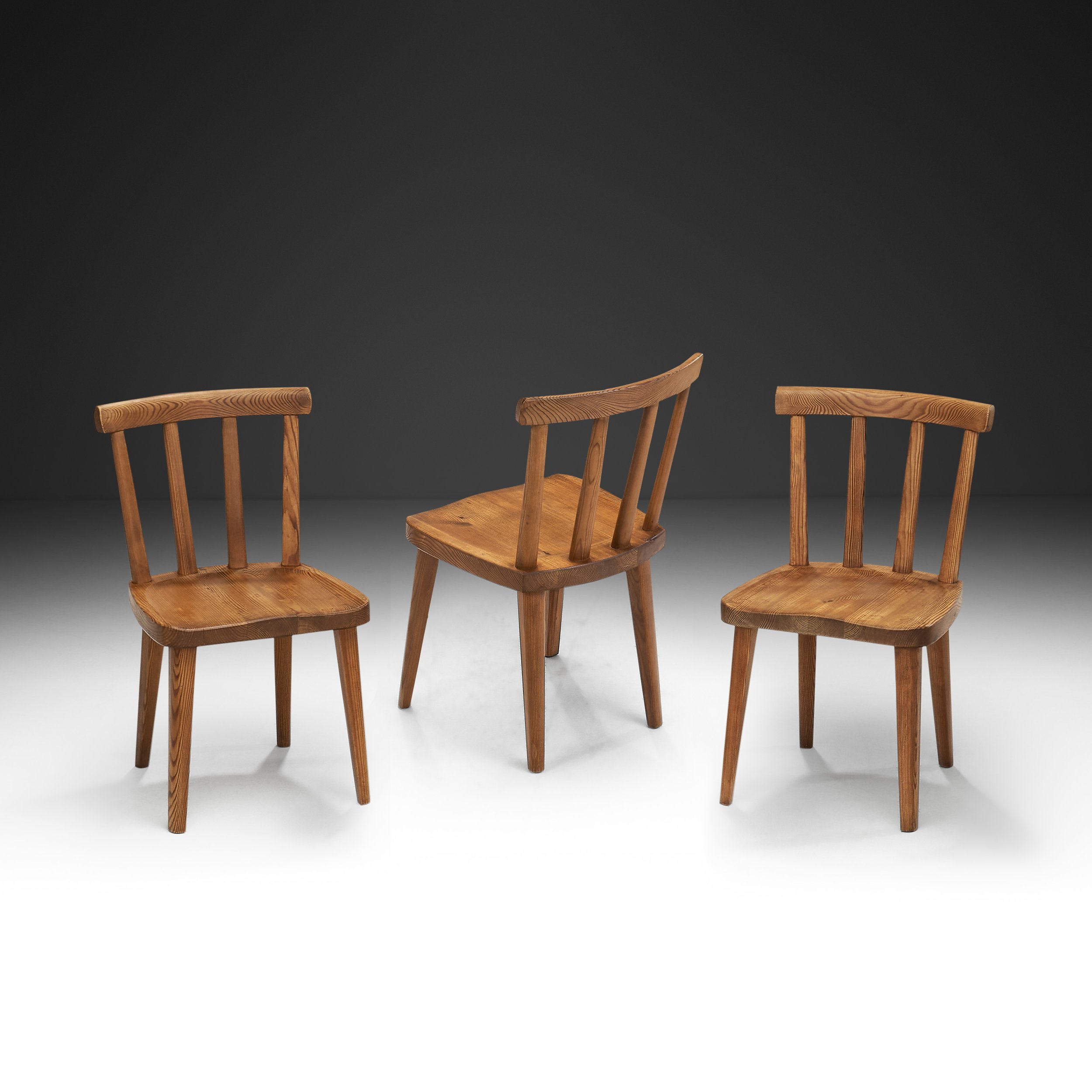
These Utö chairs were designed in 1932 as part of the collection. Unlike the department store's interiors for floors and villas in the cities, the Utö designs had a simple character with robust and basic shapes in solid pine. Accordingly, the design of these chairs focuses on simple lines and the material itself. Made of pine wood, these chairs are strong, reflecting Hjorth’s principles in which he mixed the ideals of the modernist movement with provincial Swedish traditions. As a result, the design of this set is completely timeless. Each chair demonstrates a conscious construction, where the joinery and fittings related to traditional craftsmanship are emphasized. Dominated by rounded, straight lines, the chairs have spindle backrests and ergonomically carved seats. The form alludes harmony and stability, fitting the summer cabin concept perfectly.
In an international perspective, Hjorth's “sportstugemöbler” series was the forerunner of later pioneering designers such as Charlotte Perriand. It is therefore no surprise that these Utö chairs became part of Swedish and international modernist design history. In their time, the Utö collection may have appeared as pioneering and radical, but today they are viewed as status symbols in interiors of international character.
Condition:
In good vintage condition. Wear consistent with age and use. Some marks and stains on the wood. Due to the nature and age of the wood, the items may have scratches and discolouration.
Dimensions:
18.89 in W x 18.3 in D x 31.49 in H; Seat height 16.92 in
48 cm W x 46.5 cm D x 80 cm H; Seat height 43 cm
Literature:
Christian Bjork, Thomas Ekstrom and Eric Ericson, 'Axel Einar Hjorth: Mobelarkitekt', Stockholm, 2009, p.130
About the designer:
Axel Einar Hjorth was born in a small Swedish village named Krokek, just outside Norrköping, on March 7, 1888. At the age of 20, he moved to Stockholm to study architecture and design at the Högre Konstindustriella Skolan.
Although he never graduated, in the 1920s Hjorth started working as a furniture designer for various manufacturers, such as H. Joop & Co., Myrestedt & Stern, Jonssons, and Nordiska Kompaniet. Hjorth’s designs from this period had neoclassical features combined with Swedish Grace. This romantic national style of Sweden was elegant and refined, yet simple. The anniversary exhibition of 1923 in Gothenburg marked the breakthrough of Swedish decorative arts, and made Axel Einar Hjorth a well-respected artist. From October 1926, Hjorth became the chief designer and architect of Nordiska Kompaniet department store in Stockholm. In the 1930s, Hjorth designed a furniture collection out of pine meant for serial production known as Sportstugemöbler (furniture for holiday houses).
Hjorth’s designs, from the luxury of neoclassicism to the severity of functionalism, are sharply distinctive in style, materials, and character. Unlike many of his contemporaries, Hjorth did not conform to the socially oriented ideas produced by Svensk Form (the Swedish Society of Crafts and Design). He played a significant role in the development of Swedish society as a whole, and particularly in Swedish industrial art
Today Hjorth is often viewed as a precursor to the modern designs popularized by Charlotte Perriand, Jean Royére, Pierre Chapo, or Josef Frank. Recently, there has been a revival of appreciation for his work, showing his genius in a new light. ~H.

REQUEST PRICE HERE
Price category: 2,500 - 5,000 usd / eur
The dark wood, the beautiful upholstery, and timeless design in the manner of Erik Bertil Karlén make this rare easy chair a beautiful representation of Swedish mid-century modern design history.
For this model, nature was evidently a great source of inspiration, therefore sharp edges or corners can rarely be found. With a tremendous sense of proportion, this chair model is very comfortable and fulfils its task to “serve well” and last for lifetimes. Without any ornamentation, the focus here is on the round, flowing lines of the body and its upholstery. The design has the wingback look with sides that embrace the sitter in a cosy way. On the upper end, the “wings” curve outward, which opens up the design. What makes this model special is how the back and seat form one unit both visually and structurally. This shell-like form has a masterful curve that follows the human body’s shape therefore the chair is very ergonomic. The dark, wooden tapered legs are connected by stretchers on the sides and highlight the body with their understated look. The light upholstery with appealing button tufting provides an elegant look with its textured look and a cosy sitting experience thanks to its softness.
Swedish Modern design is a distinctive style that represents a design philosophy, guided by functionality, simplicity and clean lines. The design of this model is in favour of the user, maintaining the focus on authentic simplicity.
Condition:
In very good vintage condition. Wear consistent with age and use. The chair has been reupholstered recently in a premium fabric. Each of our items can be re-upholstered by our in-house atelier in a fabric of choice. Please reach out for more information.
Dimensions:
28.14 in W x 28.74in D x 33.26 in H; Seat height 16.14 in
71.5 cm W x 73 cm D x 84.5 cm H; Seat height 41 cm
Literature:
Form: Svenska slöjdföreningens tidskrift, Svenska slöjdföreningen, Stockholm, 1943, p. 87.
Hedqvist, Hedvig & Björk, Christian, "Swedish Modern : En historia om modernismens yttringar i Sverige genom design, inredning och formgivning", Orosdi-Back, 2018, p. 228-229.
About the designer:
Erik Bertil Karlén was born on February 22, 1912 in Sundbyberg, Sweden. He was a Swedish architect and designer. His architecture characterized many areas of Stockholm’s suburbs from the 1940s, 50s and 60s.
After his training as an architect at KTH in the 1930s, Karlén got a job as an architect at Fortifikationsstyrelsen's Kasernbyrå in 1940. One of his major works at this time was designing the buildings for Svea Livgarde in Sörentorp, Solna municipality, which was completed in 1946. He gave the buildings a simple but careful architectural style using predominantly red brick as the facade material. Some had brick in combination with dark-glazed wood panels.
As many of his contemporary Scandinavian architects, Karlén also designed furniture, mostly seating models. His designs however, remain very rare to this day.
REQUEST PRICE HERE
Price category: 2,500 - 5,000 usd / eur
Throughout Scandinavia, there's a long history of craftsmanship which is especially true of Denmark and one of its most reputable furniture makers, Fritz Hansen. This beautiful chair is an exceptional flag bearer of Danish Mid-Century Modernism with an immediately recognisable look.
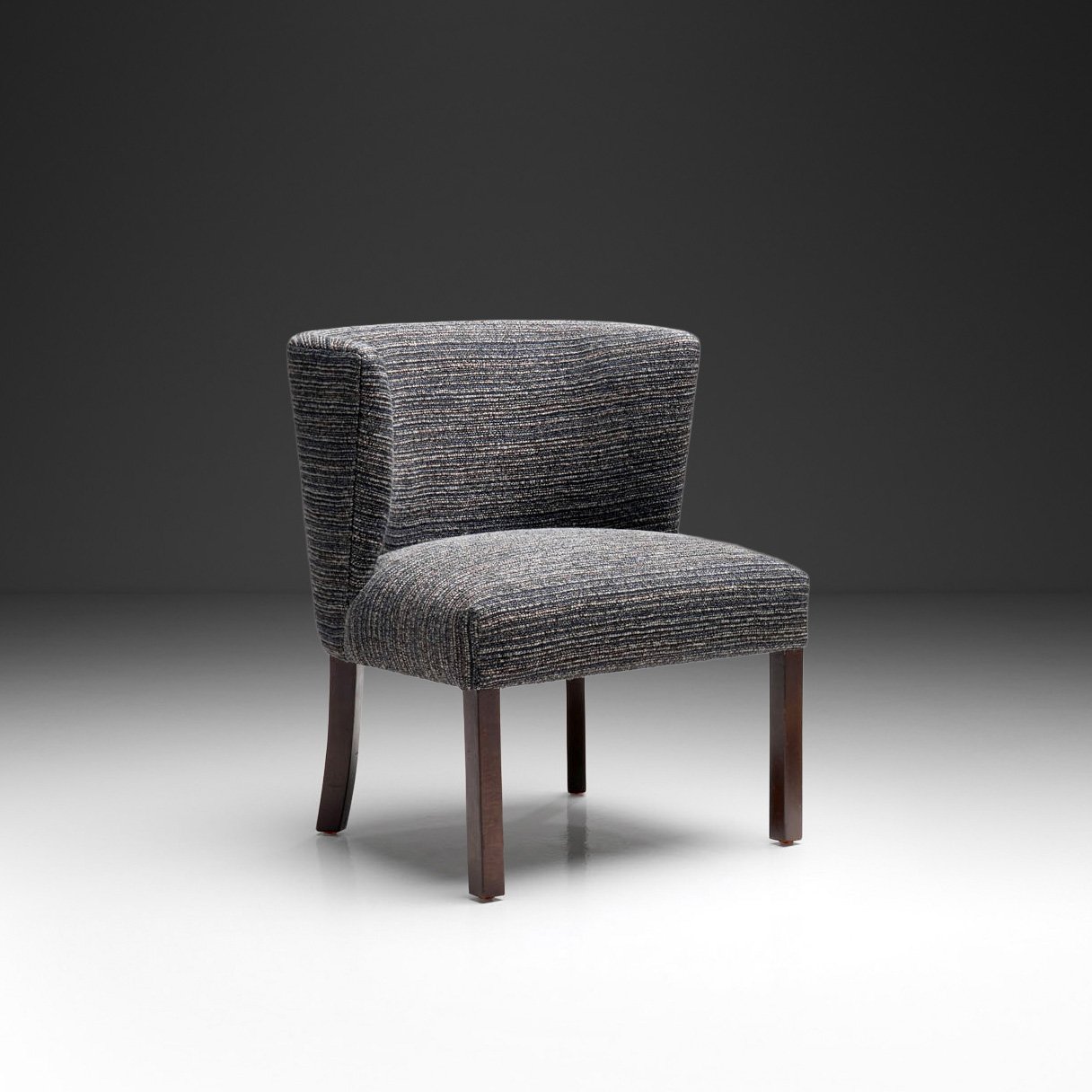
When the Copenhagen-based furniture maker Fritz Hansen opened for business more than 140 years ago, the company adhered to the traditional, time-honoured Danish values of craftsmanship in woodworking and joinery. Yet thanks to the postwar innovations of Arne Jacobsen and others, the company would become the country’s leader in Scandinavian modern design using new, forward-looking materials and methods. This model “1514” chair was designed in the 1940s. This design features stained beech legs. The back legs are slightly bent, which is a unique characteristic of Fritz Hansen’s designs. The seats and backrests are upholstered in a beautiful navy-blue fabric. The back of the chair is gently curved, accommodating the sitter. The slightly bulged seat offers great comfort, while visually complementing the backrest’s shape. The model “1514” chair illustrates the essence of an open and welcoming chair, that suits any interior. This piece is comfortable and sculptural at the very same time, a great example of Fritz Hansen’s quality works.
This Danish modern chair in many ways transcends the word ‘modern’. It has a style that can be incorporated successfully into contemporary and traditional interiors, urban and country alike, lending itself to a timeless and universal appeal.
About the designer:
Fritz Hansen’s history goes back to 1872. That year, the cabinet maker opened his workshop in Copenhagen under his name. Along with his son, Christian, Fitz Hansen started the production of high-quality furniture in 1885. The Fritz Hansen manufactory (a.k.a. Republic of Fritz Hansen) earned recognition and reputation for furnishing prestigious institutions such as the Copenhagen City Hall, the University Library and the Danish Supreme Court.
In the beginning of the 20th century, the manufactory started experimenting with a technique called ‘steam bending’, which ultimately led Fritz Hansen to become the world leader in the field in the 1930s. What started in 1915 with a steam bent beech chair, eventually made the company the specialist of laminate wood.
Thanks to Fritz Hansen’s collaborations with designers like Kaare Klint, the company played an important part in the development of what is today known as ‘Scandinavian design’. Post-war collaborations included Hans Wegner, Borge Mogensen and Arne Jacobsen. Jacobsen dominated the company’s designs in the 1950s, and among other world-famous designs, led to the creation of the ‘Egg chair” (1958).
Condition:
In good vintage condition. Wear consistent with age and use. Due to the nature and age of the chair, the legs have some small scratches and marks. The chair has recently been reupholstered in a premium fabric. Each of our items can be reupholstered by our in-house atelier in a fabric of choice. Please reach out for more information.
Dimensions:
23.63 in W. x 23.23 in D x 27.56 in H
60 cm W x 59 cm D x 70 cm H
Literature:
Fritz Hansen Catalogue 4202
REQUEST PRICE HERE
Price category: 5,000 - 7,500 usd / eur
Art Deco pieces used bold geometry to create iconic elements of interior design. While the movement is frequently associated with angular silhouettes and decorative detailing, many Scandinavian interpretations introduced a calmer and more restrained approach and rounder forms. Danish furniture makers in particular favoured sculptural curves and high-quality upholstery to define the character of a piece rather than relying on excessive ornamentation.
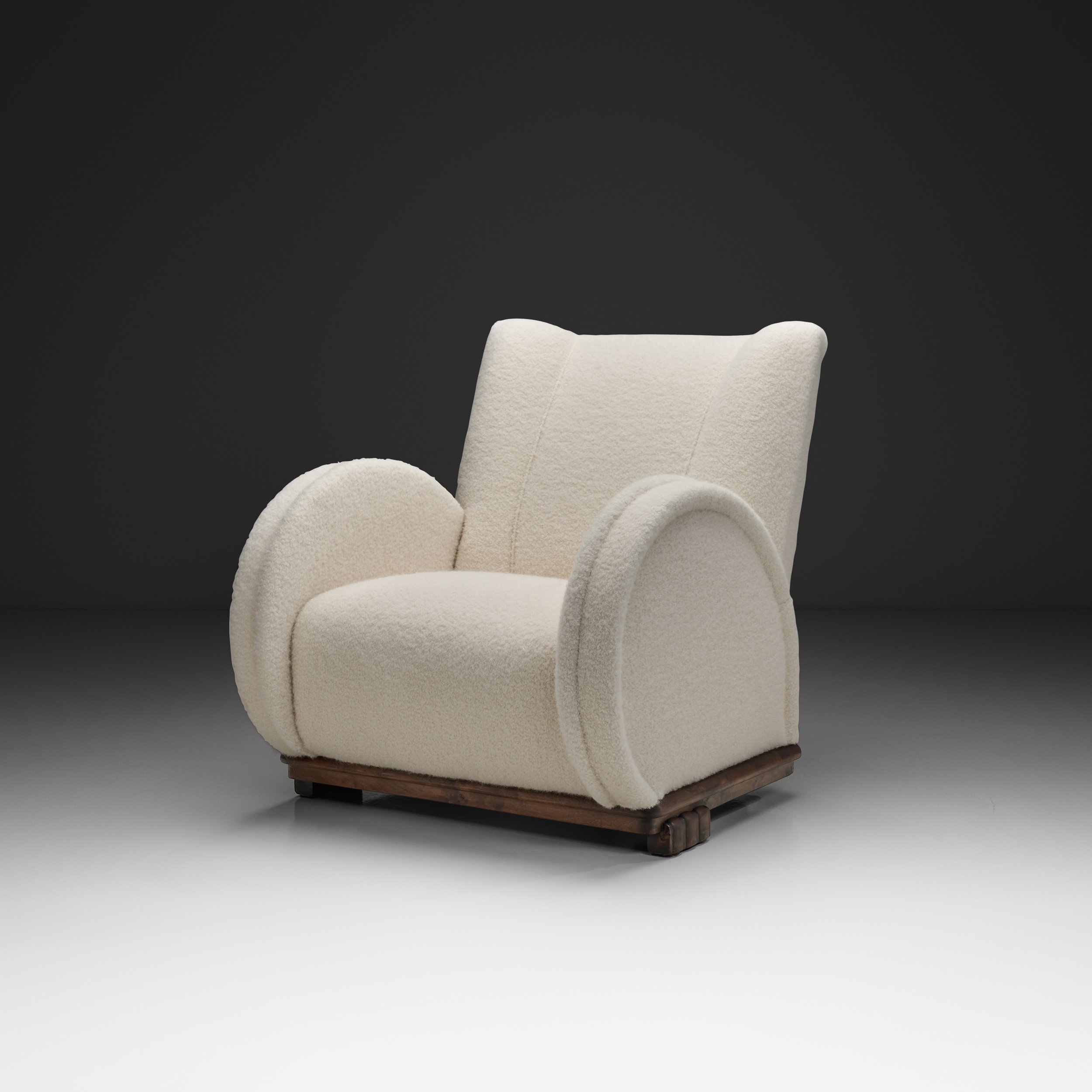
This shift produced seating that retained the elegance of Art Deco while moving toward the softer sensibility that would later define Scandinavian modernism. Through its strong contours and carefully balanced proportions, this 1930s danish armchair is reflective of its era. The most distinctive feature is the oversized circular armrests, which frame the seat in a bold, sculptural manner. The curved shape creates a strong visual rhythm while softening the otherwise classic structure of the chair. The body is fully upholstered in a thick boucle fabric whose textured surface enhances the softness of the silhouette across the curves. The backrest rises slightly above the armrests and complements the roundness of the arms with its more angular look, without disrupting its appearance. Beneath the body, the chair rests on a low wooden plinth base with small feet, grounding the form and providing visual contrast to the softness above. The restrained palette further emphasises the shapes and allows the sculptural quality of the armrests to remain the focal point.
The interplay between the upholstery and the dark wooden base gives the chair a controlled sense of weight and balance. Rather than appearing delicate or overly decorative, the design feels strong while still prioritising comfort. This piece demonstrates the refined elegance that characterised Danish interpretations of Art Deco seating.
Condition:
In good vintage condition. Wear consistent with age and use. The chair has recently been reconditioned. The item has recently been reupholstered in a premium fabric. Each of our items can be re-upholstered by our in-house atelier in a fabric of choice. Please reach out for more information.
Dimensions:
30.31 in W x 37.01 in D x 34.25 in H; Seat height 16.14 in; Seat depth 20.47 in; Arm height 23.62 in
77 cm W x 94 cm D x 87 cm H; Seat height 41 cm; Seat Depth 52 cm; Arm height 60 cm
REQUEST PRICE HERE
Price category: 9,000 - 12,500 usd / eur
Strongly influenced by the functional forms of the Bauhaus school in Germany, Danish designers led the way in furniture design during the 1950s. They combined the inspiration brought by new industrial technologies with minimalist design. This style became so influential that it is recognized as a design movement in itself, entitled Danish Design with a subgroup known as Danish Modern.
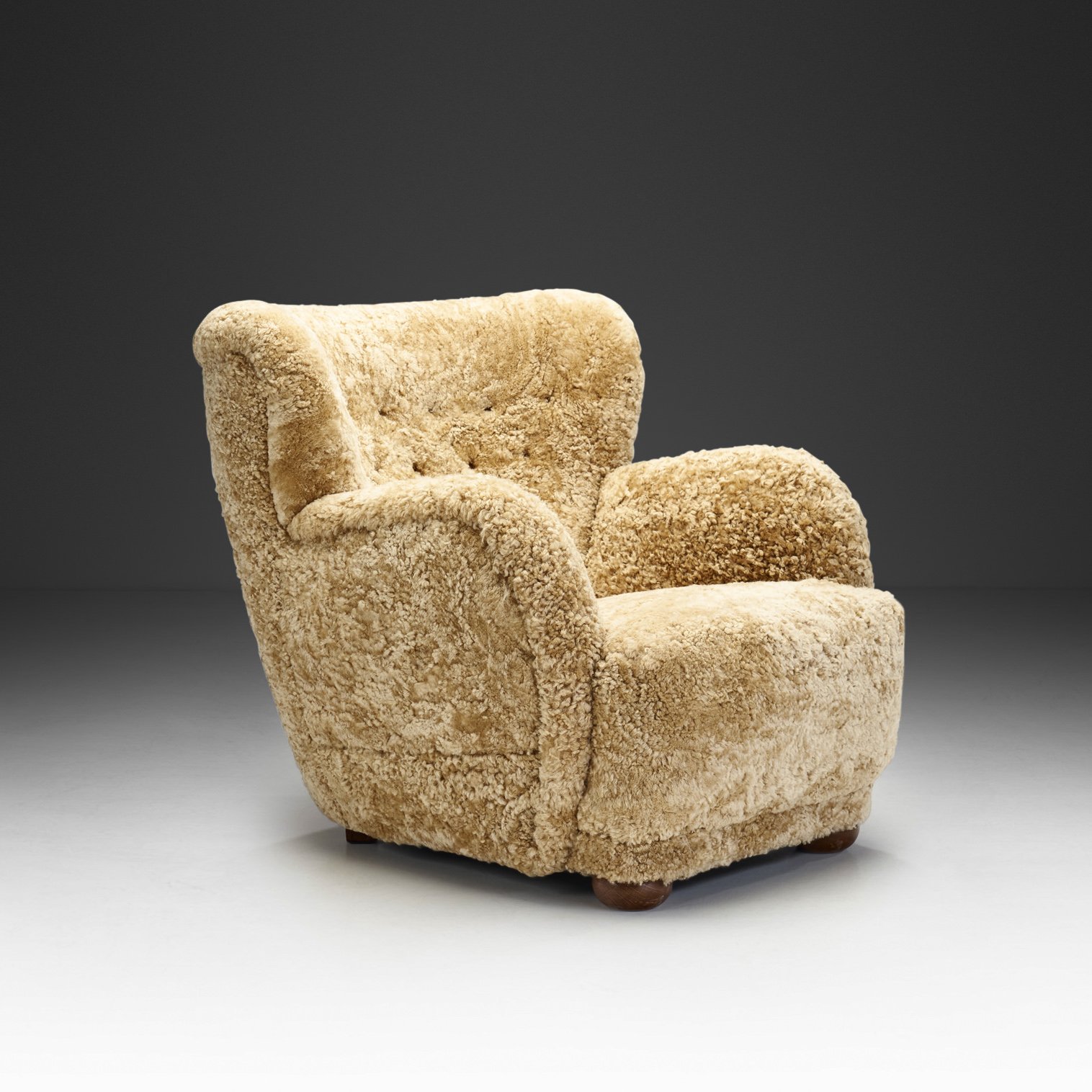
Danish Modern focused more on the aesthetics of modern design whilst employing the exquisite technique and material familiarity of highly skilled craftsmen such as cabinetmakers. This armchair is a great example of the style with its clean and pure lines coupled with craftsmanship and delicate research into proportions, materials and the requirements of the human body. Adopting the trend of abandoning ornamentation to benefit the form, this chair’s designer and manufacturer both maintained the beauty and warmth inherent to traditional Danish cabinetmaking. The body has gentle, rounded lines that are visible even through the luscious upholstery. The round edges even apply to the wooden feet in the front, which are referred to as “bun feet” which is a shape of a flattened sphere. The modern aesthetic is further elevated by the textured, premium upholstery that complements the shape and the wooden feet as well. Sheepskin is the ultimate material for comfort, warm in the winter and cool in the summer. It elevates the sheer size and shape of the chair, especially around the edges.
From every single angle, this armchair offers stunning lines and a rich texture. Above all, Danish designers believed that design could certainly be used to improve people's lives. Looking at this armchair, this was evidently and too far-fetched ideal.
Condition:
In good vintage condition. Wear consistent with age and use. The chair has been reupholstered recently in premium sheepskin. Each of our items can be reupholstered by our in-house atelier in a fabric of choice. Please reach out for more information.
Dimensions:
31.88 in W x 40.15 in D x 33.07 in H; Seat height 16.53 in
81 cm W x 102 cm D x 84 cm H; Seat height 42 cm
REQUEST PRICE HERE
Price category: 5,000 - 7,500 usd / eur
The ‘Oskar’ armchair was designed in 1939, the same year that Carl Malmsten participated in the New York World’s Fair. It was there that the expression “Swedish Modern” was coined, but Malmsten remained a traditionalist, mainly concerned with comfort in the home.
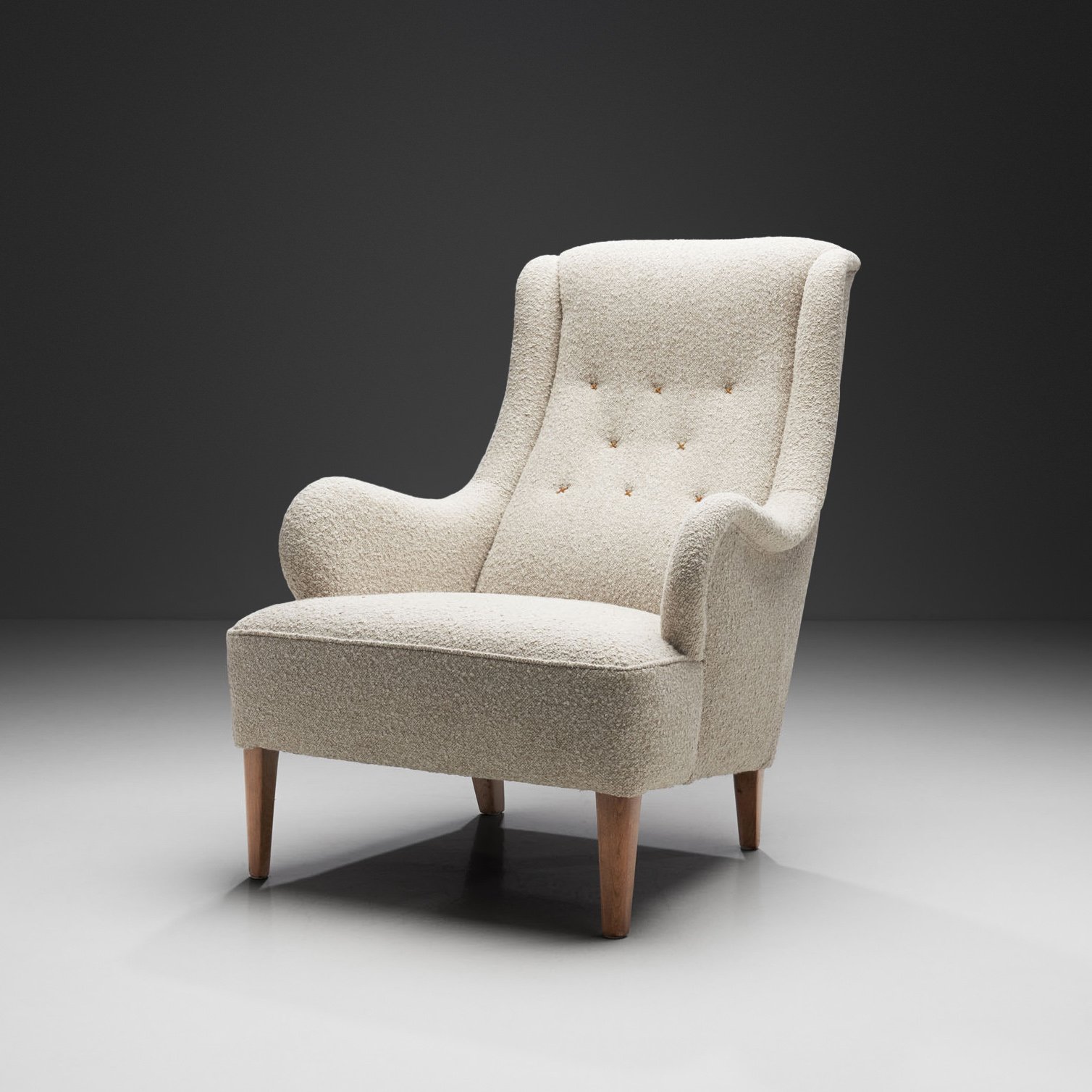
As with so many of Malmsten’s pieces of furniture, “Oskar” was modelled on an earlier design – his own or from previous generations. This armchair belongs to Carl Malmsten's earlier works, and the structure is traditionally made of solid pine from Swedish forests. As can be expected from the “Master of Wood”, the frame is expertly designed, with ergonomic and aesthetic principles at its core. While this armchair may seem less “Malmstenesque”, it already has the gentle curves that defined Malmsten’s later designs. This is especially visible in the flowing armrests that descend from the top, curling outwards to create a welcoming look. The gently bent backrest is tufted with dark yellow stitches that contrast with the light bouclé upholstery, both in colour and texture to create a stylish, visually interesting look. The structure is supported by the tapered, solid pine legs that add an organic touch to the design.
The design is reminiscent of the furnishings of the sitting room of Ulriksdal Palace, which was given to the crown prince and princess, Gustav and Louise, by the Swedish people in 1923. Malmsten was commissioned to create the decor for the room, and the ‘Oskar’ armchair may have been a template for this period, and perhaps that is why Carl Malmsten gave the chair a royal-sounding name. The company known today as O.H. Sjögren was established as early as the 1870s. Carl Malmsten, who had hitherto only produced the most exclusive and unique furniture for a limited and affluent clientele, sought manufacturers who were able to produce his furniture in larger volumes without compromising the high demands he placed on craftsmanship and quality. He chose O.H. Sjögren, and together they developed and marketed the many items of upholstered furniture that have become classics today.
Condition:
In good vintage condition. Wear consistent with age and use. The chair has been reupholstered recently in a premium bouclé fabric. Each of our items can be re-upholstered by our in-house atelier in a fabric of choice. Please reach out for more information.
Dimensions:
28.74 in W x 29.92 in D x 37.4 in H; Seat height 16.33 in
73 cm W x 76 cm D x 95 cm H; Seat height 41.5 cm
About the Designer:
Carl Malmsten (December 7, 1888 – August 13, 1972) was a Swedish furniture designer, architect, and educator. Malmsten was born in Stockholm, Sweden. Malmsten's career took off when he won a competition in 1916 to design furniture for the Stockholm City Hall and shortly after in 1917, he exhibited alongside well-known Swedish architects such as Gunnar Asplund and Uno Åhrén.
In the 1920s he was invited to furnish a room for the crown prince, Gustaf VI Adolf, and his wife Louise in Ulriksdal Palace. He was honoured with an inaugural Prince Eugen Medal for design in 1945. Already as a young designer in the early 20th century, Carl Malmsten advocated an artisanal furniture design based on local materials and traditions, available to a wide audience at a reasonable price.
Nature was Carl Malmsten's foremost teacher and source of inspiration. He conveyed his love of craftsmanship as a teacher in his own schools, at Olofskolan in Stockholm, Capellagården on Öland and the Carl Malmsten school on Lidingö, today a branch of Linköping University and one of the country's leading design colleges. As a debater, Malmsten stormed against functionalism, but in retrospect it can be seen that his ideas often coincided with the rational and frugal style ideals of function.
Malmsten has had a lasting influence on Swedish furniture design through the two schools he founded—the Carl Malmsten Furniture Studies (Carl Malmstensskolan), which has been a part of Linköping University since 2000, is situated on the island of Lidingö on the outskirts of Stockholm. Carl Malmsten spoke about the importance of tradition, craftsmanship and the nation. His furniture was in many ways a product of the thoughts and ideals of the time, they have a timeless quality that makes them just as relevant and loved today.
REQUEST PRICE HERE
Price category: 5,000 - 7,500 usd / eur
This “Krister” armchair is among Swedish design icon Arne Norell’s cosiest works. This high-back armchair’s comfort is equalled by its stylishness and elegance.
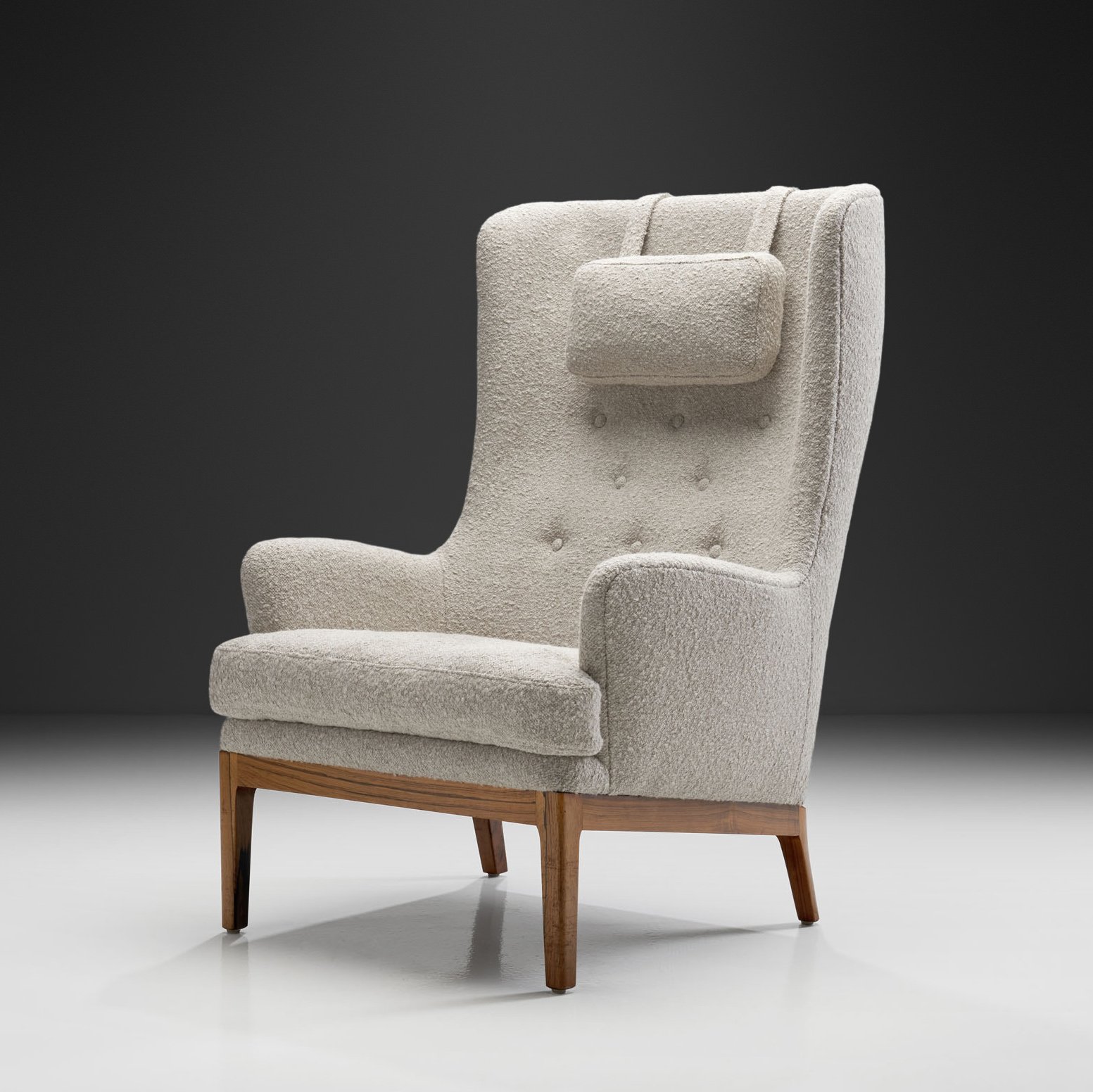
The chair is raised on a stained wood frame covered by beautiful, light coloured bouclé upholstery. A standout feature of this model is the adjustable and removable headrest, a sign of the Scandinavian design principle of functionality. The sitter of this chair is “hugged” by the ear flaps or wings on both sides of the backrest, that give it its unique silhouette, and by the loose seat cushion on the raised bottom. Norell had a unique design idiom, which is clearly visible in this model: function, durability, timeless design, and perhaps above all, comfort. This traditional yet playful “Krister” armchair combines all of these attributes, which makes it one of the most sought after works of Norell.
This chair is marked with ‘Möbel AB Arne Norell’, and its bouclé fabric upholstery it complements and enhances its elegance and comfort. The factory in Aneby, Sweden has been famous for its furniture manufactured by hand. Norell Furniture still operates to this day, keeping the legacy of the great Swedish designer alive.
Condition:
In good vintage condition. Wear consistent with age and use. Due to the nature and age of the materials, the item may have marks, scratches, and discolouration. The armchair has recently been reupholstered in a premium bouclé fabric. Each of our items can be reupholstered by our in-house atelier in a fabric of choice. Please reach out for more information.
Dimensions:
27.95 in W x 30.31 in D x 41.53 in H; Seat height 14.96 in
71 cm W x 77 cm D x 105.5 cm H; Seat height 38 cm
About the designer:
The Swedish designer, Arne Norell was born in 1917 in Åsele, Sweden, and was active in the post-war era, at the height of international fascination with Scandinavian design.
While little biographical information is available about his formative years, it is known that he opened a furniture workshop in Stockholm in 1954. In 1958, he launched his eponymous manufacturing company, “Møbel AB Arne Norell”, on a two-acre farm in Småland. Through the course of his prolific career, this idyllic setting remained Norell’s central source of inspiration and the site where he designed and produced all of his furniture until he passed away in 1971.
Norell is often praised for pioneering “conceptual” furniture, because he employed traditional materials - leather, turned wood, bentwood, and metal, for example - in unexpected forms, often with lyrical results. His designs have an affinity with those of Danish designer Kaare Klint (1888-1954), who, a generation before, brought time-honoured, vernacular forms into modernist expression. In fact, Klint’s iconic Safari Chair (1933) inspired Norell to create the Sirocco Safari Chair (1964), which is lightweight, collapsible, and held together by leather support straps instead of glue or screws. Norell’s wood-framed InkaArmchair, Indra Sofa, and IlonaSofa are likewise held together by leather.
While Norell’s designs found a solid market within his lifetime, his greatest recognition came posthumously: The British Furniture Manufacturers Association awarded Norell’s low-slung, steel-framed, leather-clad Ari Chair (1966) “Show Piece of the Year” in 1973. Norell’s pieces have become increasingly collectible in the 2010s.
Today, Norell’s daughter and son-in-law, Marie Norell-Möller and Thomas Möller, carry on his work, operating under the name Norell Møbel AB. In 2014, the company celebrated its 60th anniversary. It is the only Swedish company that has continuously manufactured the entirety of Norell’s catalogue since the 1950s.
REQUEST PRICE HERE
Price category: 7,500 - 10,000 usd / eur
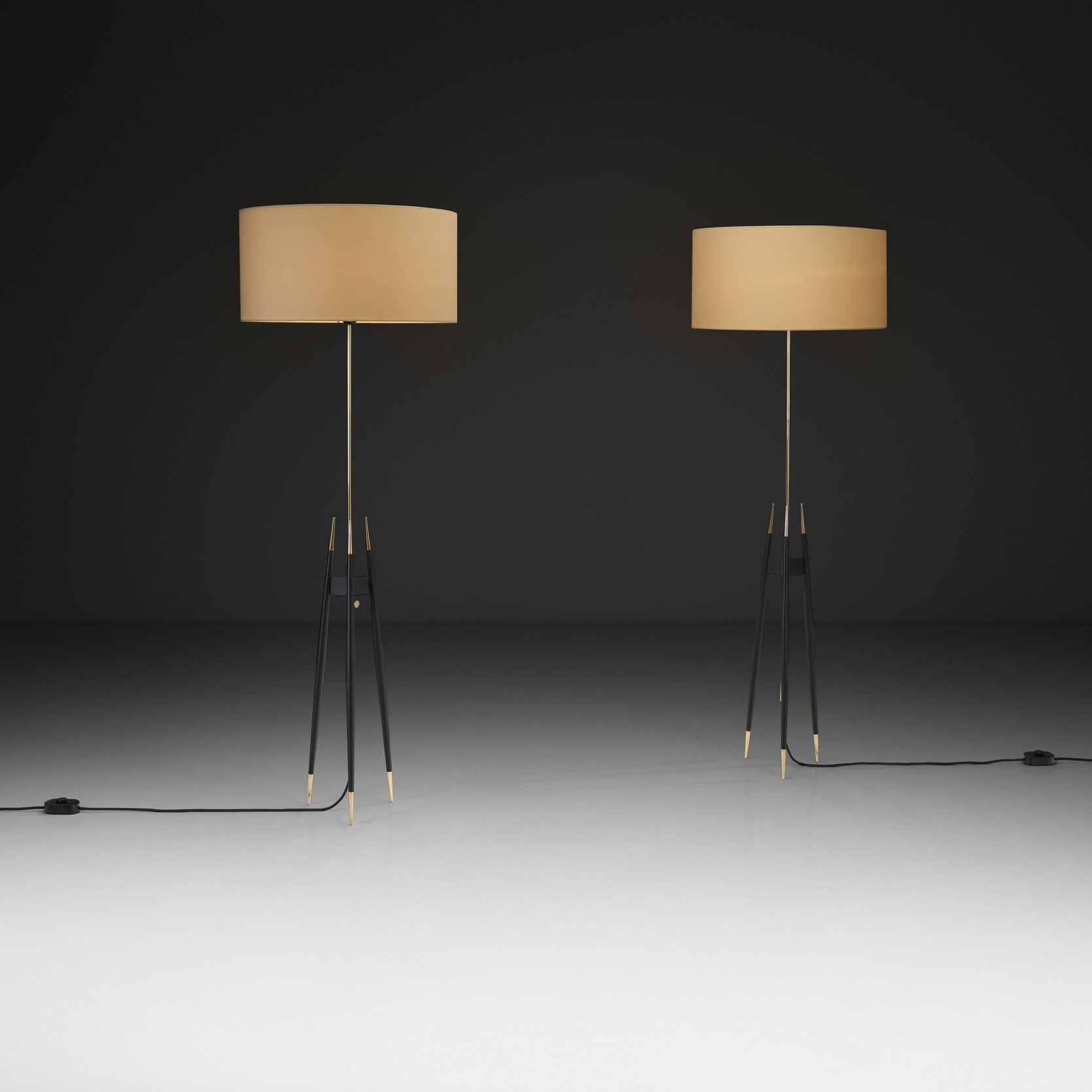
Svend Aage Holm-Sørensen was a Danish designer best known for his lighting. As a trained ornamental metalworker, he began designing lamps during the 1950s and developed a distinctive approach to metal, working with different finishes, perforated surfaces and expressive silhouettes. His designs ranged from decorative wall lights to more restrained floor lamps, often combining black lacquered metal with brass. This pair from around the 1950s shows the more minimal side of his work, with slender tripod structures and carefully placed brass details.
The lamps are constructed from black lacquered metal and brass, with three narrow legs forming each tripod base. The legs are positioned closely together beneath the central stem before spreading outward toward the floor, creating a light and elegant structure. Each leg tapers toward a small pointed brass foot, while additional brass sections appear at the upper ends of the tripod and introduce a contrast against the black lacquer. Above, a thin brass stem extends vertically from the tripod and supports a broad cylindrical fabric shade. The narrow stem highlights the height of the lamps and creates a clear separation between the tripod bases and the shades above. Their construction appears almost weightless despite the generous size of the shades, which provide a strong horizontal counterpoint to the long vertical lines below. When illuminated, the fabric softens the light into a warm glow that complements the brass and adds warmth to the graphic black framework. Used as a pair, the repetition of the tall stems and three-legged bases creates a particularly strong architectural rhythm.
Holm-Sørensen’s understanding of metalwork is clear in these lamps, where a small number of structural elements create a highly recognisable silhouette. The height and open tripod bases give them presence without adding visual weight, making the pair particularly effective on either side of a sofa, console or seating arrangement.
Condition:
In good vintage condition. Wear consistent with age and use. The floor lamps have recently been rewired and reconditioned. The shades are later replacements. Due to the age and nature of the materials, the lamp may have marks, scratches, and discolouration. This lamps are compatible with an E26 / E27 standard fitting. All lighting can be converted for US usage.
Dimensions:
19.68 in ø x 56.49 in H
50 cm ø x 143.5 cm H
REQUEST PRICE HERE
Price category: 50,000+ usd / eur
Swedish architect and furniture maker Axel Einar Hjorth worked as the lead designer for Sweden’s Nordiska Kompaniet department store from 1926 to 1938. While combining the simple, honest forms of the traditional nordic “allmoge” furniture common in Swedish rural culture, with the international 20th century Modernist movement, Hjorth designed the “Sportstugemöbler” series, (“sports cabin furnishings”) a collection of wooden furniture designed for country homes.
The “Lovö” chair was initially launched by Nordiska Kompaniet in 1932. The series was a response to a new, growing demand for furnishings for leisure houses, thus Hjorth used local pine to create a model that unites the robust and straightforward Nordic style with skilful handcrafting. The result is a modest, yet visually interesting presence with a strong and tall outline. These chairs are crafted from local pine wood, while the backrests feature iron rivets. The juxtaposition between the pine and iron provides a rustic, sturdy and resilient feel, elevating the timeless look of the model. The chairs combine simple and honest forms of the handcrafted style of traditional Nordic “allmoge” furniture, and the international 20th century Modernist movement. The seats feature loose, removable cushions, upholstered in a textured fabric. The cushions further increase the chairs’ special character, increasing both comfort and charm. The design is completed by four square, straight legs.
The “Sportstugemöbler” series had a lasting influence on Hjorth’s contemporaries, inspiring other big names within Nordic design, such as Carl Malmsten. From an international perspective, this series is the forerunner of later pioneering designs, so it comes as no surprise that these “Lovö” chairs became part of modernist design history.
Condition:
In good vintage condition. Wear consistent with age and use. The chairs have recently been reconditioned. The chairs show marks and dents Due to the age and nature of the materials, the chairs may have additional scratches or discolouration. The pillows were costum made by our in-house atelier in a premium fabric. In addition, the chairs can be purchased including their original striped cushions. Each of our items can be reupholstered by our in-house atelier in a fabric of choice. Please reach out for more information.
Dimensions:
18.5 in W x 20.86 in D x 37.4 in H; Seat height 17.71 in; Seat depth 16.54 in
47 cm W x 53 cm D x 95 cm H; Seat height 45 cm; Seat depth 42 cm