
Curved Easy Chair in the manner of Erik Bertil Karlén, Sweden 1940s


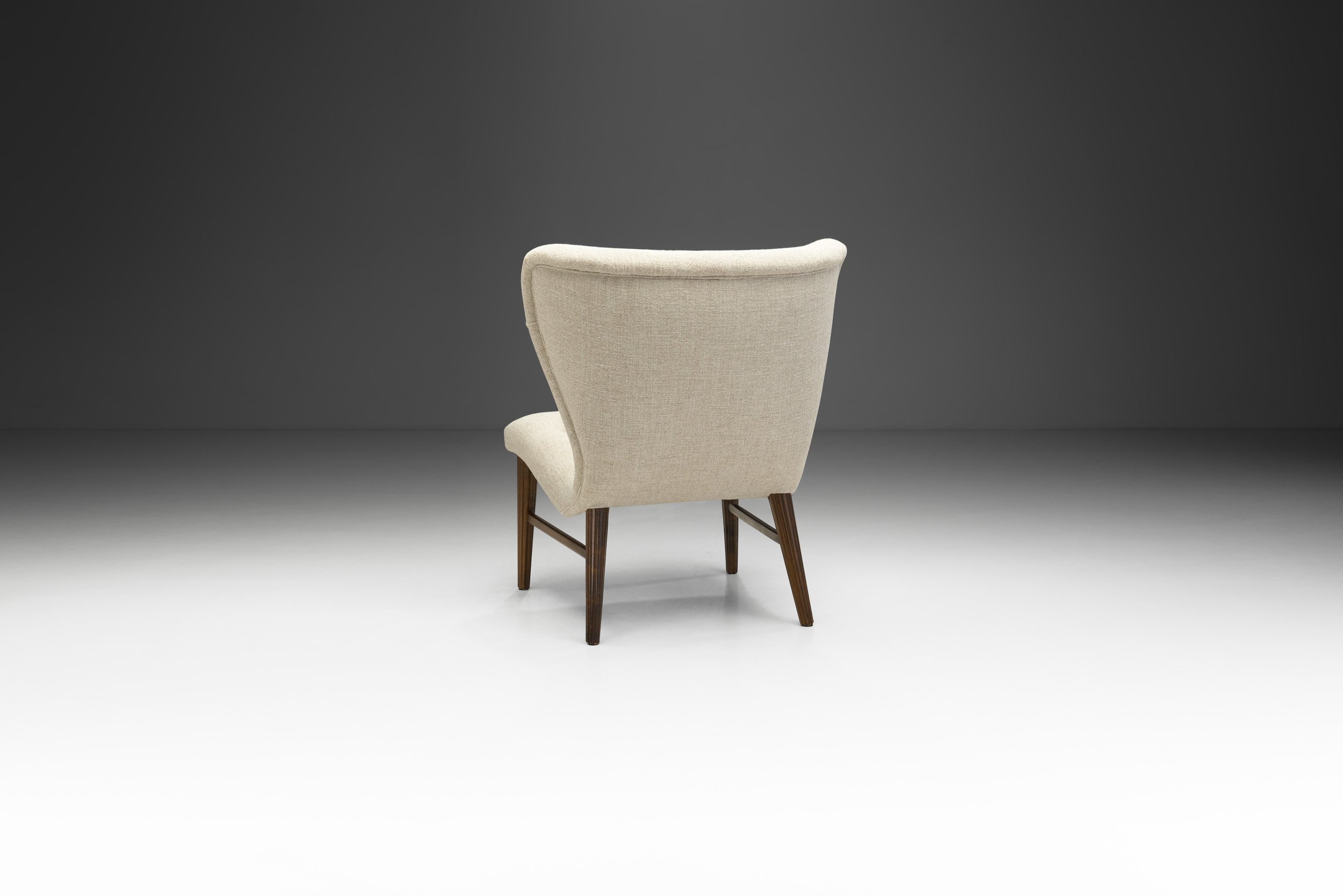


Curved Easy Chair in the manner of Erik Bertil Karlén, Sweden 1940s
REQUEST PRICE HERE
Price category: 2,500 - 5,000 usd / eur
The dark wood, the beautiful upholstery, and timeless design in the manner of Erik Bertil Karlén make this rare easy chair a beautiful representation of Swedish mid-century modern design history.
For this model, nature was evidently a great source of inspiration, therefore sharp edges or corners can rarely be found. With a tremendous sense of proportion, this chair model is very comfortable and fulfils its task to “serve well” and last for lifetimes. Without any ornamentation, the focus here is on the round, flowing lines of the body and its upholstery. The design has the wingback look with sides that embrace the sitter in a cosy way. On the upper end, the “wings” curve outward, which opens up the design. What makes this model special is how the back and seat form one unit both visually and structurally. This shell-like form has a masterful curve that follows the human body’s shape therefore the chair is very ergonomic. The dark, wooden tapered legs are connected by stretchers on the sides and highlight the body with their understated look. The light upholstery with appealing button tufting provides an elegant look with its textured look and a cosy sitting experience thanks to its softness.
Swedish Modern design is a distinctive style that represents a design philosophy, guided by functionality, simplicity and clean lines. The design of this model is in favour of the user, maintaining the focus on authentic simplicity.
Condition:
In very good vintage condition. Wear consistent with age and use. The chair has been reupholstered recently in a premium fabric. Each of our items can be re-upholstered by our in-house atelier in a fabric of choice. Please reach out for more information.
Dimensions:
28.14 in W x 28.74in D x 33.26 in H; Seat height 16.14 in
71.5 cm W x 73 cm D x 84.5 cm H; Seat height 41 cm
Literature:
Form: Svenska slöjdföreningens tidskrift, Svenska slöjdföreningen, Stockholm, 1943, p. 87.
Hedqvist, Hedvig & Björk, Christian, "Swedish Modern : En historia om modernismens yttringar i Sverige genom design, inredning och formgivning", Orosdi-Back, 2018, p. 228-229.
About the designer:
Erik Bertil Karlén was born on February 22, 1912 in Sundbyberg, Sweden. He was a Swedish architect and designer. His architecture characterized many areas of Stockholm’s suburbs from the 1940s, 50s and 60s.
After his training as an architect at KTH in the 1930s, Karlén got a job as an architect at Fortifikationsstyrelsen's Kasernbyrå in 1940. One of his major works at this time was designing the buildings for Svea Livgarde in Sörentorp, Solna municipality, which was completed in 1946. He gave the buildings a simple but careful architectural style using predominantly red brick as the facade material. Some had brick in combination with dark-glazed wood panels.
As many of his contemporary Scandinavian architects, Karlén also designed furniture, mostly seating models. His designs however, remain very rare to this day.


REQUEST PRICE HERE
Price category: 9,000 - 12,500 usd / eu
Danish Mid-Century Modern furniture reflected Scandinavian materials and craftsmanship and mixed them with a modern style, and the period from roughly 1940 through 1960 was a high point for Danish furniture makers. This set shows why.
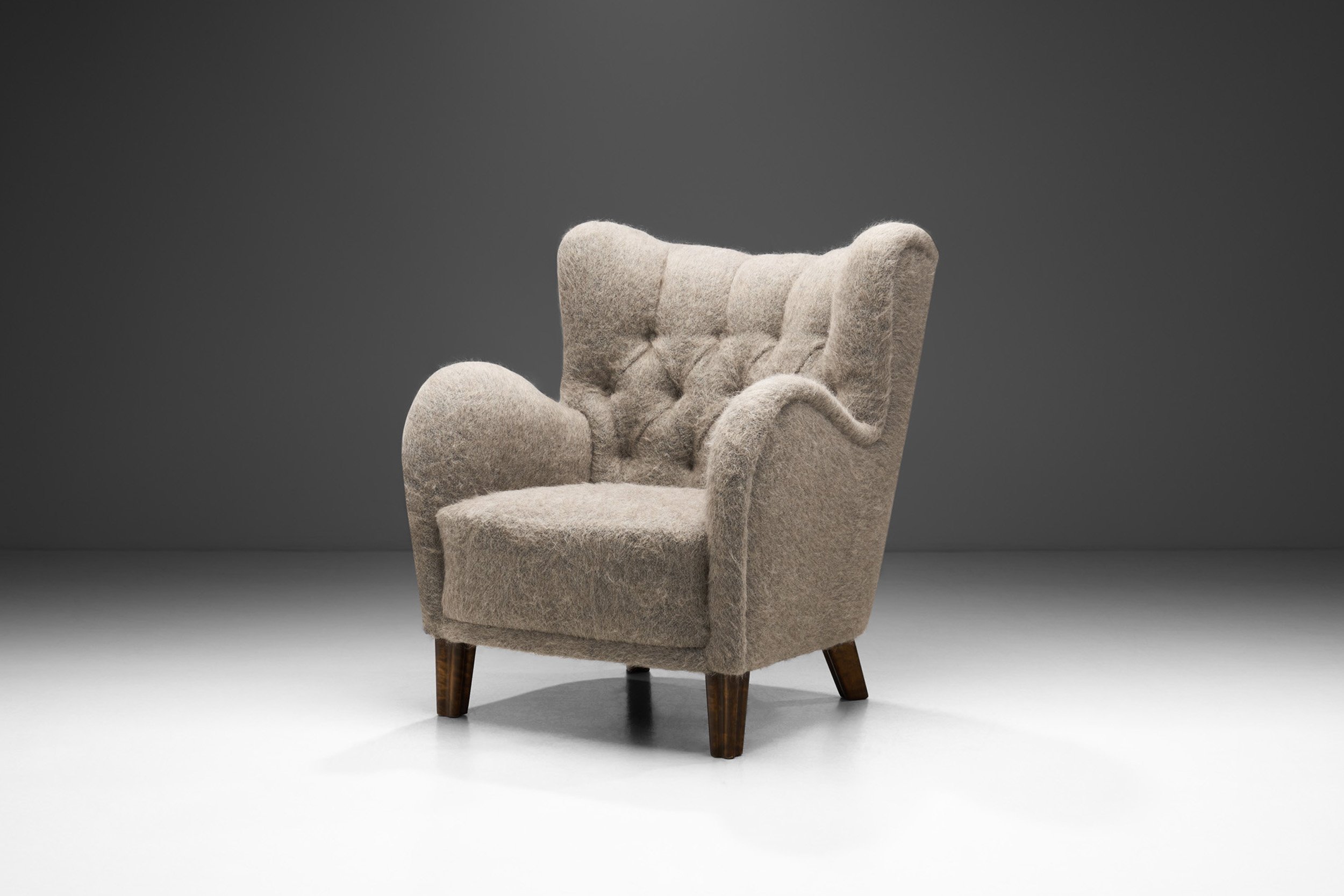
This particular chair silhouette has been popular since the 1930s, from around the time Flemming Lassen designed the overstuffed easy chair, the “Tired Man”, for The Copenhagen Cabinetmakers’ Guild Competition in 1935. The curved and organic lines of the design create an elegant silhouette for both the chair and ottoman. The design of this chair is characterized by organic, curved shapes that create a cosy and welcoming sensation. Since the enveloping back forms the arms as well but doesn’t reach all the way to the beginning of the seat, the design is very open and appears light. The gentle lines are highlighted by the soft wool blend upholstery that uniquely covers the entire bodies of the chair and footstool, including the legs as well. As a representation of early modernist seating, there is a profound focus on comfort and cosiness, that invokes a pleasant homelike feeling. Master cabinetmakers were highly aware of body proportions, prioritizing comfort just as much as the visual qualities, therefore this lounge chair provides support for the back and great sitting comfort.
We have added a newly produced matching, upholstered footstool to provide additional comfort and visual interest. Its design matches the chair with its round shape and soft wool blend upholstery. Together, they form a cosy and luxurious set that exudes Danish design and craftsmanship.
Condition:
In good vintage condition. Wear consistent with age and use. The chair has been reupholstered recently in a premium wool blend fabric; the ottoman is a later addition, upholstered in the same fabric as the chair. Each of our items can be reupholstered by our in-house atelier in a fabric of choice. Please reach out for more information.
Dimensions:
Chair
30.31 in W x 30.31 in D x 26.77 in H; Seat height 16.53 in
77 cm W x 77 cm D x 68 cm H; Seat height 42 cm
Footstool
27.16 in W x 22.63 in D x 14.76 in H
69 cm W x 57.5 cm D x 37.5 cm H
About the Designer:
Thepractical and comfortable designs of Danish cabinetmakers defined mid-20th century modern seating. The Danish Cabinetmakers focused on minimalist design executed by expertly skilled craftsmen.
Works from the Danish Cabinet-Makers' Guild is a concept of its own in collectible design. The Cabinet-Makers' Guild began annual exhibitions in 1927 in Copenhagen. The group formed an exhibit showing each year in October the quality furniture made to drawings by gifted architects. The exhibition took place each year, without interruption, for forty years. A number of successful Danish Design collaborations were formed during this time between cabinetmakers and architects.
Danish Modernism has influenced Scandinavian furniture to a great degree, defined by minimalism, simplicity, and functionality. The muted colours and gentle designs make Danish mid-century furniture an ideal addition to contemporary living spaces. Additionally, master cabinetmakers were highly aware of body proportions, prioritizing comfort just as much as the visual qualities.
The works of master cabinetmakers – such as this chair – are of the highest quality, both in terms of materials and craftsmanship. Cabinetmakers take the art of working with wood one step further, and focus on the finer details of what can be created with the material. Therefore, it comes as no surprise that numerous master cabinetmakers are part of the renowned Danish Culture Canon (Danish: Kulturkanonen). The canon contains no more than 108 works of cultural excellence, based on works with a useful function and that are still recognizable today. This small armchair is the perfect illustration of Danish design, and the work of a true cabinetmaker. ~H.