A Pair of Wicker Stools by Tony Paul, United States 1950s (sold)


A Pair of Wicker Stools by Tony Paul, United States 1950s (sold)
Form and function collide with these stools, a piece of furniture that is often underestimated. Designers define stools as jewels and statements in a space, and taking practicality into account, this pair of stools is perfect to add visual interest to any space.
These authentic wicker and walnut stools by Tony Paul are versatile, serving double duty as movable chairs or a small tables. Made of natural fibres, these stools were evidently constructed with great care. The wickerwork is carefully executed in a circular pattern with tightly woven rattan. Thanks to the expert technique, the rattan tops are sturdy and stand the test of time. The pairing of rattan and wood is interesting and gives these stool an organic and stylish feel. The tripod legs are carved from walnut with a minimalist construction that recalls Scandinavian modernism. While there are many kinds of Tony Paul wicker stools, those produced in the mid-century are the highest regarded in terms of design.
Being functional as well as aesthetically pleasing, these stool are a great addition to set the tone of a space. Paul’s design is strong but subtle, with expert wickerwork thanks to which it can add depth as well as functionality to a space.
SOLD
Condition:
In good vintage condition. Wear consistent with age and use.
Dimensions:
12.99 in ø x 11.81 in H
33 cm ø x 30 cm H
REQUEST PRICE HERE
Price category: 2,500 - 5,000 usd / eur
This remarkable armchair was designed by German artist, Willi Ohler. The so-called “Worpsweder” either denote chairs made at the Worpsweder Kunsthütten (Worpsweder arts huts) in Germany, or a specific style of German chairs with solid wood frames, broad armrests, often from tall wood, with woven seats and backs. This piece features all of those characteristics.
Crafted during a time when movements like Modernism were reshaping design worldwide, this early 20th-century armchair reflect a transitional style rooted in both simplicity and elegance. This era emphasises clean lines, unique shapes, and high-quality craftsmanship to achieve timeless pieces like this one. The honey-toned wood highlights the warm patina that has developed over decades. The softly sculpted armrests framing the chair bring both elegance and ergonomic comfort to the overall form. Woven wicker is the main highlight of the piece. The material is used to construct the seat and tall backrest. The beautifully symmetrical pattern showcases the timeless artistry of artisanal furniture. The rectangular, slim legs create a sleek structure while not abandoning sturdiness. This chair preserves the value and beauty of master craftsmanship and exquisite materials.
Worpswede in Lower Saxony is famous nationwide for its long tradition as an artists' colony. Nowadays, about 130 artists and craftsmen and women live there permanently. The artists who created the so called "Worpsweder Kuentlerkolonie" were looking for the simple and original in art and life. The traditional reed and rush woven chairs of this region were greatly appreciated by the artists of the colony, and some of them were still produced around 1900-1920. They have become collectors’ pieces thanks to the craftsmanship that went into each chair’s creation.
Condition:
In good vintage condition. Wear consistent with age and use. The chair has recently been reconditioned. Due to the nature and age of the materials the item has minor scratches and discolouration.
Dimensions:
34.64 in W x 33.07 in D x 46.45 in H; Seat height 16.53 in; Seat depth 19.68 in; Arm height 24.80 in
88 cm W x 84 cm D x 118 cm H; Seat height 42 cm; Seat depth 50 cm; Arm height 63 cm
REQUEST PRICE HERE
Price category: 2,500 - 5,000 usd / eur
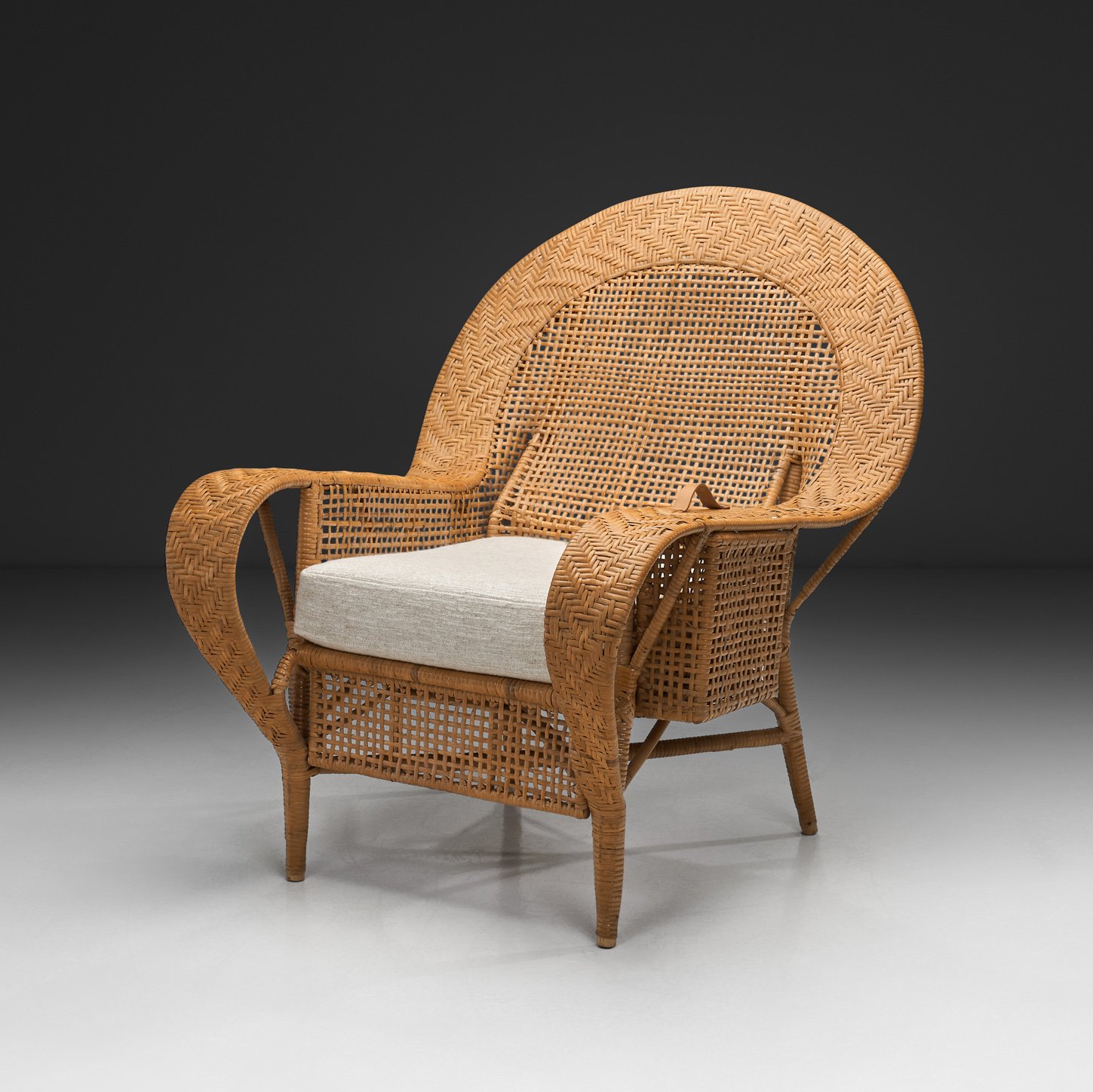
While Kay Fisker is considered a leading exponent of Danish Functionalism, his designs show why he was also a great influence on the Danish housing culture. This model was famously brought to Denmark from China by Fisker and there manufactured by Robert Wengler.
Having trained architects and designers such as Finn Juhl, Kay Fisker designed his furniture pieces with the greatest architectural precision and quality. This “Canton” is a one-of-a-kind design, with an immediately recognisable frame and wickerwork. The masterfully woven cane gives this chair an airy look, complimented by the loose, upholstered seat cushion that adds comfort and cosiness to complement the frame. From every angle, this chair is visually arresting; from the front to the sides and back, the curves and geometric lines provide plenty of visual interest. This chair has a distinct designer edge, with clear signs of a skilled architect. The straight lines are mainly in service of the structural stability, while the lower panel in the front are the creation of an equally skilled designer. The back is especially creative, as it flows down to form the armrests and then further down to the legs, creating balance between the curved and straight lines. Fisker, like many of his Danish contemporaries was highly skilled both as an architect and as a furniture designer, and the “Canton” is perhaps the best evidence of that.
The manufacturer, Robert Wengler was a German craftsman who specialised in wicker furniture, and was appointed as a wicker maker to the Danish Crown in 1914. He was a pioneer in working with rattan in the early 20th century and became the most skillful wicker-maker in Denmark.
Condition:
In good vintage condition. Wear consistent with age and use. The armchair has recently been reconditioned. Due to the age and nature of the metal, the armchair may have minor marks and discolouration. The chair has recently been reupholstered in premium fabric. Each of our items can be reupholstered by our in-house atelier in a fabric of choice. Please reach out for more information
Dimensions:
34.25 in W x 37.40 in D x 39.17 in H; Seat height 19.68 in; Seat depth 21.65 in; Arm Height 23.42 in
87 cm W x 95 cm D x 99.5 cm H; Seat height 50 cm; Seat depth 55 cm; Arm Height 59.5 cm
REQUEST PRICE HERE
Price category: 5,000 - 7,500 usd / eur
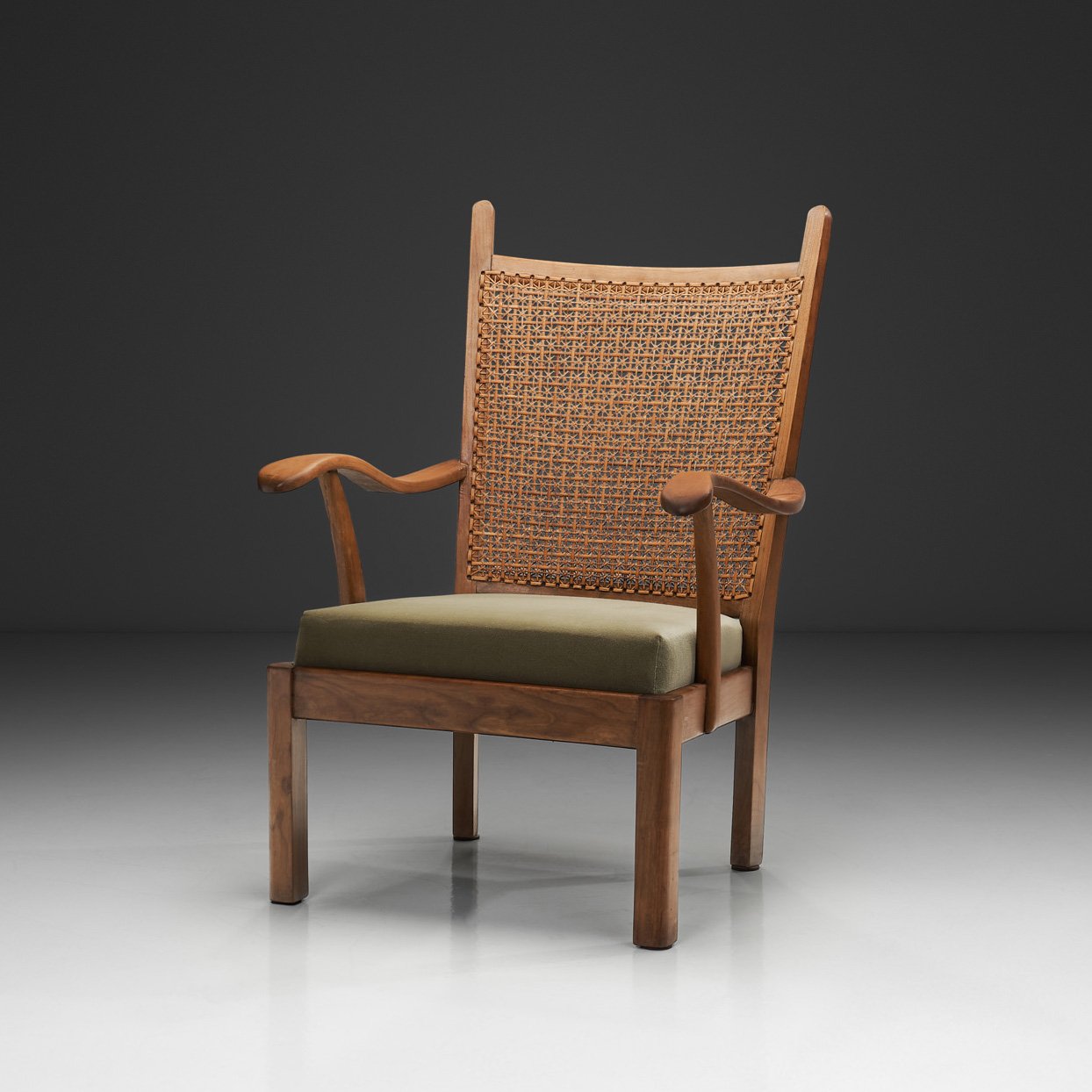
This easy chair in solid wood and wicker attributed to Dutch designer, Bas Van Pelt, is a rare model with plenty of visual delights. The construction of this piece is simple at its core, but thanks to its details, it is a playful representation of early Dutch modernism.
Bas van Pelt’s designs were, in many ways, ahead of their time. The Dordrecht-born designer’s furniture models are quite rare, a few being preserved in the Stedelijk Museum in Amsterdam. While made of solid wood, this chair has a light feel to it thanks to the woven pattern on the back. Durable yet flexible, the cane fulfils both an aesthetic and functional purpose, offering support for the sitter, while ensuring comfort through its flexibility. The shade of the wood further highlights the sandy colour of the wicker and the earthy tone of the upholstery, creating visual dynamism. The curved lines of the armrests nicely contrast with the straight contour of the frame, and show wonderful craftsmanship. The legs are much simpler in their design, serving a primarily structural role, letting the weaving and the arms stand out. Lastly, the neutral tone upholstered seat ties in the design ensuring comfort. As this chair exemplifies, blending functionality, good quality natural materials and organic colours with excellent craftsmanship was the key to the success of this design period.
Today, Bas Van Pelt’s designs are highly sought after by collectors and are considered important examples of 20th century modern design. Furniture pieces like this easy chair stand out through unique textures and materials, as well as through its classic charm.
Condition:
In good vintage condition. Wear consistent with age and use. The chair has recently been reconditioned. Due to the nature and age of the materials, the item may have some marks, scratches, and discolouration. The seat has recently been reupholstered in a premium fabric. Each of our items can be re-upholstered by our in-house atelier in a fabric of choice. Please reach out for more information.
Dimensions:
24.61 in W x 24.02 in D x 36.62 in H; Seat height 14.97 in; Seat depth 17.72 in; Arm height 23.04 in
62.5 cm W x 61 cm D x 93 cm H; Seat height 38 cm; Seat depth 45 cm; Arm height 58.5 cm
REQUEST PRICE HERE
Price category: 2,500 - 5,000 usd / eur
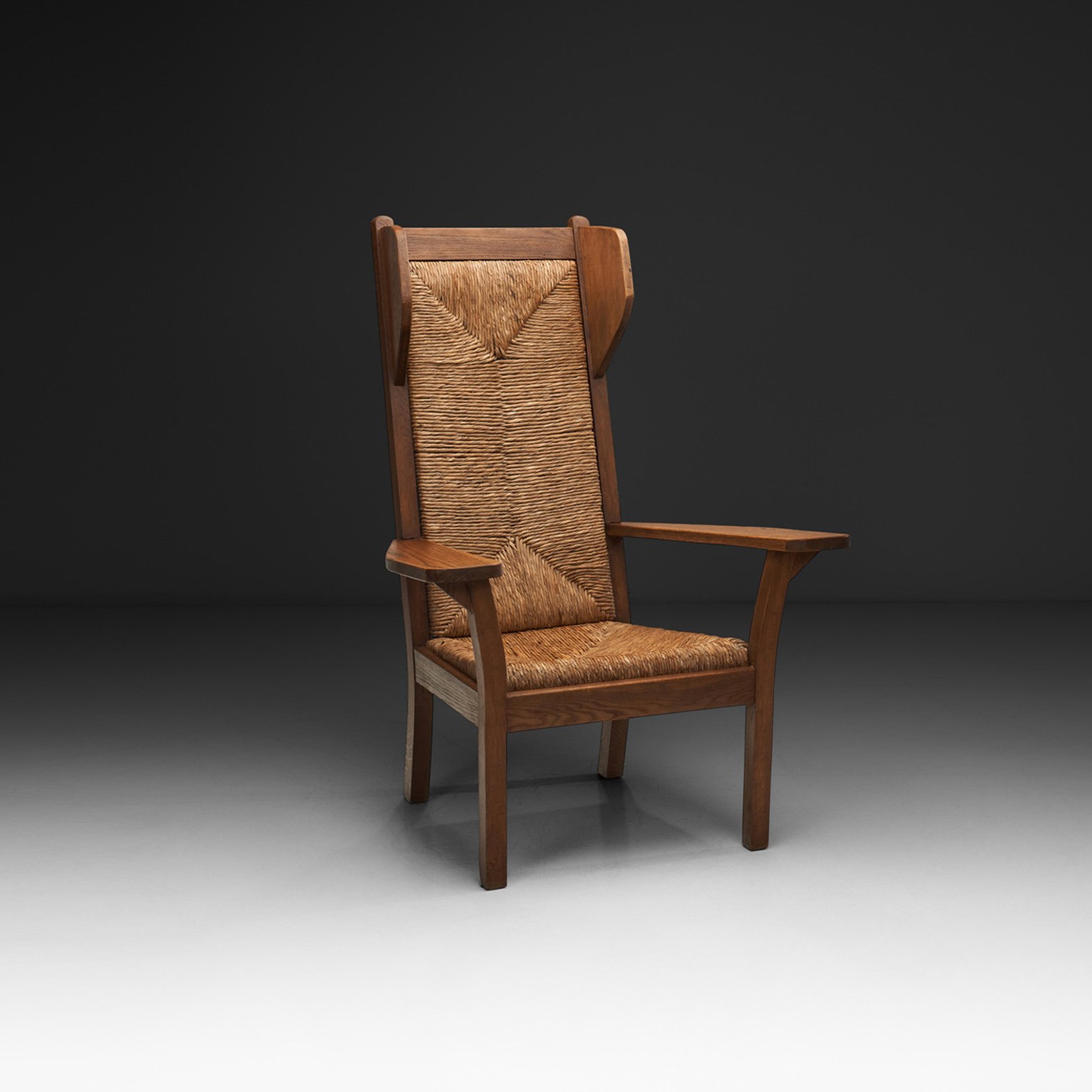
This remarkable armchair was designed by German artist, Willi Ohler. The so-called “Worpsweder” either denote chairs made at the Worpsweder Kunsthütten (Worpsweder arts huts) in Germany, or a specific style of German chairs with solid wood frames, broad armrests, often from tall wood, with woven seats and backs. This piece features all of those characteristics. The warm-toned wood highlights the warm patina that has developed over decades.
Crafted during a time when movements like Modernism were reshaping design worldwide, this 20th-century armchair reflect a transitional style rooted in both simplicity and elegance. This era emphasizes clean lines, unique shapes, and high-quality craftsmanship to achieve timeless pieces like this one. The softly sculpted armrests framing the chair bring both elegance and ergonomic comfort to the overall form. Woven wicker is the main highlight of the piece. The material is used to construct the seat and tall backrest. The beautifully symmetrical pattern showcases the timeless artistry of artisanal furniture. The most eye-catching element of this model is the wingbacked backrest. The wingback style is one of the most recognisable forms in European furniture, with a history dating back to seventeenth-century England. Its characteristic high back and projecting side wings were originally developed to shelter the sitter from drafts and retain warmth near a fireplace. It gives the upper section an enveloping quality. The rectangular, slim legs create a sleek structure while not abandoning sturdiness. This chair preserves the value and beauty of master craftsmanship and exquisite materials.
The warm brown tone makes the design feel inviting, while the strong silhouette allows it to stand confidently in a space. Positioned beside a fireplace, in a reading corner or alongside a floor lamp, this chair creates an intimate place to sit while bringing the unmistakable tradition into the twentieth century.
Condition:
In good vintage condition. Wear consistent with age and use. The chair has recently been reconditioned. The wicker has some tears. Due to the nature and age of the materials, the item has some dents, scratches, and discolouration.
Dimensions:
33.66 in W x 32.28 in D x 47.24 in H; Seat height 16.33 in; Seat depth 19.88 in; Arm height
85.5 cm W x 82 cm D x 120 cm H; Seat height 41.5 cm; Seat depth 50.5 cm; Arm height 62 cm
REQUEST PRICE HERE
Price category: 5,000 - 7,500 usd / eur
This pair of dining chairs is designed in the manner of Charles Dudouyt, one of the most distinctive figures in French decorative arts of the interwar period. Dudouyt’s work is often celebrated for its rustic charm, and masterful handling of wood, bridging tradition with the evolving aesthetics of Art Deco and modern design.
This pair embodies early 20th century qualities through its grounded presence and confident use of materials. This design is all about the wooden structures. The discreet joinery and seamless construction reflect the French emphasis on detail and quality, elevating the chairs beyond just function to objects of aesthetic value. The chairs are made from solid oak in a rich, dark stain that accentuates the natural grain to create subtle warmth and depth. Adding to their appeal are the geometric backrests, which provide firm support and a subtle architectural detail to the design. The carved elements on the sides showcase the Art Deco interest in geometric adornments. While dining chairs are generally more utilitarian types of seating, this pair still manages to look cosy and warm thanks to the woven rope seats. Moreover, each leg features carved and rounded detailing, lending rhythm and visual weight to the structures. This play between solidity and ornamentation is characteristic of French designs of the era, where pieces were not only functional but also a statement of craftsmanship and artistic individuality.
The essence of early 20th century French design is beautifully captured by these chairs. Functional yet sculptural, rustic yet refined, this pair stands as an enduring testament of the striking balance only master woodworkers are able to create.
Condition:
In good vintage condition. Wear consistent with age and use. The chairs have recently been reconditioned. Due to the nature and age of the materials, the items have minor marks, scratches, dents and discolouration.
Dimensions:
16.14 in W x 20.86 in D x 32.87 in H; Seat height 17.32 in; Seat depth 15.55 in
41 cm W x 53 cm D x 83.5 cm H; Seat height 44 cm; Seat depth 39.5 cm