
Carl Malmsten "Samsas" Coffee Table for Åfors Möbelfabrik AB, Sweden 1960s (sold)


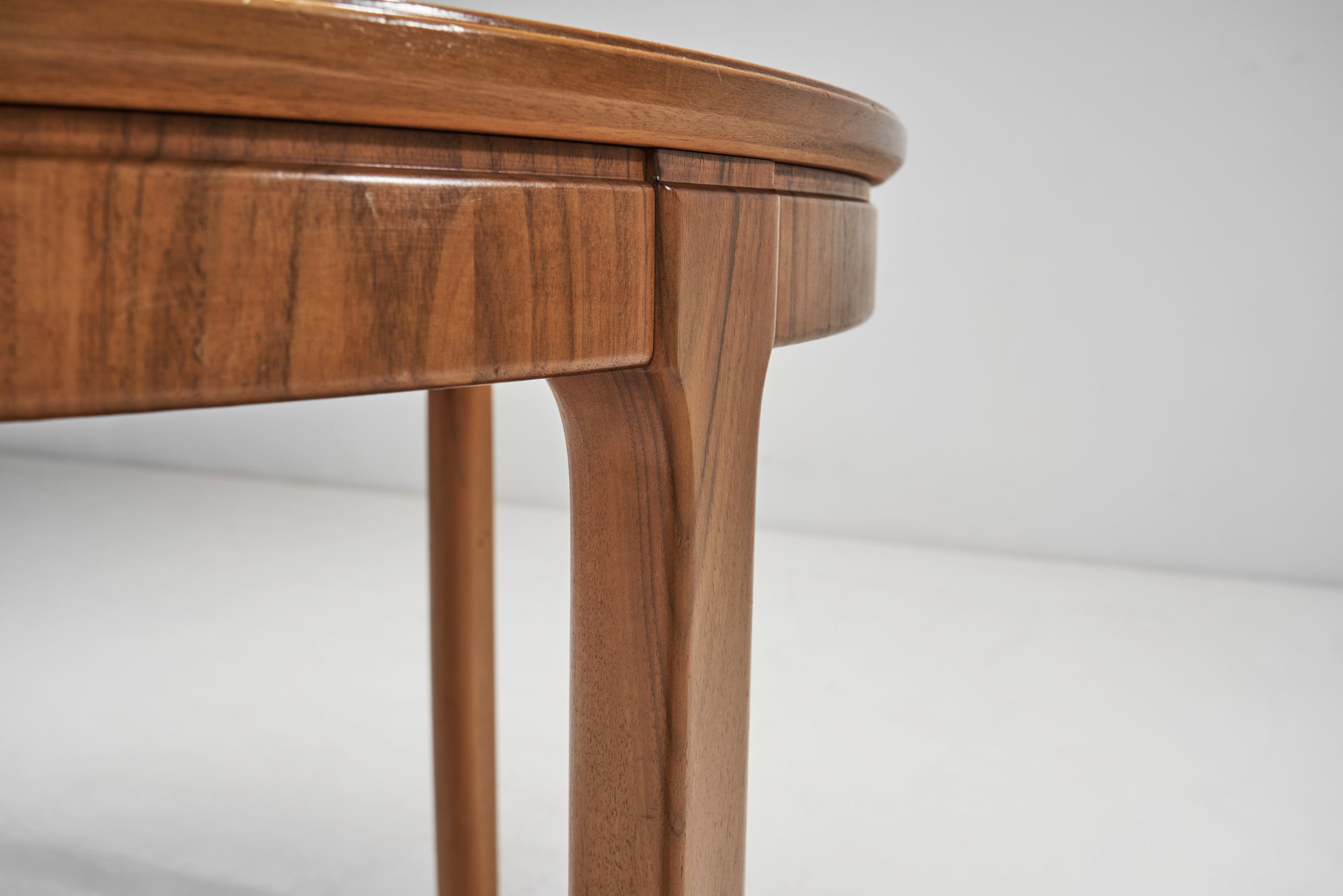


Carl Malmsten "Samsas" Coffee Table for Åfors Möbelfabrik AB, Sweden 1960s (sold)
“All edges must be thoroughly broken”, Carl Malmsten often wrote in his drawings. It was nature that was his great source of inspiration and in nature there are hardly any sharp edges or corners. This “Samsas” table is one of the greatest examples of this sentiment.
This elegant table was designed as part of the 'Samsas' series of seating models and this rare table. Neither the light, the eye nor the person likes to turn against sharp corners, Malmsten explained once. Therefore, edges should be rounded so that they become friendlier to touch and look at. Carl Malmsten was not only one of Sweden's most famous furniture designers, he was also one of the last century's great cultural personalities with a strong influence on the home environment, public environment and the contemporary public debate. His personality shines through the design of this round coffee table as well. The design is dominated by the round tabletop with a spectacular sunburst pattern. The sunburst design or figure was commonly used in architectural ornaments and design patterns; it consists of rays or "beams" radiating out from a central point in the manner of sunbeams. To support the top are four straight legs with impeccable joinery that is visible under the tabletop. Since this table was made in the heyday of the mid-century, the legs, and the design as a whole lacks heavy ornamentation and instead focuses on the natural beauty of wood and the rounded edges.
Carl Malmsten’s design was materialized by Swedish manufacturer, Åfors Möbelfabrik AB during the 1960s. “Samsas” is for many, the most associated series with Carl Malmsten. The designer devoted his life to the renewal of traditional Swedish craftsmanship, and in this spirit, the “Samsas” models are regarded today as the most typical of Malmsten’s furniture.
SOLD
Condition:
In good vintage condition. Wear consistent with age and use. Small marks on the wood.
Dimensions:
39.37 in ø x 24.02 in H
100 cm ø x 61 cm H
About the designer:
Carl Malmsten (December 7, 1888 – August 13, 1972) was a Swedish furniture designer, architect, and educator. Malmsten was born in Stockholm, Sweden. Malmsten's career took off when he won a competition in 1916 to design furniture for the Stockholm City Hall and shortly after in 1917, he exhibited alongside well-known Swedish architects such as Gunnar Asplund and Uno Åhrén.
In the 1920s he was invited to furnish a room for the crown prince, Gustaf VI Adolf, and his wife Louise in Ulriksdal Palace. He was honoured with an inaugural Prince Eugen Medal for design in 1945. Already as a young designer in the early 20th century, Carl Malmsten advocated an artisanal furniture design based on local ingredients and traditions, available to a wide audience at a reasonable price.
Nature was Carl Malmsten's foremost teacher and source of inspiration. He conveyed his love of craftsmanship as a teacher in his own schools, at Olofskolan in Stockholm, Capellagården on Öland and the Carl Malmsten school on Lidingö, today a branch of Linköping University and one of the country's leading design colleges. As a debater, Malmsten stormed against functionalism, but in retrospect it can be seen that his ideas often coincided with the rational and frugal style ideals of function.
Malmsten has had a lasting influence on Swedish furniture design through the two schools he founded—the Carl Malmsten Furniture Studies (Carl Malmstensskolan), which has been a part of Linköping University since 2000, is situated on the island of Lidingö on the outskirts of Stockholm. Carl Malmsten spoke about the importance of tradition, craftsmanship, and the nation. His furniture was in many ways a product of the thoughts and ideals of the time, they have a timeless quality that makes them just as relevant and loved today. ~H.


REQUEST PRICE HERE
Price category: 2,500 - 5,000 usd / eur
During the 1950s, Danish Modern furniture placed equal emphasis on structural clarity and refined craftsmanship. Rather than treating tables as purely functional objects, designers created furniture that integrated beauty into day-to-day life. Thanks in great part to an early emphasis on wood and a resistance to certain modernist currents by influential designers, Danish Modern has avoided associations with cold industrialisation and machine aesthetics.
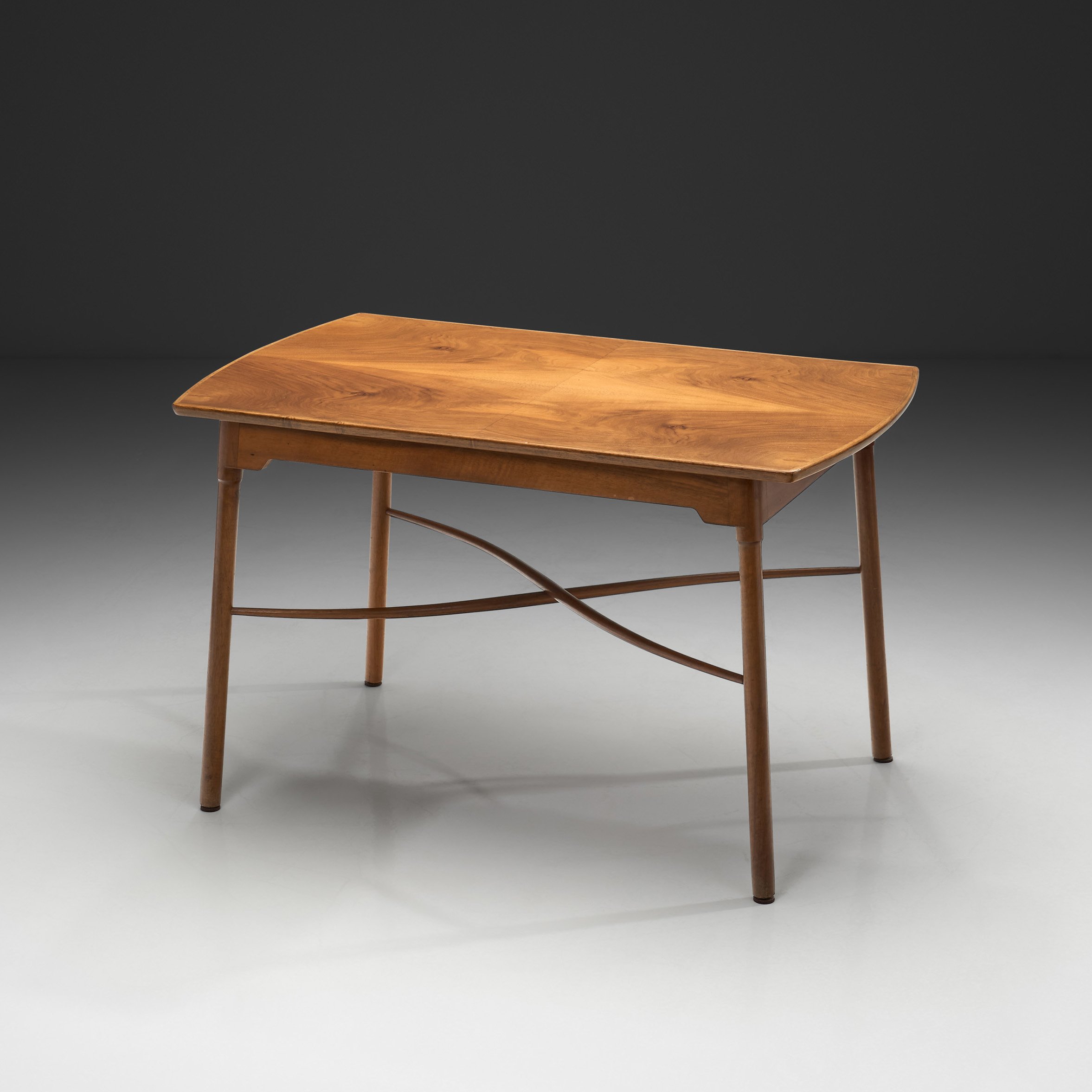
The movement's preference for fine cabinetmaking and expressive timber is evident in this coffee table, whose elegant silhouette is achieved through a restrained combination of curves and expressive wood. The long, rectangular top displays a dramatic grain pattern, with tonal variations across the surface. Supporting it is an elegant, trestle-like base. The designer strayed away from the bulky, robust versions of this iconic base style, opting instead for two sweeping curved side supports connected by a single stretcher, creating an open architectural framework beneath the tabletop. The contrast between the crisp horizontal plane of the top and the flowing curves of the base creates a dynamic, yet balanced, composition. Danish modern designs are, at their core, utilitarian objects; as a result, this table’s form follows function, offering both a generous surface area and great stability. The absence of unnecessary detailing directs attention to the quality of the timber, the precision of the joinery, and the graceful geometry of the structure.
Elegant from every angle, the table demonstrates why Danish Cabinetmakers and their designs are some of the most thoughtful pieces of furniture. Its understated design and versatile character allow it to complement a wide range of interiors while showcasing the enduring appeal of the Danish modern period.
Condition:
In good vintage condition. Wear consistent with age and use. The table has recently been reconditioned. Due to the nature and age of the material, the item has some marks and scratches on the tabletop.
Dimensions:
59.25 in W x 25.59 in D x 21.65 in H
150.5 cm W x 65 cm D x 55 cm H