
Swedish Carved Birch Ladle, Sweden Early 19th Century
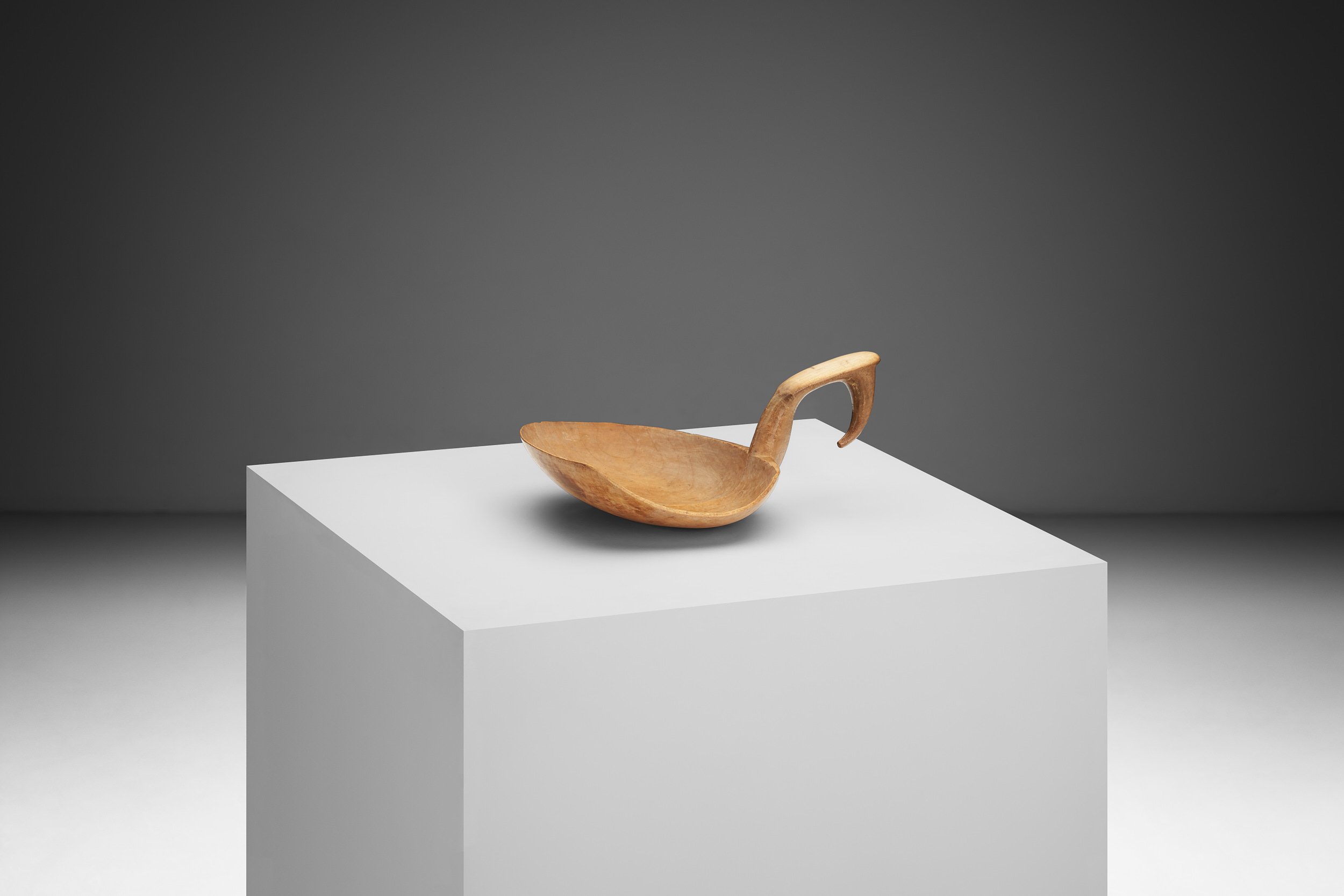
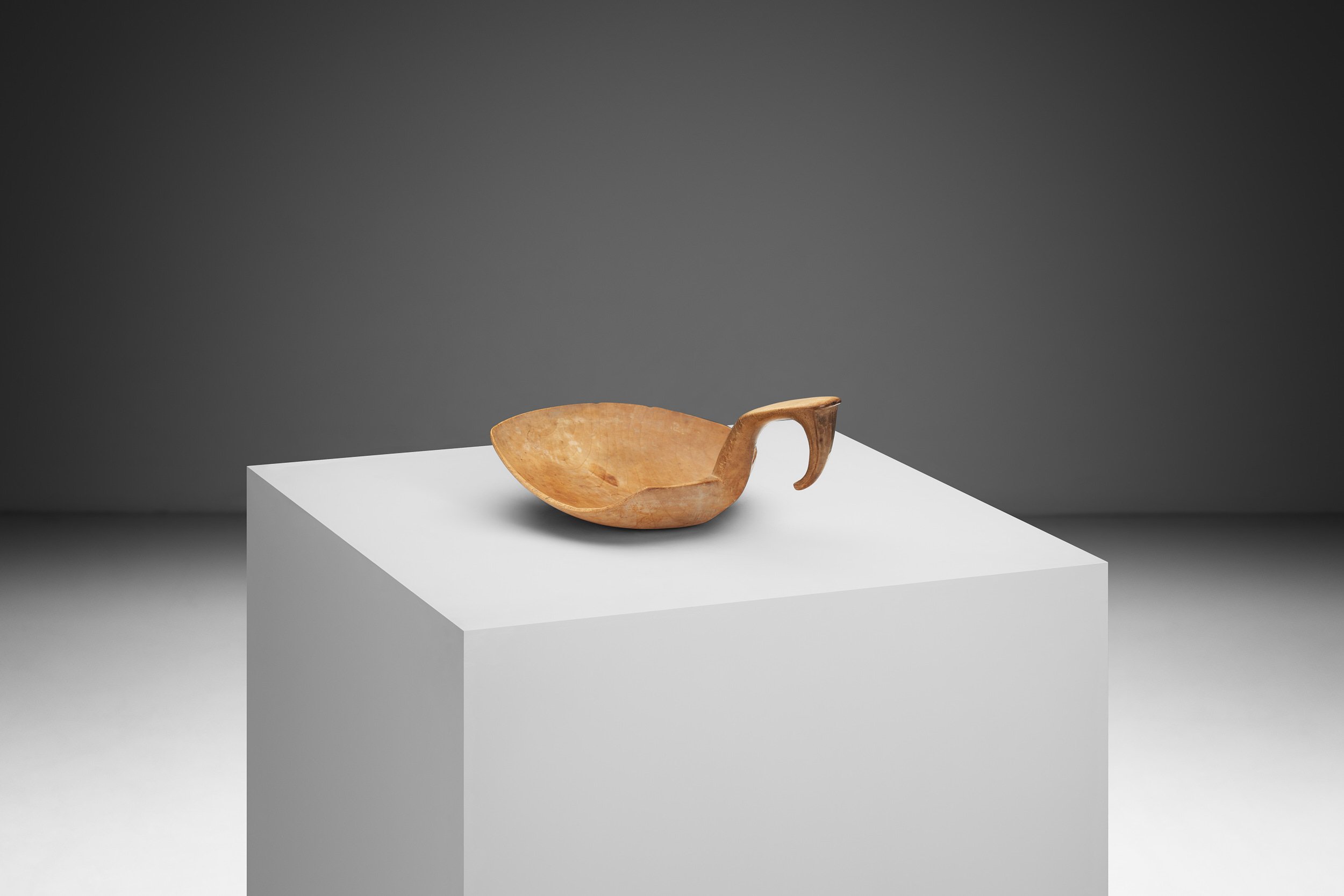
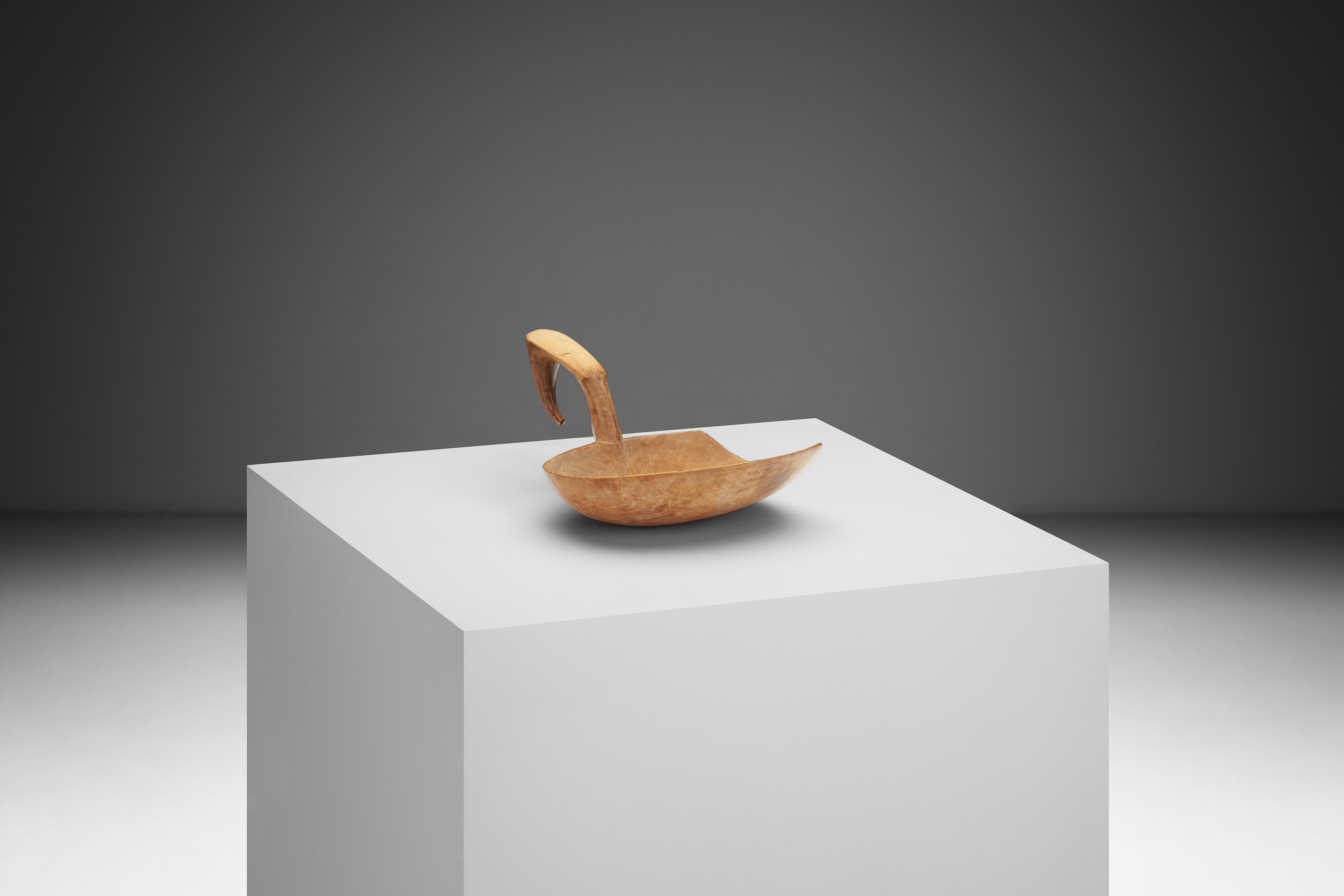
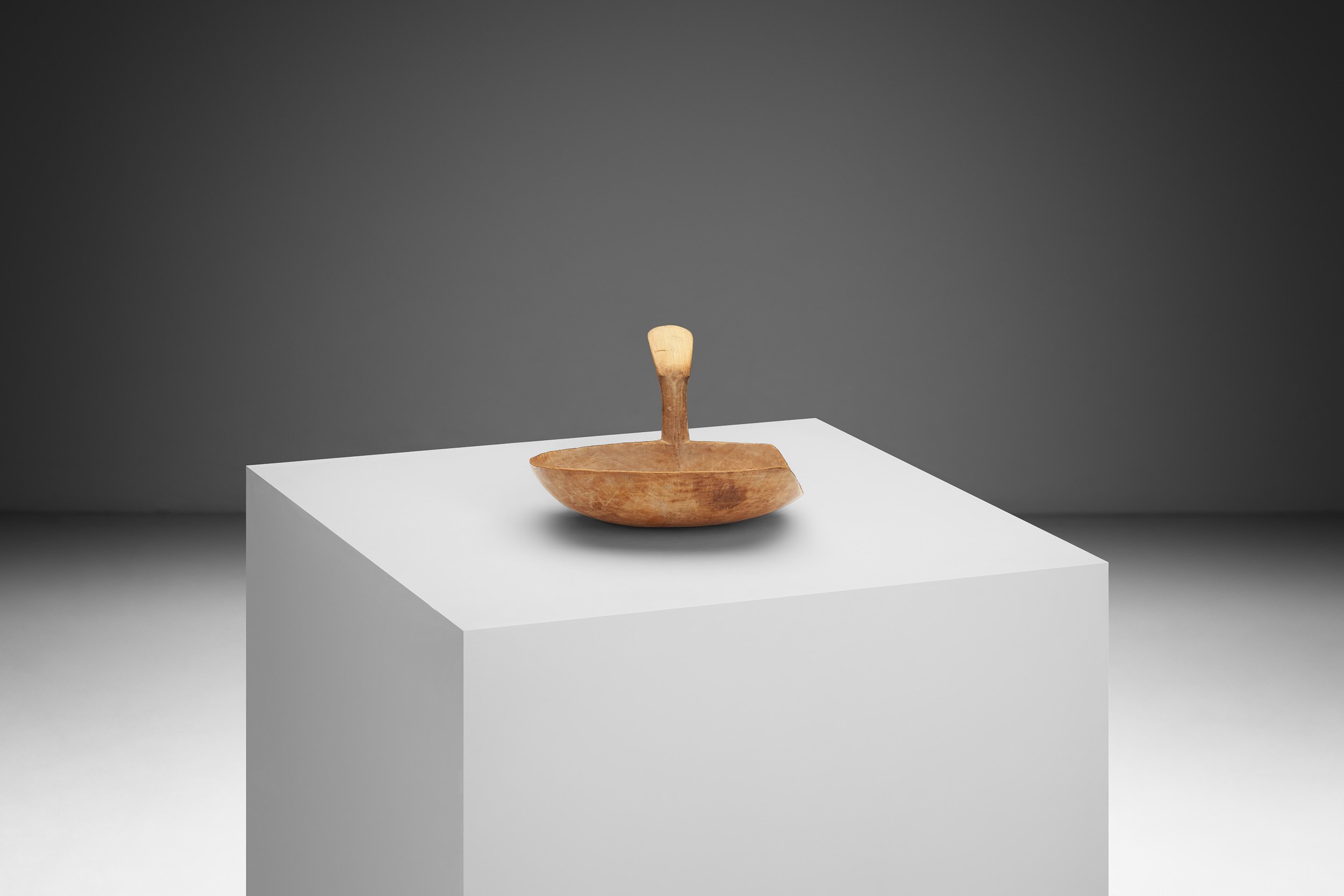
Swedish Carved Birch Ladle, Sweden Early 19th Century
REQUEST PRICE HERE
Price category: 1,000 - 2,500 usd / eur
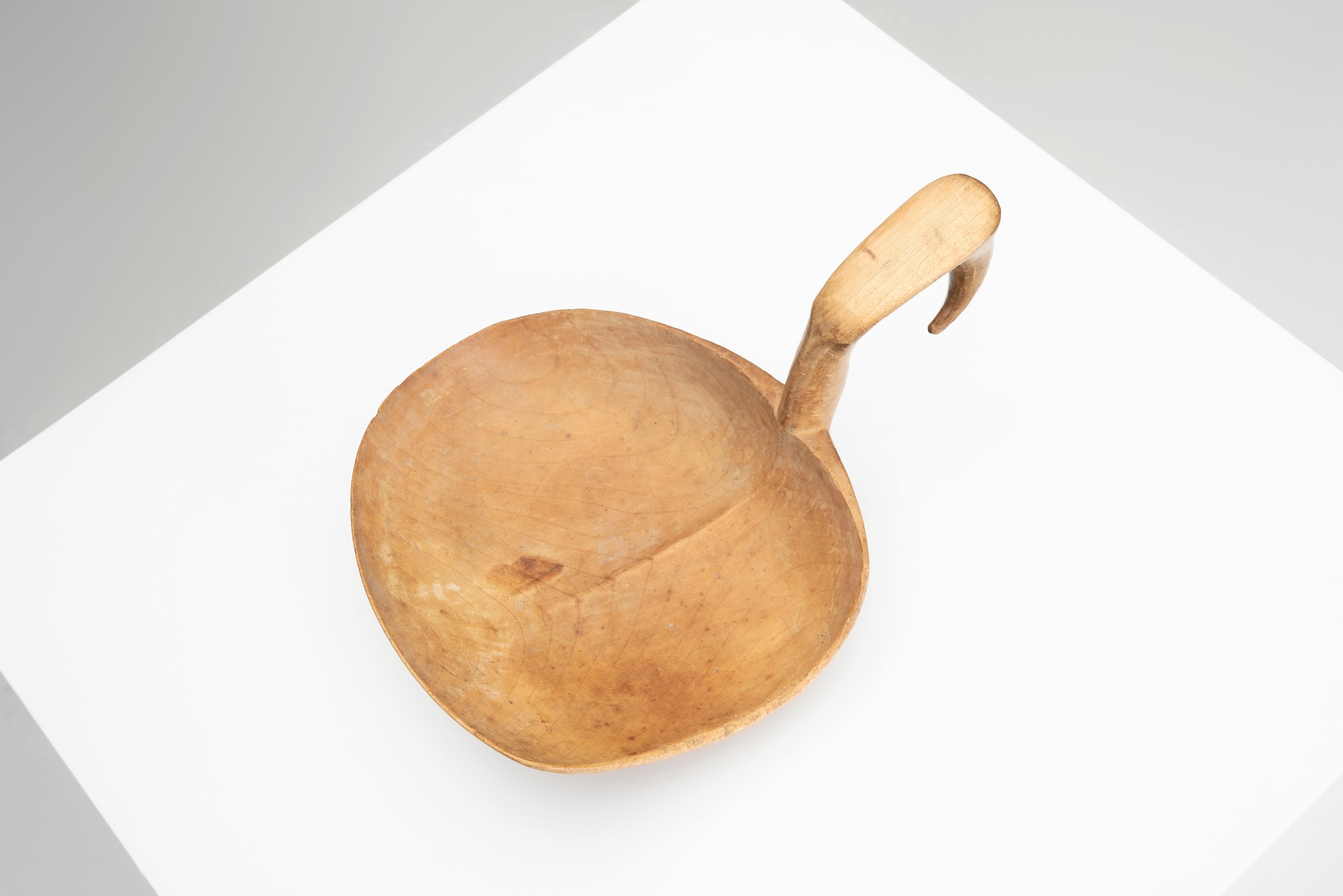
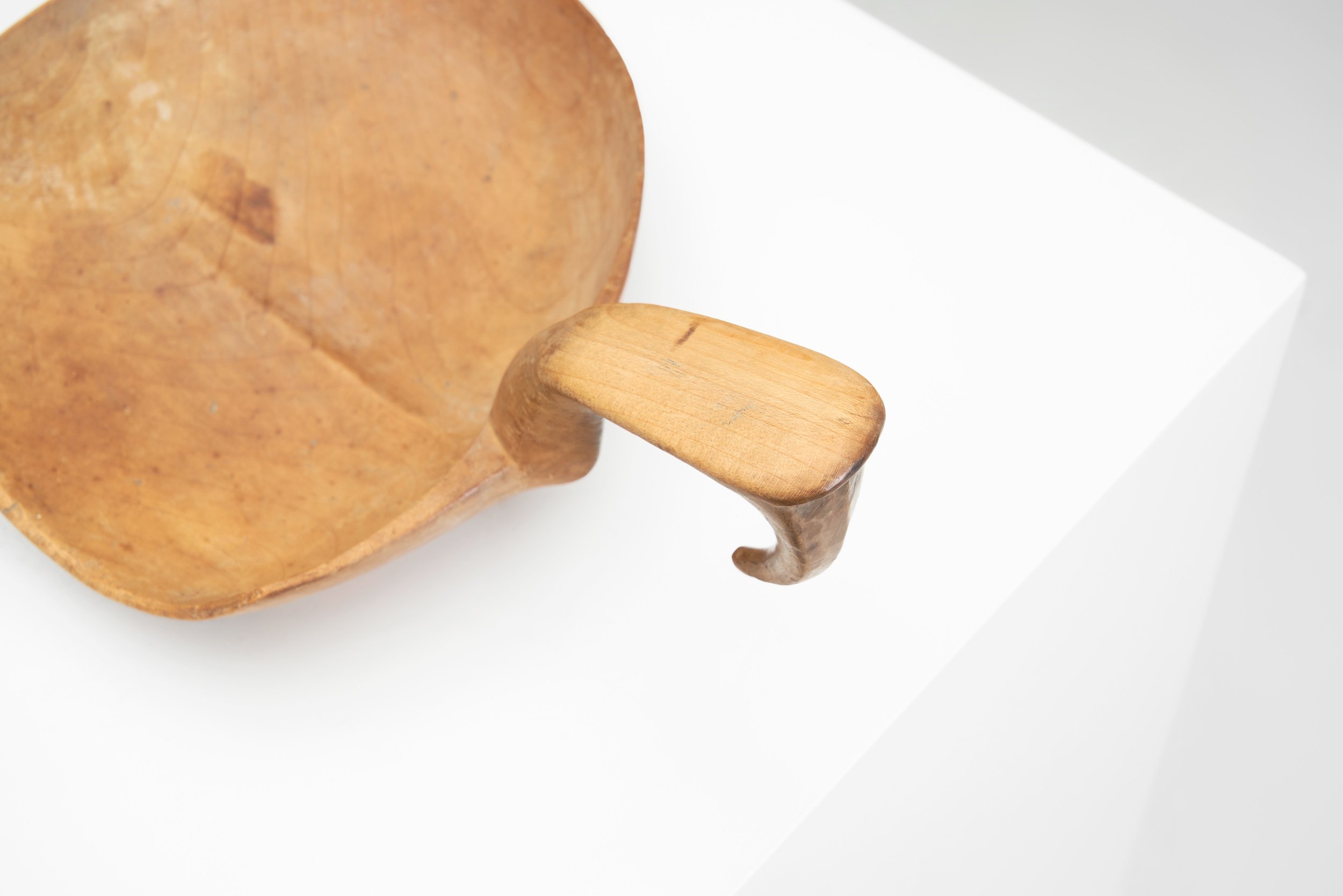
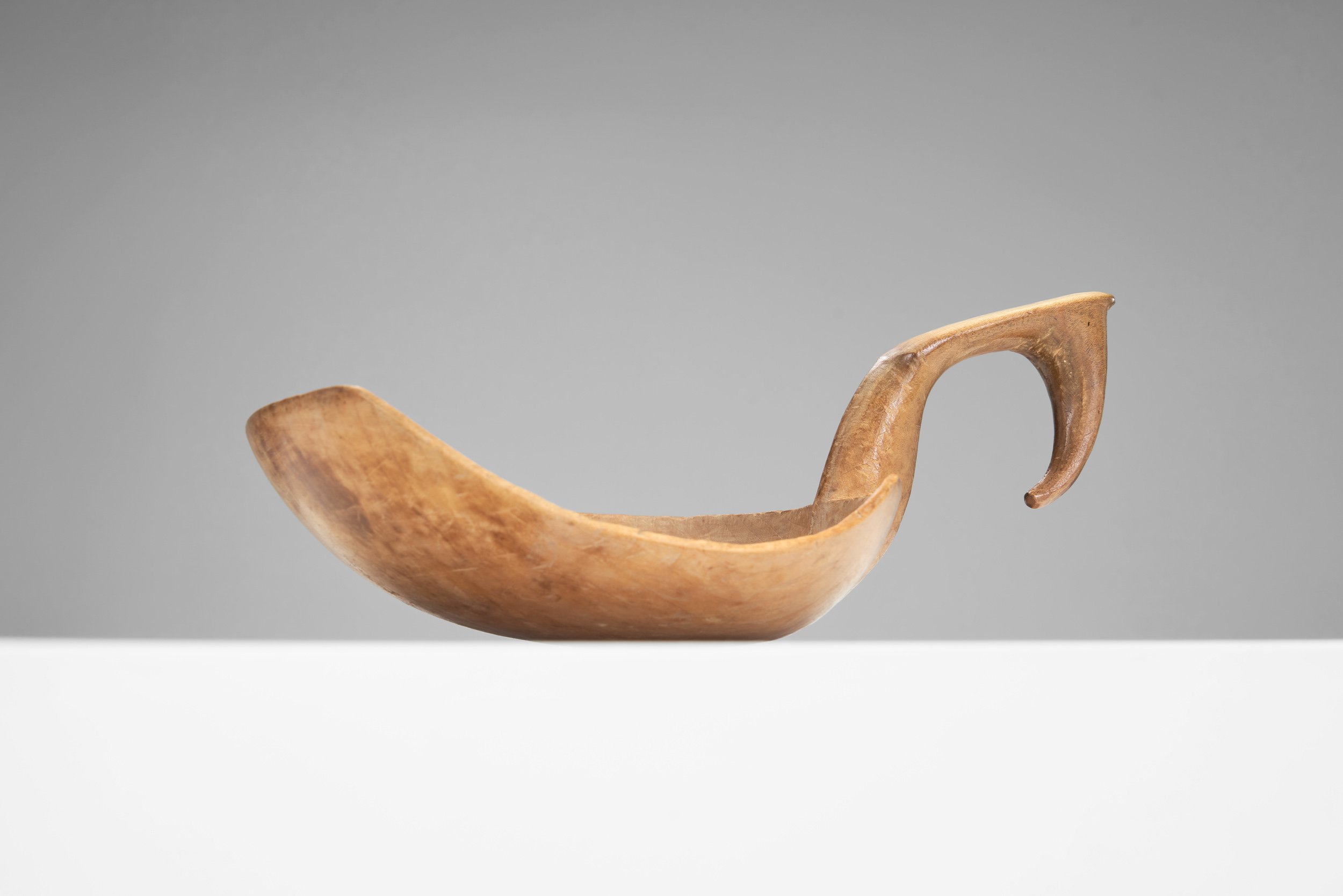
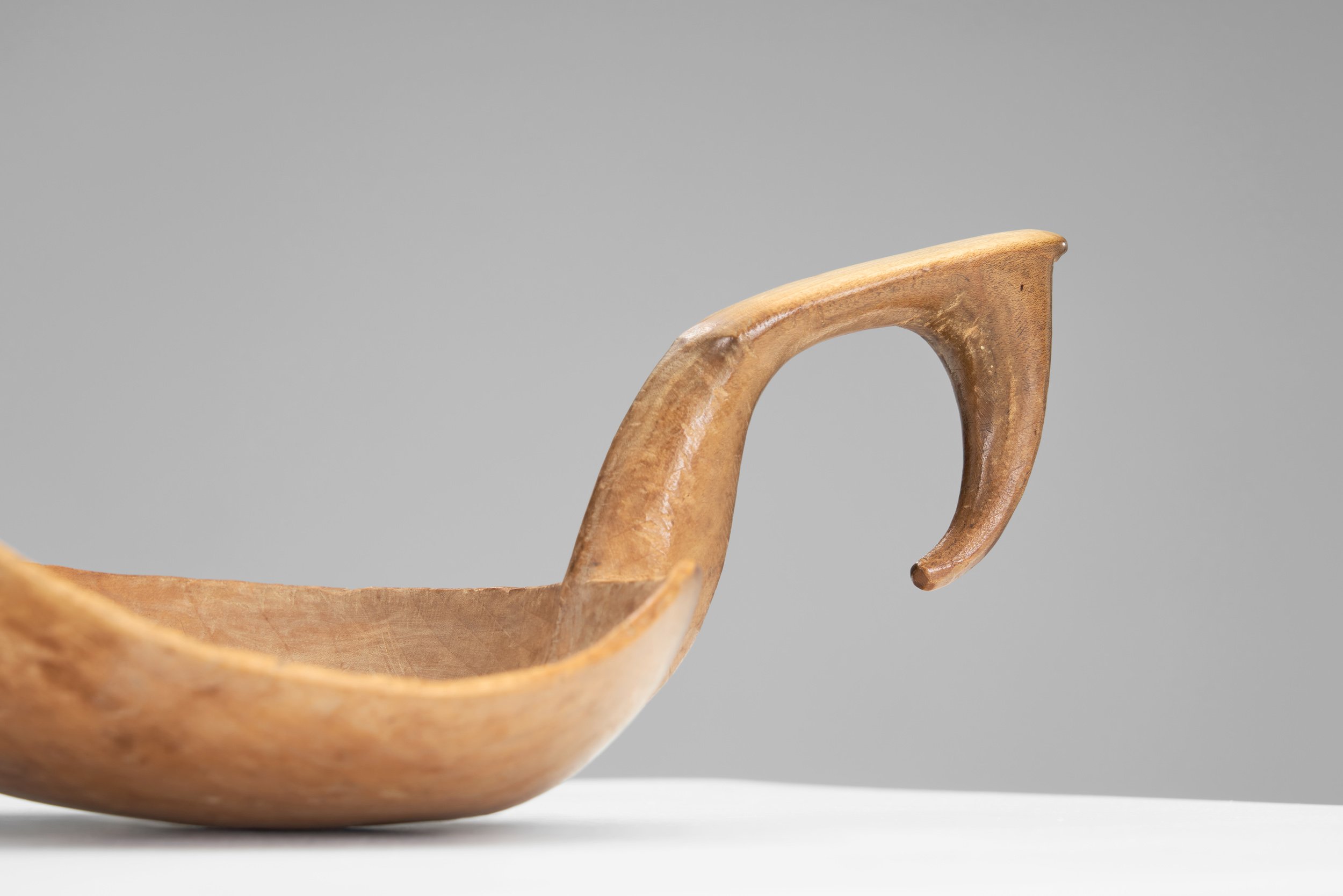
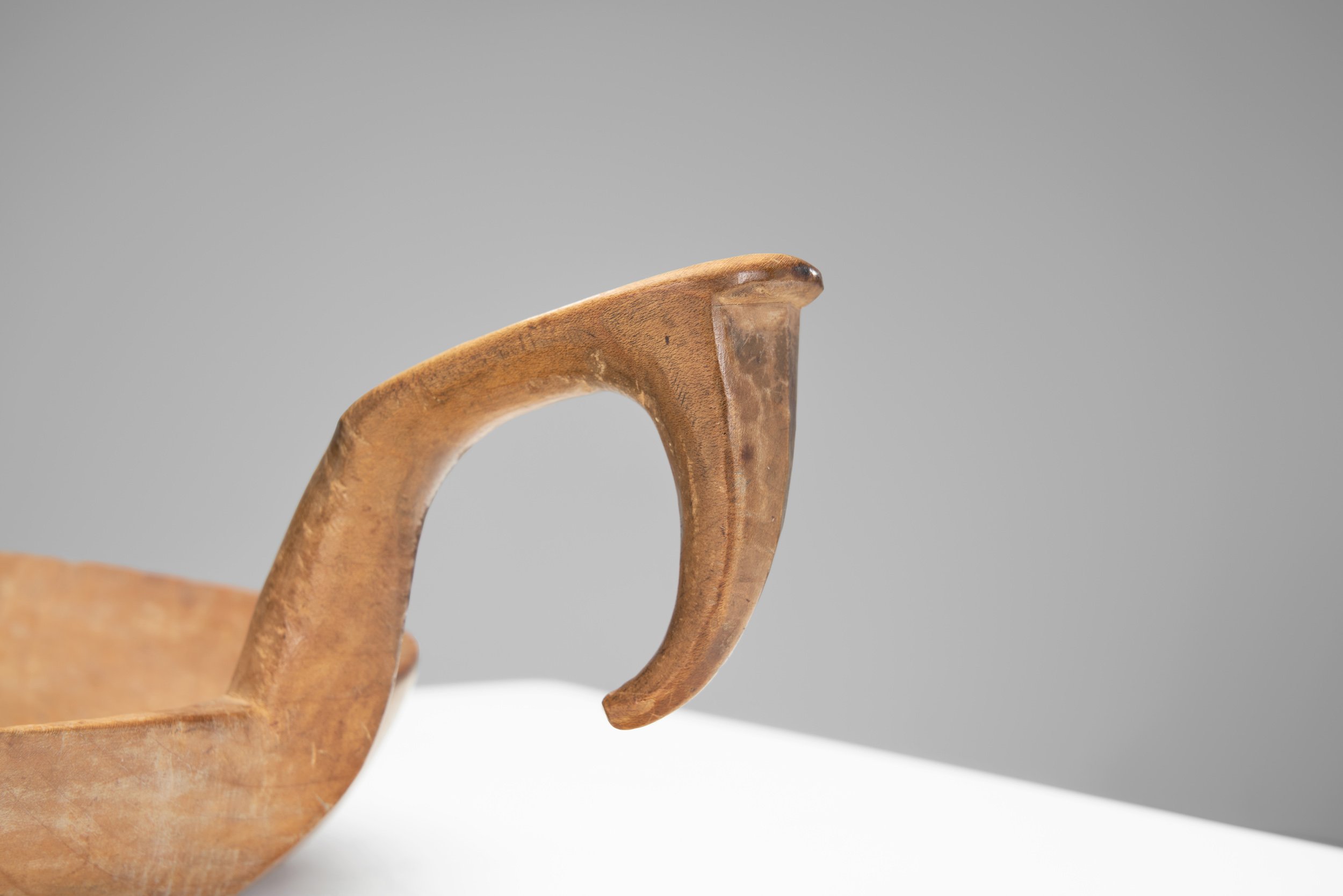
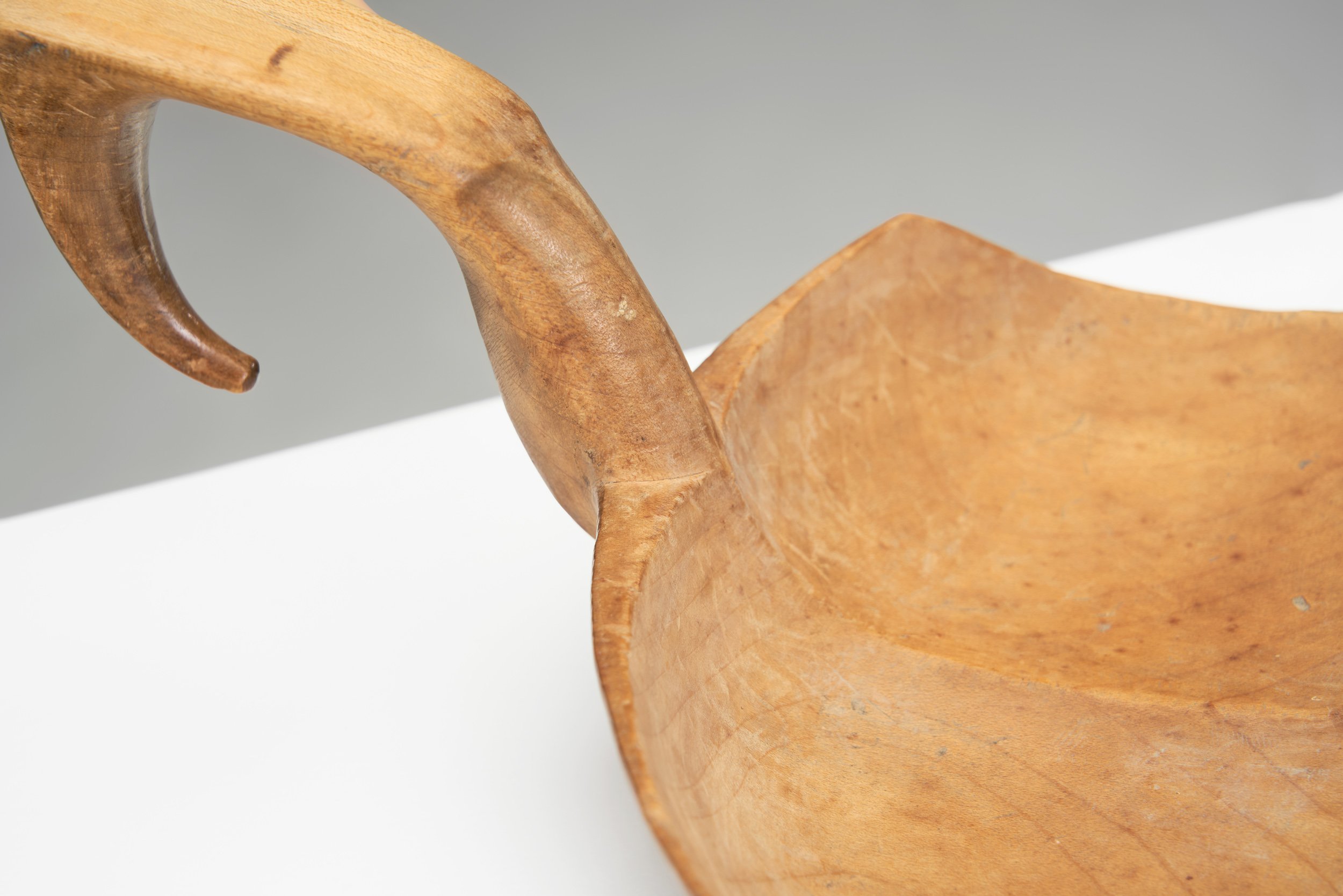
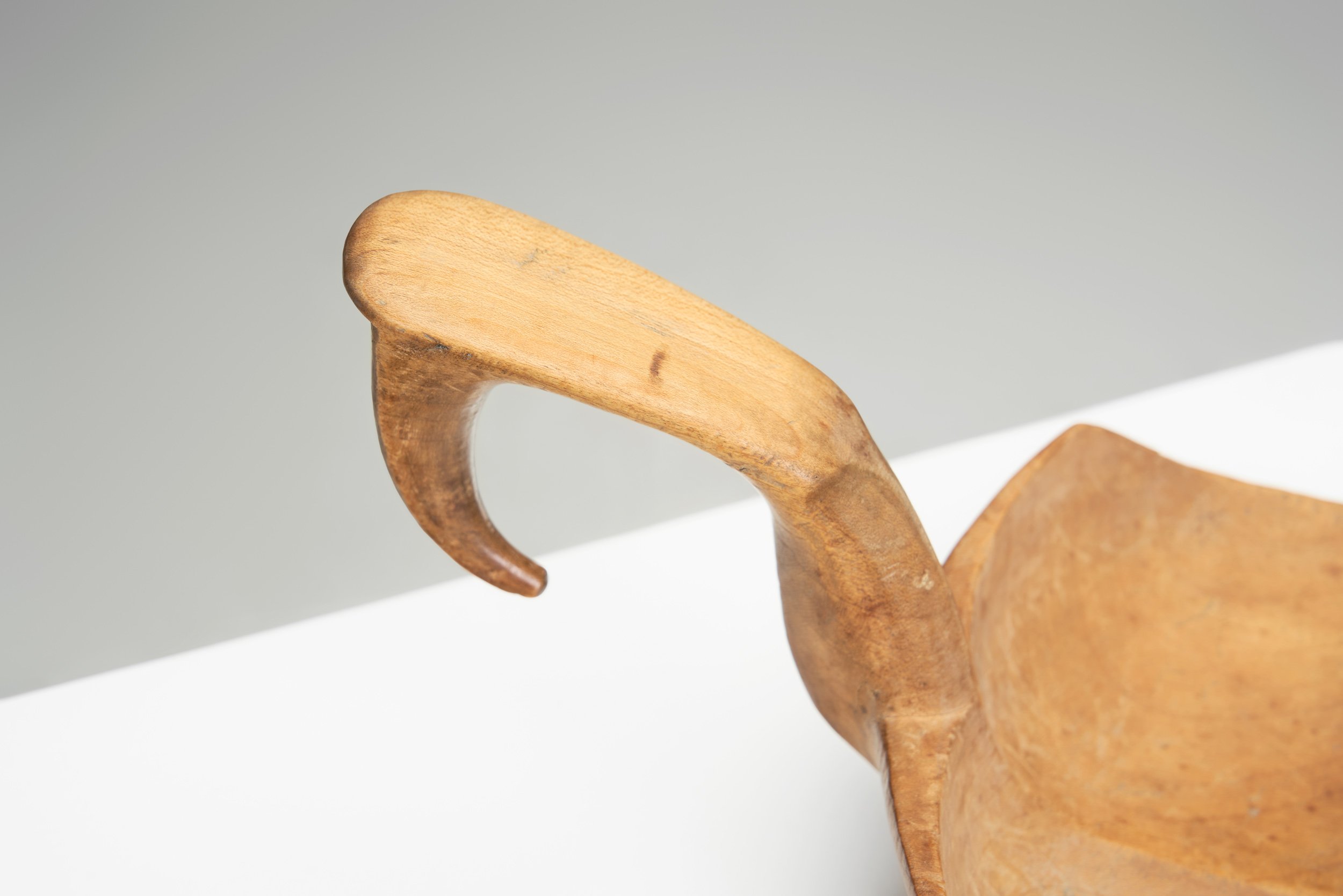
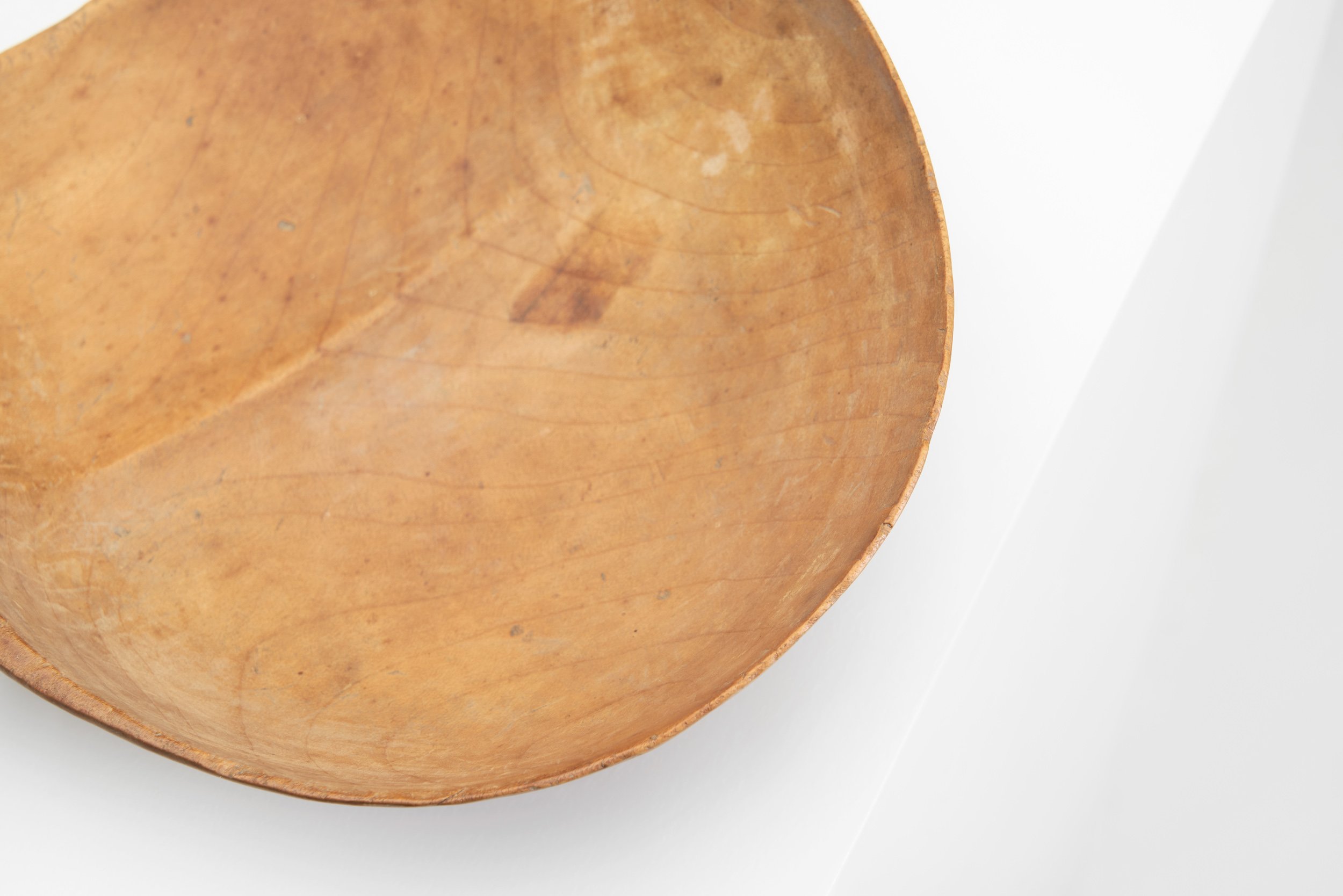
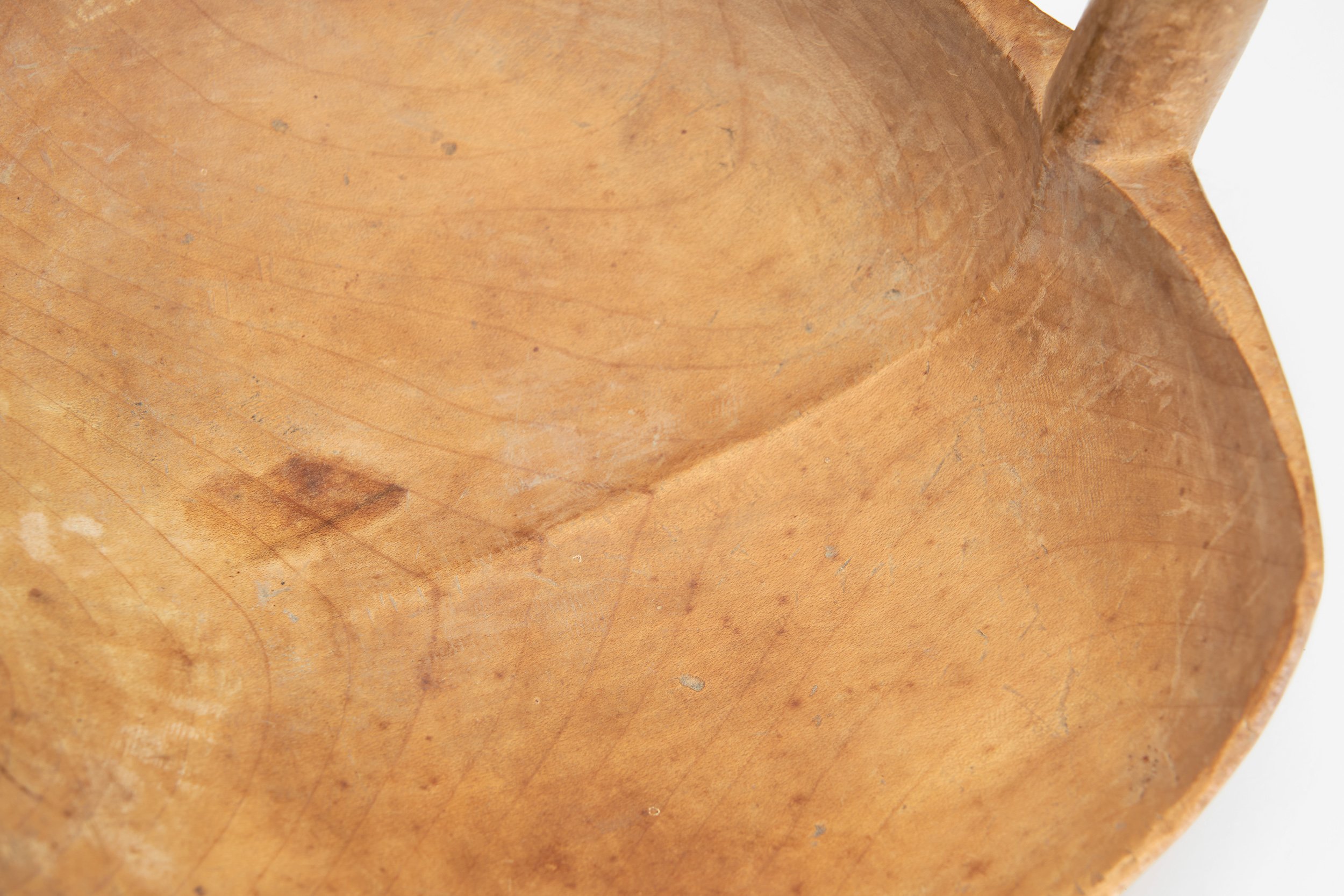
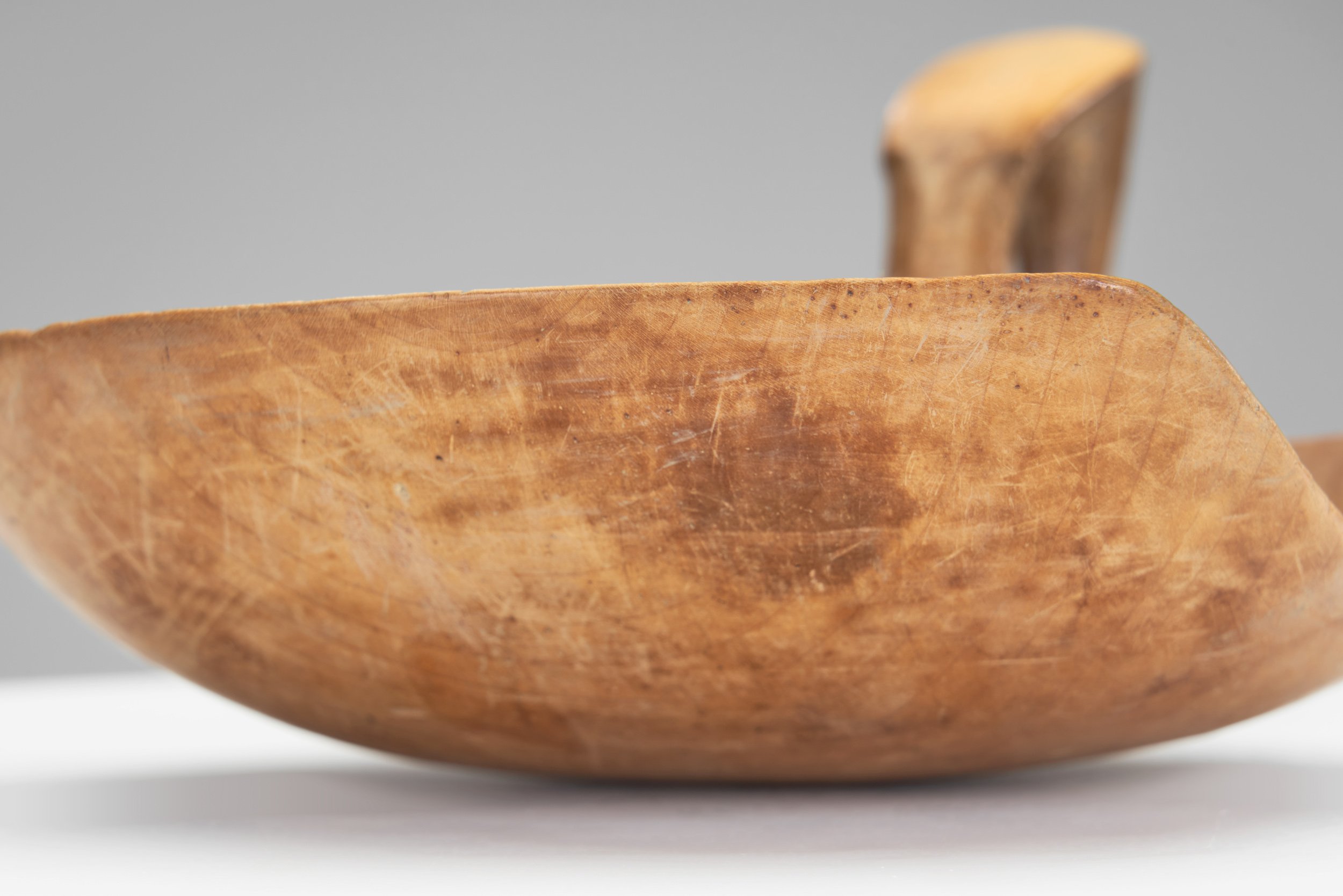
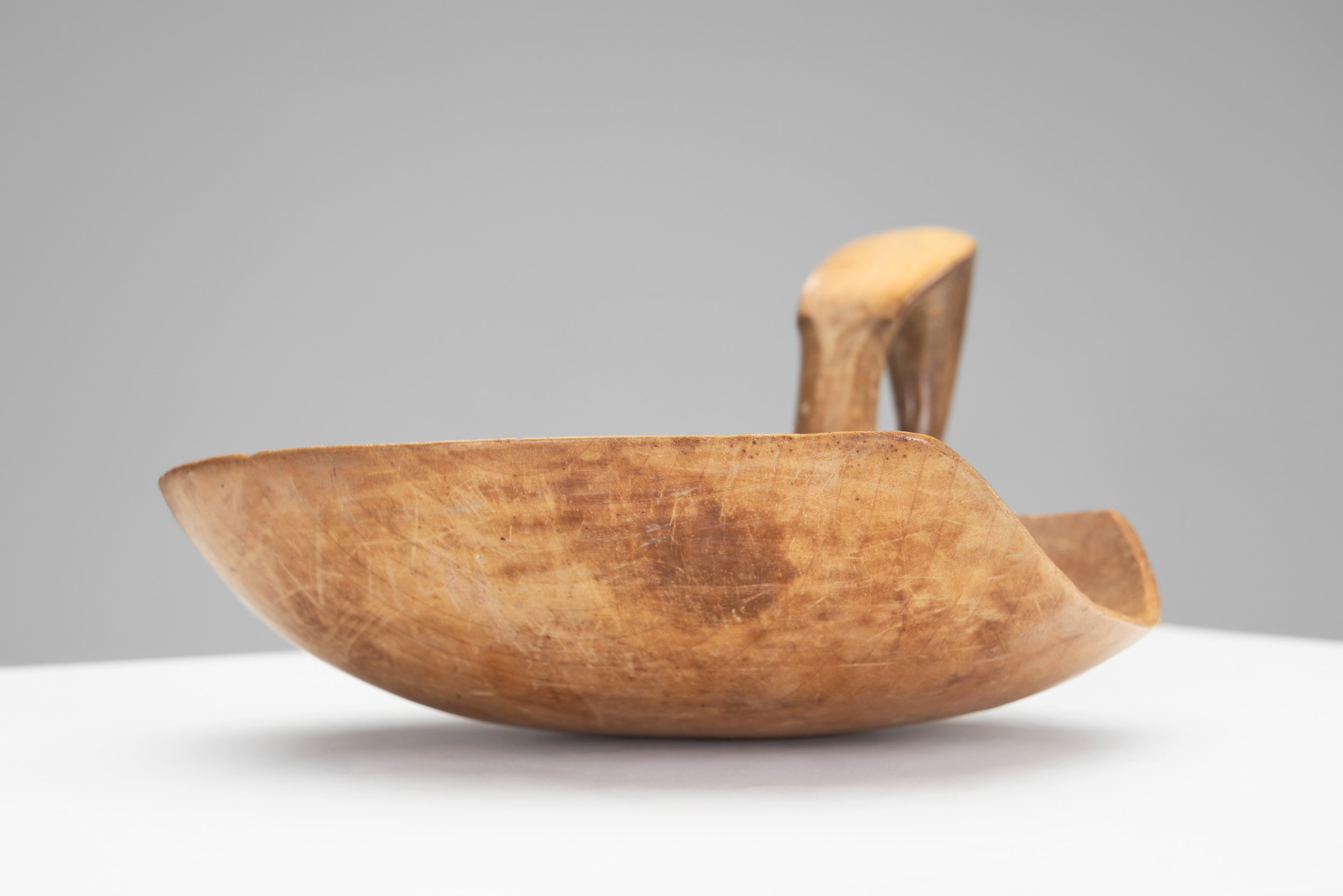
This carved birch ladle originates from Sweden in the early 19th century, a period when everyday domestic objects were shaped by strong folk traditions and regional craftsmanship. In rural Scandinavian culture, utilitarian items were often carved by hand and given expressive forms that reflected both practicality and artistry. Birch, widely available and valued for its durability and fine grain, was a preferred material for household items, allowing makers to combine function with subtle decorative character.
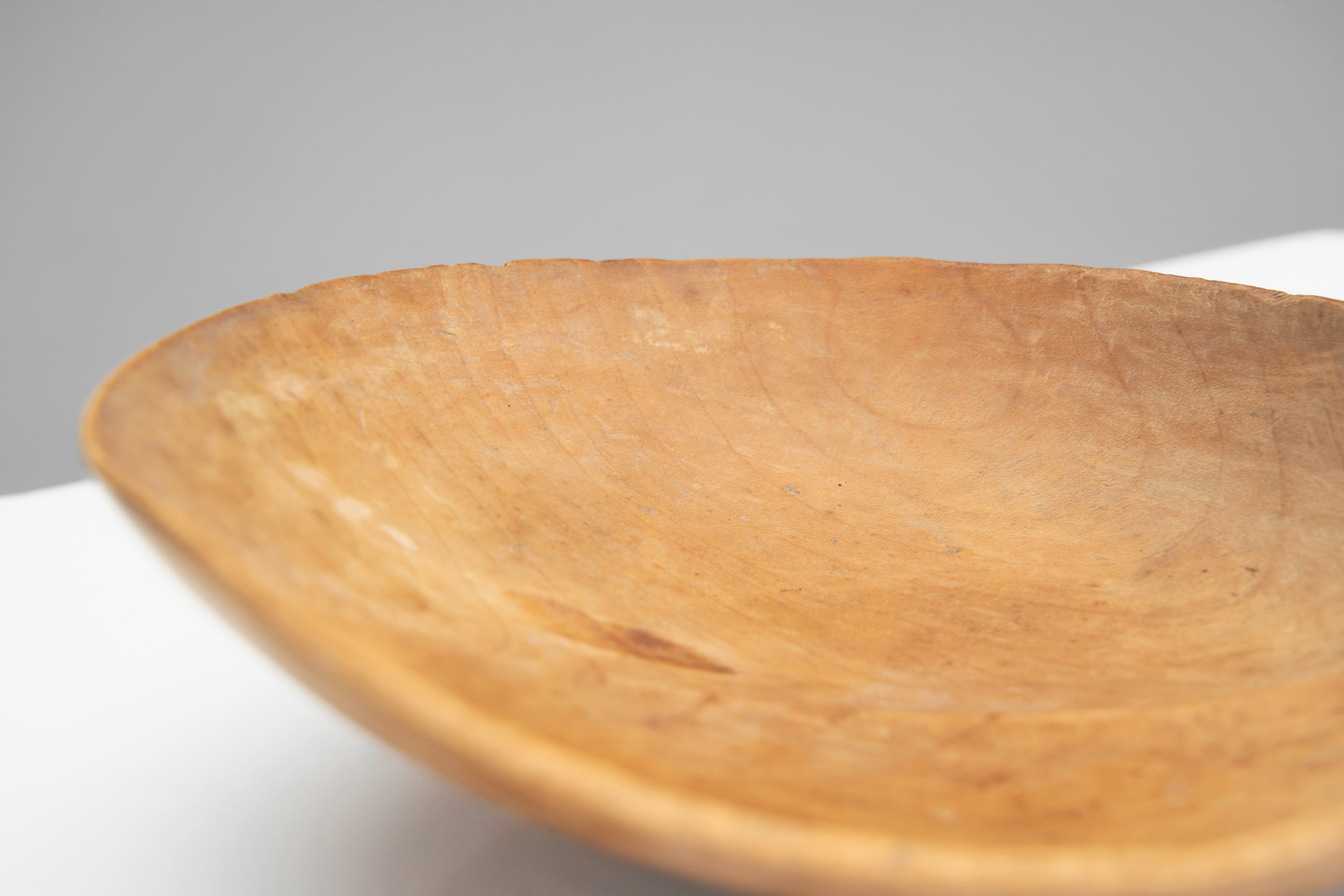
This ladle is carved from a single piece of birch wood, its bowl smoothly hollowed and gently rounded to create a balanced, organic form. The handle extends fluidly from the body, curving upward into a sculptural hook-like shape that allows it to be hung if needed. Tool marks and natural variations in the wood grain remain visible, giving the surface warmth and authenticity while highlighting the hand-carved process. The proportions are carefully considered, with the broad bowl contrasting with the slender handle in a harmonious way. The soft patina suggests long use, adding depth and character without obscuring the clarity of the original carving. Subtle asymmetries further reinforce its handmade nature, making each angle slightly different and visually engaging.
Today, this early 19th century Swedish ladle stands as both a functional and a sculptural object. Whether displayed as part of a folk art collection, styled in a contemporary interior, or appreciated for its material honesty, it offers a connection to traditional Scandinavian craftsmanship. Its restrained elegance, tactile surface, and expressive silhouette make it a compelling example of how simple tools were elevated through skill and intention.
Condition:
In good vintage condition. Wear consistent with age and use. The sculpture has recently been reconditioned. Due to the nature of the material, the item may have some marks, scratches, and discolouration.
Dimensions:
7.87 in W x 10.62 in D x 5.90 in H
20 cm W x 27 cm D x 15 cm H
REQUEST PRICE HERE
Price category: 2,500 - 5,000 usd / eur
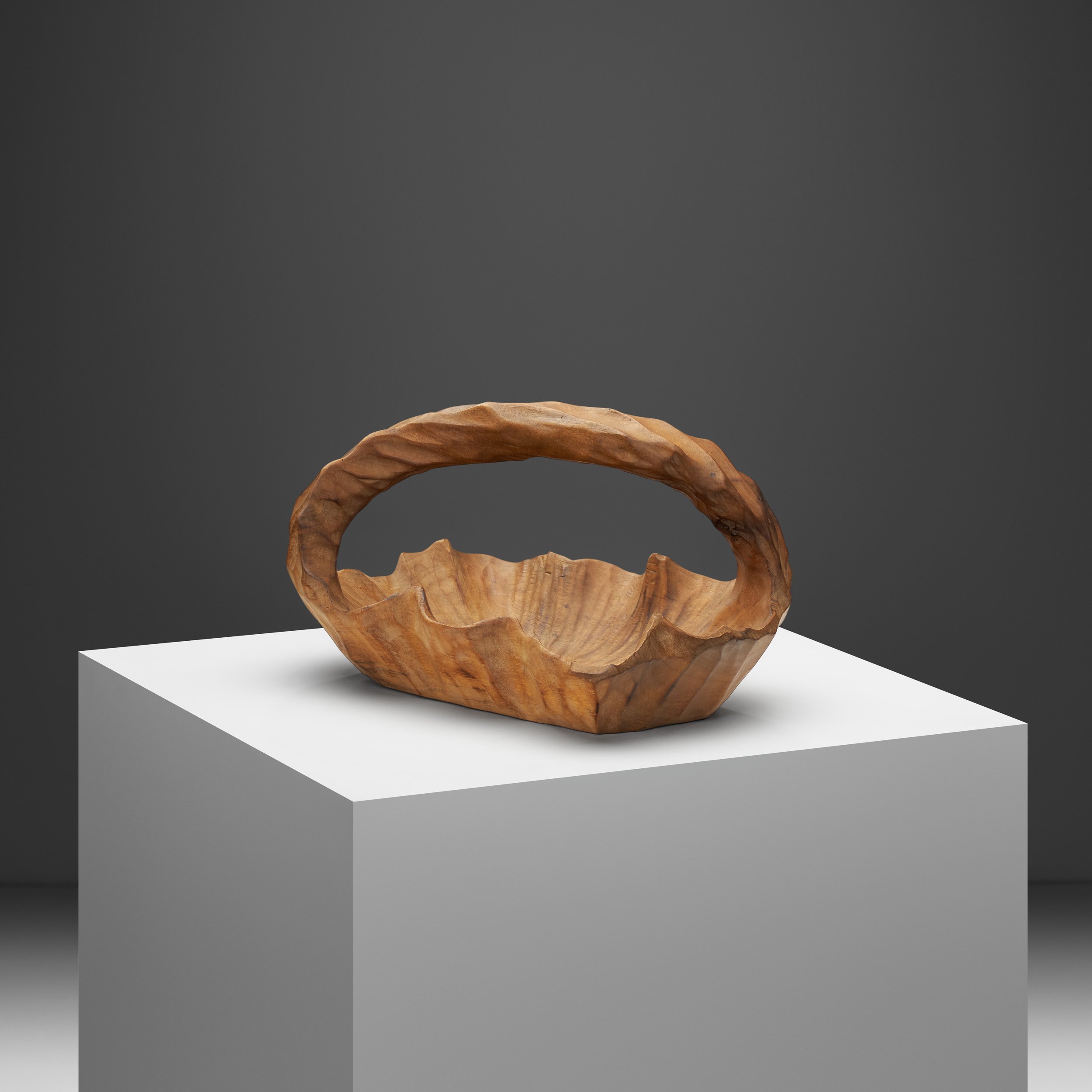
This bowl’s origins can be traced back to Rudolf Steiner’s circle and was made in the so-called Anthroposophic style. Aesthetically, the movement took established silhouettes and morphed them into warped geometries often comprised of multifaceted angular surfaces.
Anthroposophy was originally a school of thought that combined spirituality and materiality for a better humanity. According to Steiner, the thought can also be translated into forms and colours. Everything by which we are immediately surrounded in life takes on an artistic form, therefore furniture is capable of vivifying the environment and like this bowl, its approach to design is organic functionalism. The shape, lines and material of this piece show strength and dynamism, while still staying light and stylish. The bowl’s form is stylistically closer to the organic elegance of modernism, therefore it is guaranteed to fit into, and stand out in any style and type of space. The inherent organicity is also apparent in the shape that doesn’t follow strict geometric principles, instead, has a natural flow to it. Swirling grain patterns further provide a striking visual dimension, highlighting a contrast of tone and texture. The form shifts subtly depending on the viewer’s angle, inviting exploration and offering a sense of balance between lightness and strength. Whether used as a functional centerpiece or simply admired as an object of form and shadow, it draws the eye through its quiet complexity and sculptural quality.
Adding pieces like this to a modern interior not only creates a diverse and interesting aesthetic, it also reminds that perfection cannot be reached and perhaps should not even be the goal. Instead, recognising the beauty of the imperfect created by nature and reformed by a craftsman can bring happiness into everyday life.
Condition:
In good vintage condition. Wear consistent with age and use. Due to the nature and age of the material, item may have some marks, scratches, and discolouration.
Dimensions:
13.78 in W x 10.04 in D x 8.07 in H
35 cm W x 25.5 cm D x 20.5 cm H
REQUEST PRICE HERE
Price category: 2,500 - 5,000 usd / eur
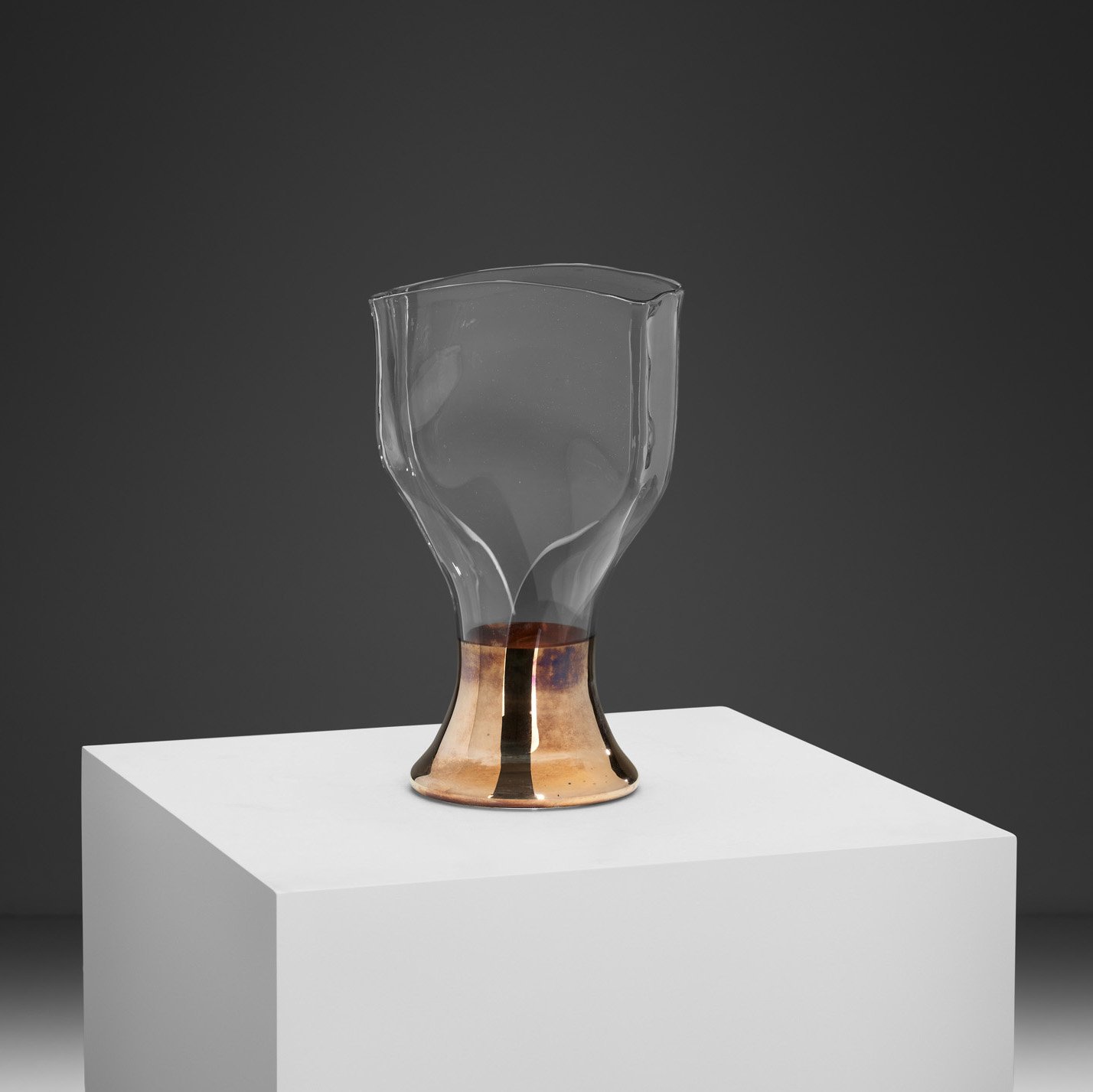
This vase was made by Richard Meitner and displays an understated elegance and timeless appeal. With an emphasis on balance and harmony, it blends traditional craftsmanship with modern aesthetics. Richard Meitner is an artist that has worked extensively with glass and has been exhibiting his works worldwide to this day.
The vase features a round brass base and extends up to a neck that connects seamlessly to the glass. The striking translucent sculptural glass is the focal point of the structure. Crafted with quality in mind, this vase is sturdy and built to last. Its base provides stability and a contemporary touch, while the glass adds a sense of mystery and sophistication to the overall design. The design embraces the allure of both the mid-century modern and space age era’s design characteristics with a result that is mature, well-thought-out, and timelessly stylish. On a side table or a sideboard, this vase will quickly find its marks in any interior. To accompany the stylish look, the brass has beautiful patina that adds vintage charm to the otherwise modern aesthetic of the design.
Adding pieces like this to a contemporary interior not only creates a diverse and interesting aesthetic, it also reminds that perfection cannot be reached and perhaps should not even be the goal. Instead, recognising the beauty of the imperfect can bring happiness into everyday life.
Condition:
In good vintage condition. Wear consistent with age and use. The item has recently been reconditioned. Some visible discolouration on the base. Additional marks, scratches, and imperfections on the glass may be present due to manufacturing inconsistencies and age of the item.
Dimensions:
8.66 in W x 6.10 in D x 13.38 in H
22 cm W x 15.5 cm D x 34 cm H

REQUEST PRICE HERE
Price category: 2,500 - 5,000 usd / eur
In her works, Kati Tuominen-Niittylä explores the concept of the container, interpreting it with natural colours and timeless, clean lines. This allows her to rediscover the beauty of both simplicity and archaic forms. The surfaces, meticulously treated as a sort of meditative practice, recall the light and landscapes of the Nordic forests.
Her minimalistic and timeless language of forms appears in every inch of this bowl that is in the field between art, design, and handicraft. This model blends multiple techniques with extraordinary skill alternating between wheel-throwing, casting, and hand-building with a prevalence of textured, carved surfaces, all of which are high-fired. The result is a uniquely textured look that is influenced by the various ceramic masses, clay slurries, glazings, and surface structures the artist uses. The bowl is just as interesting from inside as it is from the outside, with darker colours that enhance the texture and patterns. The inherent organicity is also apparent in the shape that doesn’t follow strict geometric principles, instead, has a natural flow to it. As a designer, Tuominen-Niittylä has been one of those postmodernists who softened the worst edges of the style into a more user-friendly form. Or as she put it: “I like the quiet movement.” This bowl is signed with “KTN” at its neck.
Kati Tuominen-Niittylä’s works do not fit directly under any ready definition. They have the kind of archaic timelessness that is recognizable throughout the long period of human history as we know art objects. This bowl is stylistically closer to the elegance of modernism than the playfulness of postmodernism, guaranteed to stand out in any style and type of space.
Condition:
In good condition.
Dimensions:
16.3 in W x 10.23 in D x 10.43 in H
41.5 cm W x 26 cm D x 26.5 cm H
About the designer:
Kati Tuominen-Niittylä (Finish, b. 1947) is an internationally acclaimed ceramic artist living and working in Helsinki, Finland. Her elegant minimalist works blend multiple techniques with extraordinary skill alternating between wheel-throwing, casting, and hand-building with a prevalence of textured, carved surfaces, and all of which are high-fired.
Evoking archetypal silhouettes reminiscent of functional vessels such as buckets and basketry, as well as shapes found in nature, Tuominen-Niittylä creates objects that are refined and sophisticated yet with a rough plainness that is further emphasized by the earthy neutral hues. The objects appear almost ancient or geological. The interchanging of techniques also affords a uniqueness to each piece, and it often leads to new details and finishes. Although the works are suggestive of ancient functional forms, Tuominen-Niittylä creates each piece purely with artistic purpose.
Tuominen-Niittylä studied at the Aalto University School of Arts, Architecture and Design. She is a member of the Arabia Art Department Society and has designed for Arabia Studios. Her work is in the permanent collections of numerous public institutions including the Victoria & Albert Museum in London, the Finnish State Collections, and the Shigaraki Cultural Park Museum in Japan.

REQUEST PRICE HERE
Price category: 2,500 - 5,000 usd / eur
The second half of the 20th century saw a renewed fascination with organic form and material integrity. Across Europe, the postwar years brought a quiet resistance to industrial uniformity, artists and designers returned to the tactile immediacy of natural materials. Studio craftsmen began to treat wood, clay, and metal as expressive mediums rather than mere functional matter. The result was an era that celebrated the imperfect, the handmade, and the quietly sculptural, where design and art began to intertwine with new intimacy.
Carved from a single piece of richly grained wood, the elongated bowl reveals a deep respect for both material and skill. Its shape, stretching gracefully from end to end, feels fluid and intentional, while the gently arched handle gives the object a structural balance. The surface bears traces of the maker’s hand, with soft ridges and natural irregularities that add a tactile rhythm to its form. Swirling grain patterns further provide a striking visual dimension, highlighting a contrast of tone and texture. The form shifts subtly depending on the viewer’s angle, inviting exploration and offering a sense of balance between lightness and strength. Whether used as a functional centerpiece or simply admired as an object of form and shadow, it draws the eye through its quiet complexity and sculptural quality.
As with much of European studio craftsmanship from this era, this piece speaks to a time that valued authenticity and material truth above decoration or excess. The maker’s hand is evident yet never dominant, allowing the natural form of the wood to guide the design.
Condition:
In good vintage condition. Wear consistent with age and use. Due to the nature and age of the material, item may have some marks, scratches, and discolouration.
Dimensions:
41.92 in W x 15.74 in D x 8.26 in H
106.5 cm W x 40 cm D x 21 cm H
REQUEST PRICE HERE
Price category: 1,000 - 2,500 usd / eur
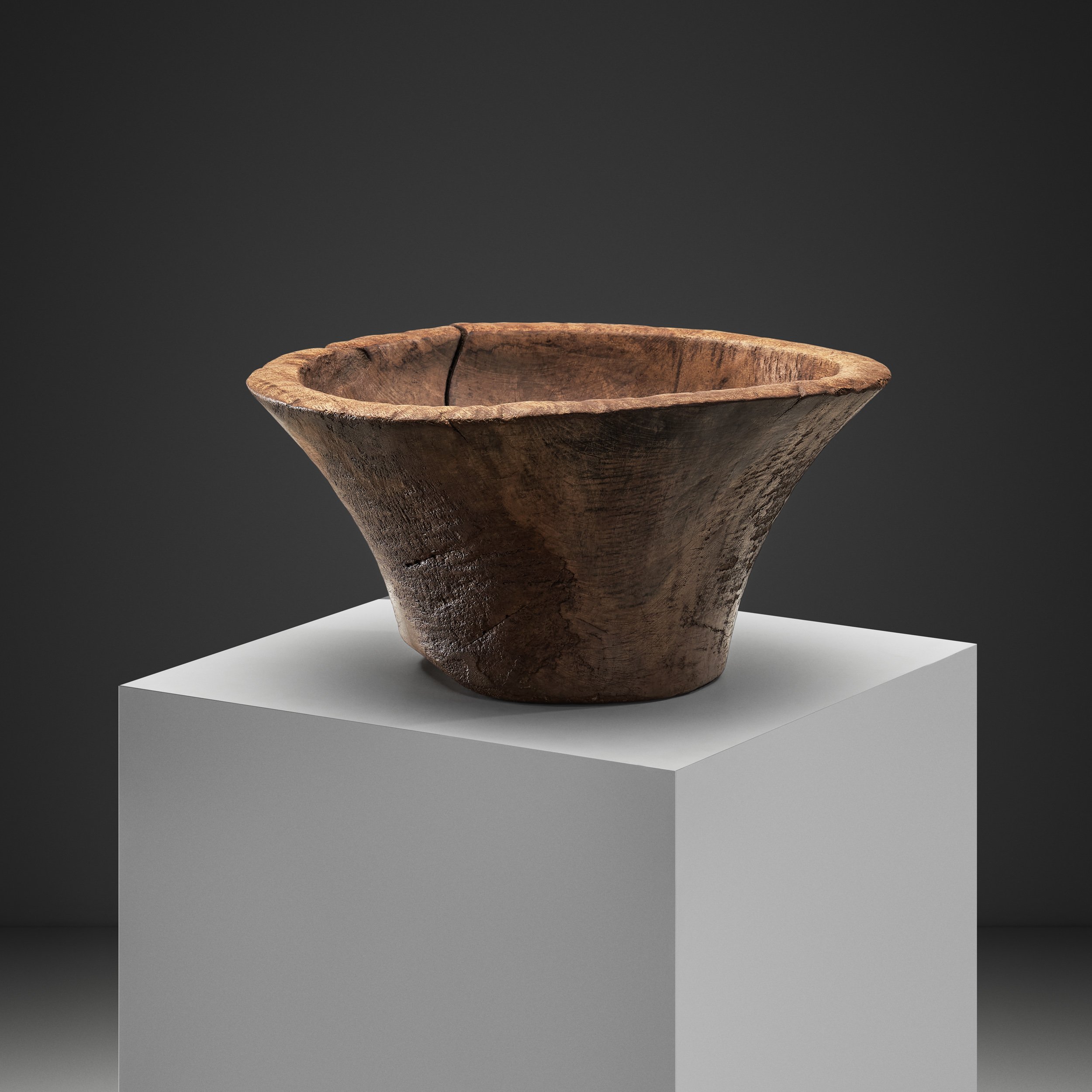
Wabi-sabi is an ancient Japanese philosophy that can be applied within interior design, and to anyone’s lifestyle as a whole. It is the practice of appreciating and accepting the beauty in simplicity, imperfections, and age. The expression defines the core principles behind this bowl’s aesthetic: minimalism, humbleness, and being in tune with nature, whilst appreciating the beauty of patina and wear. It takes inspiration from nature, which is rarely perfect or symmetrical and eventually decays.
In the absence of modern polished surfaces, this bowl has textural, rough edges and surfaces, while the wooden material takes pride in its qualities. The construction strips back the unnecessary, showcasing only the essential elements of it. The wood is left in its natural form as much as possible, while also prioritising functionality and longevity. Long before the mid-century, Asian designers and craftsmen believed that furniture should be shorn of aesthetic detail and represent the marriage of form and function. This bowl, lacking decoration but not aesthetic details, is a beautiful example of this mindset and the timeless charm of traditional craftsmanship.
The appreciation of rustic simplicity and craftsmanship has never completely gone out of style, but rather, in recent years, it saw an increase. Adding pieces, like this to a contemporary interior not only creates a diverse and interesting aesthetic, it also reminds that perfection cannot be reached and perhaps should not even be the goal. Instead, recognising the beauty of the imperfect created by nature and reformed by a craftsman can bring happiness into everyday life.
Condition:
In good vintage condition. Wear consistent with age and use. The bowl has recently been reconditioned. The item has some cracks. Due to the nature and age of the material, this item may have some marks, scratches, and discolouration.
Dimensions:
19.30 in ⌀ x 9.65 in H
49 cm ⌀ x 24.5 cm H

REQUEST PRICE HERE
Price category: 1,000 - 2,500 usd / eur
Danish mid-century furniture design, flourishing from the 1940s to the 1960s, is celebrated for its minimalist elegance, exceptional craftsmanship, and emphasis on functionality. Characterized by clean lines, organic forms, and a harmonious balance between aesthetics and practicality, this design movement embodies the ethos of "form follows function."
This Danish teak platter's distinctive form is characterized by its flowing, fluid lines, reflecting the mid-century fascination with natural aesthetics and its embrace of organic shapes. The platter's surface boasts a rich, warm patina that highlights the natural beauty of the teak wood, with a smooth, polished finish that enhances the wood's intricate grain patterns. Designed with both functionality and artistry in mind, this platter seamlessly combines form and purpose. Its robust, solid construction ensures durability, while the refined design can elevate any setting.
It is often observed that Danish mid-century designs are stripped of unnecessary ornamentation, focusing instead on simple, functional forms. This minimalism is not merely for visual appeal but also enhances the practicality of a piece, making them versatile and enduring. Whether it is displayed as a centerpiece or used in the everyday, this teak platter embodies the timeless appeal of mid-century modern Danish design and the unparalleled craftsmanship of its era.
Condition:
In good vintage condition. Wear consistent with age and use. Minor chips on the edge of the platter.
Dimensions:
23.6 in W x 12 in D x 1.2 in H
60 cm W x 30.5 cm D x 3 cm H
REQUEST PRICE HERE
Price category: 5,000 - 7,500 usd / eur
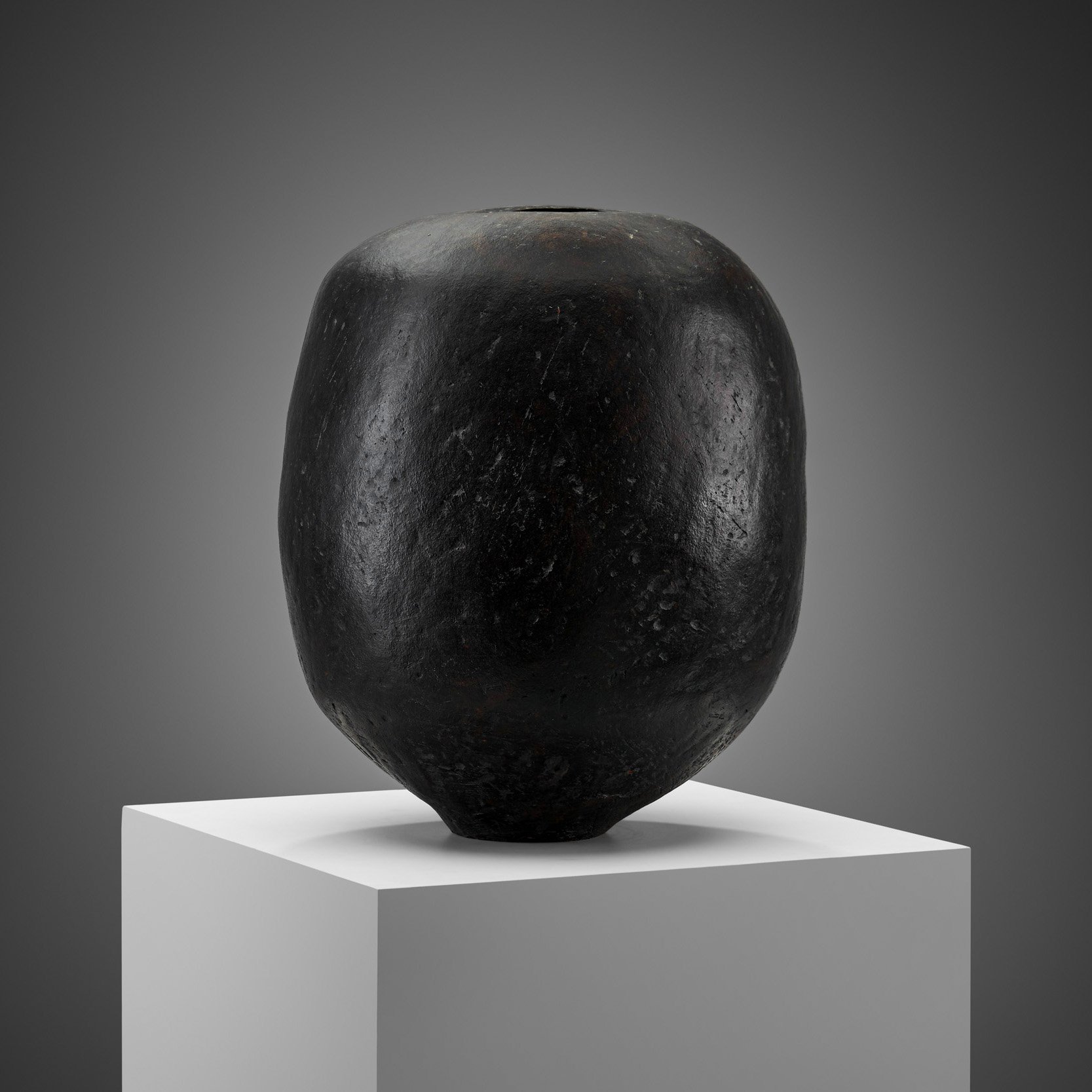
Priscilla Mouritzen is an internationally celebrated, South-African born Danish contemporary ceramic artist. Her creations reflect her expertise and mastery with a dedication to form and texture, inspired from traditional pottery techniques, African traditions, and minimalist design principles.
This vase exhibits understated elegance and a timeless appeal. With an emphasis on balance and harmony, it blends traditional craftsmanship with modern aesthetics and is exemplary of Mouritzen’s artistry. The practice of ceramics has a longstanding and celebrated tradition in Denmark. The founding of the Royal Copenhagen factory in the 18th century saw the expansion and popularisation of ceramics, although it wasn’t until in the 1950s, where artists were drawn again to material experimentation and innovation - balancing the boundaries between function and aesthetics. The Scandinavian Modern influence attracted interest from other European countries where pieces such as this vase, have become prized items. The refined design of this vase and simple form reflects its modern influence. The subtle textural details on the surface add an interesting visual element and character. While Priscilla Mouritzen has experimented with different techniques, her works often use a pinch pot approach and a wood firing process. The smoked wood firing process used adds to its unique quality - the deep black finish enhances this vase’s sculptural quality, making it a bold yet sophisticated addition to any space. Priscilla Mouritzen’s creations are made by hand and inherently add to the authentic beauty and value of this vase.
Priscilla Mouritzen has exhibited her works worldwide and still exhibits regularly to this day. Since 2001, she has been an active board member and vice-president of the Guldagergaard Foundation; a research centre and a cultural institution focused on the strengthening and development of ceramic arts.
Condition:
In good vintage condition. Wear consistent with age and use.
Dimensions:
Ø 14.96 in x 18.89 in H
Ø 38 cm x 48 cm H
REQUEST PRICE HERE
Price category: 1,000 - 2,500 usd / eur
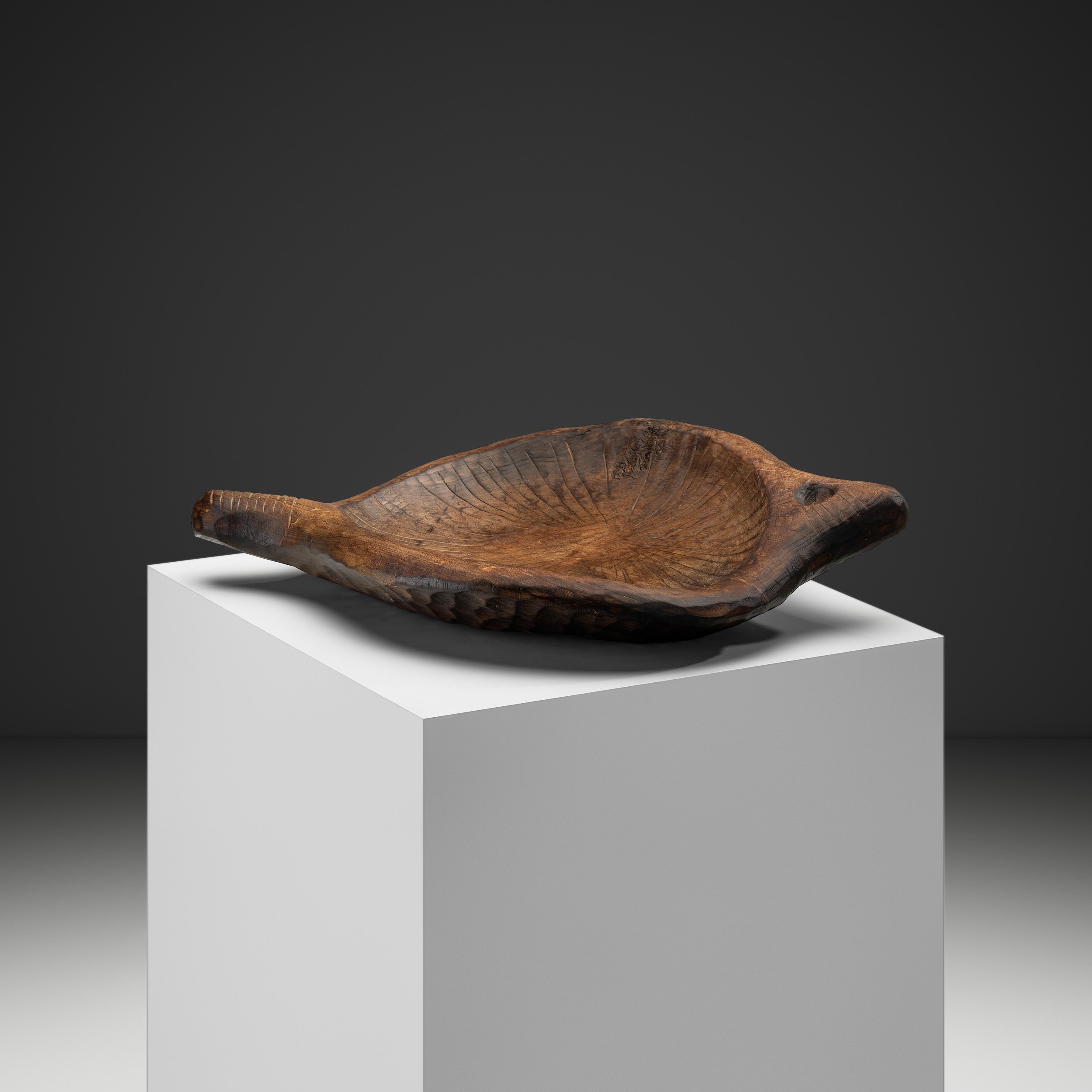
As a descendant of the modernist movement of the late 19th and the first half of the 20th century, Brutalism favoured celebrating the imperfect appeal of handmade items. With a robust, organic form, this bowl is the embodiment of Brutalism.
The piece has a refined rawness, and with its warm-toned and asymmetrical form. The wood’s stunning grain pattern is visible throughout, letting its natural expressiveness guide the design. The carvings and texture of the wood further add depth and character to the bowl - the pattern is so arresting that it can serve as a decorative element on its own. The design shows the understated beauty of the natural material, together with its endless possibilities under the hands of an expert craftsman. Organic and brutalist pieces like this bowl can be incorporated successfully into contemporary and traditional interiors alike, thanks to the timelessness of wood and the sheer quality of the piece.
The versatility and timeless elegance of darker woods make this bowl a captivating choice for those seeking to infuse their interiors with a touch of refined luxury and raw elegance.
Condition:
In good vintage condition. Wear consistent with age and use. The bowl has recently been reconditioned. Due to the nature of the material, this item may have some marks, scratches, and discolouration.
Dimensions:
23.62 in W x 16.92 in D x 5.11 in H
60 cm W x 43 cm D x 13 cm H

REQUEST PRICE HERE
Price category: 1,000 - 2,500 usd / eur
This beautiful tråg, Swedish for trough, is a simple, clean example of 18th century of Swedish folklore. It shows the handiwork that it cost to make it in a traditional Scandinavian style. With its historic details, this trough mixes well with modern spaces and design to create an interesting and charming style.
A manger or trough is a rack for fodder, or a structure or feeder used to hold food for animals. The word comes from the Old French ‘mangier’, from Latin ‘mandere’. Mangers are mostly used in livestock raising and generally found at stables and farmhouses. They are also used to feed wild animals, e.g., in nature reserves. Here, the material and its shape, which is generally described as ‘primitive’ style, is not the work of a designer, but a woodworker who most likely crafted this piece for strictly functional reasons. The lack of ornamentation testifies of this role, and is a feature that remained at the core of Scandinavian design to this day.
This historical trough has marks of wear which make it unique. These marks show that nearly 300 years ago, this piece was actively used somewhere in Sweden. It naturally has the rustic charm that many producers try to recreate nowadays. Thanks to this, it can stand out in a modern interior to add not only visual, but also historical interest to the space.
Condition:
In good vintage condition. Wear consistent with age and use. Marks of wear on the body.
Dimensions:
45.27 in W x 19.48 in D x 6.88 in H
115 cm W x 49.5 cm D x 17.5 cm H
REQUEST PRICE HERE
Price category: 500 - 1,000 usd / eur
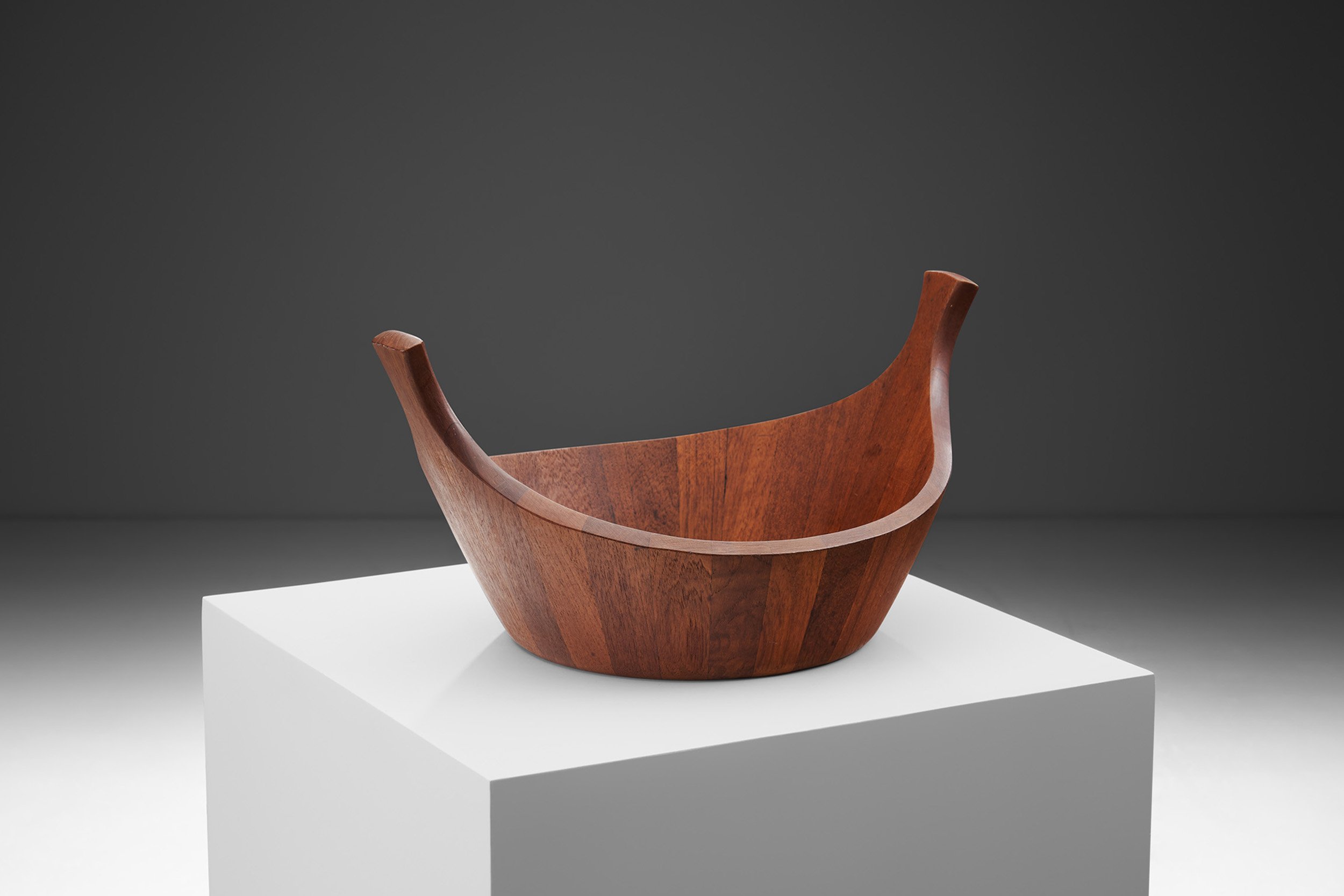
Jens H. Quistgaard set out to design beautiful things for everyday use, which is an essentially Scandinavian approach to design in general. Over the course of his prolific and varied design career, Jens Quistgaard created objects that are a meditation on the possibilities of shape for a common household object.
Intriguing and fantastical, the variety of forms the sculptor manifested expand the vocabulary of functional design, calling on an array of familiar references including natural shapes. This solid wood bowl is a beautiful example of this, with an organic shape and an immediately visible level of craftsmanship. This rare model is an early iteration of the Viking ship serving bowl with a stunningly sculpted, staved body. In this technique, after spreading a wood bonding glue onto the sides of the individual staves, the bowl is assembled by sticking the sides together. This results in an interesting look that showcases the many different colours and patterns of the wood. The majority of Jens Quistgaard’s designs were produced in teak, which has the advantage of strength, resilience, and longevity besides its aesthetic appeal. The bowl’s elongated sides and edges are all rounded gently in a true Danish manner, softening the straight lines of the staves. While intended for everyday use, this bowl is just as much a sculpture as a utilitarian object, worthy of a role as a centrepiece or decorative object. It is marked “Saved Teak Danmark JHQ” on its bottom.
For many years Jens Quistgaard was the leading, and often, the only designer for Dansk International Designs which gradually became a world-wide firm with a production influenced in all fields by the homogeneity of his style. His works now appear so obvious it is easy to forget how original and individual they were in their time. He won the Lunning Prize in 1954, and received the Neiman Marcus Award in 1958.
Condition:
In good vintage condition. Wear consistent with age and use. Small scratches on the wood.
Dimensions:
18.3 in W x 12.99 in D x 9.05 in H
46.5 cm W x 33 cm D x 23 cm H
About the designer:
Jens Harald Quistgaard (April 23, 1919 - January 4, 2008) was the principal designer for Dansk Designs from the mid-1950s through the 1980s. Quistgaard’s designs are largely responsible for introducing and defining the Scandinavian modern aesthetic for American homes. As the New York Times recognized in 1958, “Some of the most popular accessories found in American homes today have their beginnings in a small studio-workshop adjoining the modest residence of Jens Quistgaard in Copenhagen.” Quistgaard, by way of Dansk Designs, went on to transform and modernize the American dining table and kitchen.
Initially trained as a sculptor by his father, Quistgaard expanded his skills by learning from carpenters and metalsmiths, all contributing to his versatility as a master craftsman with the expertise to combine materials and techniques in novel ways. Amongst his most recognized designs is the 1953 Fjord Flatware set, iconic for combining stainless steel with teak handles. Fjord Flatware is in the collections of several prominent museums and is still in production. Many more of Quistgaard’s houseware designs, notably the teak ice buckets and colourful Kobenstyle enamelware, have become familiar classics. Over the course of his multi-decade career, Quistgaard created designs for over four thousand products.
Despite living and working in Denmark for the majority of his career, Quistgaard’s designs for Dansk focused on the consumer market in the United States. For many decades, Quistgaard remained relatively unrecognized in his home country, rarely mentioned alongside other Danish design icons such as Hans Wegner and Finn Juhl. As many Scandinavian Modern items moved from the primary consumer market to the province of collectors, Quistgaard’s oeuvre gained further international recognition. In 2015, the Herning Museum of Contemporary Art in Copenhagen mounted a career-spanning retrospective of Quistgaard’s work, with additional Danish publications expected in the near future.
REQUEST PRICE HERE
Price category: 1,000 - 2,500 usd / eur
Carved wooden vessels occupy a unique position between utility and sculpture. Across many African woodworking traditions, everyday objects such as bowls, trays, and serving vessels were shaped directly from solid trunks, allowing the natural characteristics of the timber to determine both the appearance and final form. The resulting pieces often possess a quiet power, where simple gestures and careful craftsmanship create a lasting visual impact.
The silhouette of this tray is bold and compact. Hollowed from a single section of wood, the bowl rests on four short feet that lift it subtly from the surface below. Cylindrical handles project from either side, introducing a horizontal dimension that balances the rounded volume of the vessel. The uninterrupted grain flows across the piece, revealing shifts in colour due to the single-trunk construction. Subtle tool marks and natural variations in the wood lend depth to the surface, while the smooth interior highlights the skill required to create such a form from a solid block of timber. Despite its modest scale, the tray possesses a distinctly architectural quality, built from a combination of shapes and carefully proportioned volumes.
Objects of this kind demonstrate how functional forms can achieve a sculptural presence through material alone. Whether used as a catchall or decorative centrepiece, the tray draws attention to the richness of the wood and the clarity of its construction. Its enduring appeal lies not in elaborate decoration but in the confidence of its form, where every element serves a purpose and contributes to a sense of permanence.
Condition:
In good vintage condition. Wear consistent with age and use. The accent tray has recently been reconditioned. Due to the nature and age of the material, the item may have minor marks, scratches, and discolouration. The piece features an exceptional wood grain.
Dimensions:
14.56 in W x 10.23 in D x 4.33 in H
37 cm W x 26 cm D x 11 cm H