
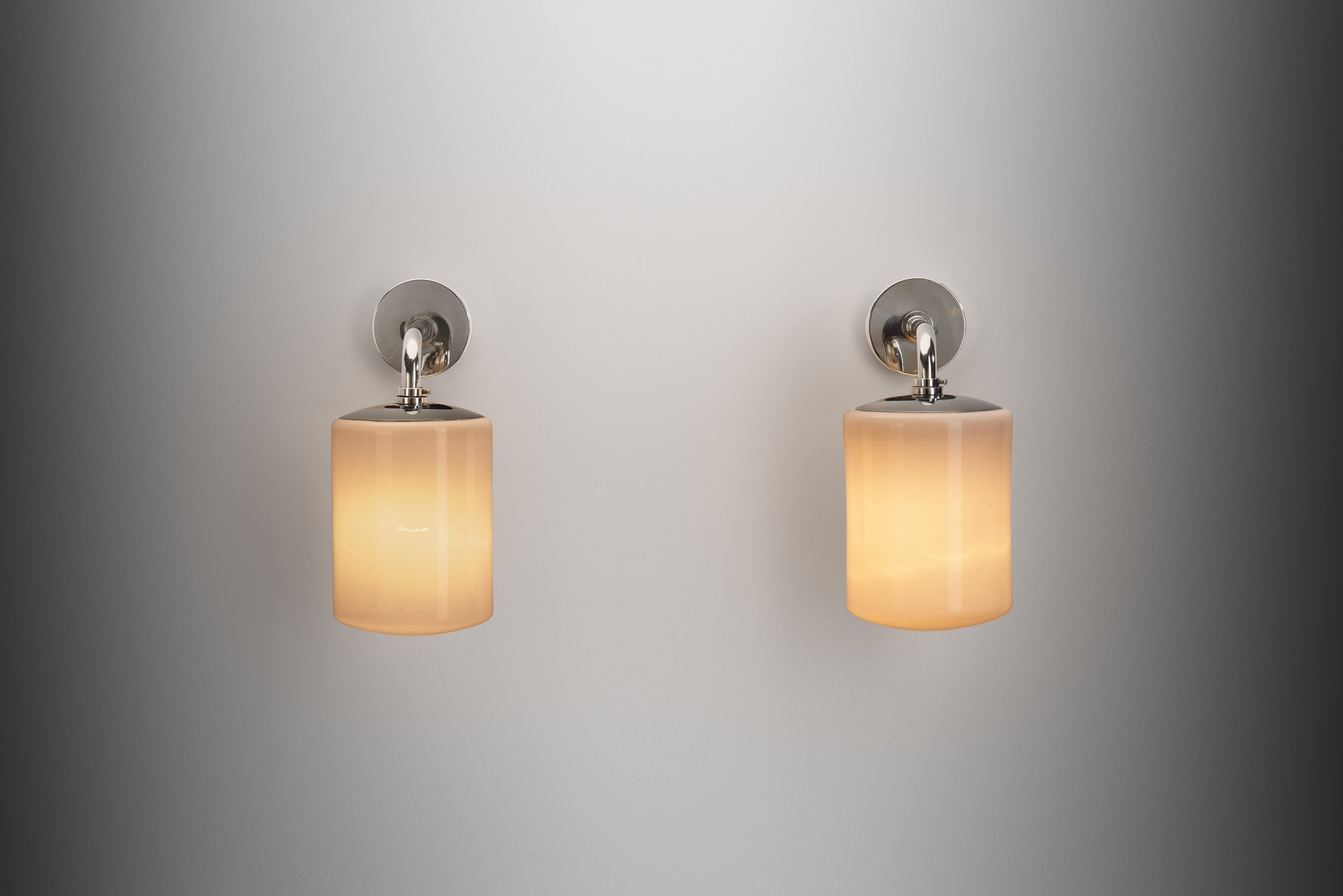
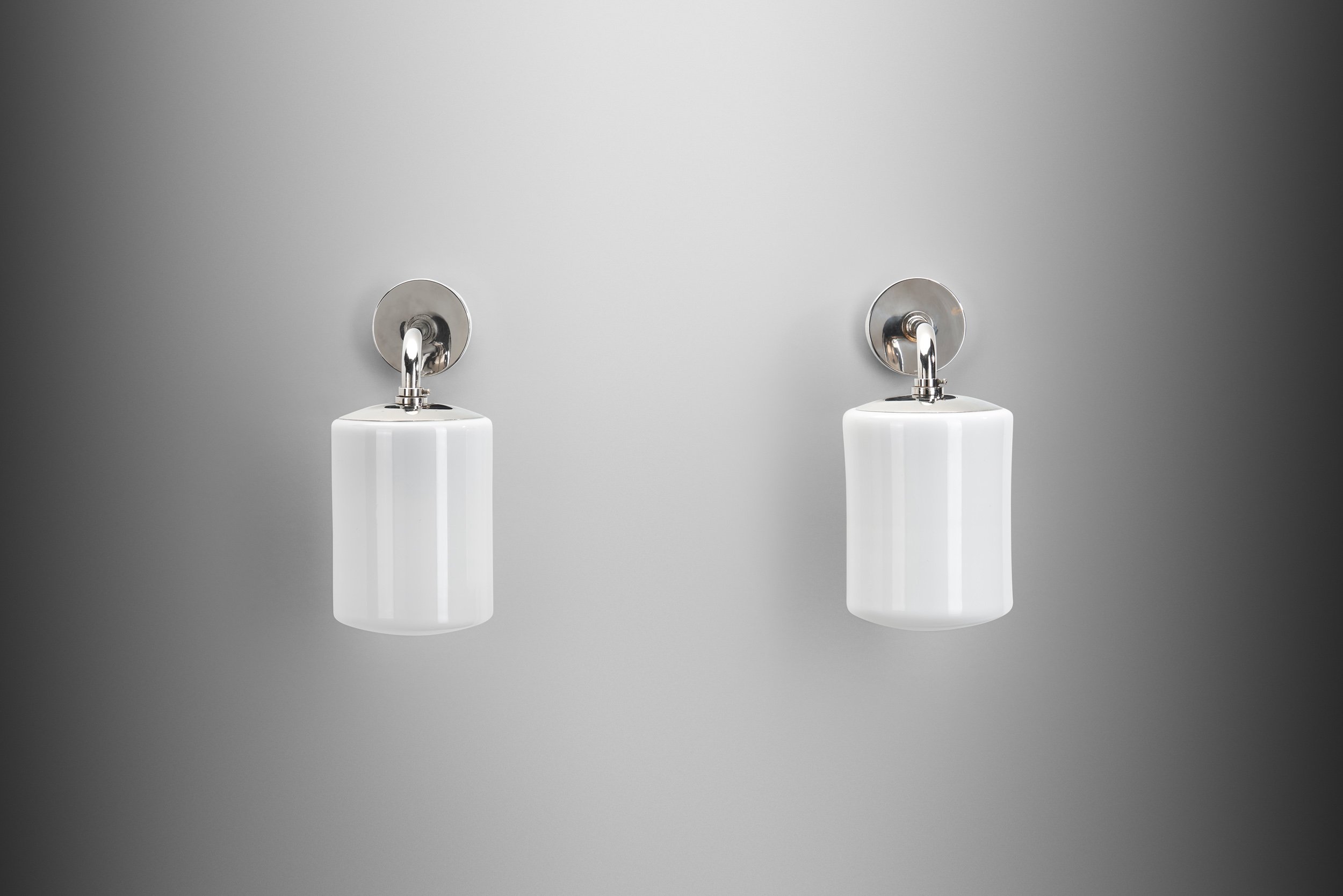
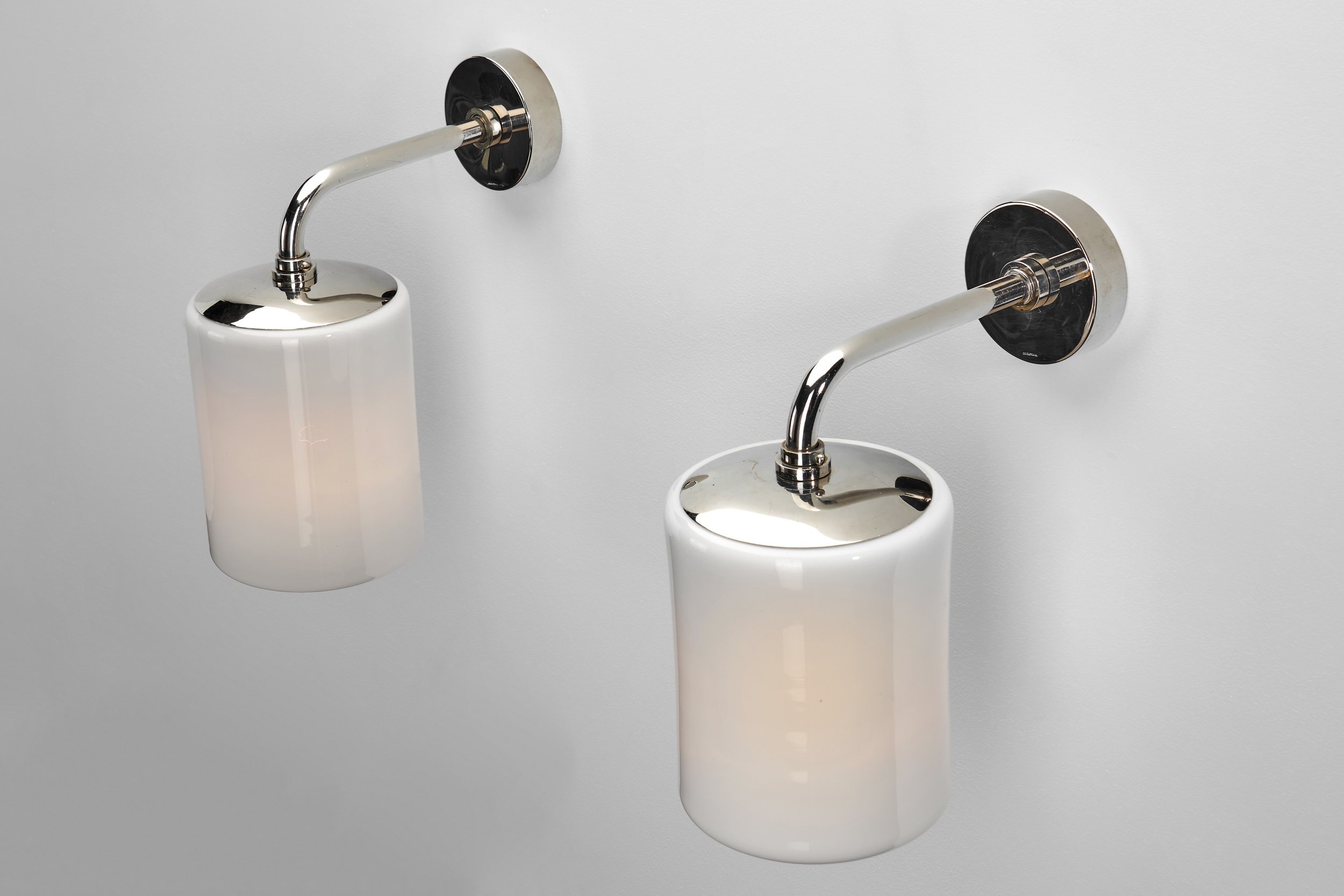
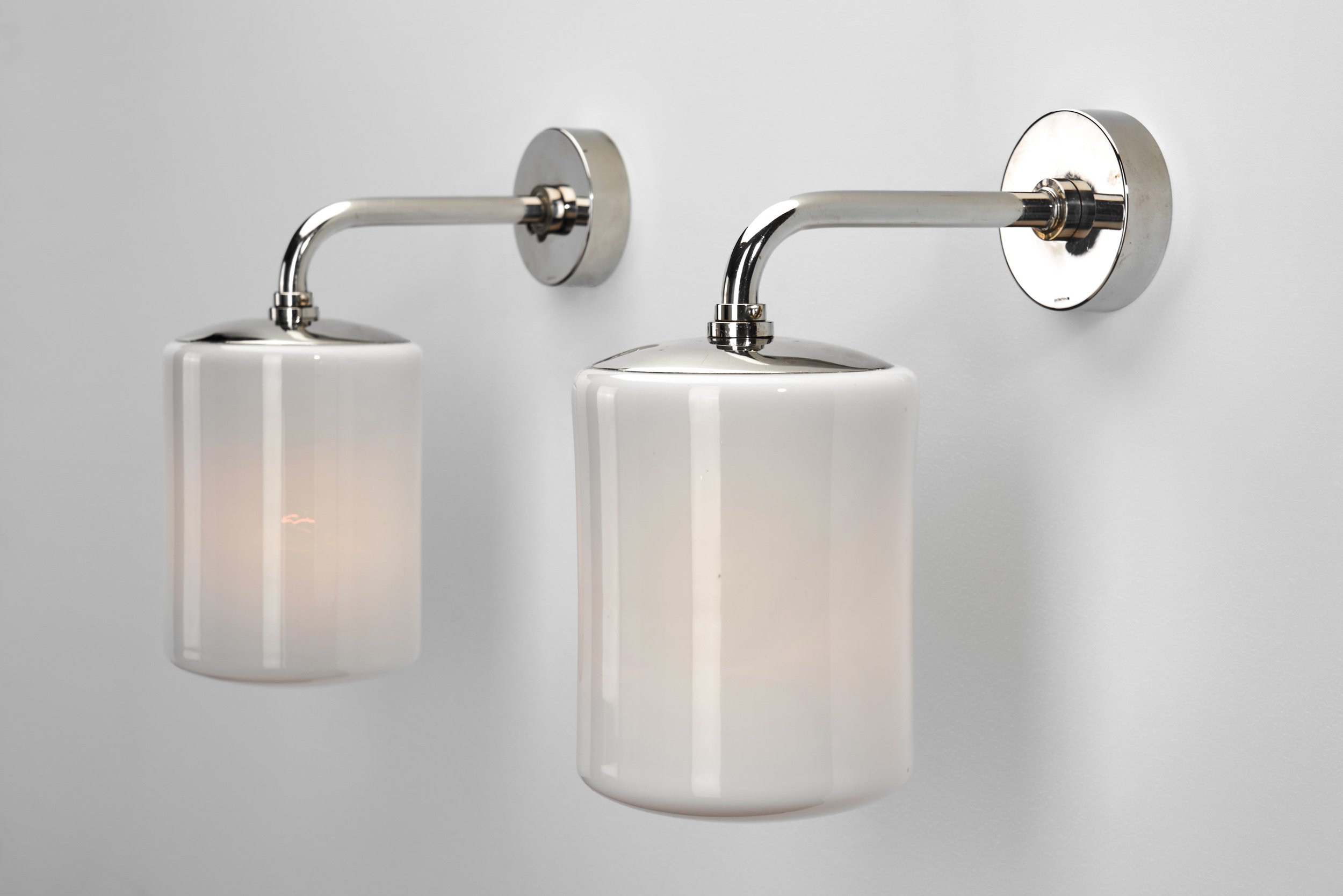
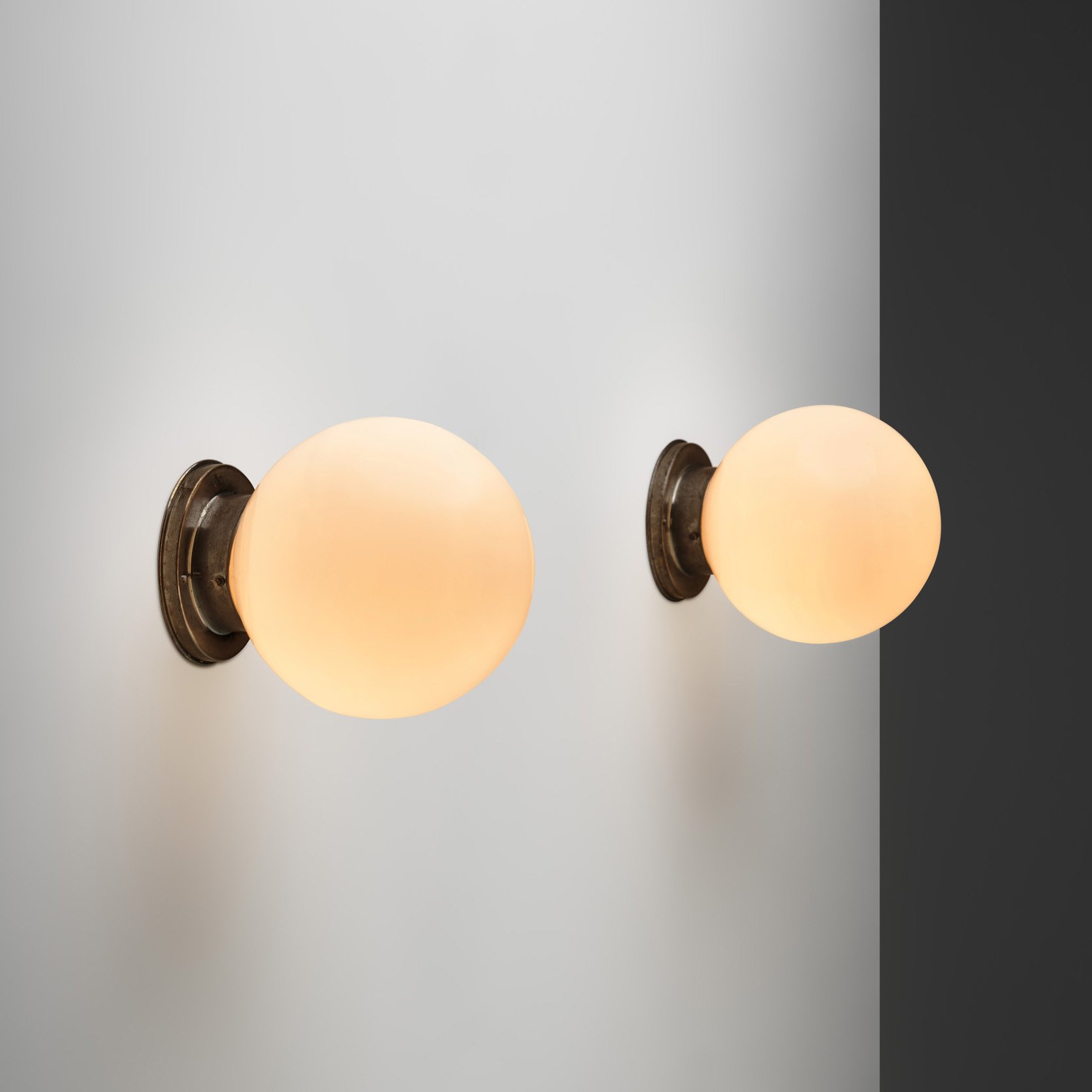
Pair of Model "7239" Wall Lights by Paavo Tynell for Taito, Finland 1930s
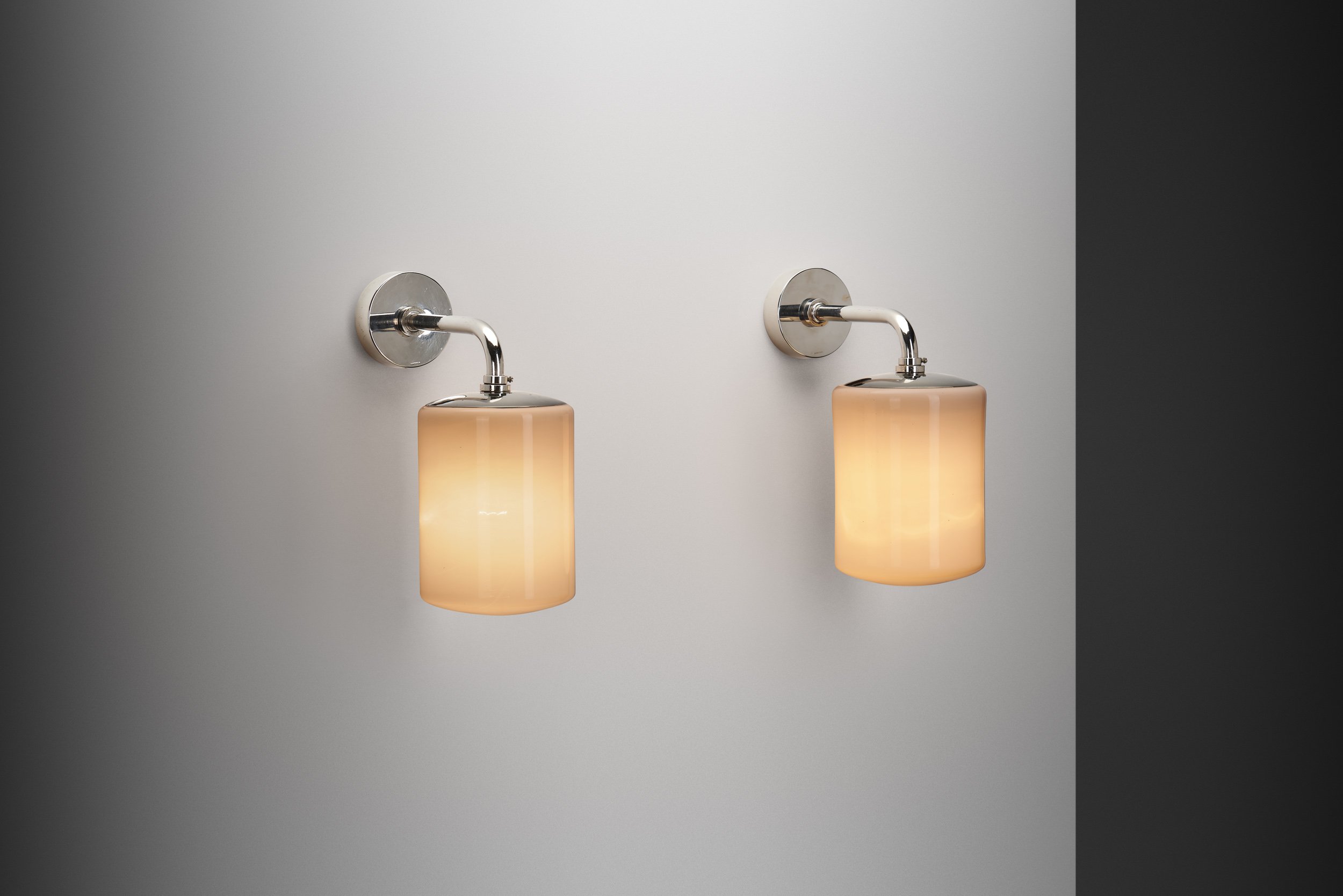
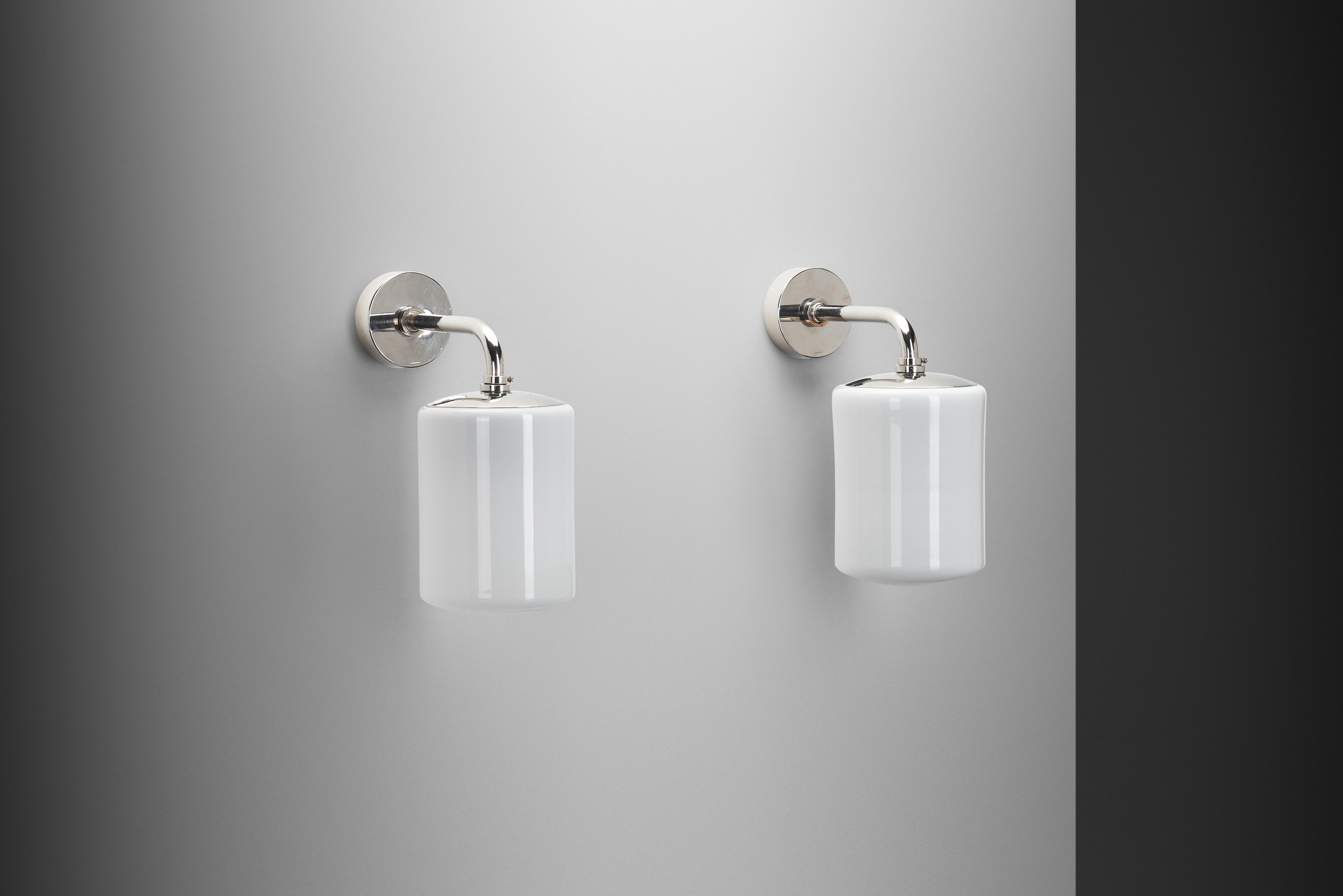
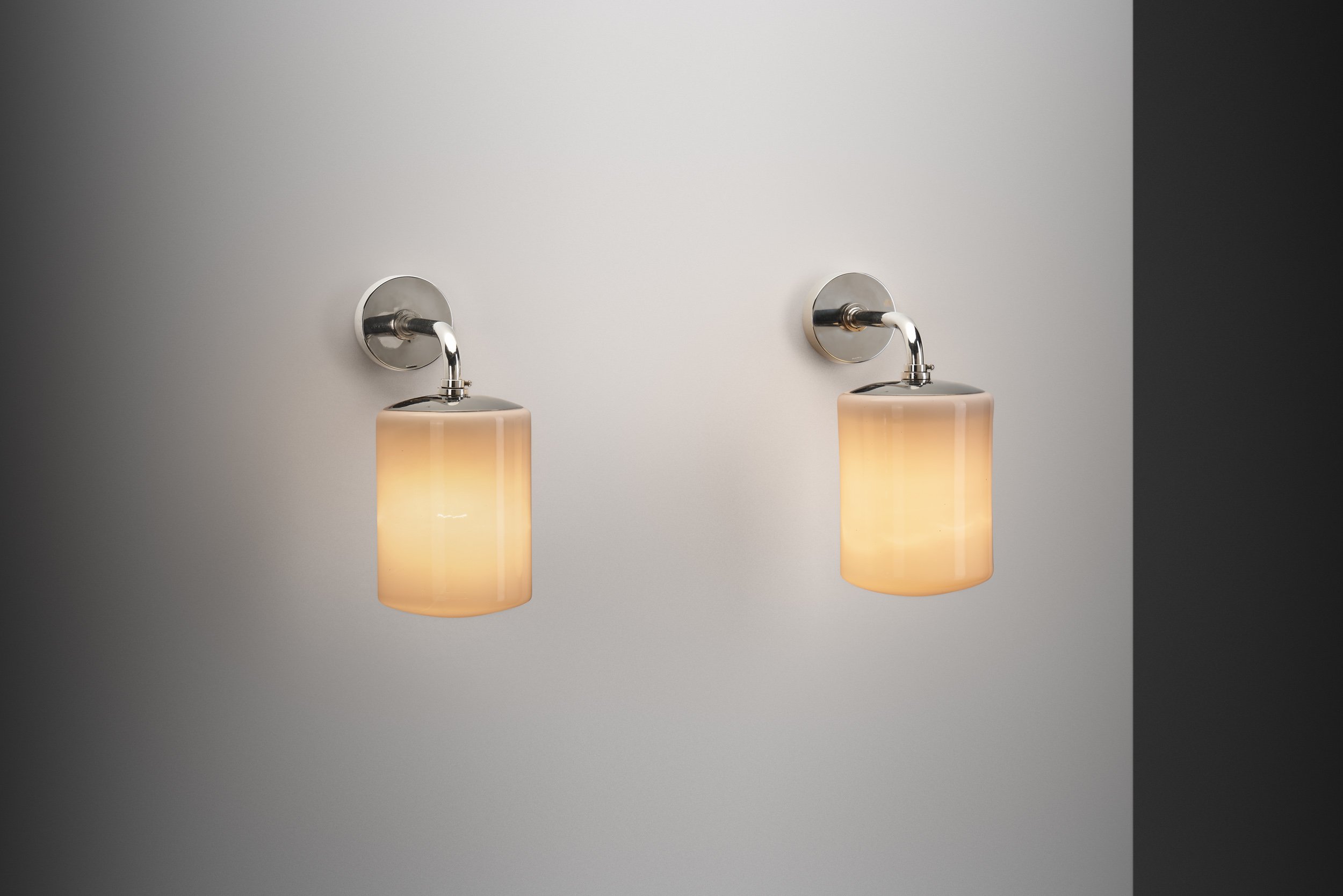
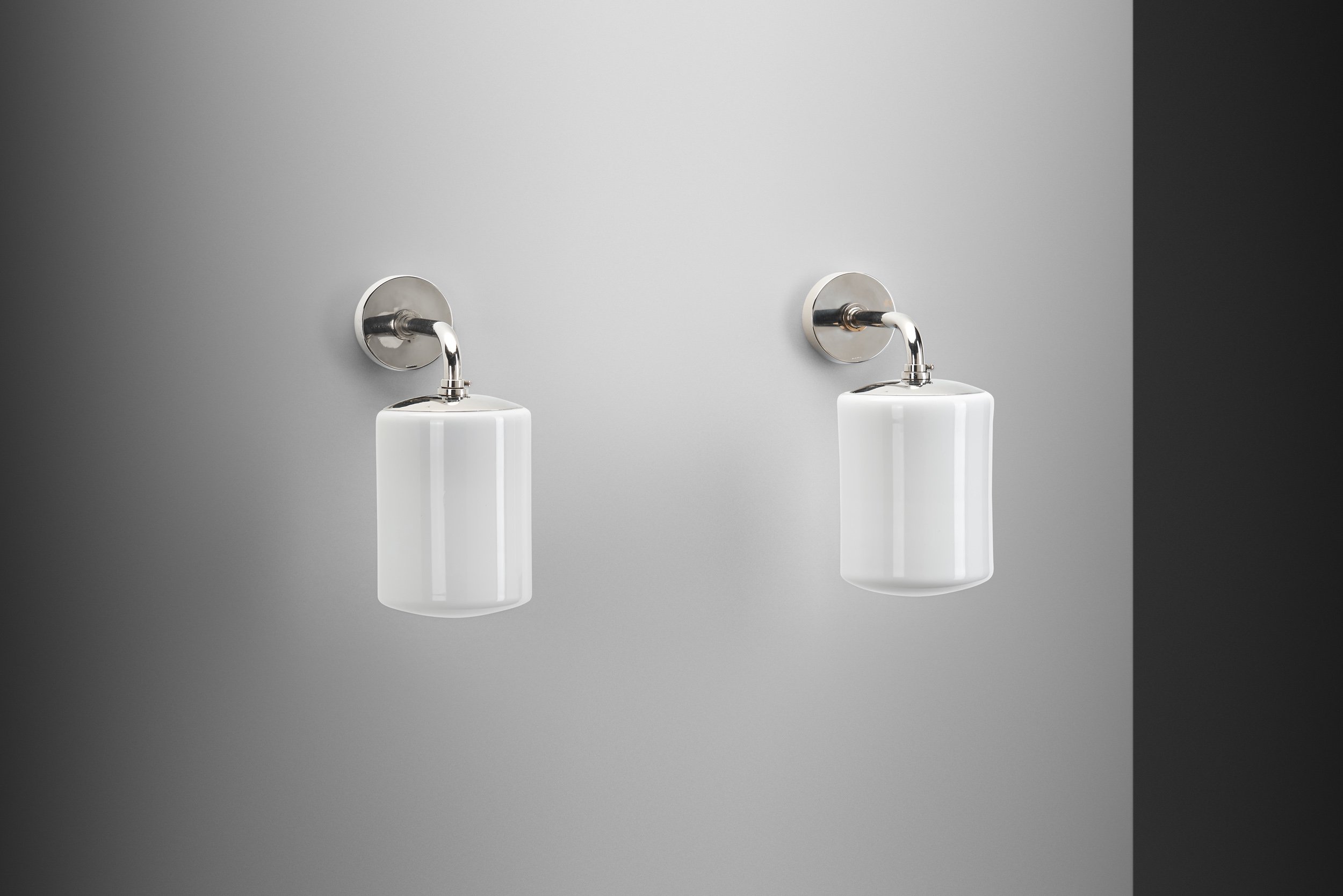
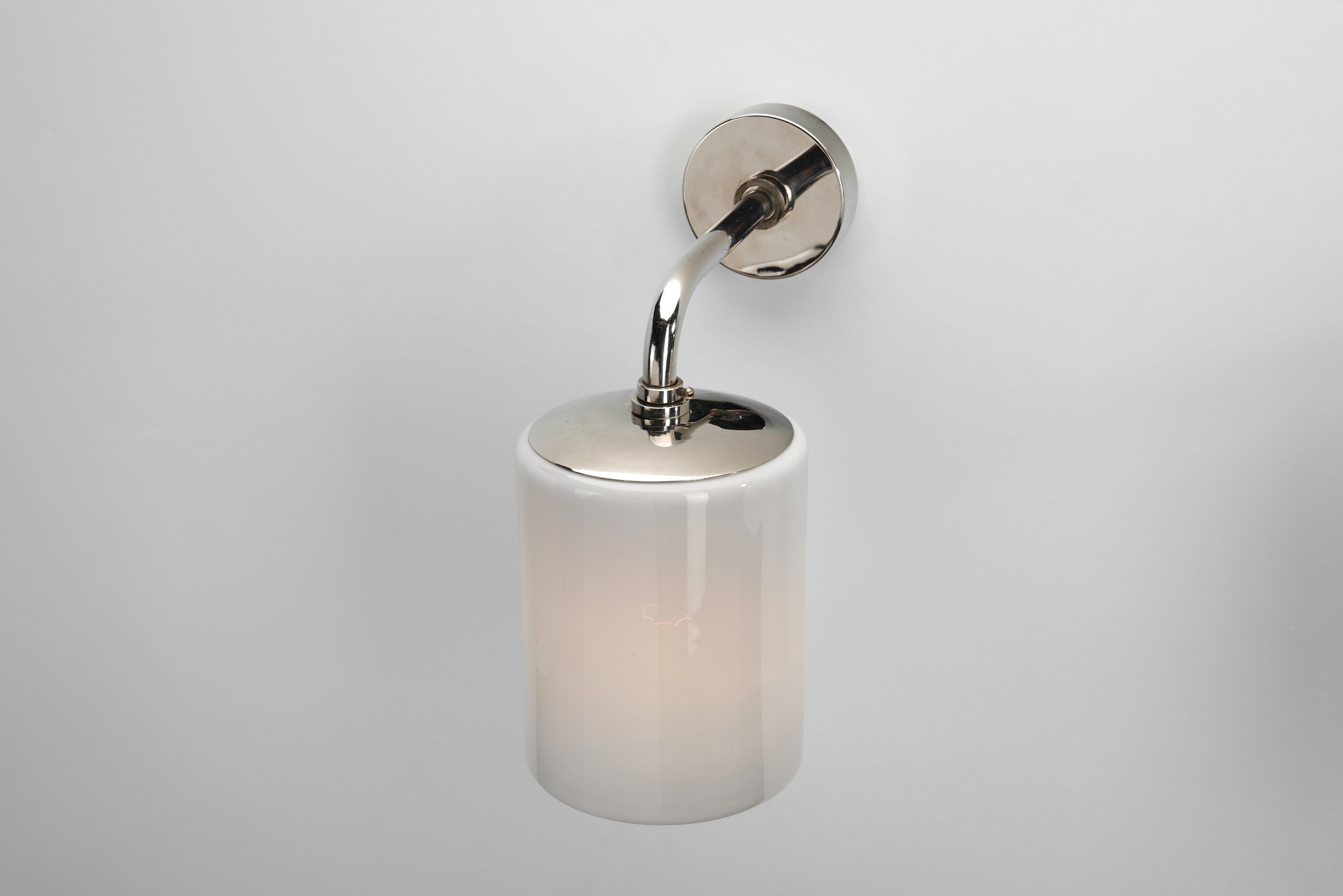
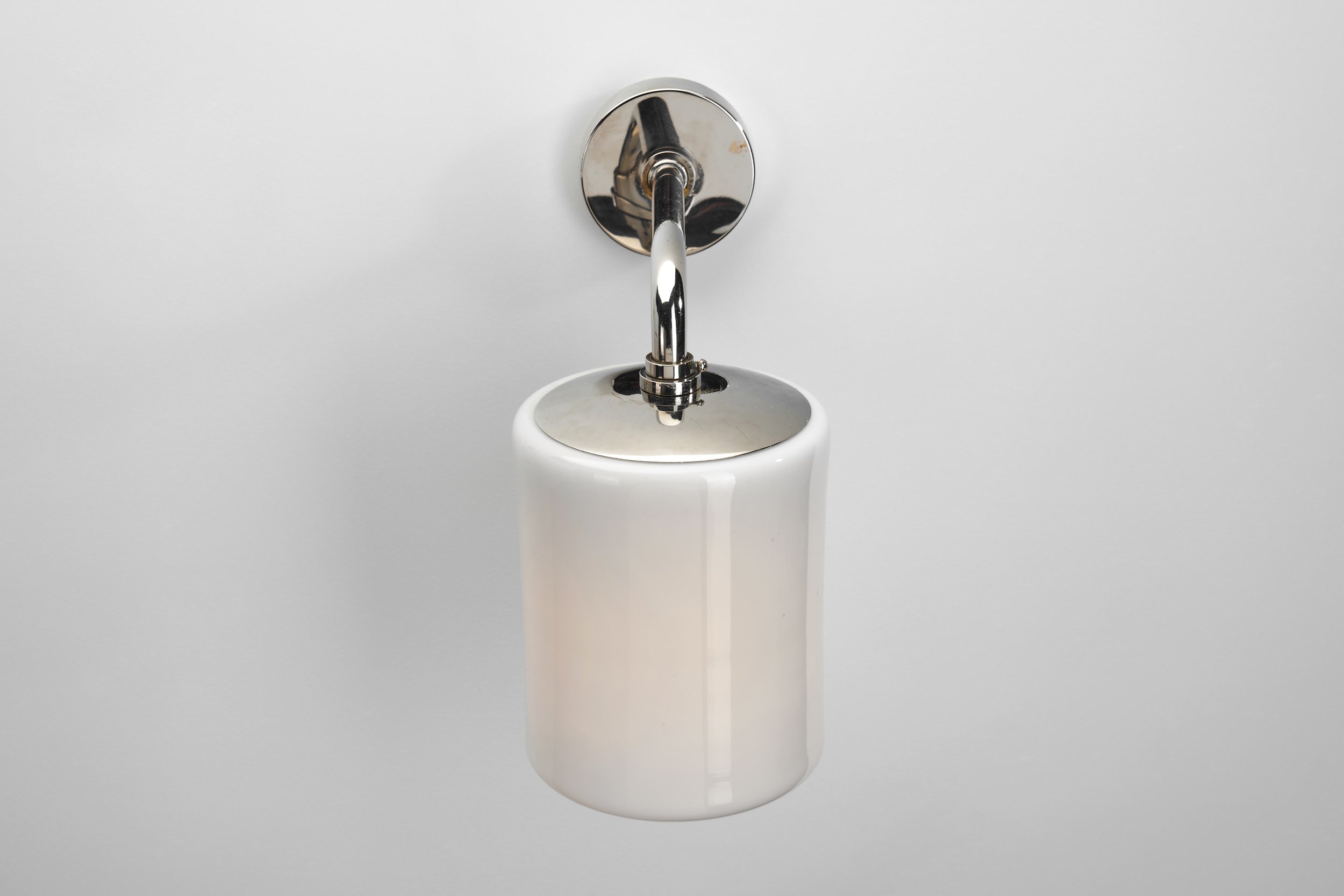
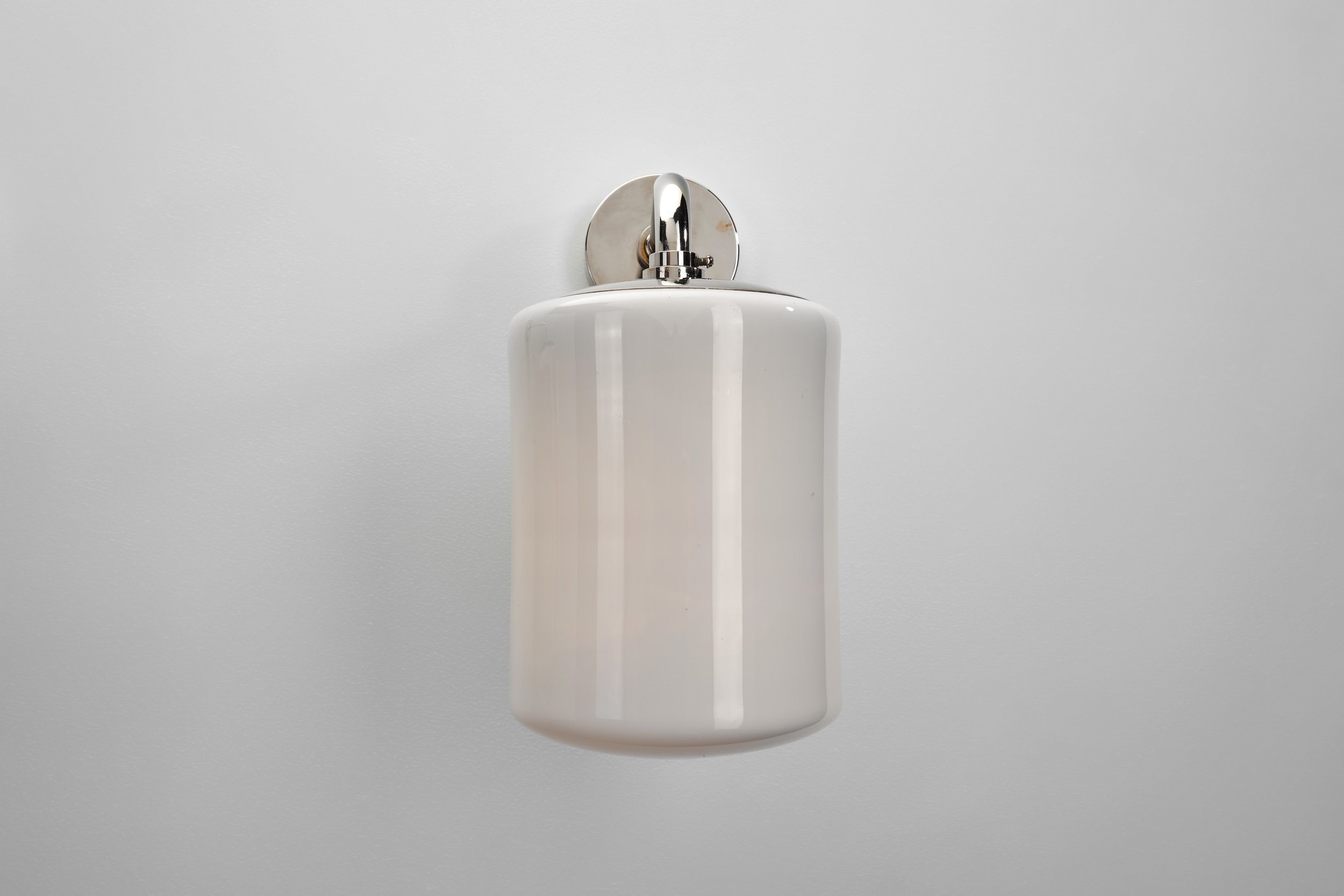
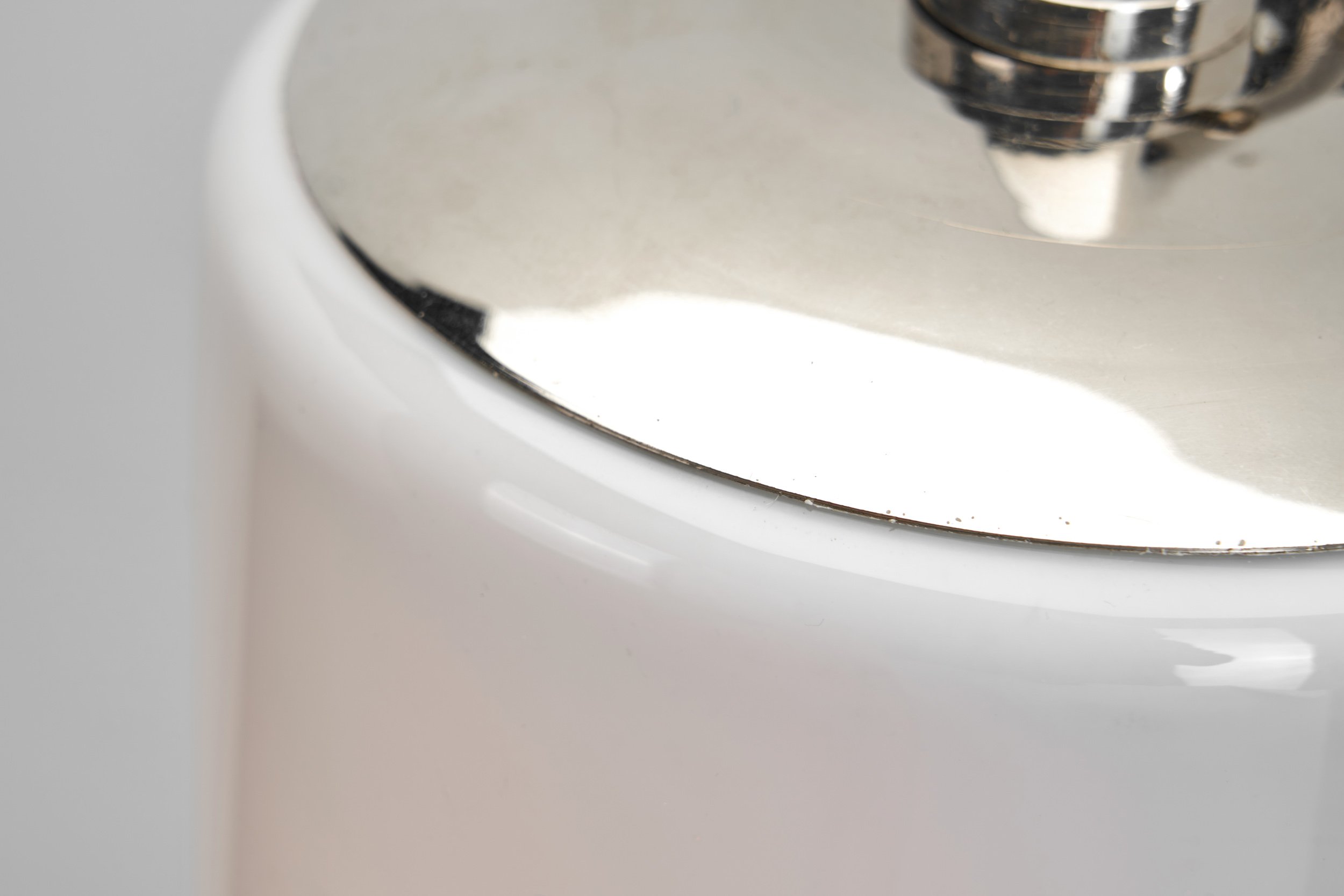
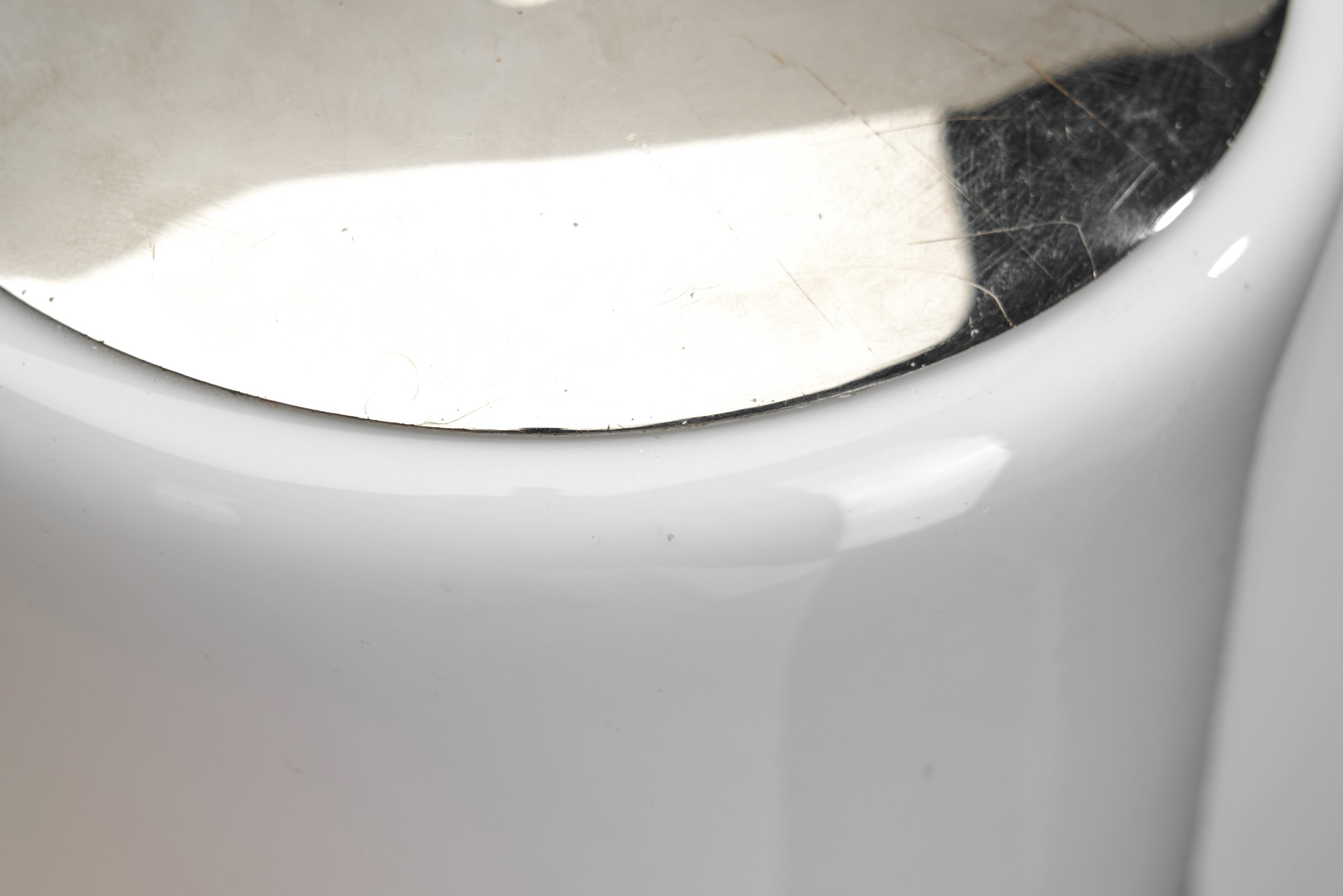


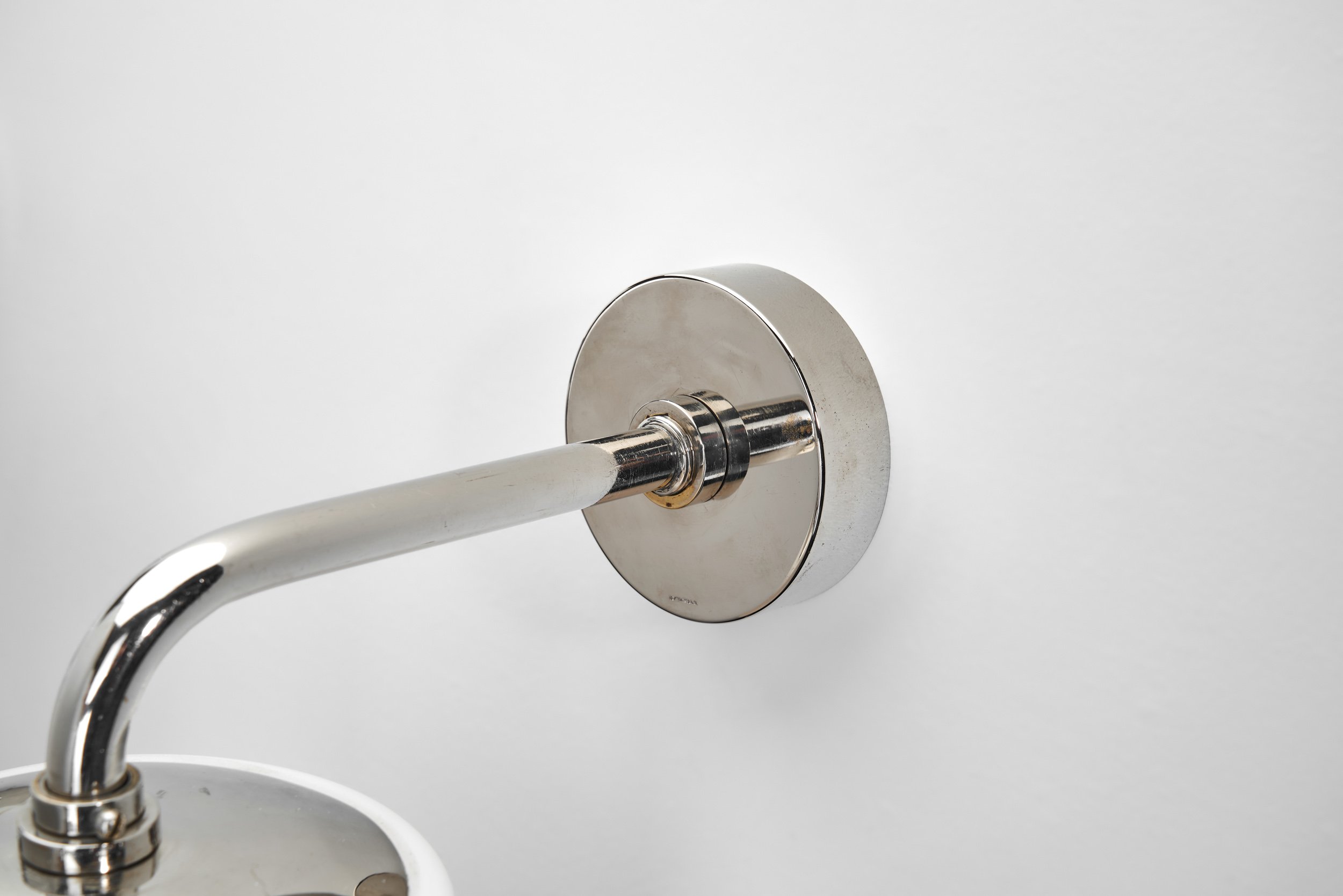
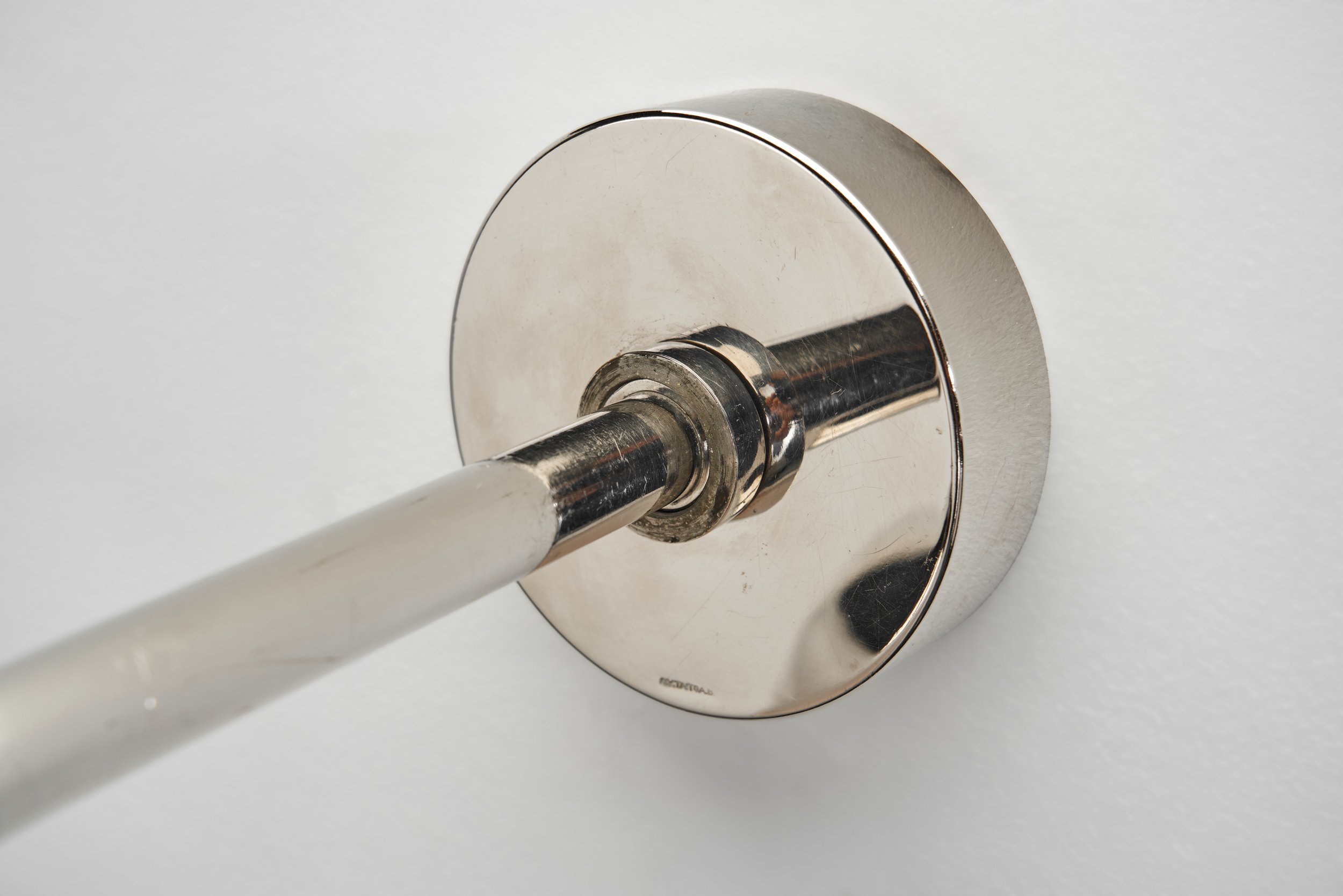
Pair of Model "7239" Wall Lights by Paavo Tynell for Taito, Finland 1930s
REQUEST PRICE HERE
Price category: 9,000 - 12,500 usd / eur
Condition:
In good vintage condition. Wear consistent with age and use. The lamps have recently been rewired and reconditioned. Due to the nature and age of the materials, the items have minor marks, scratches, and discolouration. Additional imperfections on the glass may be present due to manufacturing inconsistencies and age. All lighting can be converted for US usage.
Dimensions:
5.51 in W x 9.64 in D x 11.81 in H
14 cm W x 24.5 cm D x 30 cm H
REQUEST PRICE HERE
Price category: 5,000 - 7,500 usd / eur
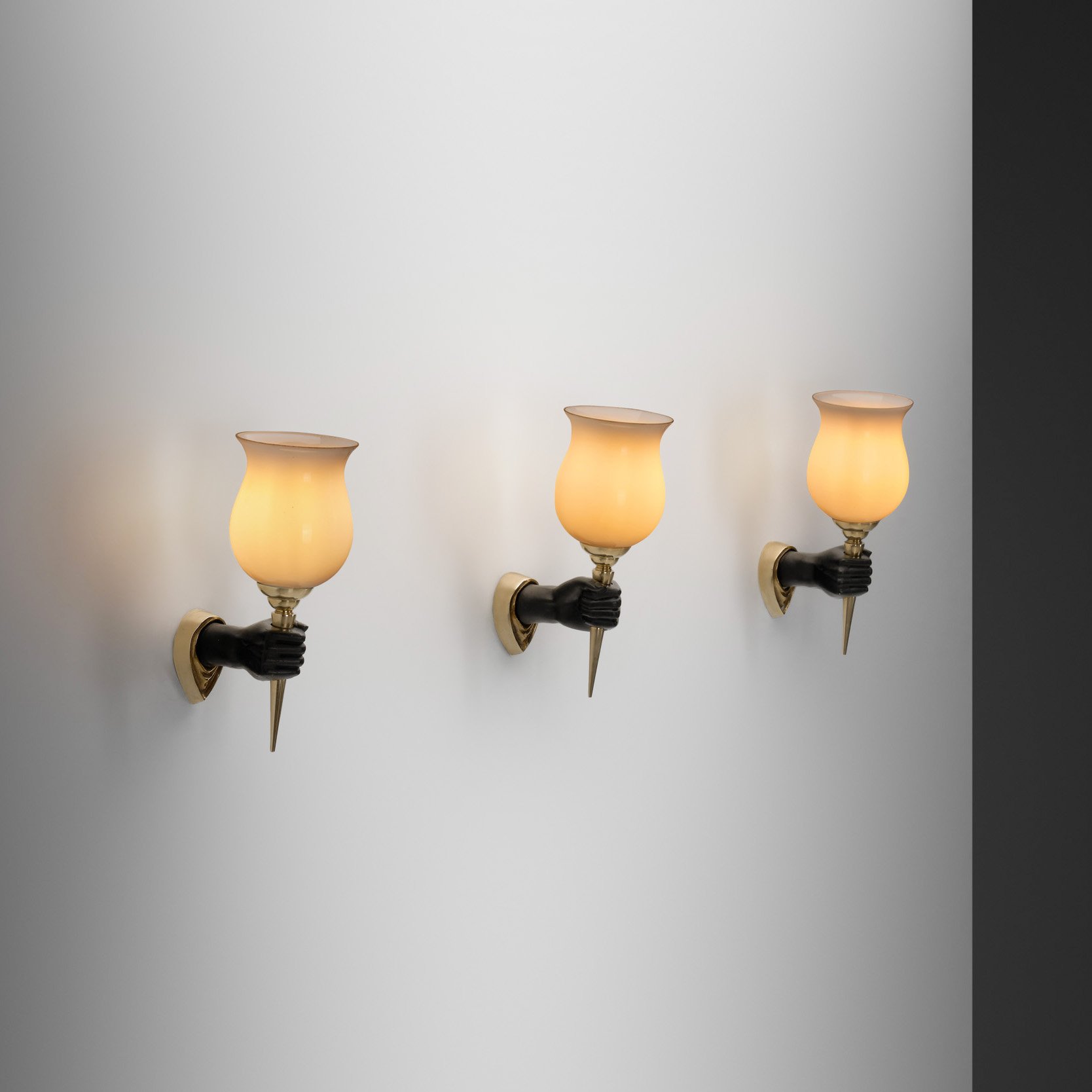
Art Deco emerged from the 1925 Paris Exposition, celebrating craftsmanship, modern materials, and stylised forms - balancing decorative flair with functional clarity. European designers became known during this period for combining bold forms with the durability of fine materials to create sophisticated lighting models like this set of three wall lamps.
These lamps perfectly marry strong edges with rounded curves to obtain the ideal balance of form. The set is constructed from patinated brass, and the material’s tones elegantly highlight both its age and craftsmanship. The interplay between the rich patina of the brass and the milk-white shades create a harmonious contrast, while the symmetrical arrangement reinforces the balance and rhythm central to Art Deco design. The visual interest of this set is accentuated by the form of the hands that suspend from the wall mounting to the body of the lamps - reminiscent of a hand holding a torch or even a wine glass. When lit, the lamps create an exceptionally atmospheric light, giving the brass a warm colour. Wall lamps such as this are a timeless example of how thoughtful craftsmanship can result in lighting fixtures that transcend their utilitarian purpose, becoming works of art in their own right. Today, we consider Art Deco and the early 20th century era a golden age for lighting design. During these decades, some of the most significant luminaries were created, and remain highly sought-after today.
This wall lamp set bridges sculptural presence and domestic functionality. It embodies the enduring qualities of the Art Deco movement in Europe: geometric refinement, tonal richness, and atmospheric light. The qualities of this set transform it into a bold design statement, while still able to complement a modern space.
Condition:
In good vintage condition. Wear consistent with age and use. The lamps have recently been rewired and reconditioned. The glass has some imperfections. Due to the nature and age of the materials, the item may have some marks, scratches, and discolouration. The lamps are compatible with E26 / E27 (standard) fittings. All lighting can be converted for US usage.
Dimensions:
4.33 in W x 6.69 in D x 11.49 in H
11 cm W x 17 cm D x 29 cm H
REQUEST PRICE HERE
Price category: 7,500 - 10,000 usd / eur
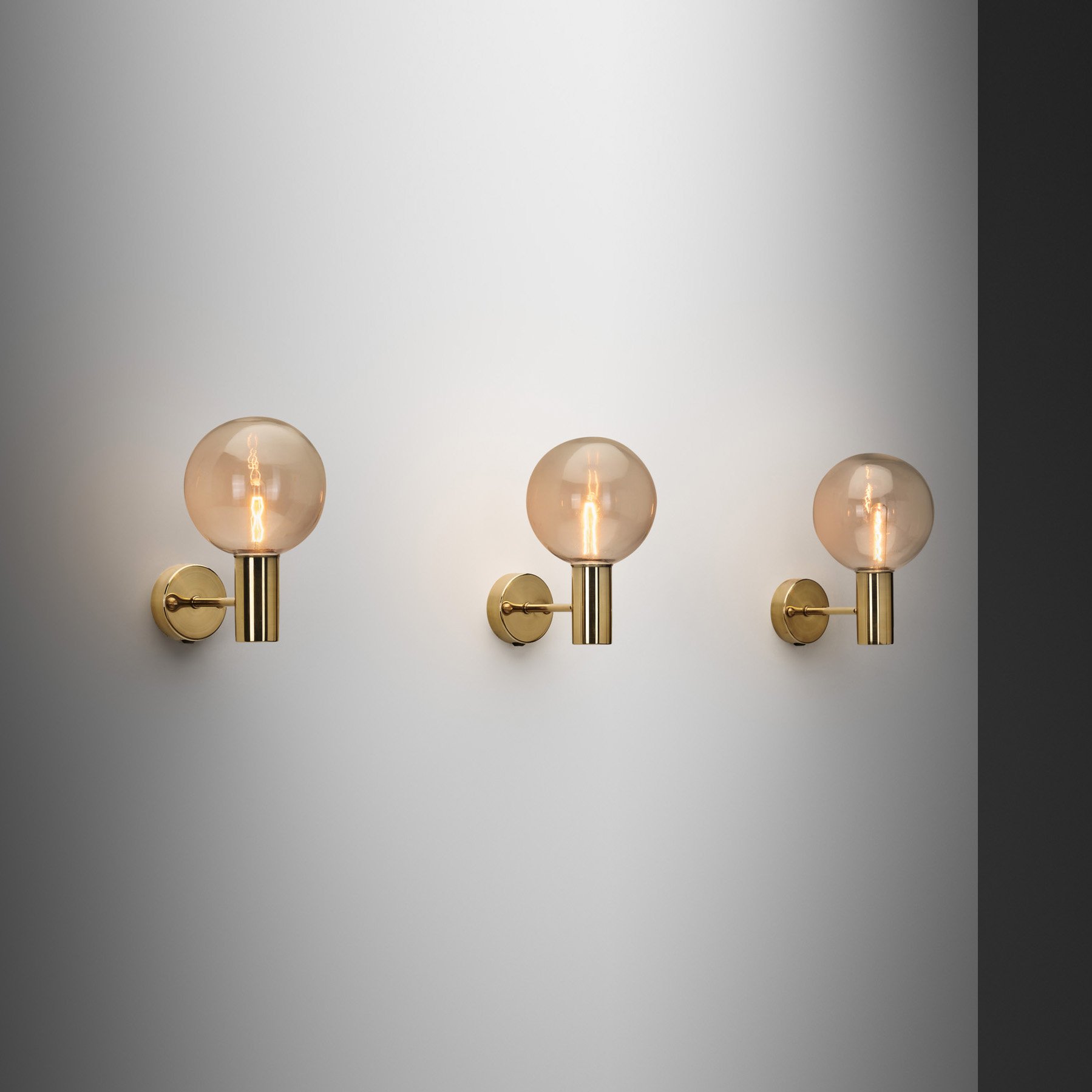
While Hans-Agne Jakobsson designed and produced various types of furniture, his lighting received greater international attention, and not without good reason. As this set of “V-149” wall sconces showcases, the Swedish designer mastered both the direction and colour of his lighting designs.
With the brass frame holding a translucent glass shade, these lamps clearly shows the Swedish designer’s studies in architecture, with beautiful geometric forms and symmetry dominating the structure. Like most mid-century Swedish lighting designs, this model is also dominated by its brass structure. The popularity of brass can be attributed to its golden hue, which adds warmth to the style's modern aesthetic. This model further emulates the mid-century modern movement's guiding principles through its clean lines and geometric shapes. The structure is composed of a back-plate and pole holding a large, elongated brass socket. Next to the brass, the translucent glass shade stands out with a shape that resembles a pressed sphere and has a generous size. Furthermore, thanks to the arrangement of the brass pole and the shade, this wall sconce divides the light evenly and brightens the yellow brass beautifully, creating a cosy, warm visual effect. This model was produced by Hans-Agne Jakobsson’s own company in Markaryd, Sweden.
Sconces are a timeless type of lighting fixture that can easily elevate their surroundings. These fixtures never go out of style, and have been in use for centuries. This is especially true for mid-century brass models like the "V-149". While already stunning individually, these light models are even more effective when placed in close proximity to each other.
Condition:
In good vintage condition. Wear consistent with age and use. The lamps have recently been rewired and reconditioned. Slight crack on one of the shades, but is not visible when mounted. Due to the nature and age of the materials, the items may have some marks, scratches, and discolouration. Minor imperfections on the glass may be present due to manufacturing inconsistencies and age. These lamps are compatible with an E26 / E27 (standard) fitting. All lighting can be converted for US usage.
Dimensions:
5.51 in W x 8.07 in D x 9.05 in H
14 cm W x 20.5 cm D x 23 cm H

REQUEST PRICE HERE
Price category: 5,000 - 7,500 usd / eur
Tynell's lamps have developed in style over time; his early lamps had a chandelier inspired design, during the 1920s, the use of glass became an increasingly important part of his lamps. During the interwar period, Tynell designed both art deco-style lamps and more functionalistic, simpler lamps. In his functionalist inspired lamps, Tynell took into account how the lamp was to be used, which is clearly traceable in the design of these “A2” lamps.
The modernistic look is achieved by the simple, yet smart design of the black lacquered cylindrical silhouette. The look is almost industrial, yet has the edge is Finnish mid-century design. By the 1950s, Finland had established itself as a force for innovation in design, and the versatility of Tynell explains why. As seen in this model, the masterful combination of materials, blend of aesthetic and functional design features, and expert craftsmanship was indispensable. Despite being made of metal, the bodies appear light mainly thanks to the structures connecting to the backplates that allow the lamps to be adjusted in almost any direction and angle. Furthermore, since the cylinders are open at both ends, providing two sources of light, making this pair both ideal task and ambient light sources. The two main structural elements - the white shade holders, and backplates and the black shades are clearly separated both by their colours and shapes. This results in a greatly balanced look that Tynell was a master of. The most significant clientele of the luminaires designed by Tynell were architects, which made Paavo Tynell the leading lighting designer for public spaces, and that likely goes for these “A2” wall lights as well.
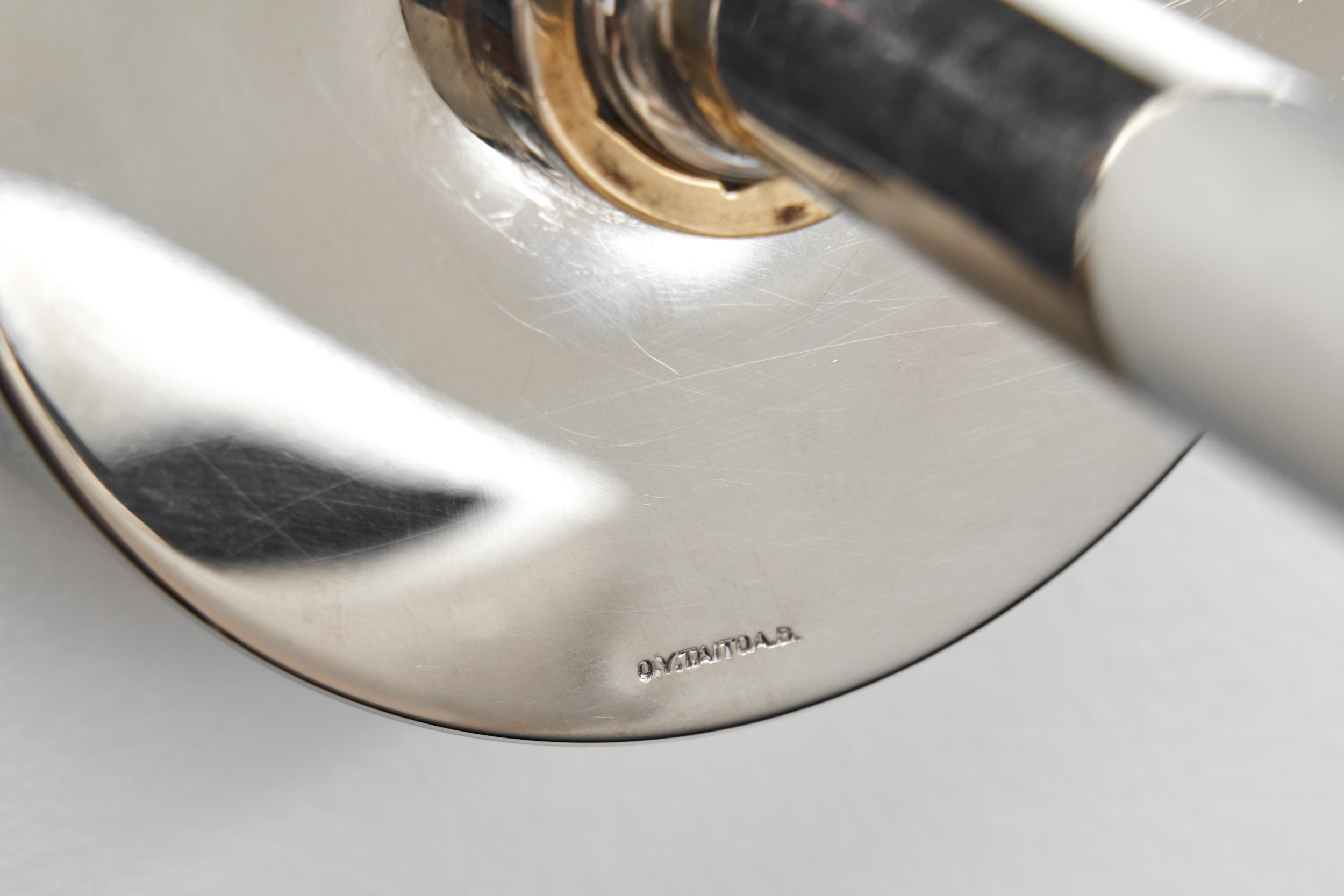
The lamps still have Idman Oy’s manufacturer’s mark. The firm, Taito Oy, was established by Tynell in 1918, and it would become his life work. In 1953, Idman Oy acquired the majority of shares in Taito Oy, nonetheless, Paavo Tynell continued to work for the company on a freelance basis, through his own design firm. This model was designed and produced during this time.
Condition:
In good vintage condition. Wear consistent with age and use.
Dimensions:
5.9 in W x 7.28 in H x 8.85 in H
15 cm W x 18.5 cm D x 22.5 cm H
About the designer:
Paavo Tynell (1890-1973) was an industrial designer, known as the great pioneer of Finnish lighting design and fondly dubbed as “the man who illuminated Finland”.
Tynell was one of the founders and chief designers of Taito Oy – the first industrial producer of lighting fixtures in Finland. With the innovation of electricity in the beginning of the 20th century, Taito Oy and Tynell expanded the thinking and manufacturing of modern lighting solutions in Europe and abroad.
Paavo Tynell rose to prominence in the 1930s and 40s where he collaborated with some of the most renowned Finnish architects, Alvar Aalto being the most notable one. Working to incorporate artificial lighting into modern environments, Tynell’s company Taito Oy produced fixtures for all of Alvar Aalto’s major projects including the Paimio Sanatorium and the Viipuri Library.
Tynell was especially appraised through his involvement with the Finland House, a design atelier in New York that showcased the work of Finnish designers and craftspeople. His elegant brass designs became an instant success in North America, and he began creating lighting designs for the prestigious American company Lightolier.
A master craftsman himself, Tynell’s designs were derivative of a traditional aesthetic with a modern sensibility, mixed with an extensive use of perforated and polished brass as material. Marked by delicacy and softness, his most famous forms in lightning echo the structures of nature; he adroitly created sculptural shapes reminiscent of the branches of trees, swirling snowflakes and seashells. ~H.
REQUEST PRICE HERE
Price category: 2,500 - 5,000 usd / eur
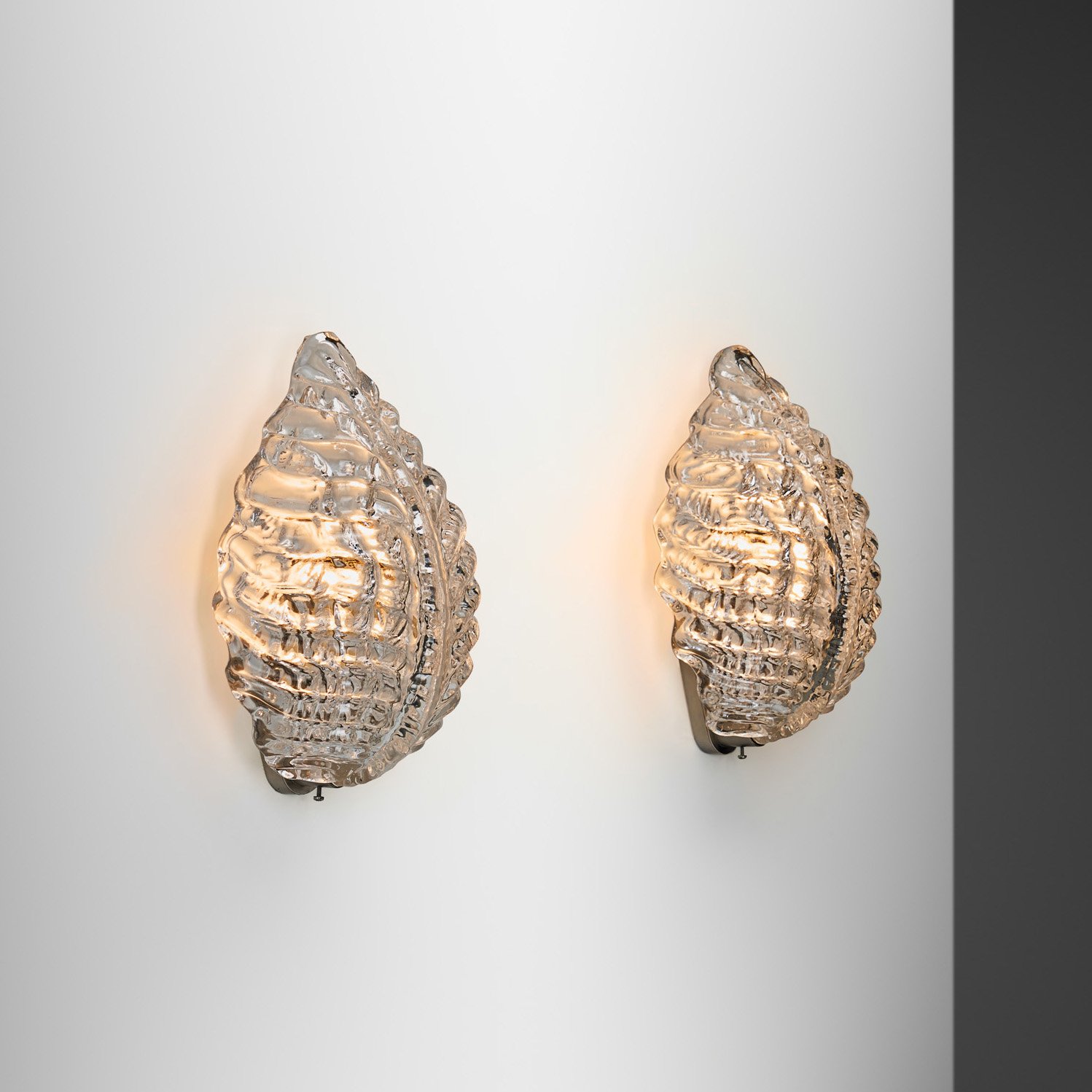
This pair of Swedish wall lamps attributed to Fritz Kurz is a playful example of the eccentric side of Scandinavian mid-century modern design. These crystal glass lamps’ organicity is quite literally expressed, representing the rare, more decorative models of Swedish modernism.
The lamps are made of a block of cast leaf-shaped glass on a metal base. These delicate leaf-shaped lamps showcase the unique qualities of the glass. The resulting effect is stunning, with shadows resulting from the play of light when the lamps are lit, creating an ambient mood while also highlighting the organic form. As flush mounts, the lamps are very close to the wall, connected to it by metal back-plates. At its most basic level, these lamps combine sleek lines with organic shapes, using new materials and methods to re-imagine traditional pieces. This model is mounted so that the body of the fixture is hidden, leaving only the shades on top of the surface. The glass’s shape truly stands out thanks to this, especially when illuminated. This pair exemplifies the expressive possibilities of glass design in the mid-20th century. More than functional objects, they serve as luminous reliefs, sculptures that animate the wall with texture and reflection.
The history of Orrefors is the story of how the simplest ingredients – lime, sand, and soda – can become magnificent glass objects. While glass has its limits, Orrefors craftsmen got as close to them as possible. Thanks to this effort, the full effect of this pair is of a real room jewel.
Condition:
In good vintage condition. Wear consistent with age and use. The items have recently been rewired and reconditioned. Minor marks, scratches and imperfections may be present on the glass due to manufacturing inconsistencies and age of the items.
Dimensions:
7.87 in W x 6.69 in D x 11.81 in H
20 cm W x 17 cm D x 30 cm H
REQUEST PRICE HERE
Price category: 2,500 - 5,000 usd / eur
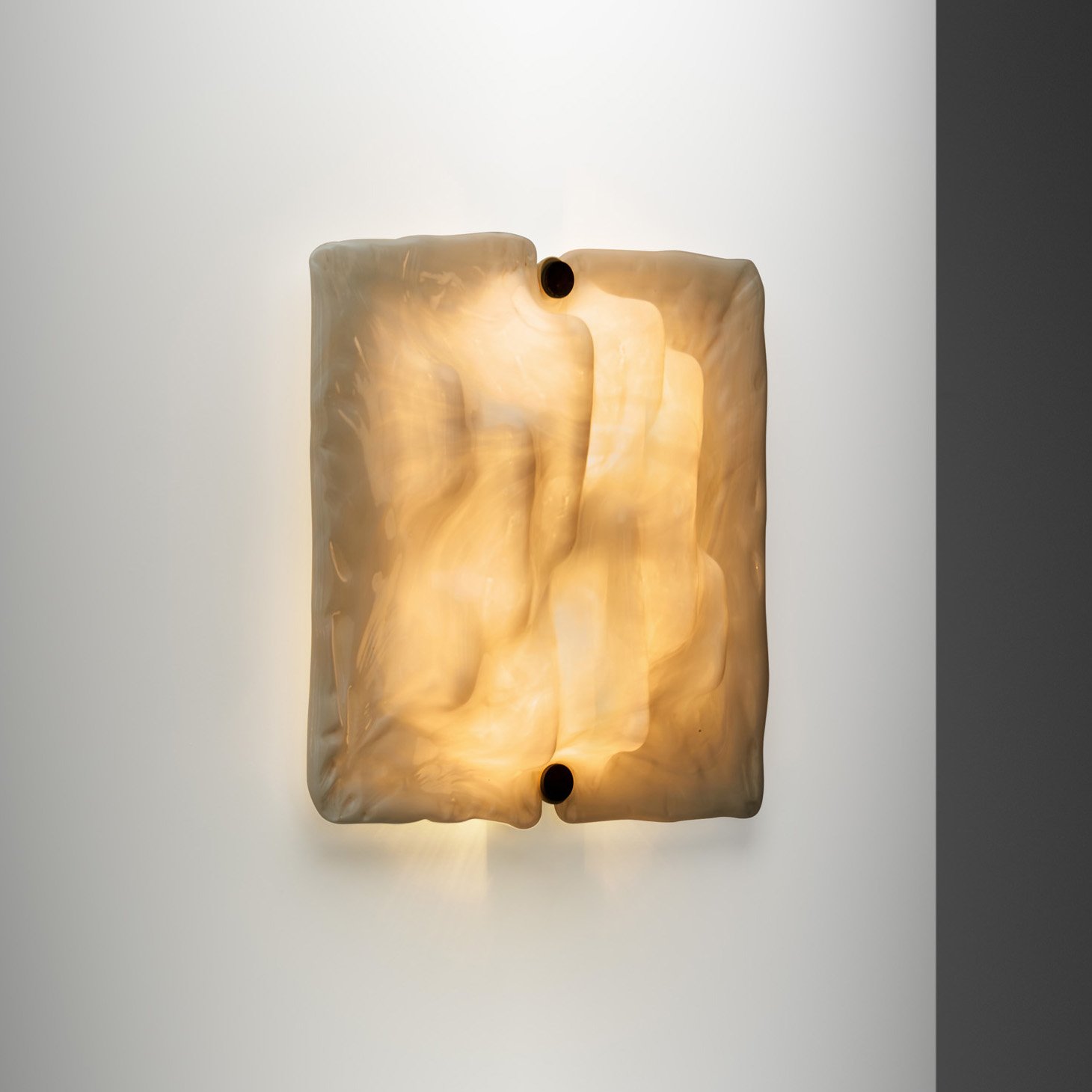
Toni Zuccheri was an Italian architect, painter and designer, whose work sits at the intersection of craftsmanship and experimentation. He developed a deep sensitivity to glass as both a functional and expressive medium. Throughout the 1960s, in his early twenties, Zuccheri collaborated with some of Italy’s leading manufacturers, including Venini, as well as with other iconic designers of the period, such as Geo Ponti. He pushed the limits of glass-making techniques to create objects that integrated sculptural form with atmospheric light.
This wall light reflects Zuccheri’s signature approach of texture and form. The piece is made of thick, moulded glass that appears almost fluid, its surface rippling with irregular folds and undulations. The glass diffuses light in a way that is both gentle and practical, creating a glow that shifts across the surface. When turned on, the lamp reveals subtle variations in tone and depth, recalling the organic qualities of ice or flowing water. This sculptural piece is secured by small metal screws that add an understated industrial contrast to the glass’s organic look. Despite the rather simple materials, the fixture commands presence through its tactile complexity and the play of light and shadow it produces. Zuccheri’s ability to manipulate glass beyond its rigid form gives the lamp an individual, hand-made character.
This wall light exemplifies the expressive possibilities of Italian glass design in the mid-20th century. More than a functional object, it serves as a sculpture that animates the wall with texture and reflection. It embodies Zuccheri’s belief that light could be both a material and an emotion, revealing the artistic depth that defines his contribution to postwar Italian design.
Condition:
In good vintage condition. Wear consistent with age and use. The lamp has recently been rewired and reconditioned. Minor marks, scratches, and imperfections may be present due to manufacturing inconsistencies and age of the item.
Dimensions:
14.37 in W x 4.33 in D x 14.56 in H
36.5 cm W x 11 cm D x 37 cm H
REQUEST PRICE HERE
Price category: 2,500 - 5,000 usd / eur
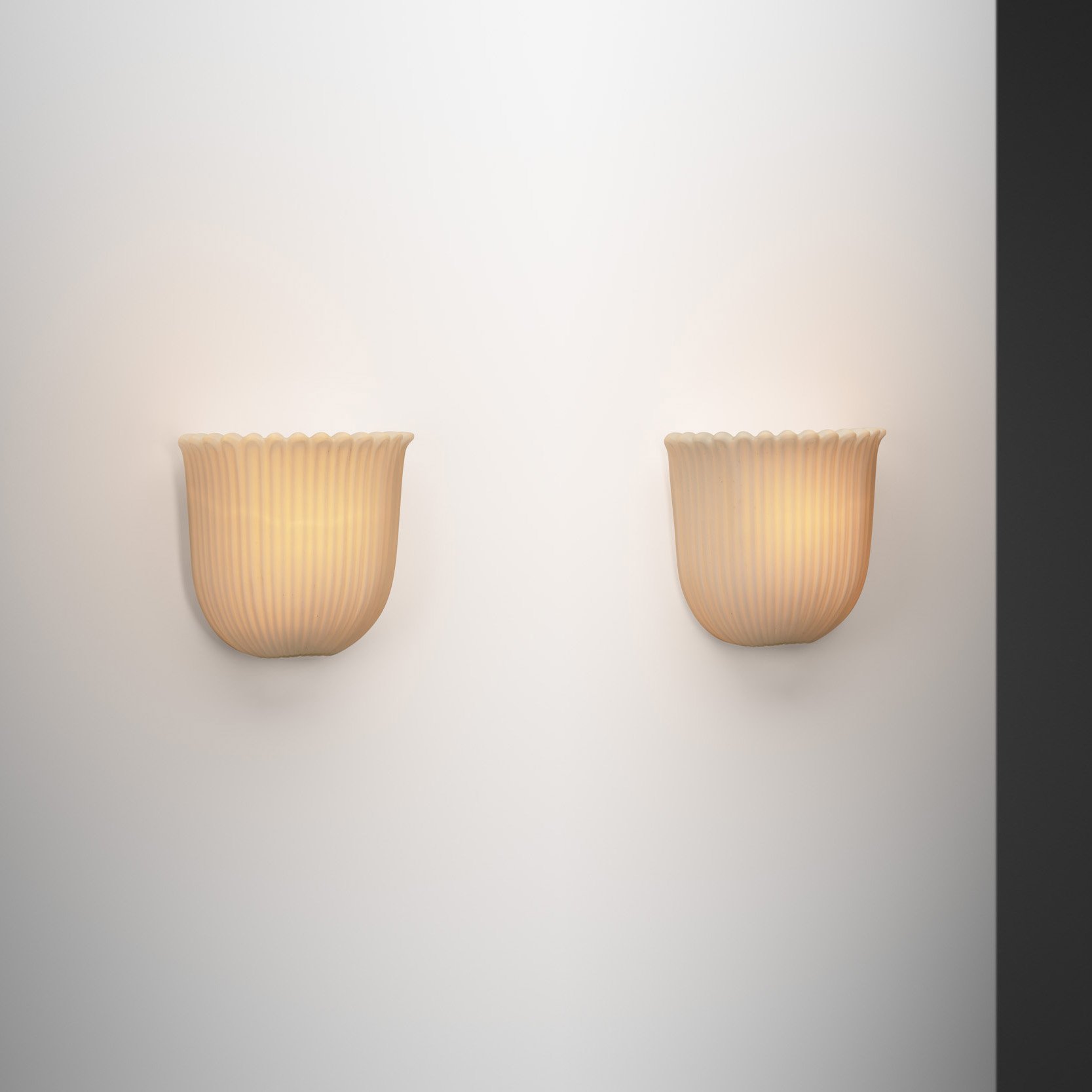
Glashütte Limburg is a German manufacturer, where impeccable craftsmanship remained in the focus throughout the past decades. While the designer of this model is unknown, many lamps of the company were created by the Designabteilung Glashütte Limburg (design department) or Atelier Glashütte Limburg.
These “2877” wall lamps are a subtle yet playful example of the sleek minimalism of the mid-century modern style. Early 1970s design accelerated the emergence of bold personal expression with an explosion of new shapes and textures to saturate households. This model’s main feature is both material, and its shape, as they are made of high-quality ribbed glass. The opaque glass, with its milky colour, evokes a sense of ethereal beauty and warmth, transforming any space into a haven of ambient illumination. At its most basic level, these lamps combine sleek lines with organic shapes, using new materials and methods to re-imagine traditional pieces. This model is mounted so that the body of the fixture is hidden, leaving only the shades on top of the surface. The glass’s shape truly stands out thanks to this, especially when illuminated. Since these wall lamps combine a traditional shape with innovative, modern touches, the result is a look that has a both timeless and contemporary feel to it. They are a little jewel that is sure to bring interest to any wall surface and a cosy, atmospheric lighting.
Adding illumination to a living space with this pair will not only improve the ambience, it will also bring a piece of design history to the space. Apart from the aesthetics, the quality of these lamps is true to its German design heritage.
Condition:
In good vintage condition. Wear consistent with age and use. The lamps have recently been rewired and reconditioned. Minor marks, scratches, and imperfections may be present on the glass due to manufacturing inconsistencies and age of the items.
Dimensions:
4.33 in W x 4.72 in D x 8.26 in H
11 cm W x 12 cm D x 21 cm H
REQUEST PRICE HERE
Price category: 2,500 - 5,000 usd / eur
“The man who illuminated Finland”, Paavo Tynell is one of the best-known Finnish lighting designers, and his work has had a great influence on modern lighting design in Finland, but also internationally.
The best qualities of Tynell's light fixtures are their atmospheric light and disciplined, functionalist design, exemplified by these model “2009” wall lamps. The design of this pair is dominated by the opal glass shades supported by the brass mounts. Tynell’s design merges together a simple and decorative shape with sculptural elements. This pair of lamps has great proportions, the shades are balanced by the back-plates to create the attention-grabbing look. When lit, these lamps create an exceptionally atmospheric light, giving the brass a warm colour as well. Quality control at Tynell’s Oy Taito Ab was perfectly thorough, therefore these lamps are durable and high-quality. This model already appeared in Taito’s #10 catalogue in 1935.
In 1918, Tynell co-founded the metalwork and lighting company Oy Taito Ab, and worked as the company’s CEO and chief designer until 1953. During the 1930s, he designed lighting for various public spaces, such as Helsinki’s Parliament House and the office of the Secretary-General of the United Nations. In his day, Paavo Tynell’s atmospheric light fixtures attracted attention as far away as the United States.
Condition:
In good vintage condition. Wear consistent with age and use. Due to the nature and age of the brass, the items may have marks, scratches, and discolouration. Additional imperfections may be present on the glass due to age and manufacturing inconsistencies.
Dimensions:
7.08 in W x 8.66 in D x 7.08 in
18 cm W x 22 cm D x 18 cm H

REQUEST PRICE HERE
Price category: 2,500 - 5,000 usd / eur
These Lyfa-edition “Saga” wall sconces by Danish architect and designer, Kay Kørbing are true collectors’ pieces. By the 1950s, Lyfa had built an international reputation for original, high-quality, modernist lamps. In the postwar era, the company collaborated with esteemed architects and designers to produce minimalist, sculptural pieces including these lamps.
Made of brass, metal, and crystal, the design of this model is entirely in the vein of modernism, while also sticking to the main ideals of Danish design, such as functionality. This can be observed in the lamps’ build that allows them to be faced either up- or downwards. The proportions are carefully thought out, with three main sections comprising the design. The three elements - the brass base, black metal shade holder, and the crystal glass shade - are clearly separated both by their shape, material, and colour. Most eye-catching are the Orrefors crystal glass shades in a peculiar shape that appear to be roll cut. Orrefors has been established in Swedish design tradition since 1898. Glass from the forests of Småland was incomparable: “Il n’y a que ça!” (There is nothing like it!) exclaimed the 1925 Paris World Fair. As these sconces showcase, the glass and shape are always in focus, combined with elegance, simplicity, and confidence. The predominantly round shapes are balanced by the square backplate. The artistic design is very honest in a purely Scandinavian manner, exposing the joinery and the materials’ natural qualities as well.
This pair of “Saga” wall sconces is a stunning example of how the 1960s are still able to deliver modern "art" to any interior. The producer, Lyfa, produced some cabin lamps and in its heyday - from the 1950s to mid-1970s - was considered a pioneer in innovative, architectural lighting. It is believed that Kay Kørbing designed this model for two school ships: M/S Princesse Margrethe and M/S Winston Churchill.
Condition:
In good vintage condition. Wear consistent with age and use. The brass body has a beautiful patina with some marks and discolouration. The glass has some marks and chips.
Dimensions:
4.72 in W x 5.51 in D x 13.77 in H
12 cm W x 14 cm D x 35 cm H

REQUEST PRICE HERE
Price category: 7,500 - 10,000 usd / eur
The most famous Finnish industrial designer, Paavo Tynell came to be known as the “man who illuminated Finland” thanks to his notable lighting designs. Functionality, a pared down, simple style and a thoughtful colour palette are key principles for Paavo Tynell, and are present in this set of three wall lamps.
In Tynell’s Functionalism inspired lamps, he would often consider how the lamp was to be used, the colour of the light, and the opal glass's nuances. This model dates to the designer’s pre-brass era and is executed in an early modern functionalist style. These lamps have a gentle, round shape that is just as soft as the light they diffuse. Even in the absence of ornamentation or elaborate shapes and forms, there is still an emphasis on interesting materials. Opal glass was a popular material for lighting fixtures of this era, due in part to its ability to difuse light. As this set demonstrates, it was also prized for its lustrous, opaque finish, which gives these lamps a sophisticated and refined look. Tynell was a master of working with this material, and his opal glass lamps are some of his most sought-after designs even today. These wall lamps are not only embodiments of simplicity and elegance, showcasing a design ethos that continues to captivate admirers, but also illustrate how minimalist design can be ingenious and expressive at the same time.
This set was manufactured by the famous Finnish factory Taito Oy, one of the most innovative Scandinavian lighting design companies of the mid-century era. Paavo Tynell was the co-founder and chief designer of the company until 1953. The company’s lighting designs defined the Finnish mid-century era, and the models of the period, including this set, are greatly sought after to this day.
Condition:
In good vintage condition. Wear consistent with age and use. The lamps have recently been rewired.
Dimensions:
8.26 in W x 16.14 in D x 12.59 in D
21 cm W x 41 cm D x 32 cm H

REQUEST PRICE HERE
Price category: 5,000 - 7,500 usd / eur
Finnish mid-century design is characterized by simple, elegant forms that Paavo Tynell was a master of. Like Finnish culture he embraced timeless beauty, sustainability and a deep connection to the natural world. His favourite material to work with was brass, and he formed the material into shapes that are very characteristic and unique.
Functionality, a pared down, simple style and a thoughtful colour palette are key principles for the Finnish icon, whose model “9414” features organic lines and focuses on the characteristics of brass itself. The lamp is adjustable at multiple points; therefore, the angles can be changed freely. Material and colour palettes are very well considered in Finnish interiors, favouring naturally derived mediums and a strong connections with nature. The forms in Tynell’s designs tend to divert from typical symmetrical, rectangular shapes, and the designer’s artistic ability to easily connect line and material is especially visible in this unique wall light. Its organic brass body holds a textile shade that has a dimming effect to create atmospheric light. The shade, like the neck, can be adjusted at its top to direct the light. The clever solutions allow this lamp to be very versatile and customizable. In the spirit of Finnish mid-century design and culture, this lamp takes on exciting, free forms adjusted to the user needs. The organically derived forms help to build an intimate, friendly, and welcoming environment.
This lamp was manufactured by the famous Finnish manufactory Taito Oy, one of the most innovative Scandinavian lighting design companies of the mid-century era. Paavo Tynell was the co-founder and chief designer of the company until 1953. The company’s lighting designs define the Finnish mid-century era, and the models of the period, including this “9414” model, are greatly sought after to this day.
Condition:
In good vintage condition. Wear consistent with age and use. The lamp has a custom textile shade that approximates the design of the original.
Dimensions:
31,10 in W x 9.06 in D x 14.57 in H
79 cm W x 23 cm D x 37 cm H
About the designer:
Paavo Tynell (1890-1973) was an industrial designer, known as the great pioneer of Finnish lighting design and fondly dubbed as “the man who illuminated Finland”. Tynell was one of the founders and chief designers of Taito Oy – the first industrial producer of lighting fixtures in Finland.
With the innovation of electricity in the beginning of the 20th century, Taito Oy and Tynell expanded the thinking and manufacturing of modern lighting solutions in Europe and abroad. Paavo Tynell rose to prominence in the 1930s and 1940s, during which period he collaborated with some of the most renowned Finnish architects, including Alvar Aalto. Working to incorporate artificial lighting into modern environments, Tynell’s company, Taito Oy produced fixtures for all of Alvar Aalto’s major projects including the Paimio Sanatorium and the Viipuri Library.
Tynell was especially appraised through his involvement with the Finland House, a design atelier in New York that showcased the work of Finnish designers and craftspeople. His elegant brass designs became an instant success in North America, and he began creating lighting designs for the prestigious American company Lightolier.
A master craftsman himself, Tynell’s designs were derivative of a traditional aesthetic with a modern sensibility, mixed with an extensive use of perforated and polished brass as material. Marked by delicacy and softness, his most famous forms in lightning echo the structures of nature; he adroitly created sculptural shapes reminiscent of the branches of trees, swirling snowflakes and seashells. ~H.

REQUEST PRICE HERE
Price category: 1,000 - 2,500 usd / eur
“The man who illuminated Finland”, Paavo Tynell is one of the best-known Finnish lighting designers, and his work has had a great influence on modern lighting design in Finland, and internationally.
The best qualities of Tynell's light fixtures are their atmospheric light and disciplined, functionalist design, exemplified by these two model “2008” ceiling lamps. The design of this model is dominated by the opal glass shades supported by the nickel plated brass stems. Tynell’s design merges together a simple and decorative shape with sculptural elements. These lamps have great proportions, the large shades are balanced by the backplates to create the attention-grabbing look. When lit, these lamps create an exceptionally atmospheric light, giving the nickel plated brass a vivid colour as well. Tynell’s designs are marked by a delicacy and softness that reveals his background in fine jewellery, and his most famous forms in lighting echo the structures of nature. Model “2008” is a modernist design to its core with a look that is timeless and can stand out and complement any space.
Idman Oy was established as early as 1897 by Karl Hjalmar Idman. In 1953, Idman Oy, acquired the majority of shares in Taito Oy, the company of Paavo Tynell. Paavo Tynell continued to work for the company on a freelance basis, through his own design firm. In his day, Tynell’s atmospheric light fixtures attracted attention as far away as the United States.
Condition:
In good vintage condition. Wear consistent with age and use. The metal base has some marks and staining. The mounting bases of the lamps differ slightly.
Dimensions:
7.08 in ⌀ x 7.87 in H
18 cm ⌀ x 20 cm H
Literature:
Idman Lighting Catalogue 140 – 1950s – Around 1956. p. 26.
About the Designer:
Paavo Tynell (1890-1973) was an industrial designer, known as the great pioneer of Finnish lighting design and fondly dubbed as “the man who illuminated Finland”. Tynell was one of the founders and chief designers of Taito Oy – the first industrial producer of lighting fixtures in Finland.
With the innovation of electricity in the beginning of the 20th century, Taito Oy and Tynell expanded the thinking and manufacturing of modern lighting solutions in Europe and abroad. Paavo Tynell rose to prominence in the 1930s and 1940s, during which period he collaborated with some of the most renowned Finnish architects, including Alvar Aalto. Working to incorporate artificial lighting into modern environments, Tynell’s company, Taito Oy produced fixtures for all of Alvar Aalto’s major projects including the Paimio Sanatorium and the Viipuri Library.
Tynell was especially appraised through his involvement with the Finland House, a design atelier in New York that showcased the work of Finnish designers and craftspeople. His elegant brass designs became an instant success in North America, and he began creating lighting designs for the prestigious American company Lightolier.
A master craftsman himself, Tynell’s designs were derivative of a traditional aesthetic with a modern sensibility, mixed with an extensive use of perforated and polished brass as material. Marked by delicacy and softness, his most famous forms in lightning echo the structures of nature; he adroitly created sculptural shapes reminiscent of the branches of trees, swirling snowflakes and seashells.
REQUEST PRICE HERE
Price category: 5,000 - 7,500 usd / eur
Danish wall lighting of the 1950s reflected the broader Scandinavian ambition to combine functionality with elegance and atmosphere. Lighting is a huge part of Danish and Scandinavian design, ranging from the warm, low light of a candle to the bright overhead glow of a ceiling light. Wall lamps offered a unique opportunity to create ambient illumination while simultaneously acting as decorative architectural elements within a room.
Brass and opal glass became particularly popular during this period, their combination allowing fixtures to feel both refined and inviting, as this pair exemplifies. Each fixture is constructed around a polished brass wall mount from which a gently sweeping arm extends outward, creating a fluid and elegant silhouette. The arm supports two tulip-shaped opal glass shades, whose organic forms introduce a softness that contrasts beautifully with the reflective brass structure. The scalloped brass collars appear almost like petals supporting the luminous shades above. When turned on, the opal glass diffuses the light evenly, producing a warm glow that enhances the golden tone of the brass and creates a welcoming atmosphere. The symmetry of the dual-light arrangement gives the lamps a balanced and harmonious appearance. Despite their relatively compact scale, the fixtures possess a distinct character, standing out through their nature-inspired form and timeless materials.
These wall lamps are a wonderful example of the appeal of Danish mid-century lighting. Their construction allows them to function equally well as practical light sources and decorative objects. Whether installed in a hallway, bedroom, or living space, they bring warmth, sophistication, and a sense of understated luxury to an interior. The enduring design demonstrates why Scandinavian lighting from this period continues to be so highly regarded today.
Condition:
In good vintage condition. Wear consistent with age and use. The lamps have recently been rewired and reconditioned. Due to the nature and age of the materials, the items may have marks, scratches, and discolouration. Minor imperfections on the glass may be present due to manufacturing inconsistencies. The lamps are compatible with an E26 / E27 (standard) fitting. All lighting can be converted for US usage.
Dimensions:
8.66 in W × 5.51 in D × 11.02 in H
22 cm W x 14 cm D x 28 cm H