
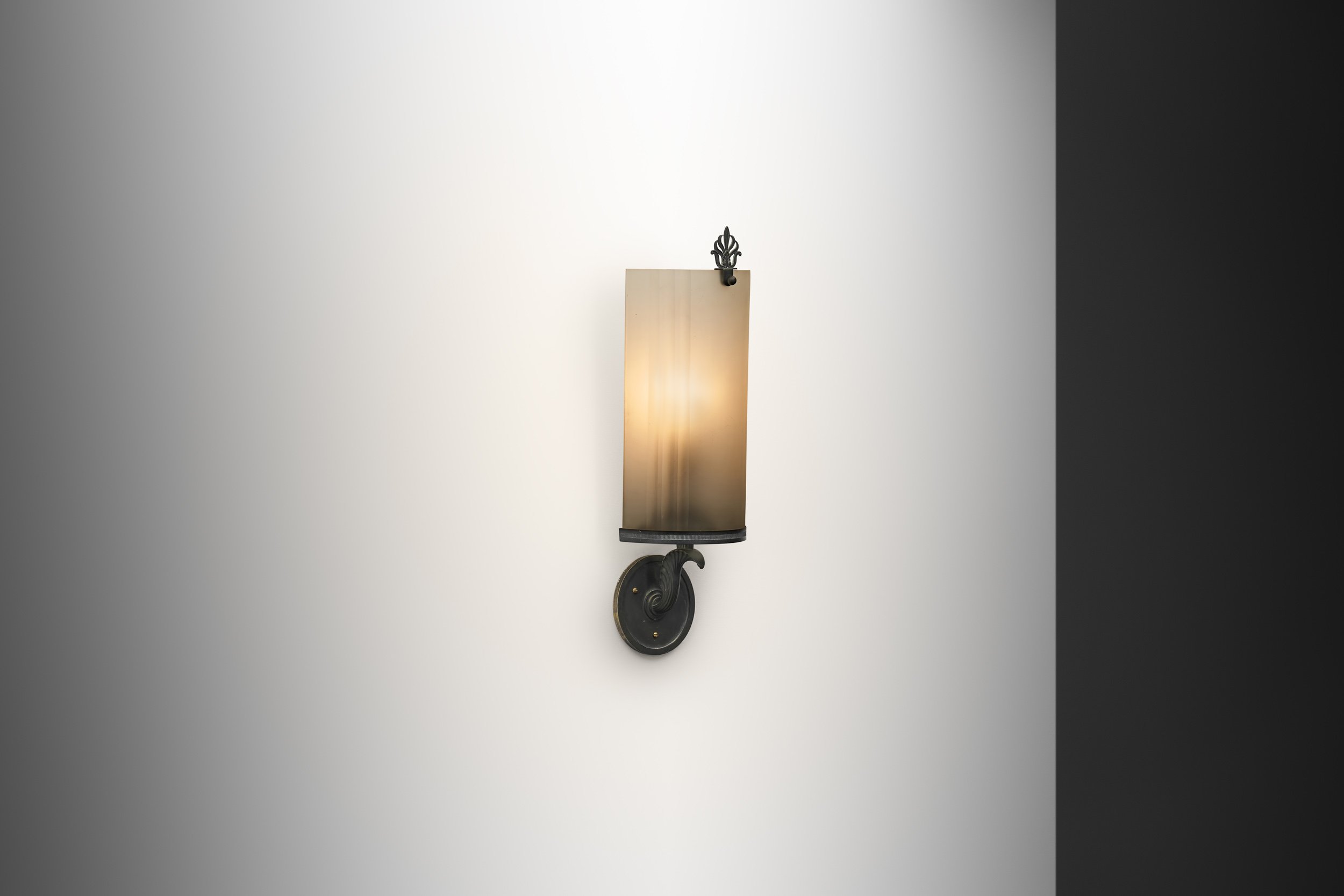
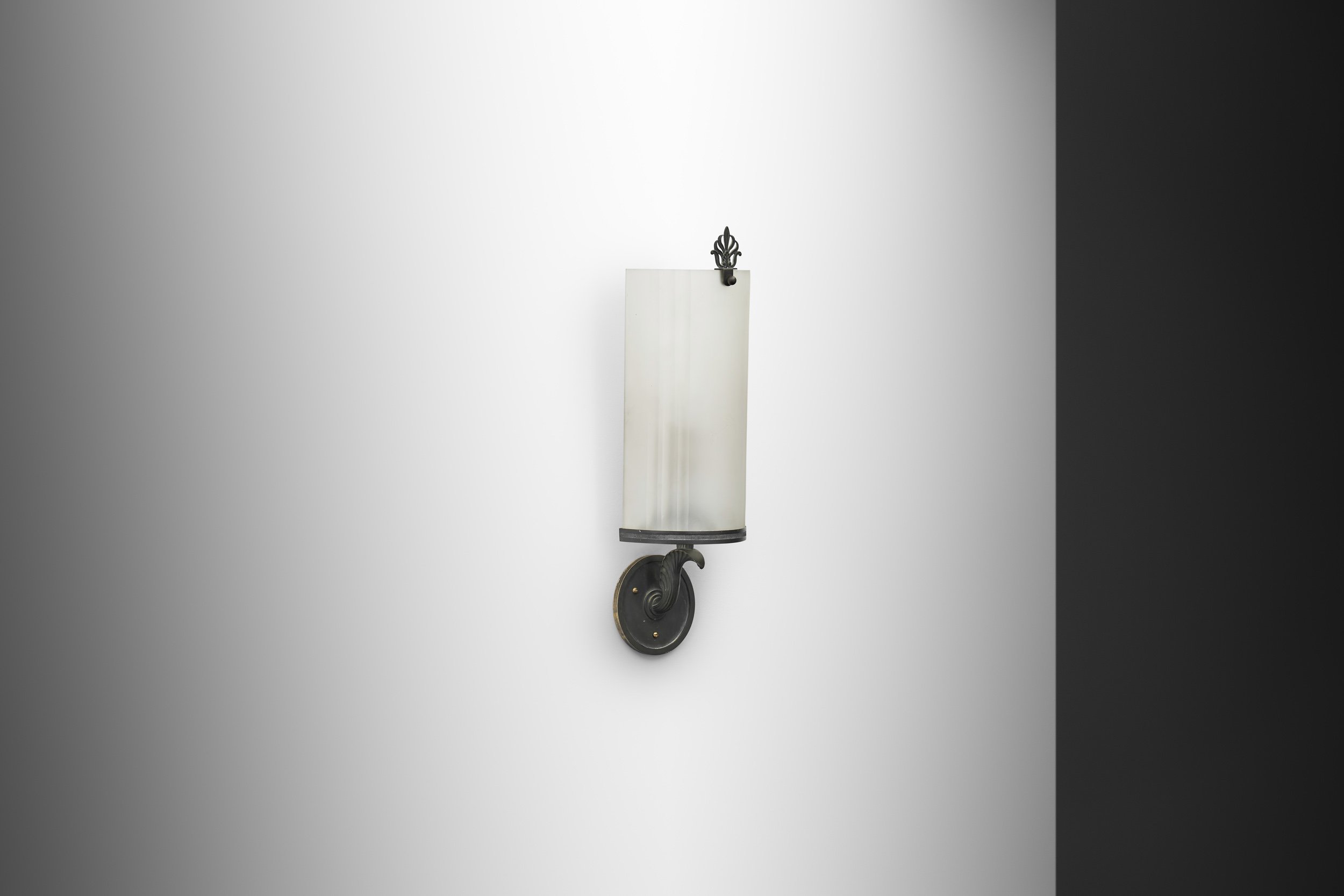
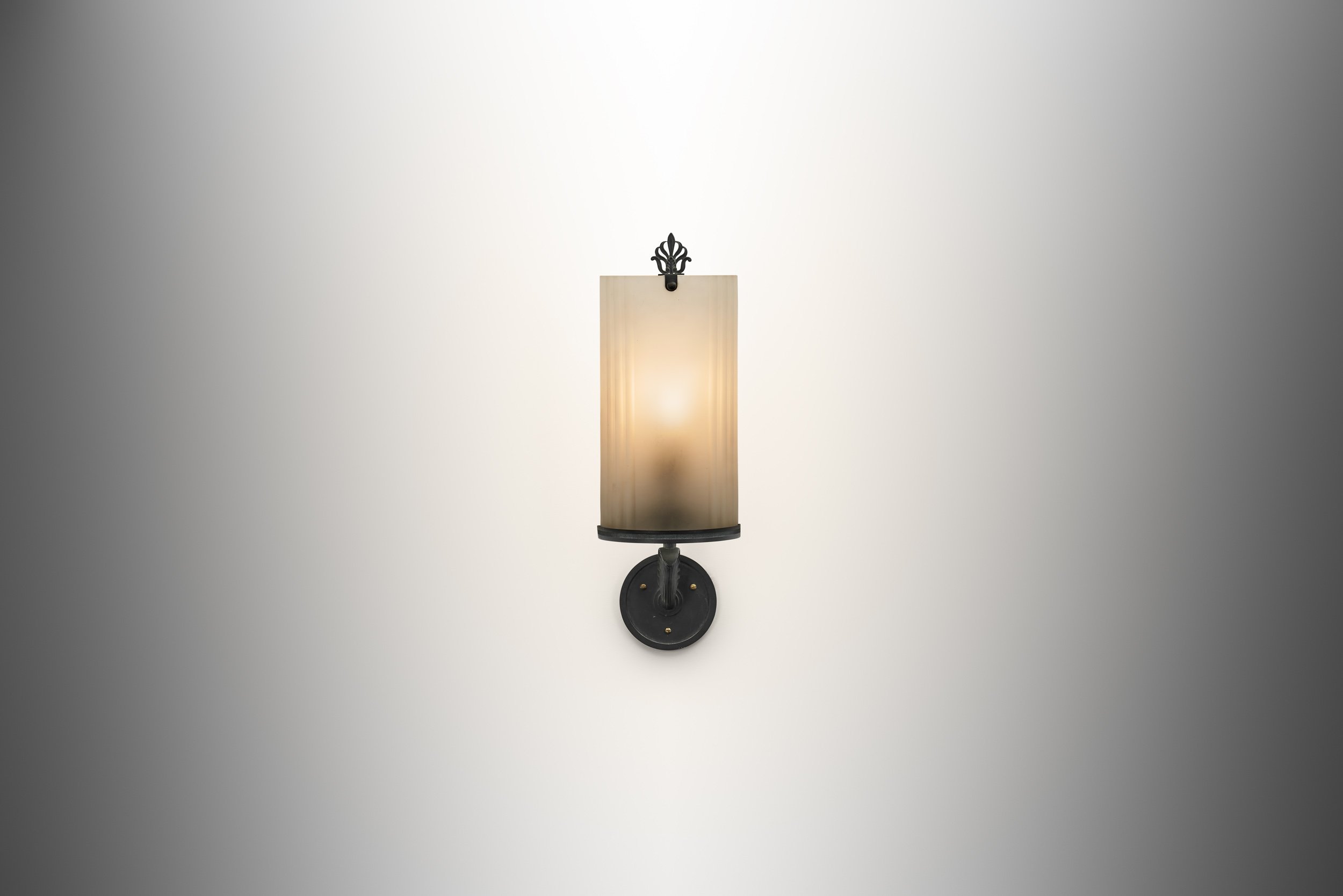
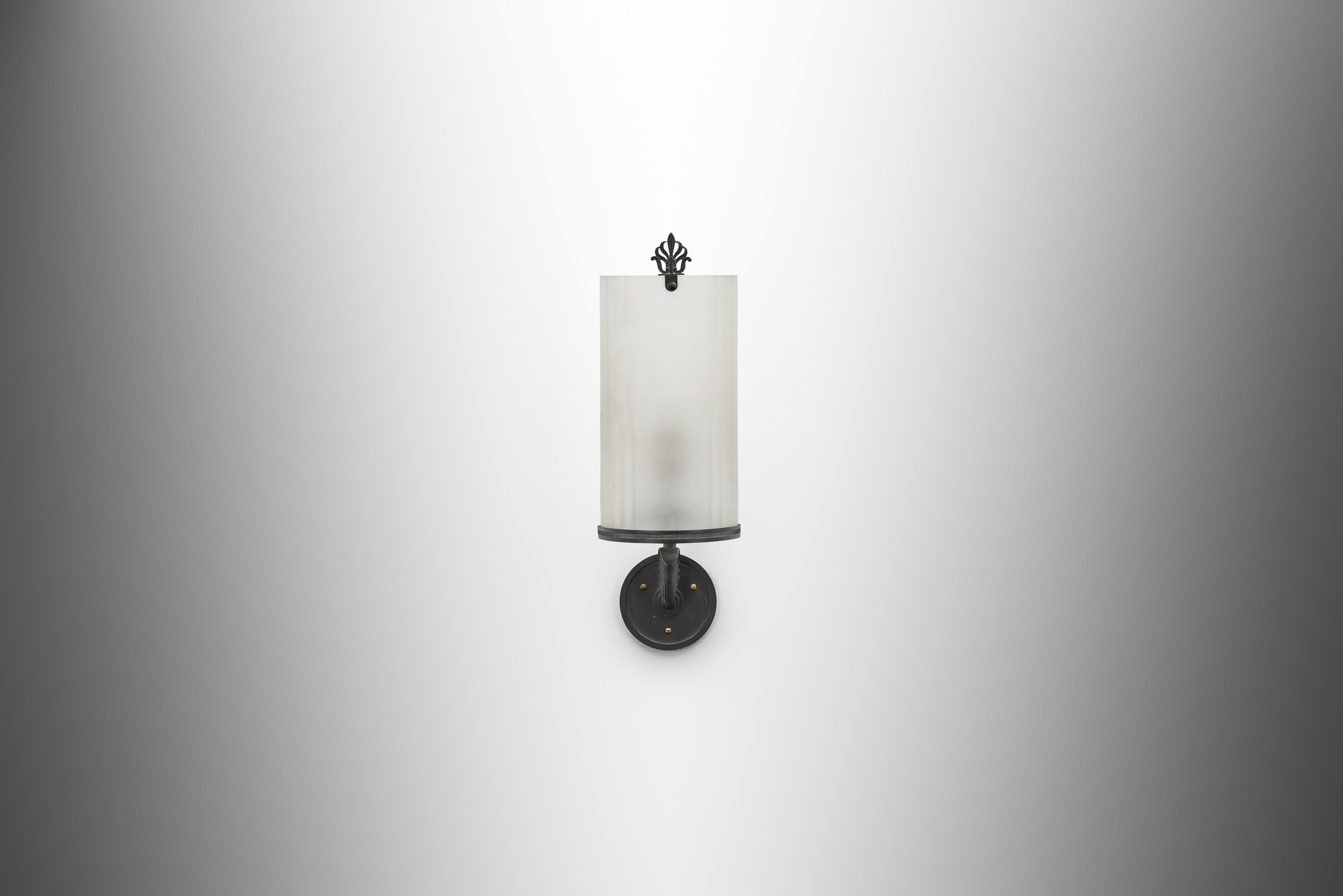
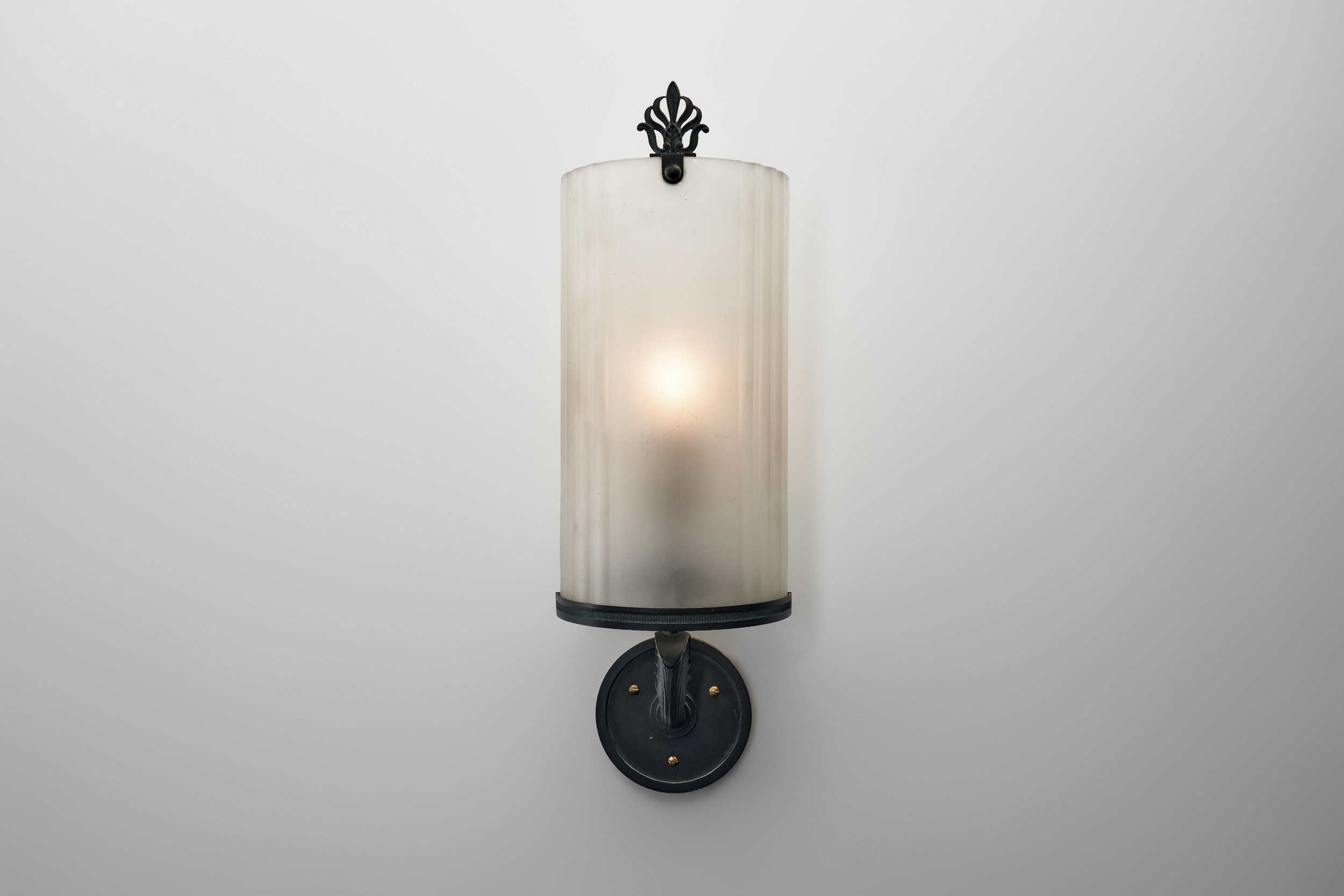
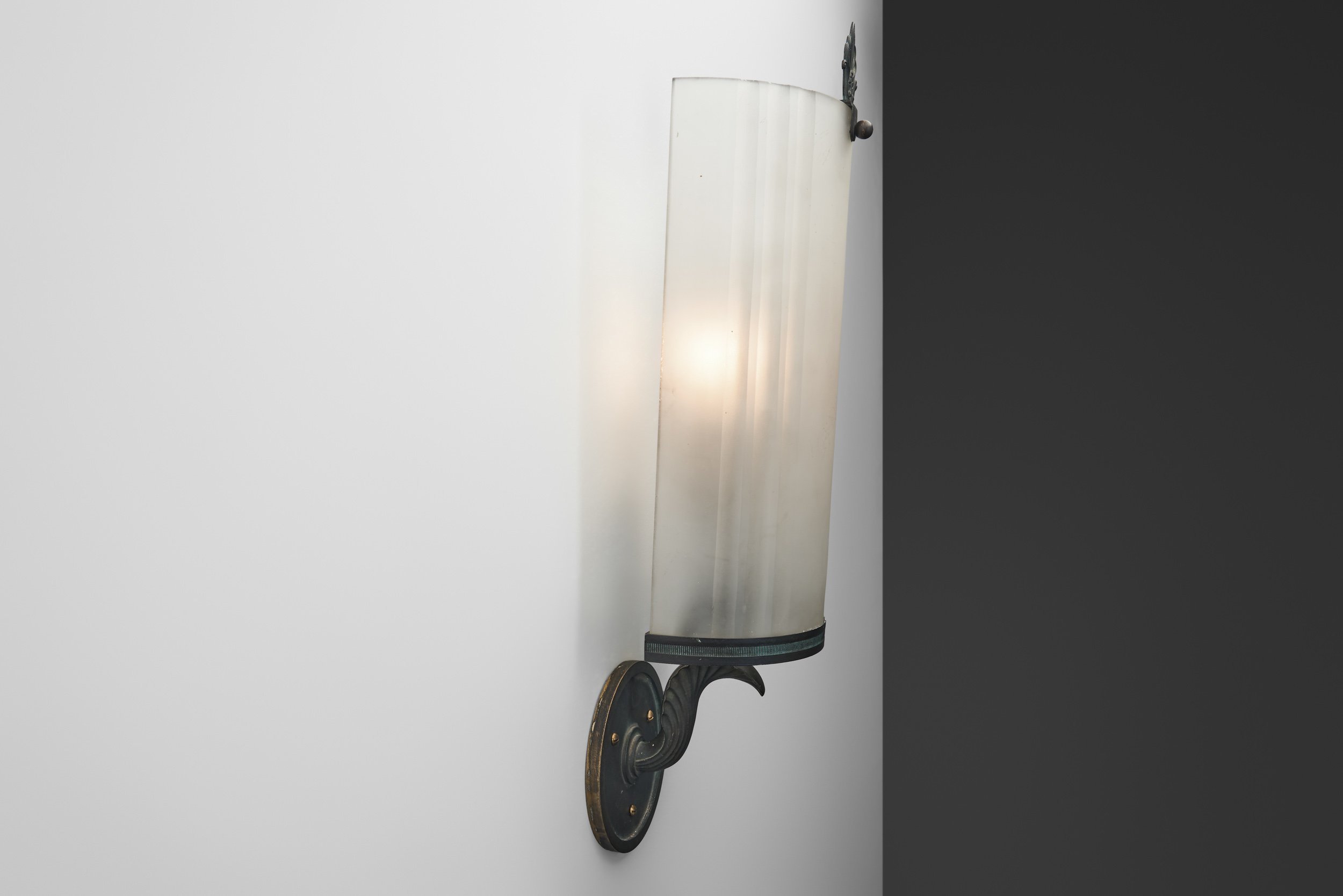
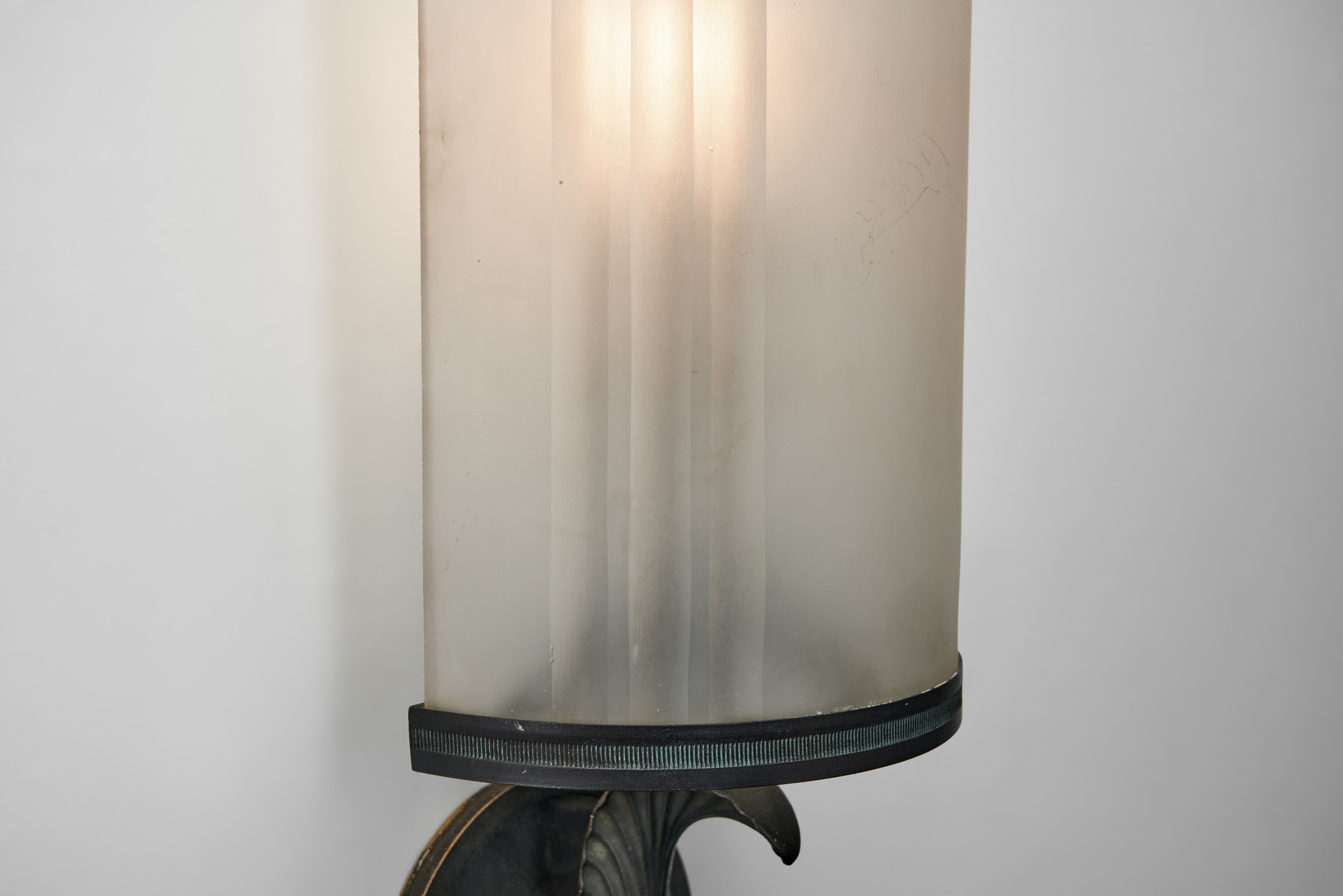
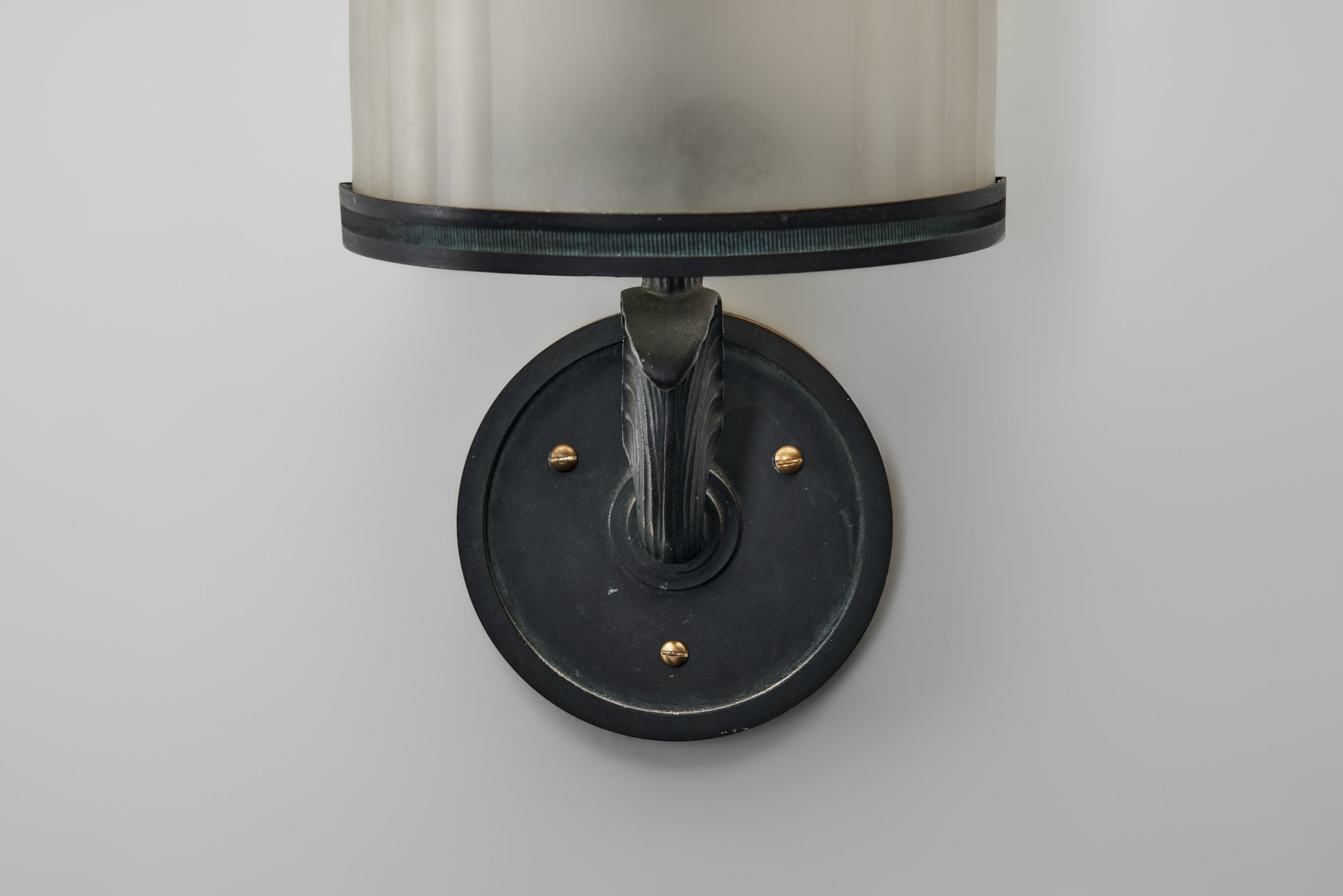
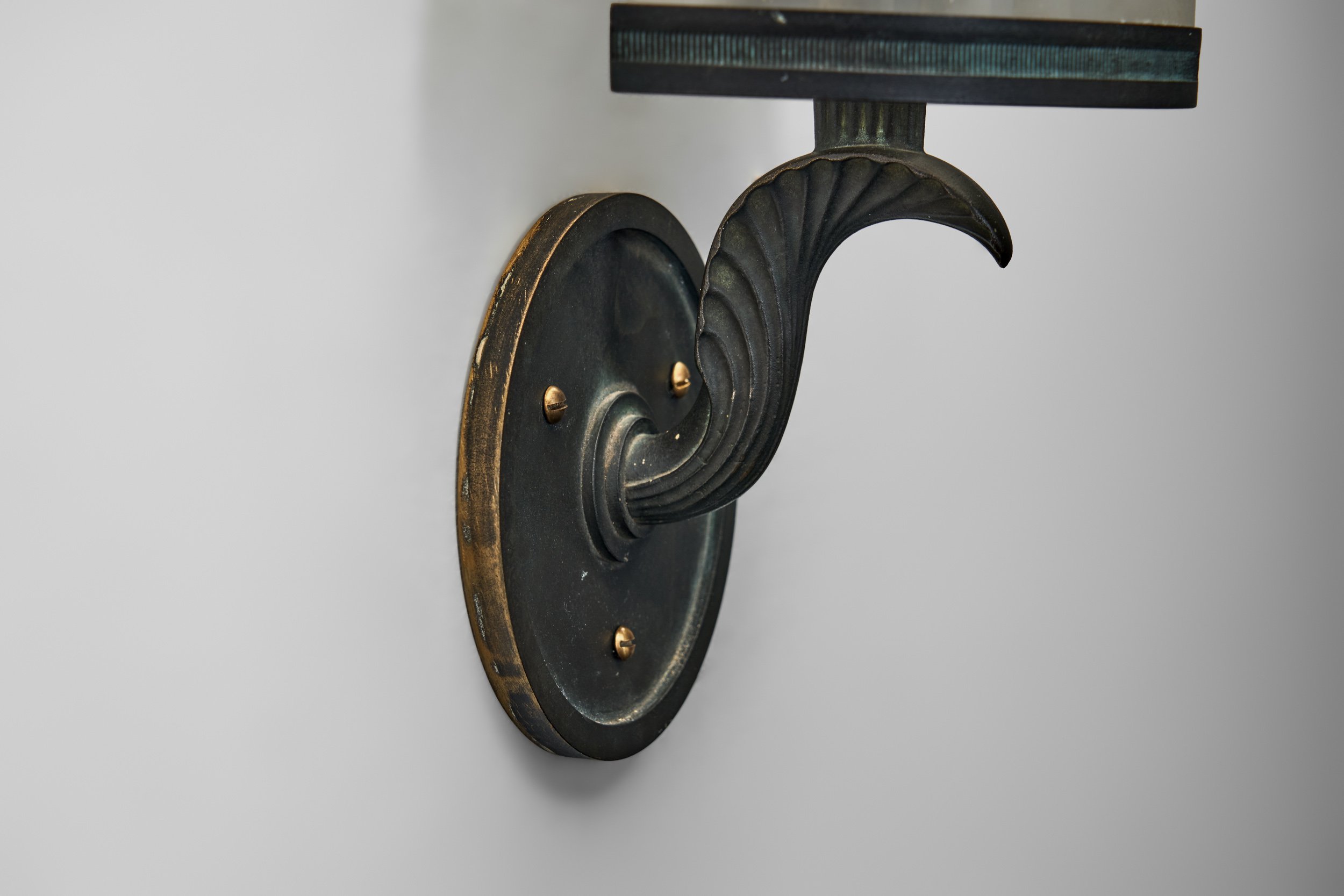
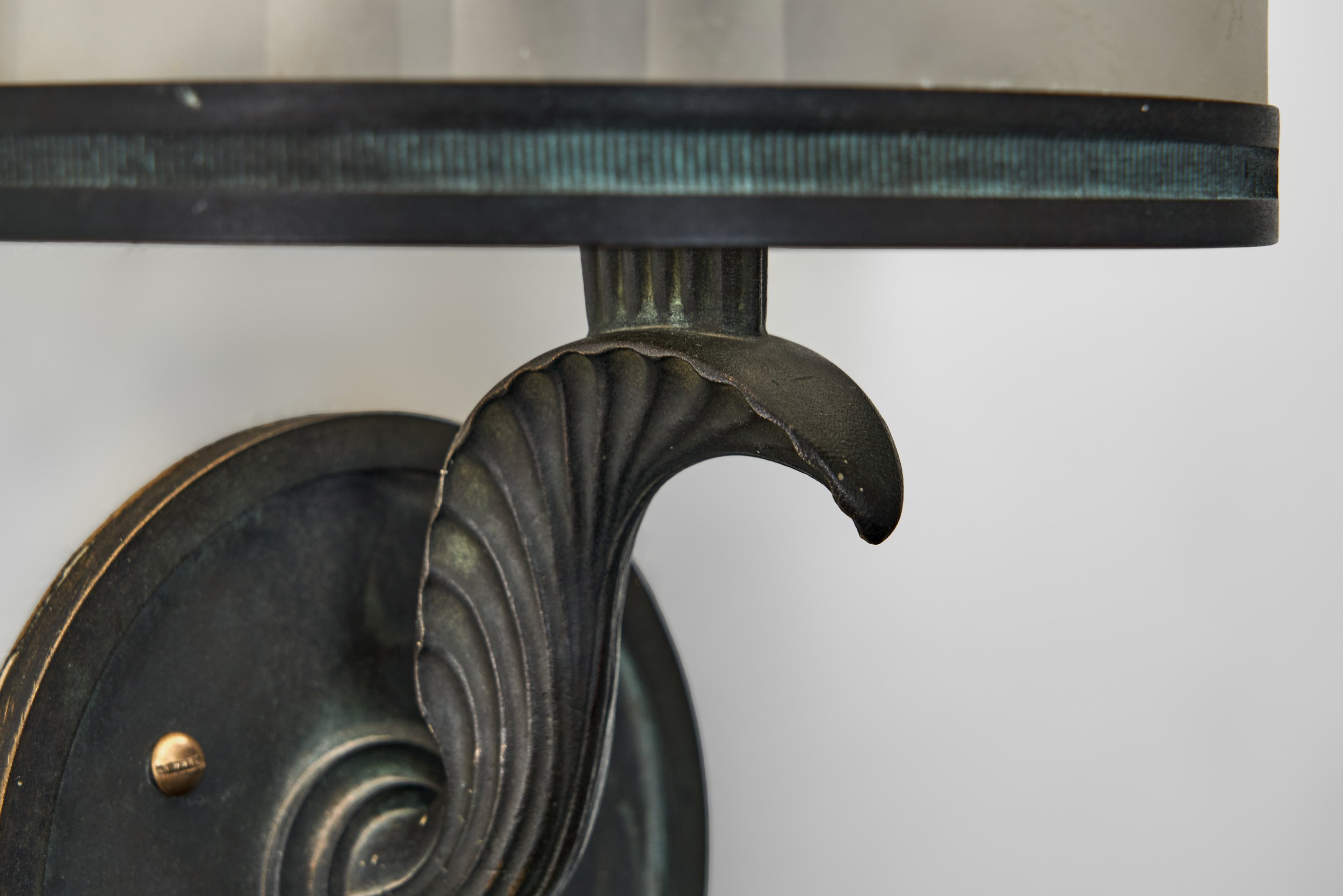
Patinated Bronze Wall Lamp by Swedish Grace, Sweden 1920s
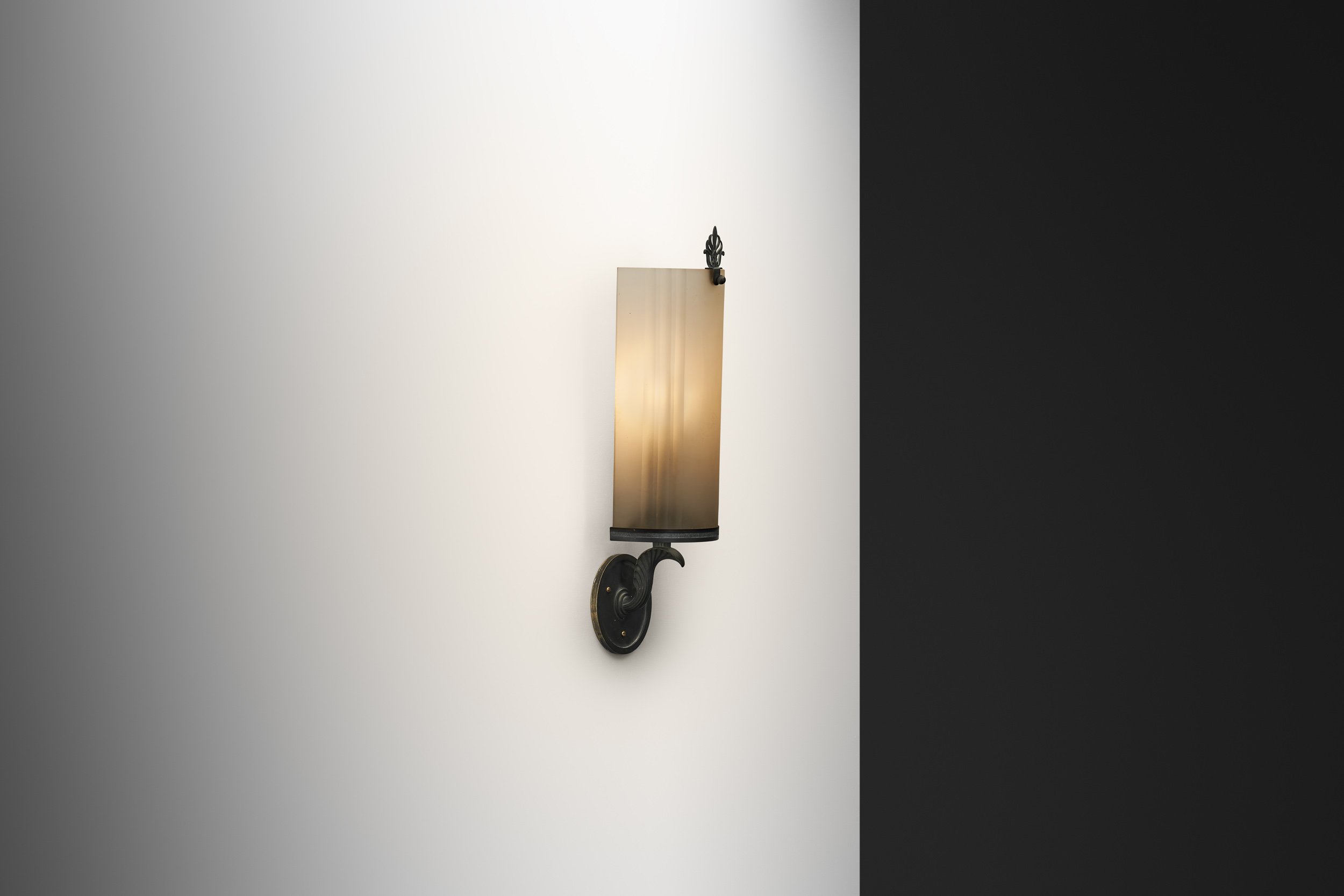
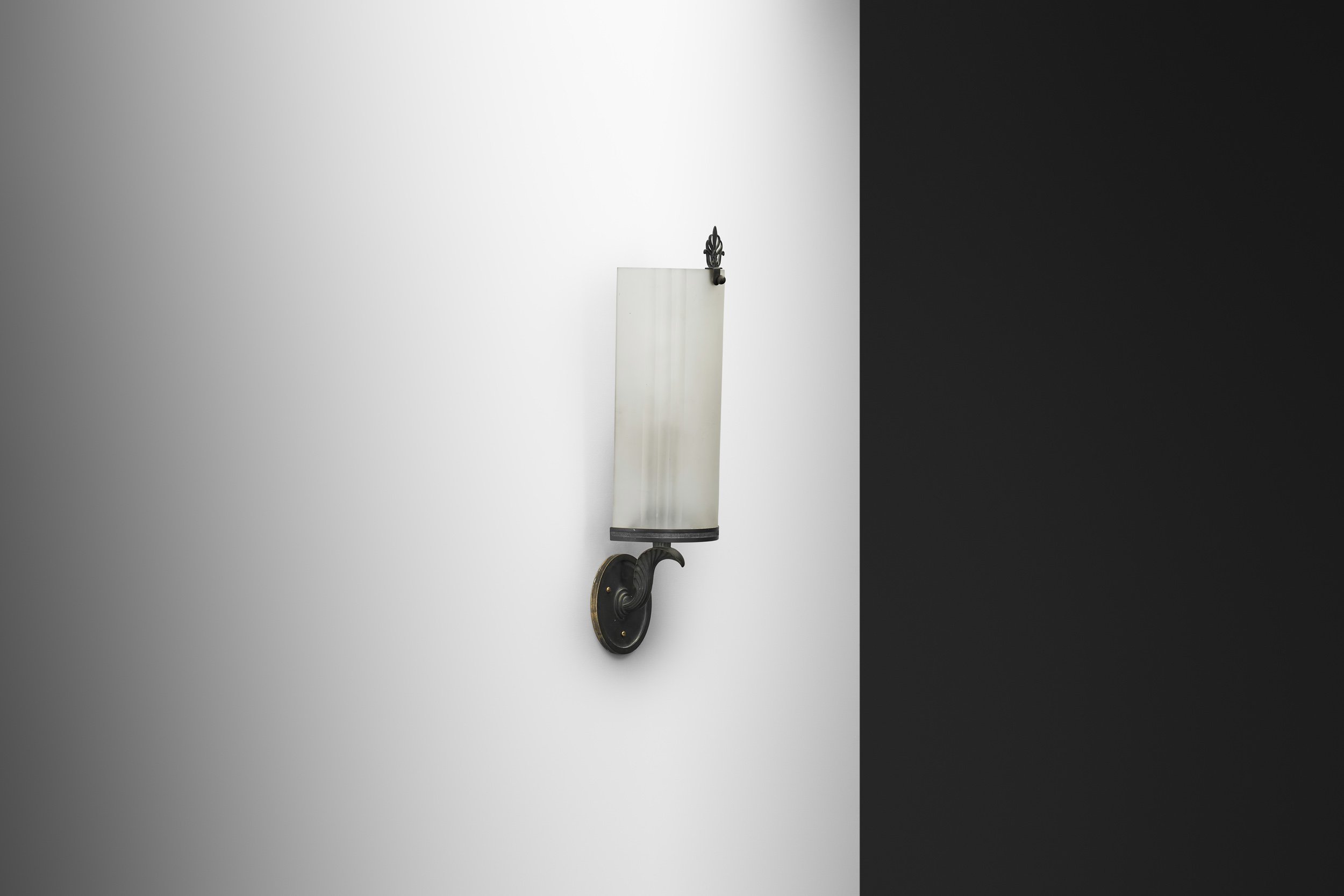
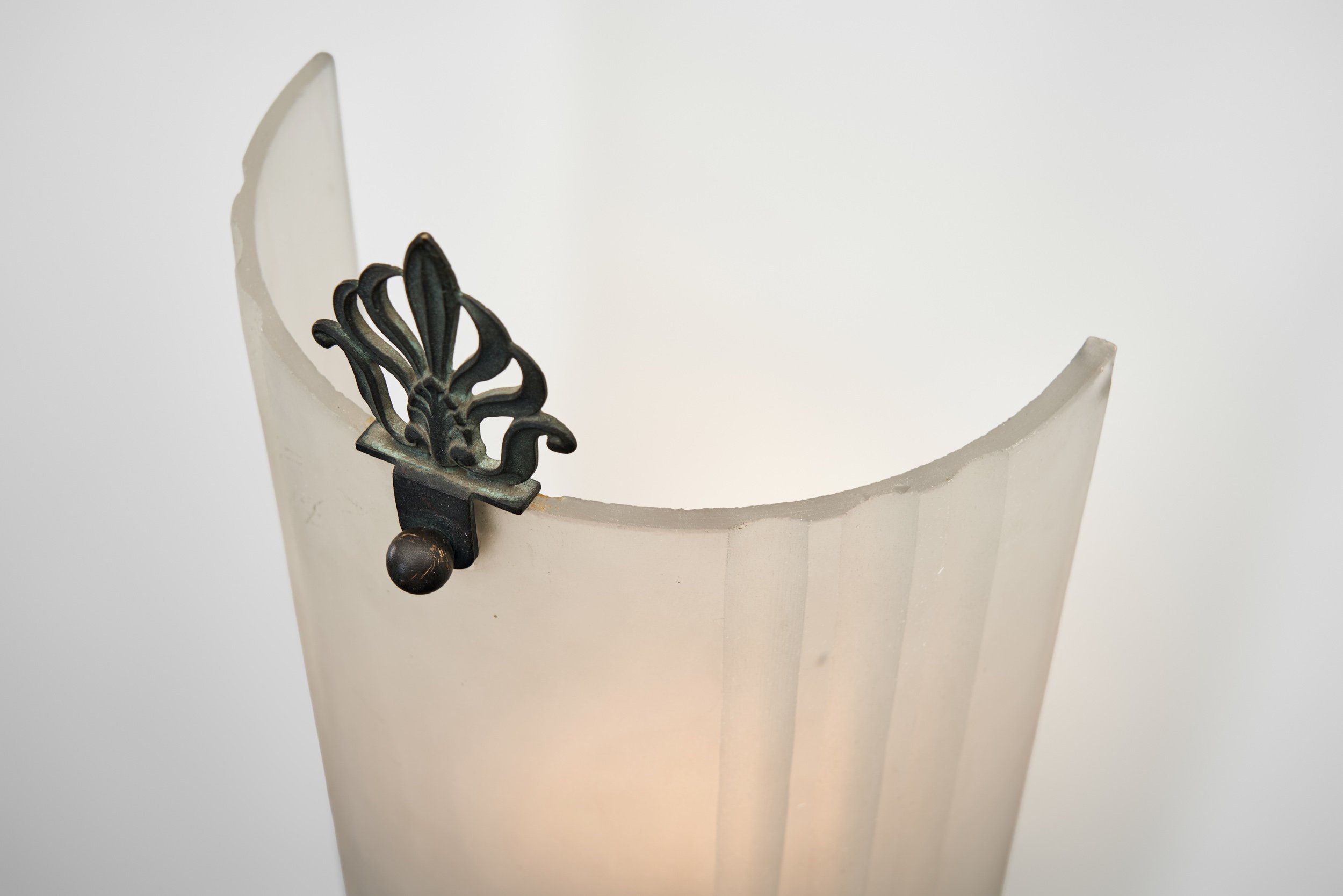
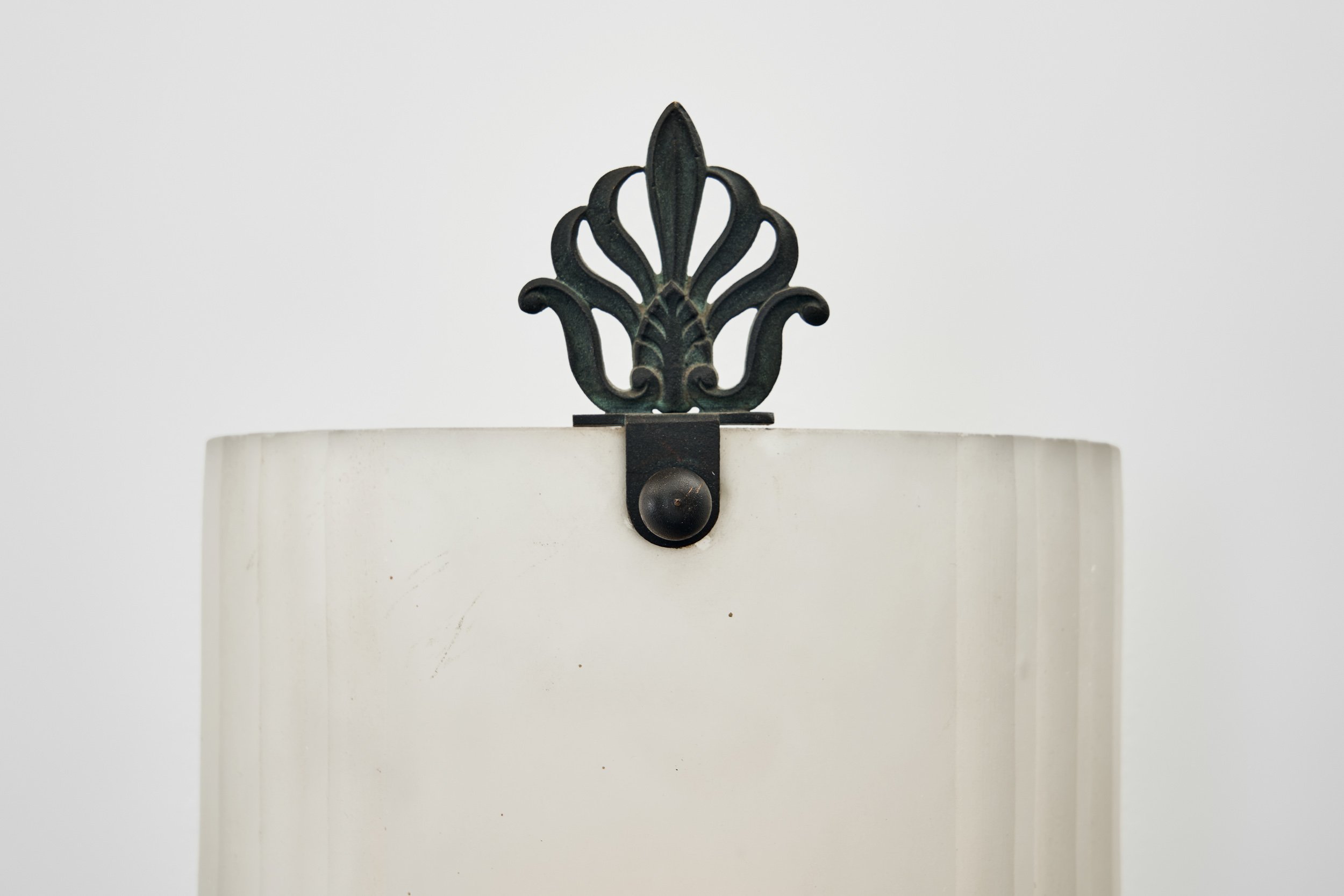
Patinated Bronze Wall Lamp by Swedish Grace, Sweden 1920s
REQUEST PRICE HERE
Price category: usd / eur
Condition:
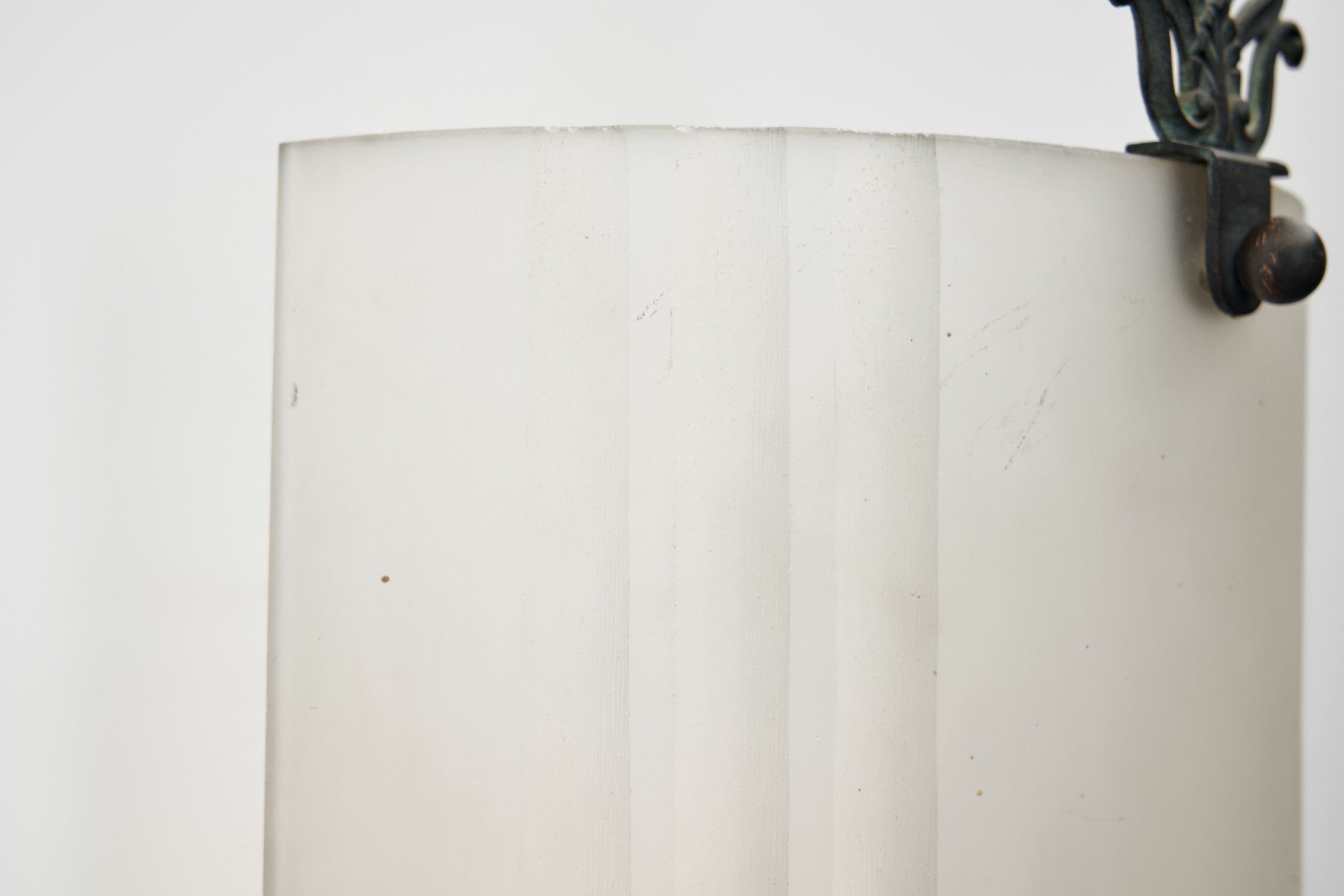
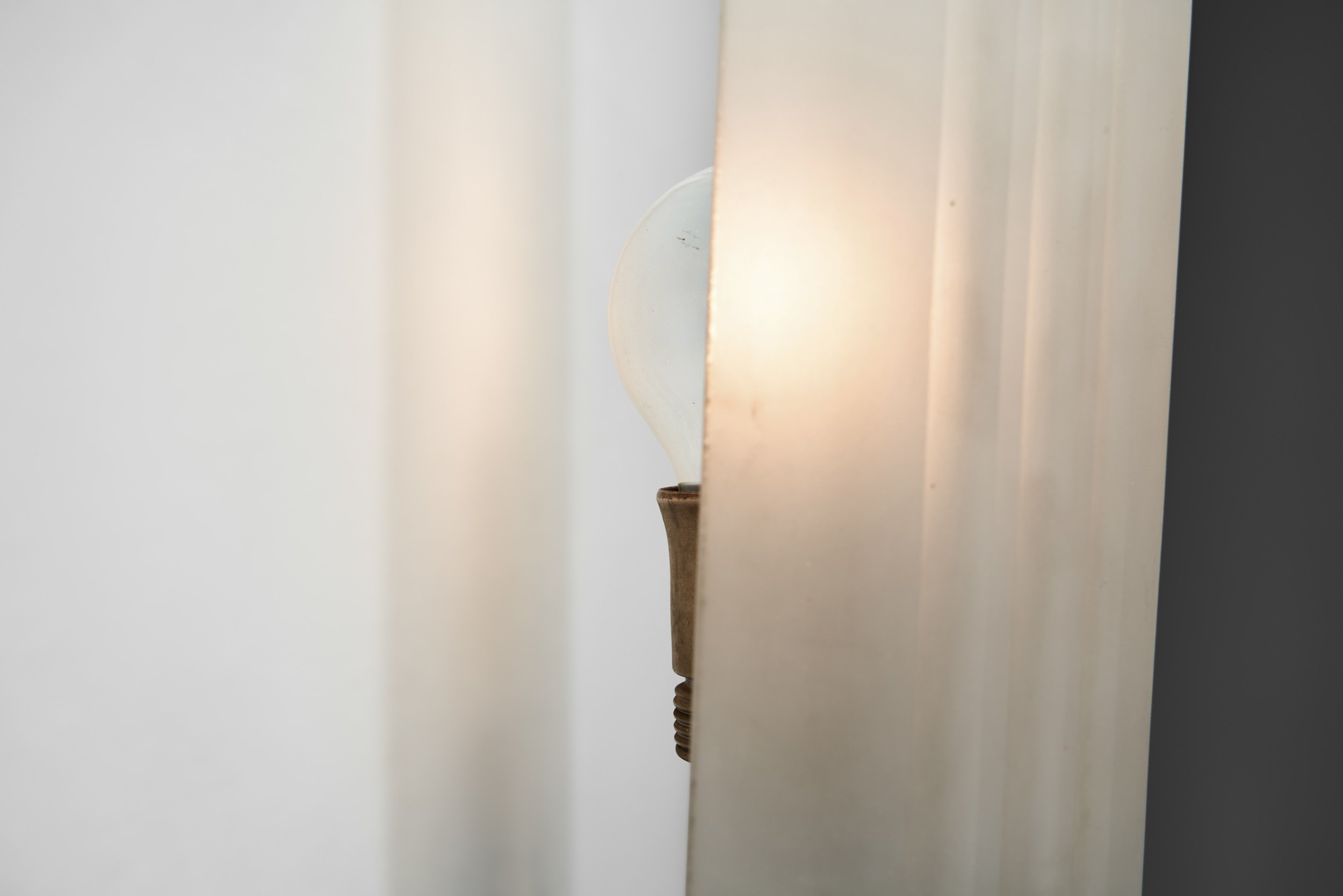
In good vintage condition. Wear consistent with age and use. The wall lamp has recently been reconditioned. The brass is patinated. There are minor dents and scratches in the metal. Due to the age and nature of the bronze, the lamp may have marks, and discolouration. Additional imperfections on the glass may be present due to manufacturing inconsistencies and age. This lamp is compatible with an E27 standard fitting.
Dimensions:
6.10 in W x 4.72 in D x 18.50 in H
15.5 cm W x 12 cm D x 47 cm H
REQUEST PRICE HERE
Price category: 2,500 - 5,000 usd / eur
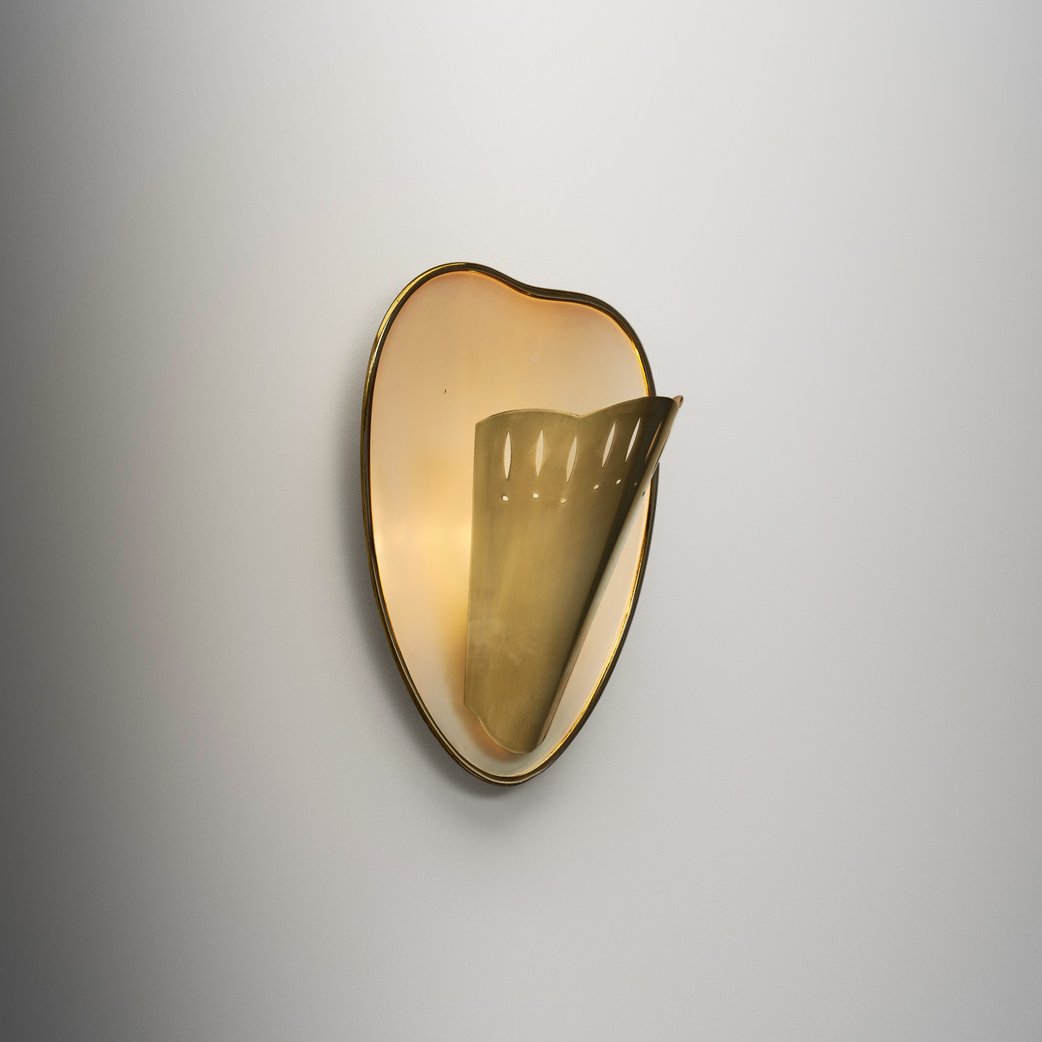
Mid 20th century lighting design endures in popularity for numerous reasons. The era’s designers managed to make practical design look beautiful, while maintaining the highest quality. The mid-20th century brought about a design revolution throughout Europe, where function and form merged in the most intriguing ways. One such example of this era’s creativity is this exceptional wall lamp.
This beautiful piece is characterised by its distinctive marriage of materials combines brass and lacquered metal in a way that is emblematic of the era's fascination with contrast. When looking at the materials’ finish, the glossy sheen of the warm brass stands out against the matte lacquered metal. Similarly, the chromatic juxtaposition of the back and front plate catches the eye, creating visual interest. The backplate has an irregular, organic outline that softens the minimal construction. Mounted in front is a rounded brass element that projects outward from the wall almost like a petal with subtle perforations. The asymmetry of the composition prevents the fixture from feeling static, while the composition of the shapes and clever decorative elements give this light a personality that isn’t loud but still stands out.
The timeless appeal of this wall lamp is a reminder of an era when designers were free to explore new horizons in crafting distinctive and captivating lighting fixtures that continue to inspire and illuminate our lives today. Its compact scale and sculptural silhouette allow it to function both as lighting and as a small wall-mounted object within an interior.
Condition:
In good vintage condition. Wear consistent with age and use. The lamp has recently been rewired and reconditioned. Due to the nature and age of the materials, the item may have marks, scratches, and discolouration. The lamp is compatible with an E26 / E27 (standard) fitting. All lighting can be converted for US usage.
Dimensions:
8.66 in W x 5.52 in D x 11.02 in H
22 cm W x 14 cm D x 28 cm H
REQUEST PRICE HERE
Price category: 5,000 - 7,500 usd / eur
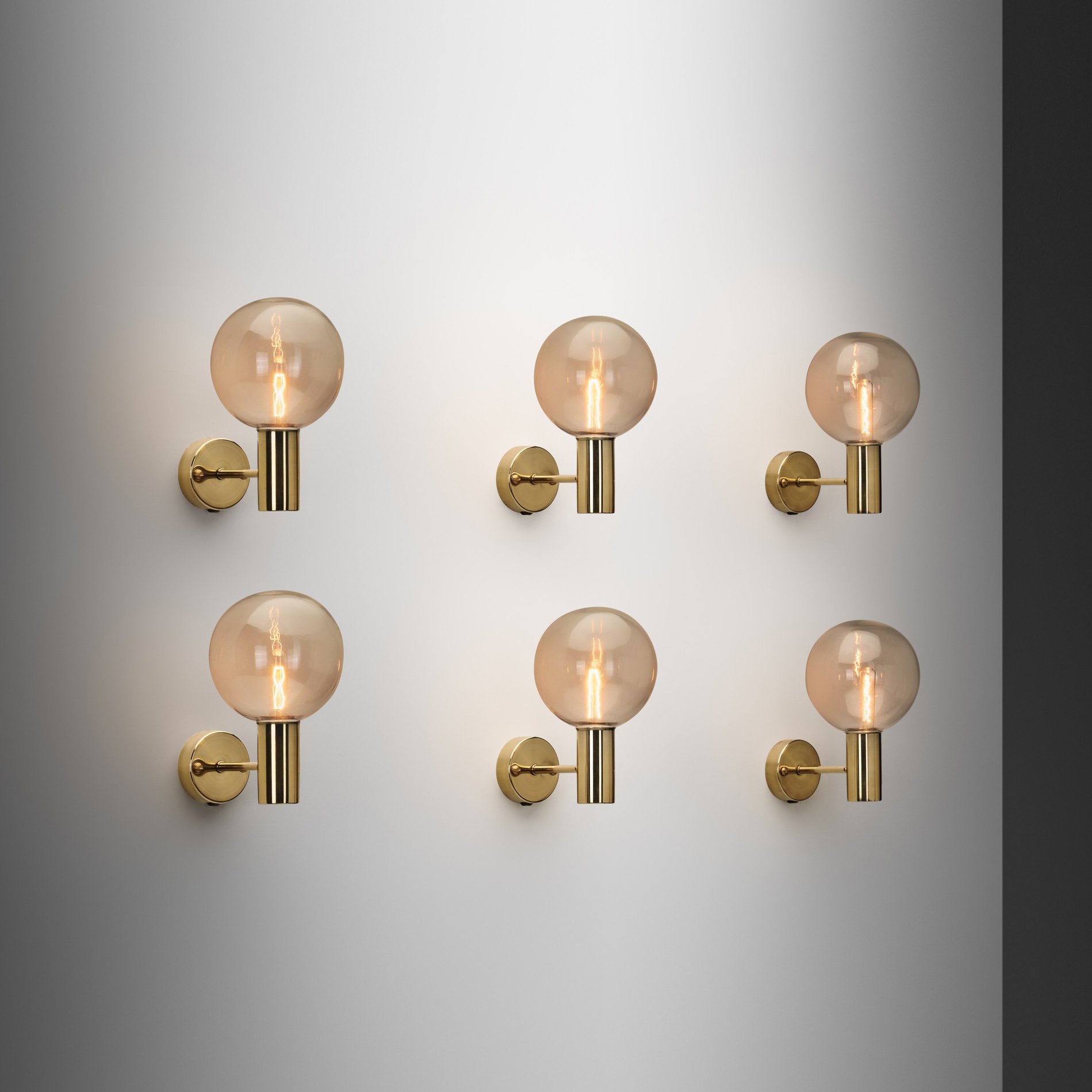
While Hans-Agne Jakobsson designed and produced various types of furniture, his lighting received greater international attention, and not without good reason. As this set of “V-149” wall sconces showcases, the Swedish designer mastered both the direction and colour of his lighting designs.
With the brass frame holding translucent glass shades, this set clearly shows the Swedish designer’s studies in architecture, with beautiful geometric forms and symmetry dominating the structures. Like most mid-century Swedish lighting designs, this model is also dominated by its brass structure. The popularity of brass can be attributed to its golden hue, which adds warmth to the style's modern aesthetic. This model further emulates the mid-century modern movement's guiding principles through its clean lines and geometric shapes. The structure is composed of a back-plate and pole holding a large, elongated brass socket. Next to the brass, the glass shade stands out with a shape that resembles a pressed sphere and has a generous size. Furthermore, thanks to the arrangement of the brass pole and the shade, these wall sconces divide the light evenly and brighten the yellow brass beautifully, creating a cosy, warm visual effect. This model was produced by Hans-Agne Jakobsson’s own company in Markaryd, Sweden.
Sconces are a timeless type of lighting fixture that can easily elevate their surroundings. These fixtures never go out of style, and have been in use for centuries. This is especially true for mid-century brass models like this lamp. While already stunning individually, these light models are even more effective when placed in close proximity to each other.
Condition:
In good vintage condition. Wear consistent with age and use. Some scratches and marks on the patinated brass structure. Due to the nature and age of the material, the items may have discolouration.
Dimensions:
7.87 in W x 5.9 in D x 9.05 in H
20 cm W x 15 cm D x 23 cm H
About the Designer:
Born in 1919 in Gotland, Sweden, Hans Agne Jakobsson is one of the most well-known Swedish lighting designers. He did his carpenter apprenticeship before studying architecture in Gothenburg.
First working as an industrial designer for General Motors, he later founded his own company after being an assistant to the designers Carl Malmsten and Werner West. In 1950, due to Christmas, he added a model of hanging lamps in small strips of pine in one of his stores to soften the lively lighting of the shop window. The people who were passing by were immediately seduced by this hanging lamp, which started it all. He established his own company in 1951: Hans Agne Jakobsson AB and began producing this model in his factories and achieved success abroad as well. In 50 years, he designed more than 2000 lamps with unique designs.
He used materials and experimented with multiple techniques, for example using fabrics with fringes, blown glass of colour and smoked glass. His great diversity resulted in a wide range of timeless lighting models. These pieces continue to seduce design lovers, as they adapt themselves to any interior, without blending into the background.
Today, Jakobsson’s works can be found in private homes as well as public institutions throughout Sweden. The designer passed away in 2009 in Sweden, leaving behind a great legacy. ~H.
REQUEST PRICE HERE
Price category: 5,000 - 7,500 usd / eur
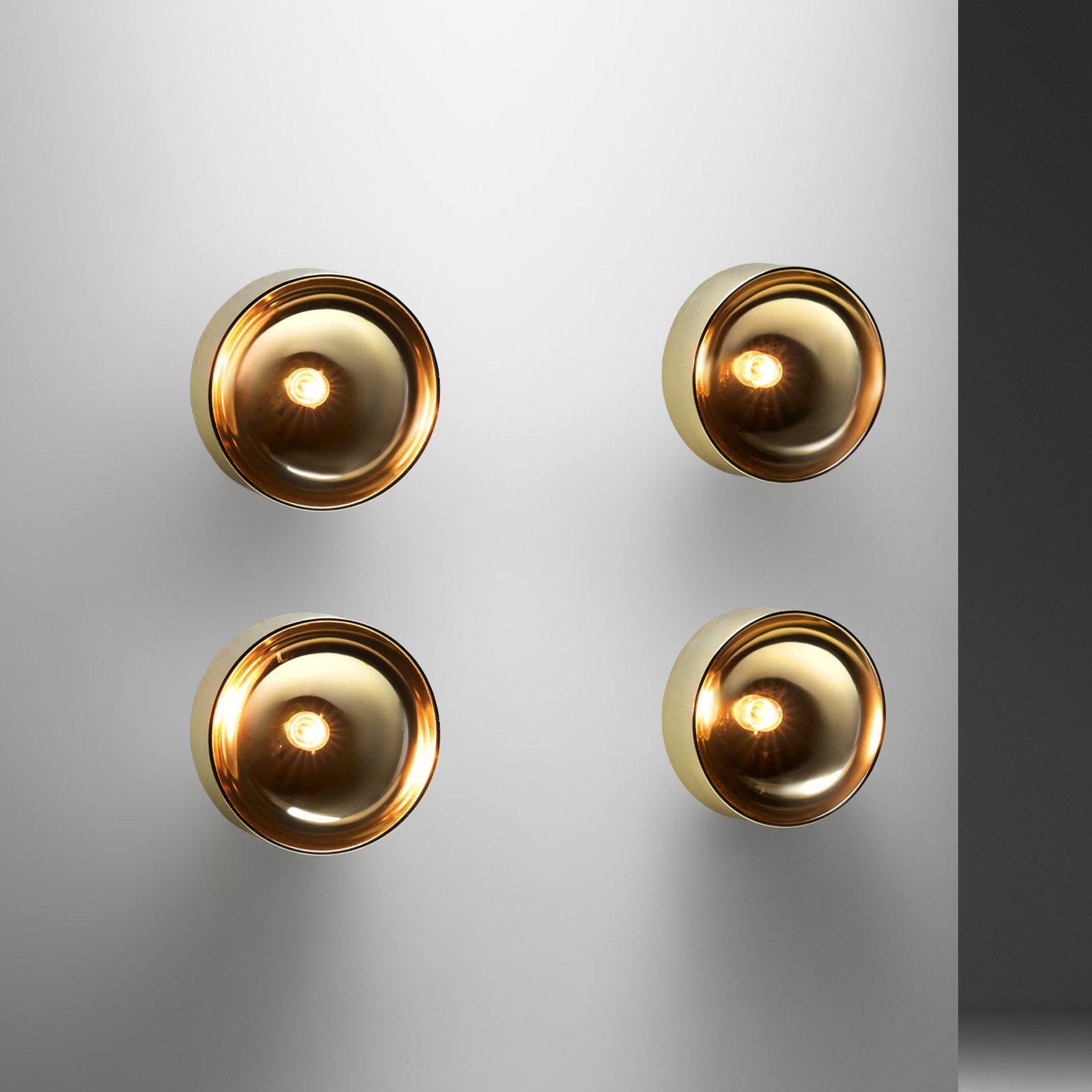
This set of Peter Celsing wall sconces are celebrated for their iconic design, bringing modernity into any setting. Being a visual representation of “Svensk design”, this model projects a powerful, concrete rendering of a sort of essentialised “Swedishness”.
These stylish brass wall sconces were designed by Celsing for Falkenberg in 1966 for the cultural center Kulturhuset in Stockholm. The modernistic look is achieved by the simple and smart design of the silhouette. The yellow brass bodies of this pair gently reflect the light, which can be elevated even more with diverse lightbulbs. The concave bowls are slightly lifted from the wall by the matte, black lacquered rings, giving them a floating appearance. The bulbs are placed directly in the centre of the bowls, reflecting the warm, subdued light evenly across the room. This model is equally attention grabbing when placed vertically on a wall or on the ceiling.
Falkenbergs Belysning was an excellent manufacturer of various lighting designs, with some models exhibited in museums to this day. Kalmar Läns Museum is among the Swedish institutions where the manufacturer’s lamps and their history is exhibited as part of the country’s cultural design heritage.
Condition:
In good vintage condition. Wear consistent with age and use. The lamps have some small marks and scratches. Due to the nature and age of the material, the item may have discolouration.
Dimensions:
11.41 in Ø x 6.29 in D
29 cm Ø x 16 cm D
About the designer:
Peter Elof Herman Torsten Folke von Celsing (January 29, 1920 – March 16, 1974) was a Swedish modernist architect.
He was born in Stockholm, Sweden and studied at the architectural school of the Royal Institute of Technology in Stockholm, and at the Royal Swedish Academy of Arts. Celsing has been the assistant of the widely known Swedish architect Sigurd Lewerentz. According to Adam Caruso, it was Celsing that helped Lewerentz to win the design competition for the Church of St. Mark (Markuskyrkan). This building and the later St. Petri Church (Olaus Petri kyrka) are now known as a starting point of brutalist architecture.
He later became professor of architecture at the Royal Institute of Technology. After working for some time in Beirut, he became head of the architectural office of AB Stockholms Spårvägar, the Stockholm tram and local railway authority, and designed a number of suburban metro stations. He also designed several churches: in Härlanda (Gothenburg), Almtuna (Uppsala), and Vällingby, a much-publicized modernist suburb of Stockholm.
Celsing often worked in a brutalist style with large exposed grey concrete surfaces, but occasionally combined this with large glass panes exposing the structure of the building from the outside, and interior details in wood. The best-known example of this are the Kulturhuset (House of Culture) at Sergels torg in central Stockholm (1966–1971). While he is mostly remembered as an architect, Celsing also designed furniture, mainly lighting, which reflects his talent in both architectural and furniture design. ~H.
REQUEST PRICE HERE
Price category: 7,500 - 10,000 usd / eur
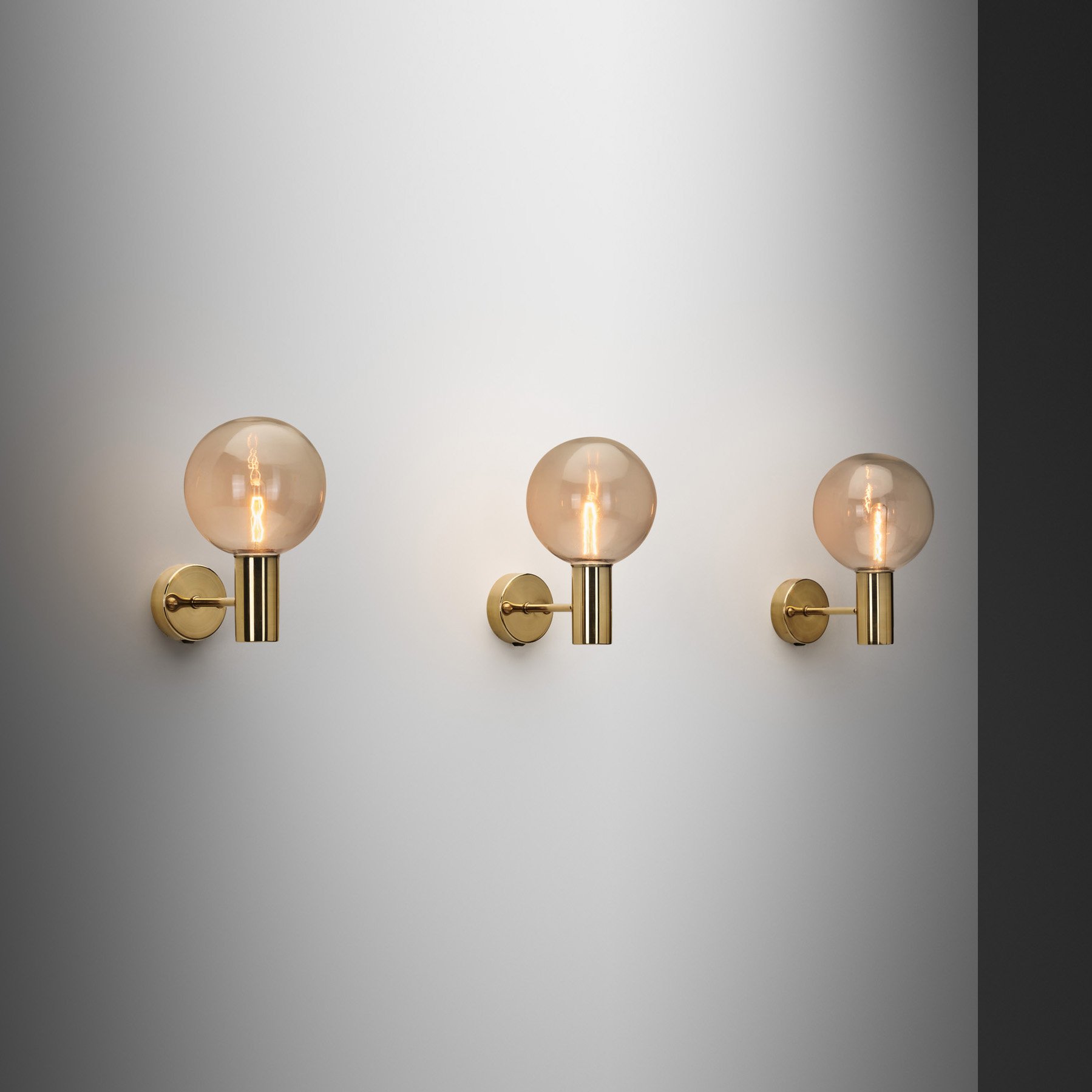
While Hans-Agne Jakobsson designed and produced various types of furniture, his lighting received greater international attention, and not without good reason. As this set of “V-149” wall sconces showcases, the Swedish designer mastered both the direction and colour of his lighting designs.
With the brass frame holding a translucent glass shade, these lamps clearly shows the Swedish designer’s studies in architecture, with beautiful geometric forms and symmetry dominating the structure. Like most mid-century Swedish lighting designs, this model is also dominated by its brass structure. The popularity of brass can be attributed to its golden hue, which adds warmth to the style's modern aesthetic. This model further emulates the mid-century modern movement's guiding principles through its clean lines and geometric shapes. The structure is composed of a back-plate and pole holding a large, elongated brass socket. Next to the brass, the translucent glass shade stands out with a shape that resembles a pressed sphere and has a generous size. Furthermore, thanks to the arrangement of the brass pole and the shade, this wall sconce divides the light evenly and brightens the yellow brass beautifully, creating a cosy, warm visual effect. This model was produced by Hans-Agne Jakobsson’s own company in Markaryd, Sweden.
Sconces are a timeless type of lighting fixture that can easily elevate their surroundings. These fixtures never go out of style, and have been in use for centuries. This is especially true for mid-century brass models like the "V-149". While already stunning individually, these light models are even more effective when placed in close proximity to each other.
Condition:
In good vintage condition. Wear consistent with age and use. The lamps have recently been rewired and reconditioned. Slight crack on one of the shades, but is not visible when mounted. Due to the nature and age of the materials, the items may have some marks, scratches, and discolouration. Minor imperfections on the glass may be present due to manufacturing inconsistencies and age. These lamps are compatible with an E26 / E27 (standard) fitting. All lighting can be converted for US usage.
Dimensions:
5.51 in W x 8.07 in D x 9.05 in H
14 cm W x 20.5 cm D x 23 cm H
REQUEST PRICE HERE
Price category: 5,000 - 7,500 usd / eur
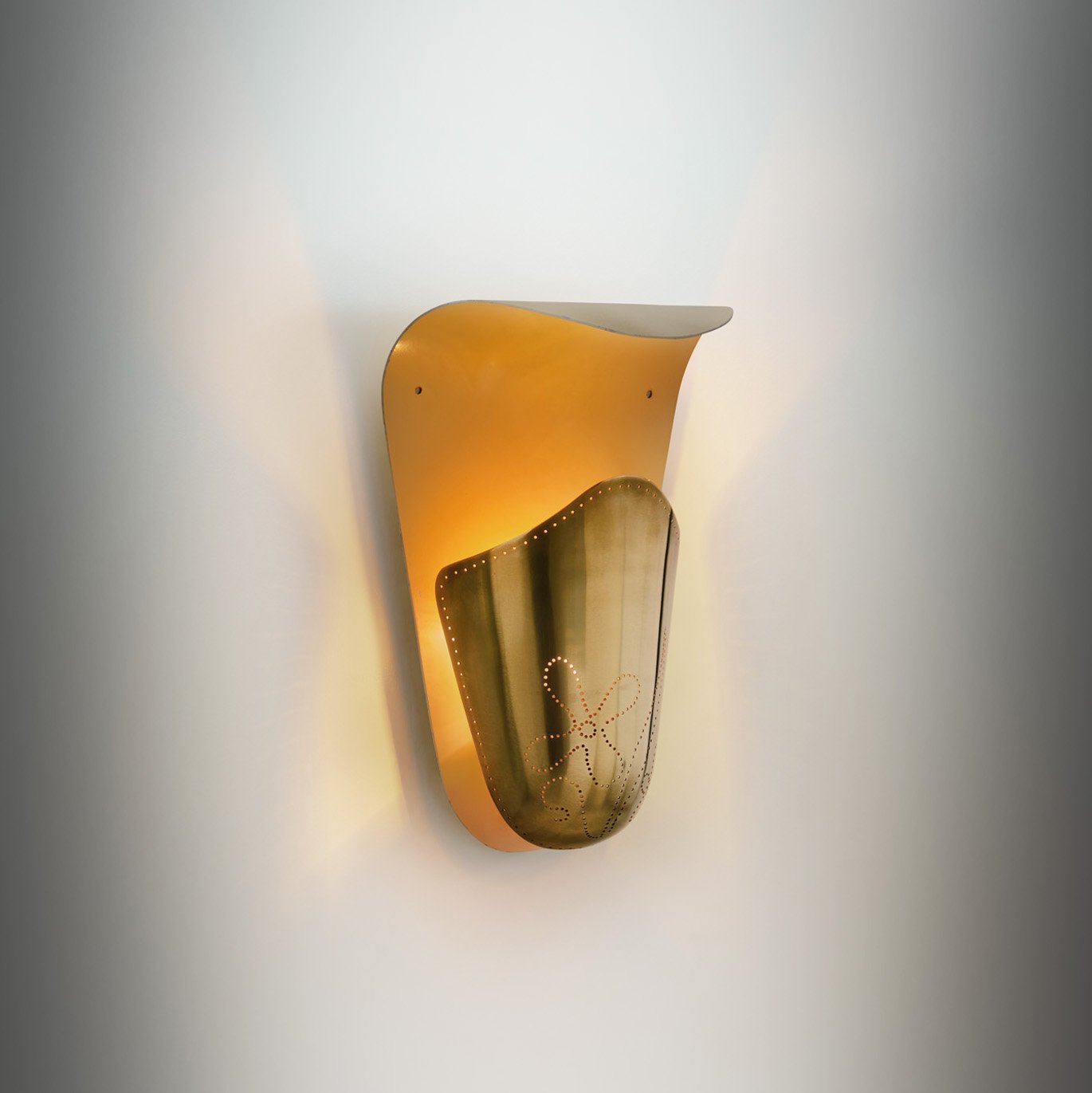
Between the 1920s and 1950s, Böhlmarks was a significant player in the Swedish design movement. Harald Notini, after becoming creative director in 1916, drove the company forward, producing what were considered pioneering and distinctive luminaires for the time. With an unmistakeable design, this model ‘8596’ wall sconce belongs to a historic collection of luminaires from a golden era.
At Arvid Böhlmarks Lampfabrik, the 1940s and 50s represented a period marked by undulating forms and organic material choices in a fundamental Swedish Modern manner. Consequently, the shape and material of the shade determines the overall aesthetic of this lamp. The design encapsulates a harmonious interplay of light and shadow, casting a gentle glow that will be sure to enhance the ambiance of any space. The 1950s was a period of renewal, prosperity, and optimism following the world wars. This resulted in lighting designers seeking to create pieces that embodied the spirit of the age, reflecting the fast-paced and industrialised world. The most distinctive design element of this model is the large white lacquered metal reflector that is in a folded shape. This ingenious addition not only provides a clean backdrop against which the front brass structure stands out, but also reflects the light to create a cosy effect. It also serves as a back-plate, therefore the lamp appears as if it were not fixed to the wall. The front brass plate also features a subtle decorative element; a perforated floral design. The brass exudes warmth and elegance, contrasting beautifully with the off-white metal.
The composition of the piece with its soft shapes and clever decorative elements give this wall lamp a stylish look that is guaranteed to set the tone of its interior. The sleek lines create a perfect balance between the ornamented features of the early 20th century, and the later phase of mid-century modernism with its more minimal, simplified lines.
Condition:
In good vintage condition. Wear consistent with age and use.
Dimensions:
8.26 in W x 4.92 in D x 11.81 in H
21 cm W x 12.5 cm D x 30 cm H
REQUEST PRICE HERE
Price category: 2,500 - 5,000 usd / eur
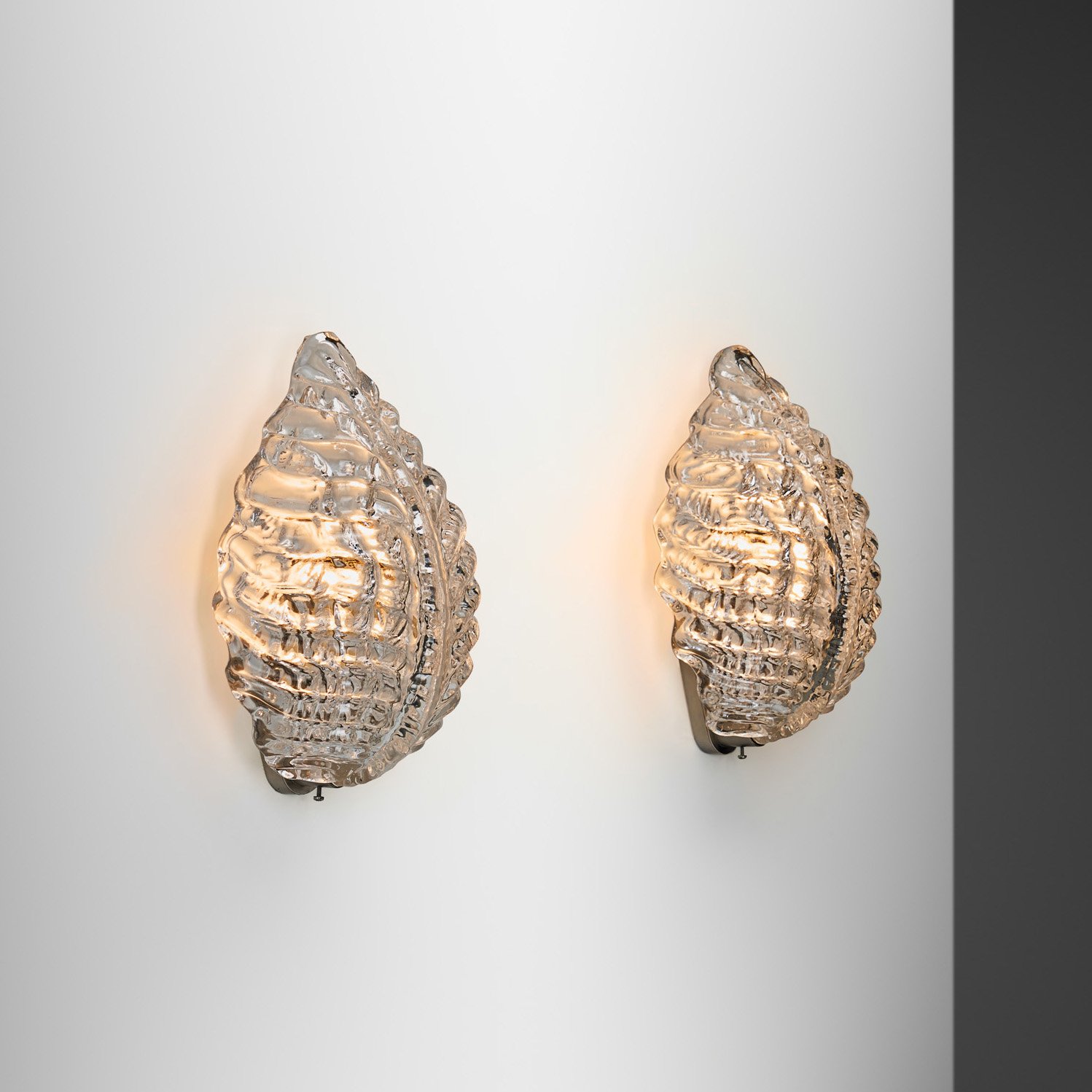
This pair of Swedish wall lamps attributed to Fritz Kurz is a playful example of the eccentric side of Scandinavian mid-century modern design. These crystal glass lamps’ organicity is quite literally expressed, representing the rare, more decorative models of Swedish modernism.
The lamps are made of a block of cast leaf-shaped glass on a metal base. These delicate leaf-shaped lamps showcase the unique qualities of the glass. The resulting effect is stunning, with shadows resulting from the play of light when the lamps are lit, creating an ambient mood while also highlighting the organic form. As flush mounts, the lamps are very close to the wall, connected to it by metal back-plates. At its most basic level, these lamps combine sleek lines with organic shapes, using new materials and methods to re-imagine traditional pieces. This model is mounted so that the body of the fixture is hidden, leaving only the shades on top of the surface. The glass’s shape truly stands out thanks to this, especially when illuminated. This pair exemplifies the expressive possibilities of glass design in the mid-20th century. More than functional objects, they serve as luminous reliefs, sculptures that animate the wall with texture and reflection.
The history of Orrefors is the story of how the simplest ingredients – lime, sand, and soda – can become magnificent glass objects. While glass has its limits, Orrefors craftsmen got as close to them as possible. Thanks to this effort, the full effect of this pair is of a real room jewel.
Condition:
In good vintage condition. Wear consistent with age and use. The items have recently been rewired and reconditioned. Minor marks, scratches and imperfections may be present on the glass due to manufacturing inconsistencies and age of the items.
Dimensions:
7.87 in W x 6.69 in D x 11.81 in H
20 cm W x 17 cm D x 30 cm H
REQUEST PRICE HERE
Price category: 2,500 - 5,000 usd / eur
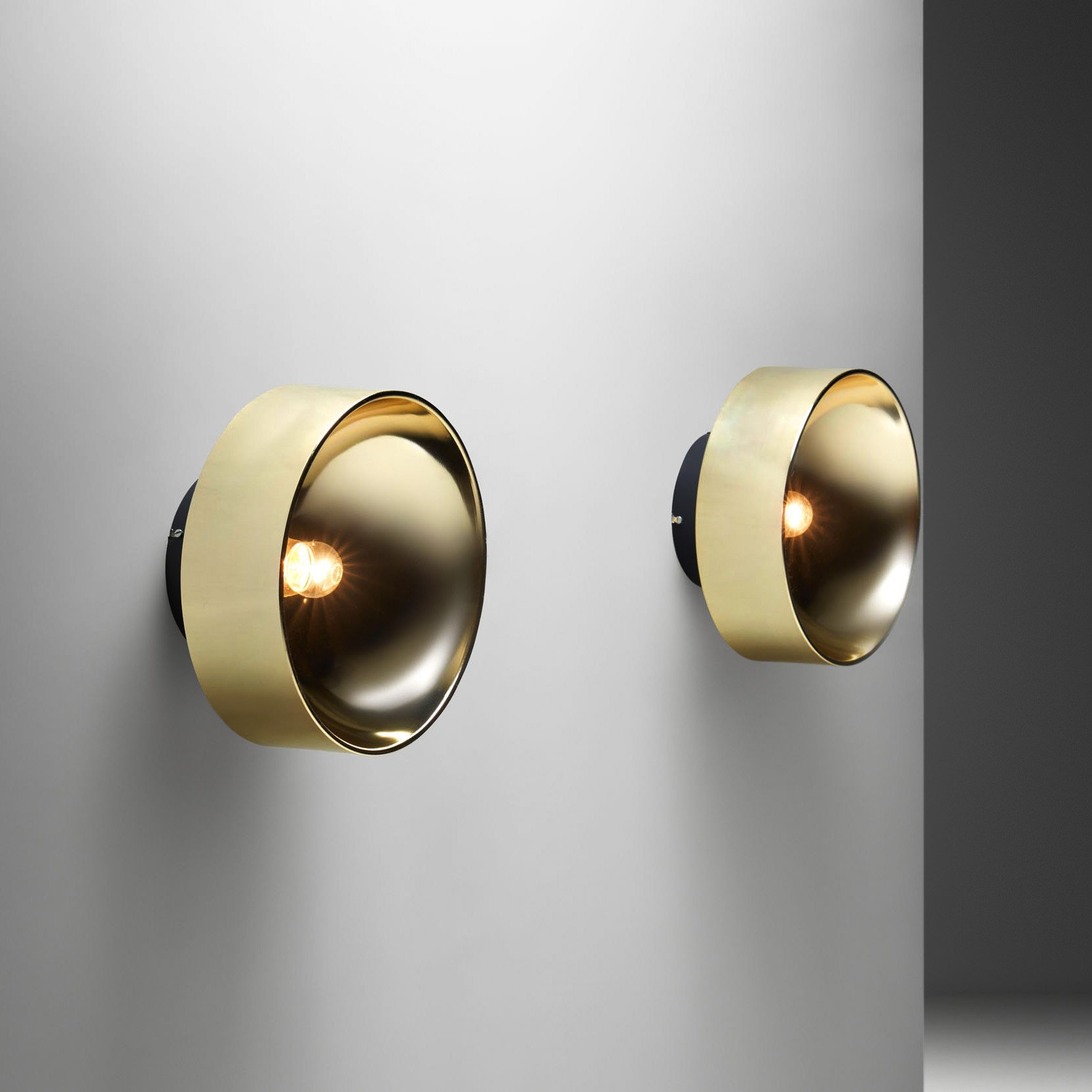
This pair of Peter Celsing wall sconces are celebrated for their iconic design, bringing modernity into any setting. Being a visual representation of “Svensk design”, this model projects a powerful, concrete rendering of a sort of “Swedishness”. It perfectly embodies the minimalist, functional, aesthetic, focused on clean lines, creating a warm atmosphere.
These stylish brass wall sconces were designed by Celsing for Falkenbergs Belysning in 1966 for the cultural center Kulturhuset in Stockholm. The modernistic look is achieved by the simple and smart form of the silhouette. The yellow brass bodies of this pair gently reflect the light, which can be elevated even more with diverse light-bulbs. The concave bowls are slightly lifted from the wall by the matte, black lacquered rings, giving them a floating appearance. Despite the use of metal exclusively, the mix of dark and warm tones creates an interesting juxtaposition which brings visual interest to the model. The bulbs are placed directly in the centre of the bowls, reflecting the warm, subdued light evenly across the room. This model is equally attention grabbing placed vertically on a wall or on the ceiling.
The Swedish Falkenbergs Belysning was an excellent manufacturer of various lighting designs, with some models exhibited in museums to this day. Kalmar Läns Museum is among the Swedish institutions where the manufacturer’s lamps and their history is exhibited as part of the country’s cultural design heritage.
Condition:
In good vintage condition. Wear consistent with age and use. Due to the nature and age of the materials, the lamps may have some marks, scratches, and discolouration.
Dimensions:
11.41 in Ø x 6.29 in D
29 cm Ø x 16 cm D
About the designer:
Peter Elof Herman Torsten Folke von Celsing (January 29, 1920 – March 16, 1974) was a Swedish modernist architect.
He was born in Stockholm, Sweden and studied at the architectural school of the Royal Institute of Technology in Stockholm, and at the Royal Swedish Academy of Arts. Celsing has been the assistant of the widely known Swedish architect Sigurd Lewerentz. According to Adam Caruso, it was Celsing that helped Lewerentz to win the design competition for the Church of St. Mark (Markuskyrkan). This building and the later St. Petri Church (Olaus Petri kyrka) are now known as a starting point of brutalist architecture.
He later became professor of architecture at the Royal Institute of Technology. After working for some time in Beirut, he became head of the architectural office of AB Stockholms Spårvägar, the Stockholm tram and local railway authority, and designed a number of suburban metro stations. He also designed several churches: in Härlanda (Gothenburg), Almtuna (Uppsala), and Vällingby, a much-publicized modernist suburb of Stockholm.
Celsing often worked in a brutalist style with large exposed grey concrete surfaces, but occasionally combined this with large glass panes exposing the structure of the building from the outside, and interior details in wood. The best-known example of this are the Kulturhuset (House of Culture) at Sergels torg in central Stockholm (1966–1971). While he is mostly remembered as an architect, Celsing also designed furniture, mainly lighting, which reflects his talent in both architectural and furniture design.

REQUEST PRICE HERE
Price category: 2,500 - 5,000 usd / eur
These Lyfa-edition “Saga” wall sconces by Danish architect and designer, Kay Kørbing are true collectors’ pieces. By the 1950s, Lyfa had built an international reputation for original, high-quality, modernist lamps. In the postwar era, the company collaborated with esteemed architects and designers to produce minimalist, sculptural pieces including these lamps.
Made of brass, metal, and crystal, the design of this model is entirely in the vein of modernism, while also sticking to the main ideals of Danish design, such as functionality. This can be observed in the lamps’ build that allows them to be faced either up- or downwards. The proportions are carefully thought out, with three main sections comprising the design. The three elements - the brass base, black metal shade holder, and the crystal glass shade - are clearly separated both by their shape, material, and colour. Most eye-catching are the Orrefors crystal glass shades in a peculiar shape that appear to be roll cut. Orrefors has been established in Swedish design tradition since 1898. Glass from the forests of Småland was incomparable: “Il n’y a que ça!” (There is nothing like it!) exclaimed the 1925 Paris World Fair. As these sconces showcase, the glass and shape are always in focus, combined with elegance, simplicity, and confidence. The predominantly round shapes are balanced by the square backplate. The artistic design is very honest in a purely Scandinavian manner, exposing the joinery and the materials’ natural qualities as well.
This pair of “Saga” wall sconces is a stunning example of how the 1960s are still able to deliver modern "art" to any interior. The producer, Lyfa, produced some cabin lamps and in its heyday - from the 1950s to mid-1970s - was considered a pioneer in innovative, architectural lighting. It is believed that Kay Kørbing designed this model for two school ships: M/S Princesse Margrethe and M/S Winston Churchill.
Condition:
In good vintage condition. Wear consistent with age and use. The brass body has a beautiful patina with some marks and discolouration. The glass has some marks and chips.
Dimensions:
4.72 in W x 5.51 in D x 13.77 in H
12 cm W x 14 cm D x 35 cm H
REQUEST PRICE HERE
Price category: 2,500 - 5,000 usd / eur
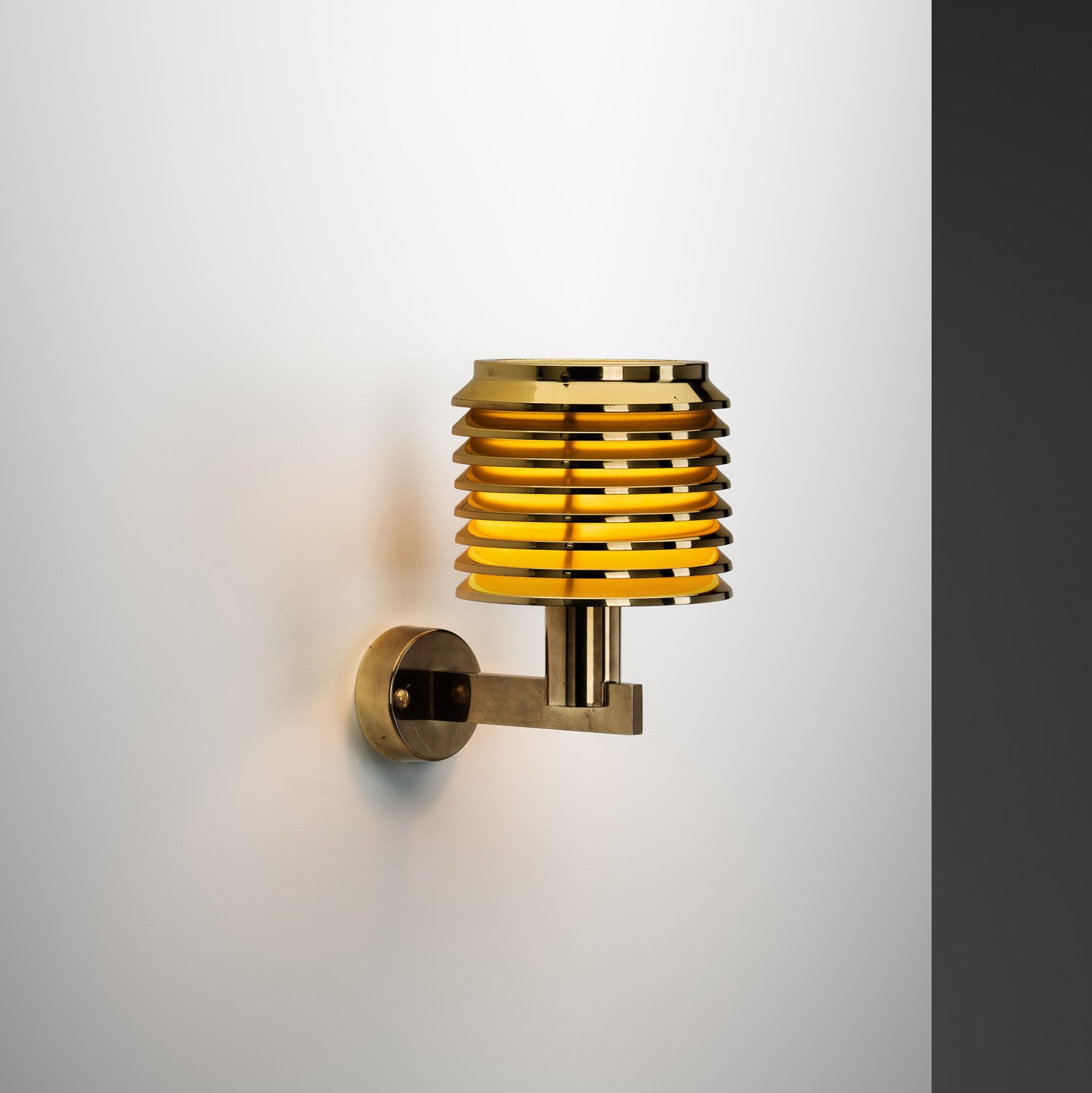
Hans-Agne Jakobsson was a Swedish interior decorator and furniture designer born in 1919 in Gotland, Sweden. After working as a carpenter apprentice, he studied architecture, followed by his career in industrial design for General Motors. The company he founded, after assisting other designers such as Carl Malmsten and Werner West, brought us beautiful pieces that are still appreciated to this day for their timeless character and quality. Jakobsson is best known for his imaginative lighting fixtures, such as this stunning brass "V-299" wall lamp.
While Jakobsson designed and produced various types of furniture, his lighting received greater international attention - and not without good reason, as this wall lamp model showcases. Like most mid-century Swedish lighting designs, the visual interest of this model is brought about by the bold brass structure. The popularity of brass can be attributed to its golden hue and charming sheen that added warmth to the style's modern aesthetic. This wall lamp further emulates the mid-century modern movement's guiding principles through its strong yet clean lines. The structure is composed of a beehive-like shape thanks to the layered shade. Due to the innovative silhouette, the design has great proportions, and when lit, it creates an exceptionally atmospheric light, giving the brass a vivid colour as well. Wall lamps are a timeless type of lighting fixture that can easily elevate their surroundings and never go out of style.
This wall lamp represents a marriage of form and function, a hallmark of Swedish mid-century modern design. Hans-Agne Jakobsson's legacy endures through pieces like this – a timeless example of how simplicity, combined with thoughtful craftsmanship, can result in lighting fixtures that transcend their utilitarian purpose, becoming works of art in their own right.
Condition:
In good vintage condition. Wear consistent with age and use. The lamp has recently been rewired and reconditioned. Due to the nature and age of the material, the item may have some marks, scratches, and discolouration.
Dimensions:
6.49 in W x 9.25 in D x 9.84 in H
16.5 cm W x 23.5 cm D x 25 cm H

REQUEST PRICE HERE
Price category: 5,000 - 7,500 usd / eur
This exceedingly rare model by Swedish designer and sculptor, Harald Notini. He was the artistic leader at Böhlmarks and is represented at the ‘Nationalmuseum’ in Stockholm.
Between the 1920s and 1950s, Böhlmarks was a significant player in the Swedish design movement. Notini drove the company forward, producing what were considered pioneering and distinctive luminaires for the time. With an unmistakeable design, this pair of model “8772/3” wall sconces belongs to a historic collection of luminaires from a golden era. At Arvid Böhlmarks Lampfabrik the 1940s and 50s represented an era with undulating forms and organic material choices in a fundamental Swedish Modern manner. This model is no exception with a stunning brass structure and unique additional features. The three symmetrically arranged brass arms branch out from the bottom of the sconce into a more organic, curved arrangement. The lamp sockets stand out for their sheer size, showcasing the brass’s beauty. The most distinctive design element however, is the large white lacquered metal reflector that is in the shape of a non-folding fan. This ingenious addition not only provides a clean backdrop against which the organic brass structure stands out, but also reflects the light to create a cosy effect. It also serves as a backplate, therefore the sconces appear as if they were not fixed to the wall.
Today we consider the mid-century era a golden age for Swedish design and craftsmanship. During these decades, some of the country's most significant luminaires were designed and produced at Böhlmarks, including these exceptionally rare wall sconces.
Condition:
In good vintage condition consistent with age and use. The metal reflectors have some scratches. The brass bodies have some weather marks and beautiful patina.
Dimensions:
11.02 in W x 3.54 in D x 17.71 in H
28 cm W x 9 cm D x 45 cm H
About the designer:
Harald Elof Notini (1879-1959), son of the sculptor Axel Notini, was a trained sculptor and interior designer who studied in his early years at the 'Högre konstindustriella skolan' - now known as Konstfack. Notini worked at Böhlmarks throughout his active career and came to play a significant role in lighting design in Sweden during the first half of the 20th century.
Notini joined Böhlmarks in 1916 and was hired as artistic director, leading Böhlmarks in a modern and innovative direction that would particularly characterize the company's range of luminaires and glass. Notini drove the company forward, producing what were considered pioneering and distinctive luminaires for the time. His expression ranged from the most ornate Swedish Grace of the 1920s and strictly functionalist luminaires, presented at the 1930 Stockholm Exhibition - to the now highly regarded Swedish Modern aesthetic of the 1940s and 1950s.
Harald remained faithful to his company for the rest of his life; at the age of 79 (1958), he still had his office and a wide range of duties. A commemorative publication of Böhlmark's 75th anniversary, published in 1947, notes that Notini was active as an artistic director with a continuing significant role in the design of luminaires and household glass. Given Böhlmark's extensive product catalogues, Notini must have had a drawing office with several designers employed.
REQUEST PRICE HERE
Price category: 7,500 - 10,000 usd / eur
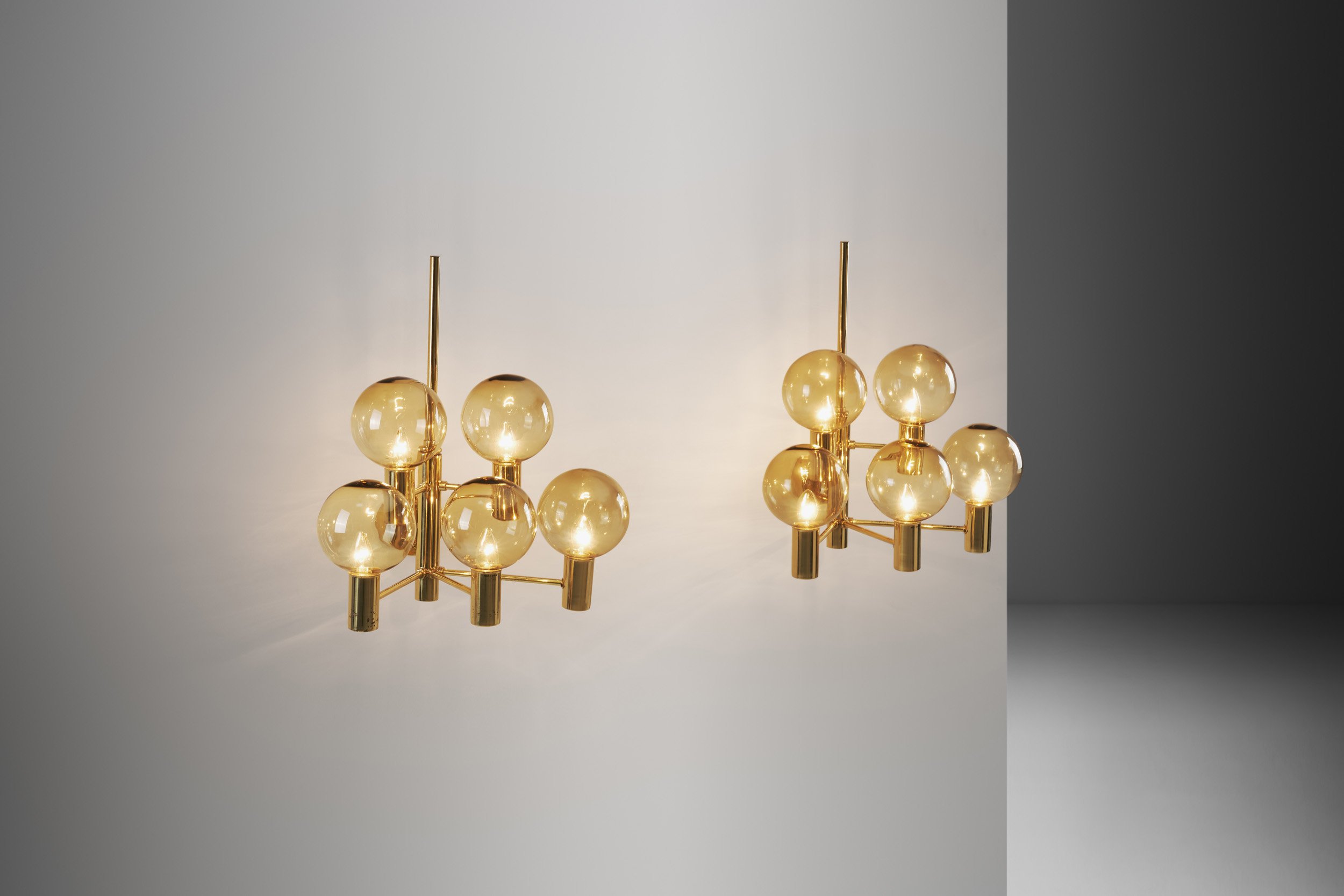
This pair of wall lamps is among the most stunning models of Jakobsson’s. With each brass frame holding five smoked, translucent glass shades, these lamps are the upgraded, larger version of the model V 149/3. The design clearly shows the Swedish designer’s studies in architecture, with beautiful geometric forms and symmetry dominating the structures.
The dominating visual feature of this model is the brass structure with five brass tubes connected by a large, vertical brass slat. The tubes are arranged on two levels, with two on the upper, and three on the lower level, with each one holding a translucent, smoked glass shade. The shades resemble pressed spheres and have a generous size. Thanks to the arrangement of the brass poles and bulbs, this wall lamp divides the light evenly and uniquely. When switched on, the light coming from the smoked glass shades brighten the yellow brass beautifully, as if it was also glowing from the inside. The vertical slat overreaches the shades, visually elongating the design, emphasizing the design’s geometrical nature.
These wall lamps have all the characteristics Jakobsson was famous for; they are elegant and stylish, and while the design allows them to be big and shiny, they never become tacky. This model was produced by Hans-Agne Jakobsson AB, Markaryd in Sweden, and the design was still popular in the 1980s, even making an appearance in the 1983 – 1984 Philips catalogue.
Condition:
In good vintage condition. Wear consistent with age and use. Some scratches and marks on the patinated brass structures.
Dimensions:
19.68 in W x 14.56 in D x 21.85 in H
50 cm W x 37 cm D x 55.5 cm H
About the Designer:
Born in 1919 in Gotland, Sweden, Hans Agne Jakobsson is one of the most well-known Swedish lighting designers. He did his carpenter apprenticeship before studying architecture in Gothenburg.
First working as an industrial designer for General Motors, he later founded his own company after being an assistant to the designers Carl Malmsten and Werner West. In 1950, due to Christmas, he added a model of hanging lamps in small strips of pine in one of his stores to soften the lively lighting of the shop window. The people who were passing by were immediately seduced by this hanging lamp, which started it all. He established his own company in 1951: Hans Agne Jakobsson AB and began producing this model in his factories and achieved success abroad as well. In 50 years, he designed more than 2000 lamps with unique designs.
He used materials and experimented with multiple techniques, for example using fabrics with fringes, blown glass of colour and smoked glass. His great diversity resulted in a wide range of timeless lighting models. These pieces continue to seduce design lovers, as they adapt themselves to any interior, without blending into the background.
Today, Jakobsson’s works can be found in private homes as well as public institutions throughout Sweden. The designer passed away in 2009 in Sweden, leaving behind a great legacy. ~H.
REQUEST PRICE HERE
Price category: 1,000 - 2,500 usd / eur
While Hans-Agne Jakobsson designed and produced various types of furniture, his lighting received greater international attention, and not without good reason. As these “V-149” wall sconces showcase, the Swedish designer mastered both the direction and colour of his lighting designs.
With the brass frames holding the glass shades, these lamps clearly show the Swedish designer’s studies in architecture, with beautiful geometric forms and symmetry dominating the structures. The popularity of brass in Swedish mid-century modern lighting design can be attributed to its golden hue, which adds warmth to the style's streamlined aesthetic. This wall sconce pair further exemplify the mid-century modern movement's guiding principles through their clean lines and geometric shapes. The structure is composed of a back-plate and single stem holding an elongated brass socket. The translucent glass shades stand out not only through the pairing of materials, but also by their generous size compared to the delicate appearance of the fixtures. These wall sconces divide the light evenly and brighten the yellow brass beautifully, creating a cosy and warm visual effect. This model was produced by Hans-Agne Jakobsson’s own company in Markaryd, Sweden.
Sconces are a timeless type of lighting fixture that easily elevate their surroundings. These fixtures never go out of style, and this is especially true for mid-century brass models like these lamps. While already stunning individually, these light models are even more effective when placed in close proximity to each other.
Condition:
In good vintage condition. Wear consistent with age and use. Some scratches and marks on the patinated brass structure. All lighting can be converted for US usage.
Dimensions:
7.87 in W x 5.9 in D x 9.05 in H
20 cm W x 15 cm D x 23 cm H
About the Designer:
Born in 1919 in Gotland, Sweden, Hans Agne Jakobsson is one of the most well-known Swedish lighting designers. He did his carpenter apprenticeship before studying architecture in Gothenburg.
First working as an industrial designer for General Motors, he later founded his own company after being an assistant to the designers Carl Malmsten and Werner West. In 1950, due to Christmas, he added a model of hanging lamps in small strips of pine in one of his stores to soften the lively lighting of the shop window. The people who were passing by were immediately seduced by this hanging lamp, which started it all. He established his own company in 1951: Hans Agne Jakobsson AB and began producing this model in his factories and achieved success abroad as well. In 50 years, he designed more than 2000 lamps with unique designs.
He used materials and experimented with multiple techniques, for example using fabrics with fringes, blown glass of colour and smoked glass. His great diversity resulted in a wide range of timeless lighting models. These pieces continue to seduce design lovers, as they adapt themselves to any interior, without blending into the background.
Today, Jakobsson’s works can be found in private homes as well as public institutions throughout Sweden. The designer passed away in 2009 in Sweden, leaving behind a great legacy. ~H.