
Carl Malmsten "Åldermannen" Winged Armchairs for O.H. Sjögren, Sweden 1950s


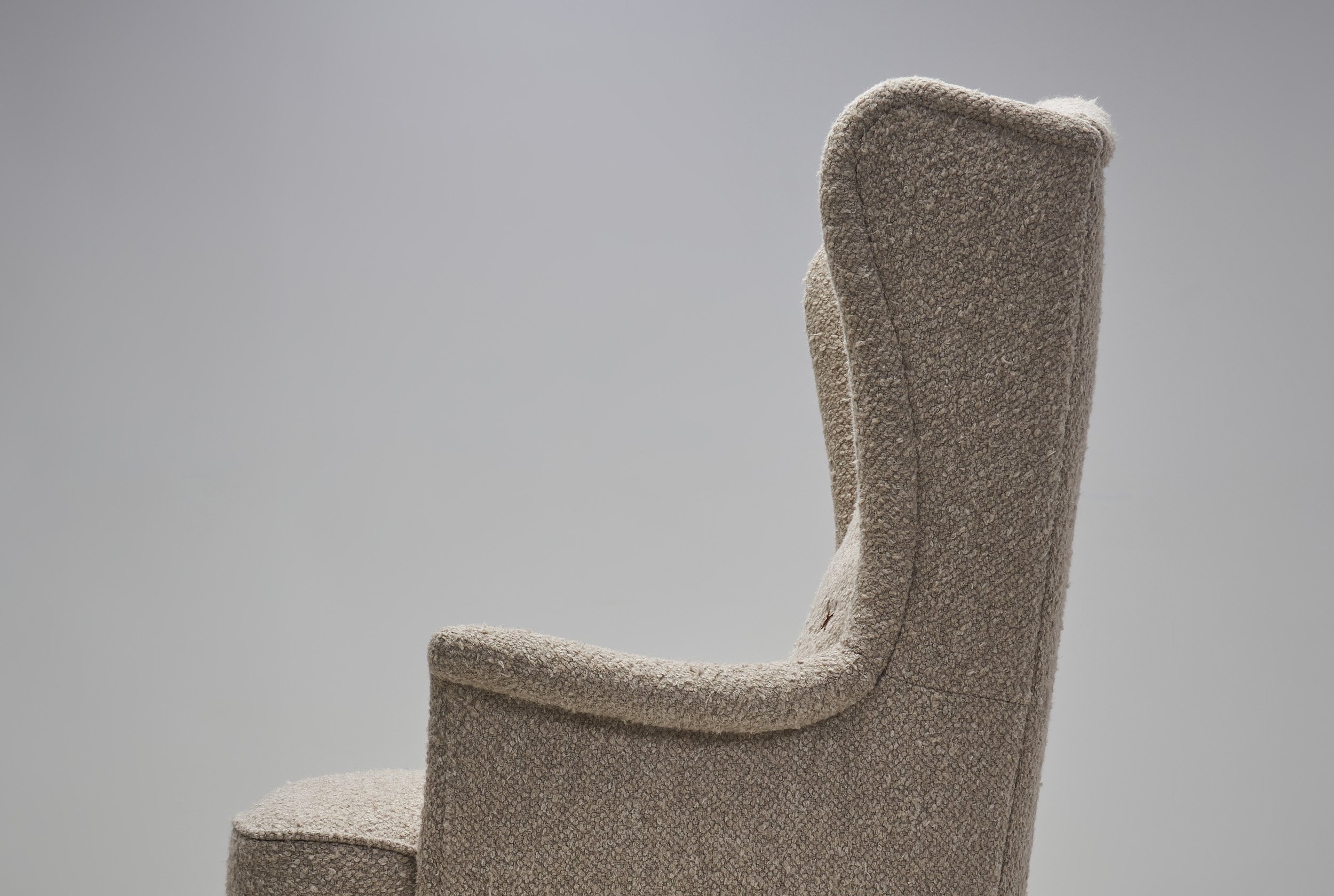

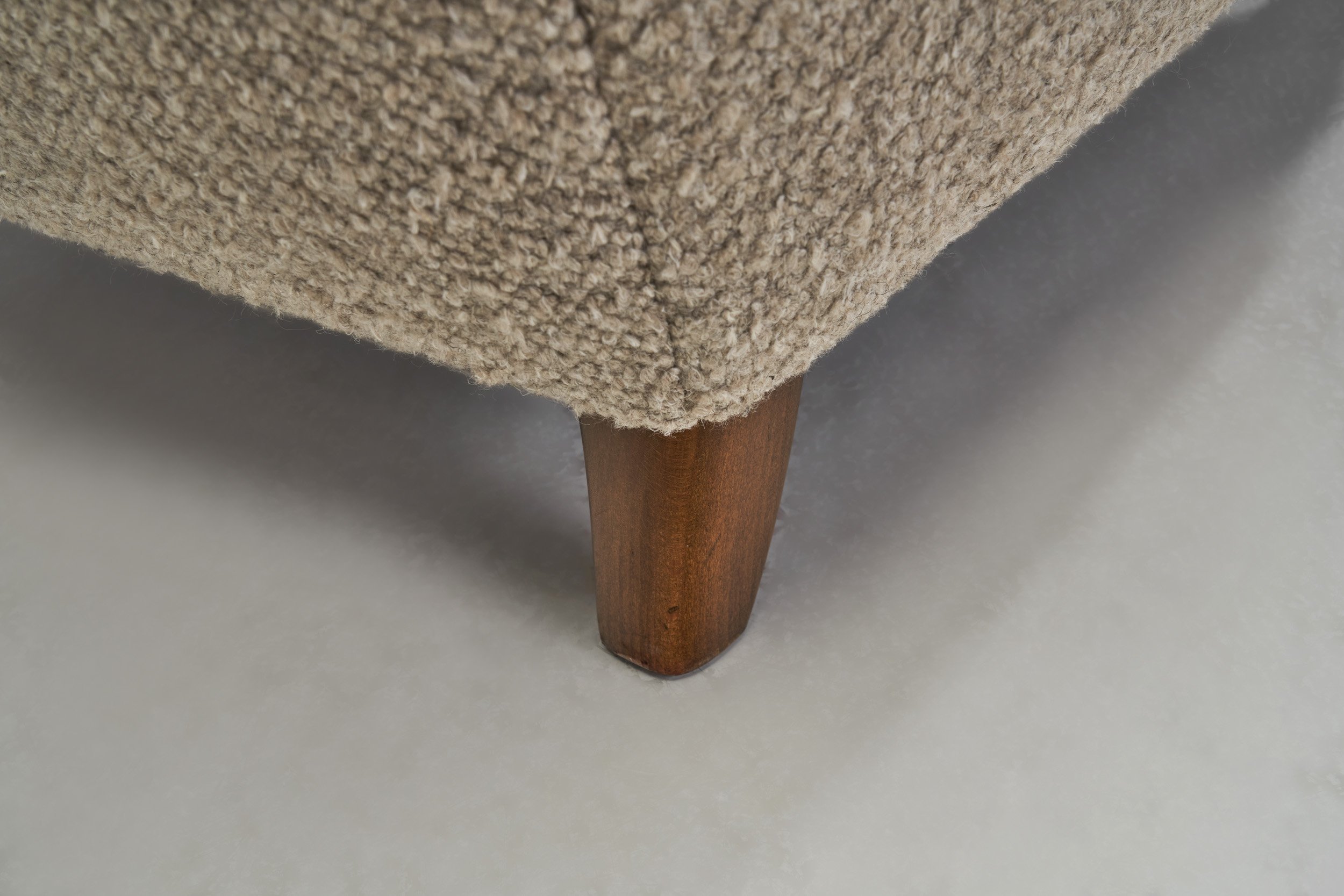


Carl Malmsten "Åldermannen" Winged Armchairs for O.H. Sjögren, Sweden 1950s
REQUEST PRICE HERE
Price category: 9,000 - 12,500 usd / eur
Carl Malmsten’s life's work spans nearly sixty intense years and his legacy is considered a national treasure in Sweden. He created a number of furniture classics including these rare “Elder man” armchairs.
His entire work is characterized by a close-to-nature philosophy which is deeply rooted in Swedish nature and commoner culture. A deeper knowledge of Carl Malmsten as a person means that his furniture can be seen not only as utilitarian objects, but also as artistic works with the ability to express a feeling or mood. These winged armchairs carry with them that certain “Malmstenesque” that is characterized by gentle curves, a cosy appearance and of course, the highest quality craftsmanship. This is especially visible in the flowing armrests that descend from the top, curling outwards to create a welcoming look. The slightly bent backrests are tufted with dark brown leather stitches that contrast with the light bouclé upholstery both in colour and texture to create a stylish, visually interesting look. As it can be expected from the “Master of Wood”, the frames are expertly designed, with ergonomic and aesthetic principles at their core. To complete the mid-century look, the structures are supported by tapered, solid wood legs that add an organic touch to the design.
In the 50s, Carl Malmsten’s furniture were produced in small series in smaller workshops, which meant that the furniture became very expensive and thus inaccessible to most people. He then decided to select a number of producers who could produce his furniture in larger volumes without sacrificing quality, beauty, and practicality. In Tranås he came into contact with O.H. Sjögren which he considered fulfilled all the high demands he placed on the production of upholstered furniture.
Condition:
In good vintage condition. Wear consistent with age and use. The chairs have been reupholstered recently in a premium bouclé fabric. Each of our items can be re-upholstered by our in-house atelier in a fabric of choice. Please reach out for more information.
Dimensions:
Chair 1
28.74 in W x 34.64 in D x 41.33 in H; Seat height 16.14 in; Arm height 21.65 in
73 cm W x 88 cm D x 105 cm H; Seat height 41 cm; Arm height 55 cm
Chair 2
29.52 in W x 32.67 in D x 41.73 in H; Seat height 14.56 in; Arm height 21.65 in
75 cm W x 83 cm D x 106 cm H; Seat height 37 cm; Arm height 55 cm
About the Designer:
Carl Malmsten (December 7, 1888 – August 13, 1972) was a Swedish furniture designer, architect, and educator. Malmsten was born in Stockholm, Sweden. Malmsten's career took off when he won a competition in 1916 to design furniture for the Stockholm City Hall and shortly after in 1917, he exhibited alongside well-known Swedish architects such as Gunnar Asplund and Uno Åhrén.
In the 1920s he was invited to furnish a room for the crown prince, Gustaf VI Adolf, and his wife Louise in Ulriksdal Palace. He was honoured with an inaugural Prince Eugen Medal for design in 1945. Already as a young designer in the early 20th century, Carl Malmsten advocated an artisanal furniture design based on local ingredients and traditions, available to a wide audience at a reasonable price.
Nature was Carl Malmsten's foremost teacher and source of inspiration. He conveyed his love of craftsmanship as a teacher in his own schools, at Olofskolan in Stockholm, Capellagården on Öland and the Carl Malmsten school on Lidingö, today a branch of Linköping University and one of the country's leading design colleges. As a debater, Malmsten stormed against functionalism, but in retrospect it can be seen that his ideas often coincided with the rational and frugal style ideals of function.
Malmsten has had a lasting influence on Swedish furniture design through the two schools he founded—the Carl Malmsten Furniture Studies (Carl Malmstensskolan), which has been a part of Linköping University since 2000, is situated on the island of Lidingö on the outskirts of Stockholm. Carl Malmsten spoke about the importance of tradition, craftsmanship, and the nation. His furniture was in many ways a product of the thoughts and ideals of the time, they have a timeless quality that makes them just as relevant and loved today. ~H.
REQUEST PRICE HERE
Price category: 15,000 - 20,000 usd / eur
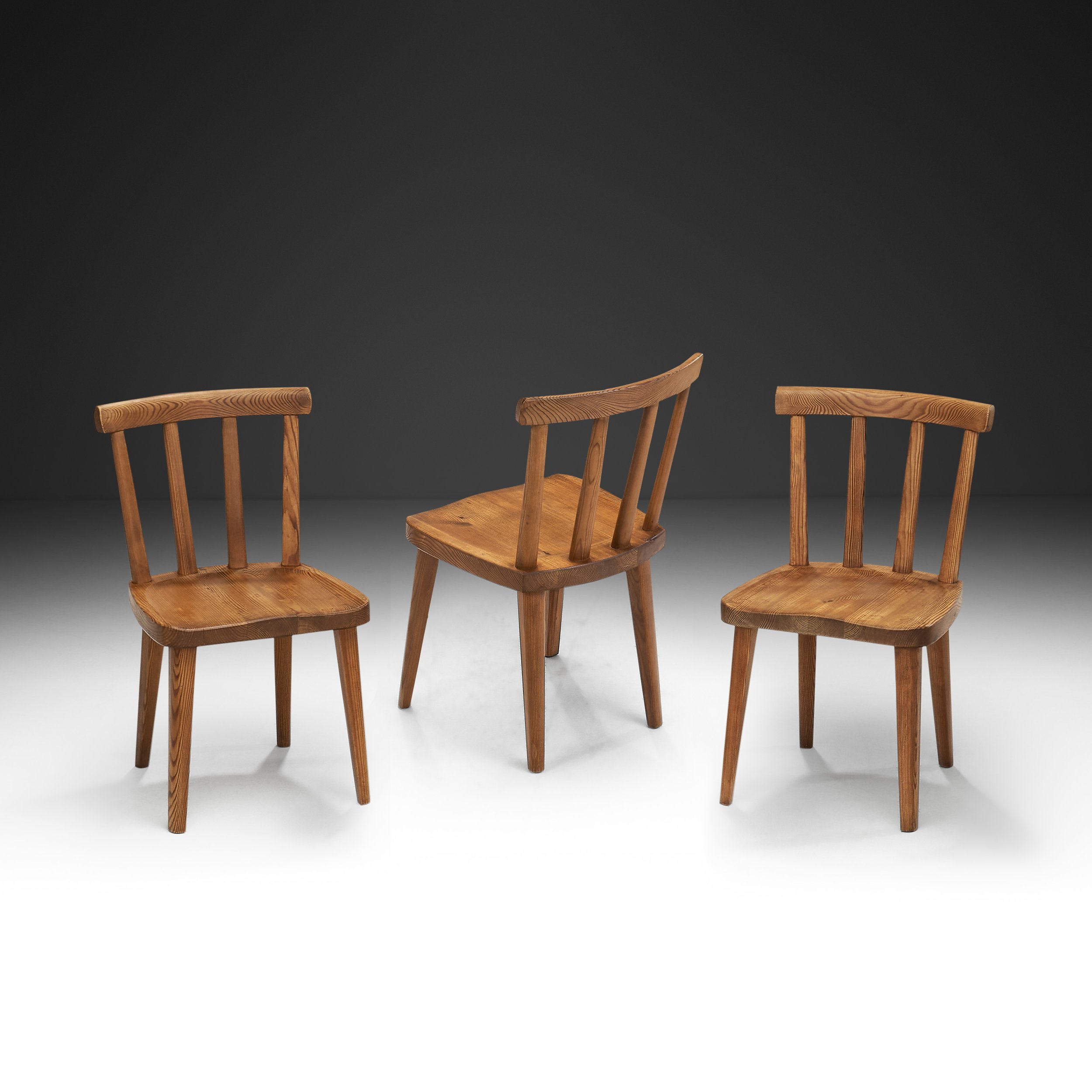
Swedish architect and furniture designer Axel Einar Hjorth served as the lead designer for Sweden’s Nordiska Kompaniet department store from 1926 to 1938. During this time, Hjorth designed the “Sportstugemöbler” series, (which translates to “sports cabin furnishings”) a collection of wooden furniture designed for country homes. The various models in the sportstugemöbler series took their names from the Stockholm archipelago – including Blidö, Lovö, and famously, Utö.
These Utö chairs were designed in 1932 as part of the collection. Unlike the department store's interiors for floors and villas in the cities, the Utö designs had a simple character with robust and basic shapes in solid pine. Accordingly, the design of these chairs focuses on simple lines and the material itself. Made of pine wood, these chairs are strong, reflecting Hjorth’s principles in which he mixed the ideals of the modernist movement with provincial Swedish traditions. As a result, the design of this set is completely timeless. Each chair demonstrates a conscious construction, where the joinery and fittings related to traditional craftsmanship are emphasized. Dominated by rounded, straight lines, the chairs have spindle backrests and ergonomically carved seats. The form alludes harmony and stability, fitting the summer cabin concept perfectly.
In an international perspective, Hjorth's “sportstugemöbler” series was the forerunner of later pioneering designers such as Charlotte Perriand. It is therefore no surprise that these Utö chairs became part of Swedish and international modernist design history. In their time, the Utö collection may have appeared as pioneering and radical, but today they are viewed as status symbols in interiors of international character.
Condition:
In good vintage condition. Wear consistent with age and use. Some marks and stains on the wood. Due to the nature and age of the wood, the items may have scratches and discolouration.
Dimensions:
18.89 in W x 18.3 in D x 31.49 in H; Seat height 16.92 in
48 cm W x 46.5 cm D x 80 cm H; Seat height 43 cm
Literature:
Christian Bjork, Thomas Ekstrom and Eric Ericson, 'Axel Einar Hjorth: Mobelarkitekt', Stockholm, 2009, p.130
About the designer:
Axel Einar Hjorth was born in a small Swedish village named Krokek, just outside Norrköping, on March 7, 1888. At the age of 20, he moved to Stockholm to study architecture and design at the Högre Konstindustriella Skolan.
Although he never graduated, in the 1920s Hjorth started working as a furniture designer for various manufacturers, such as H. Joop & Co., Myrestedt & Stern, Jonssons, and Nordiska Kompaniet. Hjorth’s designs from this period had neoclassical features combined with Swedish Grace. This romantic national style of Sweden was elegant and refined, yet simple. The anniversary exhibition of 1923 in Gothenburg marked the breakthrough of Swedish decorative arts, and made Axel Einar Hjorth a well-respected artist. From October 1926, Hjorth became the chief designer and architect of Nordiska Kompaniet department store in Stockholm. In the 1930s, Hjorth designed a furniture collection out of pine meant for serial production known as Sportstugemöbler (furniture for holiday houses).
Hjorth’s designs, from the luxury of neoclassicism to the severity of functionalism, are sharply distinctive in style, materials, and character. Unlike many of his contemporaries, Hjorth did not conform to the socially oriented ideas produced by Svensk Form (the Swedish Society of Crafts and Design). He played a significant role in the development of Swedish society as a whole, and particularly in Swedish industrial art
Today Hjorth is often viewed as a precursor to the modern designs popularized by Charlotte Perriand, Jean Royére, Pierre Chapo, or Josef Frank. Recently, there has been a revival of appreciation for his work, showing his genius in a new light. ~H.
REQUEST PRICE HERE
Price category: 9,000 - 12,500 usd / eur
The principle of Functionalism, or Funkis, by its Swedish name, can be summed up in Louis Sullivan's famous 1893 definition; "form follows function". Its key feature is that practical considerations, such as use, material and structure should determine the shape and look of a piece. Functionalism as an architectural movement can be traced back to the 1920s, a time when movements like Nordic Classicism, the Scandinavian equivalent of the European Art Deco movement, were leaving their mark on the design world.
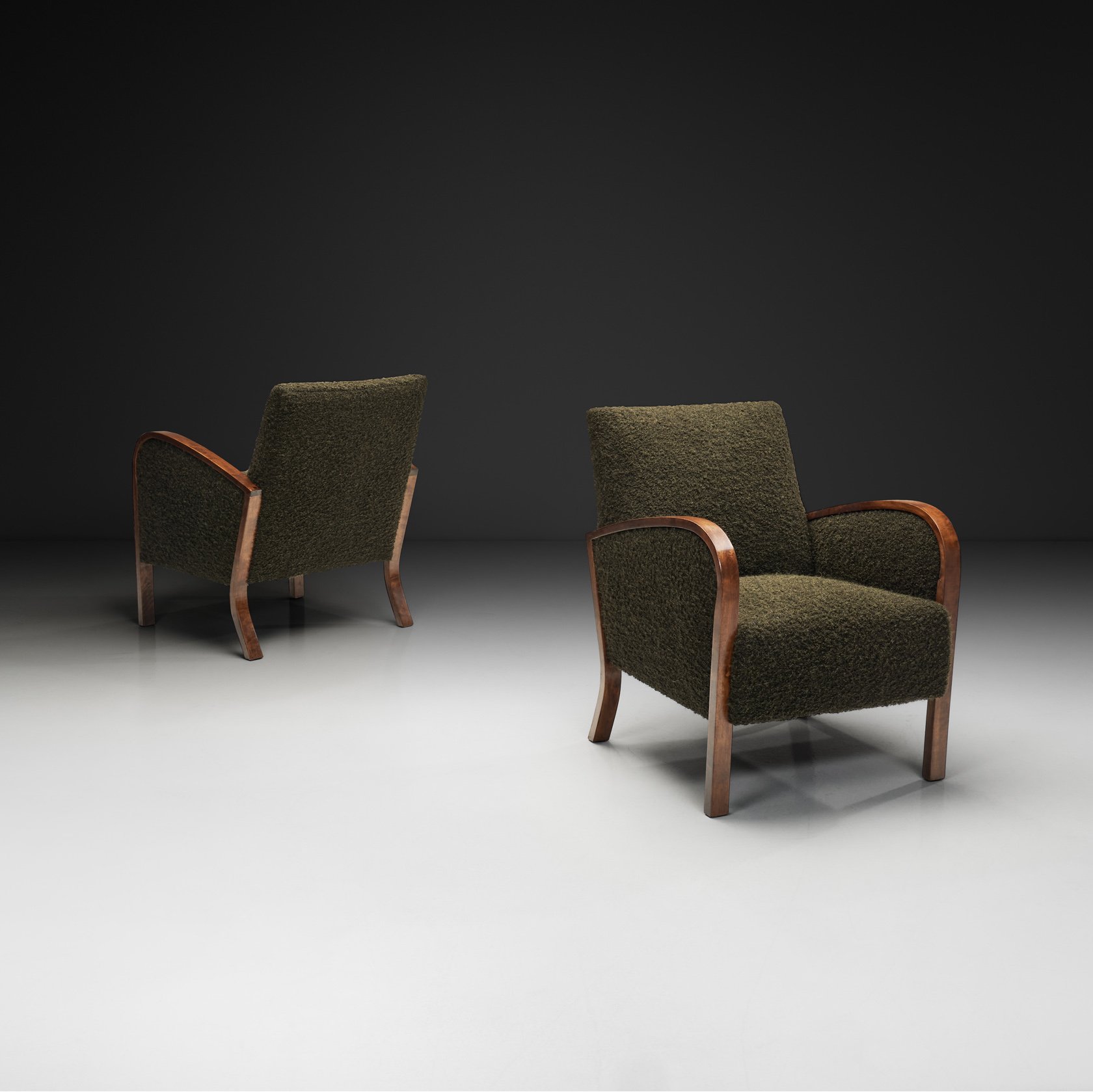
This pair of armchairs represents a reflection of the Scandinavian design landscape of the 1930s, gracefully combining aesthetic elements into a timelessly elegant look. This transitional piece marries a practical Functionalist silhouette, formed by clean lines and simple decorations, with elements of Nordic Classicism. Each chair features a subtly reclined rectangular back over a deep seat along with elegantly curved armrests framed by the birch wood. The legs allow the cosy design to stand out, enhancing the lounging experience. The thick seat cushions and gently bent backs further contribute to the comfort. Still, the arms are in the focus of the design, with a highly distinctive shape and form in the front. The dark-toned upholstery complements the structure’s individuality. The wood is especially appealing, which is why it is also showcased on the arms; its grain and colour makes it a coveted, yet still rare material in Scandinavian seating.
These chairs illustrate the perfect alliance of geometry and function combined with expert craftsmanship. Perfectly suited for a vintage or contemporary interior, this pair combines artistry and comfort, and is sure to become the focal point of any space.
Condition:
In good vintage condition. Wear consistent with age and use. The chairs have recently been reconditioned. Due to the nature and age of the materials, the wood has some marks, scratches, and discolouration. There is a visible crack on the wood. The chairs have recently been reupholstered in a premium fabric. Each of our items can be reupholstered by our in-house atelier in a fabric of choice. Please reach out for more information.
Dimensions:
23.82 in W × 29.53 in D × 29.53 in H; Seat height 16.73 in; Seat depth 19.29 in; Arm height 24.41 in
60.5 cm W x 75 cm D x 75 cm H; Seat height 42.5 cm; Seat depth 49 cm; Arm height 62 cm

REQUEST PRICE HERE
Price category: 2,500 - 5,000 usd / eur
The dark wood, the beautiful upholstery, and timeless design in the manner of Erik Bertil Karlén make this rare easy chair a beautiful representation of Swedish mid-century modern design history.
For this model, nature was evidently a great source of inspiration, therefore sharp edges or corners can rarely be found. With a tremendous sense of proportion, this chair model is very comfortable and fulfils its task to “serve well” and last for lifetimes. Without any ornamentation, the focus here is on the round, flowing lines of the body and its upholstery. The design has the wingback look with sides that embrace the sitter in a cosy way. On the upper end, the “wings” curve outward, which opens up the design. What makes this model special is how the back and seat form one unit both visually and structurally. This shell-like form has a masterful curve that follows the human body’s shape therefore the chair is very ergonomic. The dark, wooden tapered legs are connected by stretchers on the sides and highlight the body with their understated look. The light upholstery with appealing button tufting provides an elegant look with its textured look and a cosy sitting experience thanks to its softness.
Swedish Modern design is a distinctive style that represents a design philosophy, guided by functionality, simplicity and clean lines. The design of this model is in favour of the user, maintaining the focus on authentic simplicity.
Condition:
In very good vintage condition. Wear consistent with age and use. The chair has been reupholstered recently in a premium fabric. Each of our items can be re-upholstered by our in-house atelier in a fabric of choice. Please reach out for more information.
Dimensions:
28.14 in W x 28.74in D x 33.26 in H; Seat height 16.14 in
71.5 cm W x 73 cm D x 84.5 cm H; Seat height 41 cm
Literature:
Form: Svenska slöjdföreningens tidskrift, Svenska slöjdföreningen, Stockholm, 1943, p. 87.
Hedqvist, Hedvig & Björk, Christian, "Swedish Modern : En historia om modernismens yttringar i Sverige genom design, inredning och formgivning", Orosdi-Back, 2018, p. 228-229.
About the designer:
Erik Bertil Karlén was born on February 22, 1912 in Sundbyberg, Sweden. He was a Swedish architect and designer. His architecture characterized many areas of Stockholm’s suburbs from the 1940s, 50s and 60s.
After his training as an architect at KTH in the 1930s, Karlén got a job as an architect at Fortifikationsstyrelsen's Kasernbyrå in 1940. One of his major works at this time was designing the buildings for Svea Livgarde in Sörentorp, Solna municipality, which was completed in 1946. He gave the buildings a simple but careful architectural style using predominantly red brick as the facade material. Some had brick in combination with dark-glazed wood panels.
As many of his contemporary Scandinavian architects, Karlén also designed furniture, mostly seating models. His designs however, remain very rare to this day.
REQUEST PRICE HERE
Price category: 2,500 - 5,000 usd / eur
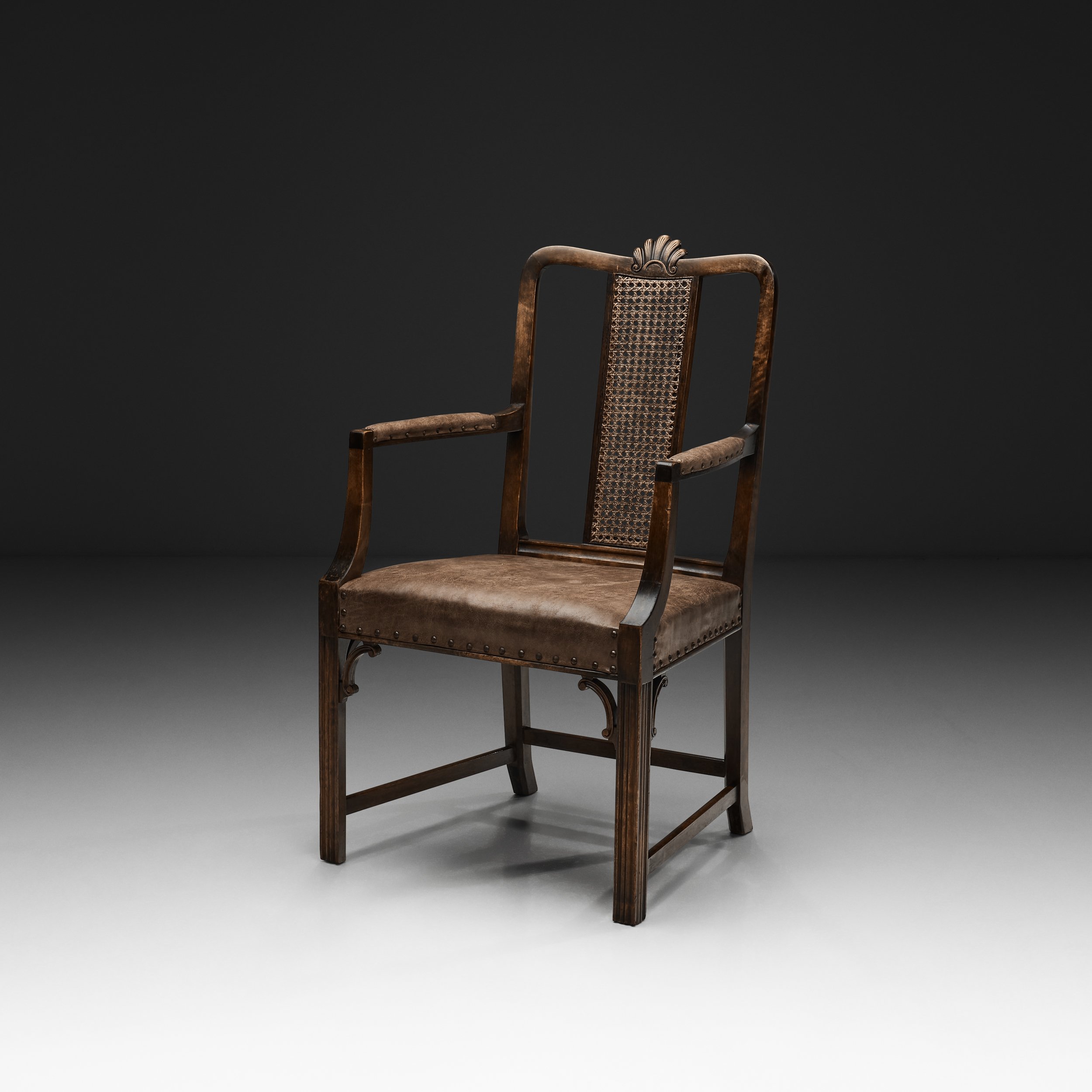
Axel Einar Hjorth’s designs are sharply distinctive in style, materials, and character. Unlike many of his contemporaries, Hjorth did not conform to the socially oriented ideas produced by Svensk Form (the Swedish Society of Crafts and Design). He often incorporated playful ornamentation from different historical periods by which he was inspired, such as the French Art Déco, using mixed exotic woods, bright colours, and textiles, as this “Radio” chair showcases.
Designed in the first half of the 20th century, this armchair possesses a refined and slender appearance with distinctive details. The chair displays a clearly defined wooden frame with a neatly upholstered seat. The sleek wooden frame offers a beautiful contrast to the upholstery, creating a visually captivating aesthetic. With these characteristics, the chair makes for a harmonious balance between contemporary elegance and traditional style. Even though Swedish design is generally democratic and meant for the masses, pieces were not stripped of their beauty for the sake of functionality. The importance of this balance can be identified in the design and execution of this armchair as well. The craftsmanship displayed in this armchair model is a testament to the high standards of Swedish design in the early 20th century, reflecting both the technical skill and artistic vision of Hjorth and Nordiska Kompaniet. This chair not only serves as functional furniture but as a timeless work of art, showcasing the elegance and innovation of the era.
The Swedish company Nordiska Kompaniet manufactured this armchair with utmost care for its quality and design. Axel Einar Hjorth worked as the lead designer for the department store from 1926 to 1938. The company was among the most renowned Swedish manufacturers during the mid-century era, working with some of the most well-known Scandinavian designers - and this "Radio" model is a prime example of the great success these collaborations resulted in.
Condition:
In good vintage condition. Wear consistent with age and use. The armchair has recently been reconditioned. The wood has some scratches and stains. Due to the age and nature of the wood, the chair may have marks and discolouration. The chair comes with its original upholstery or has been reupholstered by a previous owner. We recommend reupholstery due to some signs of wear. Each of our items can be reupholstered by our in-house atelier in a fabric of choice. Please reach out for more information.
Dimensions:
22.44 in W x 23.23 in D x 37.99 in H; Seat height 18.11 in; Seat depth 17.52 in; Arm height 26.77 in
57 cm W x 59 cm D x 96.5 cm H; Seat height 46 cm; Seat depth 44.5 cm; Arm height 68 cm
REQUEST PRICE HERE
Price category: 2,500 - 5,000 usd / eur
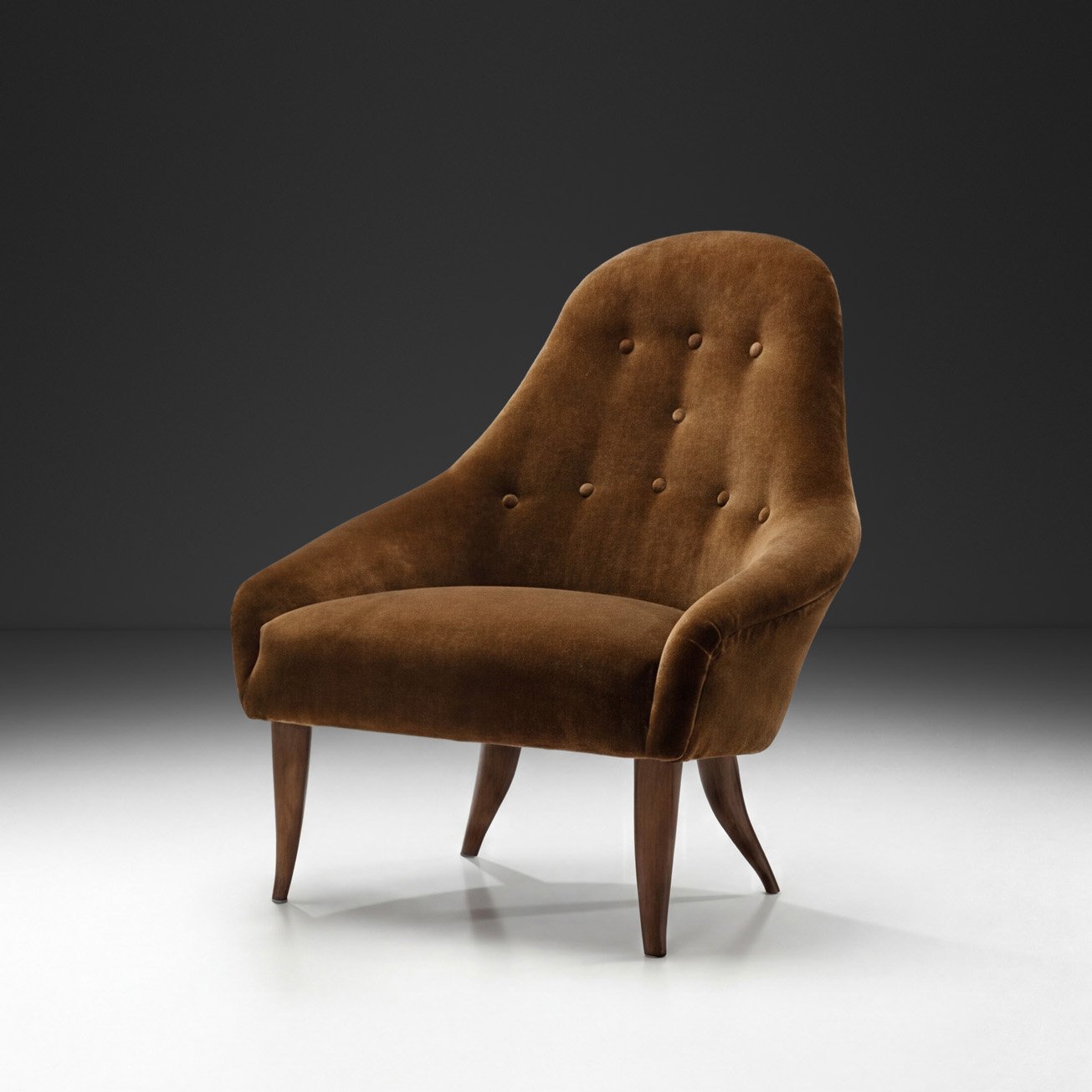
This “Lilla Eva” model is from the timeless and iconic Paradise Collection, which was created by Kerstin Hörlin-Holmquist during her time as a designer at Nordiska Kompaniet. The name is inspired by “Paradiset” – the Swedish name for Eden.
This chair holds a soft simplicity and a uniqueness in its appearance - light, clean lines with an air of romance. Without worrying about short-lived trends and what other people thought, Hörlin-Holmquist created the peculiar shape of “Lilla Eva” chairs that is only increasing in popularity. Thanks to her unique vision, these chairs have an unmistakeable backrest that flows down to form the armrests. While the armrests sit low, therefore opening the seats, the chair still gives the impression of hugging the sitter. The upholstered body elevates the visual comfort, with tufted backrests that are festooned with nine symmetrically arranged buttons.
The upholstery is a premium brown fabric with a soft touch that complements the aesthetic of Hörlin-Holmquist’s design. The cross stitches give this chair a modern flair, contrasting stylishly to the fabric. Similarly, the stained and tapered wood legs pair perfectly with the sculptural and organic form of the body. Kerstin Hörlin-Holmquist had a unique and humanistic design vision, and thanks to her uncompromising attitude, “Little Eva” easy chairs have become iconic.
Condition:
In good vintage condition. Wear consistent with age and use. The chair has recently been reconditioned. Due to the nature and age of the materials, the chair may have marks, scratches, and discolouration. The chair has been reupholstered recently in premium fabric. Each of our items can be reupholstered by our in-house atelier in a fabric of choice. Please reach out for more information.
Dimensions:
27.55 in W x 30.51 in D x 32.67 in H; Seat height 15.15 in
70 cm W x 77.5 cm D x 83 cm H; Seat height 38.5 cm
About the Designer:
Kerstin Hörlin-Holmquist was born on May 30, 1925 in Arvika, Sweden. She was a Swedish modernist architect and designer. Hörlin-Holmquist graduated from Stockholm’s Konstfack in 1952, and before that she studied and worked in England.
She often worked with her husband Erik Holmquist, and together they modelled and created the pieces together. A key aspect for the couple was always to test their designs in their own home before completing a project.
"I think both furniture and textiles, wherever they end up, must be kind, gentle and courteous, but without losing their character. They should have human qualities, not be pompous and only stand alone, but be able to adapt to the environment they end up in..."
Holmquist worked and studied in England from 1946-1947 immediately after the war where she also studied art history and became fascinated with the classic English upholstered furniture and style. Something that without a doubt inspired her own creations later in life while she still developed her own expression. She returned to Sweden where she attended Konstfack from 1948 and graduated from the school in 1952. She started working with Nordiska Kompaniet shortly after her graduation and became a lead designer. Her timeless and iconic ‘Paradiset Collection’ was created during her employment with Nordiska Kompaniet in 1956-1957 and holds a soft simplicity and a uniqueness in its appearance - light, clean lines and yet gracious with an air of romance.
Today, her designs are highly treasured collectibles. She is primarily remembered, for her ability to create designs for the modern home in the 1950s without worrying about short-lived trends and what other people thought - to stay true to her own unique and humanistic design vision.
REQUEST PRICE HERE
Price category: 5,000 - 7,500 usd / eur
The ‘Oskar’ armchair was designed in 1939, the same year that Carl Malmsten participated in the New York World’s Fair. It was there that the expression “Swedish Modern” was coined, but Malmsten remained a traditionalist, mainly concerned with comfort in the home.
As with so many of Malmsten’s pieces of furniture, “Oskar” was modelled on an earlier design – his own or from previous generations. This armchair belongs to Carl Malmsten's earlier works, and the structure is traditionally made of solid pine from Swedish forests. As can be expected from the “Master of Wood”, the frame is expertly designed, with ergonomic and aesthetic principles at its core. While this armchair may seem less “Malmstenesque”, it already has the gentle curves that defined Malmsten’s later designs. This is especially visible in the flowing armrests that descend from the top, curling outwards to create a welcoming look. The gently bent backrest is tufted with dark yellow stitches that contrast with the light bouclé upholstery, both in colour and texture to create a stylish, visually interesting look. The structure is supported by the tapered, solid pine legs that add an organic touch to the design.
The design is reminiscent of the furnishings of the sitting room of Ulriksdal Palace, which was given to the crown prince and princess, Gustav and Louise, by the Swedish people in 1923. Malmsten was commissioned to create the decor for the room, and the ‘Oskar’ armchair may have been a template for this period, and perhaps that is why Carl Malmsten gave the chair a royal-sounding name. The company known today as O.H. Sjögren was established as early as the 1870s. Carl Malmsten, who had hitherto only produced the most exclusive and unique furniture for a limited and affluent clientele, sought manufacturers who were able to produce his furniture in larger volumes without compromising the high demands he placed on craftsmanship and quality. He chose O.H. Sjögren, and together they developed and marketed the many items of upholstered furniture that have become classics today.
Condition:
In good vintage condition. Wear consistent with age and use. The chair has been reupholstered recently in a premium bouclé fabric. Each of our items can be re-upholstered by our in-house atelier in a fabric of choice. Please reach out for more information.
Dimensions:
28.74 in W x 29.92 in D x 37.4 in H; Seat height 16.33 in
73 cm W x 76 cm D x 95 cm H; Seat height 41.5 cm
About the Designer:
Carl Malmsten (December 7, 1888 – August 13, 1972) was a Swedish furniture designer, architect, and educator. Malmsten was born in Stockholm, Sweden. Malmsten's career took off when he won a competition in 1916 to design furniture for the Stockholm City Hall and shortly after in 1917, he exhibited alongside well-known Swedish architects such as Gunnar Asplund and Uno Åhrén.
In the 1920s he was invited to furnish a room for the crown prince, Gustaf VI Adolf, and his wife Louise in Ulriksdal Palace. He was honoured with an inaugural Prince Eugen Medal for design in 1945. Already as a young designer in the early 20th century, Carl Malmsten advocated an artisanal furniture design based on local materials and traditions, available to a wide audience at a reasonable price.
Nature was Carl Malmsten's foremost teacher and source of inspiration. He conveyed his love of craftsmanship as a teacher in his own schools, at Olofskolan in Stockholm, Capellagården on Öland and the Carl Malmsten school on Lidingö, today a branch of Linköping University and one of the country's leading design colleges. As a debater, Malmsten stormed against functionalism, but in retrospect it can be seen that his ideas often coincided with the rational and frugal style ideals of function.
Malmsten has had a lasting influence on Swedish furniture design through the two schools he founded—the Carl Malmsten Furniture Studies (Carl Malmstensskolan), which has been a part of Linköping University since 2000, is situated on the island of Lidingö on the outskirts of Stockholm. Carl Malmsten spoke about the importance of tradition, craftsmanship and the nation. His furniture was in many ways a product of the thoughts and ideals of the time, they have a timeless quality that makes them just as relevant and loved today.

REQUEST PRICE HERE
Price category: 5,000 - 7,500 usd / eur
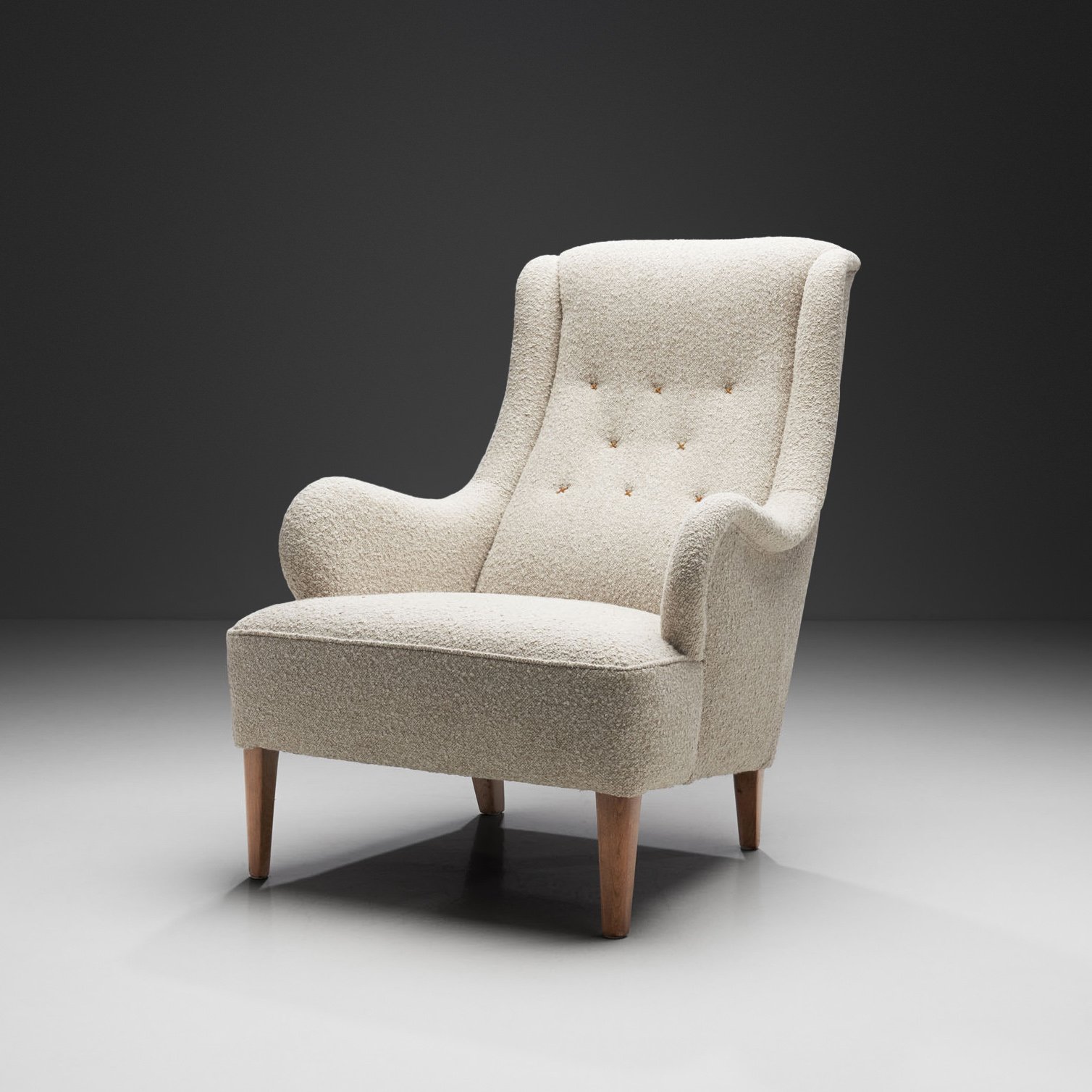
Mid-century modern is an interior style which championed notions of functionality and simplicity in design. This 1940s winged armchair is a great representation of the craftsmanship and quality of Swedish cabinetmakers, characterized by the best qualities of mid-century design.
This lounge chair design in many ways transcends the word ‘modern’, as it can be incorporated into contemporary and traditional interiors, lending itself to a universal appeal. The crisp lines “disappear” into the bouclé upholstery, resulting in a cosy impression. This is further enhanced by the enveloping back and round armrests for the ultimate lounging experience. The chair’s generous proportions and upholstery provide great sitting comfort, supported by the solid wood tapered legs. The upholstery dominates the look, and in the absence of any ornamentation, the luxurious texture of the material remains the focus.
The chair has recently been reupholstered in a bouclé fabric that is of the highest quality. The quality of the bouclé brings out the shape of this chair, illustrating how the pairing of the work of a skilled cabinetmaker and luxurious materials create exceptional pieces. With a classic look, storied design and solid quality, this Swedish chair shows why the historic movement of mid-century modernism continues to permeate our sense of what’s contemporary.
Condition:
In good vintage condition. Wear consistent with age and use. Some minor scratches and marks on the wood. The chair has been reupholstered recently in a premium bouclé fabric. Each of our items can be re-upholstered by our in-house atelier in a fabric of choice. Please reach out for more information.
Dimensions:
35.43 in W x 36.22 in D x 37.01 in H; Seat height 17.32 in; Seat depth 20.08 in; Arm height 22.83 in
90 cm W x 92 cm D x 94 cm H; Seat height 44 cm; Seat depth 51 cm; Arm height 58 cm
REQUEST PRICE HERE
Price category: 2,500 - 5,000 usd / eur
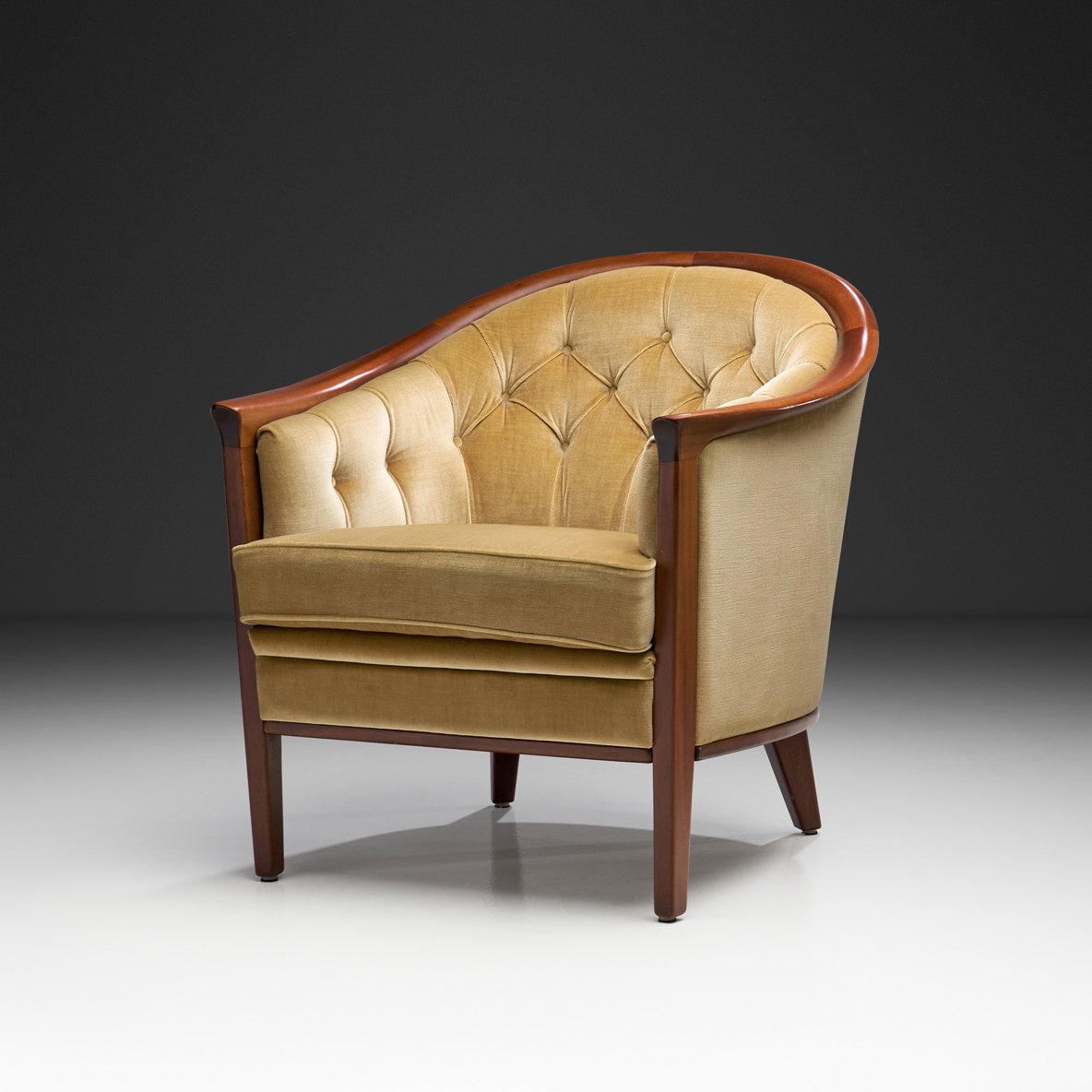
Bertil Fridhagen (1905–1993) was one of Sweden's most accomplished furniture designers, trained at Konstfack in Stockholm before becoming chief architect at Svenska Möbelfabrikerna in Bodafors, becoming one of the defining voices of Swedish Modernism. The Aristokrat series, produced by Bröderna Andersson, reflects both Fridhagen's refined design language and the manufacturer's reputation for high-quality upholstered furniture.
The “Aristokrat” armchair is defined by its elegant walnut frame, which wraps around the upholstered body in one continuous, flowing line. Rather than functioning merely as a structural element, the exposed frame becomes a defining visual feature, outlining the chair's rounded silhouette and creating a striking contrast with the soft upholstery. The button-tufted backrest adds depth and texture while gently shaping the seat for comfort, complemented by the arm supports that merge seamlessly into the curved back. A generous loose seat cushion provides seating comfort, while the slightly tapered legs give the chair a lighter appearance despite its proportions. Swedish design prefers colours rooted in nature, muted tones that aren’t overpowering, but still attract the eye naturally. The chairs’ yellow upholstery is a wonderful example of this ideal. From the smooth flowing curves to the restrained detailing, all elements allow the quality of the materials and craftsmanship to take center stage.
The “Aristokrat” model remains one of Bertil Fridhagen's most recognisable designs, demonstrating how Swedish Modern furniture successfully combined craftsmanship, functionality, and elegant proportions. Its enduring appeal echoes the success of Scandinavian design to this day.
Condition:
In good vintage condition. Wear consistent with age and use. The chair has recently been reconditioned. Due to the nature and age of the materials, the item may have marks, scratches, and discolouration. The chair comes with its original upholstery or has been reupholstered by a previous owner. Each of our items can be reupholstered by our in-house atelier in a fabric of choice. Please reach out for more information.
Dimensions:
32.08 in W x 32.48 in D x 32.48 in H; Seat height 19.48 in
81.5 cm W x 82.5 D x 82.5 cm H; Seat height 49.5 cm
REQUEST PRICE HERE
Price category: 9,000 - 12,500 usd / eur
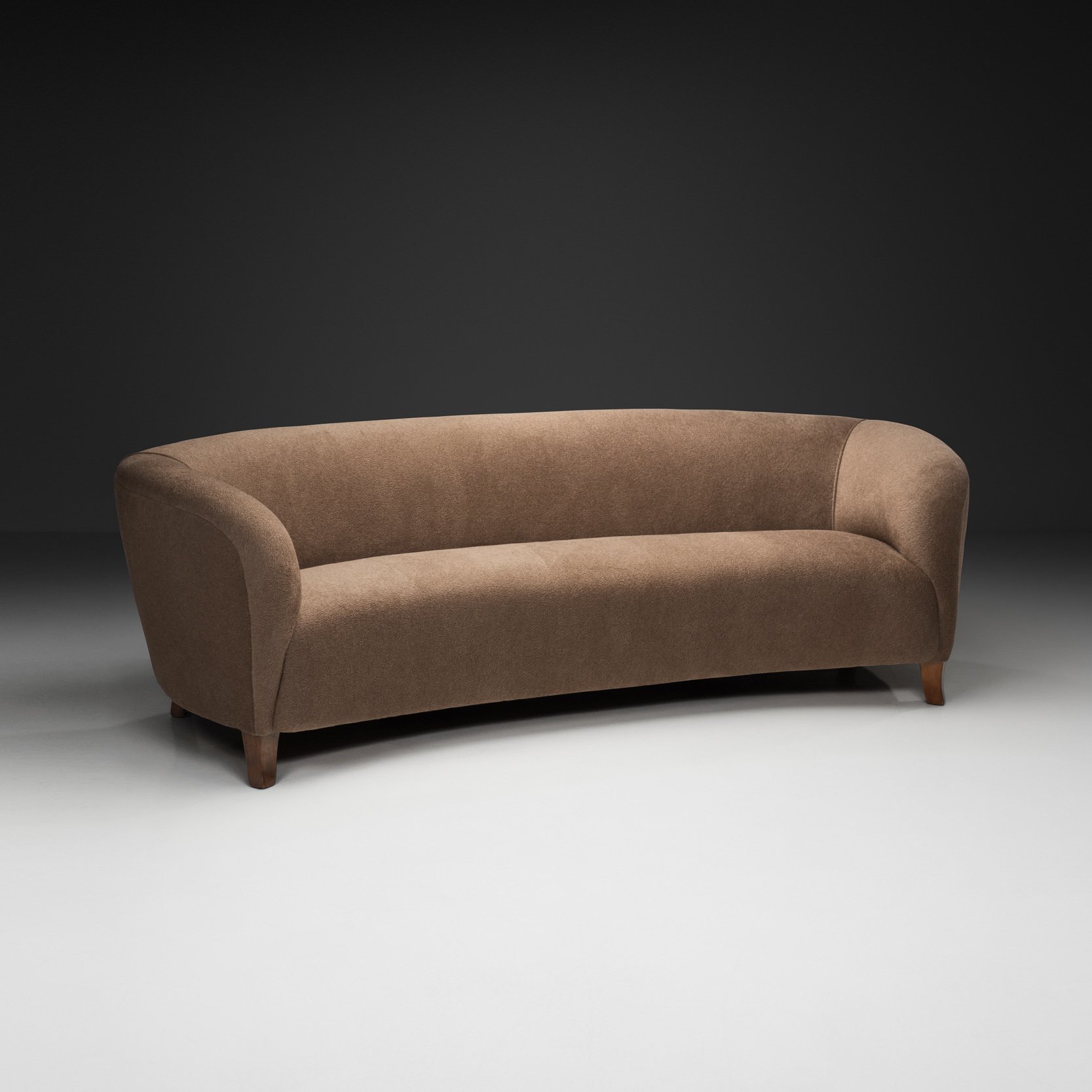
This sofa reflects the quiet confidence of Scandinavian design from circa 1930s, a period when modern ideas were being absorbed into more traditional forms. Swedish furniture of this era often balanced restraint with comfort, favouring clean silhouettes. Rather than chasing novelty, designers focused on proportion, usability, and longevity.
Curved sofas in general are considered statement pieces, for reasons that are eminently present in this three-seater sofa. With its classic shape paired with modern design, the generous size and fully upholstered body, it is outstanding, even when measured to the many beautiful sofas created in Sweden during the first half of the 20th century. The large, curved backrest follows the curve of the voluptuous seat, creating an inviting and open look. This shape is referred to as the ‘banana’ in furniture design, and is perfect to bring people closer together. The armrests are not independent, but rather a continuation of the back. The solid wooden legs provide perfect stability and visual appeal to the upholstered body, while balancing the sizeable body. Wood is the most important material in Swedish mid-century design, and the luxurious upholstery highlights and complements the beautiful colour of the wood.
Free from unnecessary ornamentation, the aesthetic of this three-seater sofa is sleek, elegant and modern. With its curved shape, it is perfect to break the rigour of any space, keeping the elegant appearance, elevated by the warm toned upholstery.
Condition:
In good vintage condition. Wear consistent with age and use. The sofa has recently been reconditioned. Due to the nature and age of the materials, the item has some marks, scratches, and discolouration. The sofa has recently been reupholstered in a premium fabric. Each of our items can be reupholstered by our in-house atelier in a fabric of choice. Please reach out for more information.
Dimensions:
92.51 in W x 33.07 in D x 27.55 in H; Seat height 17.32 in; Seat depth 17.71 in; Arm height 27.55 in
235 cm W x 84 cm D x 70 cm H; Seat height 44 cm; Seat depth 45 cm; Arm height 70 cm
REQUEST PRICE HERE
Price category: 5,000 - 7,500 usd / eur
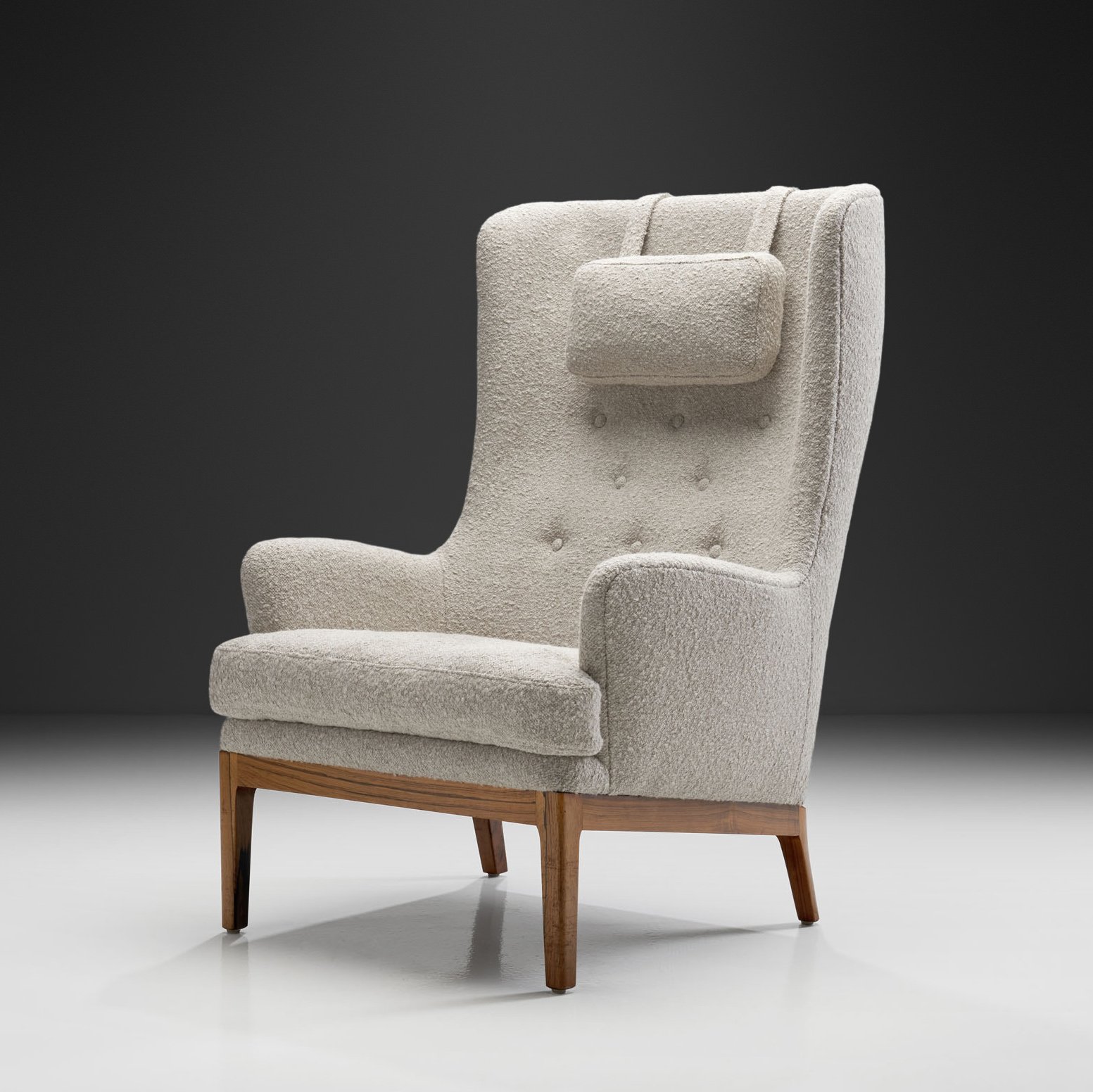
This “Krister” armchair is among Swedish design icon Arne Norell’s cosiest works. This high-back armchair’s comfort is equalled by its stylishness and elegance.
The chair is raised on a stained wood frame covered by beautiful, light coloured bouclé upholstery. A standout feature of this model is the adjustable and removable headrest, a sign of the Scandinavian design principle of functionality. The sitter of this chair is “hugged” by the ear flaps or wings on both sides of the backrest, that give it its unique silhouette, and by the loose seat cushion on the raised bottom. Norell had a unique design idiom, which is clearly visible in this model: function, durability, timeless design, and perhaps above all, comfort. This traditional yet playful “Krister” armchair combines all of these attributes, which makes it one of the most sought after works of Norell.
This chair is marked with ‘Möbel AB Arne Norell’, and its bouclé fabric upholstery it complements and enhances its elegance and comfort. The factory in Aneby, Sweden has been famous for its furniture manufactured by hand. Norell Furniture still operates to this day, keeping the legacy of the great Swedish designer alive.
Condition:
In good vintage condition. Wear consistent with age and use. Due to the nature and age of the materials, the item may have marks, scratches, and discolouration. The armchair has recently been reupholstered in a premium bouclé fabric. Each of our items can be reupholstered by our in-house atelier in a fabric of choice. Please reach out for more information.
Dimensions:
27.95 in W x 30.31 in D x 41.53 in H; Seat height 14.96 in
71 cm W x 77 cm D x 105.5 cm H; Seat height 38 cm
About the designer:
The Swedish designer, Arne Norell was born in 1917 in Åsele, Sweden, and was active in the post-war era, at the height of international fascination with Scandinavian design.
While little biographical information is available about his formative years, it is known that he opened a furniture workshop in Stockholm in 1954. In 1958, he launched his eponymous manufacturing company, “Møbel AB Arne Norell”, on a two-acre farm in Småland. Through the course of his prolific career, this idyllic setting remained Norell’s central source of inspiration and the site where he designed and produced all of his furniture until he passed away in 1971.
Norell is often praised for pioneering “conceptual” furniture, because he employed traditional materials - leather, turned wood, bentwood, and metal, for example - in unexpected forms, often with lyrical results. His designs have an affinity with those of Danish designer Kaare Klint (1888-1954), who, a generation before, brought time-honoured, vernacular forms into modernist expression. In fact, Klint’s iconic Safari Chair (1933) inspired Norell to create the Sirocco Safari Chair (1964), which is lightweight, collapsible, and held together by leather support straps instead of glue or screws. Norell’s wood-framed InkaArmchair, Indra Sofa, and IlonaSofa are likewise held together by leather.
While Norell’s designs found a solid market within his lifetime, his greatest recognition came posthumously: The British Furniture Manufacturers Association awarded Norell’s low-slung, steel-framed, leather-clad Ari Chair (1966) “Show Piece of the Year” in 1973. Norell’s pieces have become increasingly collectible in the 2010s.
Today, Norell’s daughter and son-in-law, Marie Norell-Möller and Thomas Möller, carry on his work, operating under the name Norell Møbel AB. In 2014, the company celebrated its 60th anniversary. It is the only Swedish company that has continuously manufactured the entirety of Norell’s catalogue since the 1950s.
REQUEST PRICE HERE
Price category: 2,500 - 5,000 usd / eur
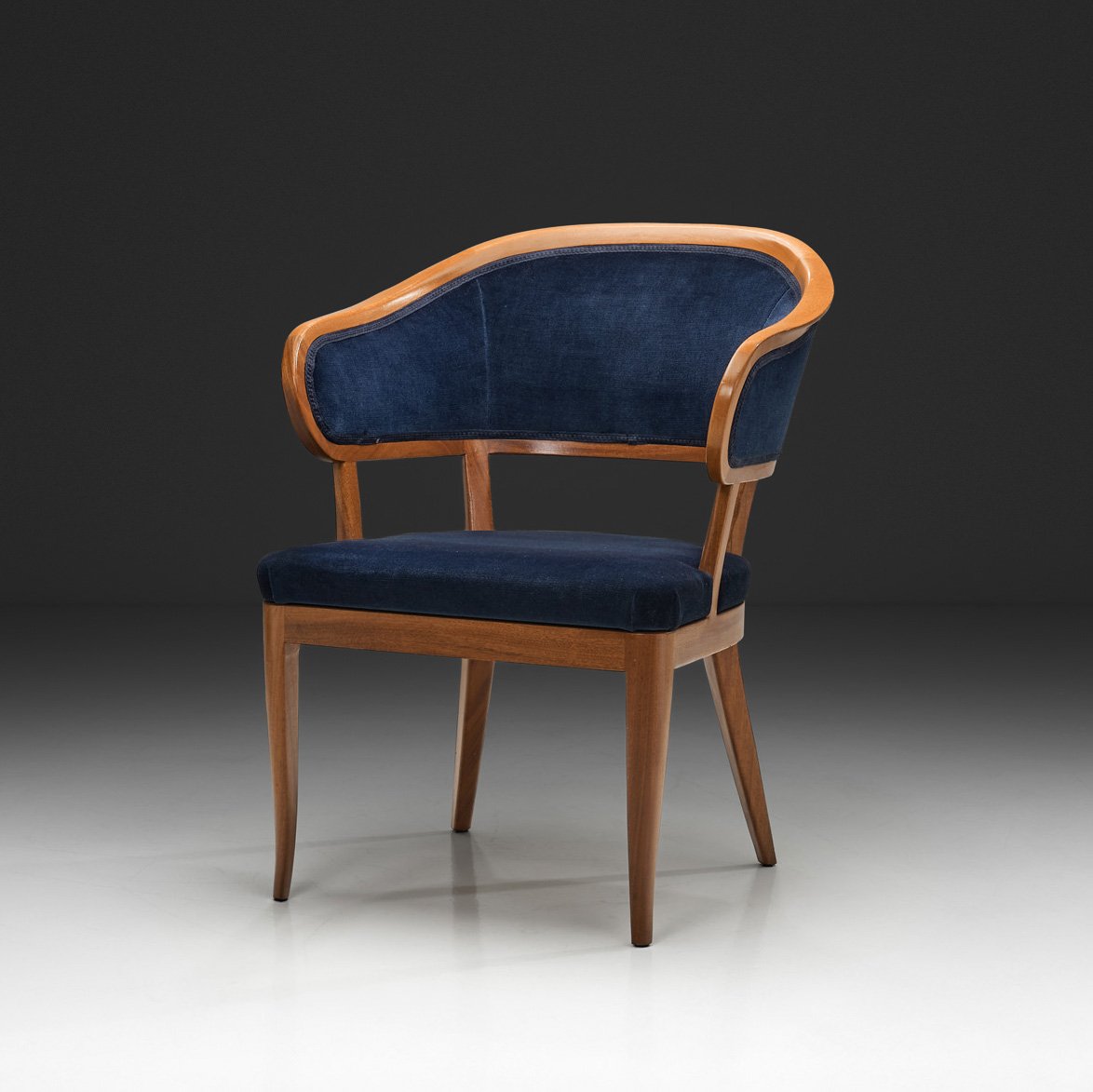
By the mid 20th century, Carl Malmsten became one of the most sought-after interior and furniture designers in all of Sweden. As a furniture maker he expressed the old, inherited forms as well as the new, bold ideas with his language of design.
“Jonas Love” is an iconic model that was the inspiration behind Malmsten’s several “count” chairs. With a klismos-style curved back, this armchair is timeless. Klismos chairs are known for sweeping lines and aesthetic beauty, as well as comfort offered by the concave back rest. These elements made this style popular with Carl Malmsten, who was outstandingly devoted to the Swedish culture he was brought up in. The “Jonas Love” model was originally designed by Malmsten for the New York World’s Fair 1939. “Break all edges thoroughly” was a frequent instruction on the designer’s drawings and nature was his great source of inspiration, therefore sharp edges or corners can rarely be found on his designs, including this chair. Moreover, wood was the most important material in Swedish mid-century design, therefore the dark blue upholstery highlights and complements the beauty of the wood rather than overpowering it. As this armchair exemplifies, blending functionality, good quality natural materials and organic colours with excellent craftsmanship is the key to the success of mid-century modernism. As an object, the chair reflects the mid-20th century pursuit of everyday beauty, objects designed not just to serve, but to enrich domestic environments.
The classic charm and versatility of this design allows it to be used as a desk chair, or in a curated corner. This chair can bring quiet sophistication to any setting. It is an ideal choice for a range of interior styles thanks to its thoughtful materials, and subtle craftsmanship.
Condition:
In good vintage condition. Wear consistent with age and use. The chair has recently been reconditioned. Due to the nature and age of the materials, the item has marks, scratches, and discolouration. This chair comes with its original upholstery or has been reupholstered by a previous owner. Each of our items can be re-upholstered by our in-house atelier in a fabric of choice. Please reach out for more information.
Dimensions:
24.41 in W x 24.02 in D x 31.50 in H; Seat height 16.54 in; Seat depth 19.69 in; Arm height 28.35 in
62 cm W x 61 cm D x 80 cm H; Seat height 42 cm; Seat depth 50 cm; Arm height 72 cm
REQUEST PRICE HERE
Price category: 50,000+ usd / eur
Swedish architect and furniture maker Axel Einar Hjorth worked as the lead designer for Sweden’s Nordiska Kompaniet department store from 1926 to 1938. While combining the simple, honest forms of the traditional nordic “allmoge” furniture common in Swedish rural culture, with the international 20th century Modernist movement, Hjorth designed the “Sportstugemöbler” series, (“sports cabin furnishings”) a collection of wooden furniture designed for country homes.
The “Lovö” chair was initially launched by Nordiska Kompaniet in 1932. The series was a response to a new, growing demand for furnishings for leisure houses, thus Hjorth used local pine to create a model that unites the robust and straightforward Nordic style with skilful handcrafting. The result is a modest, yet visually interesting presence with a strong and tall outline. These chairs are crafted from local pine wood, while the backrests feature iron rivets. The juxtaposition between the pine and iron provides a rustic, sturdy and resilient feel, elevating the timeless look of the model. The chairs combine simple and honest forms of the handcrafted style of traditional Nordic “allmoge” furniture, and the international 20th century Modernist movement. The seats feature loose, removable cushions, upholstered in a textured fabric. The cushions further increase the chairs’ special character, increasing both comfort and charm. The design is completed by four square, straight legs.
The “Sportstugemöbler” series had a lasting influence on Hjorth’s contemporaries, inspiring other big names within Nordic design, such as Carl Malmsten. From an international perspective, this series is the forerunner of later pioneering designs, so it comes as no surprise that these “Lovö” chairs became part of modernist design history.
Condition:
In good vintage condition. Wear consistent with age and use. The chairs have recently been reconditioned. The chairs show marks and dents Due to the age and nature of the materials, the chairs may have additional scratches or discolouration. The pillows were costum made by our in-house atelier in a premium fabric. In addition, the chairs can be purchased including their original striped cushions. Each of our items can be reupholstered by our in-house atelier in a fabric of choice. Please reach out for more information.
Dimensions:
18.5 in W x 20.86 in D x 37.4 in H; Seat height 17.71 in; Seat depth 16.54 in
47 cm W x 53 cm D x 95 cm H; Seat height 45 cm; Seat depth 42 cm