
Jindřich Halabala Armchair Upholstered in Longhair Sheepskin, Czechoslovakia 1930s







Jindřich Halabala Armchair Upholstered in Longhair Sheepskin, Czechoslovakia 1930s
REQUEST PRICE HERE
Price category: 7,500 - 10,000 usd / eur
It is known that Jindřich Halabala firmly believed that the furniture he created was to be functional, modular, and flawlessly-crafted, and this rare armchair stands as evidence of that. This model exemplifies why Halabala's work is considered to be a connection between innovative Czech cubism from the 1910s, Art Deco from the early 1920s and European modern art post WWII.
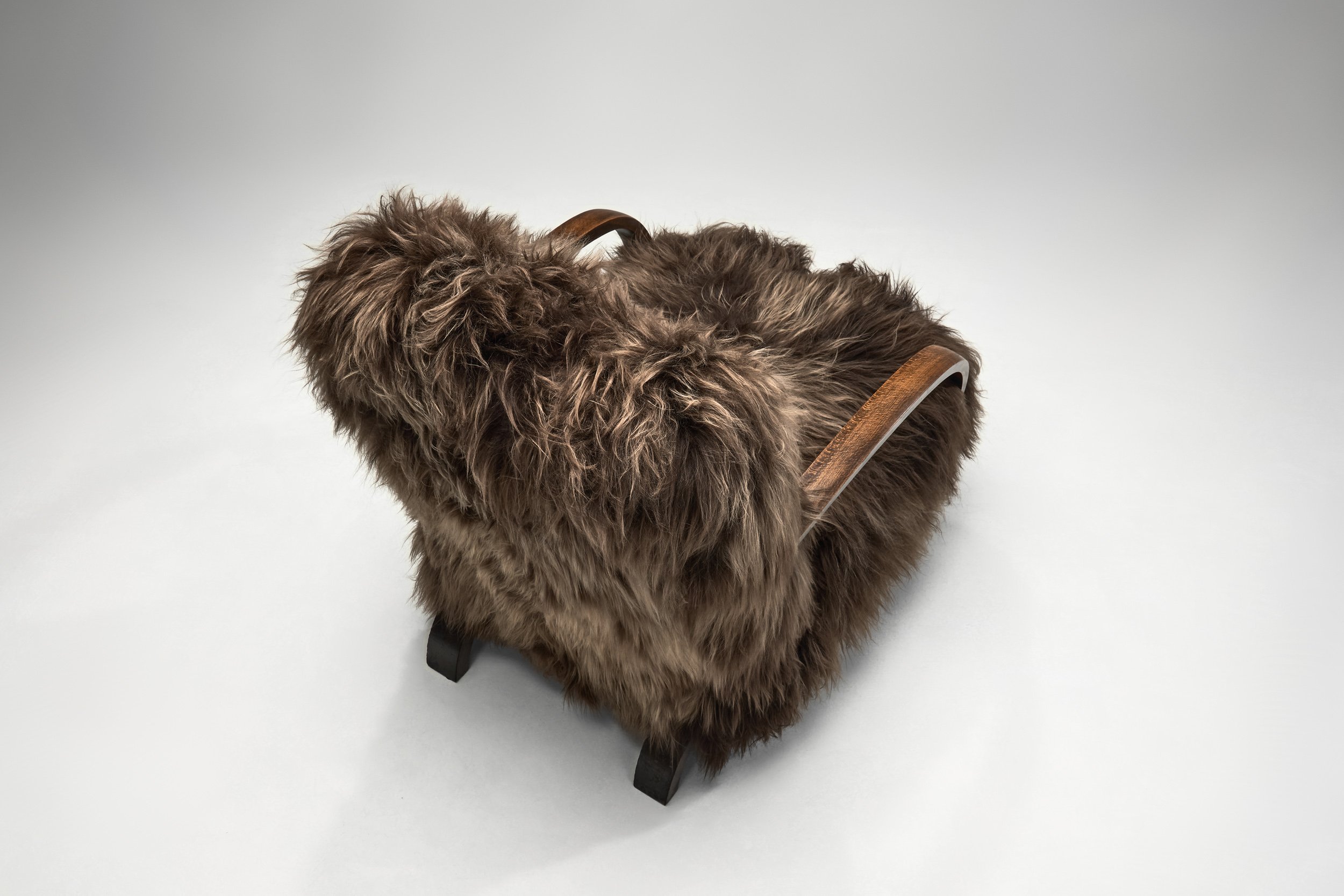
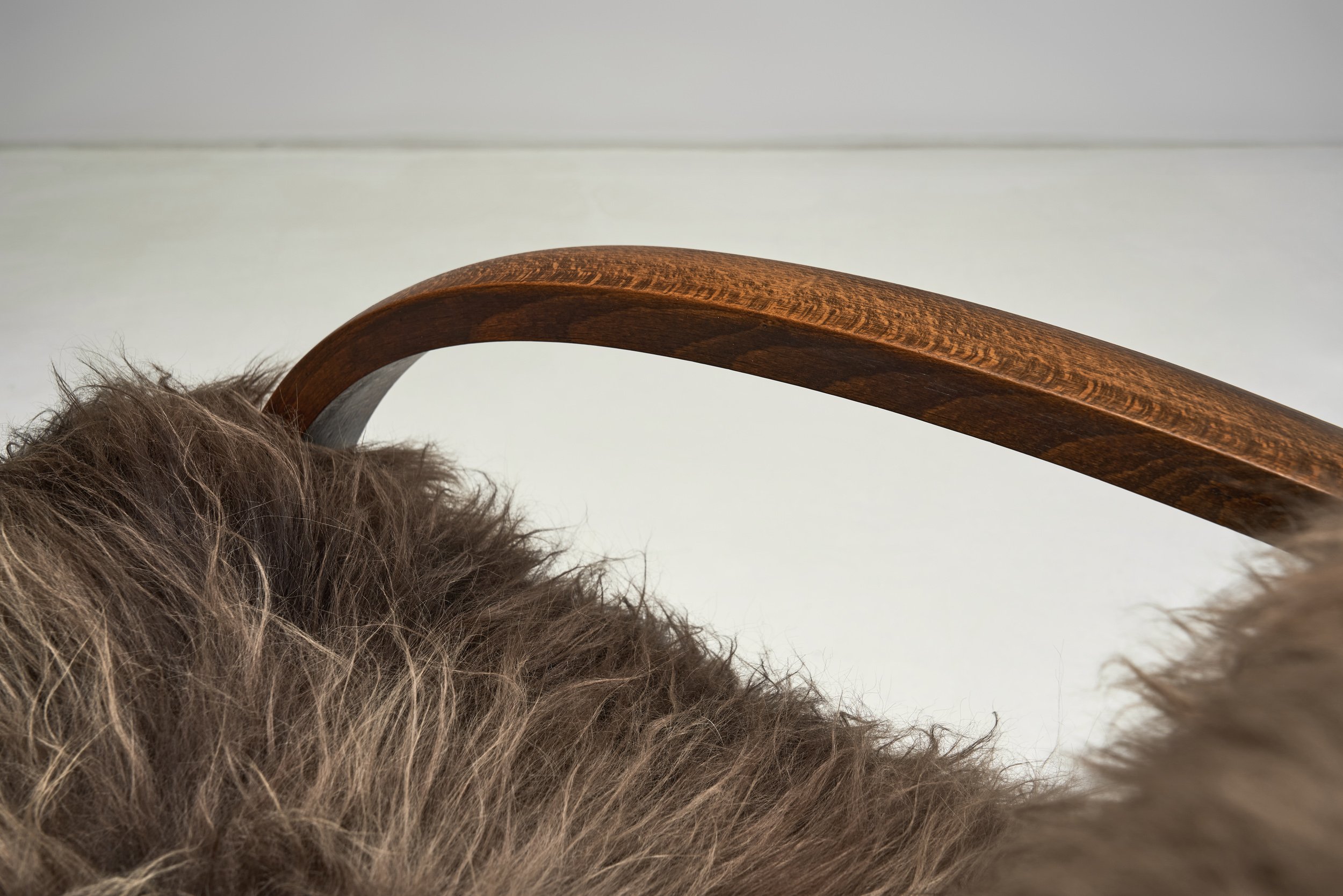
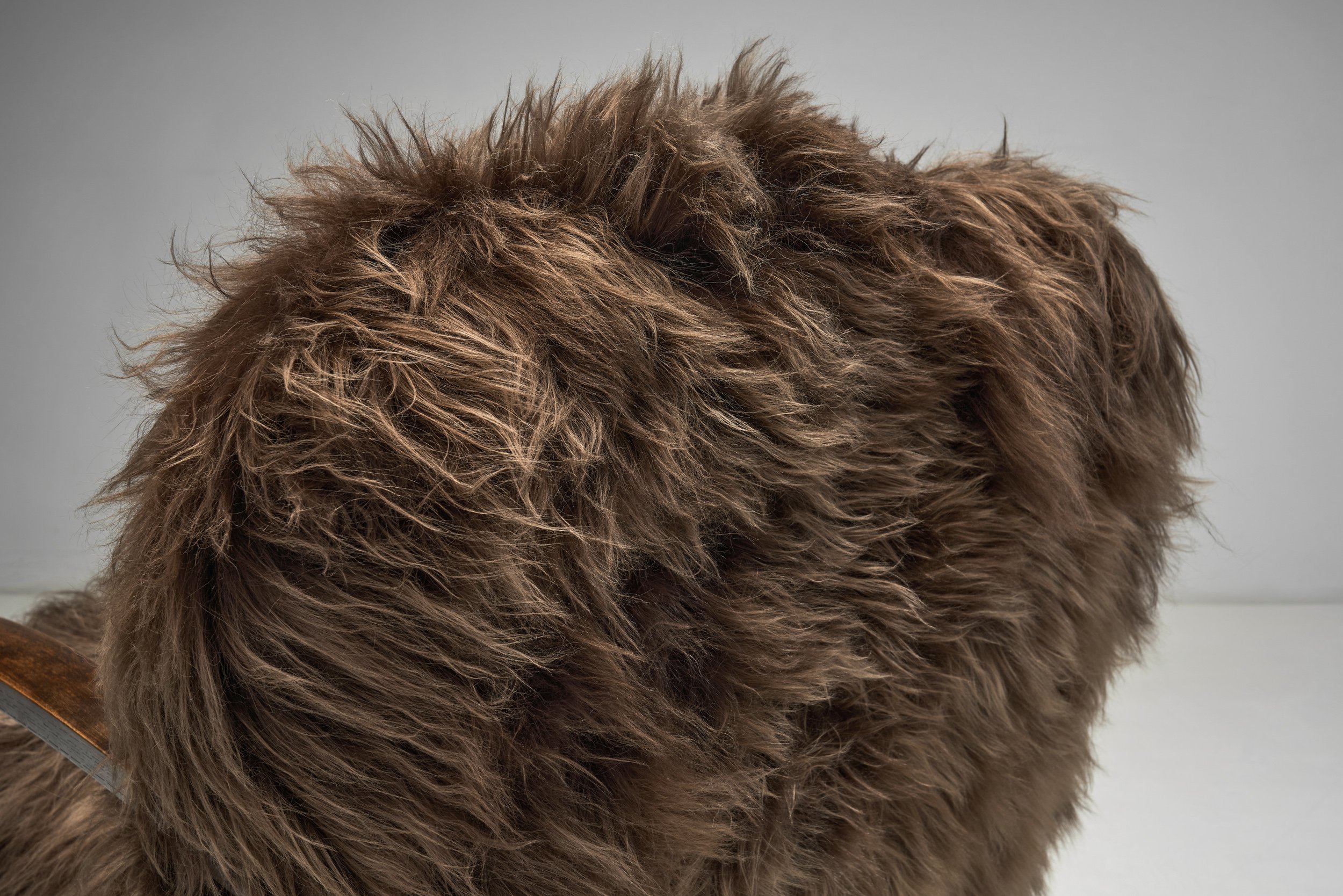
Halabala was a key figure in the interwar functionalist movement, and sought to bring high-quality, affordable modern furniture to a wider audience. The designer’s chairs such as this one carriey elements from art deco as well as early mid-century design, resulting in a unique and immediately recognisable aesthetic that’s based on daring shapes and forms. This model features a sensual curved wooden frame that contrasts beautifully with the angular, fully upholstered seat and back. The dynamic form is both sculptural and ergonomic, offering visual interest and inviting comfort. The longhair sheepskin is a visual treat that adds a luxurious, tactile presence to the chair. The material is attention-grabbing as it envelops the entire piece which enhances the form and adds warmth and softness to the overall design.
The outstanding visual characteristic of this armchair is both traditional and modern, making it simply timeless. This is precisely the charm of Jindřich Halabala pieces, the effortless style paired with the highest quality of materials and craftsmanship.
Condition:
In good vintage condition. Wear consistent with age and use. The chair has been recently reupholstered in premium longhair sheepskin. Each of our items can be reupholstered by our in-house atelier in a fabric of choice. Please reach out for more information.
Dimensions:
27.75 in W x 33.85 in D x 34.64 in H; Seat height 17.71 in
70.5 cm W x 86 cm D x 88 cm H; Seat height 45 cm
About the designer:
Jindřich Halabala (May 24, 1903 Koryčany - November 18, 1978 Brno) was a Czech furniture designer, theorist, publicist and pedagogue. He was especially famous for his designs of stylish furniture for the Brno UP plants from 1925 to 1955, where he worked as a chief designer. Thanks to this position, he fundamentally influenced the appearance of interwar and post-war Czech households.
Jindřich Halabala was born on May 24, 1903 in Koryčany to the family of carpenter Štěpán Halabala, whose craft he learned in a family business between 1918 and 1920. He then joined the State Czechoslovak Vocational School for Wood Processing in Valašské Meziříčí, which he graduated from two years later. After school, he started practicing at the United UP races, where he met their founder Jan Vaňek. In 1922 he also began to study architecture at the School of Applied Arts in Prague, specializing in furniture and interiors with prof. Pavel Janák. He completed his studies in 1926. In the same year, he created the first designs for furniture and carpets. In 1927, he was briefly employed in Bohumil Hübschmann's studio in Prague, and in 1928 he finally joined the United UP plant as the head of the Prague store in the Lucerna Palace. In 1927, Jindřich Halabala married Pavla Sekerková, with whom he had two sons; in 1929 son Jindra and in 1935 son Ivan. In 1930, he was transferred to the Brno headquarters of the United UP plant as head of the studio, where he worked in various positions (procurator, director) until 1946, and thus fundamentally contributed to a comprehensive concept of production, promotion, and sales. Later, he became interested in passing on his knowledge to future generations and between 1951 and 1954 he lectured externally at the Faculty of Forestry and Wood Engineering at the VŠPDI in Košice. In 1954, he was appointed an extraordinary (and a year later also a full) professor and began his long-term work at the Faculty of Wood Science of the University of Forestry and Wood Technology in Zvolen, where he founded and headed the Research Institute. He worked here until 1970, when he retired.
Halabala's work is considered to be a connection between innovative Czech cubism from 1910, art deco from the early 1920s and European modern art after the Second World War. His commercially successful designs were strongly based on the design of the Bauhaus. Halabala designed a variety of furniture, including chairs, tables, sideboards, chests of drawers, flower stands, coffee tables and lamps. Especially his legendary chair H-79 with frames made of bent steel tubes and his armchair type H-269 enjoyed great popularity.
REQUEST PRICE HERE
Price category: 5,000 - 7,500 usd / eur
Mid-century modern design emerged in the years after World War II, it was shaped by a desire for clarity, optimism, and a new way of living. Designers favoured clean lines, honest materials, and balanced proportions. Wood, metal, glass, and new industrial techniques were used to create pieces that were functional yet warm. This longhair easy chair belongs to this period, when comfort and material presence were just as important as clean lines and practicality.
The chair has a relaxed stance, shaped by a simple form and a tactile surface that immediately draws the eye in. The piece are generous in scale, with a rounded back and wide seat that feels welcoming for the sitter. What makes it stand out most is the longhair upholstery, which softens the entire silhouette and gives the model a warm, inviting texture. The fur catches the light in shifting tones, adding depth without being overly dramatic, and it turns the chair into a piece that feels almost alive in the space. Their shape is straightforward, built to support the body with a gentle curve along the sides that helps create a sense of enclosure. The wooden legs are modest and slightly tapered, balancing the design without distracting from the softness above. The overall effect is calm and comfortable, with enough character to make it stand out without overpowering a room.
This easy chair speaks to a moment in design when quality materials and thoughtful proportions could elevate simple forms. It brings warmth, texture, and cosiness to an interior, offering seating that is both aesthetically pleasing and useful. Their mix of simplicity and softness is what makes the piece so enduring, and why furniture like this continues to resonate in contemporary spaces.
Condition:
In good vintage condition. Wear consistent with age and use. The chair has recently been reconditioned. Due to the nature and age of the materials, the item may have some marks, scratches, and discolouration. The chair has recently been reupholstered in a premium longhair. Each of our items can be reupholstered by our in-house atelier in a fabric of choice. Please reach out for more information.
Dimensions:
30.70 in W x 31.88 in D x 33.07 in H; Seat height 18.89 in; Seat depth 19.68 in
78 cm W x 81 cm D x 84 cm H; Seat height 48 cm; Seat depth 50 cm