
Finnish Mid-Century Upholstered Armchair, Finland ca 1950s


Finnish Mid-Century Upholstered Armchair, Finland ca 1950s
REQUEST PRICE HERE
Price category: 5,000 - 7,500 usd / eur
Throughout the Nordic countries, there's a long history of pride in the craftsmanship of using natural materials like wood. This beautiful armchair is a great representation of the quality and craftsmanship of the Nordic tradition, and Finnish woodworking is world-famous for its traditions.
This armchair has a cosy and modern style, modelled on the Swedish and Danish furniture of the time, including the round edges and generous seat cushion. The body has the classic Nordic look, which is at the centre of contemporary popularity. The modern aesthetic is further elevated by the fully upholstered body that complements the shape of the arms and enveloping “ears” on the back, as well as the wooden tapered legs.
A dialogue with nature became the prime force in the ongoing evolution of Finnish design from the early 20th century. This relationship with nature was much in evidence in early and mid-20th century Finnish design, which actively expanded on the metaphors and motifs therein. This armchair brings together the best aspects of design, materials, and craftsmanship, elevated by its visible personality.
Condition:
In good vintage condition. Wear consistent with age and use. Some minor scratches and marks on the wood. The chair has been reupholstered recently in a premium fabric. Each of our items can be re-upholstered by our in-house atelier in a fabric of choice. Please reach out for more information.
Dimensions:
30.7 in W x 35.43 in D x 32.28 in H; Seat height 13.77 in
78 cm W x 90 cm D x 82 cm H; Seat height 35 cm
REQUEST PRICE HERE
Price category: 2,500 - 5,000 usd / eur
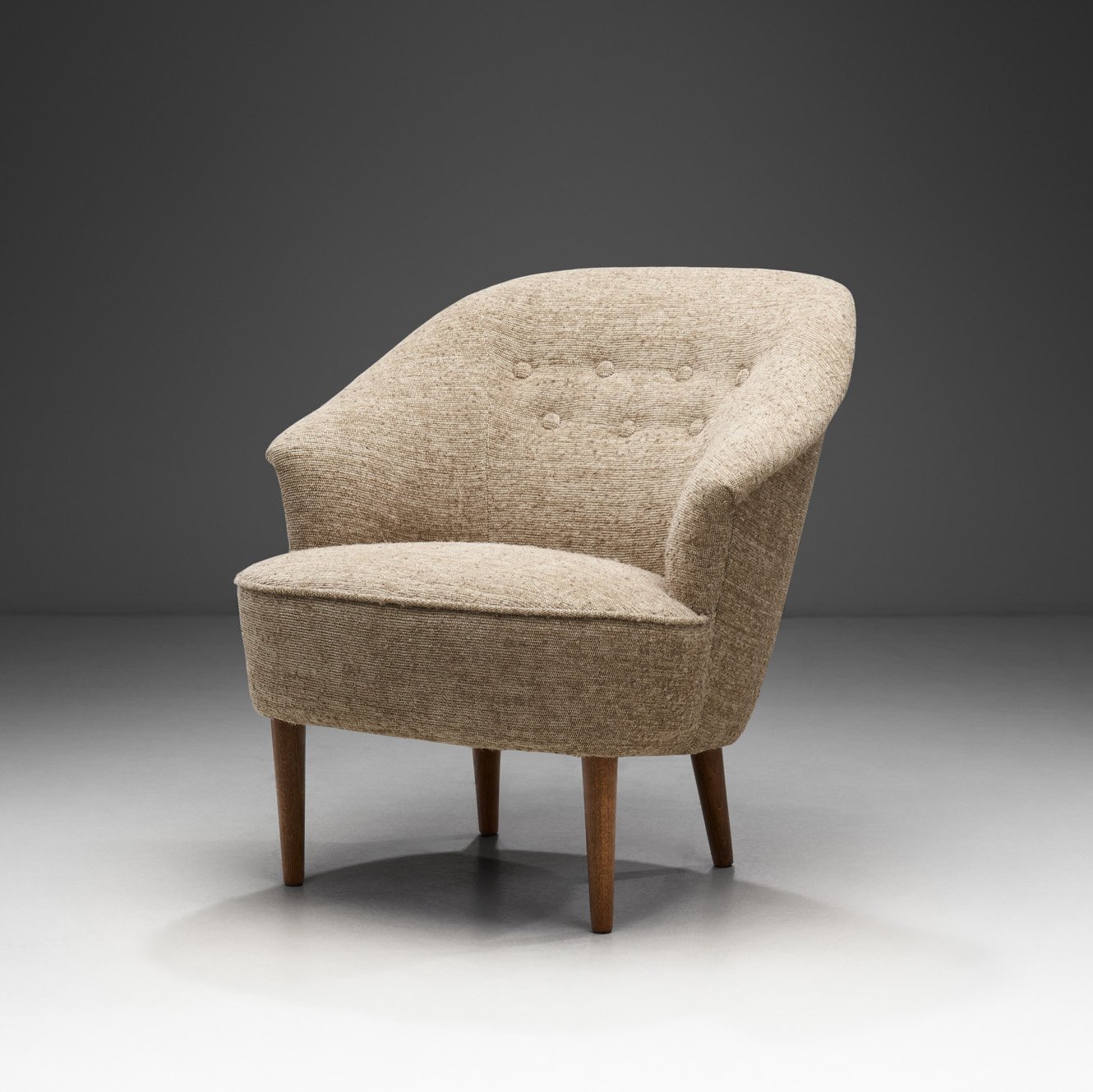
Carl Malmsten’s “Lillasyster” (little sister) easy chair is a stunning representation of the Swedish designer’s craftsmanship and creativity. “Neither light, nor eyes, nor people like bumping into sharp corners”, Malmsten explained. Therefore, all edges had to be smoothed so that they were kinder to the eye and to the touch, and this easy chair is a timeless example of this sentiment.
The chair welcomes the sitter in every sense, with an open design that includes outwardly curving arms. The back and arms together form a shell that, with their flowing lines, perfectly accommodate the sitter. The design is organic and not broken by any heavy ornamentation, instead the beautifully textured upholstery is utilised to further highlight the modern and cosy shape of the chair. The design is completed by tapered, solid wood legs, with a dark colour that contrasts nicely with the upholstery.
Although Malmsten’s furniture was very much a product of the thoughts and ideals of the time, they have a timeless quality that makes them equally up-to-date and loved today.
Condition:
In good vintage condition. Wear consistent with age and use. The chair has been recently reupholstered in a premium fabric. Each of our items can be reupholstered by our in-house atelier in a fabric of choice. Please reach out for more information.
Dimensions:
27.56 in W x 27.56 in D x 28.74 H; Seat height 16.54 in; Seat depth 18.90 in; Arm height 21.65
70 cm W x 70 cm D x 73 cm H; Seat height 42 cm; Seat depth 48 cm; Arm height 55 cm

REQUEST PRICE HERE
Price category: 2,500 - 5,000 usd / eur
Carl Malmsten is one of Sweden's most famous furniture designers. Many of his furniture are considered modern design classics. His present 'Stugan' (Cottage or Cabin in Swedish) armchair was designed by Malmsten for OH Sjögrens Stoppmöbler in Tranås, Sweden. This cosy model demonstrates Carl Malmsten’s fine sense of proportion, line tension and balance between the surfaces, and how skilfully he carried in the heritage of traditional allmoge (folk art) design.
This Stugan chair is – design-wise- in the vein of Swedish modernism, with simplicity and functionality, while also showcasing the subtle details and quality Malmsten is known and appreciated for. Even though Swedish design is generally democratic and meant for the masses, pieces were not stripped of all beauty in order to make them as easy to use as possible. The importance of this balance can be identified in the design and execution of this armchair as well: The wooden spindles comprising the back are the most apparent visual feature of the chairs, while the more subtle details, such as the upholstered seat and back cushions, make this model interesting. The design of this chair shows great balance of lines and utilization of the natural beauty of the pinewood. The solid pine structure is a frame for the cushions, both in a literal and figurative way. The light patterned bouclé fabric is beautifully framed by the chair’s frame, highlighting the captivating texture of both materials. The back and removable seat cushion are quite rotund; therefore, the sitting comfort is great. During his career, Malmsten collaborated with several architects, such as Ragnar Östberg, Ivar Tengbom, and Ferdinand Boberg. He designed furniture for Stockholm's concert hall and Ulriksdal castle. He participated in the now iconic hosing exhibition at Liljevalchs gallery in 1917, where the term "Beautiful everyday goods" was coined. Still, the producer of most of his upholstered pieces was O.H. Sjögren in Tranås, Sweden.
This “Cottage” armchair is an elegant and comfortable evidence of the mastery and artistry of the Swedish cabinetmakers who defined mid-20th century modern seating. O. H. Sjögren was one of these renowned workshops, materializing a great deal of Carl Malmsten’s most brilliant upholstered designs. This chair is of the highest quality, both in terms of materials and craftsmanship. Its name is mirrored in its construction and cosy aesthetic quality, offering the same level of comfort and sense of wellbeing and comfort as the Swedish cottages that also inspired Axel Einar Hjorth’s collectible pinewood pieces.
Condition:
In good vintage condition. Wear consistent with age and use. The chair has been reupholstered recently in premium patterned bouclé fabric.
Dimensions:
6.18 in W x 32.28 in D x 31.49 in H; Seat height 15.74 in; Arm height 23.22 in
66.5 cm W x 82 cm D x 80 cm H; Seat height 40 cm; Arm height 59 cm
About the designer:
Carl Malmsten (December 7, 1888 – August 13, 1972) was a Swedish furniture designer, architect, and educator. Malmsten was born in Stockholm, Sweden. Malmsten's career took off when he won a competition in 1916 to design furniture for the Stockholm City Hall and shortly after in 1917, he exhibited alongside well-known Swedish architects such as Gunnar Asplund and Uno Åhrén.
In the 1920s he was invited to furnish a room for the crown prince, Gustaf VI Adolf, and his wife Louise in Ulriksdal Palace. He was honoured with an inaugural Prince Eugen Medal for design in 1945. Already as a young designer in the early 20th century, Carl Malmsten advocated an artisanal furniture design based on local ingredients and traditions, available to a wide audience at a reasonable price.
Nature was Carl Malmsten's foremost teacher and source of inspiration. He conveyed his love of craftsmanship as a teacher in his own schools, at Olofskolan in Stockholm, Capellagården on Öland and the Carl Malmsten school on Lidingö, today a branch of Linköping University and one of the country's leading design colleges. As a debater, Malmsten stormed against functionalism, but in retrospect it can be seen that his ideas often coincided with the rational and frugal style ideals of function.
Malmsten has had a lasting influence on Swedish furniture design through the two schools he founded—the Carl Malmsten Furniture Studies (Carl Malmstensskolan), which has been a part of Linköping University since 2000, is situated on the island of Lidingö on the outskirts of Stockholm. Carl Malmsten spoke about the importance of tradition, craftsmanship and the nation. His furniture was in many ways a product of the thoughts and ideals of the time, they have a timeless quality that makes them just as relevant and loved today. ~H.

REQUEST PRICE HERE
Price category: 2,500 - 5,000 usd / eur
“Samsas” is for many the most associated model with Carl Malmsten. The designer devoted his life to the renewal of traditional Swedish craftsmanship, inspired by Swedish country manors and rustic styles. In this spirit, Samsas is today regarded as the most typical of Malmsten’s furniture.
In his work, Carl Malmsten often returned to his earlier designs, which he renewed and simplified. Samsas is such a product, which, when it was designed in 1960, had its roots in a model that was almost 40 years old. The original was the armchair “Konsert”, designed for the Stockholm Concert Hall in 1923. Leó Jóhannsson, long-time senior lecturer in furniture design, has described the armchair: “Samsas has everything required in an armchair: expression, comfort with a big form, fine lines and details – and the feeling of music”. As the name suggests (to get on well together), Samsas was designed to be a part of a cosy environment, and to bring people together. This armchair model is a part of a family, along with three different sofas to combine with each other. With a frame in solid pine, this armchair has a sturdy structure that was created to last. The upholstered body has a welcoming design with outward curving armrests, button tufted backrest, and a generous seat. The beautiful tapered, wooden legs add a modern detail that balances out the fully upholstered body. The light bouclé upholstery further adds to the warm and cosy aesthetic of this armchair.
Samsas is conceived as a model for pleasant socializing and as such, and it has been beloved for over 50 years. In other words, a timeless and durable model.
Condition:
In good vintage condition. Wear consistent with age and use. The chair has been reupholstered recently in premium bouclé fabric.
Dimensions:
28.34 in W x 32.28 in D x 33.46 in H; Seat height 17.71 in
72 cm W x 82 cm D x 85 cm H; Seat height 45 cm
About the designer:
Carl Malmsten (December 7, 1888 – August 13, 1972) was a Swedish furniture designer, architect, and educator. Malmsten was born in Stockholm, Sweden. Malmsten's career took off when he won a competition in 1916 to design furniture for the Stockholm City Hall and shortly after in 1917, he exhibited alongside well-known Swedish architects such as Gunnar Asplund and Uno Åhrén.
In the 1920s he was invited to furnish a room for the crown prince, Gustaf VI Adolf, and his wife Louise in Ulriksdal Palace. He was honoured with an inaugural Prince Eugen Medal for design in 1945. Already as a young designer in the early 20th century, Carl Malmsten advocated an artisanal furniture design based on local ingredients and traditions, available to a wide audience at a reasonable price.
Nature was Carl Malmsten's foremost teacher and source of inspiration. He conveyed his love of craftsmanship as a teacher in his own schools, at Olofskolan in Stockholm, Capellagården on Öland and the Carl Malmsten school on Lidingö, today a branch of Linköping University and one of the country's leading design colleges. As a debater, Malmsten stormed against functionalism, but in retrospect it can be seen that his ideas often coincided with the rational and frugal style ideals of function.
Malmsten has had a lasting influence on Swedish furniture design through the two schools he founded—the Carl Malmsten Furniture Studies (Carl Malmstensskolan), which has been a part of Linköping University since 2000, is situated on the island of Lidingö on the outskirts of Stockholm. Carl Malmsten spoke about the importance of tradition, craftsmanship and the nation. His furniture was in many ways a product of the thoughts and ideals of the time, they have a timeless quality that makes them just as relevant and loved today. ~H.

REQUEST PRICE HERE
Price category: 5,000 - 7,500 usd / eur
In the mid-1950s, Carl Malmsten awarded ten small furniture companies, mainly in Småland, the honour of making a series of some of his products. Among the first pieces was “Farmor”, which soon became the most popular armchair model.
In 1956, Carl Malmsten was on one of his regular visits to Sjögren's Upholstery Workshop in Tranås to develop new models for his furniture program. That was when this “Grandma” chair came into being and since then, she has become a dear family member in many Swedish homes. Carl Malmsten wanted the furniture to express a special feeling or mood, which is also reflected in how he named them. This armchair’s name relates to the design’s utmost comfort, that is exuded through the friendly and round shapes, femininity and cosiness. The chair’s frame is made of solid pine from Swedish forests to provide a sturdy base. The high-back has an unmistakeable “crown” on top of it, that complements the armrests’ outward curling lines. The sitting comfort of this model is quite famous, the seat and the springs together, create extreme comfort. The plump seat, patterned fabric, and button tufting further add to the warm feeling of the design, while keeping it stylish and modern.
Carl Malmsten wanted this Farmor or Grandmother armchair to express a particular feeling of warmth and comfort with the friendly and rounded forms. The femininity and the impression of homecoming that is often associated with the word grandma is apparent in the design, which is undoubtedly why this model has been continuously beloved for the past six decades.
Condition:
In good vintage condition. Wear consistent with age and use. The chair has been reupholstered recently in premium fabric.
Dimensions:
28.34 in W x 32.48 in D x 39.96 in H
72 cm W x 82.5 cm D x 101.5 cm H
About the designer:
Carl Malmsten (December 7, 1888 – August 13, 1972) was a Swedish furniture designer, architect, and educator. Malmsten was born in Stockholm, Sweden. Malmsten's career took off when he won a competition in 1916 to design furniture for the Stockholm City Hall and shortly after in 1917, he exhibited alongside well-known Swedish architects such as Gunnar Asplund and Uno Åhrén.
In the 1920s he was invited to furnish a room for the crown prince, Gustaf VI Adolf, and his wife Louise in Ulriksdal Palace. He was honoured with an inaugural Prince Eugen Medal for design in 1945. Already as a young designer in the early 20th century, Carl Malmsten advocated an artisanal furniture design based on local ingredients and traditions, available to a wide audience at a reasonable price.
Nature was Carl Malmsten's foremost teacher and source of inspiration. He conveyed his love of craftsmanship as a teacher in his own schools, at Olofskolan in Stockholm, Capellagården on Öland and the Carl Malmsten school on Lidingö, today a branch of Linköping University and one of the country's leading design colleges. As a debater, Malmsten stormed against functionalism, but in retrospect it can be seen that his ideas often coincided with the rational and frugal style ideals of function.
Malmsten has had a lasting influence on Swedish furniture design through the two schools he founded. Carl Malmsten spoke about the importance of tradition, craftsmanship, and the nation. His furniture was in many ways a product of the thoughts and ideals of the time, they have a timeless quality that makes them just as relevant and loved today. ~H.

REQUEST PRICE HERE
Price category: 5,000 - 7,500 usd / eur
There is a certain “Malmstenesque” charm to the Swedish designer’s pieces that manifests in the gentle but defined curves, cosy appearance and in the modern way Carl Malmsten skilfully carried the heritage of traditional allmoge (folk art) design.
The expression “Swedish Modern” was first used at the 1939 New York World Fair, when the designer introduced the model “Oskar”. Similarly to that model, Malmsten remained a traditionalist, mainly concerned with comfort regarding the “Stora Furulid” or the large pine. The streamlined design of this armchair preserves the homely feeling that define the aforementioned Malmstenesque. “Break all edges thoroughly”, was a frequent instruction on Carl Malmsten’s drawings and nature was his great source of inspiration, therefore sharp edges or corners can rarely be found on his designs, including this model. With a tremendous sense of proportion, this armchair is very comfortable and fulfils its task to “serve well” and last for lifetimes. At the same time, it also serves the eyes with a gently curved, button tufted back and more pronounced curves on the arms. The fully upholstered body rests on wooden tapered legs that are splayed in the back. The elegant light fabric highlights the wood and its various shades and patterns.
Carl Malmsten was -and still is- one of the most famous furniture designers of Sweden, who was also active in the cultural and political sphere of the country. This armchair is an elegant and comfortable evidence of the mastery, artistry but also of the ideals of the Swedish designer who had an important role in shaping mid-20th century Swedish Modern seating.
Condition:
In good vintage condition. Wear consistent with age and use. The chair has been reupholstered recently in a premium fabric. Each of our items can be re-upholstered by our in-house atelier in a fabric of choice. Please reach out for more information.
Dimensions:
27.16 in W x 30.11 in D x 36.02 in H; Seat height 15.35 in; Arm height 23.22 in
69 cm W x 76.5 cm D x 91.5 cm H; Seat height 39 cm; Arm height 59 cm
About the Designer:
Carl Malmsten (December 7, 1888 – August 13, 1972) was a Swedish furniture designer, architect, and educator. Malmsten was born in Stockholm, Sweden. Malmsten's career took off when he won a competition in 1916 to design furniture for the Stockholm City Hall and shortly after in 1917, he exhibited alongside well-known Swedish architects such as Gunnar Asplund and Uno Åhrén.
In the 1920s he was invited to furnish a room for the crown prince, Gustaf VI Adolf, and his wife Louise in Ulriksdal Palace. He was honoured with an inaugural Prince Eugen Medal for design in 1945. Already as a young designer in the early 20th century, Carl Malmsten advocated an artisanal furniture design based on local ingredients and traditions, available to a wide audience at a reasonable price.
Nature was Carl Malmsten's foremost teacher and source of inspiration. He conveyed his love of craftsmanship as a teacher in his own schools, at Olofskolan in Stockholm, Capellagården on Öland and the Carl Malmsten school on Lidingö, today a branch of Linköping University and one of the country's leading design colleges. As a debater, Malmsten stormed against functionalism, but in retrospect it can be seen that his ideas often coincided with the rational and frugal style ideals of function.
Malmsten has had a lasting influence on Swedish furniture design through the two schools he founded—the Carl Malmsten Furniture Studies (Carl Malmstensskolan), which has been a part of Linköping University since 2000, is situated on the island of Lidingö on the outskirts of Stockholm. Carl Malmsten spoke about the importance of tradition, craftsmanship and the nation. His furniture was in many ways a product of the thoughts and ideals of the time, they have a timeless quality that makes them just as relevant and loved today. ~H.
REQUEST PRICE HERE
Price category: 5,000 - 7,500 usd / eur
In the mid-1950s, Carl Malmsten awarded ten small furniture companies, mainly in Småland, the honour of making a series of some of his products. Among the first pieces was Farmor, which soon became the most popular armchair.
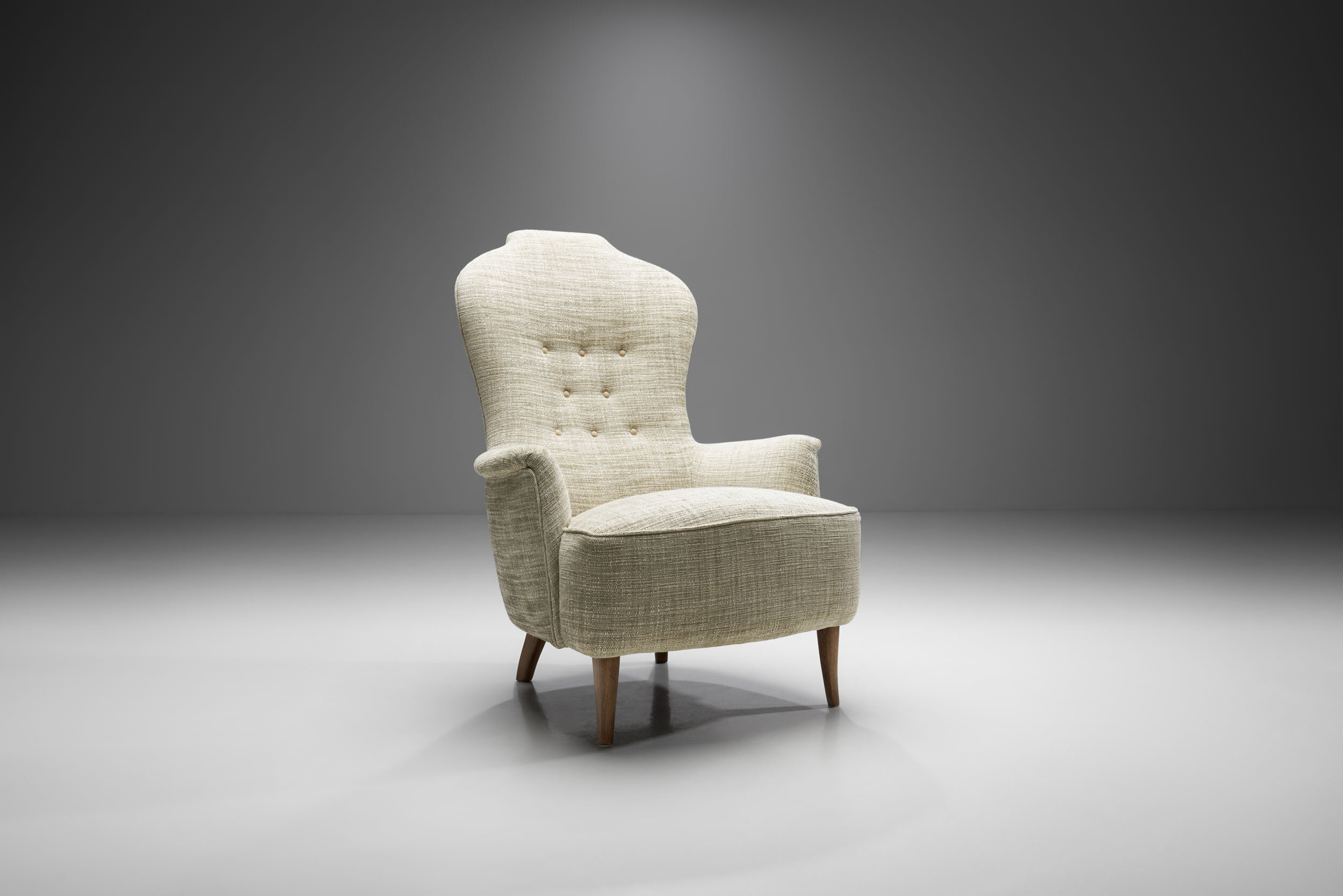
In 1956, Carl Malmsten was on one of his regular visits to Sjögren's Upholstery Workshop in Tranås to develop new models for his furniture program. That was when this “Grandma” came into being and since then, she has become a dear family member in many Swedish homes. Carl Malmsten wanted the furniture to express a special feeling or mood, which is also reflected in how he named them. This armchair’s name relates to the design’s utmost comfort, that is exuded through the friendly and round shapes, femininity and cosiness. The chair’s frame is made of solid pine from Swedish forests to provide a sturdy base. The high-back has an unmistakeable “crown” on top of it, that complements the armrests’ outward curling lines. The sitting comfort of this model is quite famous, the seat and the springs together, create extreme comfort. The plump seat and button tufting further add to the warm feeling of the design, while keeping it stylish and modern.
Carl Malmsten wanted this Farmor or Grandmother armchair to express a particular feeling of warmth and comfort with the friendly and rounded forms. The femininity and the impression of homecoming that is often associated with the word grandma is apparent in the design, which is undoubtedly why this model has been continuously beloved for the past six decades.
Condition:
In good vintage condition. Wear consistent with age and use. The chair has been reupholstered recently in premium fabric.
Dimensions:
28.34 in W x 33.85 in D x 39.96 in H; Seat height 18.3 in
72 cm W x 86 cm D x 101.5 cm H; Seat height 46.5 cm
About the designer:
Carl Malmsten (December 7, 1888 – August 13, 1972) was a Swedish furniture designer, architect, and educator. Malmsten was born in Stockholm, Sweden. Malmsten's career took off when he won a competition in 1916 to design furniture for the Stockholm City Hall and shortly after in 1917, he exhibited alongside well-known Swedish architects such as Gunnar Asplund and Uno Åhrén.
In the 1920s he was invited to furnish a room for the crown prince, Gustaf VI Adolf, and his wife Louise in Ulriksdal Palace. He was honoured with an inaugural Prince Eugen Medal for design in 1945. Already as a young designer in the early 20th century, Carl Malmsten advocated an artisanal furniture design based on local ingredients and traditions, available to a wide audience at a reasonable price.
Nature was Carl Malmsten's foremost teacher and source of inspiration. He conveyed his love of craftsmanship as a teacher in his own schools, at Olofskolan in Stockholm, Capellagården on Öland and the Carl Malmsten school on Lidingö, today a branch of Linköping University and one of the country's leading design colleges. As a debater, Malmsten stormed against functionalism, but in retrospect it can be seen that his ideas often coincided with the rational and frugal style ideals of function.
Malmsten has had a lasting influence on Swedish furniture design through the two schools he founded—the Carl Malmsten Furniture Studies (Carl Malmstensskolan), which has been a part of Linköping University since 2000, is situated on the island of Lidingö on the outskirts of Stockholm. Carl Malmsten spoke about the importance of tradition, craftsmanship and the nation. His furniture was in many ways a product of the thoughts and ideals of the time, they have a timeless quality that makes them just as relevant and loved today. ~H.
REQUEST PRICE HERE
Price category: 5,000 - 7,500 usd/eur
Carl Malmsten’s life's work spans nearly sixty intense years and his legacy is considered a national treasure in Sweden. He created a number of furniture classics including this rare “Elder man” armchair.
His entire work is characterized by a close-to-nature philosophy which is deeply rooted in Swedish nature and commoner culture. A deeper knowledge of Carl Malmsten as a person means that his furniture can be seen not only as utilitarian objects, but also as artistic works with the ability to express a feeling or mood. This winged armchair carries with it that certain “Malmstenesque” that is characterized by gentle curves, a cosy appearance and of course, the highest quality craftsmanship. This is especially visible in the flowing armrests that descend from the top, curling outwards to create a welcoming look. The slightly bent backrest is tufted with dark brown leather stitches that contrast with the light bouclé upholstery both in colour and texture to create a stylish, visually interesting look. As it can be expected from the “Master of Wood”, the frame is expertly designed, with ergonomic and aesthetic principles at its core. To complete the mid-century look, the structure is supported by tapered, solid wood legs that add an organic touch to the design.
In the 50s, Carl Malmsten’s furniture were produced in small series in smaller workshops, which meant that the furniture became very expensive and thus inaccessible to most people. He then decided to select a number of producers who could produce his furniture in larger volumes without sacrificing quality, beauty, and practicality. In Tranås he came into contact with O.H. Sjögren which he considered fulfilled all the high demands he placed on the production of upholstered furniture.
Condition:
In good vintage condition. Wear consistent with age and use. The chair has been reupholstered recently in a premium bouclé fabric. Each of our items can be re-upholstered by our in-house atelier in a fabric of choice. Please reach out for more information.
Dimensions:
28.74 in W x 34.65 in D x 41.34 in H; Seat height 16.14 in; Arm height 21.65 in
73 cm W x 88 cm D x 105 cm H; Seat height 41 cm; Arm height 55 cm
About the Designer:
Carl Malmsten (December 7, 1888 – August 13, 1972) was a Swedish furniture designer, architect, and educator. Malmsten was born in Stockholm, Sweden. Malmsten's career took off when he won a competition in 1916 to design furniture for the Stockholm City Hall and shortly after in 1917, he exhibited alongside well-known Swedish architects such as Gunnar Asplund and Uno Åhrén.
In the 1920s he was invited to furnish a room for the crown prince, Gustaf VI Adolf, and his wife Louise in Ulriksdal Palace. He was honoured with an inaugural Prince Eugen Medal for design in 1945. Already as a young designer in the early 20th century, Carl Malmsten advocated an artisanal furniture design based on local ingredients and traditions, available to a wide audience at a reasonable price.
Nature was Carl Malmsten's foremost teacher and source of inspiration. He conveyed his love of craftsmanship as a teacher in his own schools, at Olofskolan in Stockholm, Capellagården on Öland and the Carl Malmsten school on Lidingö, today a branch of Linköping University and one of the country's leading design colleges. As a debater, Malmsten stormed against functionalism, but in retrospect it can be seen that his ideas often coincided with the rational and frugal style ideals of function.
Malmsten has had a lasting influence on Swedish furniture design through the two schools he founded—the Carl Malmsten Furniture Studies (Carl Malmstensskolan), which has been a part of Linköping University since 2000, is situated on the island of Lidingö on the outskirts of Stockholm. Carl Malmsten spoke about the importance of tradition, craftsmanship, and the nation. His furniture was in many ways a product of the thoughts and ideals of the time, they have a timeless quality that makes them just as relevant and loved today. ~H.