
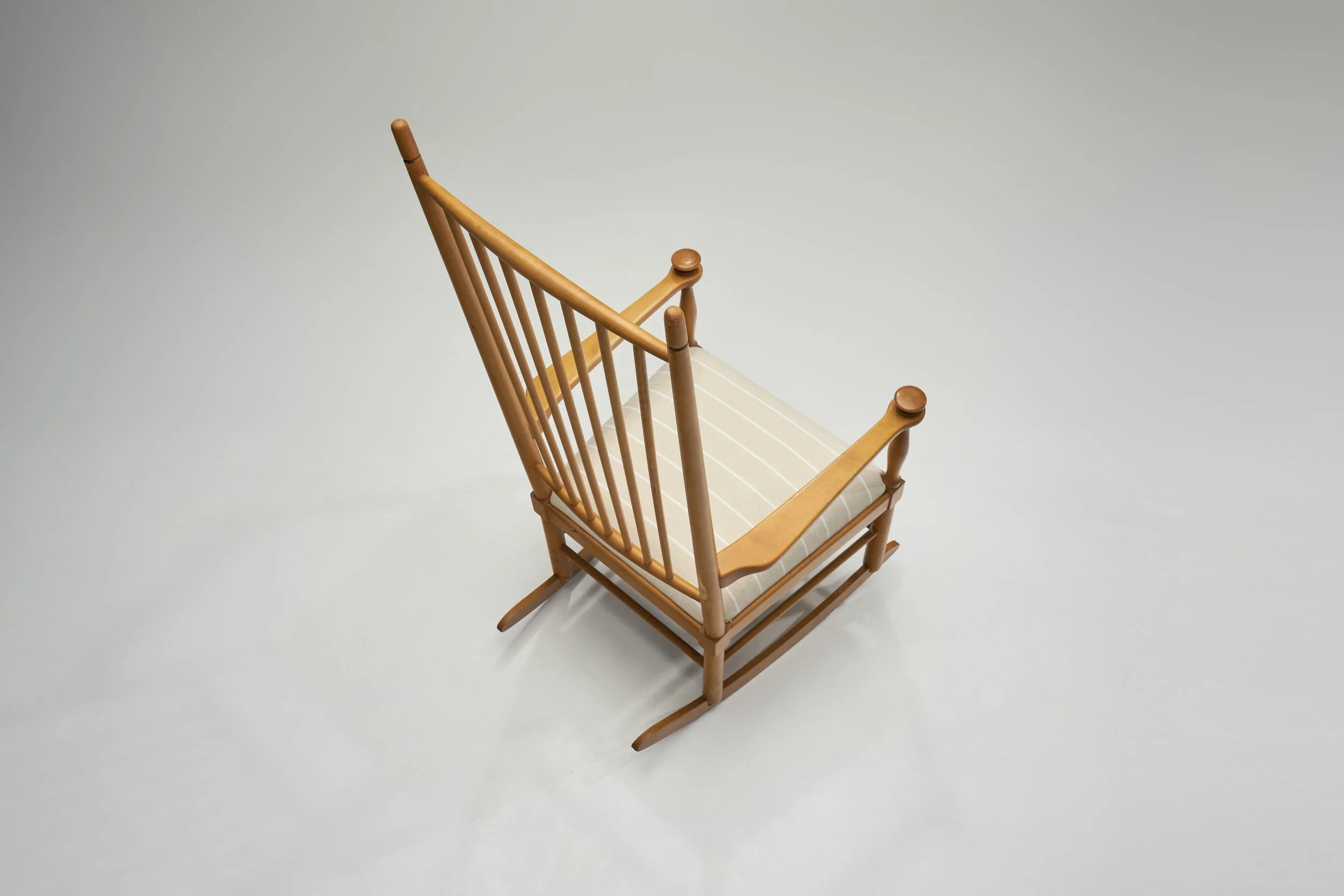
Karl-Axel Adolfsson “Isabella” Rocking Chair for Gemla, Sweden 20th Century






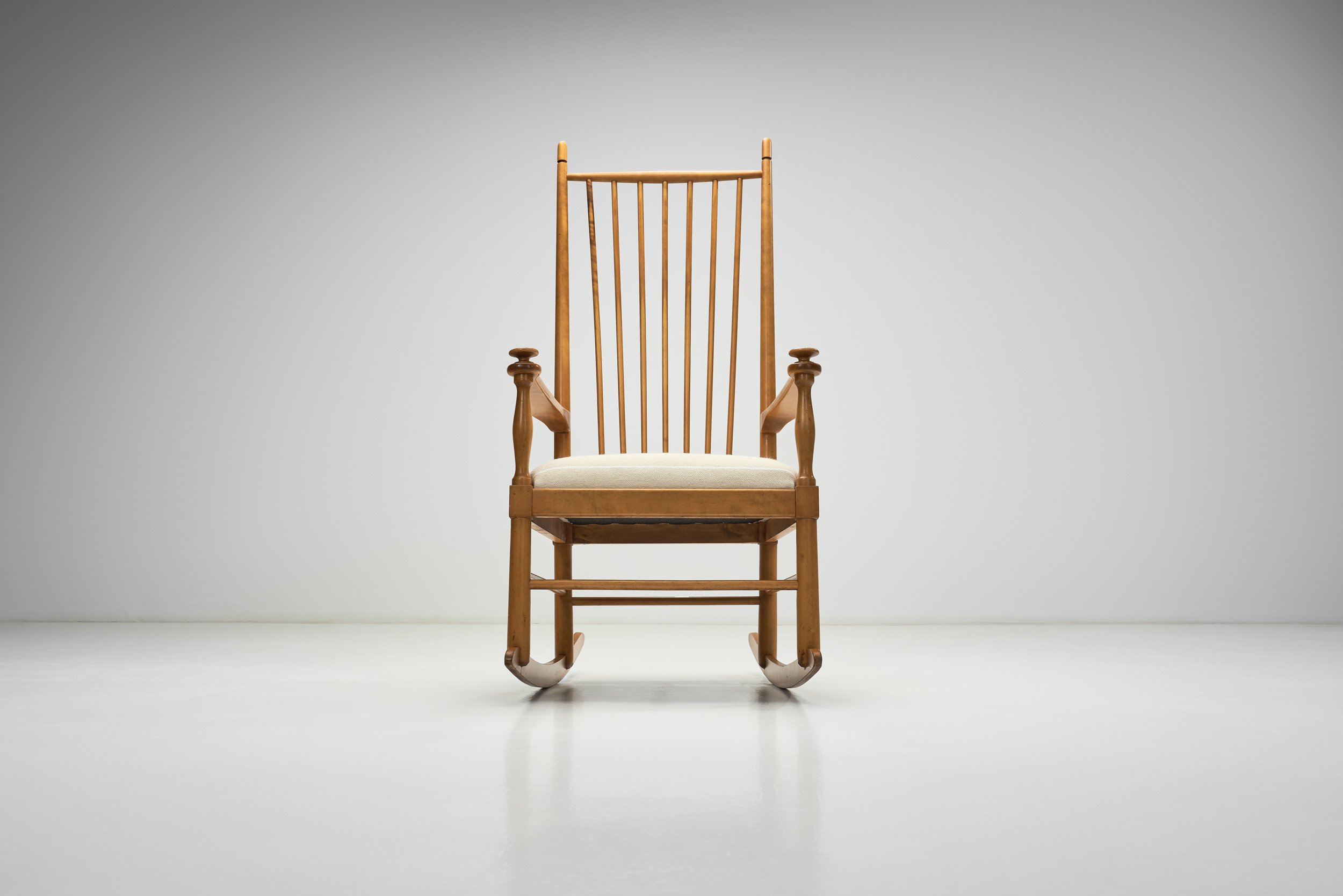



Karl-Axel Adolfsson “Isabella” Rocking Chair for Gemla, Sweden 20th Century
REQUEST PRICE HERE
Price category: 2,500 - 5,000 usd / eur
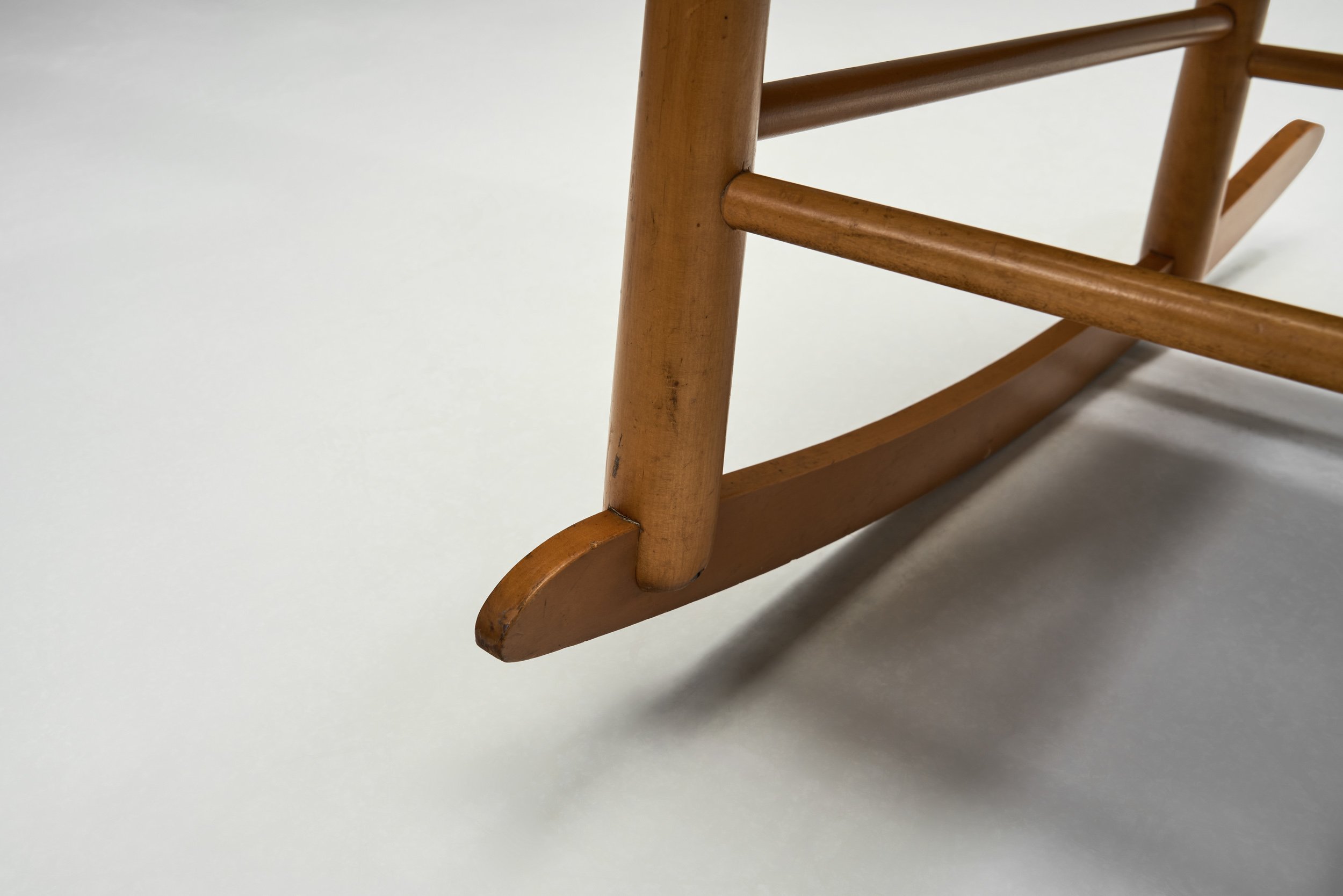
Rooted in the atmosphere of the vast, serene forests of Sweden, furniture design emerging from the region has been deeply interwoven with natural elements, and the utilisation of Swedish wood to this purpose a source of national pride. In combination with the principles of mid-century design - a deep appreciation for simplicity, functionality, and honesty of intrinsic materials - and its quiet elegance, the "Isabella" rocking chair perfectly embodies the characteristics of Swedish modernism. Gemla, located in the town of Diö, is Sweden’s oldest furniture manufacturer. Skilled craftsmen that settled in Diö brought with them revolutionary techniques developed at Thonet’s factories during the 19th century; due to this, Gemla became a pioneer of wood-bending techniques in Sweden, used to create Vienna-style furniture. Bentwood, as used for the rocking feet of the chair, requires six to twelve hours of steaming to make it soft and flexible.
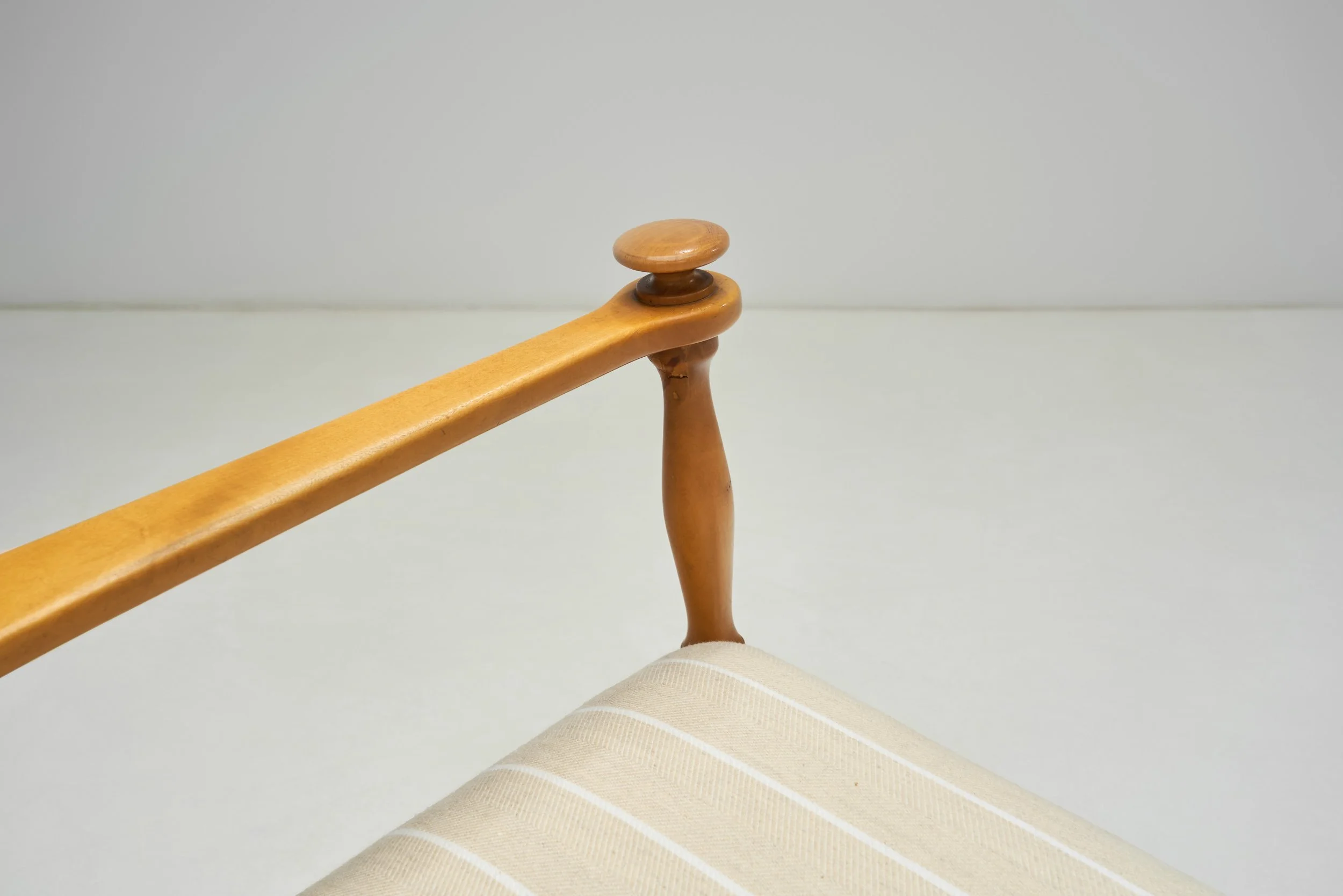
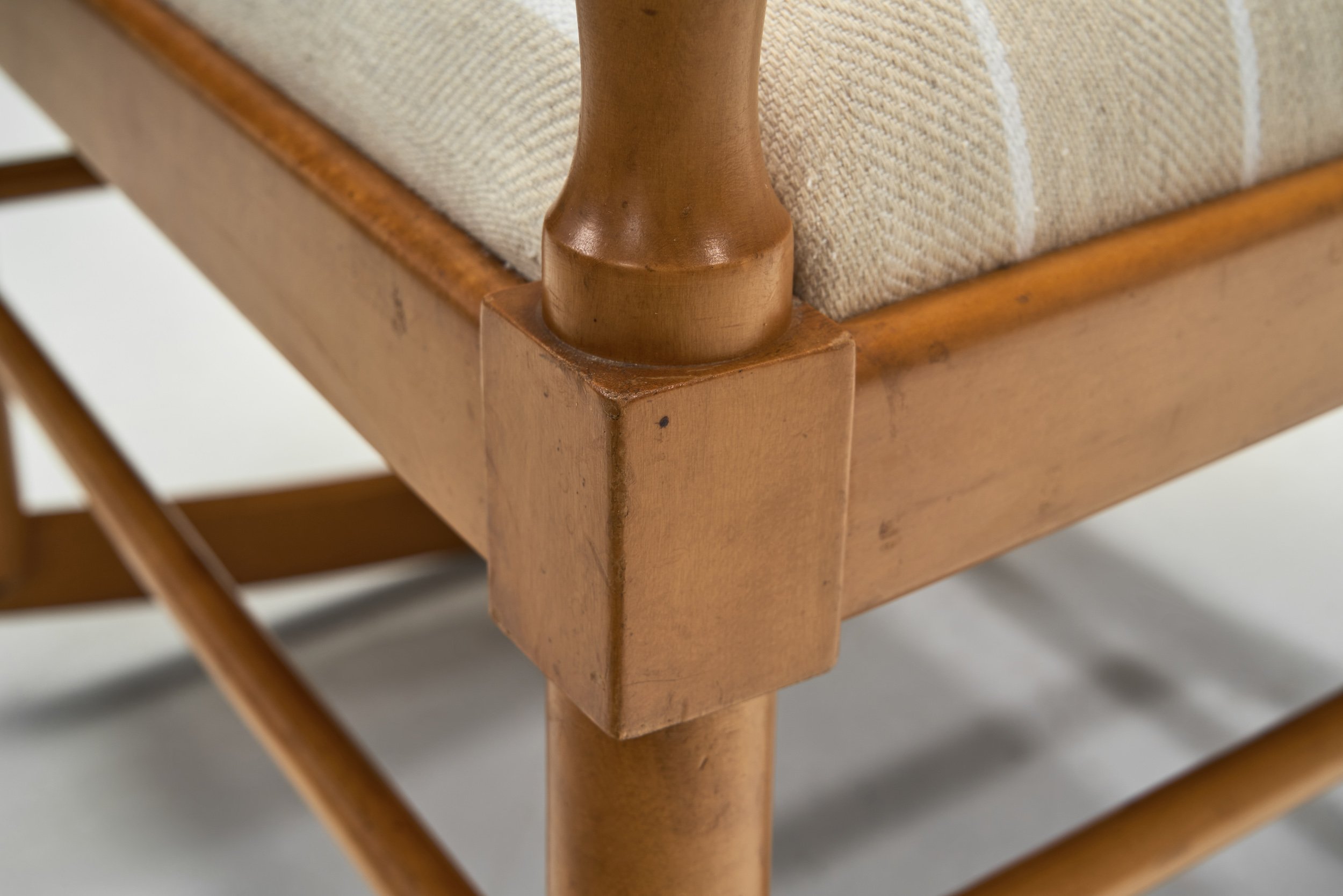
Designed by Karl-Axel Adolfsson, this rocking chair depicts brilliant craftsmanship and groundbreaking modernist ideas, while still remaining close to tradition. The high backrest is composed of seven symmetrically arranged spindles, that moderately fan out in a slight diagonal placement. The spindles offer both support as well as visual lightness, lending the design a classic, yet airy presence. The wooden frame of the rocking chair is complemented by delicate details, a series of subtle, yet character-defining elements, such as the sculpted handgrip knobs at the ends of the armrests, and the cap-like finishes on the upper frame. The armrests, which widen at the placement point of the elbow and then narrow again, add balance and brilliantly follow the human anatomy. The seat’s upholstery accommodates the sitter for a comfortable rest, as well as adding a subtle visual contrast against the backrest’s spindles with the slim horizontal stripes on the fabric. Drawing the eye lower, the frame continues with its softly rounded edges. The rocker base is elegant and follows an organic curve, contributing to its gentle and meditative movement.
Crafted with the careful precision of Karl-Axel Adolfsson, this chair is a timeless staple embodying both comfort and style, its subtle design allowing the chair to tie together any atmosphere. Its sculptural presence is a quiet invitation to slow down, to appreciate the harmony of life in the precious leisure time of reading or lounging, activities that the gentle rocking motion of the frame complements perfectly.
Condition:
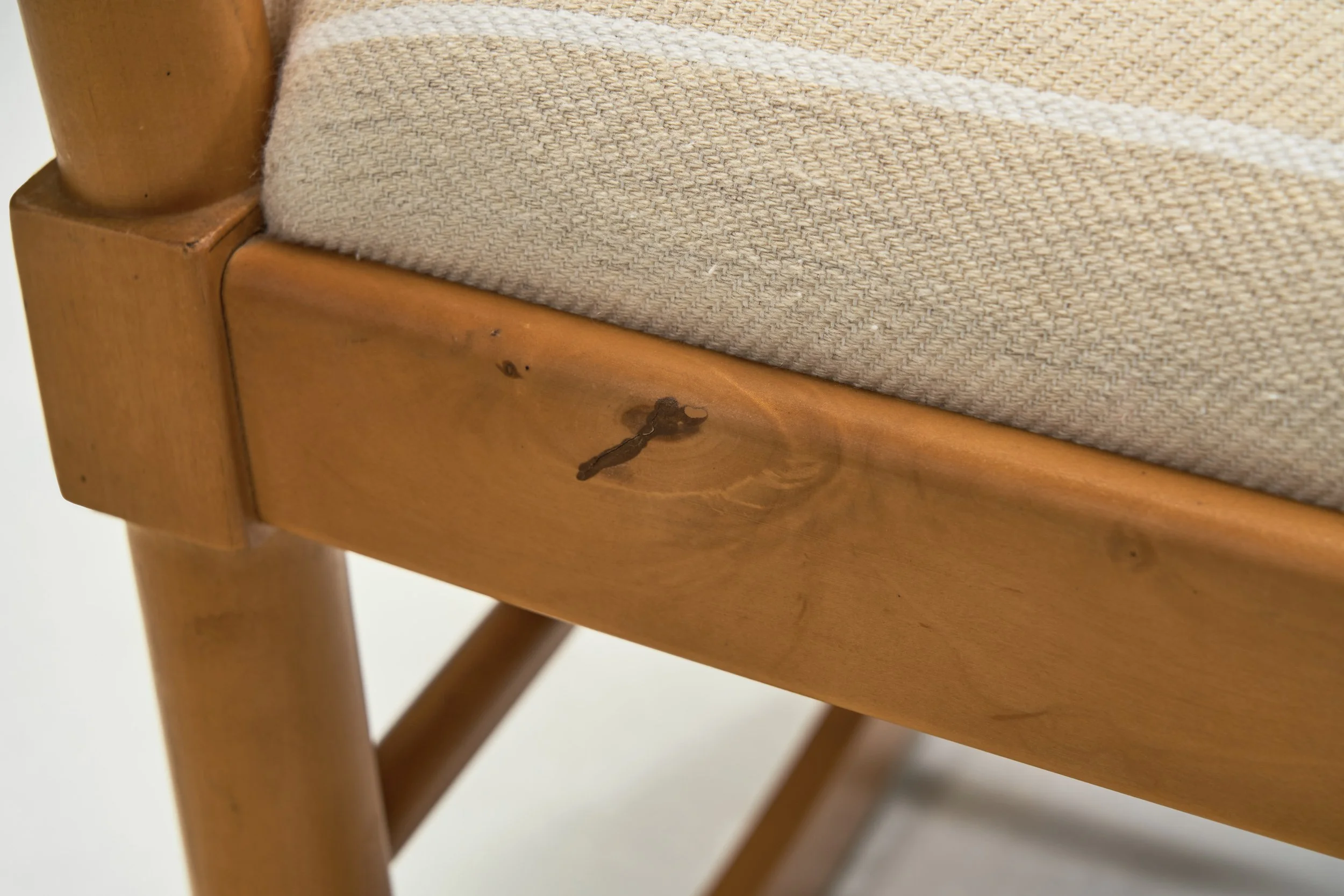
In good vintage condition. Wear consistent with age and use. The chair’s seat has been reupholstered recently in a premium fabric. Each of our items can be reupholstered by our in-house atelier in a fabric of choice. Please reach out for more information.
Dimensions:
21.65 in W x 29.53 in D x 45.86 in H; Seat height 17.51 in; Seat depth 18.50 in; Arm height 24.80 in
55 cm W x 75 cm D x 116.5 cm H; Seat height 44.5 cm; Seat depth 47 cm; Arm height 63 cm
REQUEST PRICE HERE
Price category: 7,500 - 10,000 usd / eur
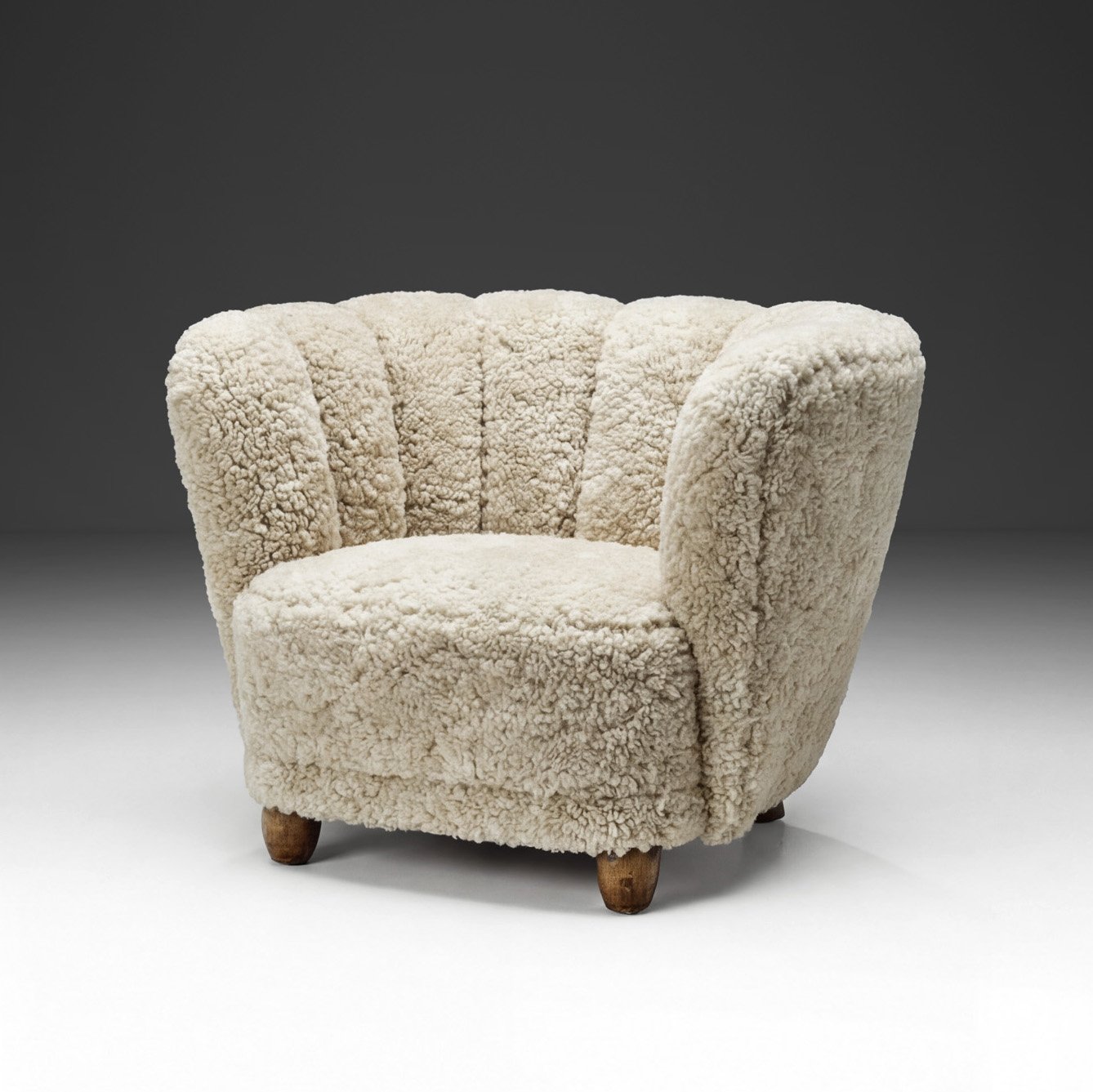
This beautiful Danish lounge chair is an early example of Scandinavian mid-century modern design as well as outstanding craftsmanship with a quality that honours the materials and users. The period from roughly the 1940s through the 1960s was a high point for Danish furniture makers, and this chair shows why.
Designed in the early phase of what we know today as mid-century modern, this lounge chair is a Danish delicacy with a unique look. With its classic shape paired with modern design elements, it combines the best design characteristics of the 1940s. The large, enveloping backrest dictates the shape of this chair, as it forms most of the structure, including the armrests. The curvature creates an inviting and open look, enhanced by the soft sheepskin upholstery. The inside of the upholstered back is sectioned which creates a shell-like look. The thick, bun feet-like front legs are a pleasant touch. The warm brown colour of the stained wood nicely contrasts to the off-white sheepskin, not to mention the thick wooden feet make a long-lasting, rock solid foundation for any chair. The chair’s back legs differ, they are straight, which is an eccentric detail that adds visual interest. Master cabinetmakers were highly aware of body proportions, prioritising comfort just as much as the visual qualities, therefore this lounge chair provides support for the back and great sitting comfort.
Perfectly suited for a vintage or contemporary interior, this chair represents a marriage of artistry and comfort. Its upholstery captures attention, adding warmth and vibrancy to any space, while the wooden feet are grounding, together making this piece into an ideal statement piece.
Condition:
In good vintage condition. Wear consistent with age and use. The wood has some scratches and marks. Due to the nature and age of the materials, the chair may have additional discolouration. The chair has recently been reupholstered in premium sheepskin. Each of our items can be re-upholstered by our in-house atelier in a fabric of choice. Please reach out for more information.
Dimensions:
34.25 in W x 33.46 in D x 27.55 in H; Seat height 14.56 in
87 cm W x 85 cm D x 70 cm H; Seat height 37 cm
REQUEST PRICE HERE
Price category: 2,500 - 5,000 usd / eur
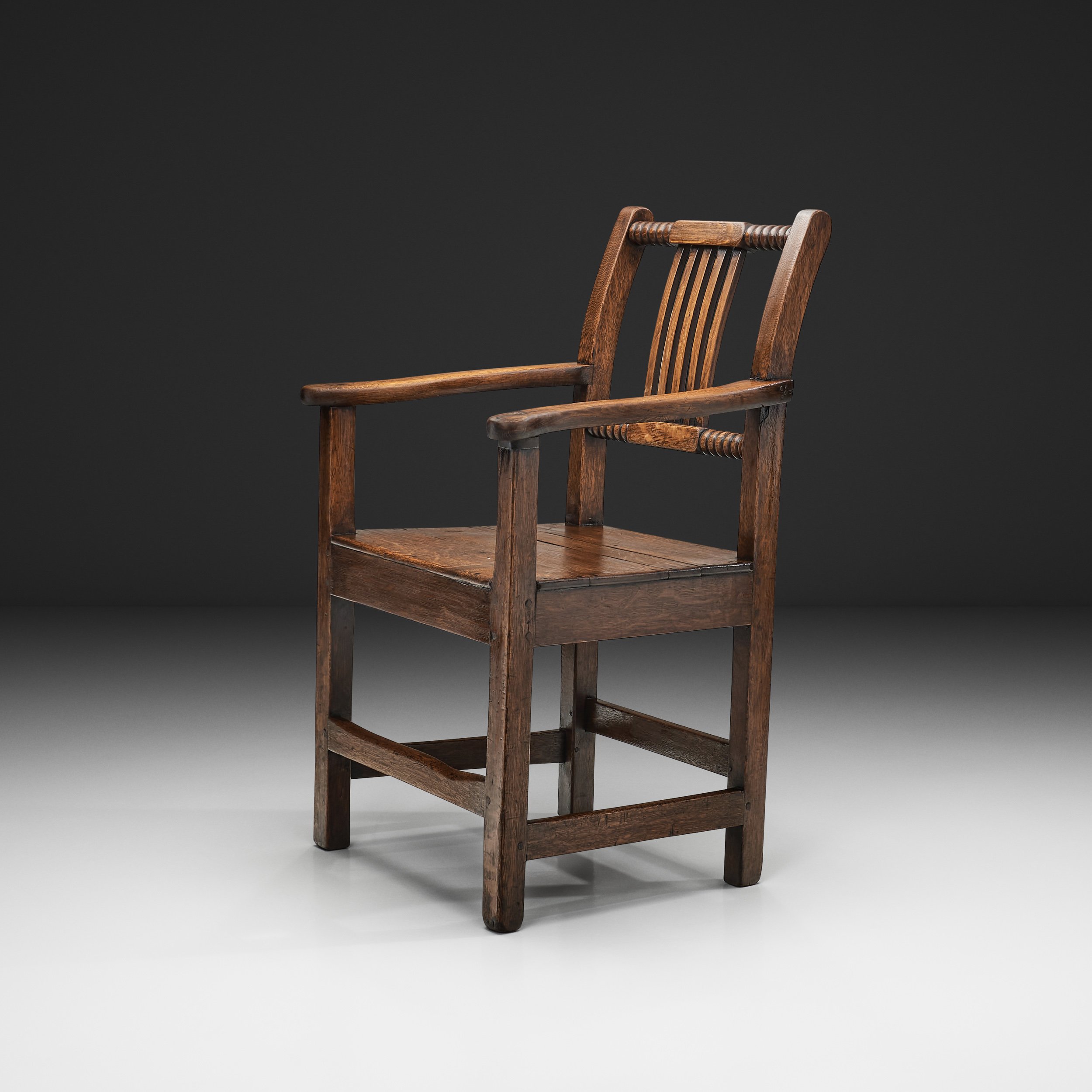
This antique armchair embodies the aesthetic, practicality and functional design that was valued in European homes of the 19th century. Displaying artisanal techniques such as weaving and beautifully carved details, pieces such as this chair showcase the expert craftsmanship of the woodworkers and furniture designers from the period.
Constructed from solid oak, the chair features a sturdy frame with a warm, natural finish that highlights the wood's grain and durability. Oak was the favoured material in this period for its resilience and beautiful grain pattern, thus increasing the visual depth of the chair. By being entirely constructed from natural materials, this piece maintains its classic charm typical of 19th century furniture, while adding versatility through its unpretentious, organic character. The armrests feature a subtle curve, providing ergonomic support, highlighting the chair's understated elegance. The wooden stretchers are positioned between each pair of legs, creating symmetry within the design. These additions go beyond their aesthetic purpose - not only do they complete the design but they also reinforce the structure, lending it additional stability.
With its organic feel and natural elements, this chair stands out with its timeless appeal. The piece’s simple yet refined structure allows them to integrate into various interior styles, from vintage-inspired rooms to more contemporary settings where they add a touch of old-world charm.
Condition:
In good vintage condition. Wear consistent with age and use. The chair has recently been reconditioned. Due to the nature and age of the wood, the item has some marks, scratches, and discolouration.
Dimensions:
23.04 in W x 22.25 in D x 37.01 in H; Seat height 18.31 in; Seat depth 17.72 in; Arm height 27.96 in
58.5 cm W x 56.5 cm D x 94 cm H; Seat height 46.5 cm; Seat depth 45 cm; Arm height 71 cm
REQUEST PRICE HERE
Price category: 7,500 - 10,000 usd / eur
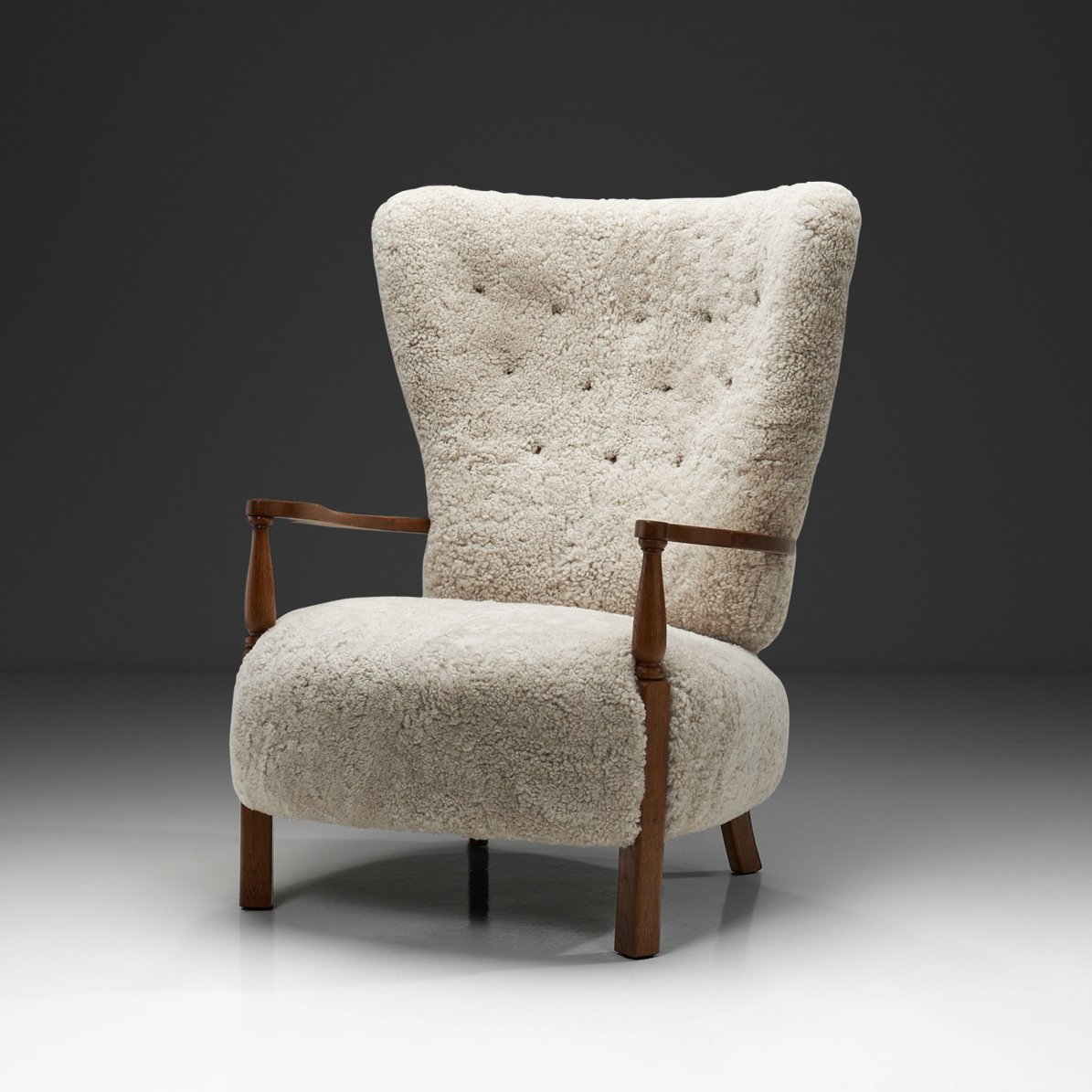
Danish Modernism can be visually described by this beautiful wing-back chair: sleek, organic and timeless. These attributes are met with high quality materials and the famous craftsmanship of the country’s cabinetmakers. This chair is a testament to the quality and craftsmanship of Villy Sørensen.
From the welcoming winged body and the solid wood frame to the cosy sheepskin upholstery, this chair expresses a quality of hygge and a feeling of contentment. The distinctive shape is a result of the two “ears” that encompass the sitter. One of the most notable chair styles that embodies Scandinavian modern design is the wing-back chair. The history of this type of chair can be traced back to the 17th century when they were originally designed to provide protection from drafts in grandiose, often chilly, European homes. With high backs and "wings" on each side to shield the sitter from cold air, these chairs were originally a symbol of prestige and comfort. To balance the sculptural, upholstered body is the beautiful solid wood frame that is left exposed on the sides as it also functions as a decorative element with its geometric angles and curves. The arms and tapered legs are formed from the same piece of wood resulting in a sleek impression. The wood’s colour and smooth surface contrast brilliantly with the sheepskin’s light colour and texture. Thanks to the properties of the sheepskin, this chair provides great, soft comfort as well.
Villy Sørensen had a unique design idiom, which is clearly visible in this model: function, durability, timeless design, and perhaps above all, comfort. This traditional yet playful chair combines all of these attributes, which makes it ideal to be the stylish focal point of any space.
Condition:
In good vintage condition. Wear consistent with age and use. Due to the nature of the wood, the item may have some marks, scratches, and discolouration. The chair has recently been reconditioned and has recently been reupholstered in premium sheepskin. Each of our items can be reupholstered by our in-house atelier in a fabric of choice. Please reach out for more information.
Dimensions:
29.92 in W x 32.28 in D x 38.98 in H; Seat height 14.96 in; Seat depth 22.83 in
76 cm W x 82 cm D x 99 cm H; Seat height 38 cm; Seat depth 58 cm
REQUEST PRICE HERE
Price category: 2,500 - 5,000 usd / eur
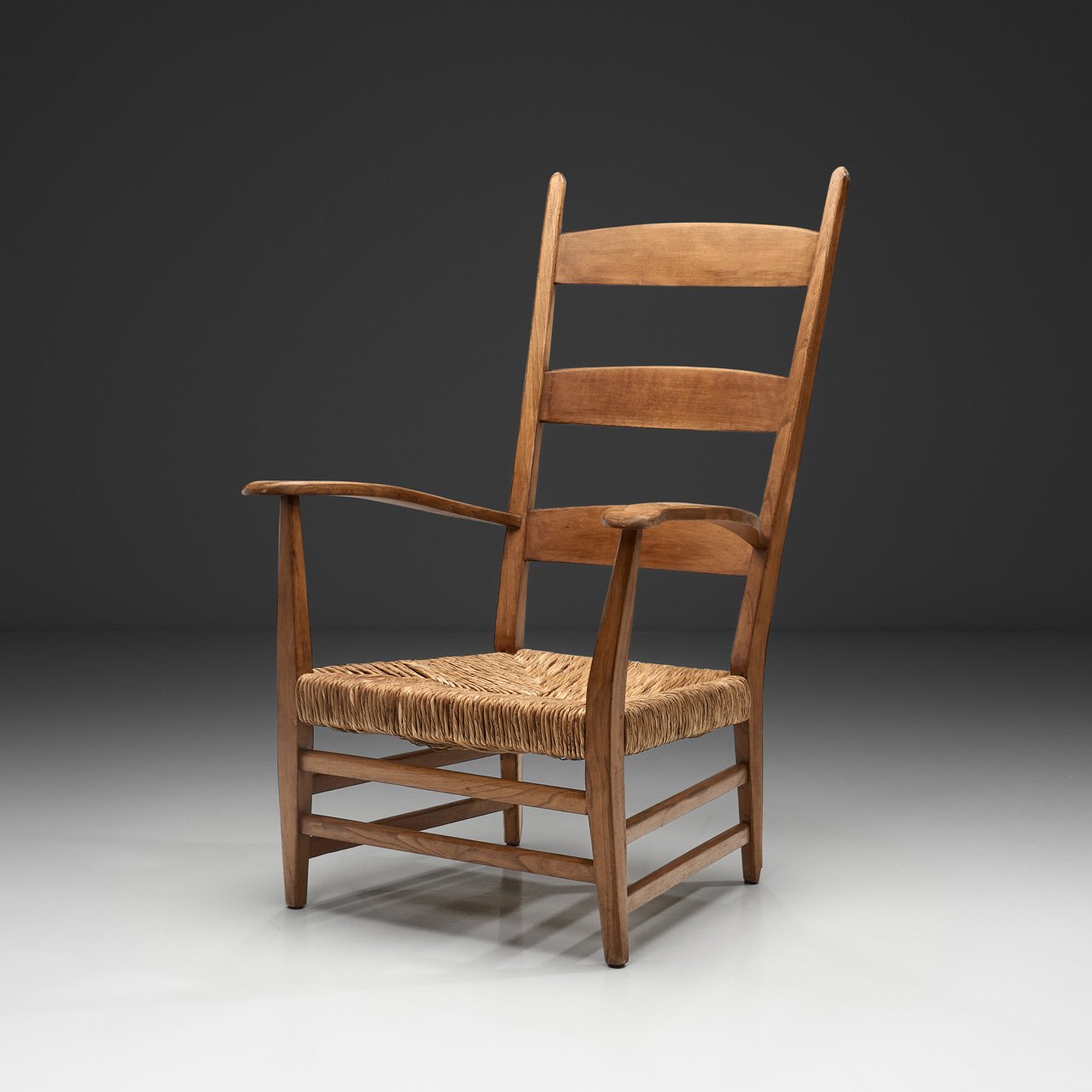
Bas van Pelt was one of the key figures in early Dutch modernist design, active during the 1930s and 1940s through his firm “My Home.” His work is recognised for its clarity of construction, careful proportions, and thoughtful integration of natural materials. Van Pelt focused on creating furniture that balanced function and craftsmanship, often incorporating elements such as wicker, rattan, and solid wood to introduce both durability and texture.
This high-back chair by Bas van Pelt combines of strong verticality and refined material contrast. The solid wooden frame establishes a clear architectural outline, with the elongated tall back defining the silhouette. The back is composed by ladder-like horizontal slats that introduce a sense of rhythm while maintaining the openness of the design. The seat is crafted from woven wicker, a material valued for its strength and breathability, which adds a tactile, organic quality to the otherwise linear construction. This contrast between the smoothness of the frame and the texture of the woven surface is central to the chair’s character. The armrests are gently shaped, introducing a subtle curvature that softens the overall form. Below, the legs are connected by stretchers that reinforce the structure and ensure stability. The craftsmanship is evident in the precision of the joinery which contribute to the overall sense of durability and refinement.
This armchair shows why Bas van Pelt is widely regarded as a Dutch design icon. From the handcrafted frame to the beautiful woven element, the chair remains of hifh quality and ideally suited for everyday use.
Condition:
In good vintage condition. Wear consistent with age and use. The chair has recently been reconditioned. Some chips and dents are present. Due to the nature and age of the materials, the item may have some marks, scratches, and discolouration.
Dimensions:
25.20 in W x 28.35 in D x 40.95 in H; Seat height 13.39 in; Seat depth 20.08 in; Arm height 23.82 in
64 cm W x 72 cm D x 104 cm H; Seat height 34 cm; Seat depth 51 cm; Arm height 60.5 cm
REQUEST PRICE HERE
Price category: 30,000 - 40,000 usd / eur
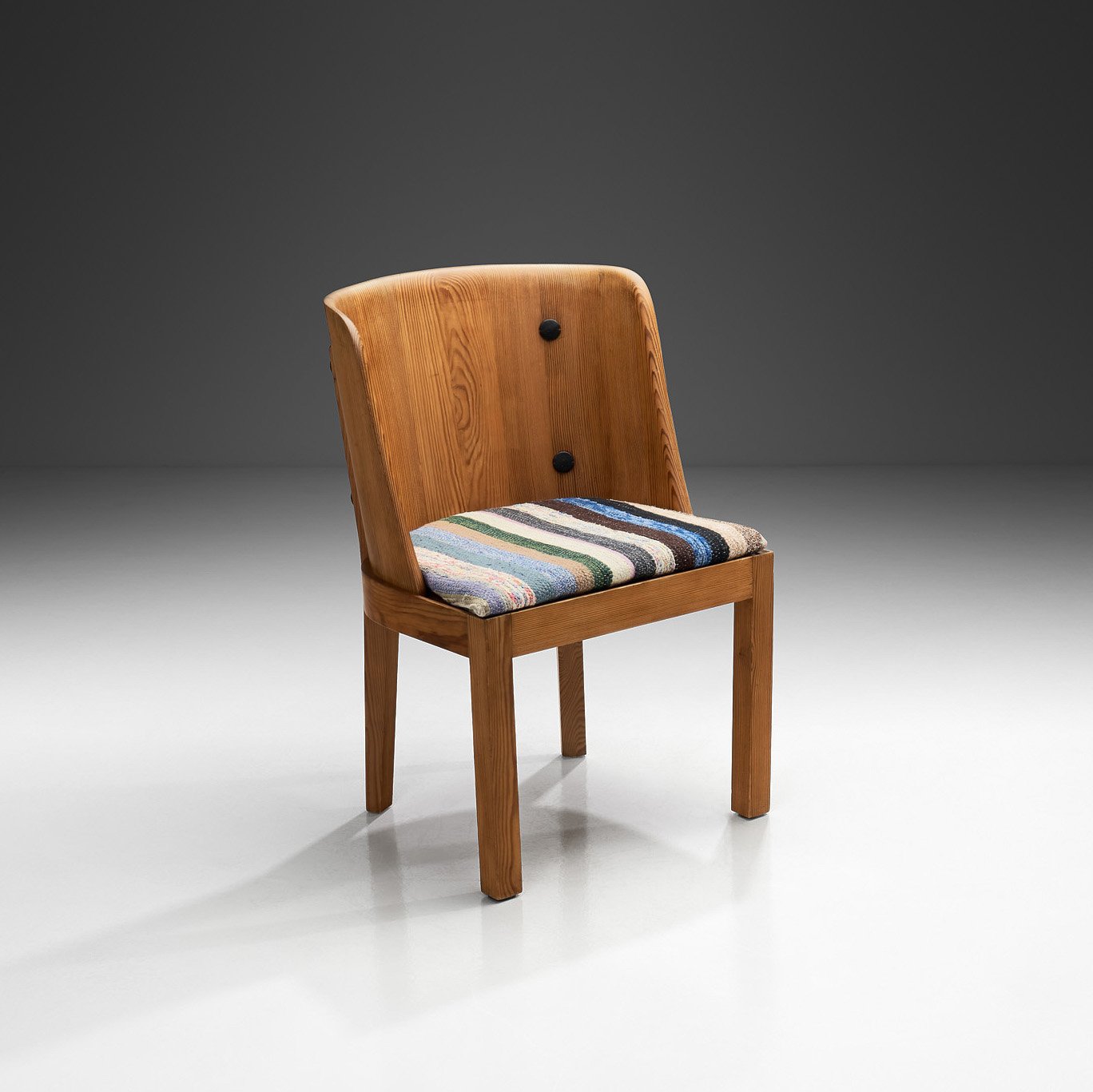
Swedish architect and furniture maker Axel Einar Hjorth worked as the lead designer for Sweden’s Nordiska Kompaniet department store from 1926 to 1938. During this time, Hjorth designed the “Sportstugemöbler” series, (which translates to “sports cabin furnishings”) a collection of wooden furniture designed for country homes. The various models in the sportstugemöbler series took their names from locations in the Stockholm archipelago – including Blidö, Lovö, and Utö.
The “Lovö” model, designed within the series of chalet furnishings, was initially launched by Nordiska Kompaniet in 1932. The series was a response to a new and growing demand for furnishings for leisure houses where the style was more informal. This chair is crafted from local pine wood, while the backrest features iron rivets. The juxtaposition between the pine and iron provides a rustic, sturdy and resilient feel, elevating the timeless look of the model. The chair combines a simple and honest form of the handcrafted style of traditional Nordic “allmoge” furniture, and the international 20th century Modernist movement. The result is a modest yet visually interesting design with a strong silhouette. The pine body is composed of a low, curved back that is slightly tilted in order to increase the sitter’s comfort - highlighting the functional nature of the chair. The seat features a loose, removable cushion, upholstered in a textural, striped fabric. Not only is the design of this model unique, but the colourful, cushion further increases the special character, ensuring remarkable charm. The design is completed by four square, straight legs, offering sturdiness.
The “Sportstugemöbler” series had a lasting influence on Hjorth’s contemporaries, inspiring other big names within Nordic design, such as Carl Malmsten. From an international perspective, this series is the forerunner of later pioneering designs, so it comes as no surprise that these “Lovö” chairs became part of modernist design history.
Condition:
In good vintage condition. Wear consistent with age and use. This chair comes with its original upholstery or has been reupholstered by a previous owner. Each of our items can be re-upholstered by our in-house atelier in a fabric of choice. Please reach out for more information.
Dimensions:
20.86 in W x 20.07 in D x 31.49 in H; Seat height 18.50 in; Seat depth 16.92 in
53 cm W x 51 cm D x 80 cm H; Seat height 47 cm; Seat depth 43 cm
About the designer:
Axel Einar Hjorth was born in a small Swedish village named Krokek, just outside Norrköping, on March 7, 1888. At the age of 20, he moved to Stockholm to study architecture and design at the Högre Konstindustriella Skolan.
Although he never graduated, in the 1920s Hjorth started working as a furniture designer for various manufacturers, such as H. Joop & Co., Myrestedt & Stern, Jonssons, and Nordiska Kompaniet. Hjorth’s designs from this period had neoclassical features combined with Swedish Grace. This romantic national style of Sweden was elegant and refined, yet simple. The anniversary exhibition of 1923 in Gothenburg marked the breakthrough of Swedish decorative arts, and made Axel Einar Hjorth a well-respected artist. From October 1926, Hjorth became the chief designer and architect of Nordiska Kompaniet department store in Stockholm. In the 1930s, Hjorth designed a furniture collection out of pine meant for serial production known as Sportstugemöbler (furniture for holiday houses).
Hjorth’s designs, from the luxury of neoclassicism to the severity of functionalism, are sharply distinctive in style, materials, and character. Unlike many of his contemporaries, Hjorth did not conform to the socially oriented ideas produced by Svensk Form (the Swedish Society of Crafts and Design). He played a significant role in the development of Swedish society as a whole, and particularly in Swedish industrial art.
Today Hjorth is often viewed as a precursor to the modern designs popularised by Charlotte Perriand, Jean Royére, Pierre Chapo, or Josef Frank. Recently, there has been a revival of appreciation for his work, showing his genius in a new light.
REQUEST PRICE HERE
Price category: 2,500 - 5,000 usd / eur
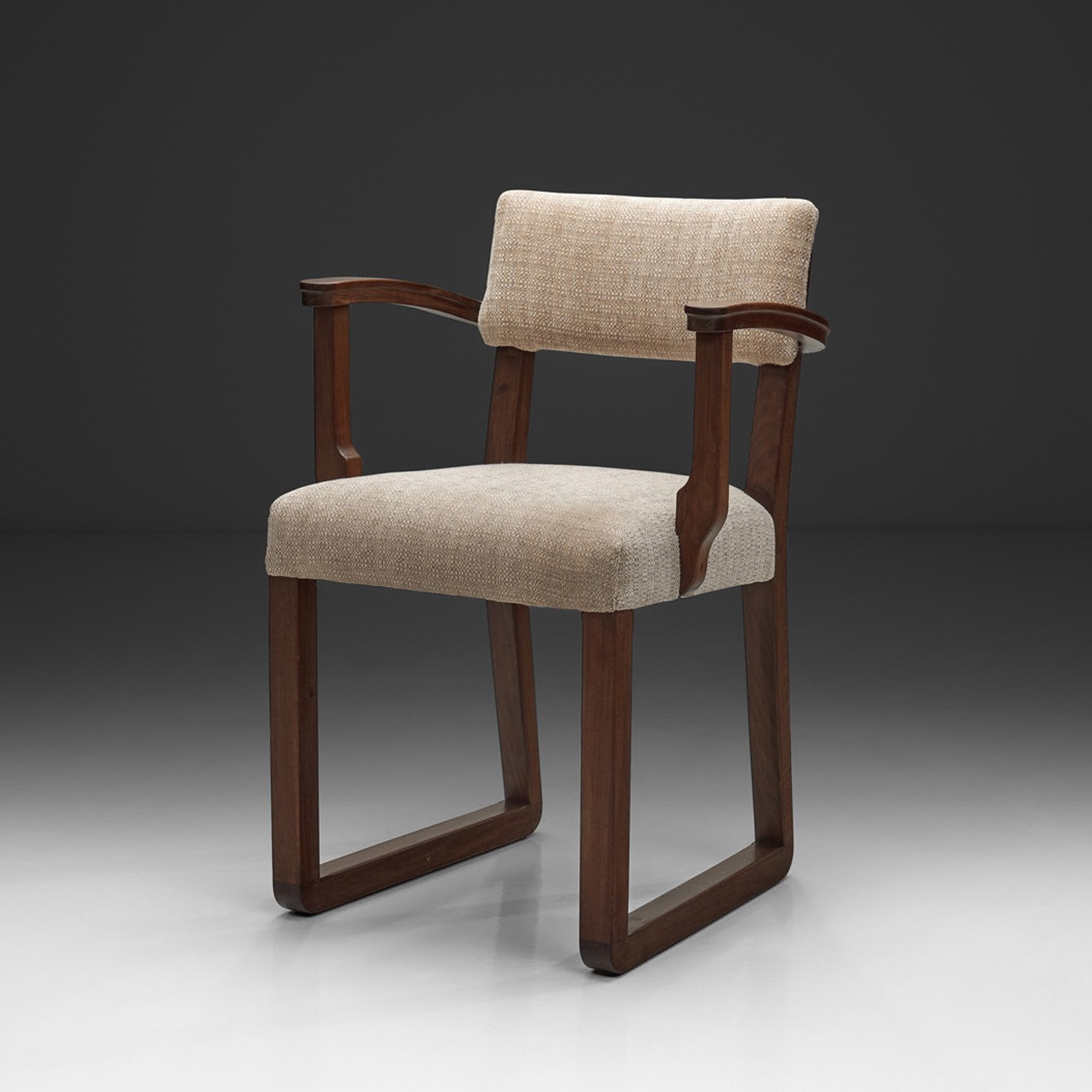
This armchair is rooted in the Dutch Art Deco movement of the 1930s. It was a period defined by confidence, structure, and a belief in modern luxury. Art Deco design emerged between the wars as a response to earlier ornament-heavy styles, favouring clarity of form, strong geometry, and refined materials. Furniture from this era often balanced comfort with a distinctly architectural presence, drawing inspiration from both classical proportion and the clean lines of modern industry. This chair reflects that mindset perfectly, presenting a strong and confident silhouette that feels intentional rather than decorative.
European designers believed that a chair should always be comfortable to sit on and beautiful to look at from all sides and angles and this piece is evidence of that. This elegantly constructed model combines comfort with style. From as early as the 1920s, cabinetmakers and architects frequently collaborated to produce exceptional furniture pieces like this. The chairs’ elegant curves, precise angles and structure all testify of this partnership’s success. Thanks to the design of the base, the form appears very grounded. With straight and curving lines following each other, the model has a dynamism rooted in organicity. Unlike pieces from outside the continent, Dutch designers’ products weren’t flashy but rather well-made to fit a warm, comfortable and welcoming home.
There is a subtle interplay of texture and tone present that allows the chair to seamlessly complement a range of interior styles, from classic vintage settings to contemporary spaces that value timelessness. This armchair is a striking example of the commitment to elegance and modernity, packaged in restrained sophistication.
Condition:
In good vintage condition. Wear consistent with age and use. Due to the nature and age of the materials, the item may have some marks, scratches, and discolouration. The item has recently been reupholstered in a premium fabric. Each of our items can be reupholstered by our in-house atelier in a fabric of choice. Please reach out for more information
Dimensions:
21.86 in W x 20.87 in D x 31.89 in H; Seat height 19.69 in; Seat depth 19.10 in; Arm height 28.15 in
55.5 cm W x 53 cm D x 81 cm H; Seat height 50 cm; Seat depth 48.5 cm; Arm height 71.5 cm
REQUEST PRICE HERE
Price category: 5,000 - 7,500 usd / eur
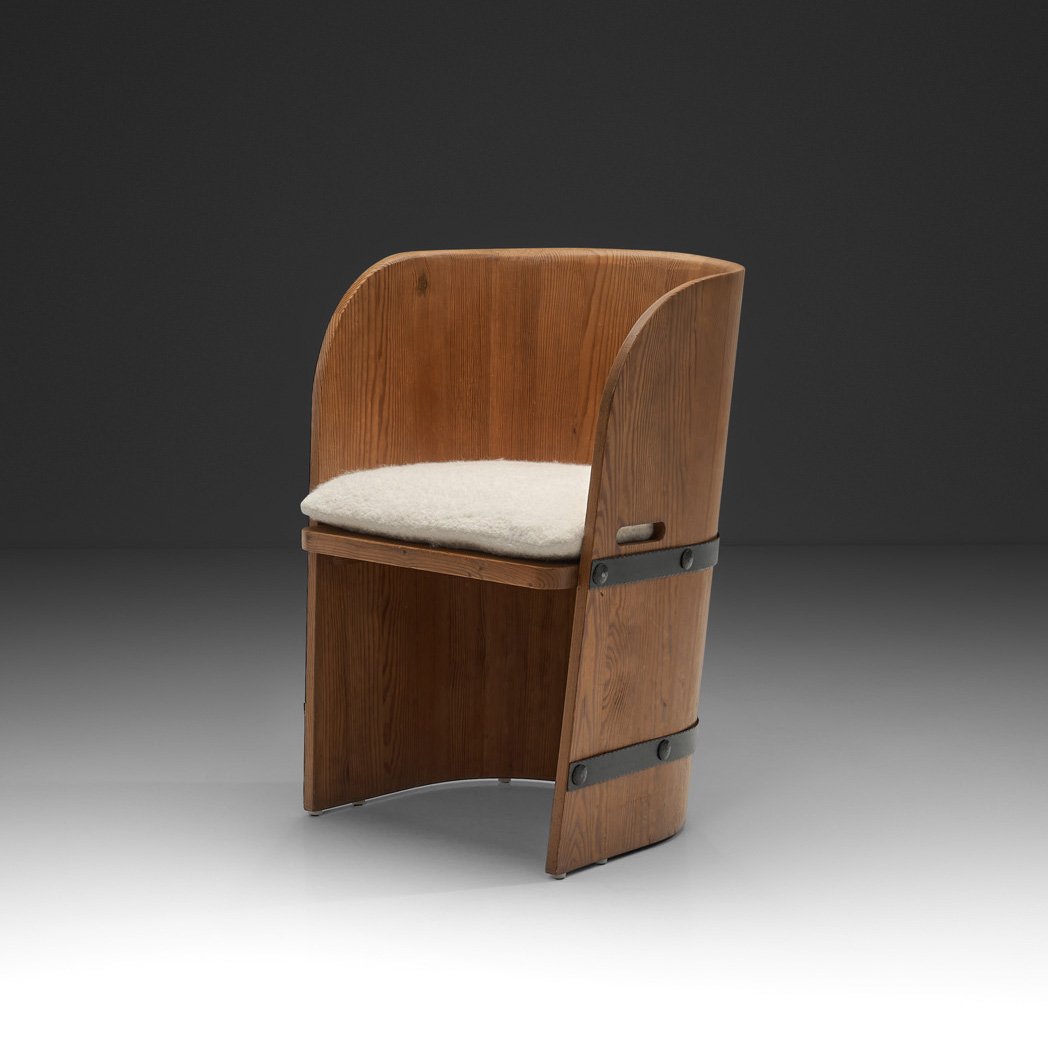
This beautiful barrel armchair is an example of Swedish mid-century design as well as outstanding craftsmanship with a quality that honours the materials and their users. The period from roughly the 1940s through the 1960s was a high point for Scandinavian furniture makers, and this chair shows why.
Åby Möbelfabrik factory was located in Tjureda parish, in Sweden’s Växjö municipality. The company primarily manufactured pine furniture. The chair’s shape and construction show the signs of the master craftsmanship of Åby Möbelfabrik as the robust, barrel-like body has a rounded construction, with the back flowing into the arms to achieve an enveloping, comforting experience for the user. The wood’s grain and pattern is very appealing throughout the design of this chair, which adds an organic touch to the design. This piece displays a beautiful contrast between the light wood frame’s colour and the elegant off-white fabric of the cushions. The upholstery is just as much a decorative element as the wooden structure with the two materials pairing exceptionally well.
Barrel chairs are generally considered among the best accent chair types as their unique shapes immediately draw the eye. Simply styled and elegant had always been mid-century designers’ speciality, and there is no better example than this pair of unique barrel chairs.
Condition:
In good vintage condition. Wear consistent with age and use. The item has recently been reconditioned. Due to age, the item has some dents, scratches, and discolouration. The cushion has recently been reupholstered in a premium fabric. Each of our items can be reupholstered by our in-house atelier in a fabric of choice. Please reach out for more information.
Dimensions:
21.26 in W x 18.70 in D x 30.32 in H; Seat height 18.90 in; Seat depth 17.32 in
54 cm W x 47.5 cm D x 77 cm H; Seat height 48 cm; Seat depth 44 cm
REQUEST PRICE HERE
Price category: 12,500 - 15,000 usd / eur
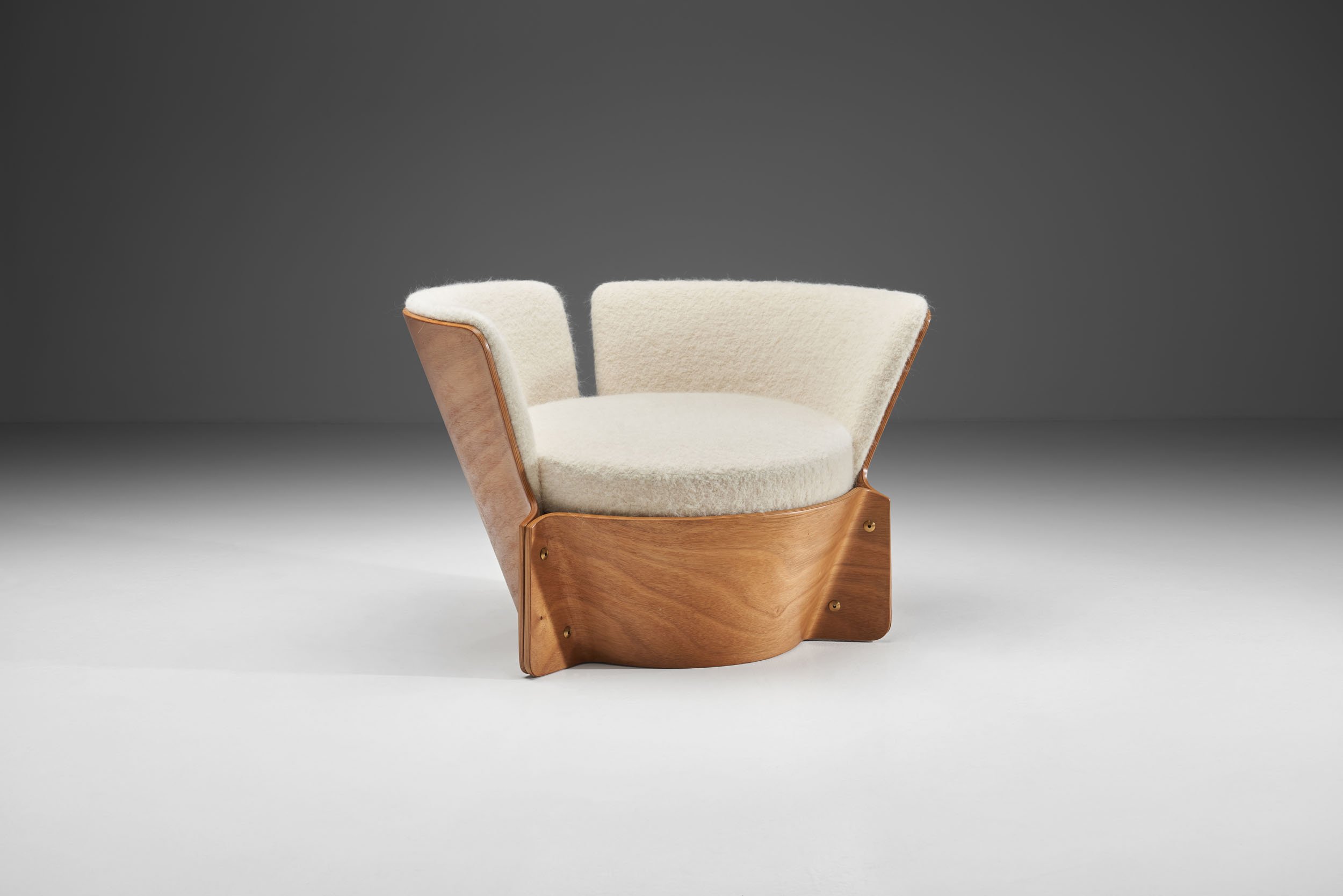
This rare "Roset" chair is a striking creation by the Danish designer duo Ole Gjerløv-Knudsen and Torben Lind, manufactured by Mogens Kold in Denmark in the early 1970s. Introduced in 1972, the “Roset” model stands out for its sculptural form and innovative construction, embodying the spirit of Danish modernism with a playful and organic twist.
The chair’s design is both functional and deeply expressive. Its unusual shape evokes the comfort of a nest, welcoming the sitter into a softly embracing form. The chair’s broad circular seat and gently curved split backrest encourage a relaxed lounging posture, creating an intimate and cocoon-like experience for the user. The feet, resembling fins, not only provide visual dynamism but also ensure stability, giving the piece a grounded yet airy presence. The body is constructed from three laminated plywood panels, precisely joined with visible brass screws that lend a subtle industrial touch while highlighting the craftsmanship and attention to structural detail. The model is upholstered in a premium wool and alpaca blend fabric, chosen for its softness, warmth, and luxurious texture. The light, tactile quality of the upholstery enhances the chair's inviting character and complements the warm natural tones and grain of the plywood shell.
The “Roset” model remains a rare piece that offers both sculptural impact and everyday warmth. It is an ideal statement chair capturing the balance between innovation, comfort, function, and aesthetics, that defines the best of Danish design from the period.
Condition:
Wear due to age and use. Some scratches and marks. Recently reupholstered in premium alpaca - wool blend fabric.
Dimensions:
35.63 in W x 31.50 in D x 23.43 in H; Seat Height 14.17 in
90.5 cm W x 80 cm D x 59.5 cm H; Seat Height 36 cm
About the designer:
Ole Gjerløv-Knudsen (1930-2009) was a Danish furniture architect. He studied at the School of Crafts, graduating in 1952 and then at the Academy of Fine Arts in Copenhagen until 1955. Gjerløv-Knudsen designed furniture series for both carpentry and industrial production in collaboration with fellow Danish furniture designer Torben Lind (1928-2016) from 1962.
Lind’s works showed a commitment to using the finest materials and extraordinary precision to create one-of-a-kind designs. Together, they became well-known for their light furniture in beech and plywood. The duo worked together at PP Møbler, creating furniture that became a trademark of Danish design.
During their long collaboration, Gjerløv-Knudsen and Lind designed numerous successful chair designs representing Danish mid-century modern, with special attention to outstanding comfort and ensuring long-lasting value by using quality materials. Many of their designs were produced by France & Son and Mogens Kold Møbelfabrik. The latter produced some of the most coveted furniture of the mid- 20th century. ~H.
REQUEST PRICE HERE
Price category: 5,000 - 7,500 usd / eur
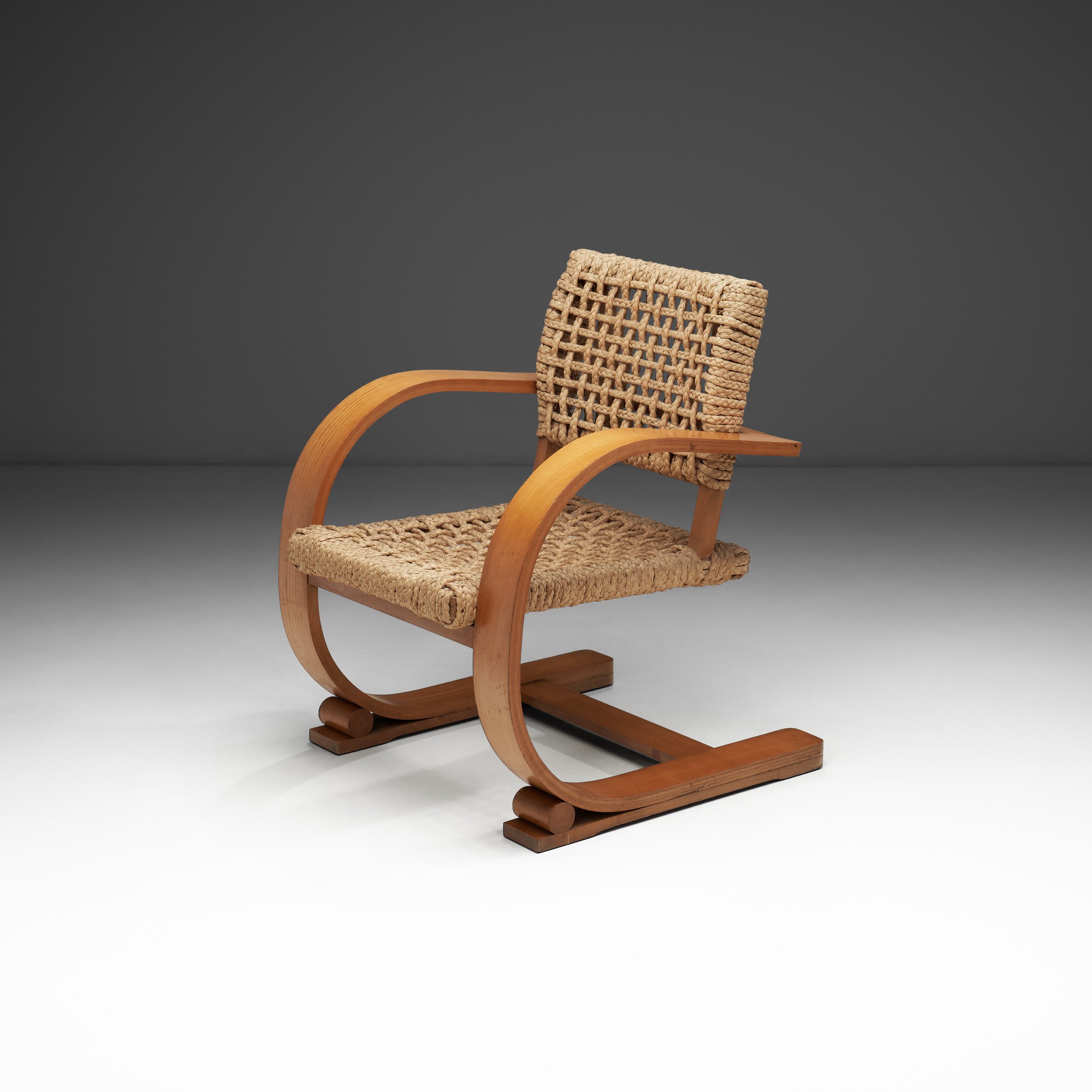
This armchair is a compelling embodiment of the French design duo Adrien Audoux and Frida Minet. Their design philosophy was centered around a commitment to accessible furnishing made out of natural materials that suit the rhythms of modern life. Active in mid-20th century France, they played a crucial role in shaping post-war design. Drawing inspiration from modernist movements, they steered the view of design towards a more functional, refined, and streamlined aesthetic.
This chair showcases excellent craftsmanship, care, and precision, visible in the smallest details of the design. The woven seat and backrest, composed of finely braided natural fibres, offer both support and comfort, gently adapting to the shape of the body for a relaxed resting experience. Unlike most chairs, this unique design does not utilise the typical four legs - instead, the structure flows seamlessly into a wide curve that comprises the frame and is the visual highlight of the chair’s form. The armrests appear to be curving down and back in two smooth lines, partially creating a supporting base. The structure of the base is further enforced by a stretcher between the two pieces of bentwood, enhancing stability. Another interesting design detail are the cylinder supports at the front where the arms and base meet, which act as a reinforcement while still maintaining harmony with the rest of the piece. This clever element helps to create a scooped base that supports the entire seat. The bent wood creates a fluid connection, giving the seat a sense of suspension - a light, almost floating presence - with the open surface of the seating and back further enhancing the airy characteristic of the armchair. Though the back rail is a separate piece between the two large curved elements it visually continues the line of the arms, creating the sense of a frame that gracefully encloses the seat.
The impressive silhouette of the armchair is defined by the choice of solid bentwood and woven rope as materials, and techniques that require expert skill, all poured into the final result to create this graceful form. The timeless appeal of this piece complements a wide range of interior styles, capable of transforming any environment with its organic appearance in both form and medium.
Condition:
In good vintage condition. Wear consistent with age and use.
Dimensions:
25 in W x 27.55 in D x 31.88 in H; Seat height 16.14 in
63.5 cm W x 70 cm D x 81 cm H; Seat height 41 cm

REQUEST PRICE HERE
Price category: 9,000 - 12,500 usd / eur
Designed in the early phase of what we know today as mid-century modern, this charming armchair is unique evidence of how traditional Swedish craftsmanship was brought into modernism. Berga Möbler, later called Berga Form, began manufacturing furniture of the highest quality in 1896.
This armchair holds all the characteristics that define the manufacturer's style: soft, organic, playful, and sophisticated. The model is slightly tilted backwards allowing for a pleasant sitting experience. The tapered wooden legs add a touch of mid-century modern flair apart from being structurally integral, while the two front legs have a precise curvature towards the end; a feature which has become a distinctive feature of Berga Möbler's designs. The rounded backrest and armrests are just some of the elements that define the elegance of the chair. Slightly inclined towards the backrest, the armrests enhance the excellent seating experience, making this piece a great choice for any contemporary living space. The back is tufted with two large buttons that allow for a friendly and welcoming appearance. The cushioning is firm yet plush, perfectly balancing comfort and support. This attention to detail ensures that the armchair is beautiful and practical for everyday use.
Crafted with precision and finished with attention to detail and care for the aesthetic dimension, this armchair stands the test of time thanks to both their visual and material quality.
Condition:
In good vintage condition. Wear consistent with age and use. The chair has been reupholstered recently in a premium fabric. Each of our items can be reupholstered by our in-house atelier in a fabric of choice. Please reach out for more information.
Dimensions:
29.52 in W x 33.46 in D x 33.07 in H; Seat height 17.71 in; Seat depth 20.86 in; Arm height 23.62 in
75 cm W x 85 cm D x 84 cm H; Seat height 45cm; Seat depth 53 cm; Arm height 60 cm
REQUEST PRICE HERE
Price category: 5,000 - 7,500 usd / eur
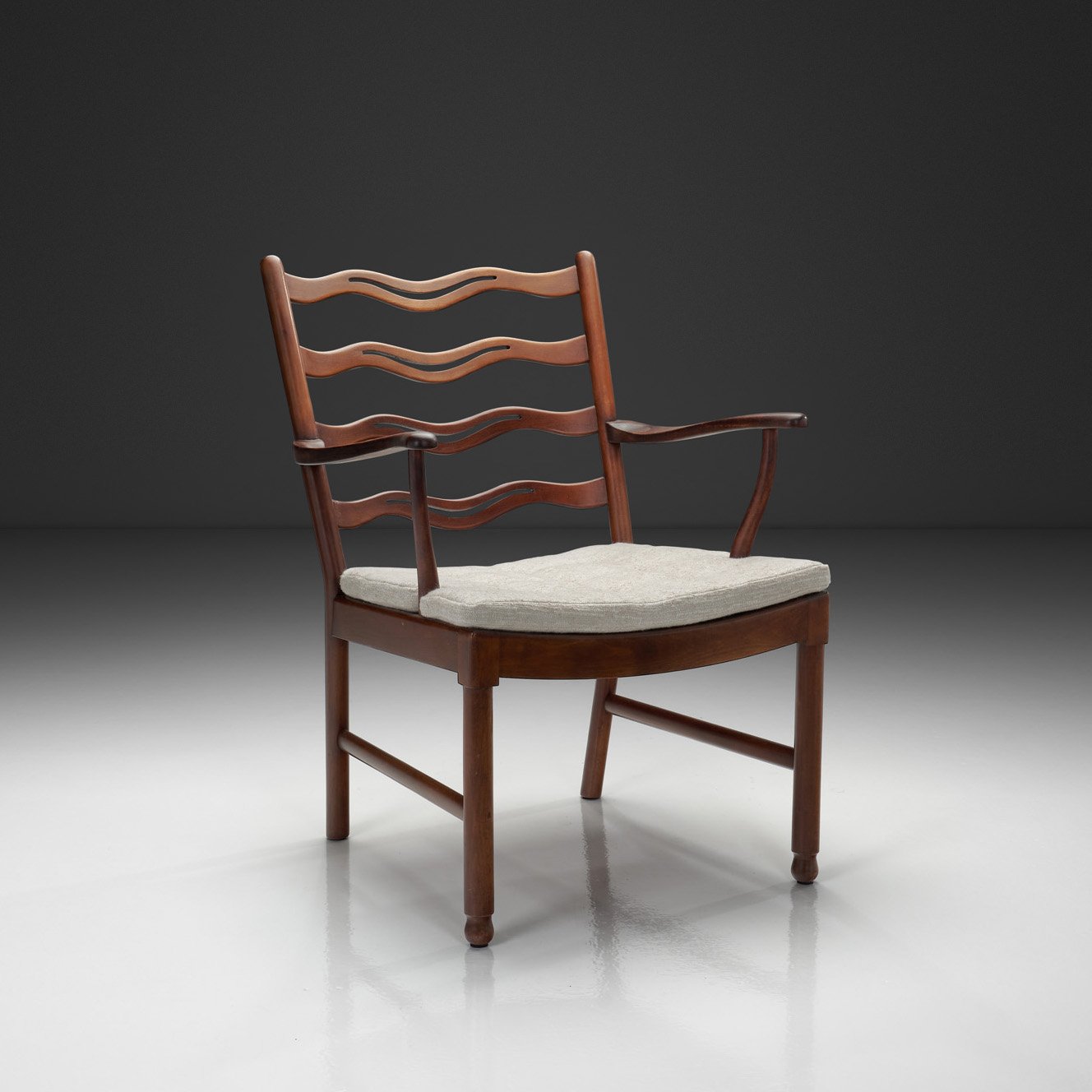
Ole Wanscher was one of the leading figures of 20th century Danish design. Trained as an architect and later a professor at the Royal Danish Academy of Fine Arts, Wanscher’s work is characterised by restraint, clarity, and a deep respect for craftsmanship. Makers like him believed that good furniture should feel appropriate in its proportions, neither excessive nor incomplete, and that belief is evident throughout his designs.
Model “1755” exemplifies this disciplined yet elegant approach. The chair’s back is composed of three gently undulating horizontal slats that introduce movement without disrupting the overall symmetry of the frame. These shaped rails provide ergonomic support while creating a subtle decorative rhythm across the backrest. The uprights are slightly tapered, lending lightness to the silhouette and preventing the form from feeling heavy. The arms extend from the back, curving forward in a subtle arc that supports the sitter while maintaining visual continuity with the backrest. Transitions and joinery are seamless and organic, demonstrating careful attention to structural flow. The legs are slender and proportioned with precision, connected by thin stretchers that reinforce stability without drawing attention away from the main lines. Every element feels considered, from the thickness of the rails to the spacing between slats, resulting in a chair that is visually calm yet structurally assured. The upholstered seat introduces a measured softness that balances the architectural clarity of the wooden frame. Its tailored form provides comfort while maintaining the light, refined character of the design.
Suitable for use at a dining table, desk, or as an occasional armchair, model “1755” reflects Wanscher’s enduring commitment to proportion, craftsmanship, and the thoughtful reinterpretation of historical furniture making within a modern context.
Condition:
In good vintage condition. Wear consistent with age and use. The chair has recently been reconditioned. Due to the nature and age of the wood, the chair may have some marks, scratches, and discolouration. The seat cushion was newly produced and upholstered in a premium fabric. Each of our items can be reupholstered by our in-house atelier in a fabric of choice. Please reach out for more information.
Dimensions:
24.60 in W x 26.37 in D x 33.85 in H; Seat height 17.12 in; Seat depth 19.68 in; Arm height 25.19 in
62.5 cm W x 67 cm D x 86 cm H; Seat height 43.5 cm; Seat depth 50 cm; Arm height 64 cm
REQUEST PRICE HERE
Price category: 5,000 - 7,500 usd / eur
Art Deco seating developed around a balance between modern construction and a more decorative approach to form. While earlier movements prioritised either ornament or strict function, Art Deco combined the two through geometry, symmetry, and the use of rich materials. Upholstered armchairs from this period often feature materials such as velvet, wood, and metal, used alongside bold shapes to create contrast while maintaining cohesion.
This armchair reflects that approach through its clear form and combination of upholstery with wooden detailing. The chair has thick armrests and a plush seat that allows for a stable and comfortable sitting position. The upholstery is fitted across the frame, with the material itself contributing to both comfort and appearance. A defining feature is the vertical wooden detailing integrated into the sides of the chair. This element introduces a contrasting material while also breaking up the otherwise smooth upholstered surfaces. The vertical flute reinforce a sense of rhythm and geometry that aligns with Art Deco’s signature characteristics. At the same time, they provide a visual transition between the soft fabric and the short feet that anchor the piece. Chromatically, the burnt orange of the textile and the warm tone of the wood come together to create a cosy, comforting look.
This chair combines a functional form with careful detailing, highlighting the artistry and timeless craftsmanship of an era that valued glamour and luxury as well as usability. It will work perfectly as an accent piece in a home, offering a clear, structured presence within an interior.
Condition:
In good vintage condition. Wear consistent with age and use. The item has recently been reconditioned. Due to the nature of the material, the item may have some marks, scratches, and discolouration. The item has recently been reupholstered in a premium fabric. Each of our items can be reupholstered by our in-house atelier in a fabric of choice. Please reach out for more information.
Dimensions:
33.85 in W x 35.82 in D x 29.72 in H; Seat height 19.48 in; Seat depth 23.22 in; Arm height 24.60 in
86 cm W x 91 cm D x 75.5 cm H; Seat height 49.5 cm; Seat depth 59 cm; Arm height 62.5 cm