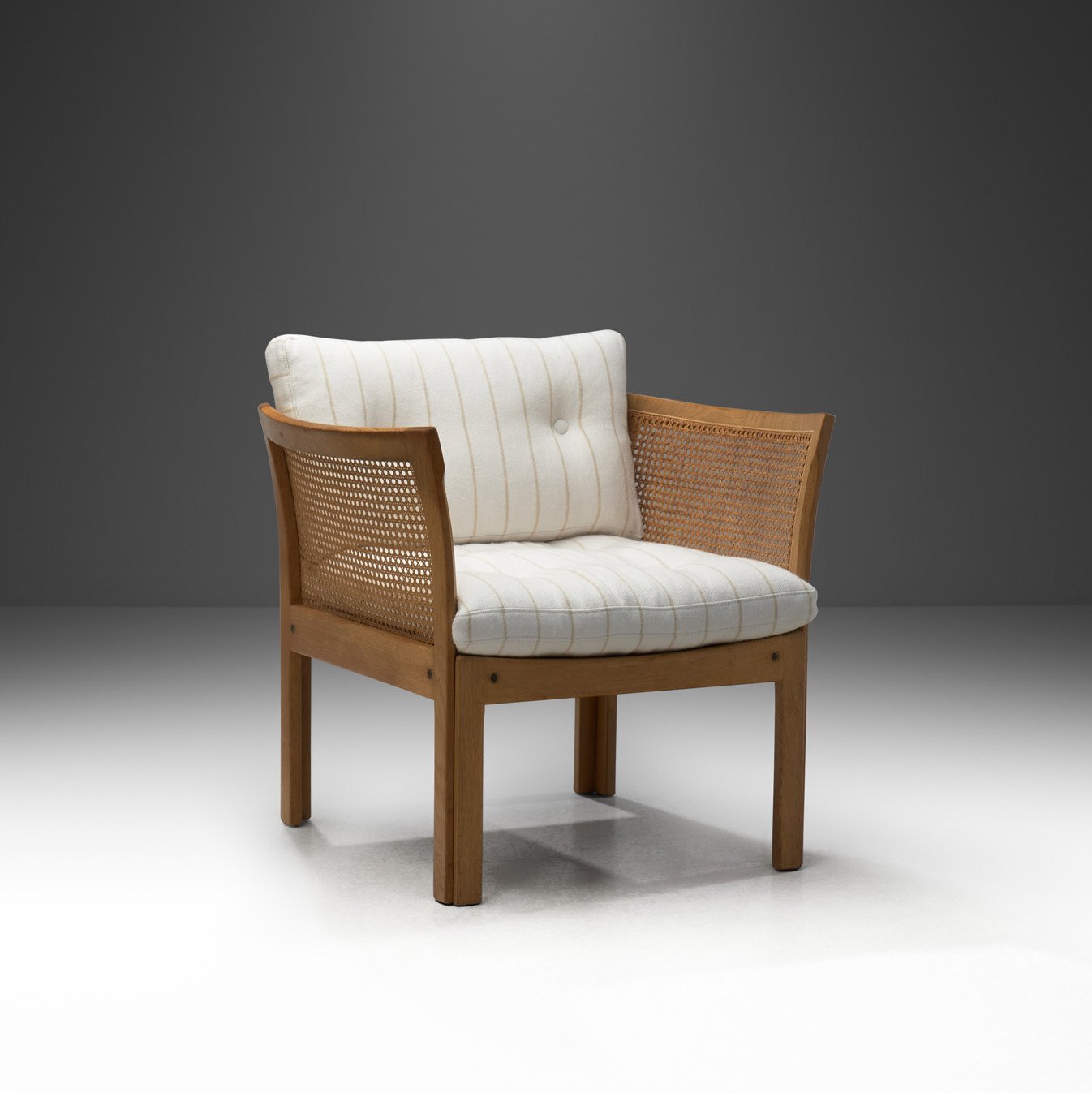
"Model no. 14" Lounge Chair with Footstool by Fredrik Fogh and Edoardo Bregani for Horsnæs, Denmark 1960s


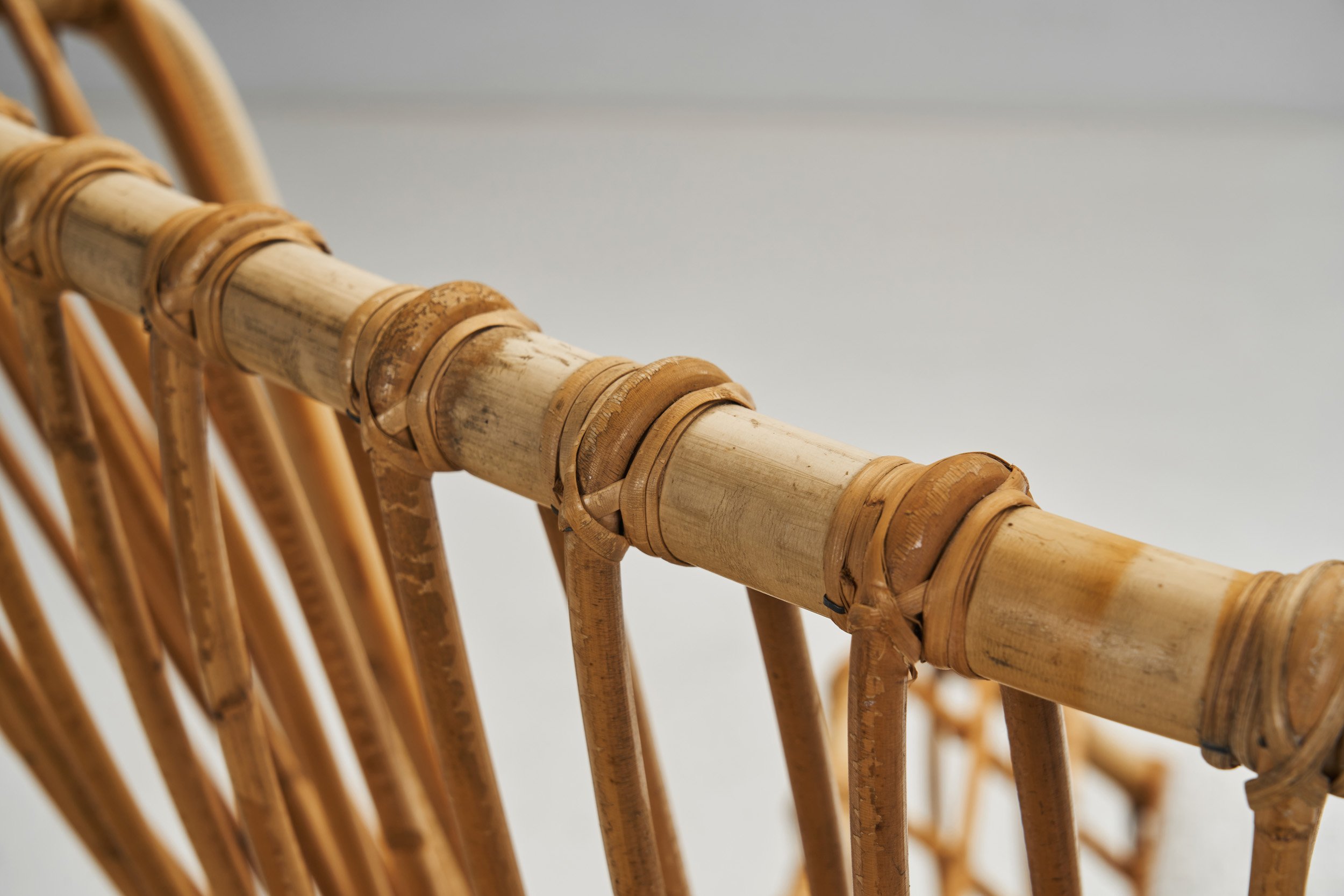


"Model no. 14" Lounge Chair with Footstool by Fredrik Fogh and Edoardo Bregani for Horsnæs, Denmark 1960s
REQUEST PRICE HERE
Price category: 2,500 - 5,000 usd / eur
This beautiful and stylish “Model No. 14” lounge chair and footstool set was designed by Fredrik Fogh and Edoardo Bregani and made by the Danish manufacturer Horsnæs. With a wide range of styles, Horsnæs’ collaboration with Fogh and Bregani is a shining example of their reputation. The collaboration created this significant contribution, often sought after by collectors and design enthusiasts, as a testament to their craftsmanship and innovation.
The lounge chair is designed for ultimate comfort and relaxation. Its high backrest provides excellent support, while the chair's intricate, organic rattan wicker and bamboo frame showcases the attention to detail typical of Fogh and Bregani's work. The natural curves and open framework add a light and airy feel to any space. The broad, flared base of the chair and ottoman not only ensures stability but also adds to their sculptural appeal. The chair's ergonomic design, with its gently sloping seat and supportive back, invites you to relax and unwind. The ottoman perfectly complements the chair, offering visual and physically suitable support.
Crafted by skilled artisans, their rattan items are sought after again for good reason: this tree-climbing vine is surging in demand due to its durability and eco-friendly nature. Retailers and manufacturers became ever more creative with the material in the mid-20th century, crafting exquisite designs in forms and structures that were impossible with wood. The cushion's premium fabric gives a textural, comfortable feeling, and the free-flowing line embraces you at each seating. Smooth forms and delicate lines characterise this model in each detail, turning an everyday object into a piece of functional art through skilled craftsmanship.
Condition:
In vintage condition. Wear consistent with age and use. Varnish on the bamboo frame worn away in several spots. The chair and footstool are upholstered in a premium fabric. Each of our items can be re-upholstered by our in-house atelier in a fabric of choice. Please reach out for more information.
Dimensions:
Chair
32.29 in W x 34.25 in D x 39.57 in H; Seat height 22.44 in
82 cm W x 87 cm D x 100.5 cm H; Seat height 57 cm
Footstool
28.15 in W x 18.31 in D x 19.29 in H
71.5 cm W x 46.5 cm D x 49 cm H
Literature:
Mobilia no. 84, July 1962
REQUEST PRICE HERE
Price category: 2,500 - 5,000 usd / eur
Crafted during a time when movements like Modernism were reshaping design worldwide, this early 20th-century armchair reflect a transitional style rooted in both simplicity and elegance. This era emphasizes clean lines, unique shapes, and high-quality craftsmanship to achieve timeless pieces like this one.
This remarkable armchair was designed by German artist, Willi Ohler. The so-called “Worpsweder” either denote chairs made at the Worpsweder Kunsthütten (Worpsweder arts huts) in Germany, or a specific style of German chairs with solid wood frames, broad armrests, often from tall wood, with woven seats and backs. These piece features all of those characteristics. The honey-toned wood highlights the warm patina that has developed over decades. The softly sculpted armrests framing the chair bring both elegance and ergonomic comfort to the overall form. Woven wicker is the main highlight of the piece. The material is used to construct the seat and tall backrest. The beautifully symmetrical pattern showcases the timeless artistry of artisanal furniture. The rectangular, slim legs create a sleek structure while not abandoning sturdiness. This chair preserves the value and beauty of master craftsmanship and exquisite materials.
Worpswede in Lower Saxony is famous nationwide for its long tradition as an artists' colony. Nowadays, about 130 artists and craftsmen and women live there permanently. The artists who created the so called "Worpsweder Kuentlerkolonie" were looking for the simple and original in art and life. The traditional reed and rush woven chairs of this region were greatly appreciated by the artists of the colony, and some of them were still produced around 1900-1920. They have become collectors’ pieces thanks to the craftsmanship that went into each chair’s creation.
Condition:
In good vintage condition. Wear consistent with age and use. The item has recently been reconditioned. The woven back and seat are slightly worn. Due to the nature of the materials, the chair may have some marks, scratches, and discolouration.
Dimensions:
33.07 in W x 33.66 in D x 38.18 in H; Seat height 16.73 in; Seat depth 19.48 in; Arm height 24.80 in
84 cm W x 85.5 cm D x 97 cm H; Seat height 42.5 cm; Seat depth 49.5 cm; Arm height 63 cm
REQUEST PRICE HERE
Price category: 2,500 - 5,000 usd / eur
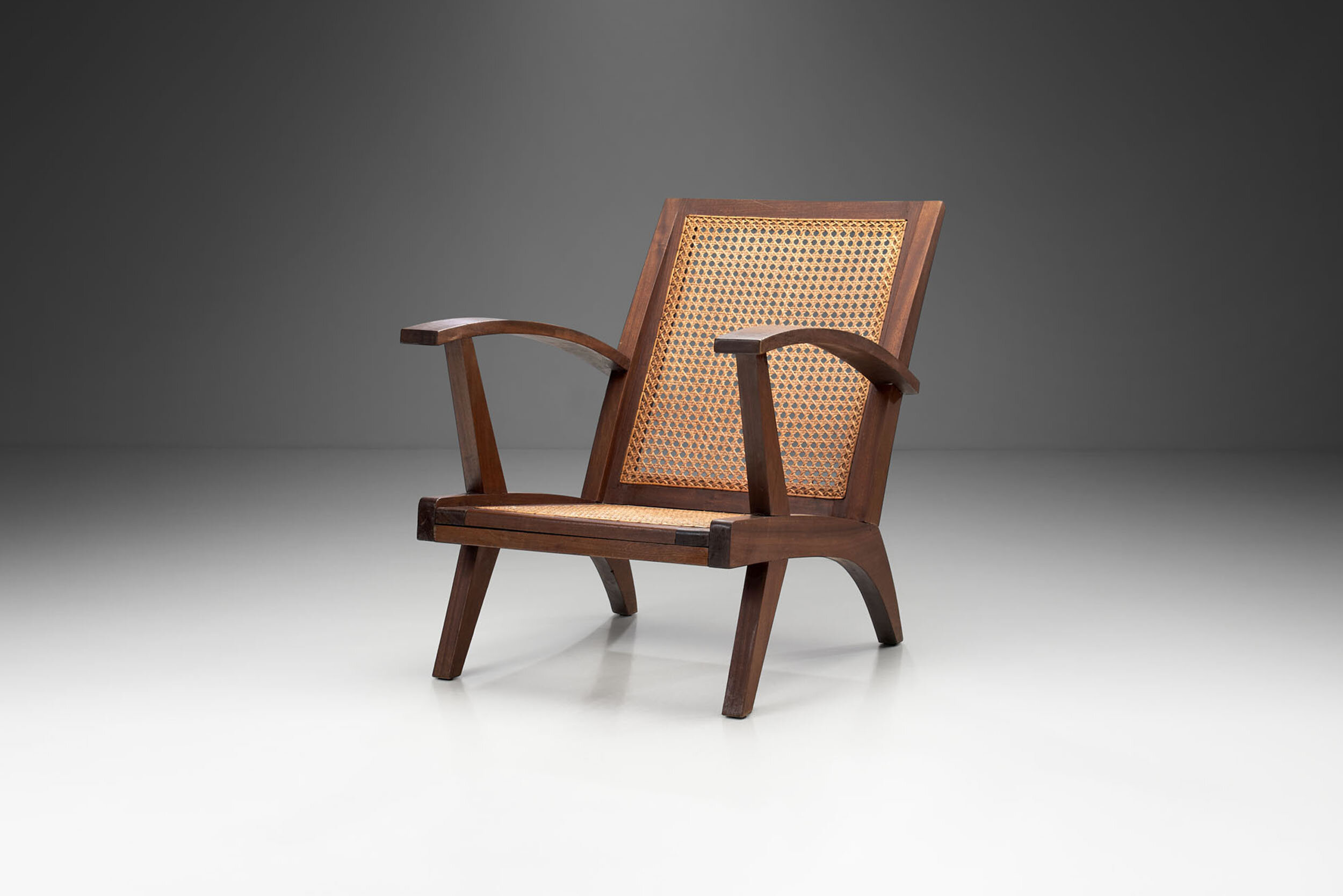
This mid-century French armchair combines a visually stunning structural body with expert caning technique and high-quality materials.
As with the UK and much of Europe, there was something of a design renaissance in France in the 1950s, due to developments in materials and technology after the war. In France, designers were often also architects, whose focus on functionality and quality resulted in sculptural models, such as this armchair. This model is all about the gorgeous teak structure and the cane panels. Pure, sleek forms, free from artifice or decoration characterise the aesthetic; a style that is commonly referred to as reconstructivism. A reconstructivist design builds upon prior, deconstructionist models and techniques, but adapts them to classic themes and structures, with the goal of creating works of genuine emotion and significance. This armchair in particular recalls the chairs of Swiss architect, Pierre Jeanneret’s designs for Chandigarh in India.
The body features octagonal mesh cane webbing, which is an elegant material that enhances quality and complements the teak wood. Cane webbing is strong enough to support the weight of a sitting person and flexible enough to bend around the sharp corners of wooden frames. Production of cane webbing requires a lot of labour, attention and craftsmanship and every production step involves repetitive careful hand selection. The cane panels are original and in great condition, testifying to the outstanding quality of this armchair and the skill of its maker. ~H.
Condition:
In good vintage condition. Wear consistent with age and use. Original cane panels. Some minor scratches and marks on the wood.
Dimensions:
25.59 in W x 32.87 in D x 31.1 in H; Seat height 11.41 in
65 cm W x 83.5 cm D x 79 cm H; Seat height 29 cm
REQUEST PRICE HERE
Price category: 2,500 - 5,000 usd / eur
The "Stora Kraal" easy chair was originally designed by Kerstin Hörlin-Holmquist in 1952, and was quickly incorporated into Nordiska Kompaniet’s famous Triva Collection, a new versatile furniture series aimed at modern, postwar consumers.
Lacquered metal, wicker and leather. This model is defined by its materials and its immediately recognizable design created by the masterful combination of them. Known for her unique and humanistic design vision, Hörlin-Holmquist created the Stora Kraal according to these principles. Accordingly, this model holds a soft simplicity and a uniqueness in its appearance - light, clean lines with organic materials and form. Without worrying about short-lived trends and what other people thought, Hörlin-Holmquist created the peculiar, shell shape of this chair that is only increasing in popularity. The design is very open, the backrest flows down and opens up to form the armrests and wide seat. While the armrests sit low and hardly separate from the back and seat, they still give the impression of hugging the sitter. The woven wicker body is held by the metal structure that is composed in a masterful way, providing stability despite its light, minimal appearance.
Hörlin-Holmquist took a larger role in the development of the Triva Collection to provide Nordiska Kompaniet with a variety of furniture designs and interior fittings that expressed a modern Scandinavian ethos through soft lines and adaptive humanism. This Stora Kraal, thanks to its materials, is the collection’s most organic piece, and to many, the most desired one as well.
Condition:
In good vintage condition. Wear consistent with age and use. New leather straps.
Dimensions:
27.75 in W x 32.67 in D x 39.37 in H; Seat height 15.74 in
70.5 cm W x 83 cm D x 100 cm H; Seat height 40 cm
About the Designer:
Kerstin Hörlin-Holmquist was born on May 30, 1925 in Arvika, Sweden. She was a Swedish modernist architect and designer. Hörlin-Holmquist graduated from Stockholm’s Konstfack in 1952, and before that she studied and worked in England.
She often worked with her husband Erik Holmquist, and together they modelled and created the pieces together. A key aspect for the couple was always to test their designs in their own home before completing a project.
"I think both furniture and textiles, wherever they end up, must be kind, gentle and courteous, but without losing their character. They should have human qualities, not be pompous and only stand alone, but be able to adapt to the environment they end up in..."
Hörlin-Holmquist worked and studied in England from 1946-1947 immediately after the war, where she also studied art history and became fascinated with the classic English upholstered furniture and style. Something that without a doubt inspired her own creations later in life while she still developed her own expression. She returned to Sweden where she attended Konstfack from 1948 and graduated from the school in 1952. She started working with Nordiska Kompaniet shortly after her graduation and became a lead designer. Her timeless and iconic ‘Paradiset Collection’ was created during her employment with Nordiska Kompaniet in 1956-1957 and holds a soft simplicity and a uniqueness in its appearance - light, clean lines and yet gracious with an air of romance.
Today, her designs are highly treasured collectibles. She is primarily remembered, for her ability to create designs for the modern home in the 1950s without worrying about short-lived trends and what other people thought - to stay true to her own unique and humanistic design vision. ~H.
REQUEST PRICE HERE
Price category: 1,000 - 2,500 usd / eur
Danish furniture designer Illum Wikkelsø believed that furniture should be built to last, to indulge the body and to please the eye. He belonged to a group of designers who represented the “Golden Age” of Danish modern design during the mid-20th century era.
In a world increasingly filled with decoration, the Danish modern style chose to focus on designs that were simple yet meaningful. This simplicity wasn’t about lacking elements but about carefully choosing each one to have purpose and function, and this chair exemplifies that. Wikkelsø generally worked with clean lines, but also had a strong sense of organic expression and was deeply inspired by nature – especially the Danish landscape. He aimed to capture the beauty he saw in the environment around him in his furniture designs. In the case of this chair, the frame is crafted from oak, an especially durable hardwood that is extremely multi-faceted with a beautiful grain. Oak became an important material in the Danish mid-century period. Furthermore, the precision of the structure and the woven cane is evident at first glance, showing great geometric order. The cane elements of the frame are woven in a tight, visually pleasing pattern. It is clear this model is entirely based on Wikkelsø’s artisanship, which hails from a generation of cabinetmakers, upholsterers and furniture producers established before the 1950s. This heritage shines through this chair with a creative design that doesn’t compromise on quality. Extremely modest and confident at the same time is how this chair can be best described, showing great craftsmanship skill, and making it a lovely addition to any interior.
The Danish modern movement, rooted in the mid-20th century, was not a fleeting trend but a lasting shift in design philosophy. Its principles, grounded in simplicity, functionality, and a deep appreciation for natural elements, have not only withstood the test of time but have become foundational for many contemporary design approaches.
Condition:
In good vintage condition. Wear consistent with age and use. The chair has been reupholstered recently in a premium fabric. Each of our items can be re-upholstered by our in-house atelier in a fabric of choice. Please reach out for more information.
Dimensions:
29.13 in W x 26.38 in D x 29.13 in H; Seat height 17.32 in; Seat depth 18.11 in; Arm height 25.20 in
74 cm W x 67 cm D x 74 cm H; Seat height 44 cm; Seat depth 46 cm; Arm height 64 cm
REQUEST PRICE HERE
Price category: 2,500 - 5,000 usd / eur
Early 20th century designers were eager to break free from the aesthetics of the past and experiment with new forms and techniques. At the same time, especially in Europe, the modernist design movement was often based on traditional styles and approaches, such as wood turning. This armchair exudes vintage charm and craftsmanship, blending intricate design with timeless elegance.
This chair model boasts a functional, well-thought-out structure, crafted from quality oak. The openness of the piece is highlighted by its horizontal slats, from the stretchers placed between the feet to the the backrest. Still, at the heart of this chair lays its materials; the durable oak and the traditional woven wicker. The wicker seat, a hallmark of practicality and comfort, adds a layer of tactile warmth to this chair. The intertwining fibres create a resilient and breathable surface that showcases the diagonal cross pattern commonly referred to as “rush weave” or wicker. Additionally, the textured surface of the woven rush contrasts nicely with the wood. The attention to craftsmanship is further evidenced by the lower structure, featuring two bobbin turned legs. This is a type of ornament which consists of a series of small knobs resembling spools, or bobbins. The detailed wood carving creates a sophisticated, almost sculptural quality, giving the chair a unique sense of texture and depth.
With its organic feel and natural elements, this chair stands out with its timeless appeal. The piece’s simple yet refined structure allows them to integrate into various interior styles, from vintage-inspired rooms to more contemporary settings where they add a touch of old-world charm.
Condition:
In good vintage condition. Wear consistent with age and use. Some minor marks and scratches on the wood.
Dimensions:
24.21 in W x 21.65 in D x 34.05 in H; Seat height 18.89 in; Seat depth 17.12 in; Arm height 27.55 in
61.5 cm W x 55 cm D x 86.5 cm H; Seat height 48 cm; Seat depth 43.5 cm; Arm height 70 cm
REQUEST PRICE HERE
Price category: 2,500 - 5,000 usd / eur
This mid-century French armchair combines a visually stunning structural body with expert caning technique and high-quality materials. From all sides, this chair’s angles are visually arresting, revoking the chairs created by the Swiss architect, Pierre Jeanneret for Chandigarh in India.
As with the UK and much of Europe, there was something of a design renaissance in France in the 1950s, due to developments in materials and technology after the war. In France, designers were often also architects, whose focus on functionality and quality resulted in sculptural models, such as this armchair. This model is all about the gorgeous teak structure and the cane panels. Pure, sleek forms, free from artifice or decoration characterise the aesthetic; a style that is commonly referred to as reconstructivism. A reconstructivist design builds upon prior, deconstructionist models and techniques, but adapts them to classic themes and structures, with the goal of creating works of genuine emotion and significance.
The body features octagonal mesh cane webbing, which is an elegant material that enhances quality and complements the teak wood. Cane webbing is strong enough to support the weight of a sitting person and flexible enough to bend around the sharp corners of wooden frames. Production of cane webbing requires a lot of labour, attention and craftsmanship and every production step involves repetitive careful hand selection. The cane panels are original and in great condition, testifying to the outstanding quality of this armchair and the skill of its maker.
Condition:
In good vintage condition. Wear consistent with age and use. Original cane panels. The wood has beautiful patina.
Dimensions:
25.59 in W x 34.64 in D x 31.88 in H; Seat height 11.81 in
65 cm w x 88 cm D x 81 cm H; Seat height 30 cm
REQUEST PRICE HERE
Price category: 2,500 - 5,000 usd / eur
In mid-century Danish design, timeless elegance and craftsmanship dominated the era, combined with the use of organic materials such as wood and papercord. Crafted from the warm brown hues of wood, this armchair showcases the inherent beauty, versatility, and timeless charm of handmade furniture defined by highly skilled craftsmanship.
Wood’s natural lustre and ability to develop a beautiful patina over time make it an ideal material for crafting enduring and appealing pieces. This armchair boasts gracefully curved armrests and linear back slats, showcasing the artisan's keen attention to form and detail. The curved arms not only provide a comfortable resting surface, but also contribute to the overall aesthetic appeal of the chair. The backrest, with its gentle curve, adds a touch of individual character and refinement to the design. Each element of the chair reflects the organic sensibility that defined Danish mid-century cabinetmakers’ designs, where form and function seamlessly converged. However, what truly injects these chairs with their organic appeal is their seats woven from papercord. This choice of material adds an organic and tactile dimension to the design. Papercord, made from twisted and woven paper fibres, offers a natural and eco-friendly alternative to traditional seating materials. Its rich texture and earthy tones complement the warmth of the wood, creating a harmonious balance in both visual and tactile aspects. The meticulous craftsmanship of the joinery further enhances the chairs' allure; impeccably constructed with no visible screws, the seamless connections speak volumes about the artisan's dedication to precision and quality. The absence of visible hardware not only contributes to the chair’s aesthetic purity, but also underscores the skilled craftsmanship that went into its creation.
This Danish wooden armchair embodies the essence of mid-century design, where natural materials, graceful forms, and meticulous craftsmanship come together. The marriage of wood and woven papercord not only highlights the organic side of this design but also ensures that the chair remains not just functional, but also an enduring heirloom piece.
Condition:
In good vintage condition. Wear consistent with age and use.
Dimensions:
22.05 in W x 22.44 in D x 32.09 in H; Seat height 18.11 in; Seat depth 17.52 in; Arm height 25.79 in
56 cm W x 57 cm D x 81.5 cm H; Seat height 46 cm; Seat depth 44.5 cm; Arm height 65.5 cm
REQUEST PRICE HERE
Price category: 2,500 - 5,000 usd / eur
In 1944, Niels Otto Møller founded J.L. Møllers Møbelfabrik in Denmark, a company that has received many awards, including the Danish Furniture Prize in 1974 and 1981. Møller is an important representative of Danish postwar design and had always been committed to excellence and the use of the finest materials.
Clean, simple designs and the quality of materials and workmanship are why Nordic design is timeless. This “model 67” chair is an appealing example of the above statement. The organically moulded solid wood frame and the woven straw seat make this model a classic. Noteworthy for its beautiful pattern, rush weaving is beloved for its functional and aesthetic qualities. The woven seat of this chair has a tight, visually pleasing pattern in great condition. The frame has exciting curves, especially visible in the front arm supports and armrests that visually complement the frame’s curves as well. The two materials pair very well, the smoothness of the wood highlights the texture of the straw’s fibre.
When Niels Otto Møller designed a chair, he would find the materials and then design the furniture. It is said that each design took him five years to complete. This work ethic - exemplified by this “model 67” chair - is why the Møller collection is relatively small for a company that’s been around for more than 70 years, but that’s what makes Møller so special.
Condition:
In good vintage condition. Wear consistent with age and use. The seat has some marks and scratches and beautiful patina.
Dimensions:
22.44 in W x 20.47 in D x 31.1 in H; Seat height 18.11 in
57 cm W x 52 cm D x 79 cm H; Seat height 46 cm
About the designer:
Niels O. Møller (1920 - 1982) is an important representative of Danish postwar design and had always been committed to excellence and the use of the finest materials.
In 1939, he finished his apprenticeship as a cabinetmaker and continued his studies at the Århus School of Design. In 1944, he founded his own furniture factory, J. L. Møllers Mobelfabrik and became an independent designer and producer. Along with the production of classical tradition furniture, Niels Møller worked for two years in a small workshop of the factory to design his first chair: N° 1. From there on, the company produced all models of Niels O. Møller. Over the years J.L. Møllers Mobelfabrik grew and began to export to Germany, the US and Japan.
In 1981, the company was awarded with a "Dansk MøbelIndustri Furniture Prize" with a special mention for its ability to combine quality craftsmanship and modern production. Niels O. Møller remained famous for his elegant teak and rosewood furniture as the iconic series 78, a model of lightness and purity. It is a reference in Scandinavian design. Today, J.L. Møllers remains family property and continues to produce all models of Niels O. Møller.
REQUEST PRICE HERE
Price category: 2,500 - 5,000 usd / eur
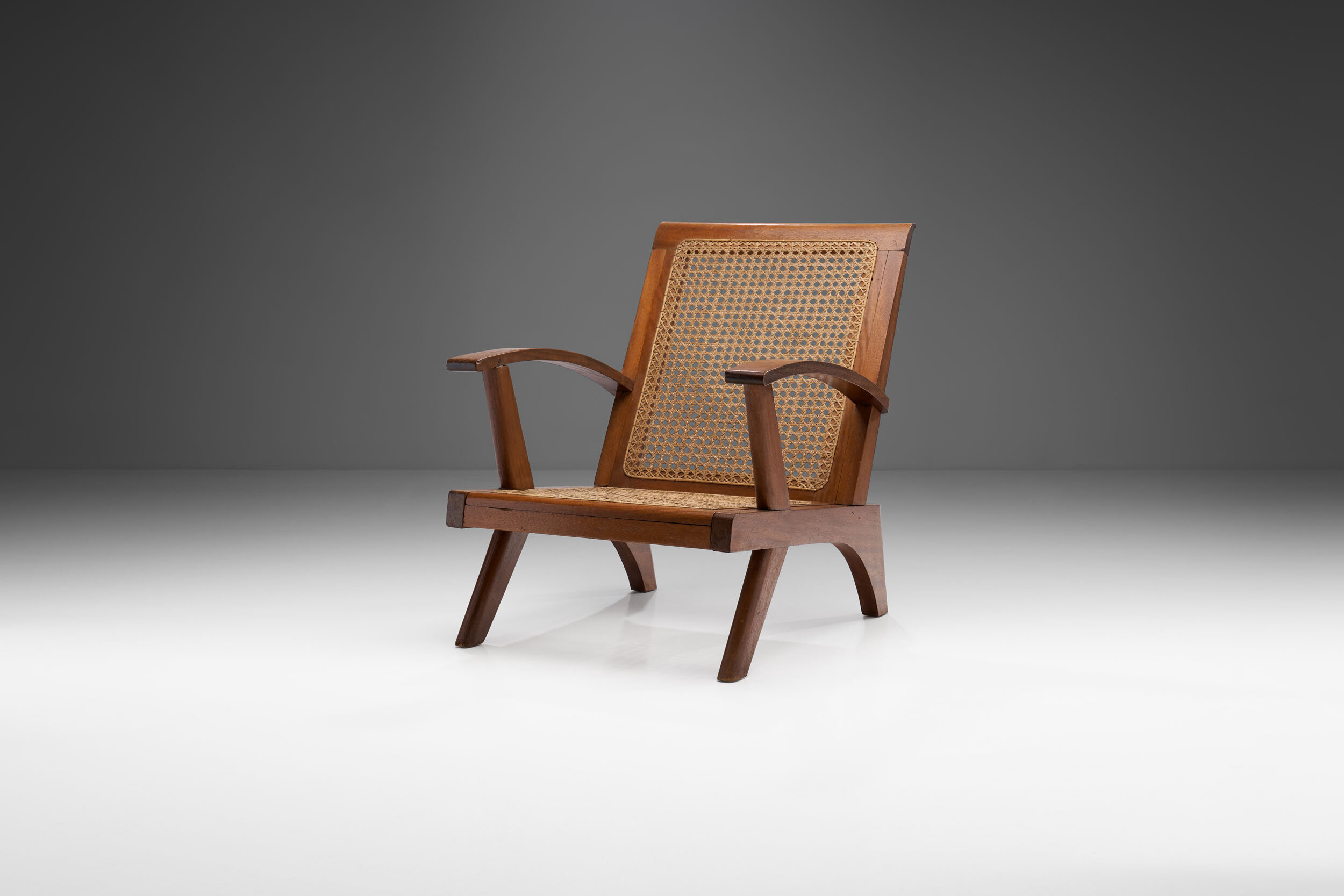
This smoking chair reveals how European designers approached everyday furniture with an appreciation for both craft and nature. This piece combines classic elements with a more modern, organic design. Using natural materials and traditional techniques, the resulting aesthetic is beautifully eye-catching.
The use of wood and wicker to craft this chair belongs to a tradition that valued honest workmanship and the tactile richness of natural materials - this material choice allowed for the creation of objects that feel grounded, inviting, and timeless. The richly toned wood highlights the warm patina that has developed over decades. The softly sculpted armrests framing the chair bring both elegance and ergonomic comfort to the overall form. The backrest is adjustable, thus allowing for optimal lounging. Woven wicker is the main highlight of the piece. The material is used to construct the seat and tall backrest. The beautifully symmetrical pattern showcases the timeless artistry of artisanal furniture. The rectangular, slim legs create a sleek structure while not abandoning sturdiness. This chair preserves the value and beauty of master craftsmanship and exquisite materials.
This chair brings atmosphere to a space, rather than just ornament, offering warmth through material and form. Whether placed in a rustic setting or paired with more contemporary pieces, it holds its own with quiet confidence. The beauty lies not in novelty but in the enduring clarity of thoughtful making, which is why chairs like this continue to resonate so strongly today.
Condition:
In good vintage condition. Wear consistent with age and use. The chair has recently been reconditioned. Due to the nature of the materials, the item may have some marks, scratches, and discolouration.
Dimensions:
25.78 in W x 33.85 in D x 33.85 in H; Seat Height 13.77 in; Seat depth 23.62 in; Arm height 22.24 in
65.5 cm W x 86 cm D x 86 cm H; Seat Height 35 cm; Seat depth 60 cm; Arm height 56.5 cm