
Peter Hvidt and Orla Mølgaard-Nielsen Armchair "Model 1748" for Fritz Hansen, Denmark 1940s


Peter Hvidt and Orla Mølgaard-Nielsen Armchair "Model 1748" for Fritz Hansen, Denmark 1940s
REQUEST PRICE HERE
Price category: 2,500 - 5,000 usd / eur
Peter Hvidt and Orla Mølgaard-Nielsen’s design language operates as a set of relations linking the everyday world - composed of objects, spaces, people - to the cultural ideologies that motivate the persistence of a social democratically infused “way of life.” The design duo’s company was a pioneering force in Danish furniture design thanks to this sentiment.
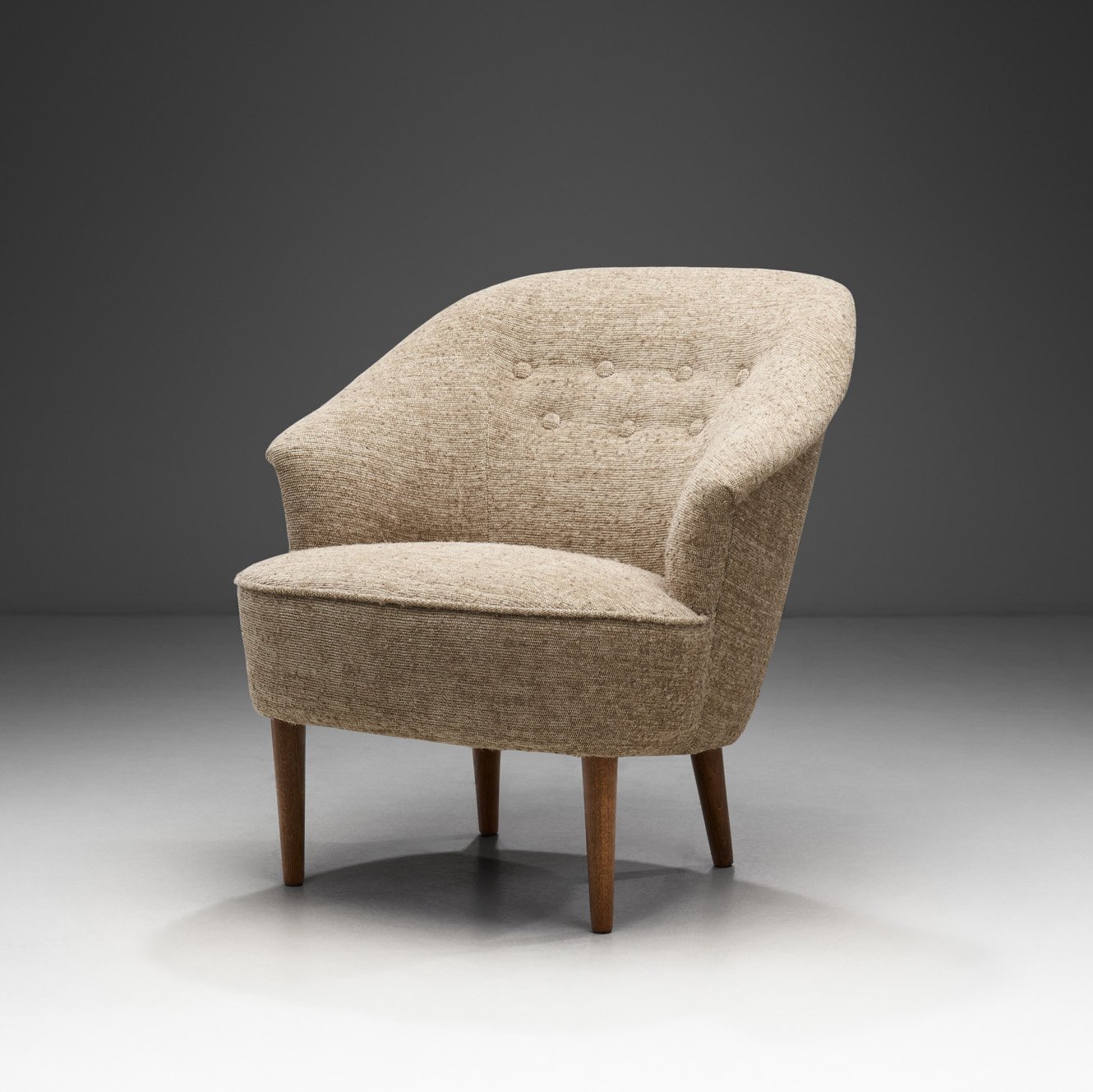
While the duo solidified their careers with industrial production, more specifically the “AX chair” in the 1950s, this earlier model is perhaps even more stunning in many aspects. “Model 1748” is their most well-known fully upholstered chair, with a design that builds on the traditions of Danish cabinetmaking. The subtle decorative qualities and the simple lines deriving from the early 20th century design movements give this chair its elegance. This armchair shows the homely curviness that defined the design of the mid-century throughout Scandinavia. The back is lightly bent for ergonomic comfort, and have stylish button tufting. The tapered, stained beech legs complement both the shape of the armchair, and the bouclé upholstery.
Quality craftsmanship was of optimum importance for Hvidt and Mølgaard-Nielsen, therefore they collaborated with the best cabinetmakers of the era. This chair was manufactured by Fritz Hansen, Denmark’s most famous company of the time. Founded in Denmark in 1872, and proceeded to manufacture many of the classic icons of Danish Design in the following decades. With a classic look, storied design and solid quality, these chairs are truly soulful and timeless.
Condition:
In good vintage condition. Wear consistent with age and use. The chair has been reupholstered recently in a premium bouclé fabric. Each of our items can be re-upholstered by our in-house atelier in a fabric of choice. Please reach out for more information.
Dimensions:
27.55 in W x 31.88 in D x 33.07 in H; Seat height 16.53 in
70 cm W x 81 cm D x 84 cm H; Seat height 42 cm
About the designer:
Hvidt & Mølgaard was a Copenhagen-based, Danish design and architectural firm which existed from 1944 until 2009. Founded by Peter Hvidt (1916-1986) and Orla Mølgaard-Nielsen (1907-1993), the company was a pioneering force in Danish furniture design and industrialized production in the 1950s, creating furniture that was easy to mass-produce and economic to transport.
Danish architect-designer Orla Mølgaard-Nielsen was born in 1907. His formative years were spent in Copenhagen, studying at the Aalborg Technical School and at the Art and Crafts School of the Design Museum (graduating in 1928). From 1931 until 1934, he continued his studies in furniture design at the Royal Danish Academy of Fine Arts under the instruction of Danish master Kaare Klint (1888-1954). Peter Hvidt was born in Copenhagen in 1916. He studied architecture and cabinetry at the School of Arts and Crafts in Copenhagen. Subsequently, he worked at various design firms before establishing his own studio in 1942.
In 1944, Hvidt designed the Portex Chair, which was one of Denmark’s first stacking chairs. Hvidt, whose design aesthetic was characterized as traditional throughout the 1940s, exhibited frequently at the Cabinetmaker's Guild exhibitions, as both a designer and architect.
In 1944, the pair co-established Hvidt & Mølgaard Studio, which they ran together until 1975. During this time, the pair created designs for Fritz Hansen, France & Søn, and Søborg Møbelfabrik. In 1950, the pair designed the AX Chair, which solidified both of their careers as industrial designers and became an icon of Danish mid-century design. It was the first Danish chair that was crafted with both a seat and back made of curved laminated wood.
From the 1970s, Hvidt & Mølgaard focused on architectural projects, which spanned office buildings and factories, as well as collective housing projects. They were known for their light, simple, and clear designs, which were carried out with precision. Both Hvidt and Mølgaard-Nielsen retired in 1975, designing over 256 pieces of furniture together over the course of their careers. Their work can be found at New York’s MoMA, the National Gallery in Melbourne, and the Danish Museum of Art & Design in Copenhagen. ~H.


REQUEST PRICE HERE
Price category: 5,000 - 7,500 usd/eur
Carl Malmsten’s life's work spans nearly sixty intense years and his legacy is considered a national treasure in Sweden. He created a number of furniture classics including this rare “Elder man” armchair.
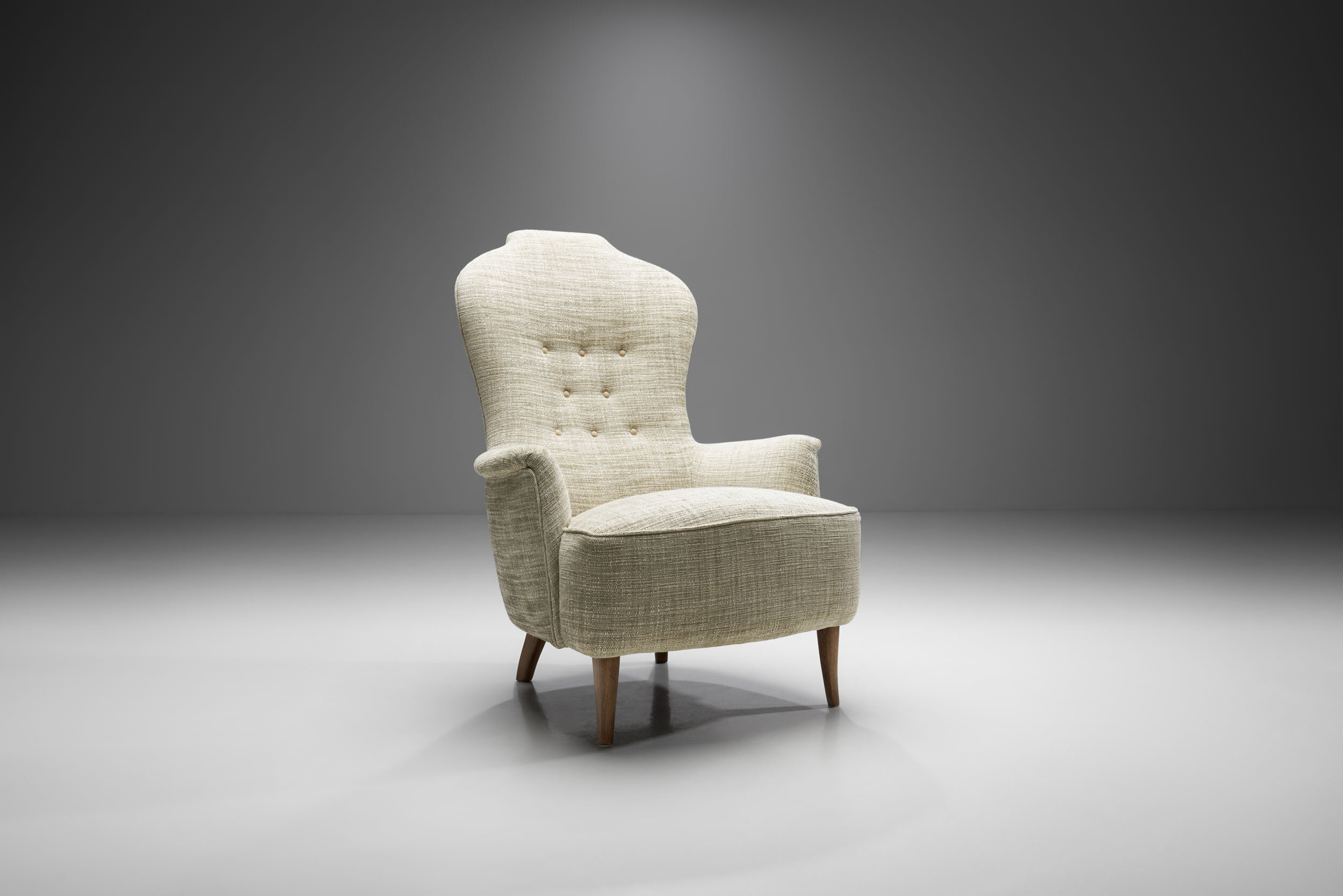
His entire work is characterized by a close-to-nature philosophy which is deeply rooted in Swedish nature and commoner culture. A deeper knowledge of Carl Malmsten as a person means that his furniture can be seen not only as utilitarian objects, but also as artistic works with the ability to express a feeling or mood. This winged armchair carries with it that certain “Malmstenesque” that is characterized by gentle curves, a cosy appearance and of course, the highest quality craftsmanship. This is especially visible in the flowing armrests that descend from the top, curling outwards to create a welcoming look. The slightly bent backrest is tufted with dark brown leather stitches that contrast with the light bouclé upholstery both in colour and texture to create a stylish, visually interesting look. As it can be expected from the “Master of Wood”, the frame is expertly designed, with ergonomic and aesthetic principles at its core. To complete the mid-century look, the structure is supported by tapered, solid wood legs that add an organic touch to the design.
In the 50s, Carl Malmsten’s furniture were produced in small series in smaller workshops, which meant that the furniture became very expensive and thus inaccessible to most people. He then decided to select a number of producers who could produce his furniture in larger volumes without sacrificing quality, beauty, and practicality. In Tranås he came into contact with O.H. Sjögren which he considered fulfilled all the high demands he placed on the production of upholstered furniture.
Condition:
In good vintage condition. Wear consistent with age and use. The chair has been reupholstered recently in a premium bouclé fabric. Each of our items can be re-upholstered by our in-house atelier in a fabric of choice. Please reach out for more information.
Dimensions:
28.74 in W x 34.65 in D x 41.34 in H; Seat height 16.14 in; Arm height 21.65 in
73 cm W x 88 cm D x 105 cm H; Seat height 41 cm; Arm height 55 cm
About the Designer:
Carl Malmsten (December 7, 1888 – August 13, 1972) was a Swedish furniture designer, architect, and educator. Malmsten was born in Stockholm, Sweden. Malmsten's career took off when he won a competition in 1916 to design furniture for the Stockholm City Hall and shortly after in 1917, he exhibited alongside well-known Swedish architects such as Gunnar Asplund and Uno Åhrén.
In the 1920s he was invited to furnish a room for the crown prince, Gustaf VI Adolf, and his wife Louise in Ulriksdal Palace. He was honoured with an inaugural Prince Eugen Medal for design in 1945. Already as a young designer in the early 20th century, Carl Malmsten advocated an artisanal furniture design based on local ingredients and traditions, available to a wide audience at a reasonable price.
Nature was Carl Malmsten's foremost teacher and source of inspiration. He conveyed his love of craftsmanship as a teacher in his own schools, at Olofskolan in Stockholm, Capellagården on Öland and the Carl Malmsten school on Lidingö, today a branch of Linköping University and one of the country's leading design colleges. As a debater, Malmsten stormed against functionalism, but in retrospect it can be seen that his ideas often coincided with the rational and frugal style ideals of function.
Malmsten has had a lasting influence on Swedish furniture design through the two schools he founded—the Carl Malmsten Furniture Studies (Carl Malmstensskolan), which has been a part of Linköping University since 2000, is situated on the island of Lidingö on the outskirts of Stockholm. Carl Malmsten spoke about the importance of tradition, craftsmanship, and the nation. His furniture was in many ways a product of the thoughts and ideals of the time, they have a timeless quality that makes them just as relevant and loved today. ~H.