
Brazilian Wood Three-Seater Sofa by Rino Levi, Brazil 1950s









Brazilian Wood Three-Seater Sofa by Rino Levi, Brazil 1950s
REQUEST PRICE HERE
Price category: 9,000 - 12,500 usd / eur
Rino Levi was one of the pioneers of the modern movement in Brazil, advocating for simple, practical and economical design, disparaging the imitation of classicism. ‘Classical spirit’ rather than classical forms was his ideal.
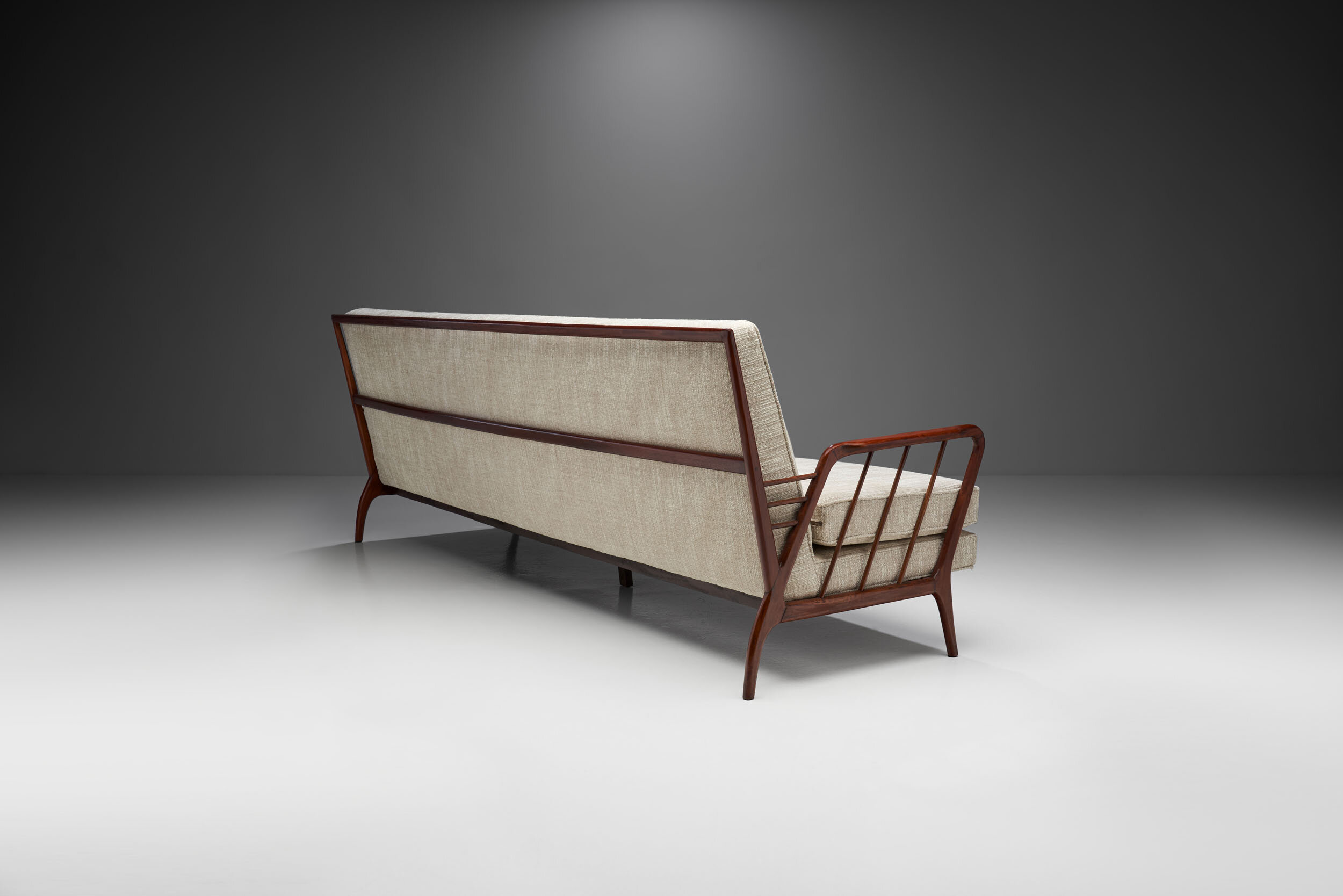
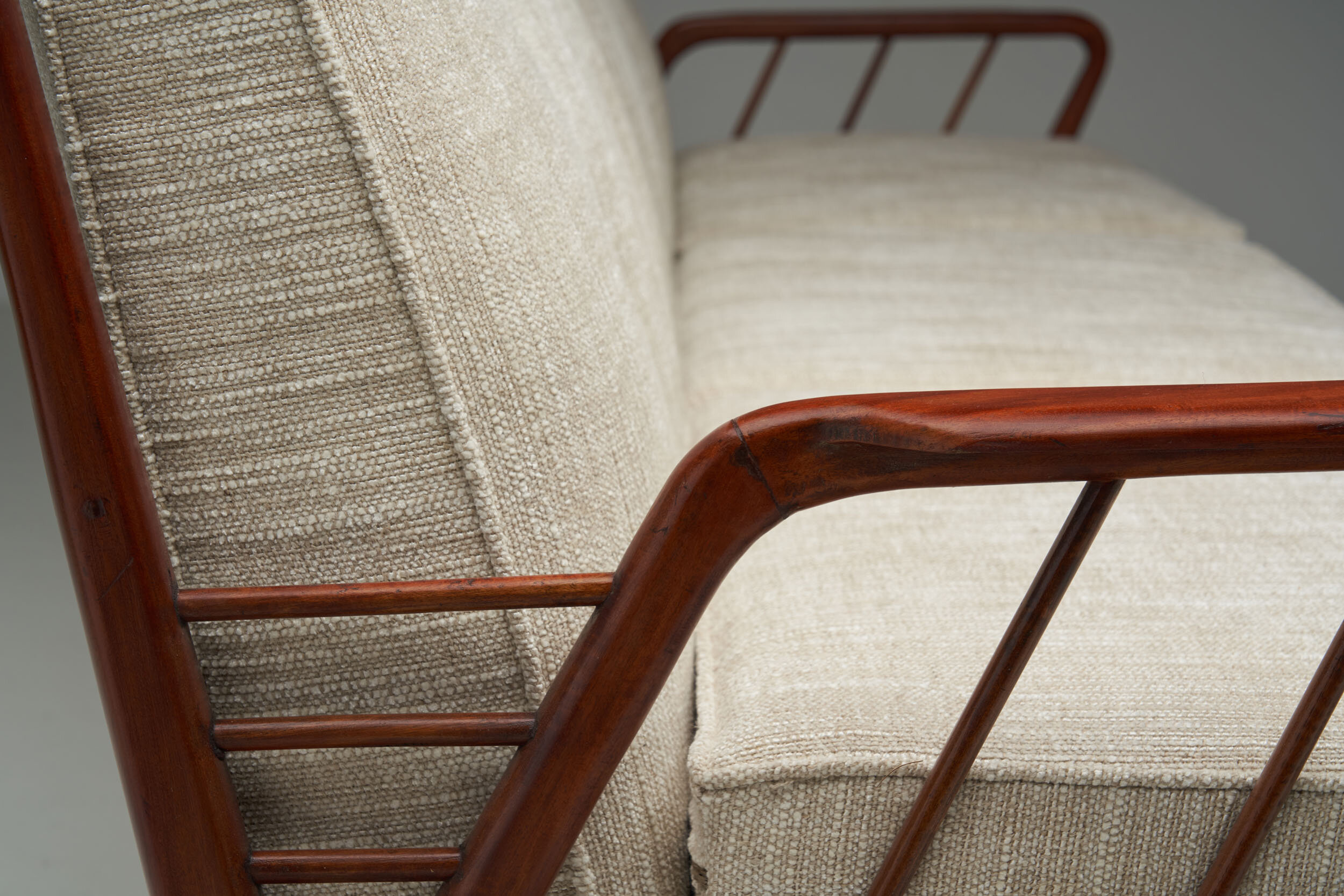
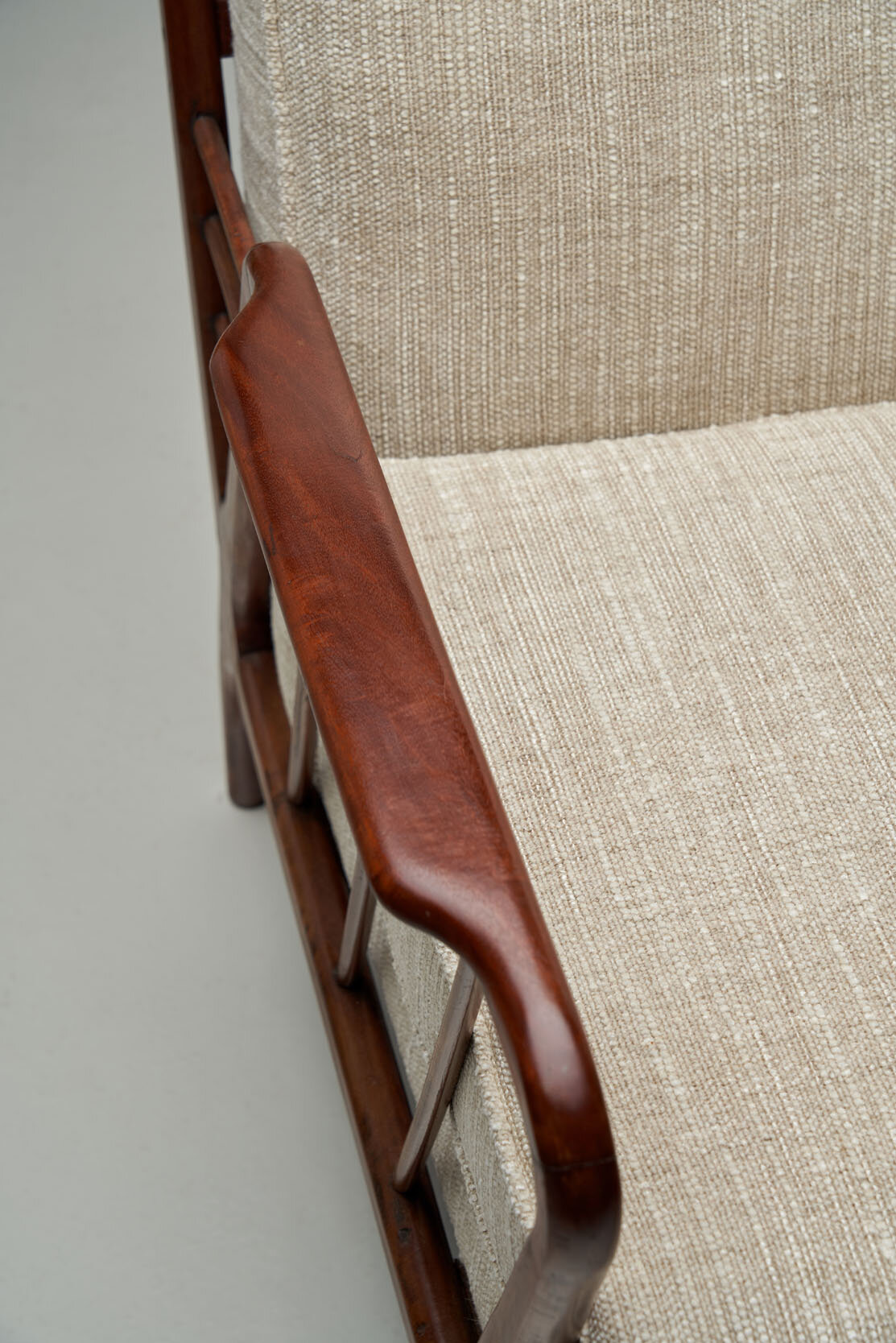
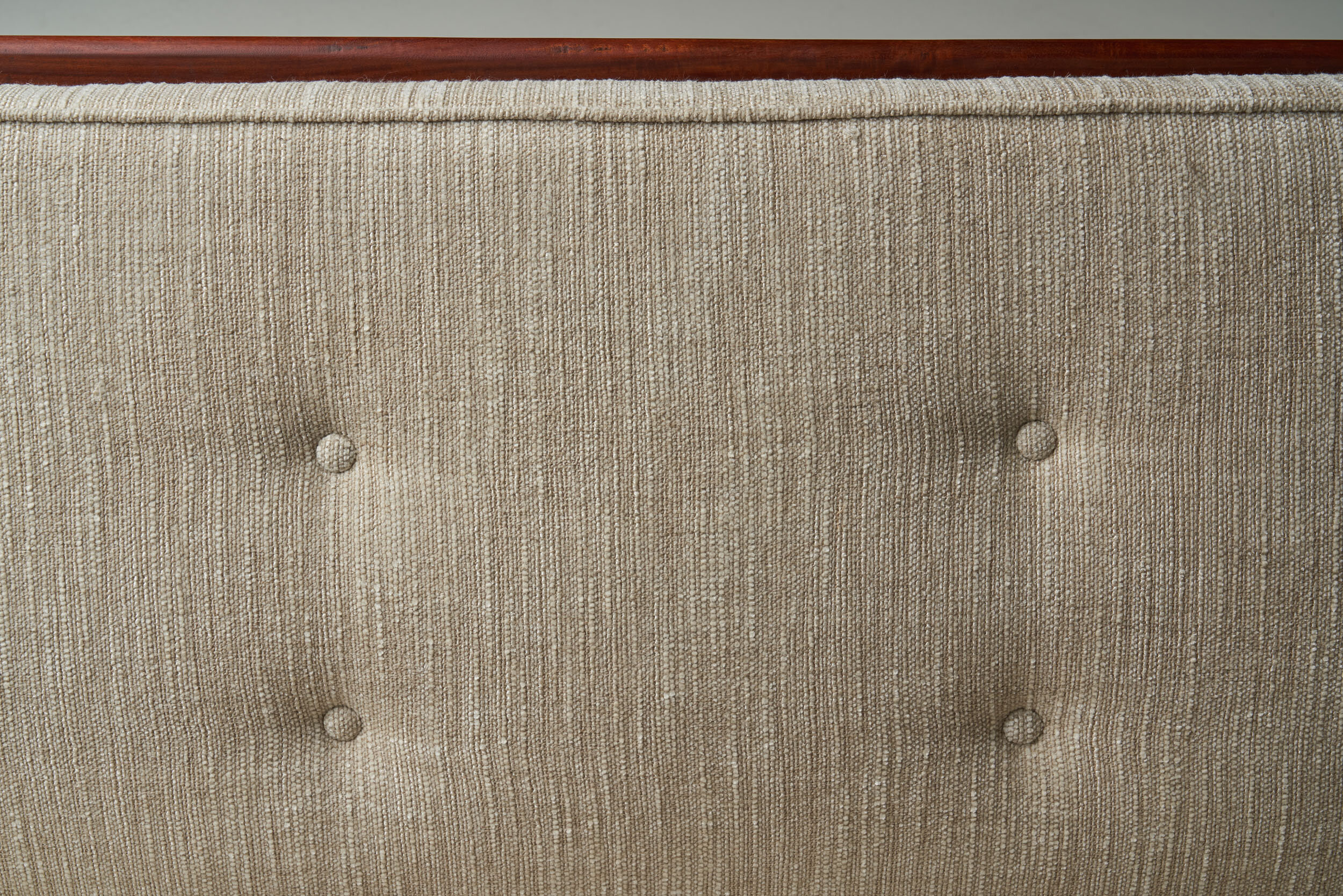
Levi was instrumental in spreading the fame of Brazilian modernism through his furniture designs as well. As this beautiful Brazilian wood sofa shows, by the 1960s, Levi abandoned Italian rationalism in favour of an approach closer to that of the Rio modernists both in his architectural and furniture designs. As a piece of true Brazilian mid-century design, the beauty of the wood and organic shapes and lines dominate this three-seater sofa. The tilted, architectural lines of wood making up the armrests create a visually distinct and exciting appearance. The additional horizontal lines connecting to the backrest are a creative addition, while also supporting the overall stability. The frame with its joinery praises Rino Levi’s craftsmanship and architectural expertise. The beautiful colour of the wood is highlighted by the light upholstery of the body in a premium bouclé fabric, including the three removable cushions.
This sofa model is rare to find, for as during Brazil's military dictatorship, it was against the law to export furniture. The ban on exports only ended in the 1980s, but it still took some time for things to change, not to mention that handmade pieces were created in limited editions. Therefore, it is no exaggeration to say that this sofa is special, and a real rarity.
Condition:
In good vintage condition. Wear consistent with age and use. Some scratches and marks on the wood. The sofa has been reupholstered recently in a premium bouclé fabric. Each of our items can be re-upholstered by our in-house atelier in a fabric of choice. Please reach out for more information.
Dimensions:
86.41 in W x 28.74 in D x 30.31 in H; Seat height 16.14 in
219.5 cm W x 73 cm D x 77 cm H; Seat height 41 cm
About the Designer:
Rino Levi was a Brazilian architect important to the development of modernism in Brazil. Levi was born to Italian Jewish parents on December 31, 1901 in São Paulo, Brazil. After graduating from Colégio Dante Alighieri in São Paulo, Levi studied in Milan and Rome under Marcello Piacentini.
In 1924, he moved to the School of Architecture of Rome. There, he met Adalberto Libera (1903 - 1963) and Marcello Piacentini (1881 - 1960) in whose office he did practice. In 1925, he published in O Estado de S. Paulo. He returned to Brazil in 1926 and worked for a year in the Santos Construction Company.
Following his return to São Paulo, Levi established the firm Rino Levi Arquitetos Associados. Levi was known for an architectural practice particularly dissociated from the construction process for his era. In the early 1930s, Levi designed a number of modernist houses in São Paulo for Italian clients. Towards the end of the decade, Levi's practice shifted to the design on theaters including the Cine Ufa Palace and Teatro Cultura Artistic.
His first major work was the Columbus Building at Avenida Brigadeiro Luís Antônio (first apartement complex in the metropolis, demolished in 1971 ), the Cine Ufa Palace in St. John Avenue, the Medici residence in Santo Amaro and Sarti Building in Republic Square. These rationalist buildings have simple volumes, with evident structure. The project Cine Ufa Palace (1936) was a role model for other cinemas projects: Cine Universe (1936), Cine Art-Palace Recife (1937), the Cine Ipiranga (1943) and the Theatre Culture Arts (1942).
Rino Levi participated in the formation and construction of the Institute of Architects of Brazil and was an active member until his death. He is remembered today as a key figure in introducing modernism to Brazil. ~H.
REQUEST PRICE HERE
Price category: 7,500 - 10,000 usd / eur
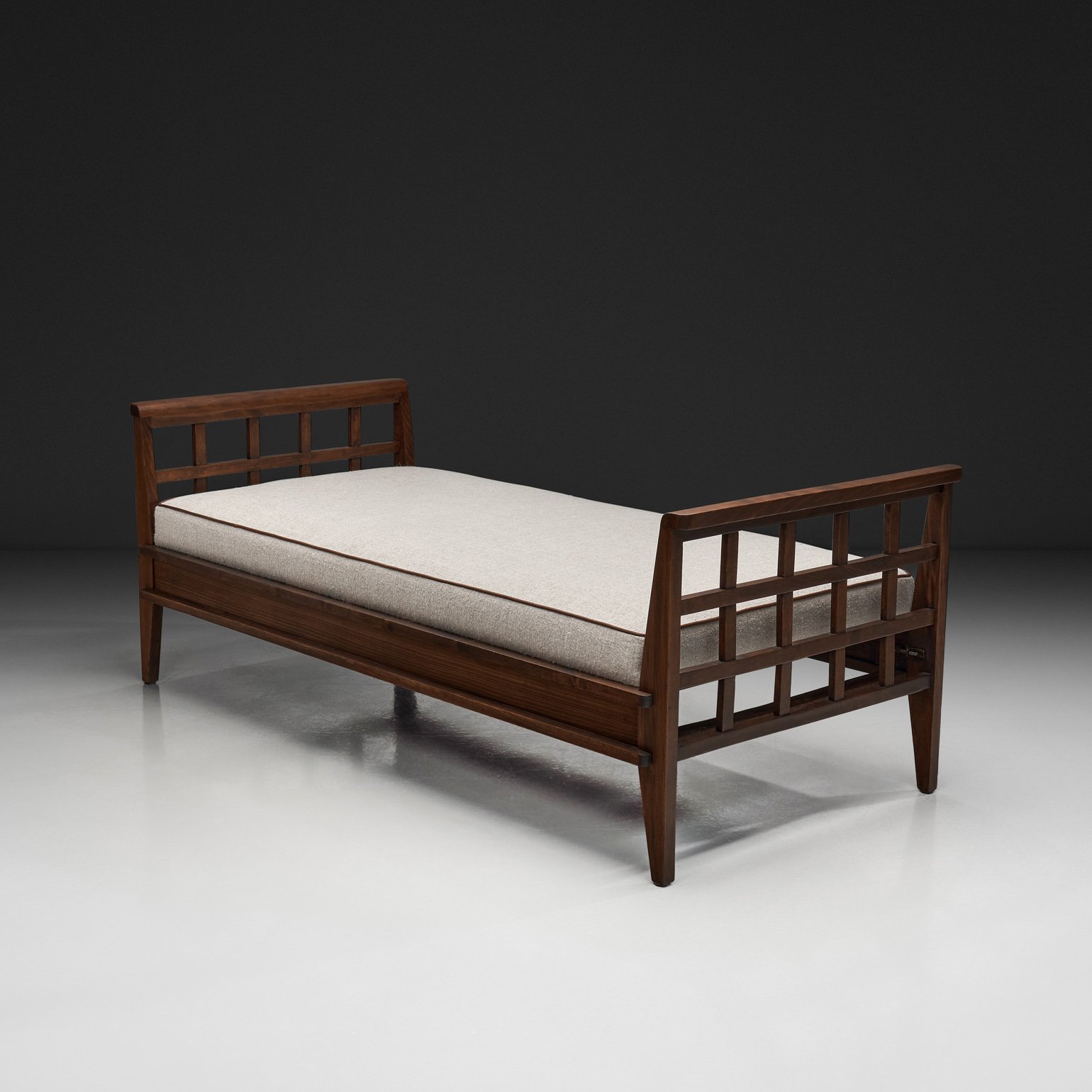
Born in 1890 in France, René Gabriel was one of the leading figures of the modernist movement in Paris. From 1923 to 1950, he presented a body of work, offering an innovative vision on the way people would live in the new century. He became widely recognised for developing practical, well-made furniture intended for the reconstruction period following the Second World War. Appointed president of the Société des Artistes Décorateurs (SAD) at the Liberation, he steered French decoration towards more economical productions, with sharp lines, efficient joinery, and a preference for the authenticity of local woods over imported species.
The daybed features a dark-stained wooden frame with clean, crisp lines that bring structure to its gentle form. Since the aesthetic is dominated by straight lines, the luxurious upholstery stays in focus, utilising the fabric’s softness to break the straight lines visually. Paired with the dark wood structure, the result is elegant and timeless, an aesthetic that can easily complement any style. In the absence of any other form of ornamentation, the materials stay in focus. The marriage of the wood and the fabric encapsulates the essence of modern French design. Every element appears carefully proportioned, with the silhouette remaining minimal yet bold and charming. Overall, this piece allows the craftsmanship and material quality to speak without unnecessary ornamentation.
Combining French craftsmanship, functional innovation, and a warm natural presence, it stands as a strong testament of French design from the 20th century that remains relevant and appreciated today.
Condition:
In vintage condition. Wear consistent with age and use. The daybed has recently been reconditioned. Due to the nature and age of the materials, the item may have some marks, scratches, and discolouration. The daybed has recently been reupholstered in premium fabric. Each of our items can be reupholstered by our in-house atelier in a fabric of choice. Please reach out for more information.
Dimensions:
70.86 in W x 32.67 in D x 26.37 in H
180 cm W x 83 cm D x 67 cm H
REQUEST PRICE HERE
Price category: 5,000 - 7,500 usd / eur
It was in Denmark that Modernism reigned between the 1920s and 1960s and produced some of the most iconic pieces of furniture to this day. The Danish modernist movement was shaped by two influences. The first was the German Bauhaus; from it, Danish Modernism adopted the trend towards functionalism and this is why one of the hallmarks of Danish furniture is its simplicity. The second was an even earlier influence found in the Funkis style, an aesthetic based on softer lines and rounded shapes.
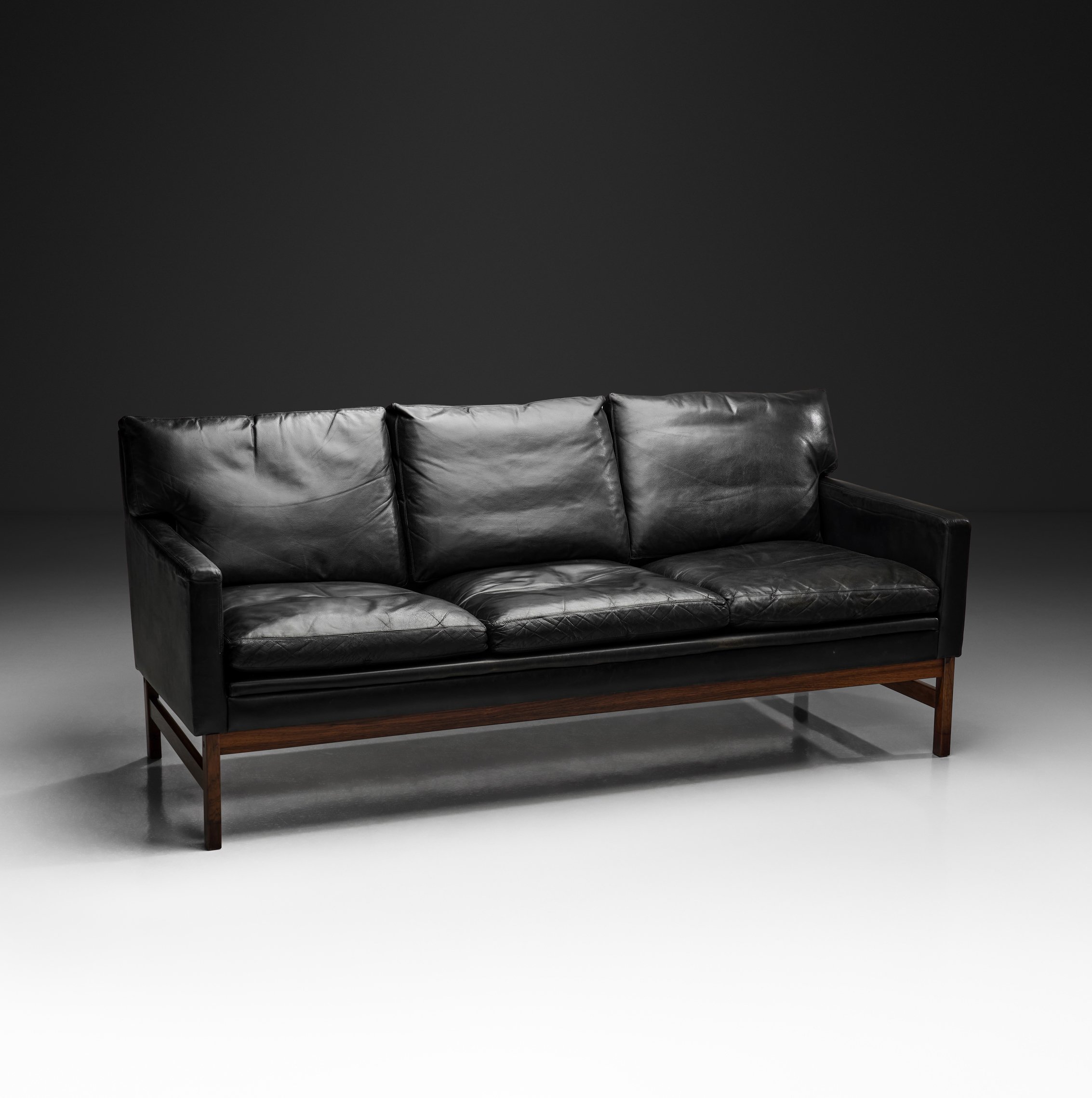
This beautifully crafted sofa features impeccable edges, sleek minimalism, and subtle curves. The quality of the design is matched by the outstanding workmanship of the maker. The lower wooden frame of this sofa offers a striking contrast to the supple black leather upholstery, creating a visually captivating aesthetic. Its gently flared upholstered arms give the piece a graceful, almost embracing profile, while the deep seat promises true comfort. Throughout the 20th century, solid wood had been the most important furniture material in Scandinavia. This is especially true for the mid-century, during which natural wood was a staple material to enhance both the structural and visual aspect of furniture, as is the case with this three-seater sofa. This piece not only reflects the craftsmanship and design ethos of the 1960s Danish design movement, but also serves as a timeless addition to any modern living space, combining form and function with enduring style. Unlike other designs, Danish products weren’t flashy but rather made to be of high quality and fit a warm, comfortable and welcoming home. Moreover, Danish makers were of the firm belief that beautiful and functional objects should be accessible to everyone.
As a whole, this sofa carries a calm, understated beauty that fits seamlessly into both traditional and contemporary settings. It speaks to the Danish approach to living, where simplicity is enriched by craftsmanship and comfort. It is a reminder of why mid-century Danish design endures: its ability to balance refinement and warmth in a way that still resonates today.
Condition:
In good vintage condition. Wear consistent with age and use. The sofa has recently been reconditioned. Due to the nature and age of the materials, the item may have some marks, scratches, and discolouration. The sofa comes with its original upholstery, we advise reupholstery. Each of our items can be reupholstered by our in-house atelier in a fabric of choice. Please reach out for more information.
Dimensions:
70.86 in W x 31.69 in D x 31.49 in H; Seat height 18.7 in; Seat depth 18.89 in; Arm height 22.63 in
180 cm W x 80.5 cm D x 80 cm H; Seat height 47.5; Seat depth 48 cm; Arm height 57.5 cm
REQUEST PRICE HERE
Price category: 15,000 - 20,000 usd / eur
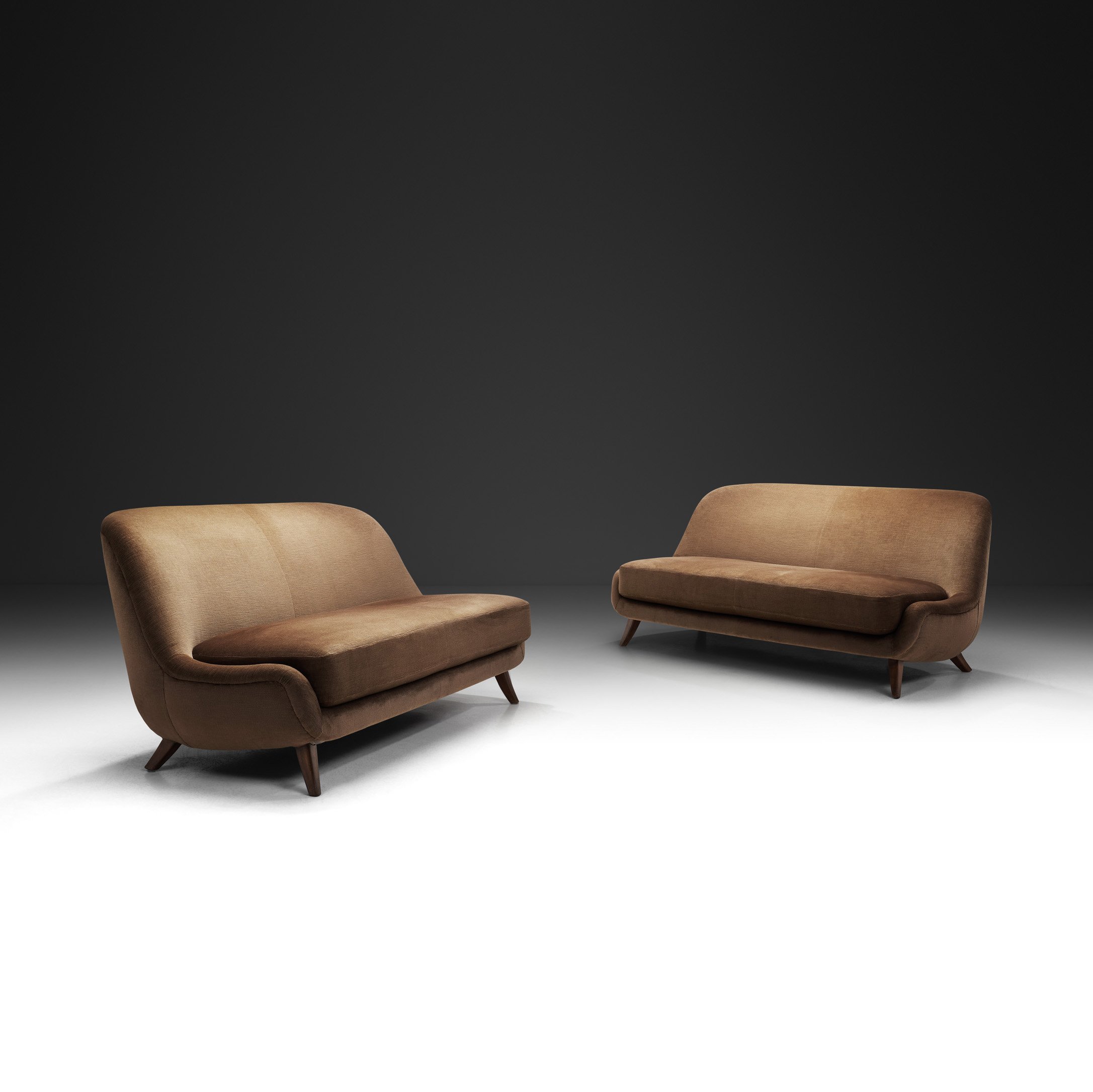
The designer of this sofa pair evidently attached great and equal importance to form and function. With an open design profile, this two-seater model carries with it some of the fundamental characteristics and ideals of mid-century modernism.
Clutter-free and disciplined, they are as functional as they are aesthetically pleasing. The round shape is reminiscent of the Artifort style in that it has a sinuous and expressive quality that is harmonious and organic. There is also a certain quiet power to the design that is pared-down to the essential, exuding simplicity and timelessness. The open construction is made up of the generous seat cushion and the large back that flows towards the front to form the shell of the seat. This creates an inviting and open look which is a signature characteristic of mid-century modernism. Thanks to the sinuous, large surfaces, the velour fabric dominates the overall look, accentuating the round shapes and curves. The short, splayed legs prevent the sofas from looking heavy by slightly lifting them off the ground, while their warm brown colour nicely compliments the elegant colour of the body.
Without any ornamentation, the focus here is on the round, flowing lines of the body and the upholstery. From the muted colour scheme to the material choices, this streamlined design is essentially mid-century modern and therefore, can add that cosy charm into any space.
Condition:
In good vintage condition. Wear consistent with age and use. The sofas are upholstered in a brown velour fabric. Each of our items can be re-upholstered by our in-house atelier in a fabric of choice. Please reach out for more information.
Dimensions:
70.07 in W x 34.84 in D x 30.31 in H; Seat height 16.92 in
178 cm W x 88.5 cm D x 77 cm H; Seat height 43 cm
REQUEST PRICE HERE
Price category: 7,500 - 10,000 usd / eur
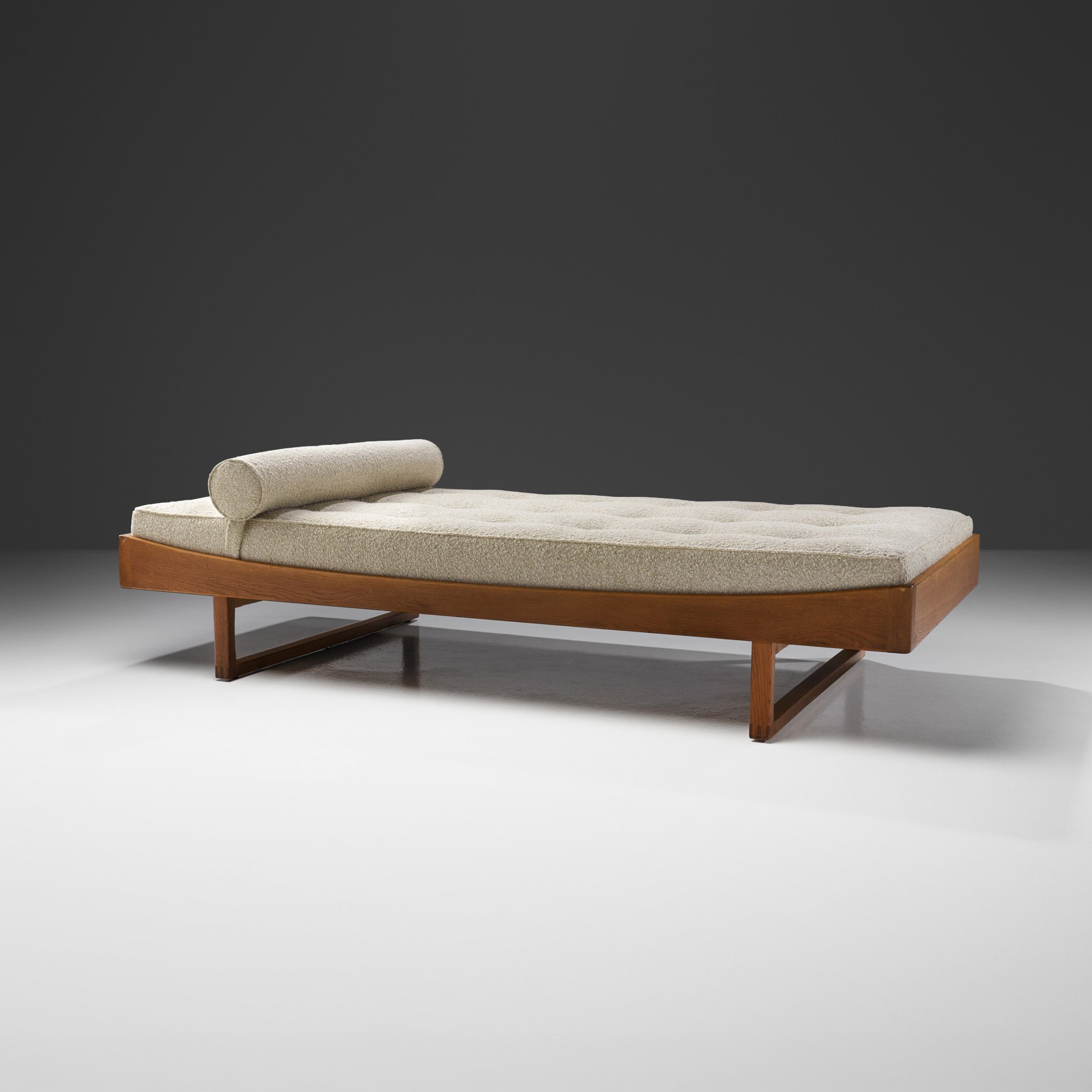
This gorgeous daybed model by the Danish furniture maker Bernhard Pedersen & Søn was inspired by classic Danish furniture design and simplicity.
The streamlined solid wood frame features a curvy top and geometric runner legs. From the minimalist design to the visible joints, “Model 159” has the characteristic “honest” look that Bernhard Pedersen and Søn is known for. The sleek appearance is created by the clean lines, functional design, and expert craftsmanship. The body supports the newly-upholstered cushion, which blends effortlessly into the frame. The attached cylindrical pillow breaks the flatness of the body, adding a modern visual interest, while the premium bouclé fabric makes this daybed an elegant addition to any space.
The period between 1950 and 1970 in particular was characterised by some of the most stunning and well-executed pieces in Bernhard Pedersen & Søn’s history. While they manufactured other designers’ models, they are renowned for their own designs, including this daybed model. Each piece was assembled by hand and numbered individually, according to their tradition.
Condition:
In good vintage condition. Wear consistent with age and use. This daybed has been recently reupholstered in a premium bouclé fabric. Each of our items can be re-upholstered by our in-house atelier in a fabric of choice. Please reach out for more information.
Dimensions:
Frame
80.51 in W x 40.74 in D x 13.97 in H
204.5 cm W x 103.5 cm D x 35.5 cm H
About the designer:
Bernhard Pedersen & Søn, is a Danish furniture maker company with a long and strong tradition in furniture and cabinetmaking, stretching all the way back to the company’s start in 1902. Through three generations the family firm has created and sold classic Danish furniture to many parts of the world.
The period between 1950 and 1970 in particular was characterized by some of the most stunning and well-executed pieces in Bernh. Pedersen & Søn’s history. Especially the classic mid-century sideboards and daybeds designed by Danish furniture designers, including the world-renowned Johannes Andersen, Svend Aage Madsen and Kurt Østervig who were – and still are – highly valued by customers worldwide.
Every piece of furniture is made in the same factory built by the Bernh. Pedersen family in 1902, located in a small community in the Danish countryside. The workshop and its skilled cabinetmakers are known for their exquisite and dedicated work based on strong Danish craft traditions; traditions recognized around the world for timeless design, high-quality craftsmanship and outstanding longevity. Unique techniques, special tools and original machinery are maintained and used to produce the sideboards in keeping with the first original pieces. The sum of it all is captured in the phrase: Made in Denmark.
Today, the fourth generation in the family, Thomas Bernhard Pedersen is focusing on an exclusive selection of the company’s most exquisite sideboards designed by Danish furniture designers, including the world-renowned architect Johannes Andersen. Every piece of furniture is made in Denmark by skilled cabinetmakers and in keeping with the strong Danish craft traditions. In 2015, great-grandson Thomas Bernhard Pedersen re-established the company and started focusing exclusively on relaunching some of the exquisite furniture designed in the 1950s and 1960s.
REQUEST PRICE HERE
Price category: 5,000 - 7,500 usd / eur
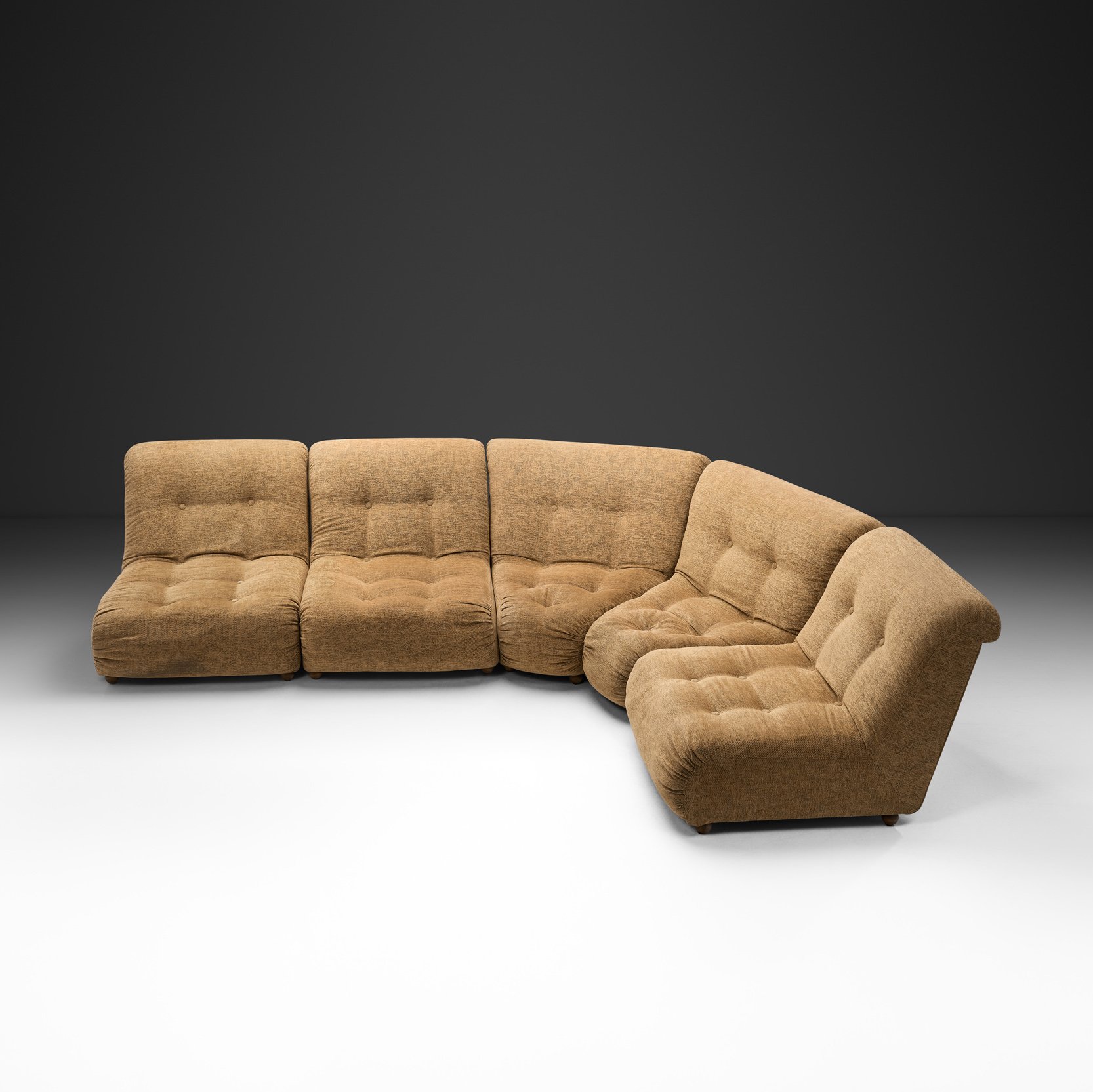
Originating in the postwar years, the Mid Century Modern movement embraced clean lines, organic forms, and an honest use of materials, rejecting the heavy ornamentation of earlier eras in favour of functional beauty. By the 1960s, European furniture designers had moved past the stark functionalism of early modernism and began exploring new ideas of comfort through foam and plush forms. The result was a generation of sofas that felt architectural yet approachable - models that defined a room while welcoming people into it.
There is a great balance in the execution of this sofa, which is achieved through the clever modular design. The curving form is welcoming, and unmistakable of the era’s design inclinations. The modular form allows for the sofa to be rearranged to fit into a multitude of spaces and the generous back and seat cushions exude an unmatched level of comfort, making this piece perfect for cosy lounging and conversing. The texture of the upholstery gives the sofa a modern edge while also enhancing the generous size of the seats and back. This five-seater was evidently constructed with extraordinary care; allowing it to be placed in any environment to enhance the visual quality of its surroundings. The upholstery adds a modern edge to the natural wood, while keeping the rustic, mid-century look in the focus.
From every single angle, this sofa offers stunning lines and a rich texture. Above all, furniture designers of the era believed that design could certainly be used to improve people's lives. Looking at this model, this was evidently a not too far-fetched ideal.
Condition:
In vintage condition. Wear consistent with age and use. The sofa has recently been reconditioned. Due to the nature and age of the materials, the item may have some marks, scratches, and discolouration. The item comes with its original upholstery or has been reupholstered by a previous owner. We recommend reupholstery, each of our items can be reupholstered by our in-house atelier in a fabric of choice. Please reach out for more information.
Dimensions:
125.59 in W x 77.95 in D x 28.35 in H; Seat height 11.81 in; Seat depth 20.86 in
319 cm W x 198 cm D x 72 cm H; Seat height 30 cm; Seat depth 53 cm
Individual unit:
27.95 in W x 36.61 in D x 28.35 in H
71 cm W x 93 cm D x 72 cm H
REQUEST PRICE HERE
Price category: 9,000 - 12,500 usd / eur
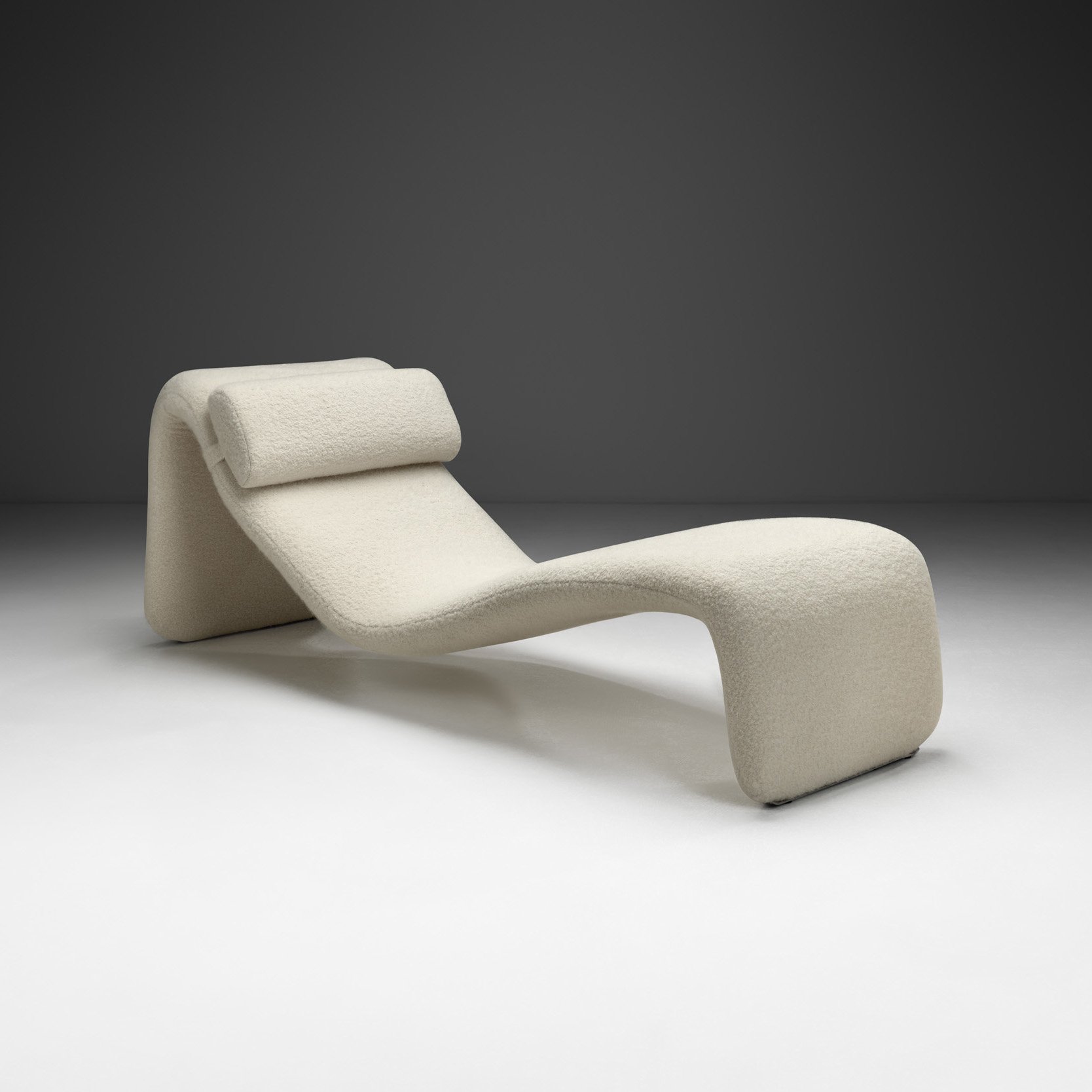
French industrial designer Oliver Mourgue obtained his degree in Interior Design at the prestigious École Boulle, from where he went on to pursue his passion in furniture design at the École Nationale Supérieure des Arts Décoratifs in Paris. After training in Finland and Sweden, he then began his collaboration with Airborne International, one of France’s most successful and influential design companies of the modernist era.
In 1965 he designed the ‘Djinn Series’, inspired by the figure of the ‘djinni’ (genie), a mystical creature of Arabian fairy tales capable of morphing into human or animal form. This fluid uncertainty is clearly visible in the elegant shape of the daybed, where curved edges and softly folded ends connect seamlessly with the low-slung seating. The carefully crafted ergonomic design moulds perfectly to a resting human figure. Without distinctive breaks and different components, the daybed suggests effortless comfort - its relaxed form inviting the person for moments of unhurried rest, aligning with the decade’s easing of societal mores. The strapped rectangular pillow at the headrest is a unique complement that adds visual interest and breaks the flat surface of the piece. This daybed has been reupholstered in a premium fabric, which guarantees outstanding comfort and softness. The light colour of the upholstery, covering every part of the daybed also contributes to its uniqueness, truly making it a statement piece in any interior.
The ‘Djinn Series’ gained immense fame after the ‘Djinn Chair’ (1965) was featured in Stanley Kubrick’s film 2001: A Space Odyssey (1968). The vivid red chairs - used to furnish the sterile Hilton lobby of Space Station Five - granted a truly futuristic yet functional ambiance for the room. With an eye-catching form, this daybed is a visually outstanding piece that will transform any environment with its bold character.
Condition:
In good vintage condition. Wear consistent with age and use. The daybed has been reupholstered recently in a premium fabric. Each of our items can be reupholstered by our in-house atelier in a fabric of choice. Please reach out for more information.
Dimensions:
68.89 in W x 24.80 in D x 24.40 in H
175 cm W x 63 cm D x 62 cm H
REQUEST PRICE HERE
Price category: 7,500 - 10,000 usd / eur
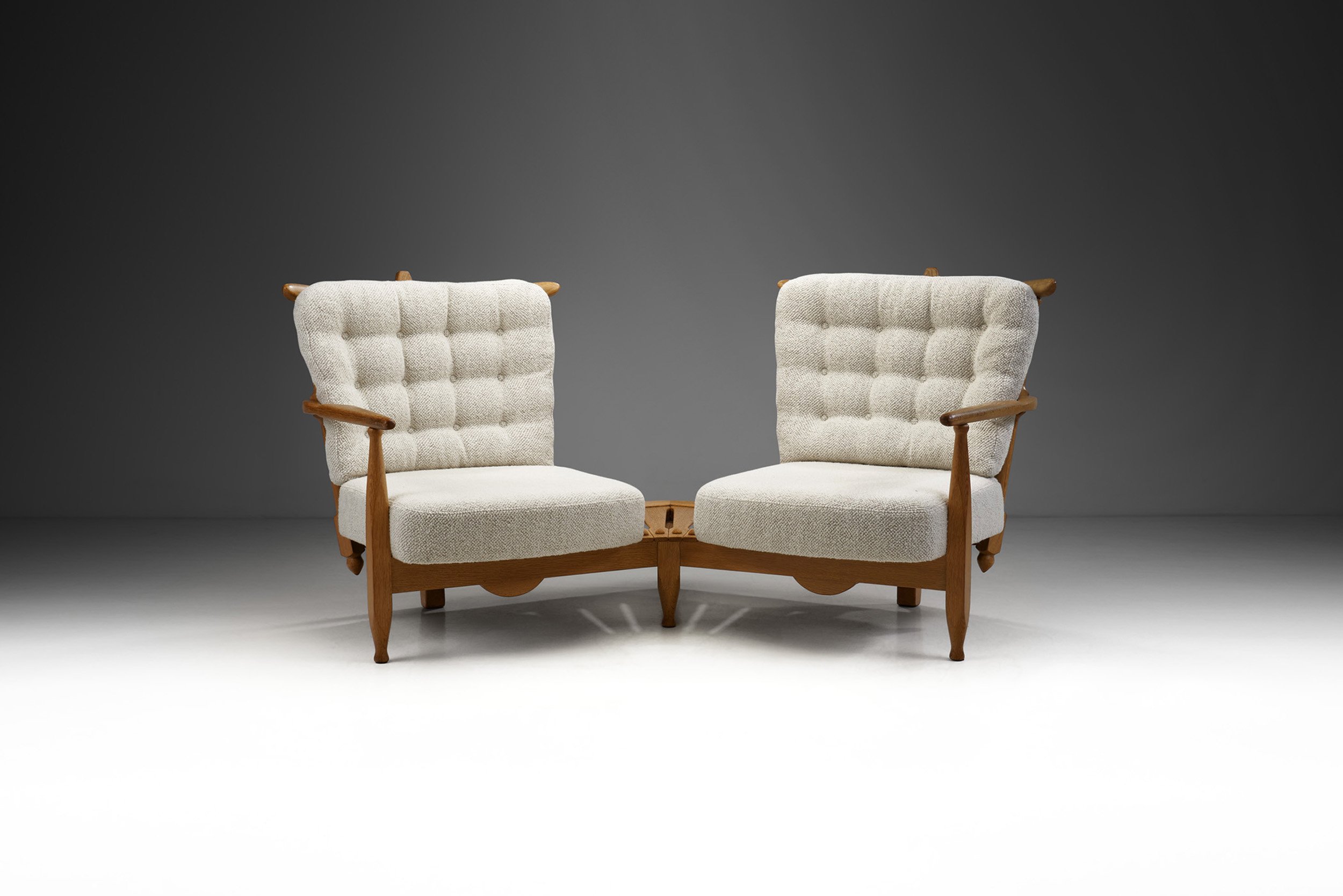
This rare oak settee is a delightful piece even if measured against the other seating models in the repertoire of the French designer duo, Robert Guillerme and Jacques Chambron. This model truly deserves adjectives such as unique or even iconic, both in terms of quality and design. It visually represents the very reason Votre Maison, the French duo’s company significantly influenced French design history.
From every angle, this settee’s design has unique solutions that are unmistakable. Starting with the duo’s trademark oak frame to the sculptural legs and backrests, while also featuring details that are one-of-a-kind. Such a detail is the curving seat and its joinery, that shows expert craftsmanship and creativity. The curve also serves as a table, adding much functionality and practicality to the sculptural look. The unusual seat resembles a slatted bench, while the two, individual backrests break the flat surfaces and emerge like thrones. The spindles enhance this appearance, especially with the longer, middle spindles that also serve as back legs. The armrests and legs are sculpted with precision to serve a double purpose: an aesthetic role, and a functional one. The corner segment adds a lot of openness to the design, preventing it from looking heavy. The curving shape and thick, comfortable seat and back cushions provide plenty of comfort, therefore this settee is perfect for cosy lounging.
Guillerme et Chambron’s work at Votre Maison not only represents the fusion of function and form, but also exemplifies the mid-century modern aesthetic - which they played a pivotal role in shaping. Their emphasis on quality craftsmanship and the use of noble materials like oak has undeniably left a lasting imprint in the world of furniture design, solidifying their legacy in the French design landscape during the mid-century era. Together, they defined new furnishings concepts. As this brilliant settee shows, well-crafted structures, polished wood and thick cushions created the now world-famous reputation of their seating designs.
Condition:
In good vintage condition. Wear consistent with age and use. Some minor scratches on the wood. The settee has been reupholstered recently in a premium fabric. Each of our items can be reupholstered by our in-house atelier in a fabric of choice. Please reach out for more information.
Dimensions:
79.92 in W x 42.51 in D x 36.61 in H; Seat height 14.96 in; Arm height 23.42 in
203 cm W x 108 cm D x 93 cm H; Seat height 38 cm; Arm height 59.5 cm
About the Designer:
Robert Guillerme graduated in 1934 from the École Boulle where he excelled in architecture and furniture design. After the Second World War he moved to Lille, in the north of France, where he decorated homes and designed furniture for the well regarded Rogier workshops.
In 1948, Guillerme was joined by his long-time friend, decorator Jacques Chambron in Lille. The following year Guillerme and Chambron met master cabinetmaker Émile Dariosecq, owner of a woodworking shop and the company Votre Maison was born. Together, they defined and imposed a new furniture concept. Thanks to their distinctive creativity, originality, and quality, the Votre Maison quickly became well-known.
The Votre Maison marked the history of French design. Guillerme drew the furniture designs while Chambron played the part of salesman, welcoming and advising clients. The power duo was complemented by Dariosecq, whose workshop took charge of the manufacturing. Together, they defined new furnishings concepts. Well-crafted chair back, polished wood and thick cushions make the reputation of their armchairs and sofas. Votre Maison continued to produce furniture right into the 20th century, with Jacques’s son Hervé Chambron, a designer and graduate of the École Boulle, having taken the over in 1983. ~H.
REQUEST PRICE HERE
Price category: 15,000 - 20,000 usd / eur
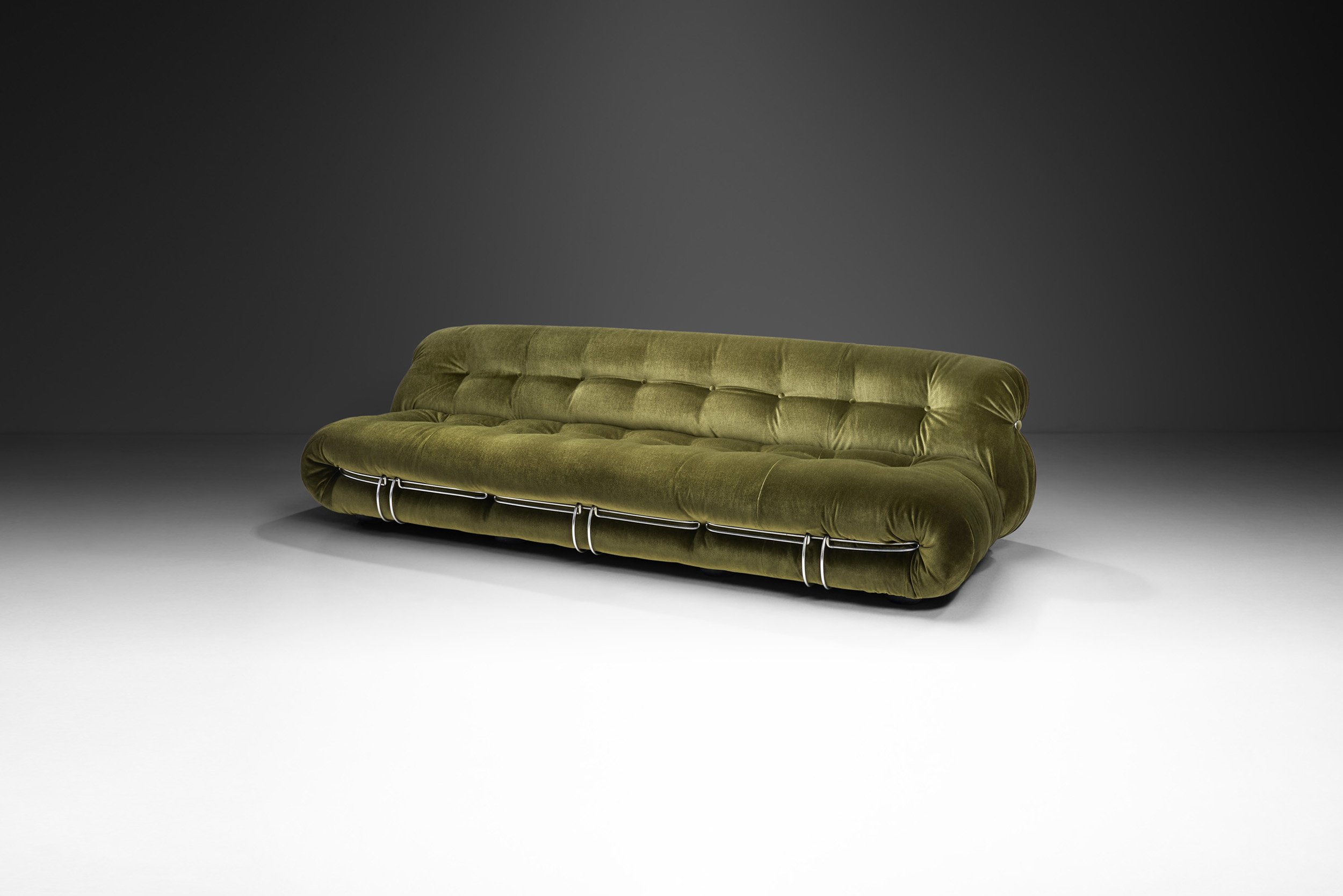
The iconic “Soriana” three-seater sofa was designed by the Italian designer duo, Afra and Tobia Scarpa in 1969. Besides its innovative manufacturing, visually,Soriana brings sophisticated and leisurely comfort to any home.
This post-modern sofa was manufactured by Cassina as part of the eponymous line that reached the coveted ‘iconic’ title soon after its launch. The award-winning design features three front metal clamps by which all soft curves and loose leather upholstery are held together, a particularly original detail that creates a sense of barely contained softness. The Soriana collection was meant to express beauty and comfort by using a whole bundle of fabric held by chrome-plated steel clamps. The defining upholstered body features tufted buttons all over it, which visually sections the sofa, while also adding depth to accentuate the softness. The interesting pairing of the metal clamps with the luxurious dark fabric creates the nowadays especially coveted post-modern look. For all its casual overtures, this sofa model remains a statement piece — a true icon of contemporary, or just simply, design.
The “Soriana Chair” was the first piece designed in the collection, and for its design in 1970, it won the Compasso d'Oro, one of the most important design awards of that time. The design has been reissued by Cassina recently, with the aim of recovering and safeguarding the works of Afra and Tobia Scarpa.
Condition:
In very good condition. The sofa is upholstered in premium green velvet fabric. Each of our items can be re-upholstered by our in-house atelier in a fabric of choice. Please reach out for more information.
Dimensions:
100 in W x 40.74 in D x 27.55 in H; Seat Height 16.53 in
254 cm W x 103.5 cm D x 70 cm H; Seat height 42 cm
Literature:
G. Gramigna, Repertorio del Design Italiano 1950-2000 per l’Arredamento Domestico. Turin: Allemandi 2003, p. 318
G. Bosoni, Made in Cassina. Milan: Skira, 2008, pp. 200-201.
About the designers:
Afra and Tobia Scarpa graduated at the Istituto Universitario di Architettura in Venice and formed one of the most successful and known professional associations. Their works can be found in museums across the USA and Europe, such as the MoMA and the Louvre. Their designs like the Soriana sofa exhibit a decidedly modernist aesthetic, prioritizing pared-back elegance and comfort. At the same time, the Scarpas are admired for the ease with which their designs complement both classical and cutting-edge interiors.
The Soriana was created for the Italian manufacturing company Cassina, which is often credited with introducing industrial design to Italy and has built an international reputation for collaborating with some of the world’s most respected designers, including Afra and Tobia Scarpa.
The husband-and-wife duo’s products played an important role in the history of Italian Design and are thriving in the Mid-Century market. The Soriana sofa is a collectors’ piece and part of the history of Italian design, destined to increase in value with the time. A piece of true Italian Modernism. ~H.

REQUEST PRICE HERE
Price category: 7,500 - 10,000 usd / eur
Throughout the 20th century, Italian design managed to distinguish itself. The 1960s was a boom time in Italy especially, a decade of mass production and innovation that signaled the end of the post-war rebuilding programme. Still, one off designs and the overflow of creativity were just as present, giving birth to outstanding pieces such as this modular “Superonda” sofa.
The “Superonda” sofa, designed in 1967 by the radical Florentine design collective Archizoom Associati, and produced for Poltronova, is a pioneering piece that challenged the conventions of traditional furniture design. The Superonda blurs the line between object and artwork, inviting interaction rather than passive use. It can serve as a sofa, a bed, or a chaise, making it as versatile as it is visually striking. Composed of two interlocking, elements, the Superonda departs from the conventional frames, legs, and backs, instead offering a sculptural, modular form that can be arranged in multiple ways. Its bold, wave-like silhouette reflects the playfulness of the Italian Radical Design movement, a rebellion against bourgeois taste and rigid functionalism.
Produced by Poltronova, a manufacturer known for championing avant-garde Italian design, the Superonda remains an unforgettable piece in design history. Its enduring relevance lies in its conceptual boldness, embodying the ideals of a generation that sought to redefine the relationship between people and their environments. Today, the Superonda stands not only as a collectible design icon but as a symbol of radical creativity and the power of design to question societal norms.
Condition:
In good vintage condition. Wear consistent with age and use. The sofa has recently been reupholstered in a premium fabric. Each of our items can be reupholstered by our in-house atelier in a fabric of choice. Please reach out for more information.
Dimensions:
94.88 in W x 44.88 in D x 15.74 in H
241 cm W x 114 cm D X 40 cm H

REQUEST PRICE HERE
Price category: 5,000 - 7,500 usd / eur
This model visually represents the very reason Votre Maison and Guillerme et Chambron significantly influenced French design history. From every angle, this sofa’s design has unique solutions that are unmistakable and blur the line between furniture and sculpture.
Featuring a solid oak frame with sharply angled arms, six legs, and vertical slat detailing along the backrest, this sofa is a hallmark of Guillerme et Chambron's structural language. The frame is striking through its composition, yet the look is enhanced even further thanks to the large, circular back cushions, which immediately draw the eye with their playful geometry. Like most of their designs, this sofa model displays a beautiful contrast between the wooden frame and the elegant light fabric of the seat and back cushions. The backrest - which is undoubtedly the main design element - consists of several spindles framed by oak rails on the top, sides and the bottom. The woodworking and joinery truly show the overall quality of this sofa, the frame is refined and the attention to the smallest detail shows the manufacturing skills of Guillerme et Chambron. The expert woodworking is especially visible in the armrests, their peculiar shape greatly adding to the visual interest of the sofa.
Guillerme et Chambron's work continues to resonate for its balance of charm, function, and artisan quality, all of which are on full display in this distinctive piece.
Condition:
In good vintage condition. Wear consistent with age and use. The sofa has been reupholstered recently in a premium fabric. Each of our items can be reupholstered by our in-house atelier in a fabric of choice. Please reach out for more information.
Dimensions:
55.5 in W x 36.6 in D x 40.55 in H; Seat height 17.3 in; Seat depth 27.55 in; Arm height 22.04 in
141 cm W x 93 cm D x 103 cm H; Seat height 44 cm; Seat depth 70 cm; Arm height 56 cm
REQUEST PRICE HERE
Price category: 5,000 - 7,500 usd / eur
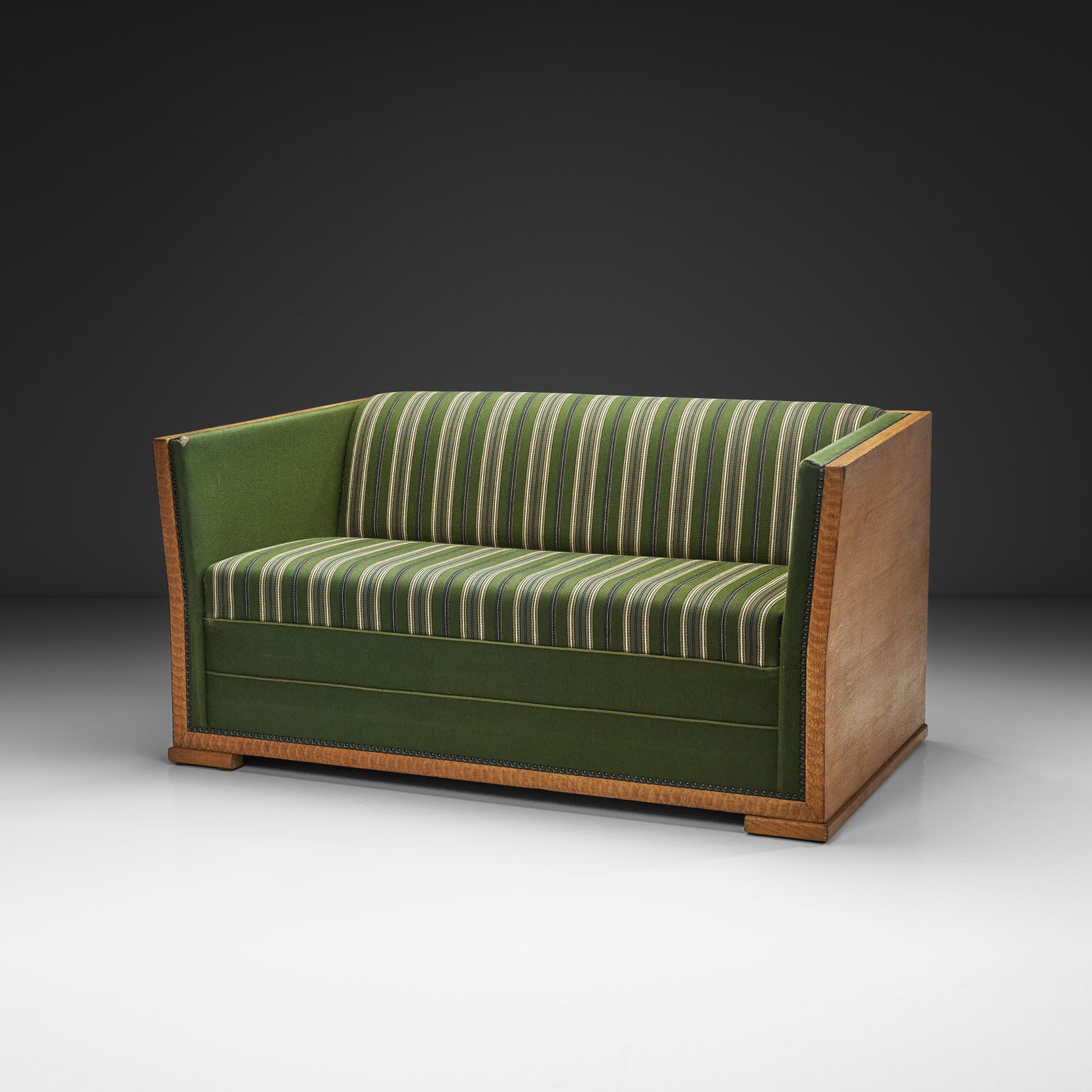
Henning Kjærnulf was a Danish mid-century designer and architect whose work is associated with the broader Scandinavian modern movement. Although relatively little is known about his personal biography, his furniture designs reveal a strong commitment to craftsmanship and carefully structured forms. Kjærnulf worked with several Danish manufacturers and developed pieces that combined traditional woodworking with modern lines and sculpted forms.
This two-seater sofa reflects those qualities through its solid oak frame and clearly defined architectural presence. The most striking feature is the wooden side and back panels that come together to form a frame for the piece. The frame acts as both a structural support and a visual boundary for the seating area. These panels give the sofa a grounded, natural feel through the deep grain of the oak. The upholstery contrasts with this structure through a layered composition. The seat, backrest, arms are covered in green textile, while the cushions are upholstered in a striped fabric that introduces rhythm across the surface. The pattern emphasizes the geometric shape of the sofa constructed on straight lines. The combination of exposed oak structure and patterned upholstery produces a clear dialogue between rigid frame and soft interior. At the same time, the carving details as well as the metal studs placed alongside the frame provide another dimension of interest, proving the complexity and attention to detail of the maker.
Together, these elements create a piece that is both functional and visually distinctive. Through the use of different materials and balanced clarity of structure, this sofa offers a great example of mid-twentieth-century Nordic seating.
Condition:
In good vintage condition. Wear consistent with age and use. The item has recently been reconditioned. The fabric has some imperfections. The wood has some scratches and dents. Due to the nature and age of the materials, the item may have some marks and discolouration. The item comes with its original upholstery or has been reupholstered by a previous owner. Each of our items can be reupholstered by our in-house atelier in a fabric of choice. Please reach out for more information.
Dimensions:
57.48 in W x 34.64 in D x 29.92 in H; Seat height 17.12 in; Seat depth 22.44 in; Arm height 29.52 in
146 cm W x 88 cm D x 76 cm H; Seat height 43.5 cm; Seat depth 57 cm; Arm height 75 cm
REQUEST PRICE HERE
Price category: 30,000 - 40,000 usd / eur
This “DS-600” sofa, designed by Ueli Berger, Eleonore Peduzzi Riva, Heinz Ulrich, and Klaus Vogt for De Sede in the early 1970s, is one of the most celebrated icons of 20th century furniture design. The sofa's fluid, serpentine form challenged traditional ideas of the living room by transforming seating into an adaptable architectural element. More than fifty years after its introduction, the “DS-600” remains a defining example of innovative Swiss craftsmanship and modular design.
As this sofa shows - functionality was not perfected at the expense of aesthetic appeal and quality. This outstanding modular piece has a creative design that allows it to be used in a multitude of ways. The ingenious design can bend into sweeping curves, circles, or custom configurations. Its exceptional comfort is matched by remarkable flexibility, making each installation unique to its environment. The sofa is upholstered in leather with a beautiful patina. The use of this material not only enhances the visual appeal but also ensures a comfortable and supportive seating experience for the whole body. The overall design speaks to the zeitgeist of the 1970s, a period characterised by a spirit of experimentation and a departure from traditional norms. This piece embodies the essence of modern design, marked by its commitment to functionality, and a bold experimentation.
Produced by the renowned Swiss manufacturer De Sede, the “DS-600” exemplifies the company's commitment to exceptional leatherwork and enduring quality. Often referred to as the "Snake" or "Non-Stop" sofa, it has become a sought-after collectible and a permanent fixture in museums, and design collections around the world. Combining playful experimentation with impeccable craftsmanship, the “DS-600” continues to stand as a timeless statement of functional sculpture and enduring modern design.
Condition:
In good vintage condition. Wear consistent with age and use. The sofa has recently been reconditioned. Due to the nature and age of the materials, the item may have some marks, scratches, and discolouration. This sofa comes with its original leather or has been reupholstered by a previous owner. Each of our items can be reupholstered by our in-house atelier in a fabric of choice. Please reach out for more information.
Dimensions:
135.04 in W x 40.55 in D x 28.94 in H; Seat height 15.35 in; Seat depth 22.05 in; Arm height 21.85 in
343 cm W x 103 cm D x 73.5 cm H; Seat height 39 cm; Seat depth 56 cm; Arm height 55.5 cm