
Hans Wegner "AT-309" Drop-Leaf Dining Table for Andreas Tuck, Denmark 1950s


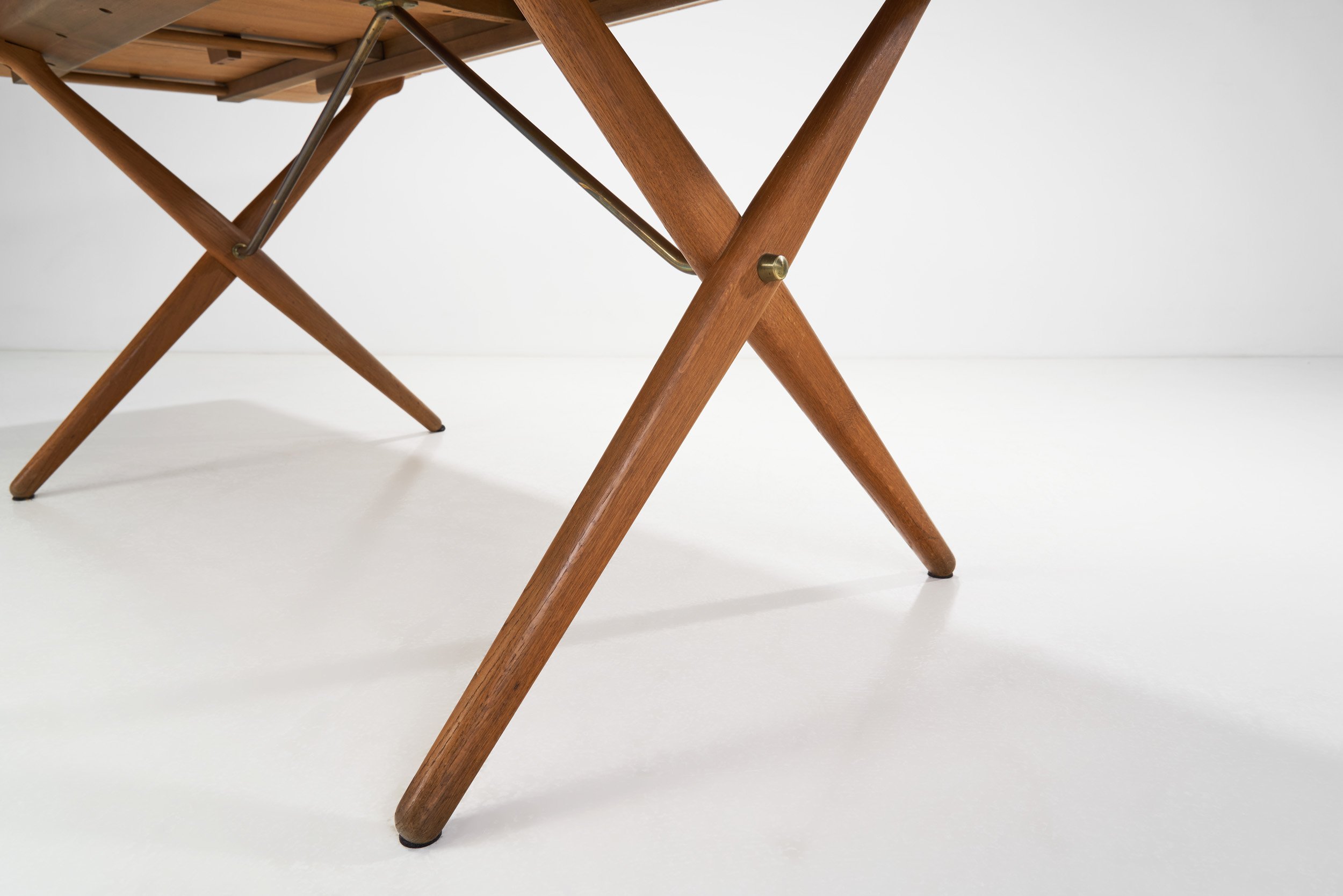


Hans Wegner "AT-309" Drop-Leaf Dining Table for Andreas Tuck, Denmark 1950s
REQUEST PRICE HERE
Price category: 7,500 - 10,000 usd / eur
This rare “AT-309” dining table was designed by Hans Wegner in 1955 and its title of ‘iconic’ is well deserved. As it is no longer produced, this model has become a collector’s item created by a designer who is credited as one of the main driving forces of the mid-century Danish modern movement.
The “AT-309” model is also commonly referred to as the “saw-horse” for its trestle base. In woodworking, a saw-horse is a trestle structure used to support a board similarly to this model’s case. While Hans J. Wegner became world-renowned for his chairs, he also designed a broad range of tables, where he was just as thorough and artistic about the proportions, construction, function, and style. With a clear statement of simplicity, quality and respect for materials, this table is a great example of Danish Modern design. The massive teak tabletop with drop-leafs is stunning on its own, showcasing the wood’s grain and offering plenty of space with the extendable solution. However, to Wegner, the most important part of his tables was not the top, but rather what was underneath. For the supporting structure he used the distinctive saw-horse look with crossed legs and brass braces. The diagonal brass reinforcement is not only a significant structural feature, it is also a visually appealing detail that gives character to this dining table. Looking beneath the top, the elaborate oak structure becomes visible, showing both Wegner’s and the manufacturer’s expert skill and knowledge.
Over the course of his career, the designer collaborated with several renowned manufacturers, including Andreas Tuck. The company was one of the greatest Danish furniture design companies of the mid-20th century, producing pieces that epitomize classic Danish craftsmanship. Wegner worked with the company for many years, creating iconic designs such as this “AT-309” table.
Condition:
In good vintage condition. Wear consistent with age and use. The tabletop has been refinished.
Dimensions:
51.96 in W (89.76 in when extended) x 33.66 in D x 28.14 in H
132 cm W (228 cm when extended) x 85.5 cm D x 71.5 cm H
About the designer:
Hans Wegner (1914–2007) is considered as one of the most influential designers of Scandinavian design. Danish-born Wegner became a national and international design idol for shaping the history of design in the 1950s and ‘60s.
In his designs, the sharp edges defining Modernism were smoothened, creating his iconic chairs. As a pioneer of the modernist style, often described as “organic functionality”, Wegner described his method as “stripping the old chairs of their outer style and letting them appear in their pure construction.”.
At 14 years old, he began his apprenticeship with Danish master cabinetmaker H. F. Stahlberg. After serving in the military he moved to Copenhagen, and attended the School of Arts and Crafts, before setting out as a furniture designer. In 1943, he established his own studio, producing designs for manufacturers like AP Stolen, Fredericia Stolefabrik, and in later years, PP Møbler.
Wegner designed more than 500 chairs in his lifetime, refining an approach that combined a variety of natural materials and pushed traditional joinery techniques to extreme tolerances and distillations. Wegner’s background as a cabinetmaker gave him a deep understanding of how to integrate exacting joinery techniques with exquisite form, realizing the perfect combination with form and purpose.
The core of Wegner’s legacy remains his focus on showing the inner soul of furniture pieces through a simple and functional exterior. ~H.

REQUEST PRICE HERE
Price category: 50,000+ usd / eur
"I can't live well with too much rigidity. The 90-degree angle, for example, is something I love, but I can't do it. The things I do end up being a little lyrical, a little sensual, in short, there is always an element that does not come from purity or cleanliness."
This beautiful pedestal table visualizes the above quote from Jorge Zalszupin. It was designed in 1959 and produced by his own company, L'atelier. Essentially, the sizeable top rests on one concrete base finished with soft leather. The solid wood patchwork on the tabletop is mesmerizing, showcasing the many shades of Brazilian hardwood. This was not a purely aesthetic choice, but also an initiative for the rationalization and use of leftover scraps of wood available at the factory, allowing at the same time a combination of their different colourings. The way the large top is supported by the thick metal structure shows architectural precision and the use of materials of the highest quality. At the time of its creation, this table was presented as a dynamic piece that could be used in both the corporate and the domestic places thanks to its casual elegance. Today, its versatility is still recognized, a mark of good design. Zalszupin’s L’Atelier was a design collective comprised of architects, engineers, craftsmen and a full-scale team of professionals who did everything from researching materials to finalizing the product. Therefore, the quality of L’Atelier furniture has transcended time and his pieces have become timeless.
The name is said to be a reference to the famous Baia de Guanabara, a traditional postcard image of Rio de Janeiro. Zalszupin's production established a dialogue very close to the artisanal traditions of working with wood, ensuring quality in the aesthetics and manufacturing of his work.
Condition:
In good vintage condition. Wear consistent with age and use. Some minor scratches on the wooden tabletop. The leather covering on the base is a later replacement.
Dimensions:
98.82 in W x 49.21 in D x 29.13 in H
251 cm W x 125 cm D x 74 cm H
Literature :
Jorge Zalszupin, Design Moderno no Brasil – Maria Cecilia Loschiavo dos Santos, Olhares Edition, São Paulo, 2014, p. 142
About the designer:
Jorge Zalszupin was born in Warsaw, Poland, in 1922. He graduated as an architect in Romania in 1945. His importance for Brazilian design has been articulated in several publications so far. In addition to being the owner of the l'Atelier furniture factory of modern furniture, Zalszupin led a unique initiative: he coordinated a team of designers working for four different factories in the same business group, the Forsa Group.
Zalszupin immigrated to Brazil in 1949 and after a brief stay in the capital, he settled in São Paulo, a city that was then entering a cycle of great industrial growth and great cultural transformations. In the first half of the 1950s, he opened an architecture office, having José Gugliota as a partner. When he got tired of designing exclusive furniture manufactured for his clients' homes, he decided to join a group of woodworkers and started to produce smaller series. This was how l'Atelier came into being, which eventually began to manufacture office furniture and went from a carpentry shop with handcrafted products to an industry with serial production. The first piece in this series was an armchair nicknamed 'Danish' by employees. It was first created in 1959.
After the crisis of the 1980s, Jorge Zalszupin dedicated himself exclusively to architecture, an activity he had never abandoned. From 2005, the company Etel Marcenaria started to produce several of the items designed by Zalszupin for l'Atelier - among them the 'Danish' armchair -, privileging the objects of the company's artisanal phase. ~H.