
A Pair of 'Model 113' Armchairs by Nanna Ditzel, Denmark 1955 (sold)


A Pair of 'Model 113' Armchairs by Nanna Ditzel, Denmark 1955 (sold)
A pair of “Model 113” armchairs by Nanna Ditzel in teak and woven paper cord. Produced by Paul Kold Savværk in Denmark, 1955.
These “Model 113” chairs, with their elegant and ergonomic shape, are instantly recognisable as being Danish mid-century modern. Nanna Ditzel is an icon of post-war Danish design, famous for her forward-thinking approach to shape and innovative use of new materials and techniques. As with most of Ditzel’s designs – like her iconic “Egg Chair” (1959) – the ‘”Model 113” chair is based on a circle shape, as shown with the deep curvature of the backrest. This graceful curve is contrasted with the square legs. The tapered shape of the legs and the smooth teak softens this juxtaposition; resulting in a balanced and clean-lined frame. The delicately hand-woven papercord seat offsets the deep richness of the teak wood frame. The slight bow of the seat flows with the curves of the frame, making the piece cohesive. These chairs – with their use of premium materials and subtle elegance – showcases the best qualities of Danish mid-century modern design.
SOLD
Condition:
In good vintage condition. Wear consistent with age and use. Wood has some minor marks. Paper cord has some minor stains.
Dimensions:
25 in W x 22.24 in D x 27.17 in H; Seat Height 17.52 in
63.5 cm W x 56.5 cm D x 69 cm H;Seat height 44.5 cm
REQUEST PRICE HERE
Price category: 12,500 - 15,000 usd / eur
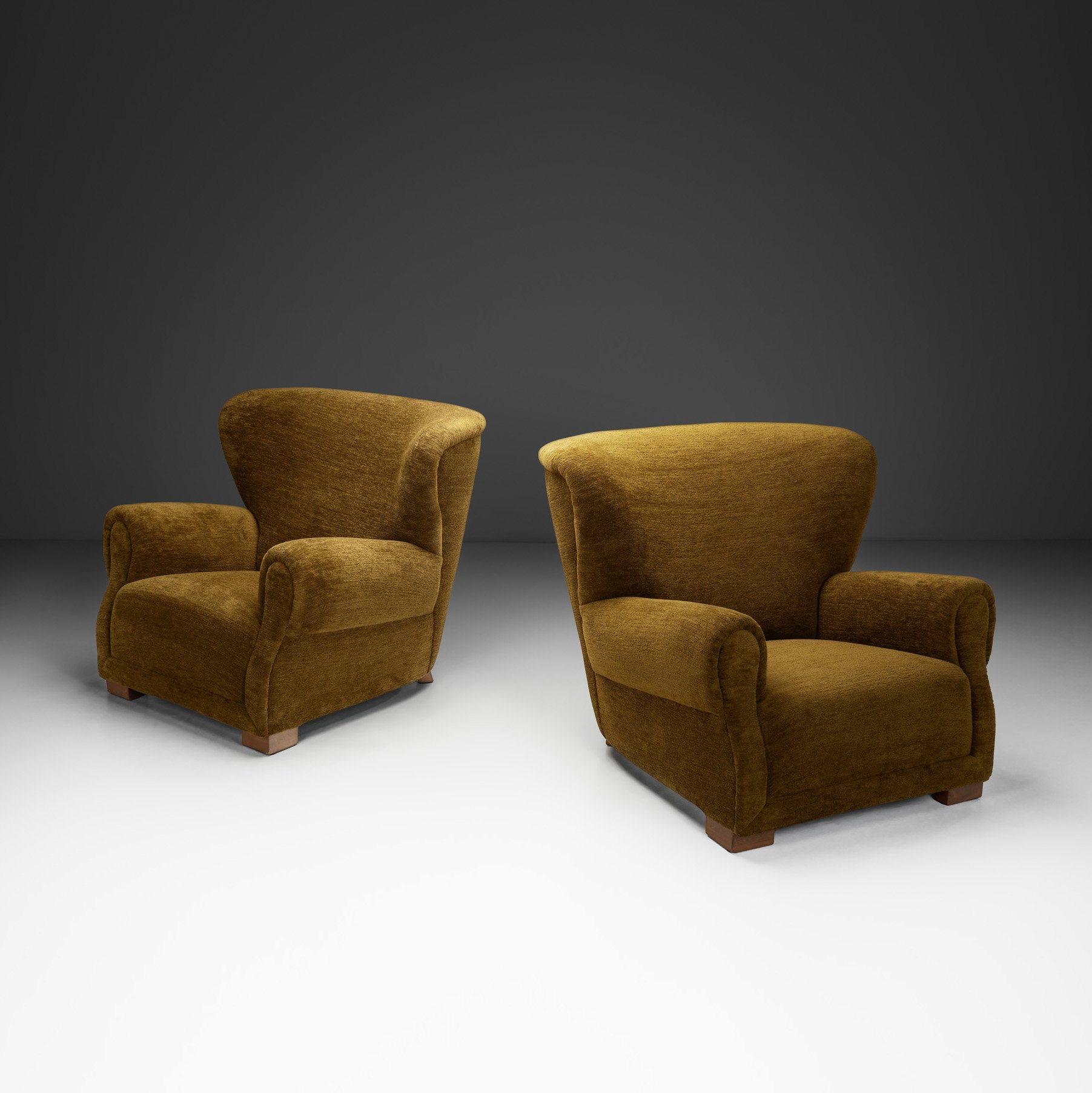
“Danish Modern” is a recognised term around the world, standing for the style of Danish design created during the 20th century. As these armchairs show, furniture created in this period is characterised by clarity of design, and extremely high-quality craftsmanship and choice of materials.
Danish and Scandinavian modern's timeless appeal has made it a go-to for designers and homeowners alike, as furniture in this style can be understated but still stand out in almost any space. This is true for this pair of armchairs as well. Adopting the trend of abandoning ornamentation to benefit the form, the designer of this pair maintained the beauty and warmth inherent to traditional Danish cabinetmaking. From as early as the 1920s, cabinetmakers and architects frequently collaborated to produce exceptional pieces like these chairs. The backs have a welcoming, enveloping shape that embraces the sitter. The fully upholstered bodies are covered in textural, soft fabric that enhances the curves and contrasts nicely with the stained wood legs. The legs are straight and square in the front and slightly bent and splayed in the back to provide structural stability. Unlike models from outside Scandinavia, Danish designers’ products weren’t flashy but made to be last generations while remaining timeless addition to a space, while completing a warm, comfortable and welcoming home. As this pair of armchairs exemplify, blending high functionality, good quality natural materials and organic colours with simple lines, elegance and excellent craftsmanship is the key to the success of Danish Modernism.
The design of this pair promotes relaxation and contentment, inviting one to sit back and enjoy a moment of peace. The understated elegance and warm tones create an alluring atmosphere, making them perfect for the purpose of evoking a hyggelig (cosy) environment in any home.
Condition:
In good vintage condition. Wear consistent with age and use. The chairs have recently been reconditioned. Minor marks and scratches on the legs. The chairs have recently been reupholstered in a premium fabric. Each of our items can be reupholstered by our in-house atelier in a fabric of choice. Please reach out for more information.
Dimensions:
37.79 in W x 41.53 in D x 32.87 in H; Seat height 14.76 in; Seat depth 22.24 in; Arm height 21.45 in
96 cm W x 105.5 cm D x 83.5 cm H; Seat height 37.5 cm; Seat depth 56.5 cm; Arm height 54.5 cm
REQUEST PRICE HERE
Price category: 12,500 - 15,000 usd / eur
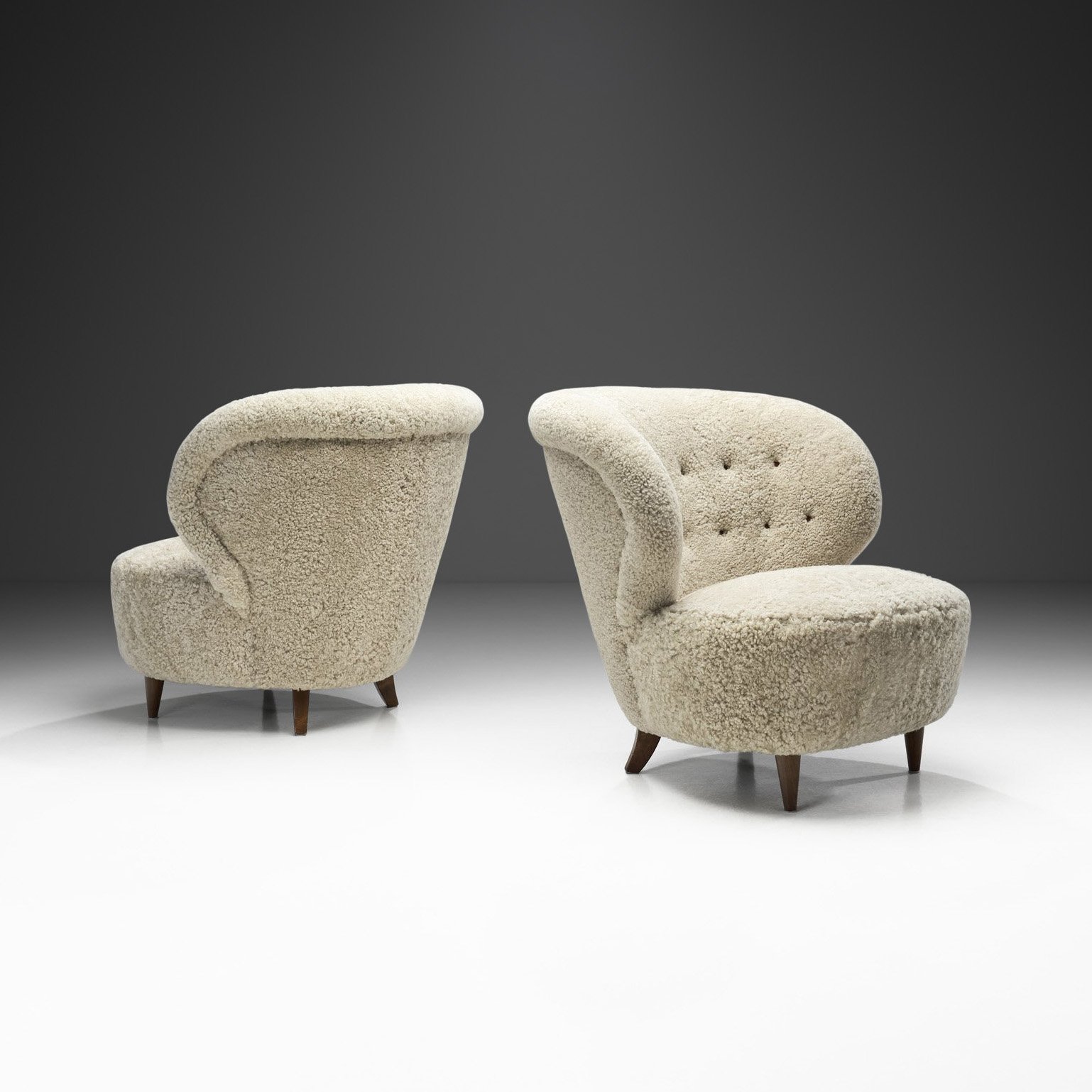
“Danish Modern” is a recognized term around the world, standing for the characteristic style of Danish design created during the 20th century. As these lounge chairs show, furniture created in this period are characterized by clarity in design, and extremely high-quality craftsmanship and choice of materials.
This pair of lounge chairs exudes quality and personality from all angles. Their classic shape is formed by the generous seat and embracing back. The large, curved backrests feature tufted buttons and follow the curve of the voluptuous seats, creating an inviting and open look which is a signature characteristic of Danish Modernism. The tufting stitches are festooned with thirteen, symmetrically arranged buttons on each chair, that sink into the soft upholstery. The tapered, lacquered wood legs prevent the chairs from looking heavy by slightly lifting them off the ground, while their warm brown colour nicely contrasts the soft, light colour of the bodies. The back legs are splayed to provide structural support to the chairs.
Thanks to the sheepskin, the chairs give a natural, textured look, making them ideal to blend a stroke of modernity to any space, with a nod to organic, simple artistry. Sheepskin is the ultimate material for comfort, warm in the winter and cool in the summer. The artisanal production quality is evident throughout this pair and takes the Danish idea of “furniture that last for generations” seriously.
Condition:
In good vintage condition. Wear consistent with age and use. The chairs have been reupholstered recently in premium sheepskin.
Dimensions:
32.28 in W x 33.46 in D x 31.1 in H; Seat height 17.32 in
82 cm W x 85 cm D x 79 cm H; Seat height 44 cm
About the Designer:
The practical and comfortable designs of Danish cabinetmakers defined mid-20th century modern seating. The Danish Cabinetmakers focused on minimalist design executed by expertly skilled craftsmen.
Works from the Danish Cabinet-Makers' Guild is a concept of its own in collectible design. The Cabinet-Makers' Guild began annual exhibitions in 1927 in Copenhagen. The group formed an exhibit showing each year in October the quality furniture made to drawings by gifted architects. The exhibition took place each year, without interruption, for forty years. A number of successful Danish Design collaborations were formed during this time between cabinetmakers and architects.
Danish Modernism has influenced Scandinavian furniture to a great degree, defined by minimalism, simplicity, and functionality. The muted colours and gentle designs make Danish mid-century furniture an ideal addition to contemporary living spaces. Additionally, master cabinetmakers were highly aware of body proportions, prioritizing comfort just as much as the visual qualities.
The works of master cabinetmakers – such as this chair – are of the highest quality, both in terms of materials and craftsmanship. Cabinetmakers take the art of working with wood one step further, and focus on the finer details of what can be created with the material. Therefore, it comes as no surprise that numerous master cabinetmakers are part of the renowned Danish Culture Canon (Danish: Kulturkanonen). The canon contains no more than 108 works of cultural excellence, based on works with a useful function and that are still recognizable today. This small armchair is the perfect illustration of Danish design, and the work of a true cabinetmaker. ~H.

REQUEST PRICE HERE
Price category: 9,000 - 12,500 usd / eur
Rich in Danish design heritage, this chair model captures the spirit of the mid-20th century, combining natural materials with the sleek, functional style that defined the era. The "Yin" chair is a rare and sought-after collectible that embodies both the beauty and practicality of Scandinavian design.
Danish Modern is known for its emphasis on simplicity, natural materials, and an intrinsic connection to nature. Richard Nissen, influenced by this design movement, often combined traditional craftsmanship with innovative forms, resulting in timeless pieces that still resonate in modern interiors. These chairs embody the principles of functional beauty and understated craftsmanship. The fluid lines of the "Yin" chair, along with its harmonious proportions, create an inviting yet sophisticated presence in any space, evoking a sense of balance and serenity that is key to its design philosophy. The chairs feature a sculptural frame made from rich, honey-toned beech wood, which is known for its durability and smooth grain. The seats are woven from natural wicker, which adds texture and an organic touch to the design. With its gently curved lines and refined proportions, the "Yin" chair exemplifies a harmonious balance between form and function, offering both comfort and aesthetic appeal. The design is a visual interpretation of balance, the careful craftsmanship and attention to detail make this pair a timeless focal point in any interior, ideal for both modern and classic settings.
This Yin Chair is a wonderful example of Richard Nissen's commitment to creating functional yet sculptural furniture pieces. It remains a coveted collectible today, admired for its timeless design and connection to one of the most celebrated movements in modern furniture history.
Condition:
In good vintage condition. Wear consistent with age and use. Some marks and scratches on the wood.
Dimensions:
25.01 in W x 21.66 in D x 34.65 in H; Seat height 16.34 in
63.5 cm W x 55 cm D x 88 cm H; Seat height 41.5 cm
REQUEST PRICE HERE
Price category: 15,000 - 20,000 usd / eur
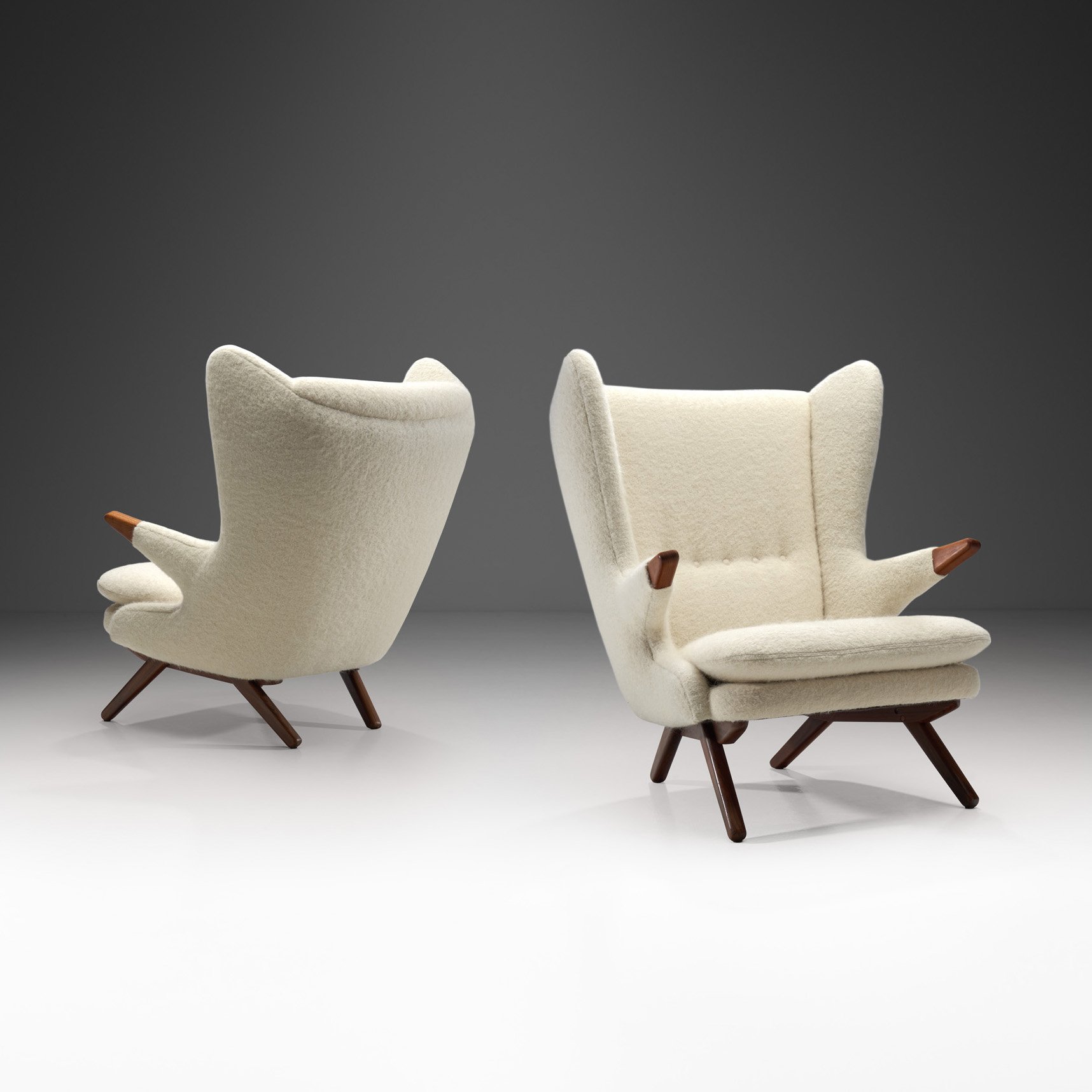
This pair is the most recognizable model of Danish designer and manufacturer, Svend Skipper, and a great example of the mid-century era design. Skipper only created commissioned pieces, meaning none of his designs were mass-produced.
“Model 91” features a masterfully sculpted teak base and legs. The teak tips “poke out” at the end of the upholstered armrests, which is a very characteristic design element of this model. The high wing-back offers back support, while enveloping the sitter. It also features tufted buttons arranged in a single, horizontal line, adding to the visual interest of the piece. The loose cushion on the seat provides great sitting comfort while also adding to the welcoming look. These details create a sculptural silhouette that made this model popular already in its time.
The design was created in 1956 and this particular piece was manufactured by Skipper Møbelfabrik in the 1960s. For its resemblance to Hans J. Wegner’s “Papa Bear” chair, this model is often referred to by that name, however, “Model 91” was only made upon order. Skipper’s craftsmanship and quality can be observed in every single detail, from the exposed teak arms, to the distinctive shape and level of comfort.
Condition:
In good vintage condition. Wear consistent with age and use. The chairs have been reupholstered recently in premium light wool. Each of our items can be re-upholstered by our in-house atelier in a fabric of choice. Please reach out for more information.
Dimensions:
31.29 in W x 34.05 in D x 38.58 in H; Seat height 15.74 in
79.5 cm W x 86.5 cm D x 98 cm H; Seat height 40 cm
Literature:
Mobilia Volume 6 #73 August 1961, edited by Paul Henningsen & Gunnar Bratvold. Published by [Snekkersten: Mobilia, 1961]
About the designer:
Svend Skipper was a Danish furniture designer and manufacturer. Skipper Møbelfabrik was founded in 1955 by the namesake and has since produced seating furniture as a Danish craft for almost 6 decades. The manufacturer still exists, and “Model 91” has been relaunched in 2011 as a response to its growing popularity and rarity.
REQUEST PRICE HERE
Price category: 7,500 - 10,000 usd / eur
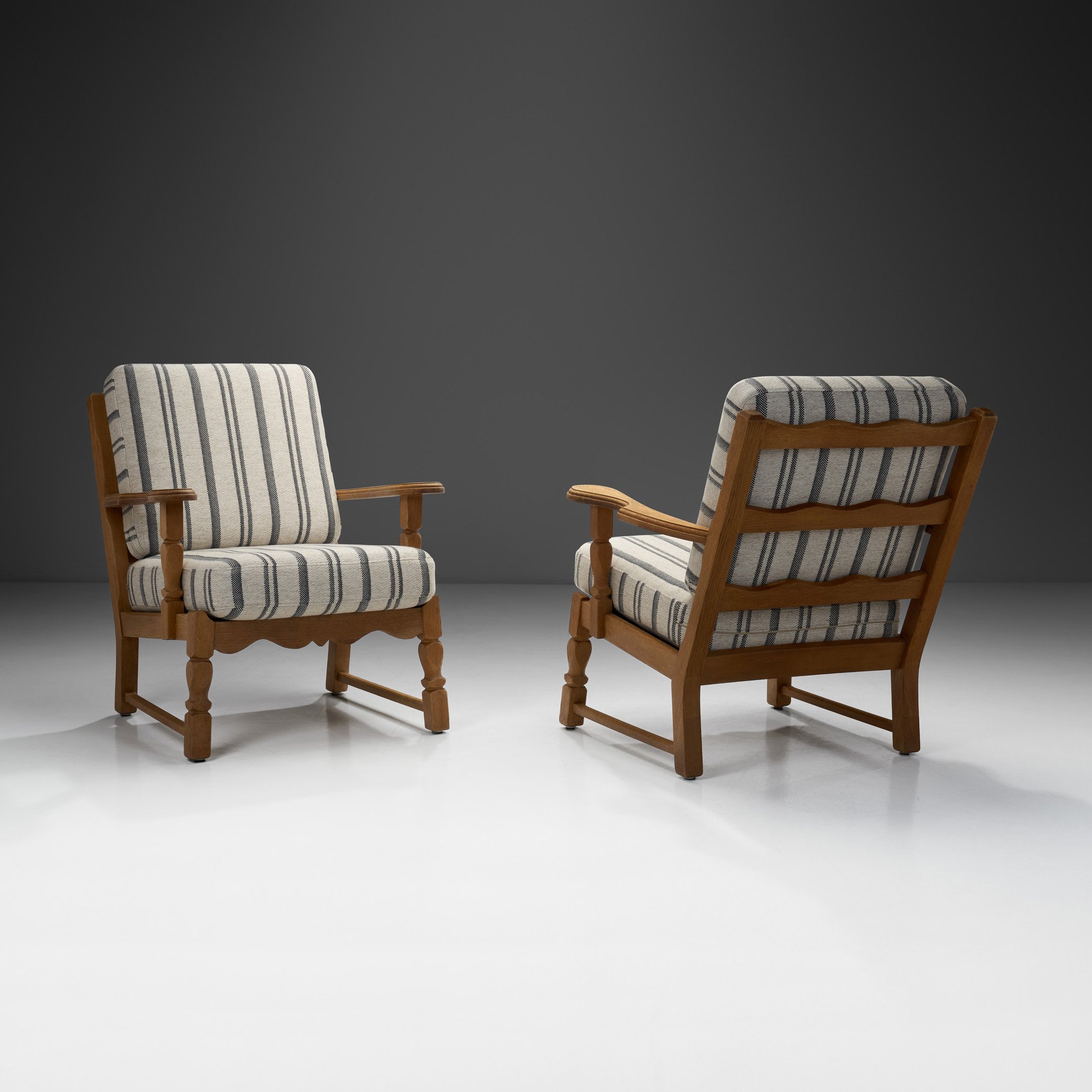
This pair of easy chairs is an elegant and comfortable evidence of the mastery and artistry of the Danish cabinetmaker, who, together with his contemporaries, largely defined mid-20th century modern seating.
These chairs feature stunning oak frames paired with fully upholstered cushions in a striped fabric. With a timeless and sturdy design, the pair is especially successful at balancing modernity and comfort. While made of solid wood, they have an open feel both from the back, thanks to the three horizontal slats that compose and divide the backrest, and from the front, through the open arms. The design plays with geometry in a masterful way. The curved lines of the armrests are beautifully crafted and follow the seat’s angle. These curves nicely contrast with the straight lines of the frame, keeping it from appearing too rigid. Thanks to the carved details the pair has an architectural feel. Furthermore, the light fabric works beautifully with the warm brown of the oak. The shape, ergonomic construction and perfect proportions show the thought and expertise that went into the creation of these chairs. The structure is robust, yet still appears elegant and delicate through its detailing. The chairs don’t have excessive embellishments, rather, the stylish upholstery and the beauty of the oak take on a decorative role.
This pair of easy chairs is the perfect illustration of how the combination of Danish design, the work of a true cabinetmaker, and well-chosen upholstery come together to create exceptional pieces. With its classically beautiful form and charming pattern, these chairs can truly elevate any interior.
Condition:
In good vintage condition. Wear consistent with age and use. Minor marks and scratches on wood. The chairs have been re-upholstered recently in a premium fabric. Each of our items can be re-upholstered by our in-house atelier in a fabric of choice. Please reach out for more information.
Dimensions:
27.95 in W x 31.1 in D x 32.87 in H; Seat height 16.53 in; Seat depth 19.68 in; Arm height 22.64 in
71 cm W x 79 cm D x 83.5 cm H; Seat height 42 cm; Seat depth 50 cm; Arm height 57.5 cm
REQUEST PRICE HERE
Price category: 15,000 - 20,000 usd / eur
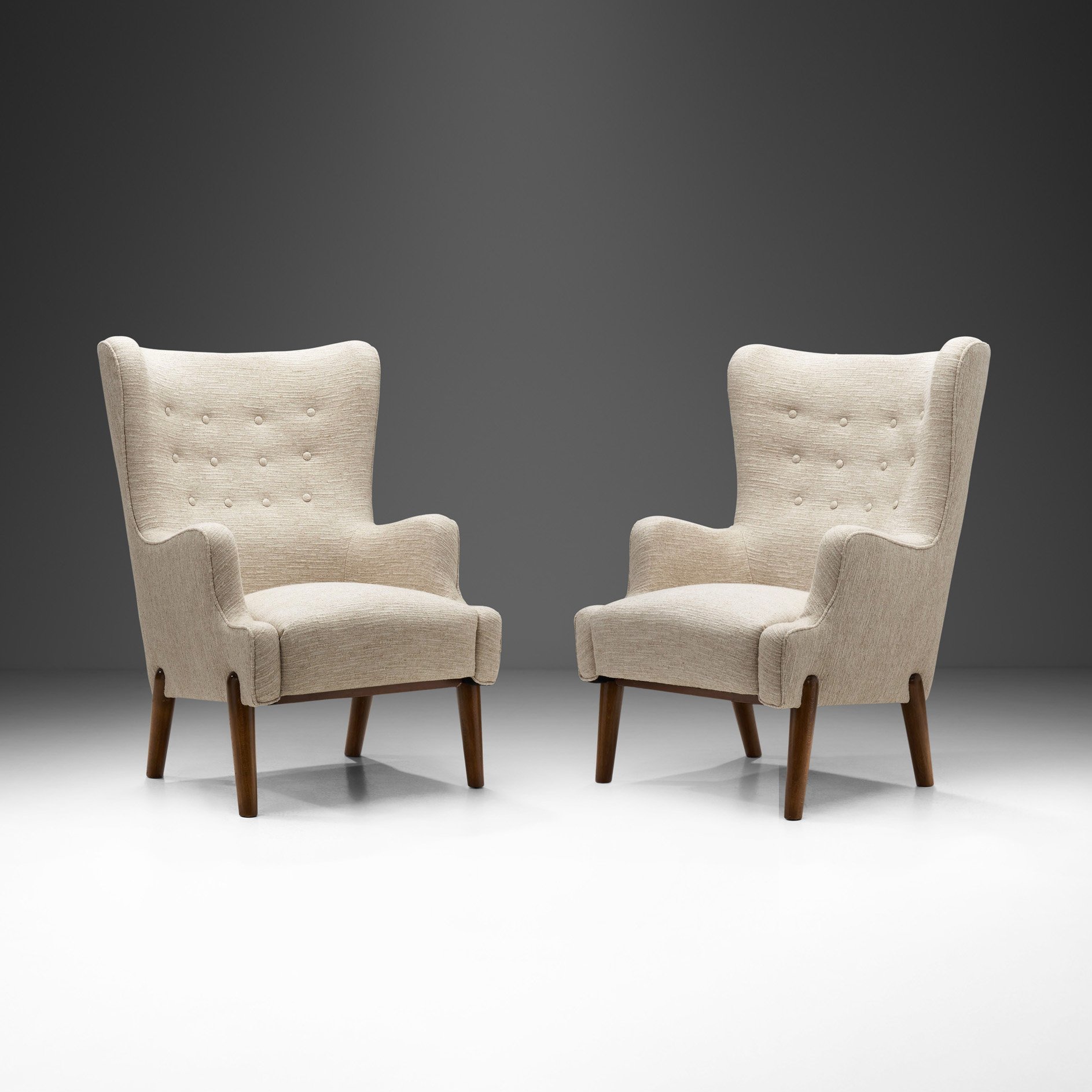
Eva and Nils Koppel met while she was studying at the Danish Academy, Copenhagen. Together they studied architecture and later worked in design icon Alvar Aalto’s office. Their furniture pieces are very representative of Scandinavian design - featuring organic shapes, architectural structure, and cosy upholstery.
This pair of chairs have some of the best characteristics of Danish modern design. The cosy and stylish elements of these chairs are especially distinctive of Eva and Nils Koppel’s work. These chairs feature a tiered side profile, starting from the “wings” on top, which step down into the arms and sides of the seats. The rounded edges contribute to the soft and cosy impression of the design, which is complimented by the unique legs that appear to gently clasp the bodies. The back legs are tilted slightly to support the seats. The dark stained, subtly tapered wooden legs pair beautifully with the light coloured fabric of the upholstery. The tufted buttons arranged in three lines enhance the wing-back shape of the backs, while the pairing of materials and colours give an elegant yet understated look to this model.
The Danish design idiom was centred around warm woods, quality fabrics and gentle but robust support for the spine - qualities that engender contentment and well-being, a defining characteristic of Danish culture. The Koppels’ exceptional architectural talent is evident even in these wing-back chairs, which are outstanding not only in the couple’s repertoire, but also among mid-century Danish chairs.
Condition:
In good vintage condition. The chairs have been reupholstered recently in a premium fabric. Each of our items can be reupholstered by our in-house atelier in a fabric of choice. Please reach out for more information.
Dimensions:
28.34 in W x 30.9 in D x 39.17 in H; Seat height 17.91 in; Arm height 23.22 in
72 cm W x 78.5 cm D x 99.5 cm H; Seat height 45.5 cm; Arm height 59 cm
About the designer:
Eva Koppel, born Eva Ditlevsen (1916-2006) and Nils Adolf Koppel (1914-2009) were a Danish functionalist architect couple who characterized the post-war era and the public building of the welfare society.
Nils and Eva Koppel met during their shared lectures at the Danish Polytechnic Teaching Institute in 1935, where Eva studied mathematics and Nils studied engineering. The same year, they applied to the Academy of the Arts' School of Architecture, where they were both admitted. The year after, in 1936, they got married.
During their studies between 1938 and 1939, they worked together in Finland at Alvar Aalto's design studio. In 1940, they had their first child and the following year they both graduated from the School of Architecture. Since Nils Koppel's father was Jewish, in 1943 they had to flee because of the Jewish persecution. They fled to Finland and resumed working at Aalto's design studio. In the years following the war, the couple designed a number of single-family homes, and set up a home of their own in 1946. Initially, they erected houses for family and friends, designed wallpaper, chairs, watches, light fixtures, and other art-industrial objects.
In 1954, their joint studio won the architectural competition for the Langelinie Pavilion, which was erected in 1958 and has been preserved. The pavilion's rigorous shape, slim profiles and its design as a 'floating' box are indebted to Ludwig Mies van der Rohe's school and the international style. The couple got their first big task in 1954 via family relations: The settlement Søllerød Park. Their house design managed to preserve the scenic parkland, and is now one of the great architectural classics for this time period.
The Koppel couple has received numerous awards and honours, including: The Wood Prize 1960, the Natural Stone Prize 1966 and the Eckersberg Medal 1955. Nils Koppel was also awarded the Knud V. Engelhardt Scholarship in 1951.

REQUEST PRICE HERE
Price category: 2,500 - 5,000 usd / eur
Danish furniture designer Illum Wikkelsø believed that furniture should be built to last, to indulge the body and to please the eye. He belonged to a group of designers who represented the “Golden Age” of Danish modern design during the mid-20th century era.
In a world increasingly filled with decoration, the Danish modern style chose to focus on designs that were simple yet meaningful. This simplicity wasn’t about lacking elements but about carefully choosing each one to have purpose and function, and these chairs exemplify that. Wikkelsø generally worked with clean lines, but also had a strong sense of organic expression and was deeply inspired by nature – especially the Danish landscape. He aimed to capture the beauty he saw in the environment around him in his furniture designs. In the case of these chairs, the frame is crafted from oak, an especially durable hardwood that is extremely multi-faceted with a beautiful grain. Oak became an important material in the Danish mid-century period. Furthermore, the precision of the structure and the woven cane is evident at first glance, showing great geometric order. The cane elements of the frame are woven in a tight, visually pleasing pattern. It is clear this model is entirely based on Wikkelsø’s artisanship, which hails from a generation of cabinetmakers, upholsterers and furniture producers established before the 1950s. This heritage shines through these chairs with a creative design that doesn’t compromise on quality. Extremely modest and confident at the same time is how this pair of chairs can be best described, showing great craftsmanship skill, and making them a lovely addition to any interior.
The Danish modern movement, rooted in the mid-20th century, was not a fleeting trend but a lasting shift in design philosophy. Its principles, grounded in simplicity, functionality, and a deep appreciation for natural elements, have not only withstood the test of time but have become foundational for many contemporary design approaches.
Condition:
In good vintage condition. Wear consistent with age and use. The chairs have been reupholstered recently in a premium fabric. Each of our items can be re-upholstered by our in-house atelier in a fabric of choice. Please reach out for more information.
Dimensions:
29.13 in W x 26.38 in D x 29.13 in H; Seat height 17.32 in; Seat depth 18.11 in; Arm height 25.20 in
74 cm W x 67 cm D x 74 cm H; Seat height 44 cm; Seat depth 46 cm; Arm height 64 cm
REQUEST PRICE HERE
Price category: 5,000 - 7,500 usd / eur
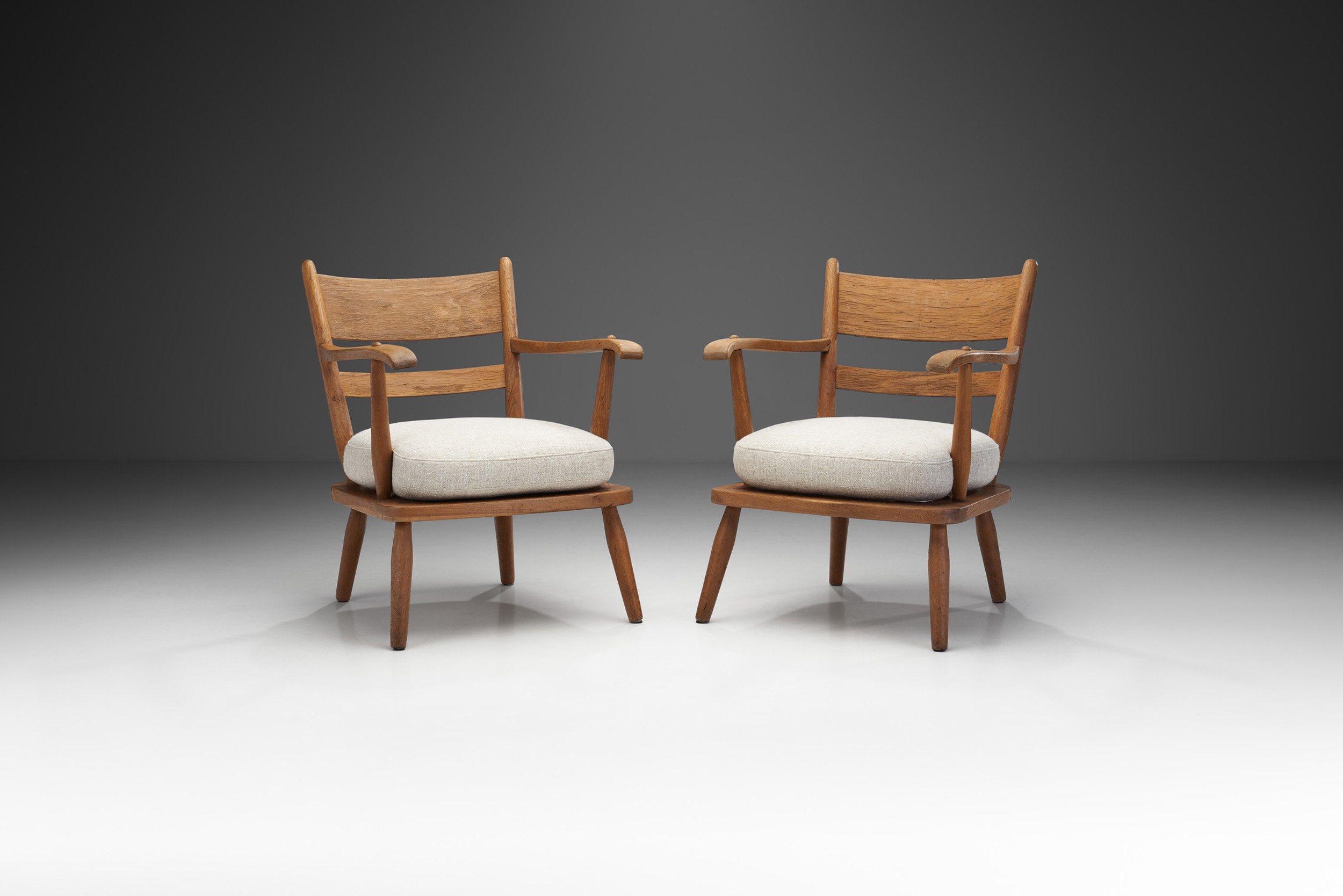
Most of the stunning minimalist designs from the turn of the century to the 1960s, termed "mid-century", captured the imagination of the world, especially Danish architect-designers’ whose creations of the era set the high bars for design.
The solid oak frames clearly indicate the designer’s knowledge of the human body. Massive and airy at the same time, the frames feature subtle design elements, such as the curved armrests, and the tilted backrests with parallel stretchers. While many Swedish designers stormed against functionalism in the 1940s, their ideas often coincided with the rational and frugal style ideals nonetheless. This can be perfectly observed in these armchairs. The design element that stands out the most is the minimalistic, straight seat that serves as a base for the plump, upholstered seat cushion in a wool blend fabric. Thanks to this, the chairs appear light despite the solid wooden bodies. This visual element creates an air of stylish calmness that is often associated with Scandinavian design.
The Danish design idiom was centred on warm woods, buttery fabrics, and gentle yet robust support for the spine - qualities that engender contentment and well-being, a defining characteristic of Danish culture. These chairs are therefore perfect examples of the early phase of the mid-century modern movement with a timeless design.
Condition:
In good vintage condition. Wear consistent with age and use. The seat cushions have been reupholstered recently in a premium wool blend fabric. Each of our items can be re-upholstered by our in-house atelier in a fabric of choice. Please reach out for more information.
Dimensions:
24.01 in W x 26.37 in D x 31.1 in H; Seat height 16.53 in
61 cm W x 67 cm D x 79 cm H; Seat height 42 cm
About the Designer:
This Danish-made sofa reflects the core traditions and ideals of Danish design. Mid-century pieces such as this sofa were of great design, using fantastic wood like teak or beech. The era was the heyday of the production by master craftsmen.
Mid-century Danish design is world-famous for the partnership between designer and manufacturer, resulting in ground-breaking creations. A master cabinetmaker is not a carpenter, as this was a rare breed of craftsman who had to be recognized by the Danish government after several years of toiling at his craft, as well as having to ace gruelling design competitions before becoming a master cabinetmaker. Since Denmark was a special instance of tempered industrialization, it managed to preserve sound traditions and continue to safeguard values of craftsmanship, materiality and usability.
Today, Danish furniture is sought after by collectors for its classic looks, storied designs and solid quality, works that are truly soulful and timeless. ~H.
REQUEST PRICE HERE
Price category: 5,000 - 7,500 usd / eur
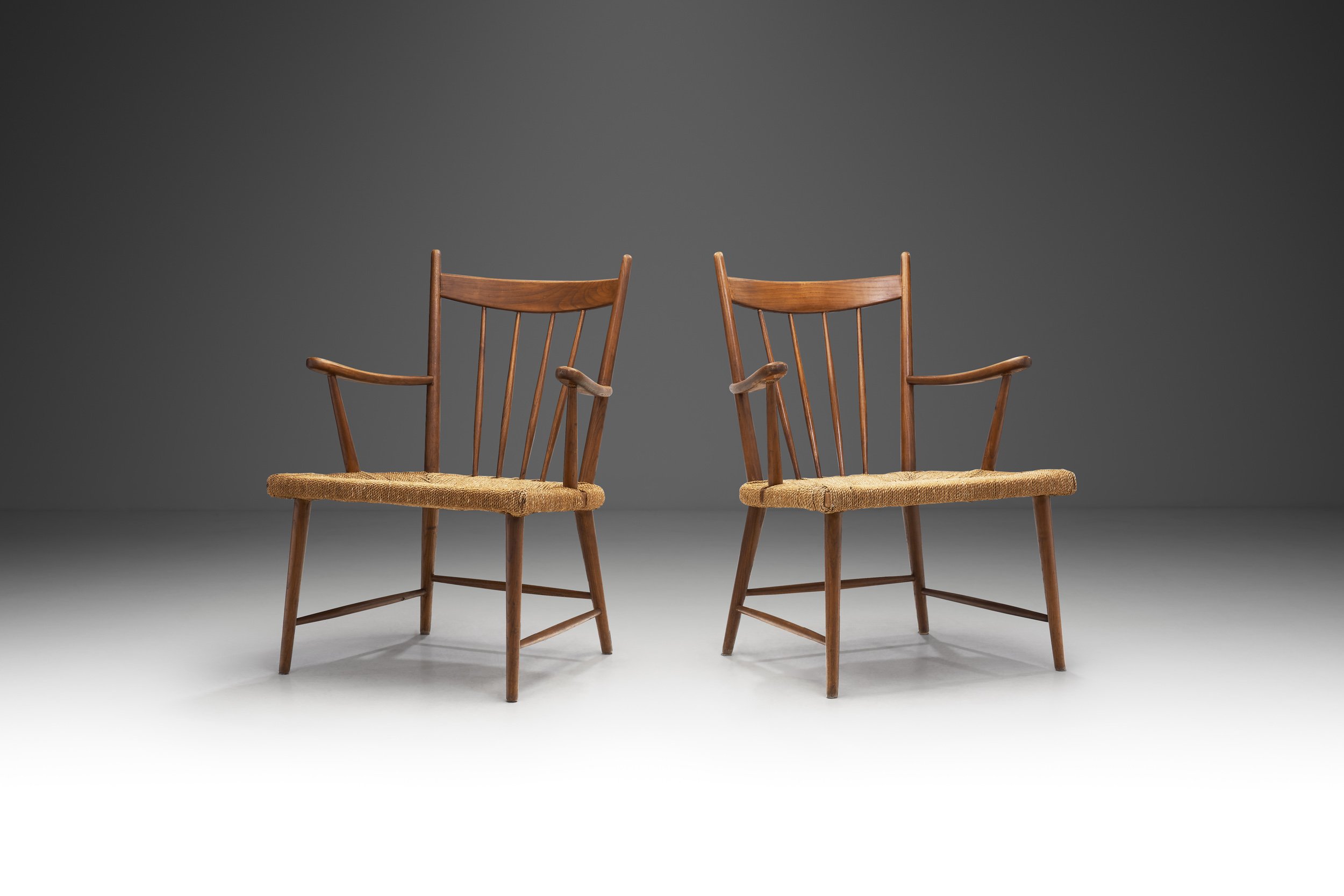
The designs of most of Danish mid-century modern furniture designers and architects aimed at functionality, an equally minimalist and appealing appearance and easy accessibility. This pair of slatback chairs with woven Danish paper cord seats is perhaps one of the best examples of these principles of the Danish modern design.
These beautifully shaped armchairs with a Shaker-like design clarity and honesty not only exude mid-century modern charm but also the organicity of wabi sabi and japandi style pieces. The most attention-grabbing visual element of this pair’s design are the backrests, with six wooden spindles that create an airy look that recalls the traditional slatback chair style. The lightly curved top rails and arms have a sculptural look, mimicked by the armrests that are also supported by a single bent slat in the front. This creates a unified appearance that highlights the diverse shapes and the natural beauty of the teak wood and its versatile grain. Interesting details are to be found everywhere in the design, including the perfectly fitted, woven paper cord seats and the uniquely arranged stretchers connecting the legs. As the lower structures with the legs and stretchers combine straight lines with smooth surfaces and a geometric arrangement, the design gains a sculptural look that is appealing from all angles. The structure displays a beautiful contrast between the smooth teak frames and the organic and textured Danish paper cord seats. One material that is often vastly underrated is Danish cord. Noteworthy for its durability, Danish cord is also beloved for its functional and aesthetic qualities. As the name implies, it is a product of Denmark that became an important material in the Danish Modern period of the 1940s and 1950s. Danish cord is a strong, three-ply, paper cord roughly 1/8” in diameter. Renowned designers such as Hans Wegner and Børge Mogensen employed Danish cord in some of their most iconic designs. The woven or basket form of seats of this pair of armchairs have a tight, visually pleasing pattern in great condition.
Extremely modest and confident at the same time is how these chairs can be best described. The most renowned Danish designers of the era preferred to work with traditional and natural materials, but also liked to experiment with new techniques; the resulting models - such as this pair - are Danish Modern classics.
Condition:
In good vintage condition. Wear consistent with age and use. Some small marks and scratches on the wood and the paper cord.
Dimensions:
24.8 in W x 24.01 in D x 33.66 in H; Seat height 16.14 in; Arm height 24.01 in
63 cm W x 61 cm D x 85.5 cm H; Seat height 41 cm; Arm height 61 cm
REQUEST PRICE HERE
Price category: 7,500 - 10,000 usd / eur
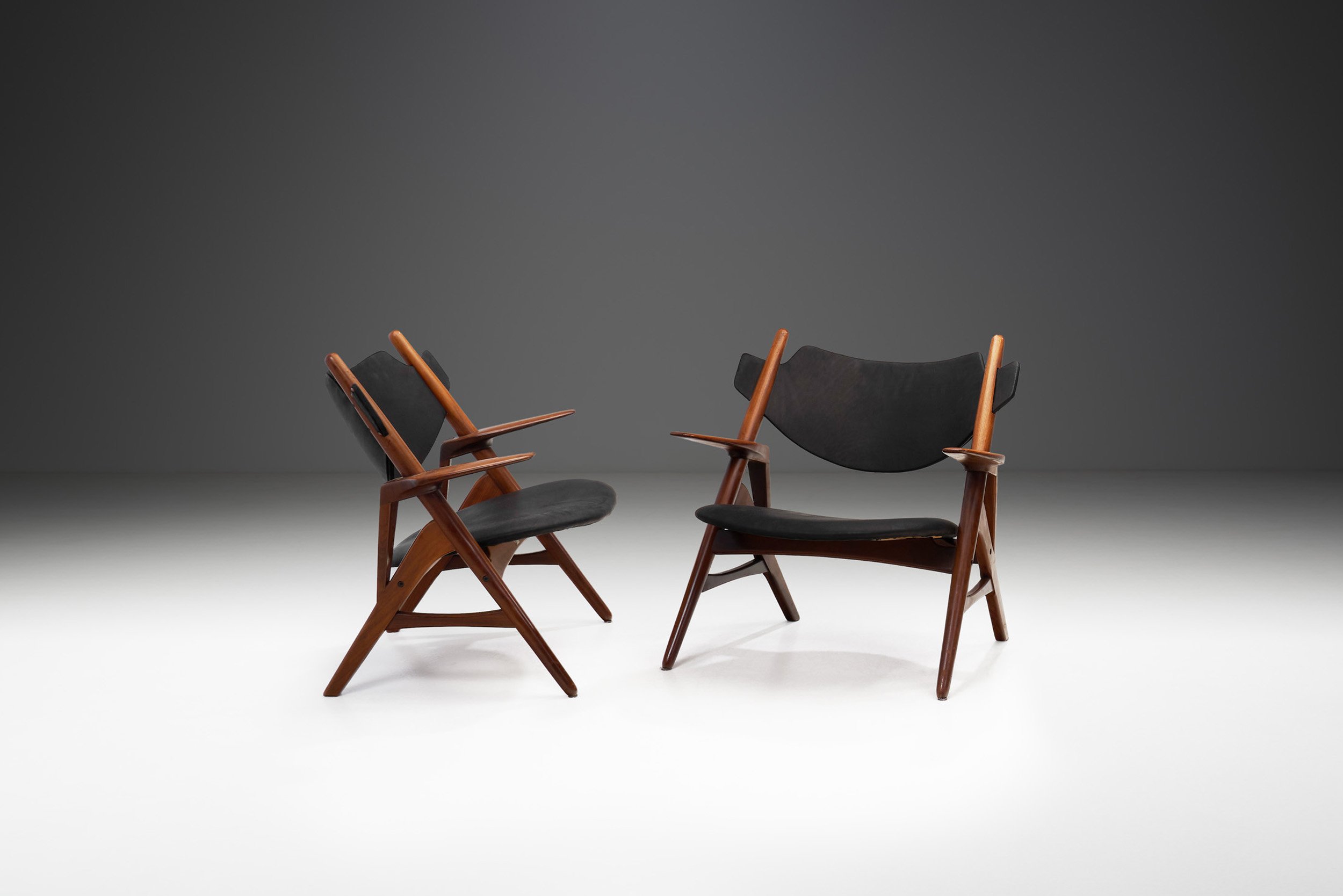
Danish Modern designers are the undisputed masters of mid-century modern chair design. As this pair shows, their furniture generally united form and function; in every design, they placed the highest demands on comfort and ergonomics. To Danish designers, a chair isn't just a piece of furniture, but a work of art made to support the human form, which especially stands for these chairs.
This set of two is a combination of good, solid details rooted in the tradition of the craftsmanship of Danish designers and craftsmen. With a clear preoccupation with geometry, this model’s outstanding architectural frame speaks of the mastery of the designer and of the producer. Still, all the decorative elements are in service of functionality, including the backrests piercing through the elongated front legs, the appealing angles of the seat, and the thick seats, arms, and triangular legs. There are numerous details that separate this model from the rest, such as the dovetail joinery connecting the armrests to the back and the front legs piercing through the former. The angles are also eye-catching enhanced by the exotic wood and the black seats and backs. The clearly lined wood frame contrasts beautifully with the black vinyl fabric. The refined linearity defines the overall aesthetic, with crisp, architectural lines. On the decoration front, the chairs aren’t in need of much thanks to the brilliance of the design itself, therefore the sole decorative element remains the design itself.
The design was created in the golden days of Danish mid-century modernism, when designers joined hands with master cabinetmakers to create products that last for a lifetime and eventually become heirloom pieces. Crafted with precision from solid wood, finished with a clear attention to detail and care for the aesthetic dimension as well, these chairs are sure to stand the test of time thanks to both their visual quality and construction.
Condition:
In good vintage condition. Wear consistent with age and use. The chairs are upholstered in a black vinyl fabric. Each of our items can be reupholstered by our in-house atelier in a fabric of choice. Please reach out for more information.
Dimensions:
29.72 in W x 24.4 in D x 29.33 in H; Seat height 14.96 in; Arm height 20.86 in
75.5 cm W x 62 cm D x 74.5 cm H; Seat height 38 cm; Arm height 53 cm
REQUEST PRICE HERE
Price category: 9,000 - 12,500 usd / eu
The difference between Danish mid-century and other furniture is that there was this partnership between the designer and the cabinetmaker that resulted in ground-breaking creations. These Great Danes believed furniture should be shorn of aesthetic detail and be an amalgam of form and function.
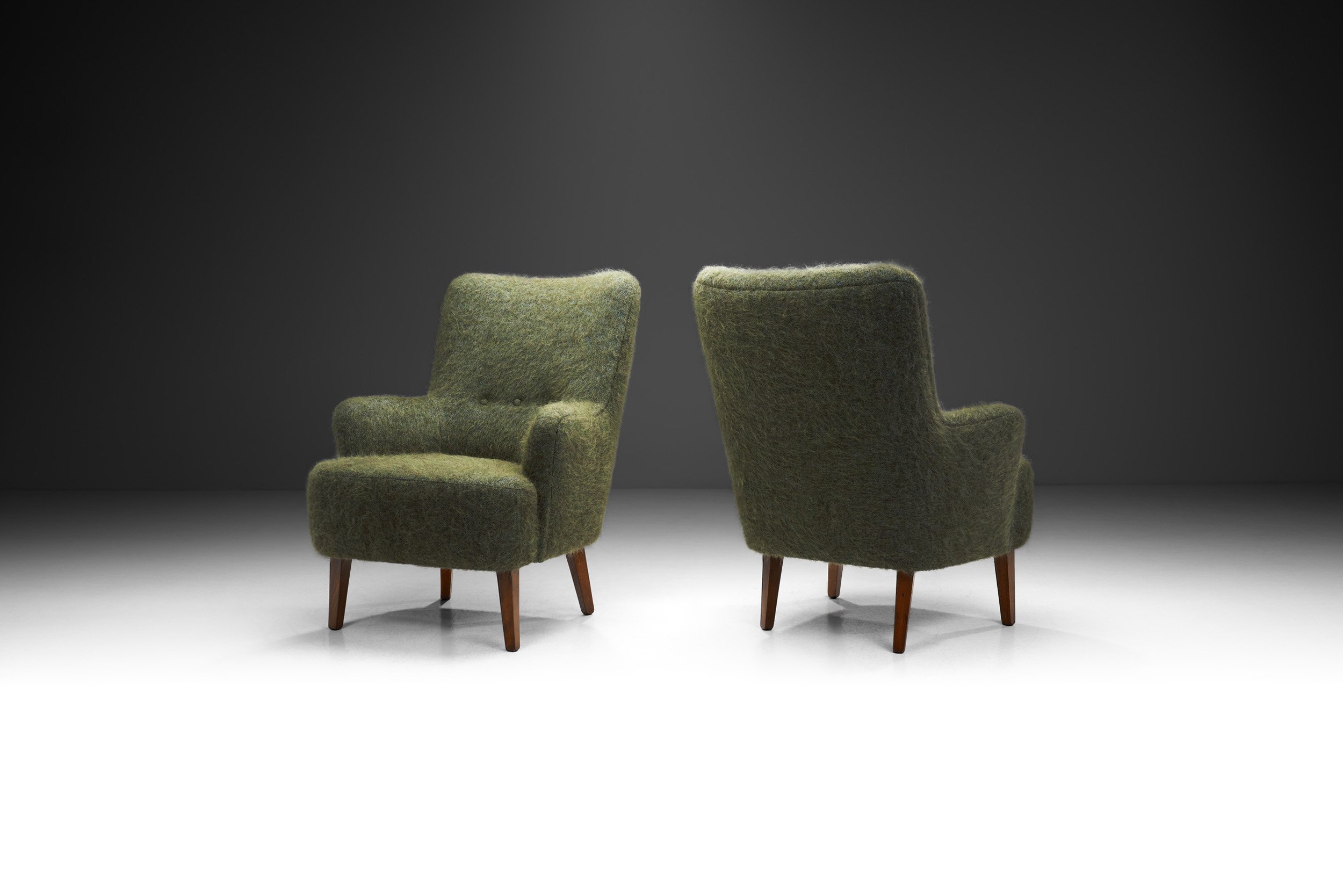
This pair of armchairs represent this sentiment both aesthetically and from a technical point of view. Denmark was a special instance of tempered industrialization, preserving sound traditions and safeguarding values of craftsmanship, materiality and usability. The gentle shape, ergonomic construction and perfect proportions show the thought and expertise that went into the creation of these chairs. The support is robust, yet the design appears light, while the slightly enveloping body creates the much coveted “hygge”, the soft cosiness and warmth. The bodies have a welcoming look, with an open construction and slightly bent backrests. In service of utmost comfort are the thick seat cushions that ensure sitting comfort, with the textured, soft wool blend upholstery elevating it even further. The green colour and texture of the fabric complements the tapered beech legs beautifully, highlighting their refined lines. This pair of armchairs is an elegant and comfortable evidence of the mastery and artistry of the Danish cabinetmaker, who, with his contemporaries largely defined mid-20th century modern seating.
The maker of this pair parlayed the wood into a modern, minimal, organic design that is soulful and timeless. These chairs’ main values are aesthetic refinement, economy of materials, usability, durability based on the tradition of arts and crafts.
Condition:
In good vintage condition. Wear consistent with age and use. The chairs have been reupholstered recently in a green wool blend fabric. Each of our items can be re-upholstered by our in-house atelier in a fabric of choice. Please reach out for more information.
Dimensions:
26.37 in W x 31.88 in D x 37.4 in H; Seat height 16.14 in; Arm height 22.44 in
67 cm W x 81 cm D x 95 cm H; Seat height 41 cm; Arm height 57 cm
REQUEST PRICE HERE
Price category: 9,000 - 12,500 usd / eur
This pair of armchairs is what we consider a timeless Danish Modern classic. The “ND83” was designed in 1952 by Nanna and Jørgen Ditzel for the exhibition 'Today’s Furniture, Home Equipment' in the Forum Hall Copenhagen in 1952.
Chairs are often considered especially revealing of a designer's skill because of the strict limits placed on their design by the demands of the human body. With this model, the Ditzels arrive at a clearly-structured solution in which a high degree of coherence is maintained while the chair appears visually light and open. The structure of the chairs is made entirely of solid oak. Each sculpted leg is made of a single piece of timber that ascend gently, giving stability to the curved backs. Rounded oak dowels plug the holes in which the fastenings for the back can be found -these help to create the elegant simplicity and honesty of the frame. The large curved backs extend up to the front, forming the armrests for a cosy and elegant profile similar to that of a tub chair. The elegance is further enhanced by the premium bouclé upholstery which complements the oak gracefully.
Cabinetmaker Søren Willadsen handcrafted these chairs, while them company Selig Co., imported them to the U.S. market from Denmark in 1952. The “ND83” model is still made to order today, however chairs – like these - from the original production show Ditzel and Willadsen’s true genius. The original marking on the wood is retained.
Condition:
In good vintage condition. Wear consistent with age and use. The chairs have been recently reupholstered in a premium bouclé fabric. Each of our items can be reupholstered by our in-house atelier in a fabric of choice. Please reach out for more information.
Dimensions:
30.9 in W x 25.98 in D x 26.96 in H; Seat height 14.76 cm
78.5 cm W x 66 cm D x 68.5 cm H; Seat height 37.5 cm
Literature:
Hanne Horsfeld Danske Designere, 'Nanna Ditzel', p.86
Oda Noritsugu, Danish Chairs, p.164
Per H. Hansen, Klaus Petersen, Den Store Danske Møbelguide, p.77