
Curved Sofa by Otto Schulz (attr.) for Boet Göteborg, Sweden 1940s (sold)
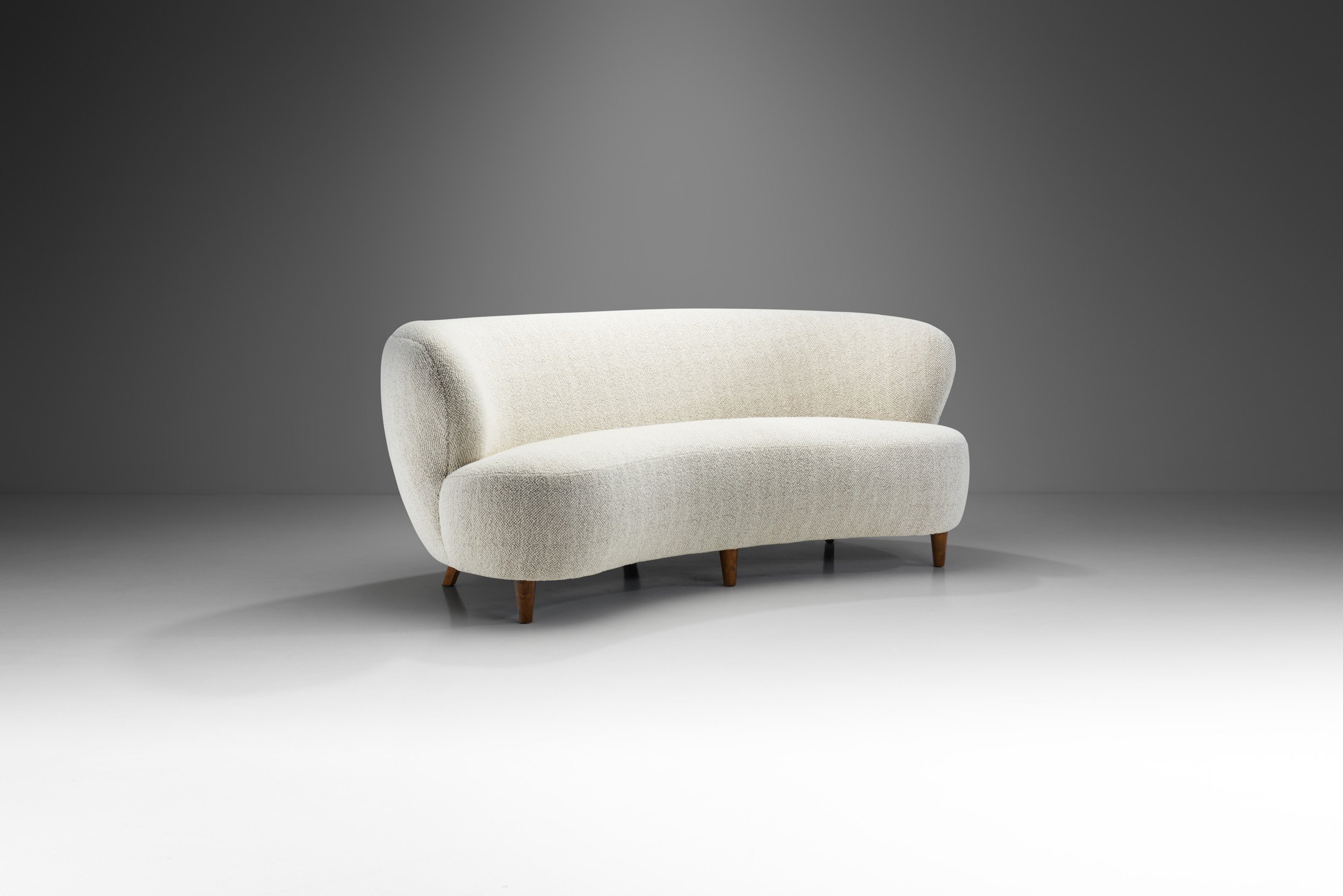


Curved Sofa by Otto Schulz (attr.) for Boet Göteborg, Sweden 1940s (sold)
Designed in the early phase of what we know today as mid-century modern, this curved sofa was produced by Otto Schulz's legendary own company, BOET in Gothenburg. In 1941, the production was transferred to the newly started Jio Möbler factory in Jönköping, which is why sometimes the latter is named as the manufacturer.
With its classic shape paired with modern design, the generous size and fully upholstered body, this sofa model is outstanding, even when measured to the many beautiful banana sofas created in Sweden during the 1940s. The large, curved backrest follows the curve of the voluptuous seat, creating an inviting and open look. This shape is referred to as the ‘banana’ in furniture design, and is perfect to bring people closer together. From the back, the sheer volume becomes even more apparent, and it seems unlikely to be supported solely by the exposed, tapered legs. And yet, the solid wooden legs provide perfect stability and visual appeal. Wood is the most important material in Swedish mid-century design, and the luxurious light bouclé upholstery highlights and complements the beautiful colour of the beech wood. Furthermore, the six legs provide the sofa with visual lightness, balancing out the sizeable body.
Otto Schulz was a German-born architect, designer, and publisher, active for over 40 years in Gothenburg, Sweden. There, he established Boet, one of Sweden's most prestigious interior design shops. As this sofa shows, Schulz was not only a brilliant designer and architect, but also excelled in producing his designs that came to be part of Swedish design history.
SOLD
Condition:
In good vintage condition. Wear consistent with age and use. Recently reupholstered in premium bouclé fabric.
Dimensions:
80.7 in W x 41.33 in D x 33.46 in H; Seat height 18.11 in
205 cm W x 105 cm D x 85 cm H; Seat height 46 cm
About the Designer:
Otto Schulz (1882-1970) was a Swedish interior designer, furniture designer, publisher and founder of the furniture company BOET in Gothenburg.
Schulz was born in Germany and moved to Sweden in 1907. He mainly produced opulent upholstered furniture, as well as lavishly inlaid, decorative box furniture style-wise between functionalism and traditionalism. He has some of his own invented techniques patented, including the use of decorative nails as part of the design, called Bopoint. After establishing his own furniture company, BOET, he used it as a showroom to exhibit his designs as well.
In the 1920s he started publishing the eponymous magazine BOET, which was also a platform for his own collection. The magazine was at the time the most influential, appearing in regular editions in Sweden and often included interviews with well-known designers and architects. ~H.
REQUEST PRICE HERE
Price category: 12,500 - 15,000 usd / eur
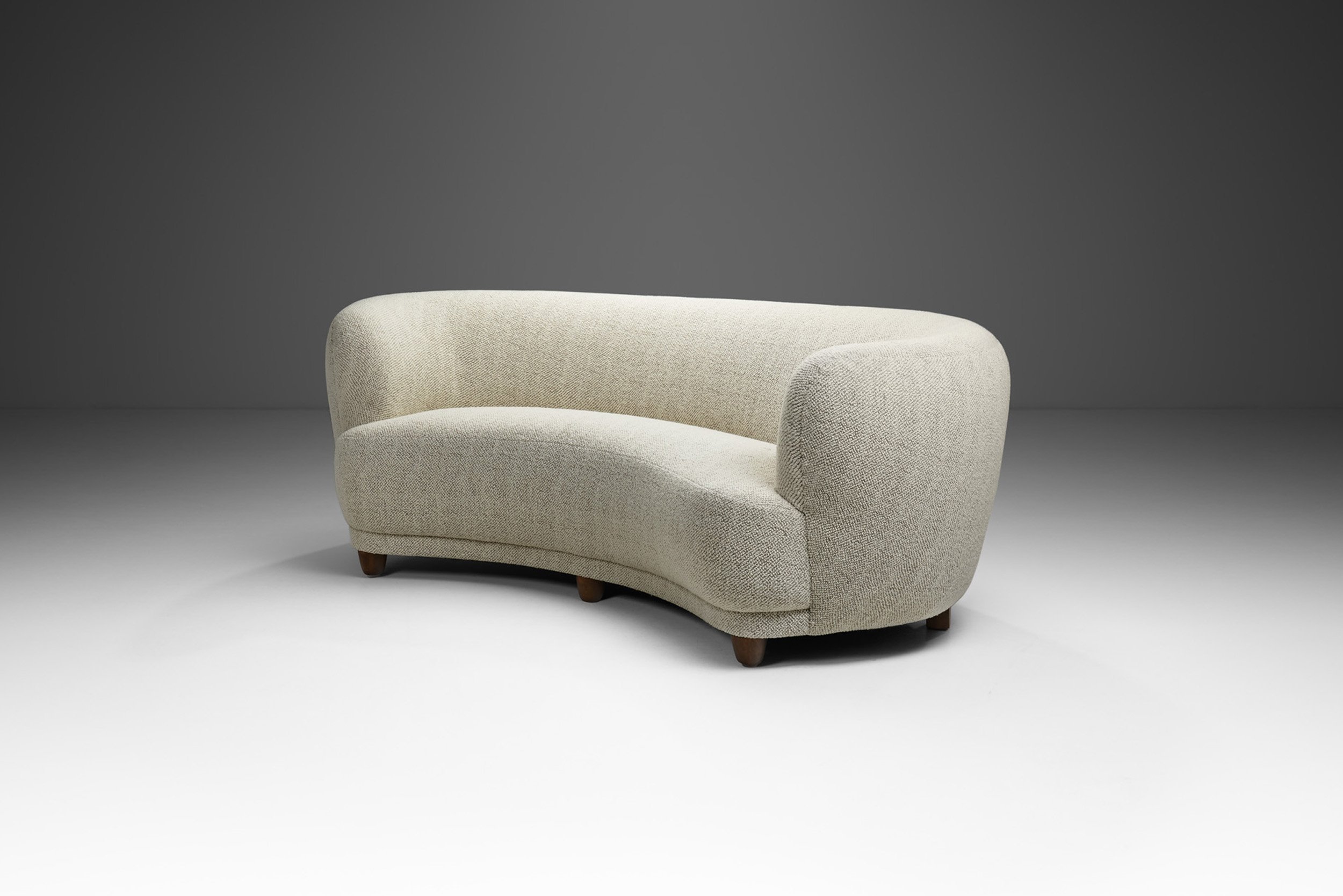
This beautiful Danish three-seater sofa features the recognizable touch of Danish Modernism: exquisite materials, craftsmanship, and an elegantly curved shape, because of which this type of sofa is often referred to as the “banana” or “boomerang” style.
The visual appearance of this sofa echoes Danish design and directs the eyes to the voluptuous body, that is the result of the exquisite craftsmanship. Many of the well-known Danish architects of the era felt the urge to try their hand at three-seater sofas, adhering to the period’s streamlined modernism. In combination with the unadorned styles of mid-century design, this sofa brings together the best attributes of the era. The rounded conical wood legs add an organic feel, while also matching the rounded profile of the sofa. The back legs differ from the front ones as they are tapered to reinforce the sofa’s stability. The masterful sense of proportions, the curved back and the soft upholstery guarantee functionality and comfort. While most curved sofas of the era feature tufting and other forms of decoration, this model is free from unnecessary ornamentation, resulting in a sleek, elegant and modern look. This sofa has been reupholstered in a premium light bouclé fabric, accentuating the stained wooden legs and the luxurious feel and look.
Derived from the French word meaning “curled” or “ringed,” bouclé provides a unique range of benefits; it is abundant in texture yet breathable. This durable fabric makes for an easy way to add instant texture and interest to any modern space, and despite its resurgence around 2020, is a timeless trend with longevity that will stand the test of time. Bouclé pairs incredibly well with curvilinear shapes as demonstrated by this sofa.
Condition:
In good vintage condition. Wear consistent with age and use. The sofa has been reupholstered recently in a premium bouclé fabric. Each of our items can be re-upholstered by our in-house atelier in a fabric of choice. Please reach out for more information.
Dimensions:
78.14 in W x 43.50 in D x 29.13 in H
200 cm W x 110,5 cm D x 74 cm H
About the Designer:
This Danish-made sofa reflects the core traditions and ideals of Danish design, while recalling the shapes of the Art Deco movement. What both movements valued highly is the highest level of craftsmanship and attention to details.
Mid-century pieces such as this early sofa were of great design, using fantastic wood like teak or beech. The mid-century was the heyday of the production by master craftsmen. Mid-century Danish design is world-famous for the partnership between designer and manufacturer, resulting in ground-breaking creations. The Danish design idiom was centred on warm woods, quality fabrics and gentle yet robust support for the spine - qualities that engender contentment and well-being, a defining characteristic of Danish culture. The “Great Danes” believed furniture should be shorn of aesthetic detail and be an amalgam of form and function.
A master cabinet-maker is not a carpenter, as this was a rare breed of craftsman who had to be recognized by the Danish government after several years of toiling at his craft, as well as having to ace gruelling design competitions before becoming a master cabinet-maker. Since Denmark was a special instance of tempered industrialization, it managed to preserve sound traditions and continue to safeguard values of craftsmanship, materiality and usability.
Today, Danish furniture is sought after by collectors for classic looks, storied designs and solid quality, works that are truly soulful and timeless. ~H.
REQUEST PRICE HERE
Price category: 20,000 - 30,000 usd / eur
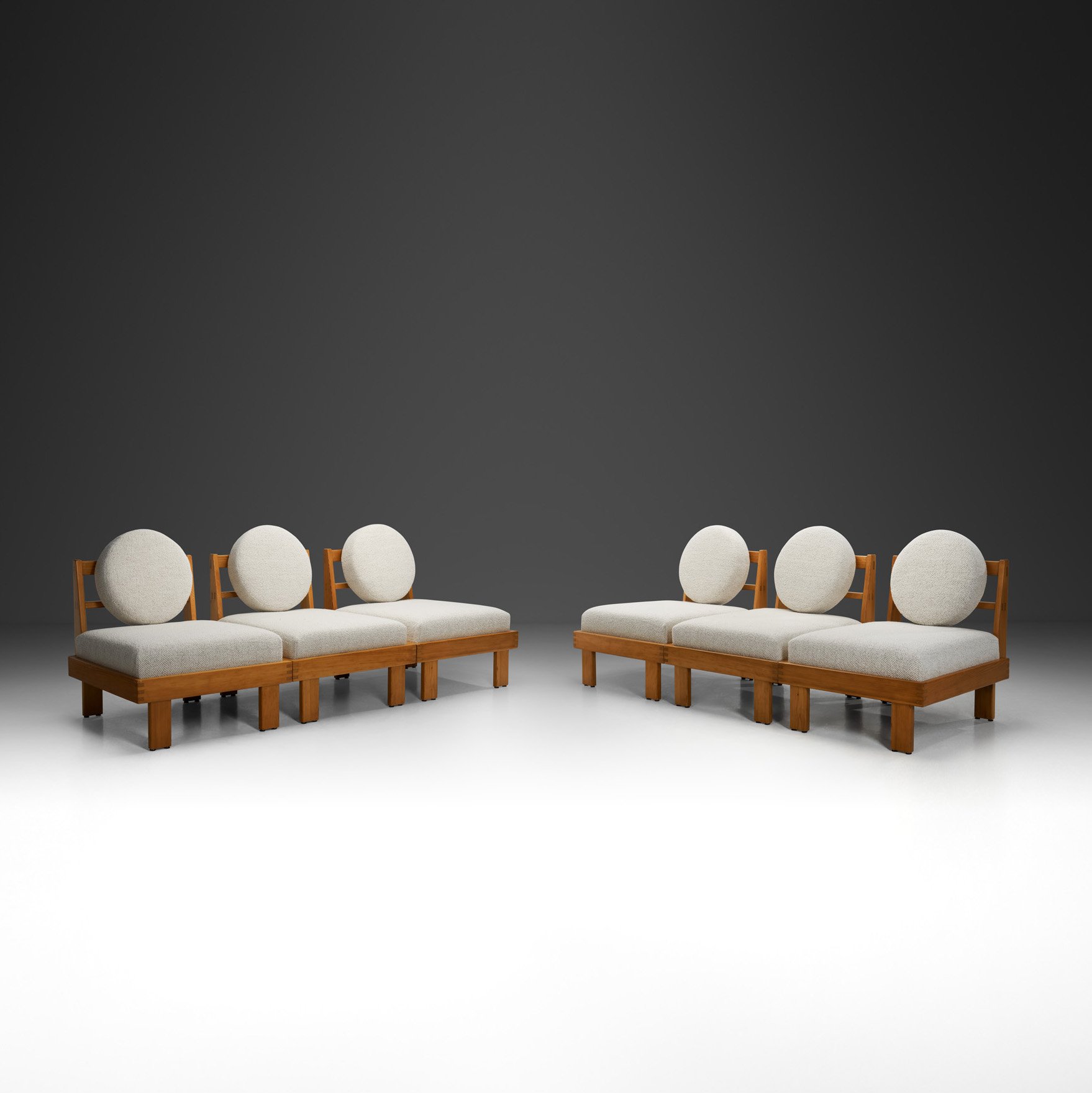
During the mid-20th century European designers turned their attention to rethinking domestic comfort, exploring how new ideas of form and proportion could transform the experience of sitting and living. Moving away from traditional ornament and into a culture of experimentation, they began focusing on honest materials, balanced lines, and structure. This was a period when modernism evolved into a human-centered vision of living.
This pair of modular sofas capture that spirit with its thoughtful interplay of geometry and tactility. The frames, crafted in solid wood with box joinery, celebrate craftsmanship while maintaining a striking simplicity. The low, grounded stance gives the pieces a quiet strength, while the broad seats invite relaxed, informal lounging. To complement the solid frame, the backrests feature circular cushions, an unexpected sculptural element that softens the sofas’ rectilinear frames and adds visual interest without unnecessary embellishment. Upholstered in richly textured bouclé fabric, the sofas pair a tactile, inviting surface with the clean lines of their timber base, achieving a compelling balance between warmth and restraint. The traditional joinery details are left visible, underscoring a mid-century belief in structural honesty and the inherent beauty of well-made construction.
As a pair, the sofas are both understated and iconic, a reminder that modern design is not about excess, but about clarity and intention. More than just a functional pair, they reflect a postwar European ethos that embraced innovation while remaining deeply connected to craft and the human experience of comfort.
Condition:
In good vintage condition. Wear consistent with age and use. The sofas may have some marks, scratches, and discolouration due to the age and nature of the materials. The cushions has been recently reupholstered in a premium fabric. Each of our items can be reupholstered by our in-house atelier in a fabric of choice. Please reach out for more information.
Dimensions:
27.36 in W x 31.10 in D x 31.50 in H (including cushion); Seat height 16.93 in; Seat depth 20.47 in
69.5 cm W x 79 cm D x 80 cm H (including cushion); Seat height 43 cm; Seat depth 52 cm

REQUEST PRICE HERE
Price category: 9,000 - 12,500 usd / eur
Rino Levi was one of the pioneers of the modern movement in Brazil, advocating for simple, practical and economical design, disparaging the imitation of classicism. ‘Classical spirit’ rather than classical forms was his ideal.
Levi was instrumental in spreading the fame of Brazilian modernism through his furniture designs as well. As this beautiful Brazilian wood sofa shows, by the 1960s, Levi abandoned Italian rationalism in favour of an approach closer to that of the Rio modernists both in his architectural and furniture designs. As a piece of true Brazilian mid-century design, the beauty of the wood and organic shapes and lines dominate this three-seater sofa. The tilted, architectural lines of wood making up the armrests create a visually distinct and exciting appearance. The additional horizontal lines connecting to the backrest are a creative addition, while also supporting the overall stability. The frame with its joinery praises Rino Levi’s craftsmanship and architectural expertise. The beautiful colour of the wood is highlighted by the light upholstery of the body in a premium bouclé fabric, including the three removable cushions.
This sofa model is rare to find, for as during Brazil's military dictatorship, it was against the law to export furniture. The ban on exports only ended in the 1980s, but it still took some time for things to change, not to mention that handmade pieces were created in limited editions. Therefore, it is no exaggeration to say that this sofa is special, and a real rarity.
Condition:
In good vintage condition. Wear consistent with age and use. Some scratches and marks on the wood. The sofa has been reupholstered recently in a premium bouclé fabric. Each of our items can be re-upholstered by our in-house atelier in a fabric of choice. Please reach out for more information.
Dimensions:
86.41 in W x 28.74 in D x 30.31 in H; Seat height 16.14 in
219.5 cm W x 73 cm D x 77 cm H; Seat height 41 cm
About the Designer:
Rino Levi was a Brazilian architect important to the development of modernism in Brazil. Levi was born to Italian Jewish parents on December 31, 1901 in São Paulo, Brazil. After graduating from Colégio Dante Alighieri in São Paulo, Levi studied in Milan and Rome under Marcello Piacentini.
In 1924, he moved to the School of Architecture of Rome. There, he met Adalberto Libera (1903 - 1963) and Marcello Piacentini (1881 - 1960) in whose office he did practice. In 1925, he published in O Estado de S. Paulo. He returned to Brazil in 1926 and worked for a year in the Santos Construction Company.
Following his return to São Paulo, Levi established the firm Rino Levi Arquitetos Associados. Levi was known for an architectural practice particularly dissociated from the construction process for his era. In the early 1930s, Levi designed a number of modernist houses in São Paulo for Italian clients. Towards the end of the decade, Levi's practice shifted to the design on theaters including the Cine Ufa Palace and Teatro Cultura Artistic.
His first major work was the Columbus Building at Avenida Brigadeiro Luís Antônio (first apartement complex in the metropolis, demolished in 1971 ), the Cine Ufa Palace in St. John Avenue, the Medici residence in Santo Amaro and Sarti Building in Republic Square. These rationalist buildings have simple volumes, with evident structure. The project Cine Ufa Palace (1936) was a role model for other cinemas projects: Cine Universe (1936), Cine Art-Palace Recife (1937), the Cine Ipiranga (1943) and the Theatre Culture Arts (1942).
Rino Levi participated in the formation and construction of the Institute of Architects of Brazil and was an active member until his death. He is remembered today as a key figure in introducing modernism to Brazil. ~H.
REQUEST PRICE HERE
Price category: 7,500 - 10,000 usd / eur
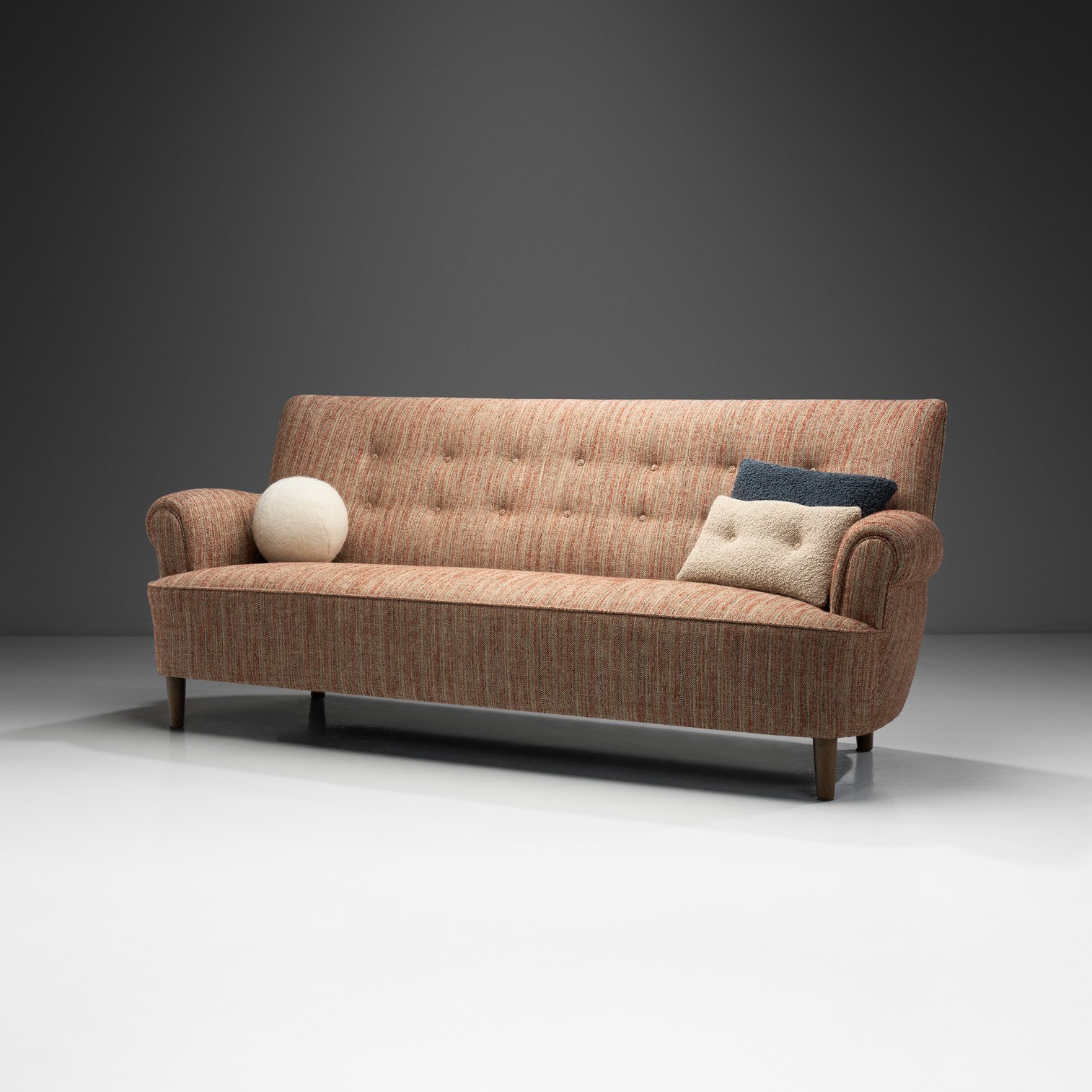
Carl Malmsten devoted his life to the renewal of Swedish craftsmanship, inspired to create furniture endowed with a creative simplicity, with functionality in mind and a high technical quality. His talent to innovate and produce unique pieces is showcased in his design of the “Hemmakväll” sofa.
From 1956 onward, O.H. Sjögren's Upholstery Workshop in Tranås became one of Carl Malmsten’s key production hubs that met all of the quality standards required. Their collaboration was followed by his exhibition at the Röhsska Museum of Design and Craft in Gothenburg where he showcased, for the first time, furniture designed for serial production. One of these series was dedicated to the family home, and included the “Hemmakväll” sofa (other items in the same series are also recognisable Malmsten pieces, such as “Farmor” and “Lillasyter”). This series inspired by familiar comforts evokes a special feeling or mood, which is also reflected in how he named his designs. “Hemmakväll” translates to “Home Evening”, evoking cosiness, joy and expressing the act of a family gathering. The design of this sofa aims to maximise comfort and function, while simultaneously putting an emphasis on elegance and refinement. This is most visible in the round, welcoming body and the eye-catching parallel lines of tufted buttons, all enhanced by the luxurious fabric of the sofa. The complementary geometrical pillows are accent pieces that add visual interest through a variation of textures, colours, and shapes. The sofa’s short, pine wood legs add a modern and organic feel, balancing out the voluptuous profile of the piece.
Carl Malmsten was - and still is - one of the most famous furniture designers in Sweden, who was also active in the cultural and political sphere of the country. He had a lasting influence on Swedish and contemporary furniture design, and was known for his devotion to ‘slöjd’ (traditional Swedish craftsmanship), which is visible in every one of his models. With this sofa, the ‘slöjd’ is combined with modern elements and luxurious upholstery to create stylish pieces with longevity for generations to come.
Condition:
In good vintage condition. Wear consistent with age and use. The pillows are newly produced. The sofa has been reupholstered recently in a premium fabric. Each of our items can be re-upholstered by our in-house atelier in a fabric of choice. Please reach out for more information.
Dimensions:
80.3 in W x 33.1 in D x 33.3 in H; Seat height 16.1 in; Seat depth 20.9 in; Arm height 24.4 in
204 cm W x 84 cm D x 84.5 cm H; Seat height 41 cm; Seat depth 53 cm; Arm height 62 cm
REQUEST PRICE HERE
Price category: 7,500 - 10,000 usd / eur
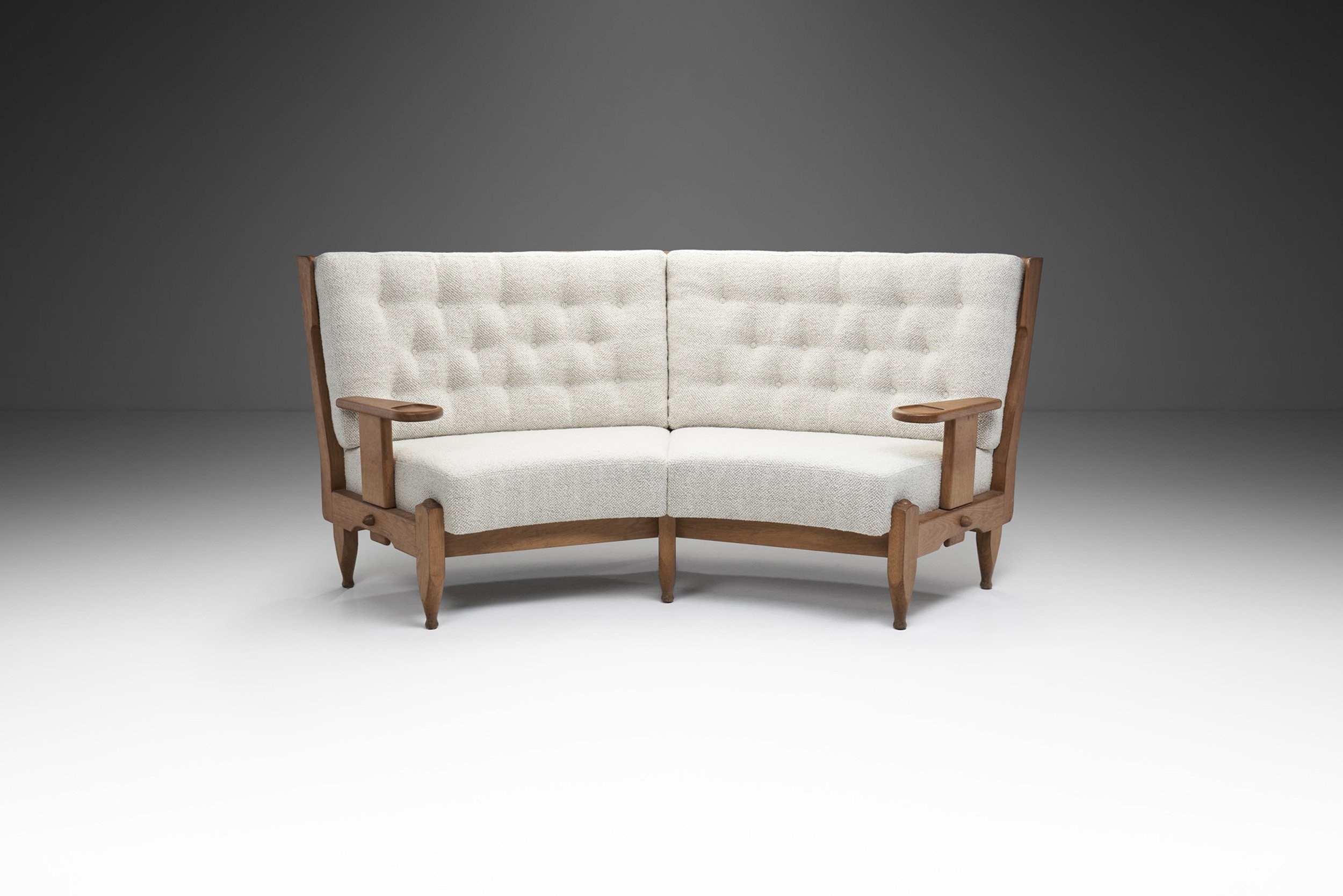
The best design characteristics of Guillerme et Chambron meet in this beautiful, artistic oak sofa. The duo’s designs are exceptional for a wide array of reasons, starting from the use of solid oak as the main material to the masterfully crafted details and carvings.
Guillerme et Chambron are known for their high-quality, solid oak furniture created for their own company, Votre Maison. Like most of their designs, this sofa model displays a beautiful contrast between the wooden frame and the elegant light fabric of the seat and back cushions. The backrest - which is undoubtedly the main design element - consists of eight, wide wooden spindles framed by oak rails on the top, sides and the bottom. The spindles widen in the middle and are hollow, creating a striking patter. The two sides of the sofa are joined in the middle at an angle that creates an appealing curve that further highlights the sculpted back. The backrest is slightly tilted for comfort, aided by the generous seat and back cushions upholstered in bouclé fabric. The armrests and legs have a peculiar shape, the former stand freely, unattached to the back with carved dents in the front, while the legs have a fluted shape. These details complete and distinguish the overall design, making this sofa unique and characteristic of Guillerme and Chambron at the same time.
The woodworking and joinery truly show the overall quality of this sofa, the frame is refined and the attention to the smallest detail shows the design and manufacturing skills of the French duo. Guillerme drew the furniture designs while Chambron played the part of salesman, and the pair was working with master cabinetmaker, Émile Dariosecq, whose workshop took charge of the manufacturing. Together, they defined new furnishings concepts.
Condition:
In good vintage condition. Wear consistent with age and use. Some minor scratches on the wood. This sofa has been reupholstered recently in a premium bouclé fabric. Each of our items can be reupholstered by our in-house atelier in a fabric of choice. Please reach out for more information.
Dimensions:
84.64 in W x 40.15 in D x 37 in H; Seat height 16.92 in
215 cm W x 102 cm D x 94 cm H; Seat height 43 cm
About the Designer:
Robert Guillerme graduated in 1934 from the École Boulle where he excelled in architecture and furniture design. After the Second World War he moved to Lille, in the north of France, where he decorated homes and designed furniture for the well regarded Rogier workshops.
In 1948, Guillerme was joined by his long-time friend, decorator Jacques Chambron in Lille. The following year Guillerme and Chambron met master cabinetmaker Émile Dariosecq, owner of a woodworking shop and the company Votre Maison was born. Together, they defined and imposed a new furniture concept. Thanks to their distinctive creativity, originality, and quality, the Votre Maison quickly became well-known.
The Votre Maison marked the history of French design. Guillerme drew the furniture designs while Chambron played the part of salesman, welcoming and advising clients. The power duo was complemented by Dariosecq, whose workshop took charge of the manufacturing. Together, they defined new furnishings concepts. Well-crafted chair back, polished wood and thick cushions make the reputation of their armchairs and sofas. Votre Maison continued to produce furniture right into the 20th century, with Jacques’s son Hervé Chambron, a designer and graduate of the École Boulle, having taken the over in 1983.

REQUEST PRICE HERE
Price category: 12,500 - 15,000 usd / eur
The term “Swedish Modern” was quickly established as a reinterpretation of the Modern style during the 1940s, where functionalism was replaced by a freer and more artistic ideal. Swedish Modern furniture is popular because it speaks to both our inclination towards uncluttered, tidy spaces and our desire to reside in inviting and comfortable settings.
There is a great balance in the execution of this sofa, which is achieved through the clever use of the undulating rounded edges of the upholstered body and the detail of the divot design on the front legs. The curving back and armrests are welcoming, and unmistakable of the era’s design inclinations, particularly in Sweden. The rich texture of the cozy upholstery gives the sofa a modern edge while also enhancing the generous size of the seat and back, creating a luxurious look and feel..
The short, decorated wooden legs add a modern and attractive touch, balancing out the voluptuous profile of the sofa. The masterful sense of proportions, the curved back and the soft seat cushion guarantee comfort and functionality.
Condition:
In good vintage condition. Wear consistent with age and use. The sofa has been reupholstered recently in a premium fabric. Each of our items can be re-upholstered by our in-house atelier in a fabric of choice. Please reach out for more information.
Dimensions:
74.80 in W x 37.79 in D x 31.88 in H; Seat height 16.14 in; Arm height 23.62 in
190 cm W x 96 cm D x 81 cm H; Seat height 41 cm; Arm height 60 cm

REQUEST PRICE HERE
Price category: 9,000 - 12,500 usd / eur
The mid-20th century marked a transformative period in interior design and architecture, with the rise of movements such as Scandinavian modernism forever influencing design history. This movement, rooted in minimalism and functionality, focused on creating designs that were both beautiful and practical. Influenced by a desire to merge art with everyday life, Scandinavian designers embraced clean lines, organic forms, and a deep respect for craftsmanship.
One prime example of this ethos is this 1940s sofa, which captures the essence of Swedish modernism with its graceful, curving form and understated elegance. The gently sloped backrest and arms create an inviting, soft silhouette, emphasizing comfort without compromising on style. The upholstery, in a neutral white tone, not only adds a sense of lightness to the design but also highlights the clean, minimalist lines of the piece. The soft texture of the fabric contributes to the comfort of the sofa, making it as functional as it is visually appealing. Defining the piece is the stained oak frame, which introduces warmth and a natural quality to the look. The oak’s rich finish contrasts beautifully with the light upholstery, adding depth and sophistication. The oak overlays flow along the armrests, creating a striking visual element that sets the sofa apart. The tapered legs further enhance the sofa’s elegant form, giving it a lightweight appearance that is balanced by the sturdy body.
The combination of natural materials, clean lines, and functional beauty exemplified by this piece is a testament to the lasting appeal of Scandinavian modernism. The fusion of beauty and practicality ensures that this piece remains relevant for modern living, offering both style and comfort in equal measure.
Condition:
In good vintage condition. Wear consistent with age and use. The sofa has been reupholstered recently in a premium fabric. Each of our items can be reupholstered by our in-house atelier in a fabric of choice. Please reach out for more information.
Dimensions:
64.56 in W x 35.82 in D x 32.28 in H; Seat height 17.32 in; Seat depth 18.89 cm; Arm height 25.19 in
164 cm W x 91 cm D x 82 cm H; Seat height 44 cm; Seat depth 48 cm; Arm height 64 cm

REQUEST PRICE HERE
Price category: 2,500 - 5,000 usd / eur
Swedish design is characterised by a minimal, clean approach that seeks to combine functionality with beauty. The mastery of Swedish designer and architect, Bertil Fridhagen lies in creating a model that is, as its name suggests, aristocratic and minimal at the same time. With a lack of a corresponding Swedish name, 'mid-century modern' describes the attributes that were popular during the middle of the 20th century.
This sofa follows the ideals of mid-century Sweden in a very visible way: its grounded silhouette and simple form, and the superficially set tufted buttons in long rows soften the look. This three-seater sofa, which is part of Fridhagen’s “Aristokrat” line, combines elements of classical and modern design with utmost quality. The solid wood beautifully frames the upholstered body, outlining the welcoming silhouette of the sofa. The frame has a stunning curvaceous design, with an outward-curving end that breaks the otherwise square shape. The embracing body’s curve enhances the beautiful original chenille upholstery with small deep-stitched buttons. Swedish design prefers colours rooted in nature, muted tones that aren’t screaming about their presence, but still attract the eye naturally. The sofa’s yellow chenille upholstery is a wonderful example of this ideal. The cushions are removable and reversible, adding to the comfort of the sitter.
Bröderna Andersson, the sofa’s manufacturer is first and foremost characterised by quality, Småland craftsmanship and professional pride. At Bröderna Andersson's, the entire production chain was under one roof. From the choice of wood species to the production of the frames, and careful attention so that the last seam is in place, quality is Bröderna Andersson’s word of honour.
Condition:
In good vintage condition. Wear consistent with age and use. The sofa can be reupholstered by our in-house atelier in a fabric of choice. Please reach out for more information.
Dimensions:
75.59 in W x 32.48 in D x 32.48 in H; Seat height 19.48 in
192 cm W x 82.5 cm D x 82.5 cm H; Seat height 49.5 cm
About the Designer:
Bertil August Julius Fridhagen was born on February 16 in1905 in Norra Sandsjö parish, Jönköping county, and was a renowned Swedish architect and furniture designer.
Bertil Fridhagen grew up in Bodafors. His father was a carpenter and he also started as a carpenter at AB Svenska Möbelfabrikerna in Bodafors, where he became the student of the architect Carl Erik Ekholm. Later, he decided to further his education at Konstfack in Stockholm. In a reversed way, Fridhagen started out gaining experience in cabinetry before completing his formal education in architecture.
He returned to Bodafors in 1937, where at first, he was employed at Sandsjö Möbelfabrik (1937-39) and then became chief architect at Svenska Möbelfabrikerna in Bodafors, where he succeeded his teacher, Ekholm. He became an important figure for the success of Svenska Möbelfabrikerna and in 1964 Bertil Fridhagen's models accounted for two thirds of home furniture production, which was an extreme success. For comparison, the much more well-known designer, Carl Malmsten's models accounted for a quarter. Bertil Fridhagen's biggest sales success was the combination series “Variett”.
Fridhagen won numerous prizes at various design competitions, including in Denmark in 1954, the California State Fair in Sacramento with the Librettserien in 1956, in Italy in 1966, 1968 and 1970 and in Tennessee in 1972. He also designed buildings, but above all interiors, he is remembered for the Bodafors church. The designer is remembered for his versatile models which are beautiful examples of Swedish design ideals.
REQUEST PRICE HERE
Price category: 7,500 - 10,000 usd / eur
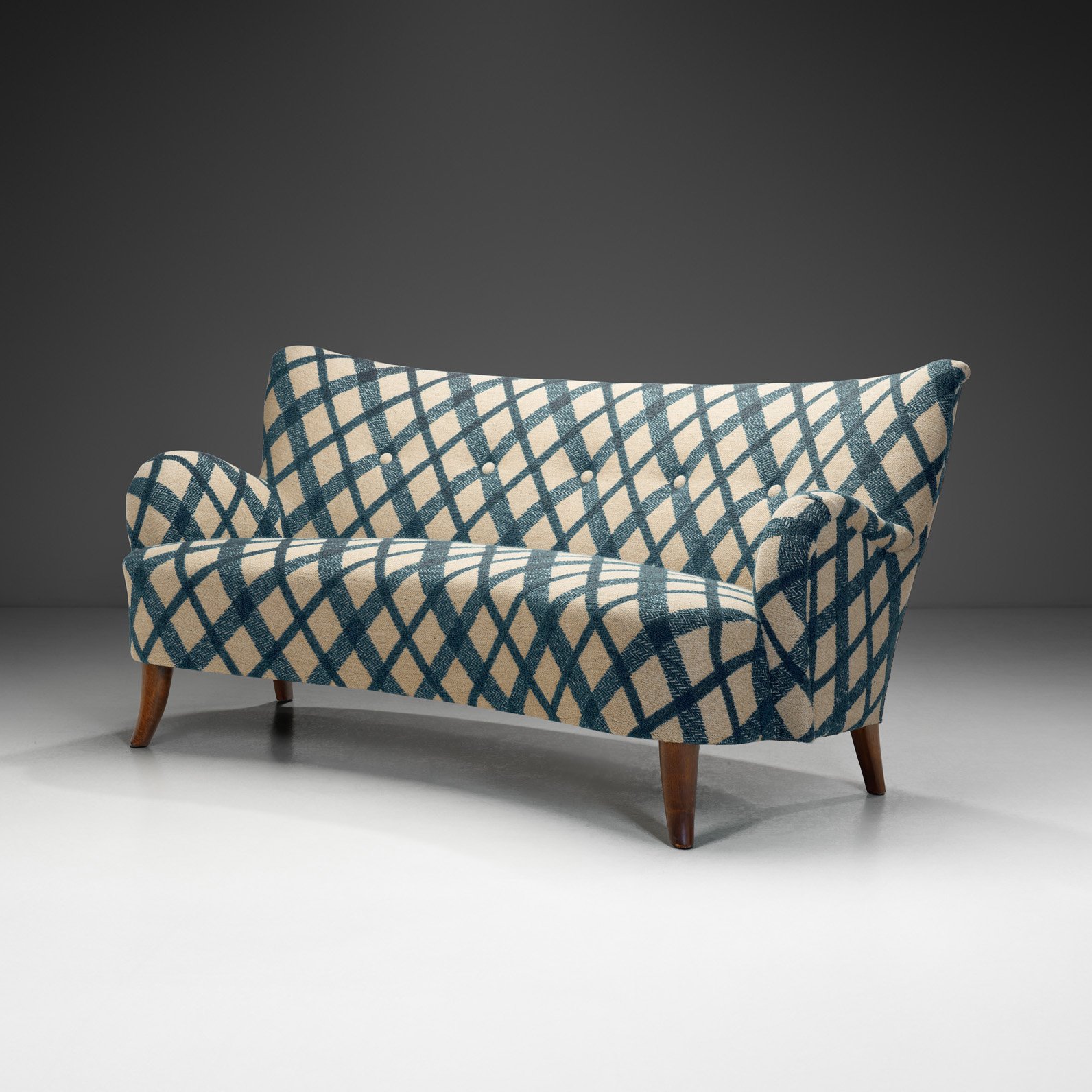
Sofas in general are considered statement pieces in any space. Scandinavian sofas, with their generous bodies, materials of the highest quality are the result of master cabinetmakers’ craftsmanship. The design of this sofa directs the eyes to the voluptuous, uniquely upholstered body, the result of the exquisite work of its maker.
Visually, this sofa represents modernism by rejecting the common design choices of styles from the past, such as heavy ornamentation and the prioritisation of form over function. The sofa’s upholstery stands out, adding to the modern elegance and cosiness of this piece. The design elements of this sofa - from the curved lines, to the dark wood and luxurious upholstery not only create an intimate gathering place, but also define the look of a room whilst maintaining the warmth and cosiness that is often associated with mid-century design. Its genius lies in the simplicity of its lines, such as with the slightly curved back which continues seamlessly down to form the curved armrests. The four solid wood legs add an organic feel, balancing out the voluptuous profile. The pairs of tapered legs assure great structural stability, while also enhancing the width of the sofa visually. This sofa is ideal for any space, as it utilizes its size in a smart and stylish manner. The legs’ wooden tones further allow the upholstery to shine through, and even represent a focal point of the piece.
This beautiful three-seater sofa speaks to the elegance and craftsmanship synonymous with the mid-century modern era. Its sleek silhouette, combined with the bold upholstery, ensures that it stands out in any room, creating a striking contrast against neutral backgrounds or complementing vibrant, eclectic decor. Not only this, but the use of the highest quality materials and meticulous craftsmanship ensures the longevity of the piece.
Condition:
In good vintage condition. Wear consistent with age and use. The sofa has been reupholstered recently in premium fabric. Each of our items can be re-upholstered by our in-house atelier in a fabric of choice. Please reach out for more information.
Dimensions:
68.11 in W x 37.8 in D x 33.07 in H; Seat height 18.5 in; Seat depth 21.25 in; Arm height 24 in
173 cm W x 96 cm D x 84 cm H; Seat height 47 cm; Seat depth 54 cm; Arm height 61 cm
REQUEST PRICE HERE
Price category: 9,000 - 12,500 usd / eur
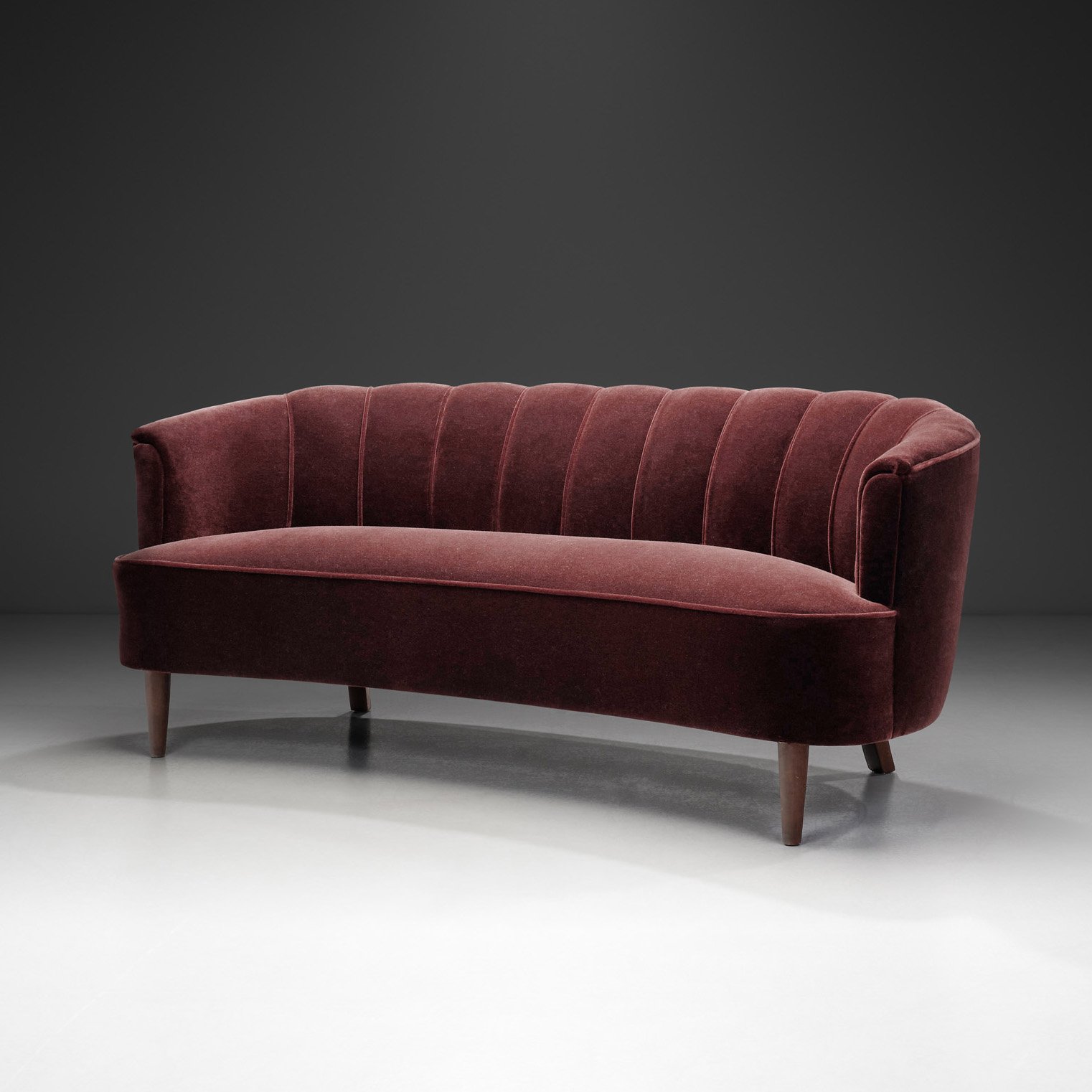
Designed in the early phase of what we know today as mid-century modern, this charming sofa is a unique example of how traditional Swedish craftsmanship was brought into modernism. A functional anchor piece is all that is needed to introduce mid-century modern flair to any interior.
The Swedish perspective on cabinetmaking is exceptional, which is why the country’s cabinetmakers’ craft remains world-famous. As an essentially Swedish Modern piece, this sofa is built around the core characteristics of the style: gently rounded edges, solid wooden legs, and a generous fully upholstered body. Accordingly, this sofa has a very precise, defined outline, accentuated by the visually sectioned back. There is a great balance in the design, which is achieved through the clever use of the straight and rounded edges of the upholstered body and the short wooden legs. The curving back and armrests are welcoming, and the rich texture of the upholstery gives the sofa a modern edge, while also enhancing the generous size of the seat and back. There is something more inviting about rounded shapes, which is true for the legs as well. The splayed, dark-stained wood legs further add to the modern, cosy feel, balancing out the voluptuous profile of the sofa. In combination with the unadorned styles of mid-century design, this sofa brings together the best attributes of the era. The masterful sense of proportion guarantees functionality and comfort.
Swedish master cabinetmakers have been creating products that last for a lifetime and become heirlooms. Crafted with precision from solid wood, finished with attention to detail and care for the aesthetic dimension, this sofa stands the test of time thanks to both its visual and material quality.
Condition:
In good vintage condition. Wear consistent with age and use. The sofa is upholstered in a premium fabric. Each of our items can be re-upholstered by our in-house atelier in a fabric of choice. Please reach out for more information.
Dimensions:
65.75 in W x 32.67 in D x 28.15 in H; Seat height 19.68 in; Seat depth 19.09 in; Arm height 25.59 in
167 cm W x 83 cm D x 71.5 cm H; Seat height 50 cm; Seat depth 48.5 cm; Arm height 65 cm
REQUEST PRICE HERE
Price category: 9,000 - 12,500 usd / eur
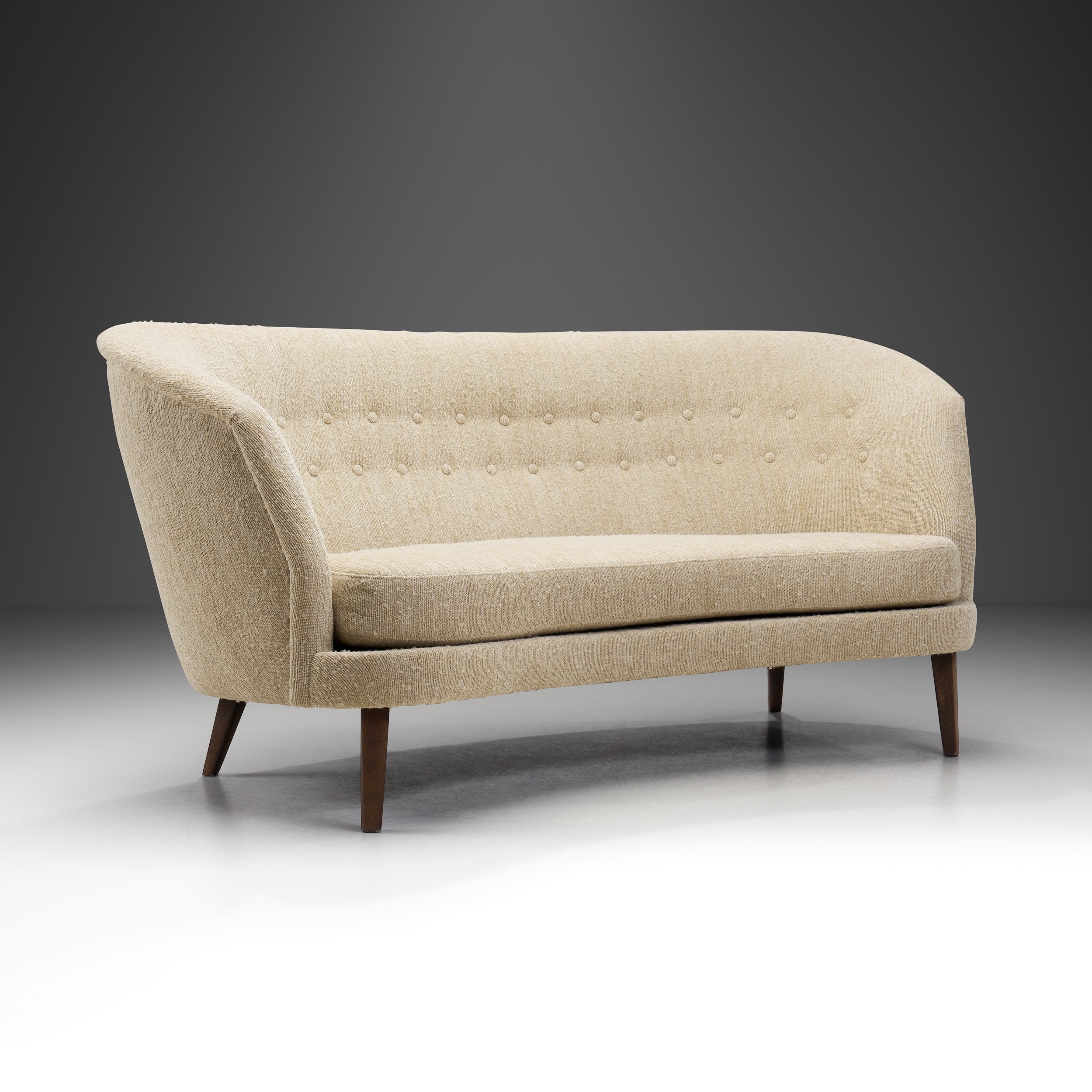
Designed in the early phase of what we know today as mid-century modern, this charming sofa is a unique piece of evidence showing how traditional Swedish craftsmanship was brought into modernism. The Swedish perspective on cabinetmaking is exceptional, which is why the country’s cabinetmakers’ craft remains world-famous. As a quintessentially Swedish Modern piece, this sofa is built around the core characteristics of the style: gently rounded edges, solid wooden legs, and a generous fully upholstered body.
This sofa has a solid wood frame with carefully thought out proportions. The design appears very open, which is the result of the light fabric that accentuates its curved edges. Together, these details create a welcoming design that communicates cosiness and well-being, further aided by the tufted buttons and warm wood. In combination with the unadorned styles of mid-century modern design, this sofa brings together the best attributes of the era. The four conical wood legs add an organic feel, balancing out the voluptuous profile. The two pairs of tapered legs assure great structural stability, while also enhancing the width of the sofa visually. Free from unnecessary ornamentation, the aesthetic of this two-seater sofa is sleek, elegant, and modern. With its curvy shape, this sofa is perfect to break the rigour of any space while keeping an elegant appearance, which is elevated by the light, textured upholstery.
Swedish master cabinetmakers have been creating products that last for a lifetime and become heirlooms naturally. Crafted with precision from solid wood, finished with attention to detail and care for the aesthetic dimension as well, this sofa stands the test of time thanks to both its visual and material quality.
Condition:
In good vintage condition. Wear consistent with age and use. The sofa has been recently reupholstered in a premium fabric. Each of our items can be re-upholstered by our in-house atelier in a fabric of choice. Please reach out for more information.
Dimensions:
66.14 in W x 36.61 in D x 31.10 in H; Seat height 16.54 in; Seat depth 20.47 in; Arm height 27.56 in
168 cm W x 93 cm D x 79 cm H; Seat height 42 cm; Seat depth 52 cm; Arm height 70 cm
REQUEST PRICE HERE
Price category: 7,500 - 10,000 usd / eur
This rare sofa model was designed by Ingvar Stockum in 1965 for Futura Möbler, but was only in production for two years before it was discontinued as a result of high production costs. The design embodies the clean lines and minimalist aesthetic characteristic of the mid-century era, while also incorporating elements that ensure both comfort and style. Its silhouette is sleek and sophisticated, with a low profile that exudes a contemporary feel.
The designer’s fine sense of proportion, line tension and balance between the surfaces, and how skillfully he incorporated the heritage of traditional design, is evident in this sofa. The frame is constructed from wood, which offers durability and stability, while the generous cushioning ensures a comfortable seating experience. Throughout the 20th century, solid wood had been the most important furniture material in Europe. This is especially true for the mid-century, during which natural wood was a staple material to enhance both the structural and visual aspect of furniture, as is the case with this three-seater sofa. The striped upholstery complements the minimalist design and allows the sofa to blend seamlessly into various interior settings. The attention to detail in Stockum's design is evident in the well-proportioned structure and thoughtful use of materials. This piece not only reflects the craftsmanship and design ethos of the 1960s Scandinavian movement, but also serves as a timeless addition to any modern living space, combining form and function with enduring style.
Design-wise, this sofa is in the vein of Scandinavian modernism, with simplicity and functionality, while also showcasing the subtle details and quality mid-century design is known and appreciated for.
Condition:
In good vintage condition. Wear consistent with age and use. The sofa has been reupholstered recently in a premium fabric. Each of our items can be re-upholstered by our in-house atelier in a fabric of choice. Please reach out for more information.
Dimensions:
78.74 in W x 31.30 in D x 29.13 in H; Seat height 16.14 cm; Seat depth 25.20 in; Arm height 23.23 in
200 cm W x 79.5 cm D x 74 cm H; Seat height 41 cm; Seat depth 64 cm; Arm height 59 cm