
Handcarved Solid Wood Mirror with a Triangular Edge, Europe ca 1950s (sold)


Handcarved Solid Wood Mirror with a Triangular Edge, Europe ca 1950s (sold)
Accent mirrors have numerous advantages, and among them round mirrors pack the most versatility. This European model has a distinctive look with unbeatable craftsmanship and quality materials.
This large accent wall mirror features an eye-catching frame composed of wooden triangles. The whole frame is handcrafted from large pieces of wood in a triangular shape creating an eye-catching look. The individual “spikes” are rounded at their edges and each one has a slightly different shape and size. As a result, the mirror has an organic look that avoids perfect symmetry. The wooden frame boasts a warm, eye-catching pattern and grain that captures the imagination and highlights its exceptional design. The mirror is complete with an oval glass and may be hung vertically or horizontally to best suit your space. Suitable for all types of spaces, accent mirrors can not only brighten up dark areas of a room or give the appearance of a larger environment, they can even form part of a feature wall. This model is ideal to take centre stage and adjust to almost any style.
Mirrors have long been used to make rooms feel bigger and brighter by reflecting light and creating an illusion of additional space, but there is much more beyond functionality. As this model shows, an accent mirror can incorporate a touch of the unexpected into a home.
SOLD
Condition:
In good vintage condition. Wear consistent with age and use. Some small marks on the wood.
Dimensions:
23.22 in W x 0.98 in D x 55.31 in H
59 cm W x 2.5 cm D x 140.5 cm H

REQUEST PRICE HERE
Price category: 1,000 - 2,500 usd / eur
In 1934, Josef Frank made his first attempt at modernizing the classic candelabra. With softly swaying forms, he eliminated the base in the middle, placing the branches of this model directly on the tabletop. This candelabra emits a pleasant light and its special design makes it a perfect centrepiece.
Candlesticks and candle holders are appreciated decoration details that bring warmth and spread a soft glow in the room. In the case of this model, the body itself spreads a soft glow thanks to its bright brass structure. This model predates the famous Knot of Friendship, but already showcases the looping calligraphic design. The six branches share the same curve but are arranged asymmetrically so that the candles stand at different heights. This allows the design to look different from each angle. The candles elongate the otherwise busy design and keep the upper part light and airy while also highlighting the elaborate brass structure. The candles are held by brass cups that have so-called chambersticks, small pans to catch dripping wax. The cups have removable extra cups in an organic, flower-like shape. The glass has a golden rim to accentuate the shape and elevate the aesthetic of the whole candle holder.
The Austrian designer and architect, Josef Frank was the most prestigious designer in the Stockholm design company Svenskt Tenn (Swedish Pewter), recruited by the founder of the company, Estrid Ericson herself. Svenskt Tenn hired Josef Frank in 1934, the same year he created the design of this model, making it one of his earliest designs at the company.
Condition:
In good vintage condition. Wear consistent with age and use. The brass has a beautiful patina with some marks.
Dimensions:
11.81 in W x 11.81 in D x 8.66 in H
30 cm W x 30 cm D x 22 cm H
About the designer:
Josef Frank (July 15, 1885 – January 8, 1967) was an Austrian-born architect, artist, and designer who adopted Swedish citizenship in the latter half of his life. Together with Oskar Strnad, he created the Vienna School of Architecture, and its concept of Modern houses, housing, and interiors.
Josef Frank was one of early Vienna modernism’s foremost figures, but already in the beginning of the 1920s he started to question modernism’s growing pragmatism. He had little appreciation for the French architect Le Corbusier’s belief that a house should be “a machine for living in”. He was against puritanical principles and on the contrary, feared that standardized interiors would make people all too uniform. Josef Frank represented a freer, more artistic style ideal, and he developed his own type of modernism where values like comfort, hominess, and a wealth of colour were at its core. He resisted limitations and models for his furniture and textiles came from across all boundaries both in time and space.
Josef Frank began working at Svenskt Tenn in 1934 and just a few years later, the Frank-Ericson duo made their international breakthrough. Svenskt Tenn’s exhibition room at the World Expositions in Paris in 1937 and New York in 1939 was completely contrary to the ideal of the time with its bold contrasts in materials, colours, and prints. The duo received a great deal of attention and became, somewhat paradoxically, the model for the expression “Swedish Modern”. Although he was already 50 years old when he left Vienna for Sweden, Frank is considered one of Sweden’s most important designers.
REQUEST PRICE HERE
Price category: 1,000 - 2,500 usd / eur
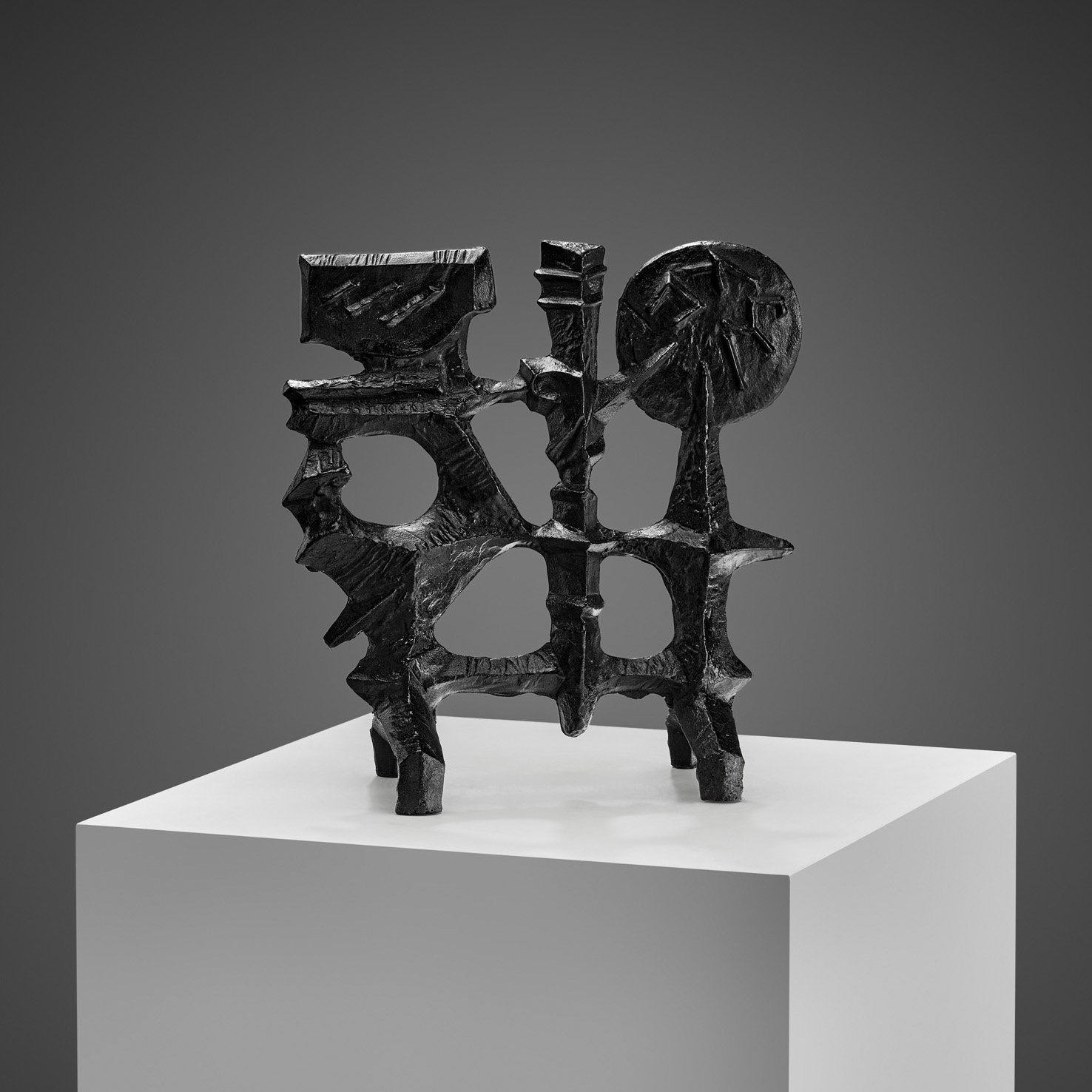
Swedish sculptor, Olle Hermansson is primarily known for his cast iron sculptures and fire screens in his signature Brutalist style. The characters and shapes appearing in his works are often inspired by Nordic mythology.
In this piece, Hermansson uses the robust and weighty medium of cast iron to create a dynamic form that stands as both a piece of art and a reflection of Sweden’s industrial heritage. The sculpture is characterised by bold geometric shapes and textured surface, which provide both visual interest and tactile appeal. Hermansson’s mastery of form is evident in the way the sculpture plays with negative space, light, and shadow, creating an ever-changing visual experience which changes depending on the viewer's perspective. The design reflects the Brutalist ethos of the 1960s, emphasising ruggedness, and the exploration of materials. At the same time, it speaks to the organic qualities of nature, with curves and contours that soften the otherwise rigid structure of the cast iron. As a unique intersection of art and functionality, this sculpture stands as a testament to the collaborative spirit between artists and industry. The integration of modern design with industrial materials like cast iron not only celebrates the aesthetic possibilities of the material but also speaks to the cultural and economic climate of Sweden in the 1960s. Whether displayed indoors or outdoors, this work encapsulates the innovative energy of the era.
This Brutalist sculpture, with its distinctive design and robust materials, becomes a statement, a conversation starter, and a timeless addition that will elevate the aesthetics of any space it occupies.
Condition:
In good vintage condition. Wear consistent with age and use.
Dimensions:
13.38 in W x 6.49 in D x 14.37 in H
34 cm W x 16.5 cm D x 36.5 cm H

REQUEST PRICE HERE
Price category: 2,500 - 5,000 usd / eur
Characteristic for Swedish artist, Björn Selder, are powerful, expressive sculptures, such as this piece, in heavy materials like bronze, iron, and stone. This unique piece shows that Selder was active as a sculptor and also as a graphic artist. He is represented with numerous monumental sculptures in public environments in Sweden.
Swedish sculptor Björn Selder is renowned for his distinctive style that seamlessly merges modern sensibilities with classical influences. His works are characterized by a harmonious blend of fluidity and precision, breathing life into static forms. Selder's sculptures - like this one - often depict the human figure, capturing the essence of movement, emotion, and introspection. One of the defining aspects of Selder's artistic expression is his preference for bronze as a sculpting material. Bronze offers him a unique combination of durability and malleability. Its enduring nature ensures that his creations stand the test of time, while its pliability allows him to mould intricate details and convey subtle nuances of form and expression. This versatile material accommodates the organic flow of Selder's style, enhancing the tactile and visual experience of his sculptures, enhanced by the green patina that naturally develops with time. Bronze holds a timeless allure due to its inherent strength, ability to retain intricate details, and the captivating patina that develops over time. This anthropomorphic piece takes advantage of its material fully, with the different hues and the surface of the bronze highlighting the versatile organic curves that define the surface.
Selder's present sculpture not only pays homage to the bronze sculpture tradition but also elevates it with a contemporary twist infusing it with his unique blend of abstraction and an unmistakeable contemporary flair. This work invites viewers to engage with the interplay of tradition and innovation, celebrating the enduring appeal of bronze as a medium for artistic expression.
Condition:
In good vintage condition. Wear consistent with age and use. The bronze has a green patina with some marks and scratches.
Dimensions:
7.48 in W x 6.69 in D x 17.32 in H
19 cm W x 17 cm D x 44 cm H
About the designer:
Björn Selder (March 7, 1940, Stockholm - 1999) was a Swedish graphic designer and sculptor. Selder was married to the textile artist Margaretha Selder. He made several study trips to Paris where, among other things, he studied with the American graphic artist W Wellington as well as graphic colour and printing with Theo Mortensen.
He also conducted self-study during trips to the Netherlands, Belgium, Austria, Spain, and North Africa. Furthermore, he worked as director of Grödingesgruppen's graphics workshop in Stockholm 1963–1964. Separately, he debuted with an exhibition at Galerie Catharina in Stockholm in 1961 and together with Ove Dahlstrand he exhibited at Lorensberg's art salon in Gothenburg and together with Bertil Sagnér at Galleri Brinken in Stockholm. He participated in the Grödinge group's exhibitions and various group exhibitions at Liljevalch's art gallery. In addition to graphics, his art consists of polychrome wood reliefs. He made numerous fountains in public settings since 1989. He was a professor at the Central Academy of Fine Arts in Beijing, China, and made relief decorations on the Great Wall of China on behalf of the Chinese state.
Selder is represented at the Modern Museum, Kalmar Art Museum and Gothenburg's school administration. He is chairman emeritus of the Sculptors' Association and professor at the Central Academy of Fine Arts, Beijing. Björn Selder was also the initiator of the Sculptors' House in Vinterviken, Stockholm.

REQUEST PRICE HERE
Price category: 500 - 1,000 usd / eur
Gunnar Ander was an industrial designer and architect, and one of the brightest stars of 20th-century Swedish metal, wood, and glass design. His most well-known models are the innovative designs for Ystad Metall, such as this unique candle holder. His designs are represented in numerous museums in Sweden.
This black lacquered wrought iron and brass “Sonata” candle holder has an intrinsically modern, sculptural look. The versatile shape and form come alive thanks to the modern materials and the colour choice. Like with lamps, it says a lot about a design when it stands out even without its source of light, in this case, candles. With home improvements on the upswing, candlesticks and holders have found a resurgence, as they are rather impactful additions to any space despite their size. This candle holder can also serve as a centrepiece on a table, as it is sure to draw attention. The smooth black lacquered iron body rest on a hollow circle base and curve upwards. It has four brass cups with so-called chambersticks, small pans to catch dripping wax. The last cups have an elongated lower part ending in a brass sphere. This ingenious feature creates perfect balance as well as a focal point. The design is also customizable in the sense that any type and colour of candles can be placed in the cups to match the interior and personal preferences.
Gunnar Ander was a long-time employee at Ystad-Metall, where he designed utility and art objects in brass, silver, and other materials. The company was founded in 1919 in the south of Sweden. It was active until 1969 and was highly successful thanks to its stylistically pure objects of various metals. Many well-known Swedish designers like Ivar Ålenius-Björk, Carl-Einar Borgström also worked alongside Gunnar Ander during the company’s heyday.
Condition:
In good vintage condition. Wear consistent with age and use. The brass has a beautiful patina with some marks.
Dimensions:
8.66 in Ø x 9.44 in H
22 cm Ø x 24 cm H
REQUEST PRICE HERE
Price category: 5,000 - 7,500 usd / eur
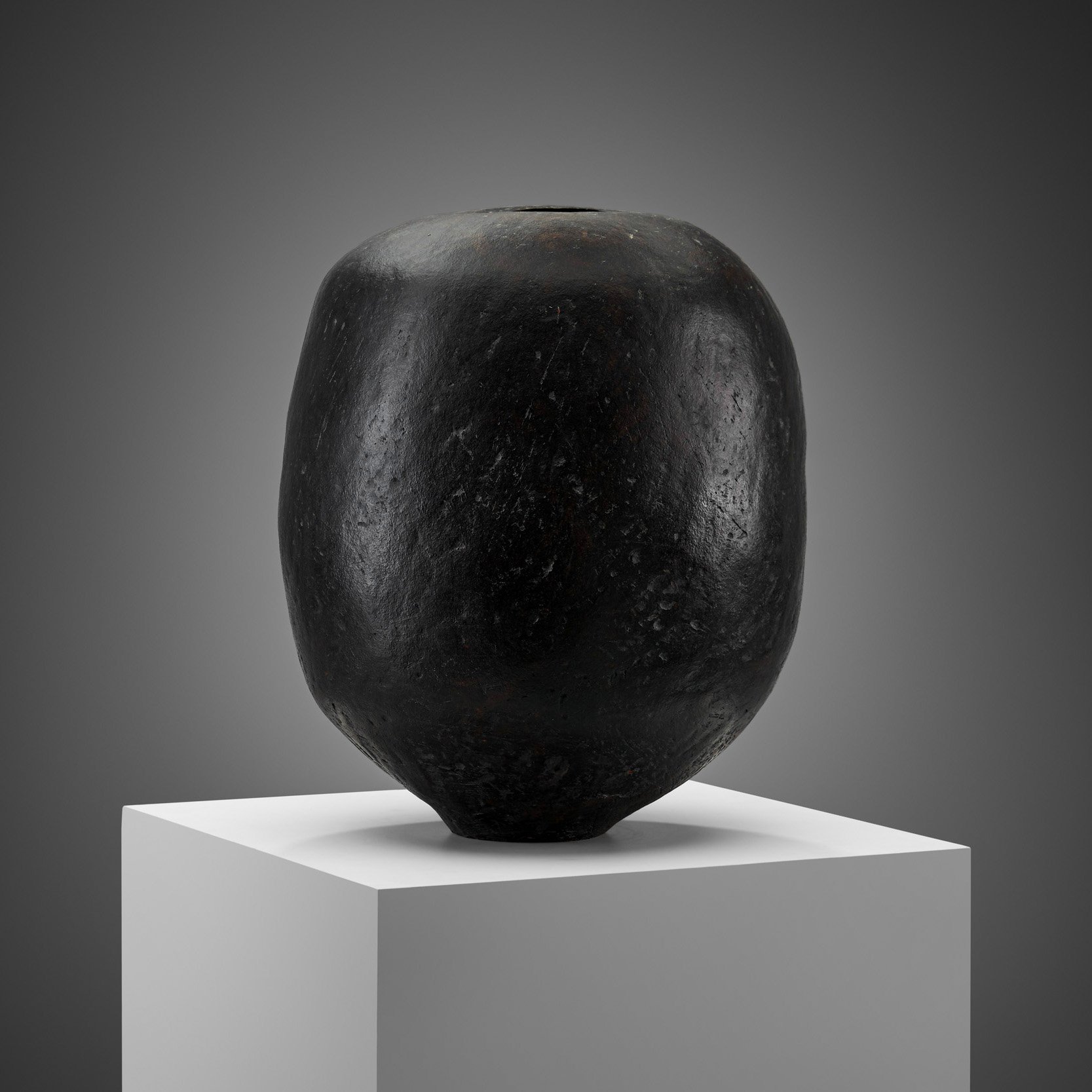
Priscilla Mouritzen is an internationally celebrated, South-African born Danish contemporary ceramic artist. Her creations reflect her expertise and mastery with a dedication to form and texture, inspired from traditional pottery techniques, African traditions, and minimalist design principles.
This vase exhibits understated elegance and a timeless appeal. With an emphasis on balance and harmony, it blends traditional craftsmanship with modern aesthetics and is exemplary of Mouritzen’s artistry. The practice of ceramics has a longstanding and celebrated tradition in Denmark. The founding of the Royal Copenhagen factory in the 18th century saw the expansion and popularisation of ceramics, although it wasn’t until in the 1950s, where artists were drawn again to material experimentation and innovation - balancing the boundaries between function and aesthetics. The Scandinavian Modern influence attracted interest from other European countries where pieces such as this vase, have become prized items. The refined design of this vase and simple form reflects its modern influence. The subtle textural details on the surface add an interesting visual element and character. While Priscilla Mouritzen has experimented with different techniques, her works often use a pinch pot approach and a wood firing process. The smoked wood firing process used adds to its unique quality - the deep black finish enhances this vase’s sculptural quality, making it a bold yet sophisticated addition to any space. Priscilla Mouritzen’s creations are made by hand and inherently add to the authentic beauty and value of this vase.
Priscilla Mouritzen has exhibited her works worldwide and still exhibits regularly to this day. Since 2001, she has been an active board member and vice-president of the Guldagergaard Foundation; a research centre and a cultural institution focused on the strengthening and development of ceramic arts.
Condition:
In good vintage condition. Wear consistent with age and use.
Dimensions:
Ø 14.96 in x 18.89 in H
Ø 38 cm x 48 cm H
REQUEST PRICE HERE
Price category: 500 - 1,000 usd / eur
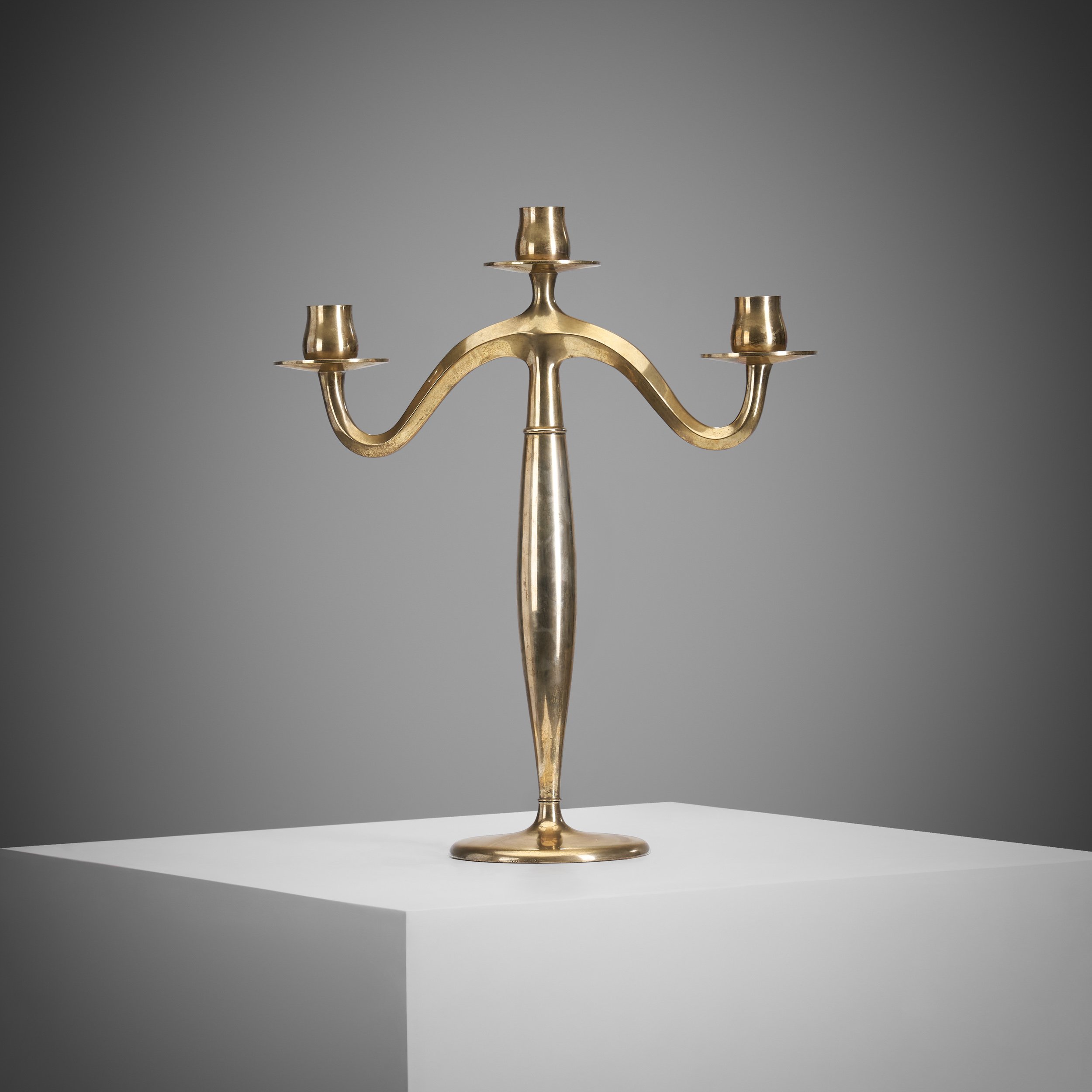
The artists of Nordic Art Nouveau took inspiration from organic and natural forms, resulting in elegant designs with sinuous curves and lines. As this clever candelabra clearly demonstrates, hey also injected the style with their traditional design ideals such as functionality and an uncluttered look.
This model has a lot more to offer than it would seem at first glance with unique and clever solutions. Firstly, the mysterious material itself, dirigold. Dirigold was invented by two Swedish engineers, C. Molin and C. A. von Malmborg, and the alloy would consist of 90% copper and 10% aluminium. The two engineers were in charge of the Metal company Alco in Örebro in the 1920s. Newspaper articles around Sweden soon praised the material, Gothenburg Dagblad wrote in 1922: “Dirigold maintains its high shine even after long-standing use unlike silver.” It also quickly became popular for as it withstood discolouration. As this candelabra showcases, the light gold colour is especially effective on round, carved shapes with diverse angles. The structure is rather traditional with a round base, long column and three arms with cups and so-called chambersticks, small pans to catch dripping wax. And then the not so obvious element: the top part is removable, converting the design into a vase. This ingenious feature praises John Norelius as a designer and immediately distinguishes this model from all other candelabras. Norelius became a trainee at AB Alcometaller around 1920, and eventually came to lead the dirigold production in the new factory in Mosås.
The composition of the alloy was kept secret, and because of a shortage in materials, the production of dirigold items ceased, making this stately candelabra a museum quality piece.
Condition:
In good vintage condition. Wear consistent with age and use. The dirigold has some marks and patina.
Dimensions:
12.79 in W x 4.72 in D x 14.76 in H
32.5 cm W x 12 cm D x 37.5 cm H
REQUEST PRICE HERE
Price category: 2,500 - 5,000 usd / eur
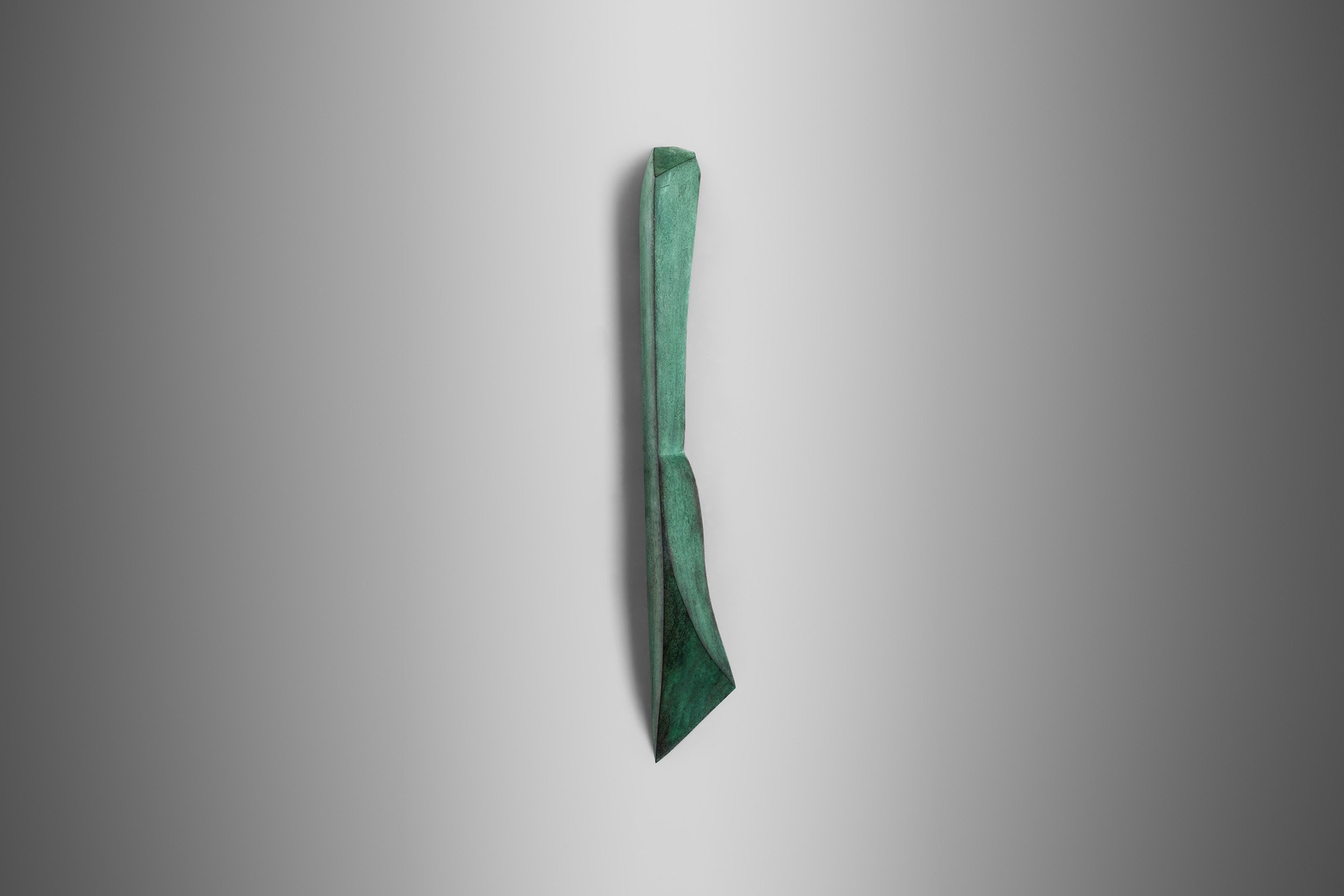
Characteristic for Swedish artist, Björn Selder, are powerful, expressive sculptures, such as this piece, in heavy materials like bronze, iron, and stone. This unique abstract wall sculpture shows that Selder was active as a sculptor and also as a graphic artist. He is represented with numerous monumental sculptures in public environments in Sweden.
Swedish sculptor Björn Selder is renowned for his distinctive style that seamlessly merges modern sensibilities with classical influences. His works are characterized by a harmonious blend of fluidity and precision, breathing life into static forms. Selder's sculptures - like this one - often depict organic and abstract forms, capturing the essence of movement, emotion, and introspection. One of the defining aspects of Selder's artistic expression is his preference for bronze as a sculpting material. Bronze offers him a unique combination of durability and malleability. Its enduring nature ensures that his creations stand the test of time, while its pliability allows him to mould intricate details and convey subtle nuances of form and expression. This versatile material accommodates the interesting flow and shapes of Selder's style, enhancing the tactile and visual experience of his sculptures, enhanced by the green patina that naturally develops with time. Bronze holds a timeless allure due to its inherent strength, ability to retain intricate details, and the captivating patina that develops over time. This piece takes advantage of its material fully, with the different hues and the surface of the bronze highlighting the versatile lines that define the surface and conjure images of the flora and of the fauna that surrounds us.
Selder's present wall sculpture not only pays homage to the bronze sculpture tradition but also elevates it with a contemporary twist infusing it with his unique blend of abstraction and an unmistakeable contemporary flair. This work invites viewers to engage with the interplay of tradition and innovation, celebrating the enduring appeal of bronze as a medium for artistic expression.
Condition:
In good vintage condition. Wear consistent with age and use. The bronze has a green patina with some marks and scratches.
Dimensions:
2.55 in W x 2.75 in D x 18.3 in H
6.5 cm W x 7 cm D x 46.5 cm H
About the designer:
Björn Selder (March 7, 1940, Stockholm - 1999) was a Swedish graphic designer and sculptor. Selder was married to the textile artist Margaretha Selder. He made several study trips to Paris where, among other things, he studied with the American graphic artist W Wellington as well as graphic colour and printing with Theo Mortensen.
He also conducted self-study during trips to the Netherlands, Belgium, Austria, Spain, and North Africa. Furthermore, he worked as director of Grödingesgruppen's graphics workshop in Stockholm 1963–1964. Separately, he debuted with an exhibition at Galerie Catharina in Stockholm in 1961 and together with Ove Dahlstrand he exhibited at Lorensberg's art salon in Gothenburg and together with Bertil Sagnér at Galleri Brinken in Stockholm. He participated in the Grödinge group's exhibitions and various group exhibitions at Liljevalch's art gallery. In addition to graphics, his art consists of polychrome wood reliefs. He made numerous fountains in public settings since 1989. He was a professor at the Central Academy of Fine Arts in Beijing, China, and made relief decorations on the Great Wall of China on behalf of the Chinese state.
Selder is represented at the Modern Museum, Kalmar Art Museum and Gothenburg's school administration. He is chairman emeritus of the Sculptors' Association and professor at the Central Academy of Fine Arts, Beijing. Björn Selder was also the initiator of the Sculptors' House in Vinterviken, Stockholm.

REQUEST PRICE HERE
Price category: 1,000 - 2,500 usd / eur
This beautiful tråg, Swedish for trough, is a simple, clean example of 18th century of Swedish folklore. It shows the handiwork that it cost to make it in a traditional Scandinavian style. With its historic details, this trough mixes well with modern spaces and design to create an interesting and charming style.
A manger or trough is a rack for fodder, or a structure or feeder used to hold food for animals. The word comes from the Old French ‘mangier’, from Latin ‘mandere’. Mangers are mostly used in livestock raising and generally found at stables and farmhouses. They are also used to feed wild animals, e.g., in nature reserves. Here, the material and its shape, which is generally described as ‘primitive’ style, is not the work of a designer, but a woodworker who most likely crafted this piece for strictly functional reasons. The lack of ornamentation testifies of this role, and is a feature that remained at the core of Scandinavian design to this day.
This historical trough has marks of wear which make it unique. These marks show that nearly 300 years ago, this piece was actively used somewhere in Sweden. It naturally has the rustic charm that many producers try to recreate nowadays. Thanks to this, it can stand out in a modern interior to add not only visual, but also historical interest to the space.
Condition:
In good vintage condition. Wear consistent with age and use. Marks of wear on the body.
Dimensions:
45.27 in W x 19.48 in D x 6.88 in H
115 cm W x 49.5 cm D x 17.5 cm H
REQUEST PRICE HERE
Price category: 500 - 1,000 usd / eur
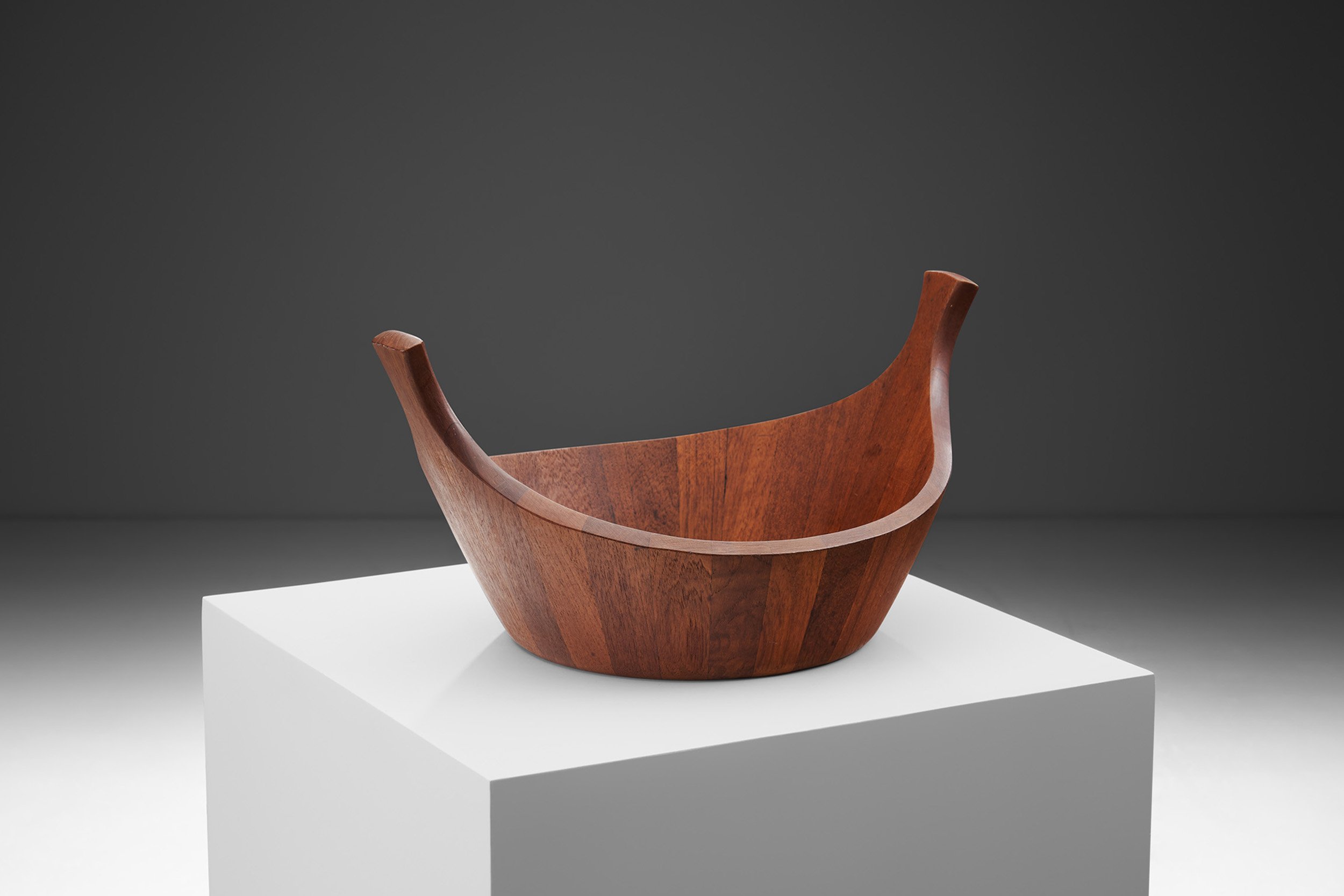
Jens H. Quistgaard set out to design beautiful things for everyday use, which is an essentially Scandinavian approach to design in general. Over the course of his prolific and varied design career, Jens Quistgaard created objects that are a meditation on the possibilities of shape for a common household object.
Intriguing and fantastical, the variety of forms the sculptor manifested expand the vocabulary of functional design, calling on an array of familiar references including natural shapes. This solid wood bowl is a beautiful example of this, with an organic shape and an immediately visible level of craftsmanship. This rare model is an early iteration of the Viking ship serving bowl with a stunningly sculpted, staved body. In this technique, after spreading a wood bonding glue onto the sides of the individual staves, the bowl is assembled by sticking the sides together. This results in an interesting look that showcases the many different colours and patterns of the wood. The majority of Jens Quistgaard’s designs were produced in teak, which has the advantage of strength, resilience, and longevity besides its aesthetic appeal. The bowl’s elongated sides and edges are all rounded gently in a true Danish manner, softening the straight lines of the staves. While intended for everyday use, this bowl is just as much a sculpture as a utilitarian object, worthy of a role as a centrepiece or decorative object. It is marked “Saved Teak Danmark JHQ” on its bottom.
For many years Jens Quistgaard was the leading, and often, the only designer for Dansk International Designs which gradually became a world-wide firm with a production influenced in all fields by the homogeneity of his style. His works now appear so obvious it is easy to forget how original and individual they were in their time. He won the Lunning Prize in 1954, and received the Neiman Marcus Award in 1958.
Condition:
In good vintage condition. Wear consistent with age and use. Small scratches on the wood.
Dimensions:
18.3 in W x 12.99 in D x 9.05 in H
46.5 cm W x 33 cm D x 23 cm H
About the designer:
Jens Harald Quistgaard (April 23, 1919 - January 4, 2008) was the principal designer for Dansk Designs from the mid-1950s through the 1980s. Quistgaard’s designs are largely responsible for introducing and defining the Scandinavian modern aesthetic for American homes. As the New York Times recognized in 1958, “Some of the most popular accessories found in American homes today have their beginnings in a small studio-workshop adjoining the modest residence of Jens Quistgaard in Copenhagen.” Quistgaard, by way of Dansk Designs, went on to transform and modernize the American dining table and kitchen.
Initially trained as a sculptor by his father, Quistgaard expanded his skills by learning from carpenters and metalsmiths, all contributing to his versatility as a master craftsman with the expertise to combine materials and techniques in novel ways. Amongst his most recognized designs is the 1953 Fjord Flatware set, iconic for combining stainless steel with teak handles. Fjord Flatware is in the collections of several prominent museums and is still in production. Many more of Quistgaard’s houseware designs, notably the teak ice buckets and colourful Kobenstyle enamelware, have become familiar classics. Over the course of his multi-decade career, Quistgaard created designs for over four thousand products.
Despite living and working in Denmark for the majority of his career, Quistgaard’s designs for Dansk focused on the consumer market in the United States. For many decades, Quistgaard remained relatively unrecognized in his home country, rarely mentioned alongside other Danish design icons such as Hans Wegner and Finn Juhl. As many Scandinavian Modern items moved from the primary consumer market to the province of collectors, Quistgaard’s oeuvre gained further international recognition. In 2015, the Herning Museum of Contemporary Art in Copenhagen mounted a career-spanning retrospective of Quistgaard’s work, with additional Danish publications expected in the near future.
REQUEST PRICE HERE
Price category: 1,000 - 2,500 usd / eur
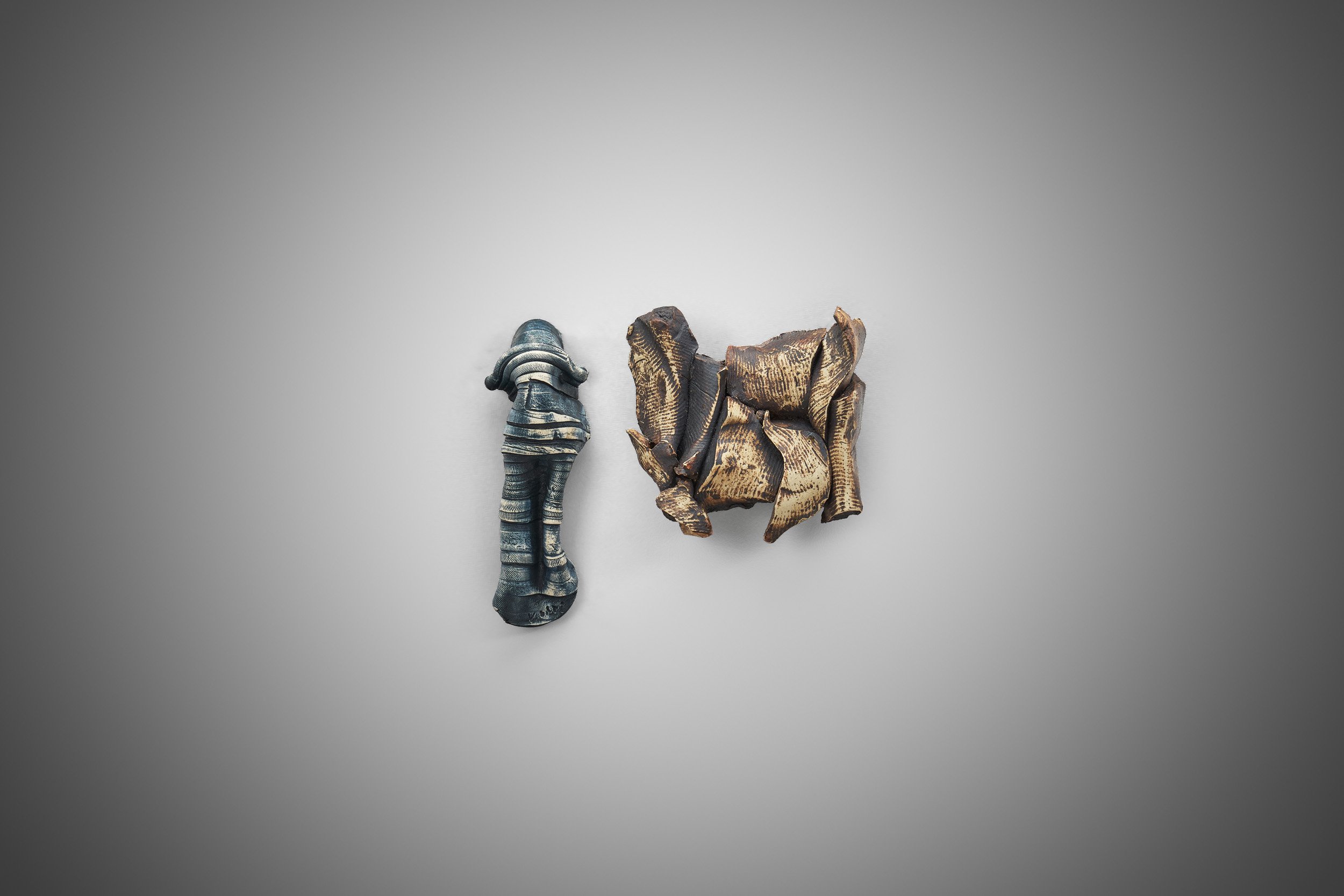
Born in Eskilstuna, Sweden, Ulla Viotti is an internationally renowned Swedish artist whose creations are delightfully original. Her work, as showcased by these stoneware pieces, consists of large sculptures and architectural ceramics employing a range of techniques.
Viotti’s style is an interesting mixture of different impressions, affected by her study of Etruscan pottery in Italy, which influenced the formal aspect of her work developing a figurative element. Also by a visit to Israel during the 1960s where she first experienced the combination of sculpture and architectural ceramics and met ceramic artists who used materials in a more free way. These stoneware pieces however, reflect her work in a stoneware factory in Jaffa when her aesthetic changed dramatically, and started recalling the structures of the landscape that manifested the feeling of 'forsakenness', a theme that often recurs in her later work. These pieces, while visually quite different, form a pair in an unexpected way. Stoneware fires darker colours, is less dense (higher porosity) and less vitreous, finally the fired surface is less homogeneous. As a result of these qualities, these mural pieces appear rough, almost abstract. At the same time, it is evident that the colours, every line and shape is the result of a well though-out process of sculpting. Works which appear to be non-figurative often do recall the visible world and so is the case here as well. It is hard to gaze away in the presence of these Viotti works. Both pieces are signed by the artist.
The blues and browns of the uneven layered forms convey a strong feeling of organic surfaces given further resonance with the diverse curved shapes and forms. Ulla Viotti’s small scale mural works are very rare and never repeated, making this pair even more special.
Condition:
In good vintage condition. Wear consistent with age and use.
Dimensions:
Brown piece
6.88 in W x 2.55 in D x 2.75 in H
17.5 cm W x 6.5 cm D x 7 cm H
Blue piece
2.95 in W x 2.16 in D x 8.46 in H
7.5 cm W x 5.5 cm D x 21.5 cm H
About the designer
Ulla Lilli Marianne Viotti was born on the 20th of November in 1933 in Eskilstuna, Sweden. She studied at the School of Art in Blackpool in Great Britain between 1950-1951 and at Konstfack in Stockholm 1952-1956, for the first two years at the ceramics department and then at the school's higher art-industrial department.
She was awarded a scholarship from the Swedish Crafts Association and a scholarship from the King's Fund in 1961, as well as a travel scholarship from Värmland's museum friends. Furthermore, she has exhibited in, among other places, Karlskoga and at Konsthantverkarna in Stockholm. Since 1958 she has participated in several exhibitions in Sweden but also outside of her home country. Internationally, she has been represented at exhibitions in Viterbo, Haifa and Tel-Aviv.
Since 2005, she has been living and working in Brantevik in Österlen. Her art consists of rustic utilitarian earthenware, ceramic sculptures and earthenware reliefs as well as paintings and drawings. Viotti is represented at, among others, the National Museum in Stockholm, the Värmland Museum, the Jönköping County Museum and the collections of the Israeli state.
Her work is represented in museums and collections throughout the UK and Sweden, including the collection in Aberystwyth. She participated in the first International Potters Festival, Aberystwyth in 1987. ~H.

REQUEST PRICE HERE
Price category: 1,000 - 2,500 usd / eur
Gunnar Ander was an industrial designer and architect, and one of the brightest stars of 20th-century Swedish metal, wood, and glass design. His most well-known models are the innovative designs for Ystad Metall, such as this unique pair of candle holders. His designs are represented in numerous museums in Sweden.
These black lacquered wrought iron and brass “Sonata” candle holders have an intrinsically modern, sculptural look. The versatile shapes and forms come alive thanks to the modern materials and the colour choice. Like with lamps, it says a lot about a design when it stands out even without its source of light, in this case, candles. With home improvements on the upswing, candlesticks and holders have found a resurgence, as they are rather impactful additions to any space despite their size. These candle holders can also serve as centrepieces on a table, as they are sure to draw attention. The smooth black lacquered iron bodies rest on a hollow circle base and curve upwards. Each of them have four brass cups with so-called chambersticks, small pans to catch dripping wax. The last cups have an elongated lower part ending in a brass sphere. This ingenious feature creates perfect balance as well as a focal point. The design is also customizable in the sense that any type and colour of candles can be placed in the cups to match the interior and personal preferences.
Gunnar Ander was a long-time employee at Ystad-Metall, where he designed utility and art objects in brass, silver, and other materials. The company was founded in 1919 in the south of Sweden. It was active until 1969 and was highly successful thanks to its stylistically pure objects of various metals. Many well-known Swedish designers like Ivar Ålenius-Björk, Carl-Einar Borgström also worked alongside Gunnar Ander during the company’s heyday.
Condition:
In good vintage condition. Wear consistent with age and use. The brass has a beautiful patina with some marks.
Dimensions:
8.66 in Ø x 9.44 in H
22 cm Ø x 24 cm H
REQUEST PRICE HERE
Price category: 1,000 - 2,500 usd / eur
Josef Frank designed Vänskapsknuten (the Knot of Friendship) as a symbol of friendship and peace at a time when Europe was filled with turmoil. The very first sketch of the candelabra dates back to 1938, just a year before the outbreak of the Second World War, but it is as relevant now as it was then.
The Austrian designer and architect may be best known for his vivid textiles for Swedish firm Svenskt Tenn, but his artistic touch reached far beyond textiles and created iconic objects such as this candle holder. The elaborate brass structure intertwines at multiple points, but the brass rods only meet in the middle where a small sphere connects them. Each of the three brass cup have so-called chambersticks, small pans to catch dripping wax. The looping calligraphic design gives this piece a weightless grace that is stunning even without the symbolism behind it. The body’s busy look is completed and balanced by the long candles. The design changes from angle to angle and shows Frank’s sensitive touch. The Knot of Friendship has become an iconic object not only in Svenskt Tenn’s range, but also of Sweden. The production traditionally required a process of thorough methodology and great craftsmanship. Josef Frank was the most prestigious designer in the Stockholm design company Svenskt Tenn (Swedish Pewter), recruited by the founder of the company, Estrid Ericson herself.
Since 2018, after a careful assessment of Josef Frank’s original drawing, the candelabra regained its original form from 1938 under the hands of Svenskt Tenn. However, the production of this well-known and widely-loved candle holder now takes place at Humstorp Metal in Västergötland. This piece however, is from the original production from the post-war era.
Condition:
In good vintage condition. Wear consistent with age and use. The brass has a beautiful patina with some marks. Due to the nature and age of the material, the item may have some scratches and discolouration.
Dimensions:
8.85 in W x 7.48 in D x 6.29 in H
22.5 cm W x 19 cm D x 16 cm H
About the designer:
Josef Frank (July 15, 1885 – January 8, 1967) was an Austrian-born architect, artist, and designer who adopted Swedish citizenship in the latter half of his life. Together with Oskar Strnad, he created the Vienna School of Architecture, and its concept of Modern houses, housing, and interiors.
Josef Frank was one of early Vienna modernism’s foremost figures, but already in the beginning of the 1920s he started to question modernism’s growing pragmatism. He had little appreciation for the French architect Le Corbusier’s belief that a house should be “a machine for living in”. He was against puritanical principles and on the contrary, feared that standardized interiors would make people all too uniform. Josef Frank represented a freer, more artistic style ideal, and he developed his own type of modernism where values like comfort, hominess, and a wealth of colour were at its core. He resisted limitations and models for his furniture and textiles came from across all boundaries both in time and space.
Josef Frank began working at Svenskt Tenn in 1934 and just a few years later, the Frank-Ericson duo made their international breakthrough. Svenskt Tenn’s exhibition room at the World Expositions in Paris in 1937 and New York in 1939 was completely contrary to the ideal of the time with its bold contrasts in materials, colours, and prints. The duo received a great deal of attention and became, somewhat paradoxically, the model for the expression “Swedish Modern”. Although he was already 50 years old when he left Vienna for Sweden, Frank is considered one of Sweden’s most important designers.