
Danish Cabinetmaker Upholstered Easy Chair with Beech Legs, Denmark 1940s (sold)


Danish Cabinetmaker Upholstered Easy Chair with Beech Legs, Denmark 1940s (sold)
The Danish cabinetmakers' annual exhibitions began in 1927 and continued through until 1966, for almost the whole of what is now seen as the classic period of early modern Danish design. This easy chair carries subtle, but obvious features of this famous era.
By 1930 the cabinetmakers began a strong working relationship with architects to produce well-made chairs. That partnership with architects seems now, with hindsight, crucial. As a result, the quality of the structure and craftsmanship had few rivals, completed by the creative overflow of the designers. Comfort and functionality were often the priority and as this easy chair exemplifies and strong ornamentation was considered unnecessary. The frame has a distinct, sharply-curved look which is especially pronounced in the front. The design element that stands out immediately is the welcoming, rounded shape of the voluminous curved arms that is a signature characteristic of Danish Modernism. The low back is lightly bent and has stylish cross stitches in yellow. The fabric of the bouclé upholstery gives a natural, textured look. That elegance is playfully interrupted visually by the vivid cross stitches. Made of stained beech, the back legs are straight, while the front legs are more rounded with edgy brass tips. It is these small details of the construction that give this chair some edge to complement the otherwise traditional Danish modernist look.
The strong tradition of carefully considered design and master craftsmanship along with quality materials and skill in manufacture are very much at the core of Danish design and production and therefore, also this easy chair’s.
SOLD
Condition:
In good vintage condition. Wear consistent with age and use. The chair has been reupholstered recently in a premium bouclé fabric. Each of our items can be re-upholstered by our in-house atelier in a fabric of choice. Please reach out for more information.
Dimensions:
27.16 in W x 34.25 in D x 30.51 in H; Seat height 16.53 in; Arm height 24.8 in
69 cm W x 87 cm D x 77.5 cm H; Seat height 42 cm; Arm height 63 cm
About the designer:
The practical and comfortable designs of Danish cabinetmakers defined mid-20th century modern seating. The Danish Cabinetmakers focused on minimalist design executed by expertly skilled craftsmen.
Works from the Danish Cabinet-Makers' Guild is a concept of its own in collectible design. The Cabinet-Makers' Guild began annual exhibitions in 1927 in Copenhagen. The group formed an exhibit showing each year in October the quality furniture made to drawings by gifted architects. The exhibition took place each year, without interruption, for forty years. A number of successful Danish Design collaborations were formed during this time between cabinetmakers and architects.
Danish Modernism has influenced Scandinavian furniture to a great degree, defined by minimalism, simplicity, and functionality. The muted colours and gentle designs make Danish mid-century furniture an ideal addition to contemporary living spaces. Additionally, master cabinetmakers were highly aware of body proportions, prioritizing comfort just as much as the visual qualities.
The works of master cabinetmakers – such as this easy chair– are of the highest quality, both in terms of materials and craftsmanship. Cabinetmakers take the art of working with wood one step further, and focus on the finer details of what can be created with the material. Therefore, it comes as no surprise that numerous master cabinetmakers are part of the renowned Danish Culture Canon (Danish: Kulturkanonen). The canon contains no more than 108 works of cultural excellence, based on works with a useful function and that are still recognizable today. This small armchair is the perfect illustration of Danish design, and the work of a true cabinetmaker. ~H.
REQUEST PRICE HERE
Price category: 2,500 - 5,000 usd / eur
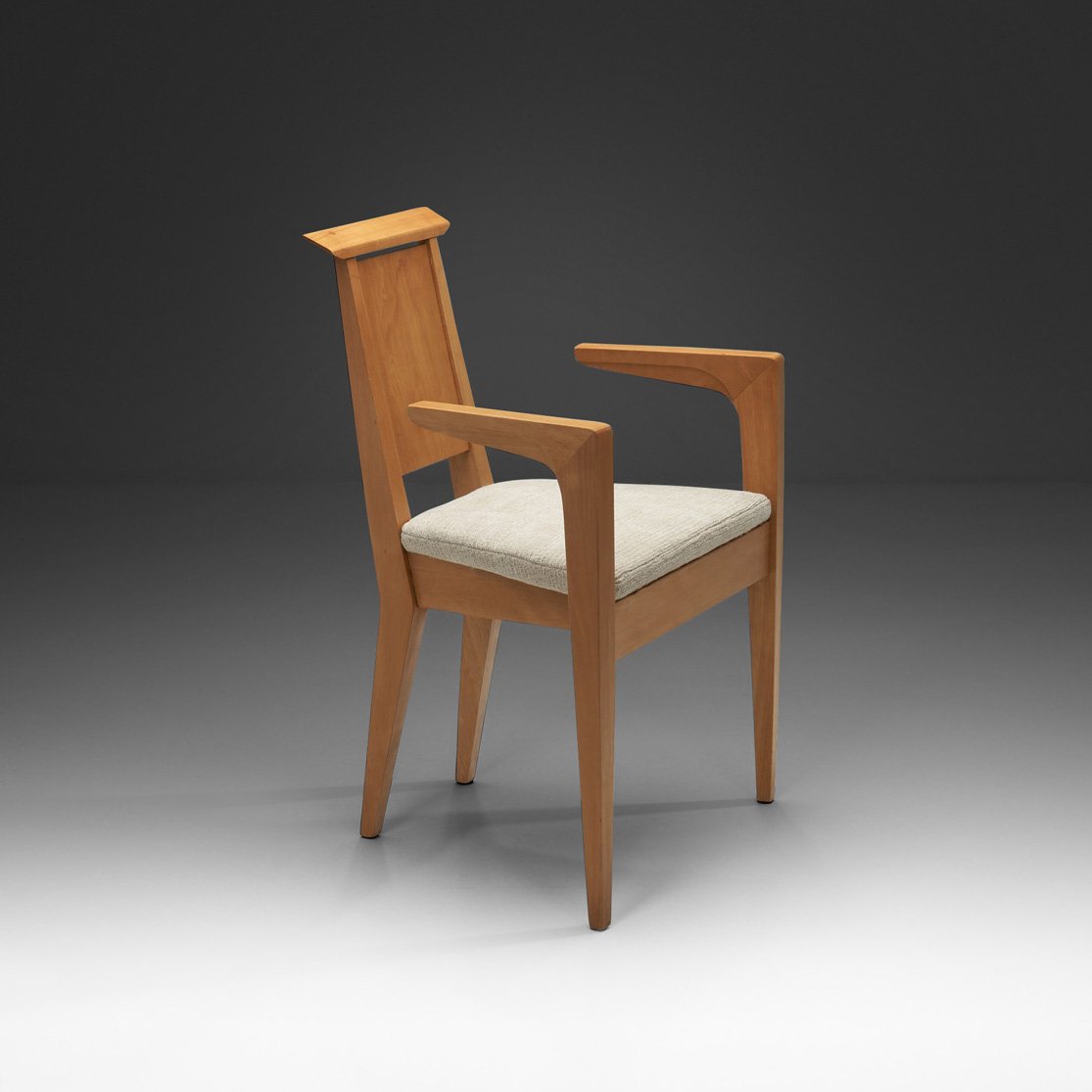
The design philosophy in Germany in the second half of the 20th century was often focused on functionality and ergonomics, but with a playful twist. There was a tendency to mix and match styles and materials, resulting in eclectic and sometimes whimsical pieces, like this prototype chair by Stefan Wewerka.
German designers were influenced by the broader contemporary European trends, including the Danish and Italian modernist movements. There was also a strong influence from the avant-garde and the counterculture movements, which encouraged experimentation and the breaking of traditional design norms. This striking chair epitomises the bold and innovative design ethos of the era. This chair’s frame is quite distinctive even beyond its arms. The shape and construction of this model shows the modern edge that Stefan Wewerka’s designs often have thanks to its sculptural look. The backrest is visually “unattached” to the arms which creates an impression of weightlessness. The chair has an overall flow to it, which is a result of the pointed arms that continue to form the front legs. The cushioned seat, upholstered in a light textured fabric compliments the colour of the wood and provides a calm yet inviting feel. The four legs balance the chair, preserving the open design, while maintaining structure and stability.
With its bold geometry and exceptional craftsmanship, this prototype chair is a testament to German design and a perfect addition for those seeking to infuse their interiors with a touch of vintage futuristic style. Whether used as a standout accent piece or as functional seating in a modern setting, it promises to be a lasting symbol of mid-20th century design innovation.
Condition:
In good vintage condition. Wear consistent with age and use. The chair has recently been reconditioned and reupholstered in a premium fabric. Each of our items can be reupholstered by our in-house atelier in a fabric of choice. Due to the nature of the beech, the chair may have some marks, scratches, and discolouration. Please reach out for more information.
Dimensions:
22.44 in W x 18.11 in D x 33.66 in H; Seat height 18.89 in; Seat depth 15.74 in; Arm height 26.37 in
57 cm W x 46 cm D x 85.5 cm H; Seat height 48 cm; Seat depth 40 cm; Arm height 67 cm
REQUEST PRICE HERE
Price category: 7,500 - 10,000 usd / eur
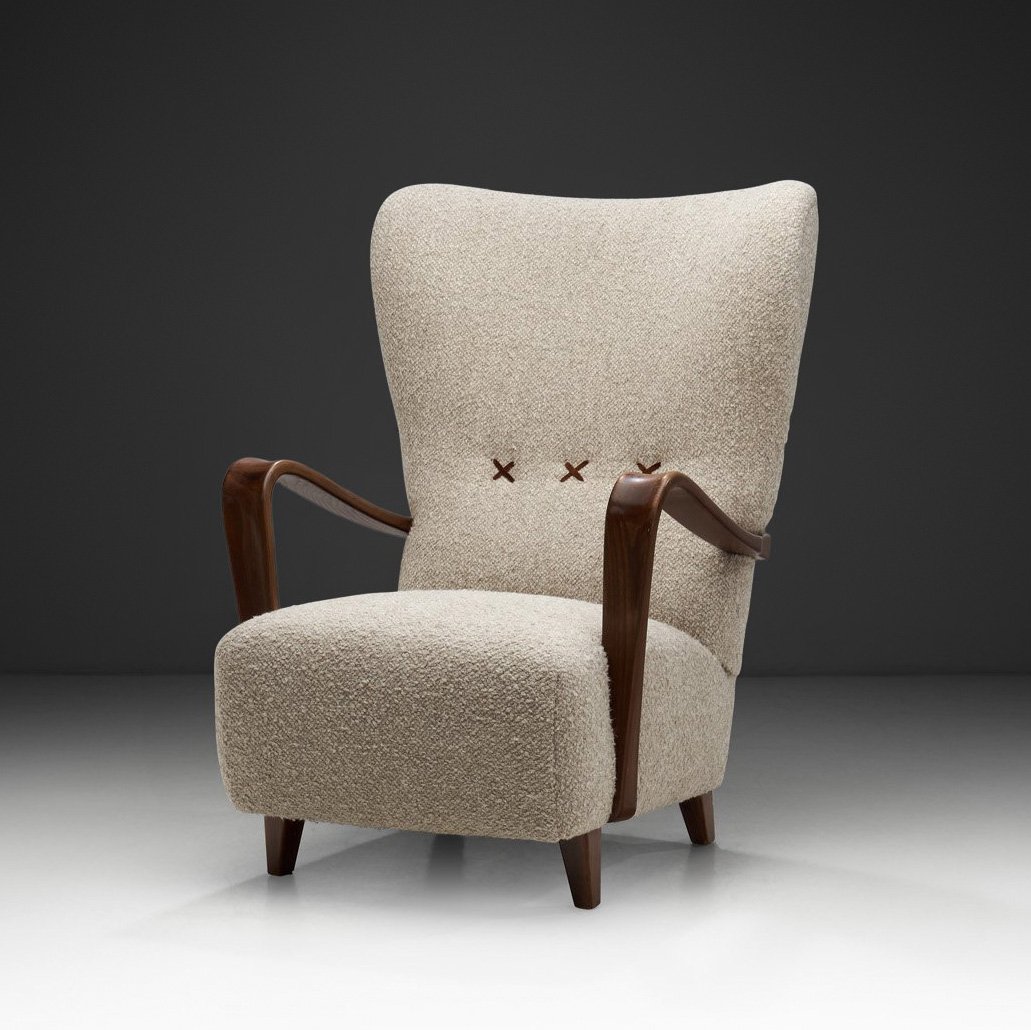
In Sweden, “svensk design” in particular operates as a set of relations linking objects, spaces, people to the cultural ideologies that motivate the persistence of a social democratically infused “way of life.” Thanks to this sentiment, the cabinetmaker of this chair put an emphasis on soft elegance and functionality, making it timeless in every sense of the word.
The Swedish design movement has exercised a wide influence on modern architecture and interior furnishings internationally since the early twentieth century. As this beautiful high-back lounge chair shows, early mid-century modern designers and cabinetmakers not only prioritised outstanding craftsmanship, but also an aesthetic quality that honours the materials and their users alike. Swedish proponents of modern design ideals were able to cultivate their principles in a climate of relative calm with the long-term persistence of crafts traditions being especially formative. This craftsmanship is apparent in this lounge chair with a sinuous body that is as artistic as it is functional. The main principles of Swedish Modernism centre around minimalism, simplicity, and functionalism. This chair achieves to follow these principles while offering plenty of visually arresting qualities, including the high, curved back and exposed, sculptural arms that claw into the upholstery. The rich texture of the bouclé fabric accentuates the expressive shape of the frame that praises the maker’s sense of proportions. The short wood legs don’t take away from the robust, cosy appearance, instead they keep the design grounded and perfectly stable while also providing contrast with the beautiful colour. The expert Swedish craftsmanship is clearly visible throughout this piece, with impeccable woodworking and construction.
This beautiful, inviting lounge chair lives up to its Swedish heritage both in terms of visual and material quality. While its aesthetic is clean and functional, it has an eye-catching look with luxurious upholstery and cross stitches that make it an ideal accent piece as well.
Condition:
In good vintage condition. Wear consistent with age and use. Due to the nature and age of the materials, the item may have some mark, scratches, and discolouration. The chair has been reupholstered recently in a premium bouclé fabric. Each of our items can be re-upholstered by our in-house atelier in a fabric of choice. Please reach out for more information.
Dimensions:
29.13 in W x 37.79 in D x 39.96 in H; Seat height 14.76 in; Arm height 24.21 in
74 cm W x 96 cm D x 101.5 cm H; Seat height 37.5 cm; Arm height 61.5 cm
REQUEST PRICE HERE
Price category: 2,500 - 5,000 usd / eur
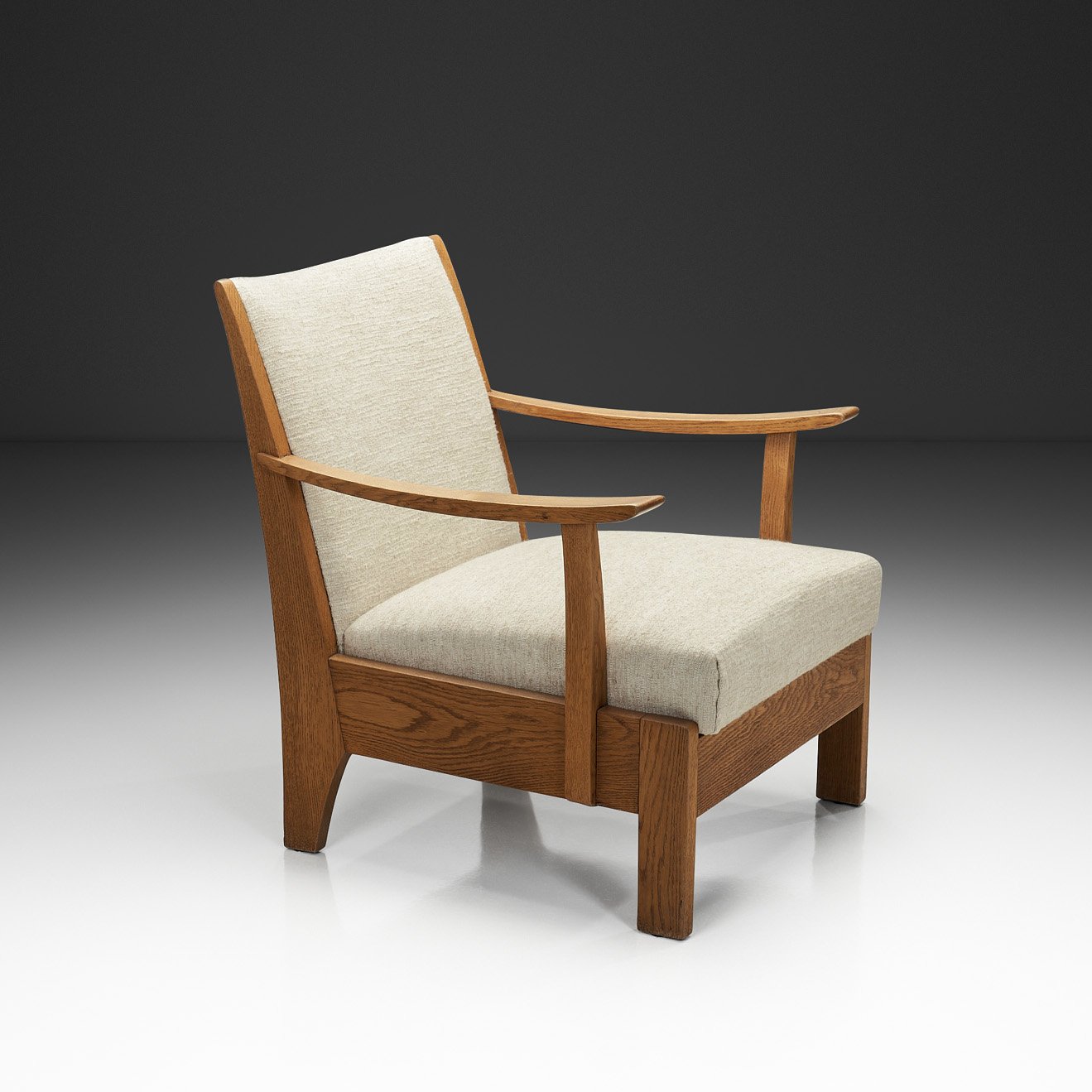
In the decades after World War II, furniture across Europe pursued a careful balance between simplicity and craftsmanship. In the Netherlands as well as in Scandinavia, there was a rejection of heavy ornament and instead the focus fell on materials like solid wood and textiles while keeping the overall form simple and purposeful. Chairs from this period often reflect a belief that good design should be both visually pleasant and functionally comfortable.
This modernist armchair, in the manner of Jan den Drijver, illustrates these principles through a straightforward yet thoughtful construction. The frame is built from solid wood, finished to reveal a warm, natural grain that highlights its organic beauty. The backrest rises with a gentle backward slope, providing ergonomic support without excess bulk, and the wide, flat armrests extend forward in a smooth and sleek line that aligns with the sitter’s posture. The seat and backrest surround the upholstery, a textured fabric that contrasts softly with the wood while maintaining a neutral palette. The cushions are padded to increase comfort. The legs are sturdy and substantial, ensuring support while not taking away from the rest of the design. This unadorned construction allows the quality of the piece to remain the focus - the clear form, the seamless joinery, and the dialogue between materials allows for the chair to feel timeless and considered rather than fleeting or overtly stylised.
Functionally and visually, this armchair demonstrates how mid-20th century European design could bridge tradition and modernity without sacrificing comfort or structural clarity. It is well suited to domestic living rooms, libraries, or quiet seating nooks while its understated modernism makes it versatile alongside both mid-century and contemporary interiors.
Condition:
In good vintage condition. Wear consistent with age and use. Minor scratches and discolouration. Due to the nature of the material, the item may have some additional marks. The chair has recently been reconditioned and reupholstered in a premium fabric. Each of our items can be reupholstered by our in-house atelier in a fabric of choice. Please reach out for more information.
Dimensions:
27.36 in W x 31.49 in D x 30.31 in H ; Seat height 16.33 in; Seat depth 21.85 in; Arm height 22.04 in
69.5 cm W x 80 cm D x 77 cm H ; Seat height 41.5 cm; Seat depth 55.5 cm; Arm height 56 cm

REQUEST PRICE HERE
Price category: 7,500 - 10,000 usd / eur
The 1940s in Denmark saw a renewed focus on comfort and craftsmanship, merging traditional woodworking skills with the evolving aesthetics of modern design. Danish furniture from this era often emphasized organic shapes and luxurious materials to create pieces that invited relaxation and warmth to create hygge. This period highlighted human-centred design, where functionality and elegance were deeply intertwined.
This Danish armchair features a robust yet elegant stained beech frame that showcases the natural richness of the wood, lending the piece a comforting warmth. The curving armrests, which showcase the skilfully shaped and polished beech overlays, flow gracefully into the generous backrest and seat, emphasizing their fluidity. The sumptuous dark red mohair upholstery brings a deep, velvety texture that enhances the chair’s inviting character while adding a dramatic touch of colour to any interior. The design envelops the sitter through the rounded wing-back, cushioned to offer maximum comfort, making the chair as practical as it is visually striking. Subtle button tufting on the backrest adds a refined detail that complements the chair's classic lines. The sturdy yet soft model speaks to Danish traditions of creating furniture made to last generations.
This easy chair combines rich materials and an appealing form encapsulates the timeless charm of mid-century design. Through its craftsmanship, comfort, and enduring elegance, this chair commands appreciation for its cabinetmaker.
Condition:
In good vintage condition. Wear consistent with age and use. The chair has been reupholstered recently in a premium mohair fabric. Each of our items can be reupholstered by our in-house atelier in a fabric of choice. Please reach out for more information.
Dimensions:
29.92 in W x 36.22 in D x 31.49 in H; Seat height 15.74 in; Seat depth 20.07 in; Arm height 23.62 in
76 cm W x 92 cm D x 80 cm H; Seat height 40 cm; Seat depth 51 cm; Arm height 60 cm
REQUEST PRICE HERE
Price category: 2,500 - 5,000 usd / eur
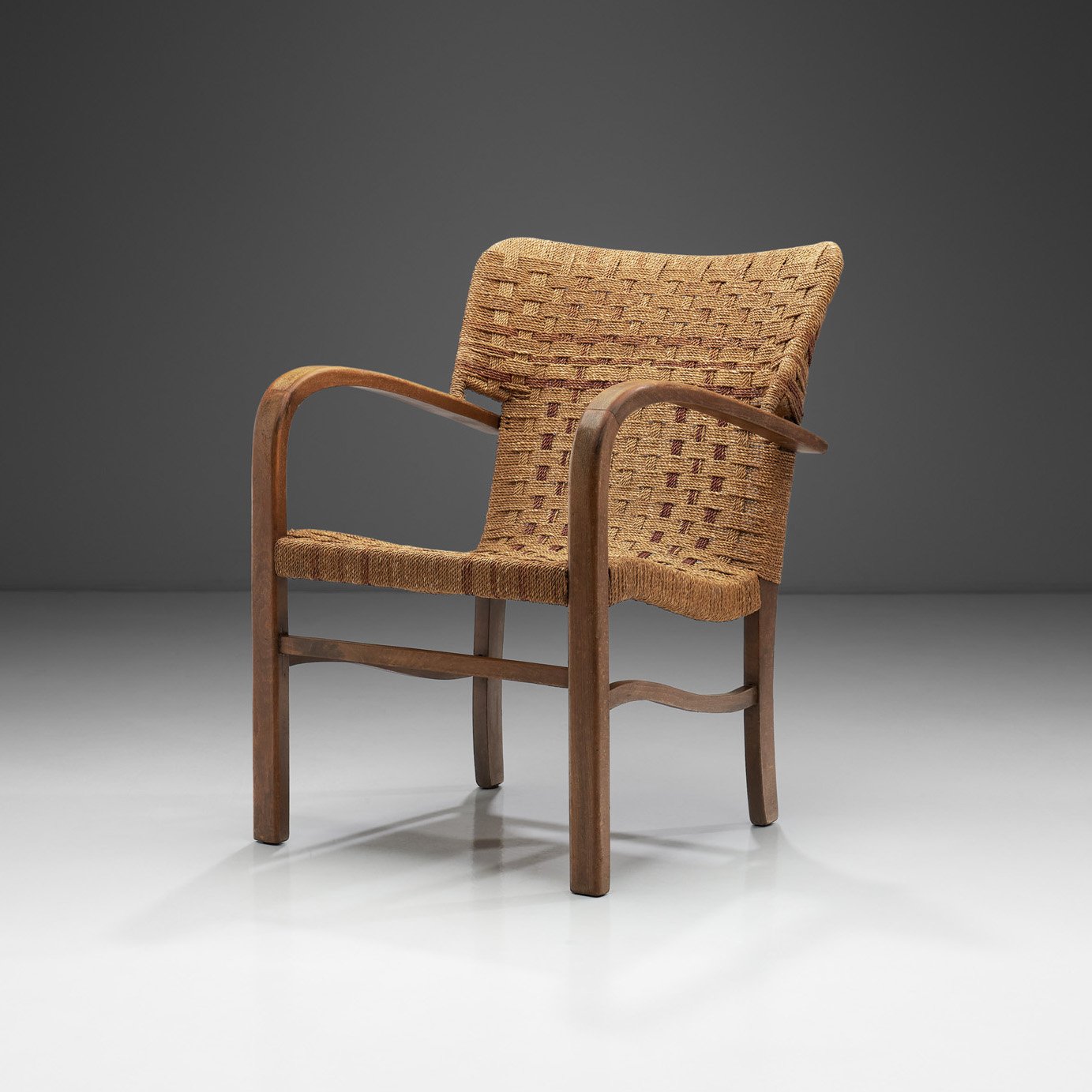
Denmark in the mid-20th century saw brilliant designers working to create furniture of the highest quality that explored truly modern shapes and forms. These designers experimented with new materials and construction methods but, crucially, they all had a formal training, either as architects or as furniture makers. This sculptural armchair shows how successful their creative experiments were.
This chair is a timeless example of mid-century Scandinavian design. Made from solid beech wood, the frame showcases clean, organic lines and gentle curves that speak to the era’s emphasis on functional beauty and simplicity. The honey-toned wood highlights the natural grain and the warm patina that has developed over decades. The softly sculpted armrests and legs bring both elegance and ergonomic comfort to the overall form. Woven cord, a hallmark of Danish craftsmanship, is the main highlight of this piece. The cord is used to construct the seat and backrest of the chair, cleverly woven into a checkered-like pattern. Durable yet flexible, the material fulfils both an aesthetic and functional purpose. The frame offers the design a sturdy base, while featuring geometric elements within the armrests.
This piece preserves the value and beauty of master craftsmanship and exquisite materials. Danish cabinetmakers were and still are world-renowned for their unmatched skill that distinguishes their mid-century cabinetmaker furniture.
Condition:
In good vintage condition. Wear consistent with age and use. The chair has recently been reconditioned. Item may have some marks, scratches, and discolouration.
Dimensions:
22.44 in W x 25.59 in D x 26.77 in H; Seat height 14.76 in; Arm height 20.86 in
57 cm W x 65 cm D x 68 cm H; Seat height 37.5 cm; Arm height 53 cm
REQUEST PRICE HERE
Price category: 2,500 - 5,000 usd / eur
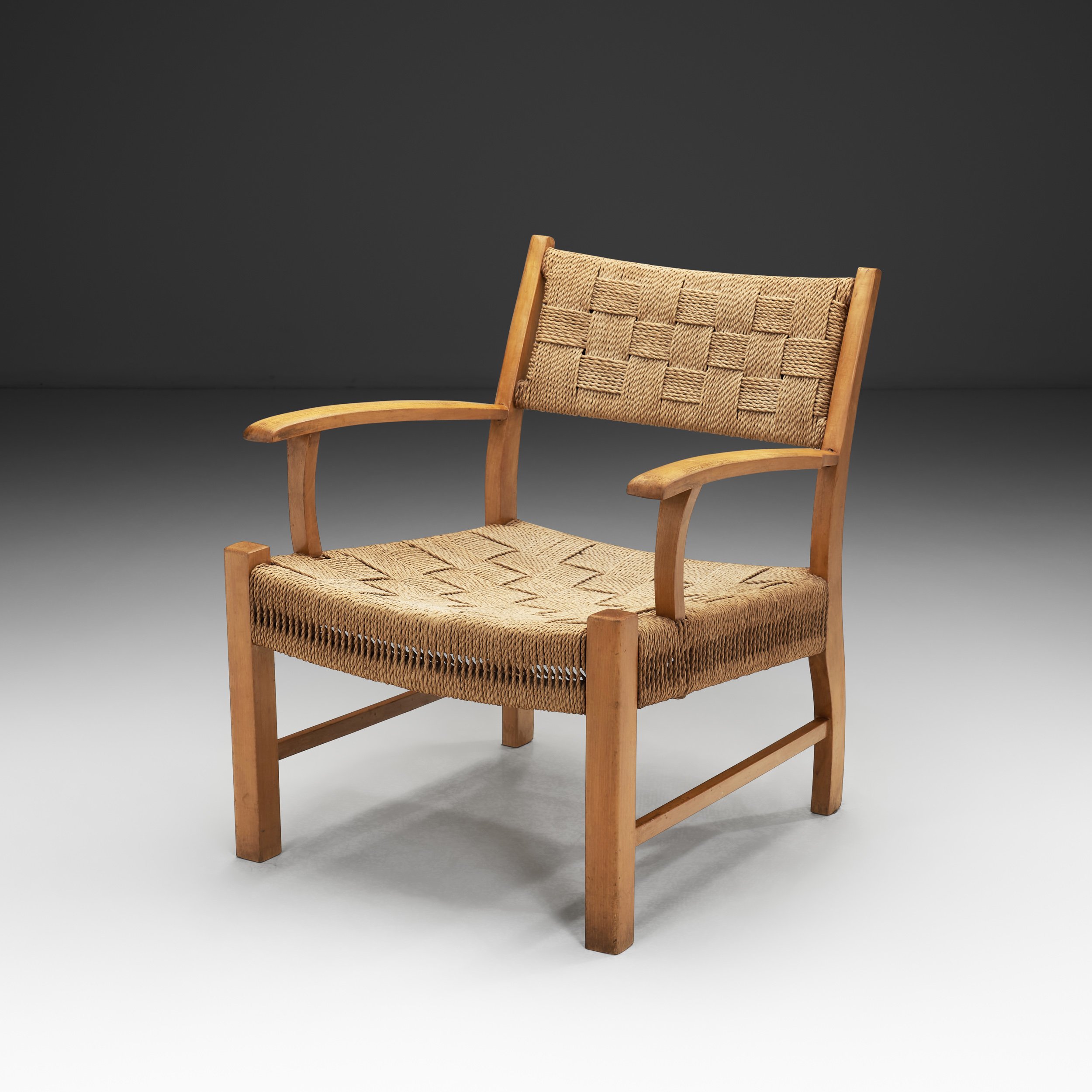
This armchair, recalling the Bauhaus, is made of wood and woven rope, and brings to mind iconic designs of the early 20th century. Erich Dieckmann’s furniture models are often characterized by quality hardwoods, cane matting and geometric frames that link the armrests and legs, creating a unique runner construction. This model is visually reminiscent of Dieckmann’s work thanks to the curved armrests and quality materials.
The wooden structure of this chair was a technical innovation in its time as it was created by steam bending the wood. During the process, the wood is exposed to steam to make it pliable. The steam bending is most apparent in the armrests, where the curvature flows down to form the front legs, and in the stretchers where there is a wavy look - these elements allow the otherwise simple design to stand out and become a work of art in its own right. The frame is complemented by the elegant rope seat and backrest woven tightly around the wood, with the woven seating giving it a warm and cosy feel all while staying very functional. The chair’s simplicity and honest elegance makes it an exceptional piece of furniture. This chair is defined by it’s materials, steam bent wood and woven rope. Both techniques require expert skill, which the craftsman and the manufacturer evidently both possessed.
Unlike designs from outside the continent, European designers’ products weren’t flashy but instead focused on being well-made and to fit a warm, comfortable and welcoming home. As this chair exemplifies, blending functionality, good quality natural materials and organic colours with excellent craftsmanship is the key to the success of this design period.
Condition:
In vintage condition. Wear consistent with age and use.
Dimensions:
23.23 in W x 26.38 in D x 31.5 in H; Seat height 16.53 in; Seat depth 16.92 in; Arm height 24.8 in
59 cm W x 67 cm D x 80 H; Seat height 42 cm; Seat depth 43 cm; Arm height 63 cm

REQUEST PRICE HERE
Price category: 2,500 - 5,000 usd / eur
Peter Hvidt and Orla Mølgaard-Nielsen’s design language operates as a set of relations linking the everyday world - composed of objects, spaces, people - to the cultural ideologies that motivate the persistence of a social democratically infused “way of life.” The design duo’s company was a pioneering force in Danish furniture design thanks to this sentiment.
While the duo solidified their careers with industrial production, more specifically the “AX chair” in the 1950s, this earlier model is perhaps even more stunning in many aspects. “Model 1748” is their most well-known fully upholstered chair, with a design that builds on the traditions of Danish cabinetmaking. The subtle decorative qualities and the simple lines deriving from the early 20th century design movements give this chair its elegance. This armchair shows the homely curviness that defined the design of the mid-century throughout Scandinavia. The back is lightly bent for ergonomic comfort, and have stylish button tufting. The tapered, stained beech legs complement both the shape of the armchair, and the bouclé upholstery.
Quality craftsmanship was of optimum importance for Hvidt and Mølgaard-Nielsen, therefore they collaborated with the best cabinetmakers of the era. This chair was manufactured by Fritz Hansen, Denmark’s most famous company of the time. Founded in Denmark in 1872, and proceeded to manufacture many of the classic icons of Danish Design in the following decades. With a classic look, storied design and solid quality, these chairs are truly soulful and timeless.
Condition:
In good vintage condition. Wear consistent with age and use. The chair has been reupholstered recently in a premium bouclé fabric. Each of our items can be re-upholstered by our in-house atelier in a fabric of choice. Please reach out for more information.
Dimensions:
27.55 in W x 31.88 in D x 33.07 in H; Seat height 16.53 in
70 cm W x 81 cm D x 84 cm H; Seat height 42 cm
About the designer:
Hvidt & Mølgaard was a Copenhagen-based, Danish design and architectural firm which existed from 1944 until 2009. Founded by Peter Hvidt (1916-1986) and Orla Mølgaard-Nielsen (1907-1993), the company was a pioneering force in Danish furniture design and industrialized production in the 1950s, creating furniture that was easy to mass-produce and economic to transport.
Danish architect-designer Orla Mølgaard-Nielsen was born in 1907. His formative years were spent in Copenhagen, studying at the Aalborg Technical School and at the Art and Crafts School of the Design Museum (graduating in 1928). From 1931 until 1934, he continued his studies in furniture design at the Royal Danish Academy of Fine Arts under the instruction of Danish master Kaare Klint (1888-1954). Peter Hvidt was born in Copenhagen in 1916. He studied architecture and cabinetry at the School of Arts and Crafts in Copenhagen. Subsequently, he worked at various design firms before establishing his own studio in 1942.
In 1944, Hvidt designed the Portex Chair, which was one of Denmark’s first stacking chairs. Hvidt, whose design aesthetic was characterized as traditional throughout the 1940s, exhibited frequently at the Cabinetmaker's Guild exhibitions, as both a designer and architect.
In 1944, the pair co-established Hvidt & Mølgaard Studio, which they ran together until 1975. During this time, the pair created designs for Fritz Hansen, France & Søn, and Søborg Møbelfabrik. In 1950, the pair designed the AX Chair, which solidified both of their careers as industrial designers and became an icon of Danish mid-century design. It was the first Danish chair that was crafted with both a seat and back made of curved laminated wood.
From the 1970s, Hvidt & Mølgaard focused on architectural projects, which spanned office buildings and factories, as well as collective housing projects. They were known for their light, simple, and clear designs, which were carried out with precision. Both Hvidt and Mølgaard-Nielsen retired in 1975, designing over 256 pieces of furniture together over the course of their careers. Their work can be found at New York’s MoMA, the National Gallery in Melbourne, and the Danish Museum of Art & Design in Copenhagen. ~H.
REQUEST PRICE HERE
Price category: 7,500 - 10,000 usd / eur
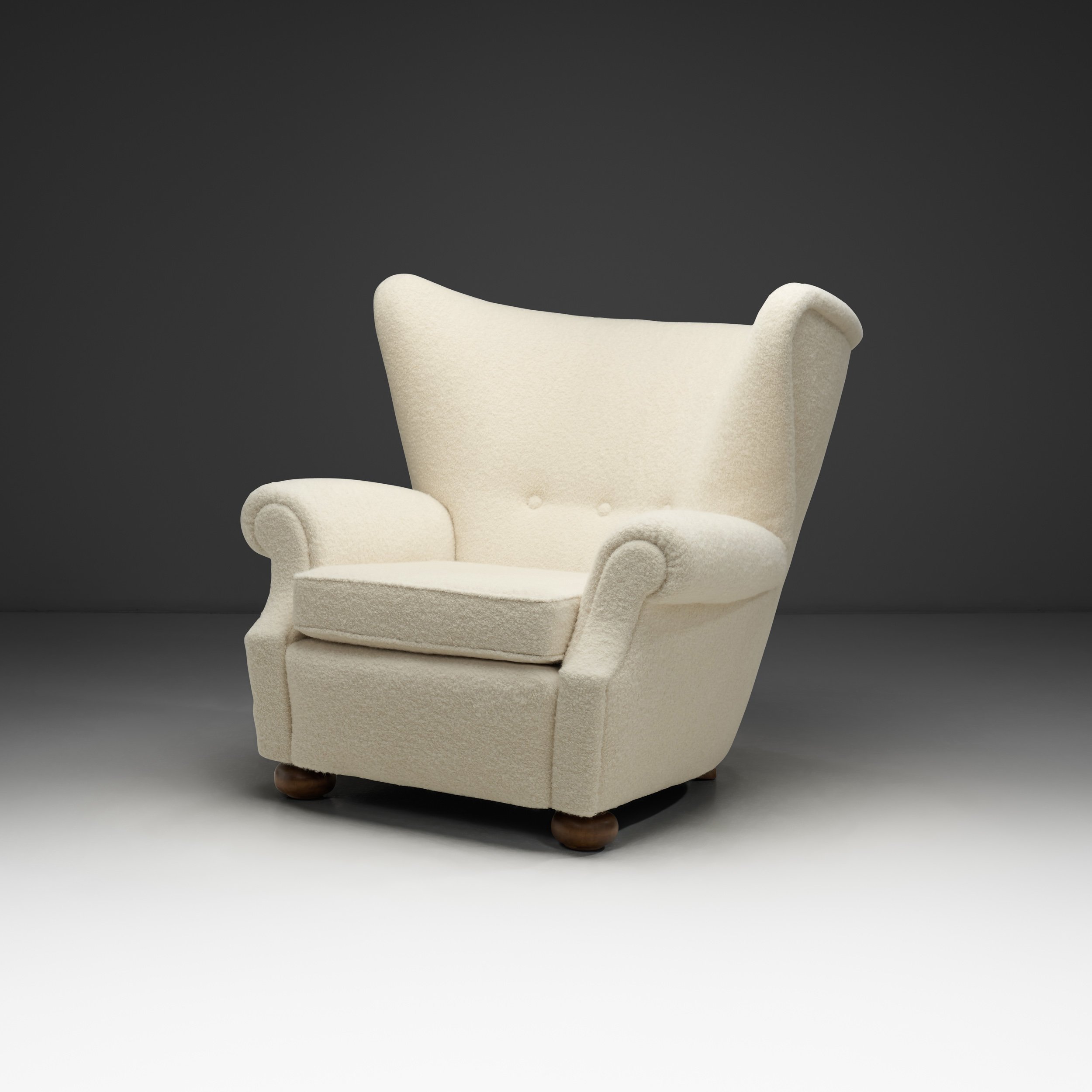
Designed in the early phase of what we know today as mid-century modern, this charming armchair is evidence of how traditional Swedish craftsmanship was brought into modernism. A functional anchor piece is all that is needed to introduce mid-century modern furniture to any interior, and this chair is perfect to fill that role.
Swedish design is characterised by a minimal, clean approach that seeks to combine functionality with beauty. From the welcoming winged body and the solid wood frame to the upholstery, this chair expresses a quality of conviviality that engenders a feeling of contentment. The distinctive shape is a result of the two “ears” or “wings” that encompass the sitter. Originally, the wingback style was created as a way to help shield a person from drafts of cold air and also to trap the heat from a fireplace. That is why wingback chairs are sometimes called fireside chairs, as it was a popular style of chair to have pulled up in front of or flanking a fireplace. This armchair additionally has the touches of mid-century modernism, with upholstery decorated with button tufting. The button tufting is arranged in a line that enhances the depth visually. Furthermore, the quality of the bouclé upholstery brings out the shape of this design, illustrating how the pairing of the work of a skilled cabinetmaker and luxurious materials create exceptional pieces. Made of solid wood, the front legs are spherical, and the back posts are more angular. It is this detail of the construction that gives the chair a more stylish and sturdy form.
The Swedish perspective on cabinetmaking is exceptional, which is why the country’s cabinetmakers’ craft remains world-famous. In combination with the unadorned styles of mid-century design, this armchair brings together the core characteristics of the style: gently rounded edges, solid wooden legs, and a generous fully upholstered body. The design also possesses the elegant homely curviness, an aesthetic balance that is only seemingly easy to achieve, but this piece exudes it.
Condition:
In good vintage condition. Wear consistent with age and use. The armchair has recently been reupholstered in a premium bouclé fabric. Each of our items can be reupholstered by our in-house atelier in a fabric of choice. Please reach out for more information.
Dimensions:
40.35 in W x 43.30 in D x 38.97 in H; Seat height 17.91 in; Seat depth 23.81 in; Arm height 23.62 in
102.5 cm W x 110 cm D x 99 cm H; Seat height 45.5 cm; Seat depth 60.5 cm; Arm height 60 cm

REQUEST PRICE HERE
Price category: 2,500 - 5,000 usd / eur
Italian designer Giancarlo Piretti emerged as a leading figure in postwar furniture design, known for combining technical ingenuity with sculptural forms. A longtime collaborator with Anonima Castelli, Piretti developed several groundbreaking pieces in the 1960s and 70s, many of which explored modularity, and ergonomics. His works, such as the iconic Plia folding Chair and Plia Table won multiple international design awards, and still find their home in museums word-wide, from Austria to the Czech Republic, Slovenia and the United States.
The “Alky” lounge chair, first released in the early 1970s, is among his most celebrated works and reflects the experimental spirit of the period while maintaining a strong sense of comfort and approachability. The chair showcases its signature curvilinear form, expertly upholstered in a soft off-white bouclé that enhances the chair’s inviting charm. The piece is organic, almost reminiscent of a cloud, both thanks to its plushy shape and soft fabric. The design features a continuous silhouette from backrest to seat to base, all supported by a lightweight aluminium structure. The sled frame rests on two aluminium feet, ensuring the stability of the chair. Its organic shape hugs the body and provides a comfortable sitting experience, highlighting Piretti’s attention to ergonomics. The design is balanced, as the textile surface adds warmth, contrasting the modernist structure with a sense of softness.
This “Alky” chair remains an example of 1970s Italian design and a perfect illustration of how form and function can harmonise effortlessly. Ideal as a statement piece in a living room, lounge, or studio, it offers timeless comfort and a sculptural presence that continues to resonate in contemporary interiors.
Condition:
In good vintage condition. Wear consistent with age and use. The chair has been reupholstered recently in a premium bouclé fabric. Each of our items can be reupholstered by our in-house atelier in a fabric of choice. Please reach out for more information.
Dimensions:
26.38 in W x 32.28 in D x 27.56 in H; Seat height 16.14 in; Seat depth 22.05 in
67 cm W x 82 cm D x 70 cm H; Seat height 41 cm; Seat depth 56 cm

REQUEST PRICE HERE
Price category: 1,000 - 2,500 usd / eur
Bridge Chairs - Fauteuil Bridge - from France are generally lightweight, often part of a set of matching chairs and bridge table. They were originally designed in the late 1930s for ladies for leisure activities, such as for games of bridge, afternoon tea, and gossiping. As this bridge chair exhibits, the models are stylish, well-made, and comfortable.
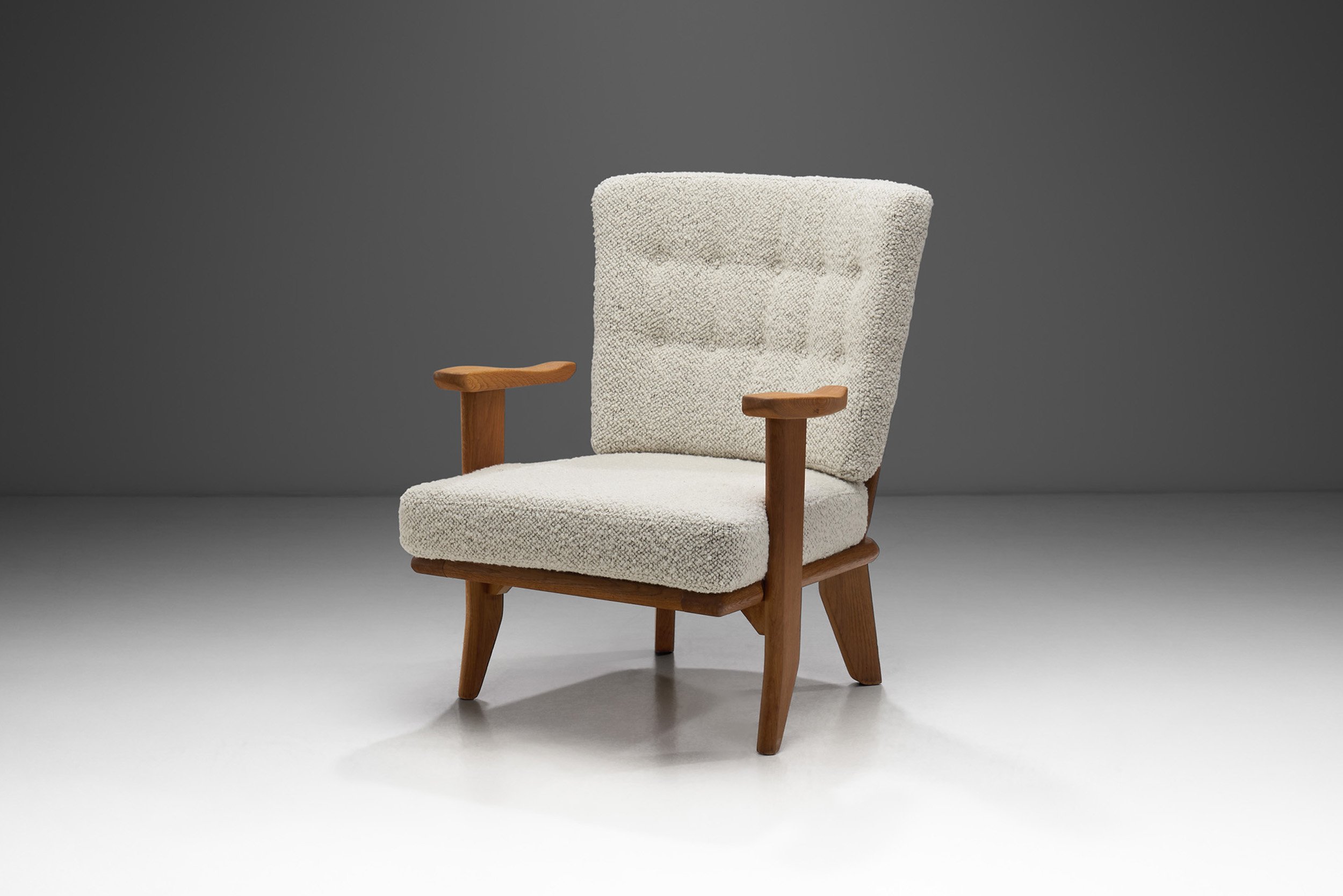
This solid oak “Fumay” is part of a dining group designed in 1965 by the world-famous French duo, Robert Guillerme and Jacques Chambron. As the version with arms, this chair’s frame is quite distinctive; the decorative elements on the backrest and armrest show an interesting curvature that is characteristic of the designer duo. These sculptural elements paired with the tapered legs are carved out of the blonde oak in an artistic way, testifying of the quality that the duo’s company, Votre Maison became famous for. The stretchers arranged between the legs at different heights in the fronts and sides are another clever detail. The genius of the design lies in these details that no matter how different, still complement each other. The sleek look is completed by the upholstered cushion in light bouclé fabric, that pairs beautifully with the colour of the blonde oak.
The French designers’ models are considered as a reference among the furniture of the 1950s through the 70s. This dining chair from the 60s gives a visual explanation why: the proportions, the subtle decorative elements, and the quality of woodworking is of the highest-quality, and the result is an immediately recognisable look that will never go out of style.
Condition:
In good vintage condition. Wear consistent with age and use. This chair has been reupholstered recently in a premium fabric. Each of our items can be reupholstered by our in-house atelier in a fabric of choice. Please reach out for more information.
Dimensions:
22.04 in W x 20.86 in D x 32.28 in H; Seat height 18.11 in
56 cm W x 53 cm D x 82 cm H; Seat height 46 cm
About the designer:
Robert Guillerme graduated in 1934 from the École Boule where he excelled in architecture and furniture design. After the Second World War he moved to Lille, in the north of France, where he decorated homes and designed furniture for the well regarded Rogier workshops.
In 1948, Guillerme was joined by his long-time friend, decorator Jacques Chambron in Lille. The following year Guillerme and Chambron met master cabinetmaker Émile Dariosecq, owner of a woodworking shop and the company Votre Maison was born. Together, they defined and imposed a new furniture concept. Thanks to their distinctive creativity, originality, and quality, the Votre Maison quickly became well-known.
The Votre Maison marked the history of French design. Guillerme drew the furniture designs while Chambron played the part of salesman, welcoming and advising clients. The power duo was complemented by Dariosecq, whose workshop took charge of the manufacturing. Together, they defined new furnishings concepts. Well-crafted chair back, polished wood and thick cushions make the reputation of their armchairs and sofas. Votre Maison continued to produce furniture right into the Twentieth Century, with Jacques’ son Hervé Chambron, a designer and graduate of the Ecole Boulle, having taken the reins in 1983.
REQUEST PRICE HERE
Price category: 5,000 - 7,500 usd / eur
This rare oak lounge chair is a delightfully unique piece even if measured against the other seating models in the repertoire of the French designer duo, Robert Guillerme and Jacques Chambron. This curving, spindle back model truly deserves the title of iconic, both in terms of quality and design. It visually represents the very reason Votre Maison, the duo’s company, significantly influenced French design history.
From every angle, the lounge chair’s design has unique solutions that are unmistakeable and blur the line between furniture and sculpture. From the oak frame to the sculptural legs, arms and backrest, this model is characteristic of the designers’ unique style, while also featuring details that are one-of-a-kind. Such a detail are the freestanding, sculpted armrests that form the front legs as well. This design element shows expert craftsmanship and creativity. The unusual backrest emerges from the seat like a throne. The spindles enhance this appearance, especially with the back cushion’s loops attached to them. The legs are similarly sculpted with great precision to serve a double purpose: an aesthetic role, and a functional one. Thanks to the ergonomic curves and thick, comfortable seat and back cushions, this chair is perfect for cosy lounging. The light bouclé fabric is a great choice, as it highlights the oak’s smooth surface and colour as well.
Guillerme drew the furniture designs for Votre Maison while Chambron played the part of salesman. The pair worked with master cabinetmaker, Émile Dariosecq, whose workshop took charge of the manufacturing. Together, they defined new furnishings concepts. As this brilliant chair shows, well-crafted structures, polished wood and thick cushions created the now world-famous reputation of their seating designs.
Condition:
In good vintage condition. Wear consistent with age and use. Some minor scratches on the wood. The cushions have been reupholstered recently in a premium bouclé fabric. Each of our items can be re-upholstered by our in-house atelier in a fabric of choice. Please reach out for more information.
Dimensions:
28.14 in W x 30.51 in D x 34.05 in H; Seat height 15.94 in; Arm height 22.04 in
71.5 cm W x 77.5 cm D x 86.5 cm H; Seat height 40.5 cm; Arm height 56 cm
About the Designer:
Robert Guillerme graduated in 1934 from the École Boulle where he excelled in architecture and furniture design. After the Second World War he moved to Lille, in the north of France, where he decorated homes and designed furniture for the well regarded Rogier workshops.
In 1948, Guillerme was joined by his long-time friend, decorator Jacques Chambron in Lille. The following year Guillerme and Chambron met master cabinetmaker Émile Dariosecq, owner of a woodworking shop and the company Votre Maison was born. Together, they defined and imposed a new furniture concept. Thanks to their distinctive creativity, originality, and quality, the Votre Maison quickly became well-known.
The Votre Maison marked the history of French design. Guillerme drew the furniture designs while Chambron played the part of salesman, welcoming and advising clients. The power duo was complemented by Dariosecq, whose workshop took charge of the manufacturing. Together, they defined new furnishings concepts. Well-crafted chair back, polished wood and thick cushions make the reputation of their armchairs and sofas. Votre Maison continued to produce furniture right into the 20th century, with Jacques’s son Hervé Chambron, a designer and graduate of the École Boulle, having taken the over in 1983.
REQUEST PRICE HERE
Price category: 5,000 - 7,500 usd / eur
Artifort was founded in 1890, when Jules Wagemans started a business as an upholsterer in Maastricht. A great deal changed with the arrival of the interior and furniture designer Kho Liang Ie, and in 1959 he recruited the French designer Pierre Paulin, beginning a long and fruitful collaboration between Paulin and the Dutch manufacturer. Pierre Paulin’s model “577” lounge chair, also known as the “Tongue Chair” or “Langue” in French, represents a bold and fluid design language that emerged in the mid-20th century.
Designed in 1967, and produced by Artifort, the chair is a hallmark of Paulin’s sculptural approach to furniture. He believed that “a chair should be more than simply functional”. This "577" lounge chair model features a seamless, flowing form that echoes the curve of a human tongue. The lounge chair offers a fresh departure from traditional seating, embodying the futuristic and organic sensibilities of the 1960s. Constructed with a metal frame covered in foam and upholstered in a beautiful off-white textured fabric, the design prioritises both form and comfort. The low armless profile encourages a relaxed posture and makes it visually striking from all angles. Paulin’s innovative use of materials and emphasis on ergonomic design allowed this chair model to become a functional piece and a statement - ideal for modernist interiors that value design and experimentation.
Today, the “577”/ “Langue” chair stands as a timeless icon of modern design, revered for its originality and enduring appeal. Through this design, Pierre Paulin and Artifort captured a unique moment when comfort, form, and avant-garde aesthetics come together beautifully.
Condition:
In good vintage condition. Wear consistent with age and use. The chair has been reupholstered recently in a premium fabric. Each of our items can be reupholstered by our in-house atelier in a fabric of choice. Please reach out for more information.
Dimensions:
31.88 in W x 38.18 in D x 24.80 in H; Seat height 14.56 in; Seat depth 22.83 in
81 cm W x 97 cm D x 63 cm H; Seat height 37 cm; Seat depth 58 cm