
French Cast Iron Table with Varnished Stone Top, France 1980s (sold)





French Cast Iron Table with Varnished Stone Top, France 1980s (sold)
There have been plenty of tell-tale signs that we’re looking back for our interior ideas, retro decor, nature-inspired rattan interiors, and bouclé fabrics to name a few. The 1980s’ style is also making a comeback; it is nostalgic and fun, which can bring comfort and a bit of whimsy into a home. The key to working ‘80s trends into a space is using an accent piece, such as this unique French table.
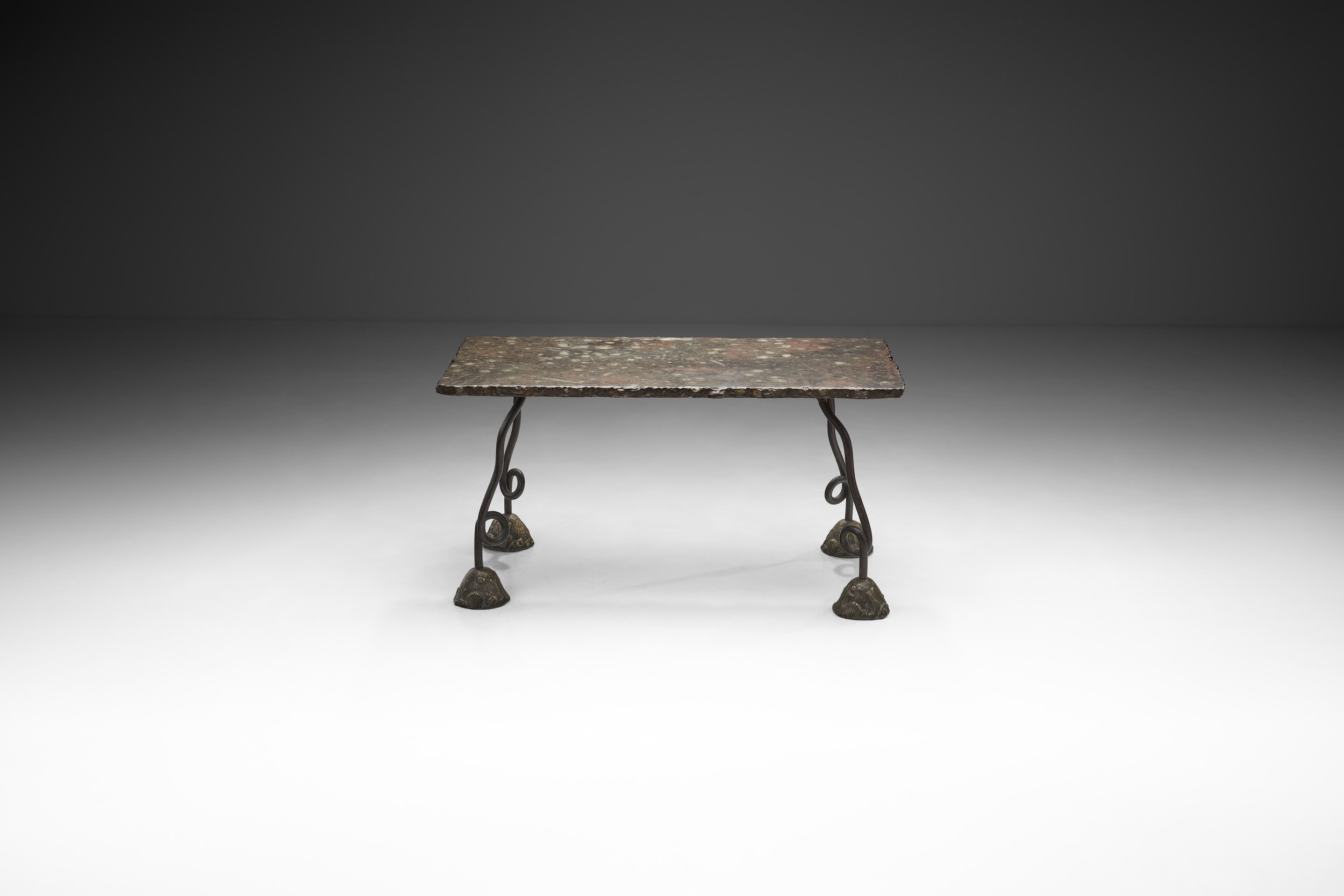
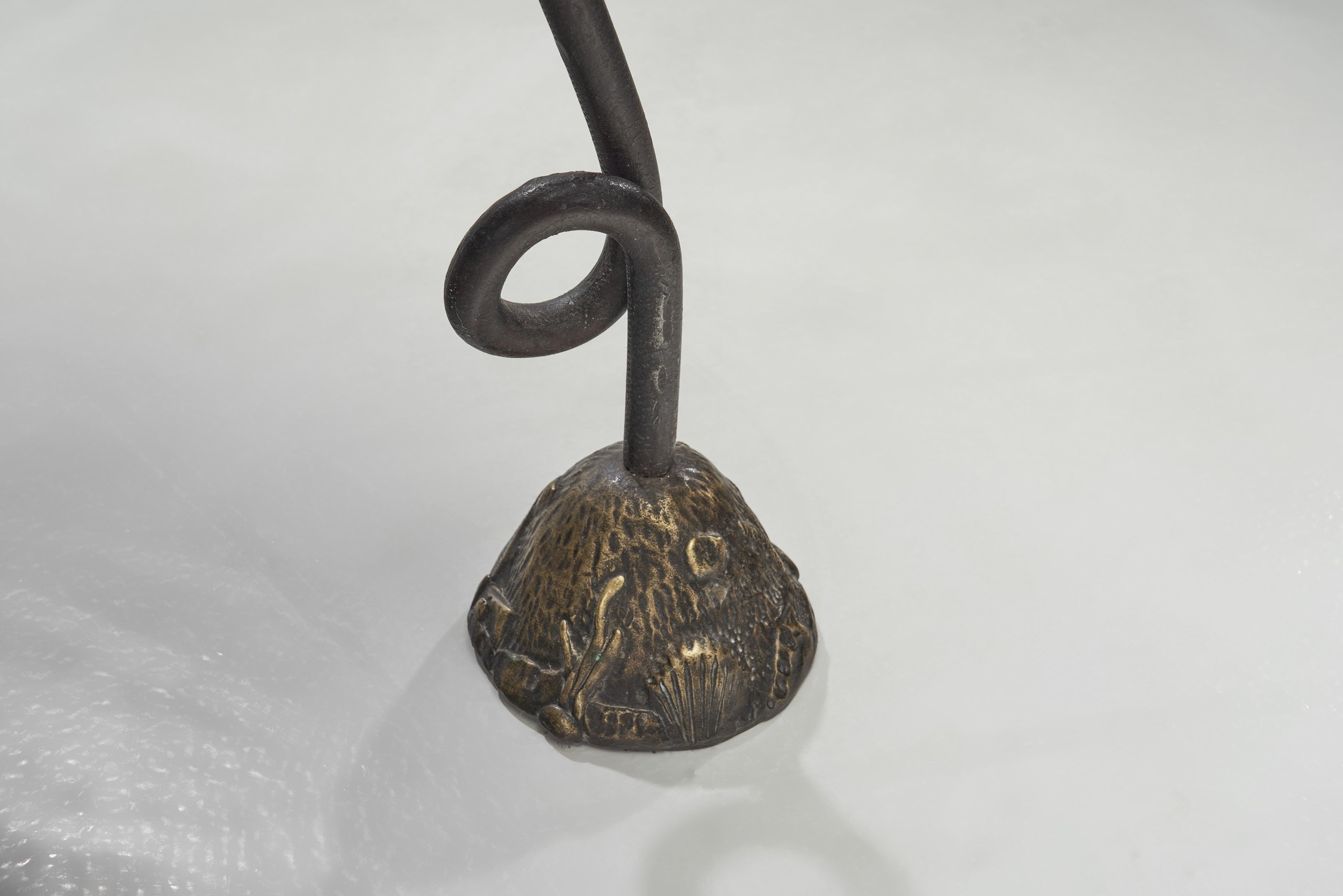
When one thinks of this decade, words like over-the-top, bold, and even loud come to mind. Playing around with textures and patterns paved the way for experimenting with shapes, whereby curved furniture made its debut and softened the typically sharp edges of mid-century modern design. This table is peculiar in many ways, yet it can be adapted for more contemporary interiors. The design treads a fine line between art and design, sculpture and furniture. The structure is made of cast iron, allowing the curling lines to take their unique shape. The legs are twisted with loops, standing on ornamented bases. These are decorated with shell and starfish motifs and beautiful patina. The table-top is made of varnished stone with roughly cut edges and bold patterns. The thick top and thin legs create an interesting and balanced look. The 80s era is well known for its maximalist aesthetic, and like this table, was filled with wavy and modular forms bringing an energetic and playful look into homes. No matter from which angle this table is looked at, it has something outstanding to offer. The flamboyant, unashamedly whimsical post-modernist spirit popularized by Ettore Sottsass and his young collaborators in the Memphis movement in Milan is echoed in this table, which is its undeniable charm.
Bringing curved furniture into a home is a trend that can effortlessly bring character to any space; from daring and playful to natural and calm. The look of the 80s, and therefore of this table, is a trend that can effortlessly provide this character; from daring to playful to natural and calm. While curves work well in most styles, the most obvious match would be mid-century modern where its roots first began.
SOLD
Condition:
In good vintage condition. Wear consistent with age and use.
Dimensions:
35.82 in W x 20.07 in D x 18.5 in H
91 cm W x 51 cm D x 47 cm H


REQUEST PRICE HERE
Price category: 50,000+ usd / eur
"I can't live well with too much rigidity. The 90-degree angle, for example, is something I love, but I can't do it. The things I do end up being a little lyrical, a little sensual, in short, there is always an element that does not come from purity or cleanliness."
This beautiful pedestal table visualizes the above quote from Jorge Zalszupin. It was designed in 1959 and produced by his own company, L'atelier. Essentially, the sizeable top rests on one concrete base finished with soft leather. The solid wood patchwork on the tabletop is mesmerizing, showcasing the many shades of Brazilian hardwood. This was not a purely aesthetic choice, but also an initiative for the rationalization and use of leftover scraps of wood available at the factory, allowing at the same time a combination of their different colourings. The way the large top is supported by the thick metal structure shows architectural precision and the use of materials of the highest quality. At the time of its creation, this table was presented as a dynamic piece that could be used in both the corporate and the domestic places thanks to its casual elegance. Today, its versatility is still recognized, a mark of good design. Zalszupin’s L’Atelier was a design collective comprised of architects, engineers, craftsmen and a full-scale team of professionals who did everything from researching materials to finalizing the product. Therefore, the quality of L’Atelier furniture has transcended time and his pieces have become timeless.
The name is said to be a reference to the famous Baia de Guanabara, a traditional postcard image of Rio de Janeiro. Zalszupin's production established a dialogue very close to the artisanal traditions of working with wood, ensuring quality in the aesthetics and manufacturing of his work.
Condition:
In good vintage condition. Wear consistent with age and use. Some minor scratches on the wooden tabletop. The leather covering on the base is a later replacement.
Dimensions:
98.82 in W x 49.21 in D x 29.13 in H
251 cm W x 125 cm D x 74 cm H
Literature :
Jorge Zalszupin, Design Moderno no Brasil – Maria Cecilia Loschiavo dos Santos, Olhares Edition, São Paulo, 2014, p. 142
About the designer:
Jorge Zalszupin was born in Warsaw, Poland, in 1922. He graduated as an architect in Romania in 1945. His importance for Brazilian design has been articulated in several publications so far. In addition to being the owner of the l'Atelier furniture factory of modern furniture, Zalszupin led a unique initiative: he coordinated a team of designers working for four different factories in the same business group, the Forsa Group.
Zalszupin immigrated to Brazil in 1949 and after a brief stay in the capital, he settled in São Paulo, a city that was then entering a cycle of great industrial growth and great cultural transformations. In the first half of the 1950s, he opened an architecture office, having José Gugliota as a partner. When he got tired of designing exclusive furniture manufactured for his clients' homes, he decided to join a group of woodworkers and started to produce smaller series. This was how l'Atelier came into being, which eventually began to manufacture office furniture and went from a carpentry shop with handcrafted products to an industry with serial production. The first piece in this series was an armchair nicknamed 'Danish' by employees. It was first created in 1959.
After the crisis of the 1980s, Jorge Zalszupin dedicated himself exclusively to architecture, an activity he had never abandoned. From 2005, the company Etel Marcenaria started to produce several of the items designed by Zalszupin for l'Atelier - among them the 'Danish' armchair -, privileging the objects of the company's artisanal phase. ~H.