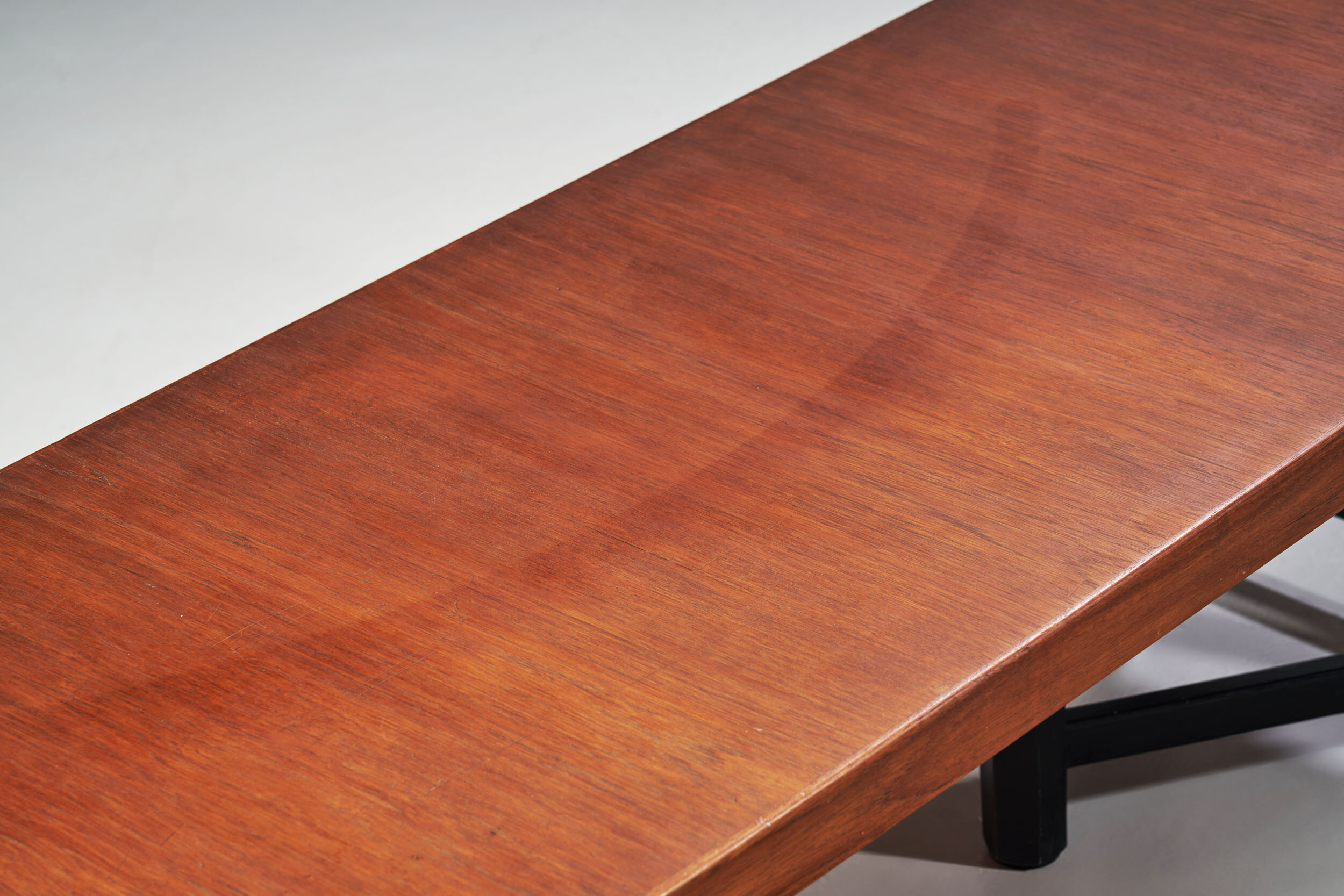
Carl Gustaf Hiort af Ornäs "TV-bench" for Huonekalu Mikko Nupponen, Finland 1950s (sold)


Carl Gustaf Hiort af Ornäs "TV-bench" for Huonekalu Mikko Nupponen, Finland 1950s (sold)
At the Tenth Milan Triennial in 1954, Finland received the largest relative proportion of available prizes. The amount was even more than those eight prizes the country collected at a previous Triennial in 1951, when it made its initial break-through in the international exhibitions of design. A new era had begun: The 1950s and 1960s became known as the golden age of Finnish design and also of designer, Carl Gustaf Hiort af Ornäs.
Distinctive and original furniture characterize the Finnish mid-century, with immediately recognizable features such as the legs of this so-called “Kolmiojalka” (triangular foot) or simply ‘TV bench”. The teak veneered top is supported by two, solid wood trestles. The gaze first attaches to these unusual, triangular legs that inspired the model’s name. They are painted black, thanks to which the geometrical form stands out even more. The colour contrast between the legs and the top is very apparent, resulting in a modern, unmistakeably Finnish look. Many of Hiort af Ornäs’s designs aimed for multiple uses. This model is also versatile due to its airy and light structure, and it forms a whole family of products: It can be used as a table, a bench, or as a stand for a television or even books. An upholstered version of this model also exists that was used at the end of beds and waiting rooms. Regardless of where and how it is used, it beautifully emphasizes the objects placed on it. The beautifully finished details make this bench an eye-catching classic.
The 1950s’ design language looks just as attractive and fresh today as it did decades ago. Every piece of Hiort af Ornäs furniture is a Finnish handicraft, manufactured in Finland, respecting traditions from the very beginning of production. This model was produced at Huonekalu Mikko Nupponen in Lahti, Finland during the 1950s.
SOLD
Condition:
In good vintage condition. Wear consistent with age and use. Minor scratches on the wood.
Dimensions:
55.11 in W x 18.89 in D x 15.15 in H
140 cm W x 48 cm D x 38.5 cm H
About the designer:
Carl-Gustaf Vilhelm (nicknamed “Nalle”) Hiort of Ornäs was born on 27 February 1911 and lived most of his life in Tapiola/Espoo in Finland, and in his later life moved to Spain. He is remembered as a Finnish interior architect and designer known to be uncompromising.
Before the Finnish wars (1939-1944), Hiort af Ornäs spent his time in Pori, working at Björneborgs Mekaniska Verkstad. He studied at the Helsinki University of Technology to become an architect, but never graduated. He did, however, become known as an interior designer, and eventually even more known as a furniture designer.
In 1945, Hiort af Ornäs founded the furniture company Puunveisto Oy, for which he developed versatile techniques for shaping plywood. He started the furniture manufacturing shop on Lauttasaari in Helsinki (Veneentekijäntie 14) together with his brother. The wood shop, showroom and office were all located in the same building in Helsinki. Rolf Mesterton was the man in charge of producing the furniture, but there were several other carpenters at work in the woodshop. Hiort af Ornäs’s furniture was exhibited and sold by the shop Nupponen who also distributed Olavi Hänninen’s designs, while Puunveisto’s furniture were also sold by Gösta Westerbergs Möbler in Stockholm, Sweden, but despite a good selection of chairs, tables and shelves, did not do too well. Since production costs were high, Hiort af Ornäs faced economic troubles. The company was later sold to Nupponen after which Hiort af Ornäs’s interest in the company waned.
Hiort af Ornäs spent his retirement in Spain, and designed several buildings for Fuengirola’s Los Pacos neighbourhood, which has a large Finnish population. His house that he drew and built in Tapiola, Espoo, Finland, ‘Villa Hiort’, still stands and houses some of the designer’s original drawings. It is a beautiful example of 1950s Modernism and the talent of Hiort af Ornäs that brought him recognition that lasts to this day. ~H.
REQUEST PRICE HERE
Price category: 2,500 - 5,000 usd / eur
This coffee table is a stunning example of Modernism in design: clear forms without exaggeration with the high-quality work of a Danish cabinetmaker. Humble in its material and size, this table still draws attention thanks to its distinctive look and personality.
Early on, many of the Danish cabinetmakers’ workshops had been producing historical furniture; master cabinetmakers had been renowned for their solid wooden furniture rendered in various styles of the past. This coffee table, while not specifically historical in style, shows some restrained decorative elements that are generally rather sparse in Scandinavian mid-century furniture. However, accordingly to the design ideals of Danish designers, the scalloping pattern is not overwhelming the table, nor does it demand attention, rather, it is an understated but clever addition to the design. The scalloped patterns on the tabletop and legs differ slightly; the scallops on the legs are more pronounced with straight lines between each scallop, while under the tabletop, it is in a more traditional, round shape.
The wavy effect is even more pronounced thanks to the beautiful grain and colour of the solid oak that is most apparent on the wide, circular top. As it can be expected from Danish design and craftsmanship, visually appealing elements usually serve a functional role as well. In this case, the wooden elements under the table reinforce the stability of the structure in this ingenious manner.
Condition:
In good vintage condition. Wear consistent with age and use. Due to the nature and age of the material, the item may have some marks, scratches, and discolouration.
Dimensions:
35.03 in W x 35.03 in D x 22.04 in H
89 cm W x 89 cm D x 56 cm H
About the Designer:
The practical and comfortable designs of Danish cabinetmakers defined mid-20th century modern seating. The Danish Cabinetmakers focused on minimalist design executed by expertly skilled craftsmen.
Works from the Danish Cabinetmakers' Guild is a concept of its own in collectible design. The Cabinet-Makers' Guild began annual exhibitions in 1927 in Copenhagen. The group formed an exhibit showing each year in October the quality furniture made to drawings by gifted architects. The exhibition took place each year, without interruption, for forty years. A number of successful Danish Design collaborations were formed during this time between cabinetmakers and architects.
Danish Modernism has influenced Scandinavian furniture to a great degree, defined by minimalism, simplicity, and functionality. The muted colours and gentle designs make Danish mid-century furniture an ideal addition to contemporary living spaces. Additionally, master cabinetmakers were highly aware of body proportions, prioritizing comfort just as much as the visual qualities.
The works of master cabinetmakers – such as this chair – are of the highest quality, both in terms of materials and craftsmanship. Cabinetmakers take the art of working with wood one step further, and focus on the finer details of what can be created with the material. Therefore, it comes as no surprise that numerous master cabinetmakers are part of the renowned Danish Culture Canon (Danish: Kulturkanonen). The canon contains no more than 108 works of cultural excellence, based on works with a useful function and that are still recognisable today. These lounge chairs are the perfect illustrations of Danish design, and the work of a true cabinetmaker. ~H.
REQUEST PRICE HERE
Price category: 2,500 - 5,000 usd / eur
Danish design is known for its meticulous balance of classic and timeless appearance. This coffee table showcases exactly that - the top with a beautiful design reflecting an enduring appeal, together with the combination of the traditional arrangement of the legs. The work of Søren Jean Larsen displays excellent craftsmanship, with his ability to balance out heavy materials that in the end display a serene and light vision.
Hemmed around by a beautiful oak border, at the heart of the piece lies its true charismatic point: a circular stoneware inlay, composed of glazed ceramic tiles. Contributing to its organic look, the unique tabletop features abstract forms shimmering in earthy tones of deep olive green, amber, and hazelnut colours, all adding to the warm, autumnal atmosphere of the table. The asymmetry of the forms becomes apparent in the varying shades and textures of the inlay, the contrast of materials creating visual interest and a striking, unique character. While somewhat abstract, the conscious placement of the ceramic pieces is palpable in the composition of the colours and forms. The swirls of the glazed ceramic are especially visible with the amber colours emerging from the centre outwards. Underneath the top, the weight of the table is balanced out in four, slightly inward-tilted legs that end in a stable and distinctive X-shape. The construction of the frame, made of solid oak, demonstrates a lovely grain within the wood that has aged beautifully.
This table by Søren Jean Larsen is a distinguished example of Scandinavian design, perfect for both modern and eclectic interiors with a strong emphasis on practicality as well as exceptional craftsmanship. Its durable stoneware top ensures longevity as does its solid wood structure, making sure to lighten spaces and cater to heartwarming times over coffee and tea in the early afternoons for years to come.
Condition:
In good vintage condition. Wear consistent with age and use.
Dimensions:
50.98 in ⌀ x 20.27 in H
129.5 cm ⌀ x 51.5 cm H
REQUEST PRICE HERE
Price category: 2,500 - 5,000 usd / eur
Danish sculptor and industrial designer Jens Quistgaard (1919–2008) had a distinguished career in Denmark and the United States, and was especially active during the 1950s and '60s. Initially trained as a sculptor by his father, Jens Quistgaard expanded his skills by learning from carpenters and metal smiths, all contributing to his versatility as a master craftsman with the expertise to combine materials and techniques in novel ways. Quistgaard quickly became known for his fluid lines and for using unusual materials, often in combination. His most renowned and commercially successful works were created for the American company Dansk Designs. The company introduced Quistgaard and his minimalist Nordic design aesthetic to the United States, significantly contributing to the American appreciation of Danish Modern design. By the late 1950s, Quistgaard's work was synonymous with modern living. This teak side table is a clear example of his philosophy and clear aesthetic choices.
Intriguing and fantastical, the variety of forms Jens Quistgaard created expanded the vocabulary of functional design, calling on an array of familiar references, including natural shapes. This side table has precise forms without ornamentation, showcasing Jens Quistgaard's high-quality craftsmanship skills. Humble in its material and size, this table draws attention thanks to its distinctive look and personality. It has a round reversible top, which is characterised by the wood's grain and warm colours. The circular pattern has a constant rhythm and visually creates a beautiful alternation between darker and lighter tones. The pattern does not overwhelm the table - instead, it is an understated but clever addition to the design. The four legs are joined together by cross stretchers, which also serve the purpose of holding the top in place, gently letting it rest with no need for additional joinery or screws. This manner of combining the two separate parts is a detail that certainly derives from Quistgaard's sculptural training. The legs are slightly larger at the bottom, providing stability and visual interest. As can be expected from Danish design and craftsmanship, visually appealing elements usually also serve a functional role. In this case, the wooden elements under the table reinforce the stability of the structure in this ingenious manner, with the table top being supported gently by the legs.
Throughout his career, Quistgaard received numerous awards, including the Lunning Prize in 1954, the Neiman Marcus Award for Distinguished Service in the Field of Fashion in 1958, and Munch's Der Goldene Löffel in 1962. His work has been exhibited in museums worldwide, such as the Danish Museum of Art and Design in Copenhagen, the Victoria & Albert Museum in London, and the National Museum in Stockholm. This teak side table showcases Quistgaard's skills and adds an elegant touch to any living space.
Condition:
In good vintage condition. Wear consistent with age and use.
Dimensions:
22.24 in ⌀ x 17.12 in H
56.5 cm ⌀ x 43.5 cm H
REQUEST PRICE HERE
Price category: 2,500 - 5,000 usd / eur
With warm tones, exceptional versatility, and crafted with a range of appealing materials, Peter Hvidt & Orla Mølgaard Nielsen furniture showcase the Danish duo’s penchant for innovation and durable design. For decades, the pair created sleek coffee tables - like this piece - that are characterised by the practicality and elegance commonly attributed to Scandinavian modernism.
In mid-century modern design, the use of wood held a special significance: it was not merely a material choice, but a philosophy that emphasised the natural and organic over the ornate and extravagant. The design of this coffee table is inspired by the mid-century inclination towards elemental shapes, featuring a simple, elegant circle as its tabletop, supported by four straight legs connected by overlapping cross stretchers. This minimalist approach combined with solid wood creates a timeless appearance that resonates with any design style. Furthermore, round tables, such as this model, held a special place in mid-century design. Their open, unobtrusive look fosters social interaction, making them ideal for gathering, discussion, and shared experiences. The absence of sharp corners enhances safety and flow within a space, promoting a harmonious environment. This table has a humble but well-thought-out structure that relies on its material for its aesthetic, with a natural expression dominated by the natural beauty of the wood and its characteristics. The most eye-catching design (and functional) element remains the cross stretchers connecting the legs. Albeit simple, its uncommon overlap - as opposed to bisecting - design catches the eye, and contrasts effectively with the top.
The design of this table encapsulates a rich moment in furniture design history. It's a tangible embodiment of the mid-20th century era’s focus on materiality and craftsmanship, while also reflecting the innovative spirit of Danish designers like Peter Hvidt & Orla Mølgaard Nielsen.
Condition:
In good vintage condition. Wear consistent with age and use. Some marks and scratches on the wood.
Dimensions:
36.22 in Ø x 22.05 in H
92 cm Ø x 56 cm H
Literature:
Fritz Hansen catalogue, 1951
About the Designers:
Both Hvidt and Mølgaard-Nielsen attended what is now the Royal Danish Academy of Fine Arts, with Mølgaard-Nielsen having completed his studies under the Danish furniture design pioneer and architect Kaare Klint. Trained as an architect and cabinetmaker, Hvidt established his own firm in 1940 and taught at his alma mater for a few years. After they won a design competition held in Stockholm, Hvidt partnered with Mølgaard-Nielsen in 1944 to establish their firm in Copenhagen.
The collaboration between Hvidt and Mølgaard-Nielsen yielded more than 250 designs and lasted over 30 years. Aside from having created a wardrobe for the Queen of Denmark as well as numerous architectural structures, the pair’s flagship achievements include 1944’s teak Portex chair, which is Denmark’s first-ever stacking chair (and is occasionally attributed to Hvidt alone), and the AX Chair.
Hvidt and Mølgaard-Nielsen retired in 1975. Hvidt passed away in 1986 and Mølgaard-Nielsen in 1993. Hvidt received the Diplôme d'Honneur at Milan’s Triennale in 1951 and 1954. Mølgaard-Nielsen was jointly awarded an iF Product Design Award for the Safari lamp for Nordisk Solar Compagni (1981, Christian Hvidt, Peter Hvidt & Orla Mølgaard-Nielsen). Their work can be found at New York’s MoMA, the National Gallery in Melbourne, and the Danish Museum of Art & Design in Copenhagen.
REQUEST PRICE HERE
Price category: 2,500 - 5,000 usd / eur
Danish pieces like this coffee table showcase balance with a classic, timeless design. With a clear statement of simplicity and an emphasis on material quality, this table is a great example of “Danish Modern” design. The base is made of solid wood, yet gives a lightweight and airy impression. The large top surface shows off the beautiful pattern of the wood.
The main design element is the teak veneered top with an amazing sunburst design. A sunburst is a design or figure commonly used in architectural ornaments and design patterns; it consists of rays or "beams" radiating out from a central point in the manner of sunbeams. Thanks in great part to an emphasis on the use of wood, this table has avoided associations with cold industrialisation and machine aesthetics of the era. European (and especially Scandinavian) designers’ predilection for curvilinear shapes and certain woods - often teak - is evident in this coffee table’s circular top and solid wood body. The use of teak veneer with a beautiful grain further gives this table a natural, elemental feel.
Countering the shape of the top, the legs and feet have a simple yet beautiful structure with gently rounded edges. The feet are connected at a point at the bottom, showcasing the seamless joinery. The sleek look resulting from the soft lines, functional design and expert craftsmanship make this table a perfect and stylish addition to any dining area.
Condition:
In good vintage condition. Wear consistent with age and use. Visible marks and scratches on the wood.
Dimensions:
40.16 in Ø x 21.46 in H
102 cm Ø x 54.5 cm H
REQUEST PRICE HERE
Price category: 12,500 - 15,000 usd / eur
Made upon order. Lead time ca 8-10 weeks
This Água table by contemporary artist Domingos Tótora, is an exceptional piece. The name, meaning water in Portuguese speaks for itself as the sight of this table’s design is akin to the process of sediment settling into a riverbed. There may be no artist who demonstrates sustainability as wholly as Tótora. His masterworks have journeyed full circle, narrating the story of sustainable earth without uttering a single word.
Designed by Domingos Tótora, the Água Table demonstrates lightness through heavy elements. With his special but traditional technique, this table was created with recycled cardboard with added graphite pigment. A smooth, matte surface and the organic shape characterize the designer’s work and are witness to his extensive experience in object design. During the creation process Tótora reduces the cardboard to a semi-liquid pulp, hand moulds it into the desired shape and dries the almost finished product in the Brazilian sun. With a smooth finish, the three large “stones” and the glass top evoke the image of a river with crystal clear waters. Sustainability is essential for the Brazilian artist and accordingly, this table was made in a certified sustainable way. In this beautiful and labour-intensive process, the cardboard that originated as wood is essentially brought back a full cycle by taking on a wood-like quality again. For Tótora “sustainability happens through actions and not words”.
In 2008, this table-sculpture won first place and an honourable mention in Craft + Design and second place in the Brazilian Object. A year later, it was ranked first in the Sustainable Design category at Top XXI and won the Brazil Design Awards, in the furniture category. In 2010, recognition came at the Ibero-American Design Biennial in Spain.
Condition:
New.
Dimensions:
61.02 in ⌀ x 12.99 in H
155 cm ⌀ x 33 cm H
About the designer:
Domingos Tótora (1960-) is a contemporary Brazilian designer whose work falls between art and design. Born and raised in the mountainous region of Maria da Fé, nature is an essential part of Tótora’s aesthetic. Being true to nature means that imperfections are a welcome part of Tótora’s designs, embracing asymmetry and unevenness in the spirit of wabi-sabi.
Following his studies in São Paulo, Tótora found inspiration on the streets in the form of discarded cardboards. He created a process in which cardboard can be recycled by breaking it down to small pieces, transforming it to cellulose plaster. With the addition of water, glue and natural pigments, the cardboard can be shaped into new forms. Through this sustainable process, waste cardboards are turned into a wood-like material. Tótora and his small team believe sustainability happens through actions and not words.
His studio, Domingos Tótora Estúdio de Artes Design, was founded in 2005 in his hometown, Maria da Fé. The beauty of his work manifests itself in its philosophy of creation and respect for the environment. The production process of Tótora’s designs is 100% manual and the cardboard he uses is fully recycled. Domingos Tótora is a true mixture of artist, designer, and craftsman. In recent years, the originality and elegance of his creations have been recognized in several exhibitions. ~H.
REQUEST PRICE HERE
Price category: 1,000 - 2,500 usd / eur
Danish furniture design possesses a homely tone in nature and character. The best works are characterized by the will to produce genuine, technical workmanship, a sound critical attitude to untimely modernism. There is also a natural desire to take up the problems for renewed investigation and solutions in accordance to the exigencies of the times.
Thanks to these characteristics and attitudes, Danish pieces like this coffee table have an outstanding balance with a classic, timeless design. With a clear statement of simplicity, quality and respect for materials, this table is a great example of Danish Modern design. The rectangular tabletop is made of exotic wood, yet it has a light impression. The large surface shows off the pattern of the wood, including diverse swirls and a large colour variety ranging from light to dark brown. Countering the restrained shape of the top, the legs, and feet have an intricate structure with gently rounded edges. The feet are connected thus the look resembles the sledge style. The standout feature however, is the pair of brass braces; this diagonal reinforcement is not only an important structural feature, it is also a visually appealing detail that gives character to this coffee table. Looking beneath the top, the elaborate wooden structure becomes visible, showing the cabinetmaker’s expert skill and knowledge.
The combination of the beautiful exotic wood and the brass creates the modern look that Danish Mid-Century design is coveted for. The quality of the execution leaves no questions behind, making this table a stylish and timeless piece ideal for any interior.
Condition:
In good vintage condition. Wear consistent with age and use.
Dimensions:
54.92 in W x 19.48 in D x 18.89 in H
139.5 cm W x 49.5 cm D x 48 cm H
REQUEST PRICE HERE
Price category: 5,000 - 7,500 usd / eur
Ole Wanscher was a leading figure in Danish and Scandinavian design, as was his mentor, the legendary Kaare Klint, renowned to be the “father” of modern Danish furniture design. Together, they made significant achievements in redefining classic forms. Drawing inspiration from human anatomy, his developments influenced the concept of Scandinavian modernism as we know it today. Wanscher’s contribution to the field is widely acknowledged as he acquired his skills at the esteemed Det Kongelige Danske Kunstakademi - Billedkunst Skolerne in Copenhagen.
The post-war era, especially the period spanning from 1940 to 1960 resembled the golden age of Danish furniture, and was when Wanscher created his most well known works. This model "1762" coffee table retains the cherished Danish modernist traits, such as simplicity and functionality, while also reflecting an ongoing precise focus on quality materials. This minimalist approach combined with solid wood creates a timeless appearance that resonates with any design style. The stunning grain pattern of the table top enhances the visual appeal, yet the most eye-catching design (and functional) element remains the curving cross stretchers connecting the legs. Albeit simple, its uncommon overlap - as opposed to bisecting - design catches the eye, and contrasts effectively with the top.
The design of this table encapsulates a rich moment in furniture design history. It is a tangible embodiment of the mid-20th century era’s focus on materiality and craftsmanship, while also reflecting the innovative spirit of Danish designers like Ole Wanscher.
Condition:
In good vintage condition. Wear consistent with age and use. The table has recently been reconditioned. Due to the nature and age of the wood, the item has visible marks and scratches, and may show slight discolouration.
Dimensions:
35.44 in W × 21.66 in D × 21.66 in H
90 cm W x 55 cm D x 55 cm H