
Guillerme et Chambron "Portefeuille" Folding Dining Table for Votre Maison, France 1970s (sold)

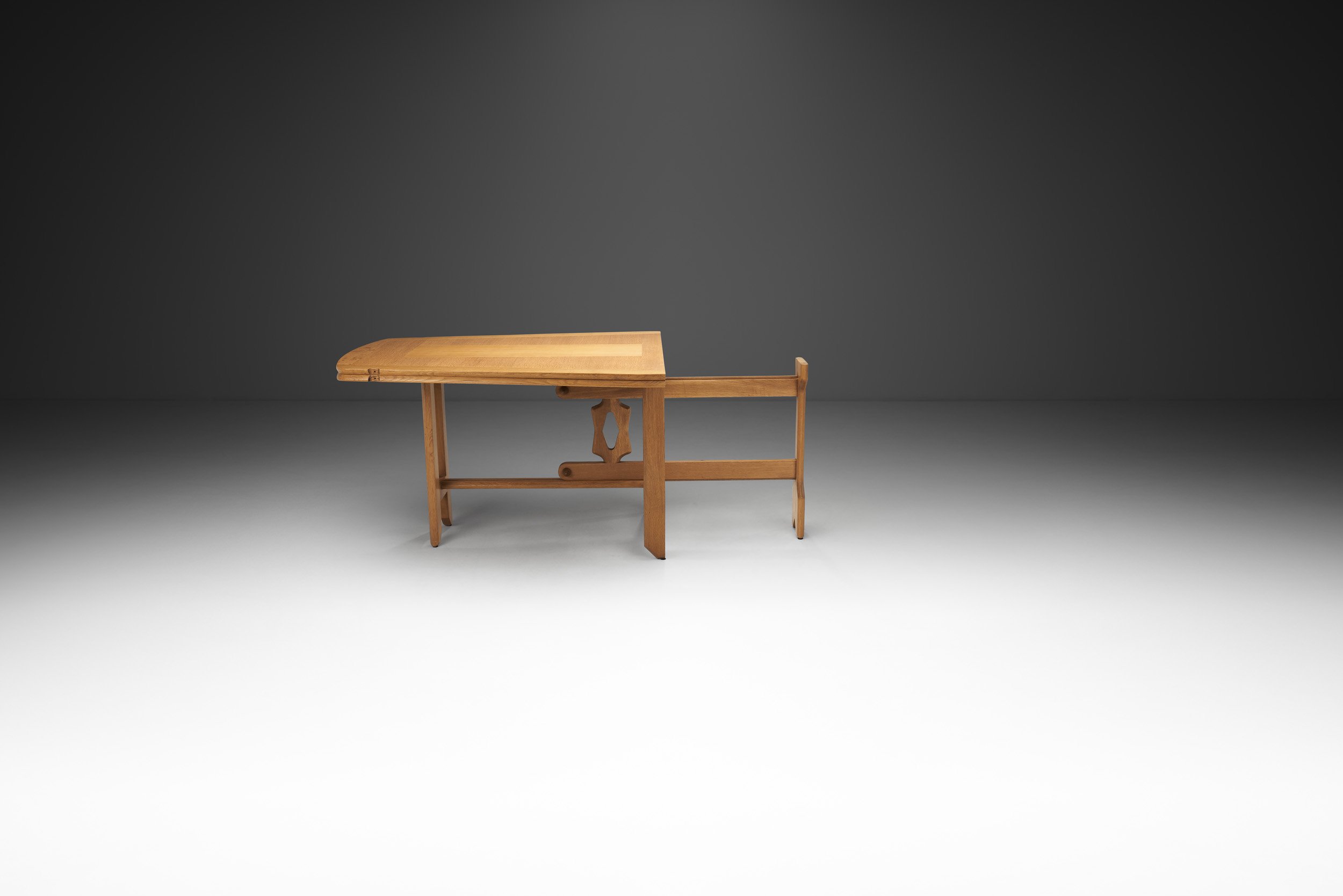


Guillerme et Chambron "Portefeuille" Folding Dining Table for Votre Maison, France 1970s (sold)
This “Portefeuille” oblong table is perhaps the most innovative and distinctive table design of the French designer duo, Guillerme et Chambron. The true genius of the duo’s present model is that the multifunctional design manages to be innovative, functional, and as always, visually stunning.
The design shows an organic approach and the duo’s unique visions in the decorative and functional details. Unlike in most mid-century models, ornamentation was an important part of the duo’s creations, and while apparent, they were never overwhelming. This balance kept the pieces’ elegance, like in the case of this dining table. The design features a folding tabletop and a sliding lower structure with beautifully sculpted lines. The wooden parts slide in a sculpted rail that shows expert level craftsmanship. The oblong top can be doubled in size thanks to the foldable half, accompanied by the extendable leg that slides out smoothly to support it. This leg carries the decorative, sculpted elements; the hexagram shaped piece and the arrow-shaped leg. The rest of the legs have an interesting, pointed shape and are connected by horizontal stretchers. The screws have wooden joinery caps, showing how much thought was put to the smallest details as well. The body and the precise connecting and adjusting elements are made of solid oak, showing the natural pattern of the wood. The duo’s multifunctional tables in particular show how aesthetical design and functionality are equally important for the designers.
The designer duo’s organic approach to arts and crafts resisted the stark industrial look that was dominant in the post-war period under the influence of socialism. This Portefeuille dining table is undoubtedly an emblematic model of post-war French decorative arts and design with a distinctive appearance and multifunctionality. Robert Guillerme and Jacques Chambron were as sensitive to the use of furniture in everyday life as to the creation of innovative design.
SOLD
Condition:
In very good vintage condition. Wear consistent with age and use. Some small marks. The oak has a beautiful patina.
Dimensions:
94.49 in W x 41.34 in D x 28.35 in H; Folded = 47.24 in W x 41.34 in D x 28.35 in H
240 cm W x 105 cm D x 72 cm H; Folded = 120 cm W x 105 cm D x 72 cm H
About the Designers:
Robert Guillerme graduated in 1934 from the École Boulle where he excelled in architecture and furniture design. After the Second World War he moved to Lille, in the north of France, where he decorated homes and designed furniture for the well regarded Rogier workshops.
In 1948, Guillerme was joined by his long-time friend, decorator Jacques Chambron in Lille. The following year Guillerme and Chambron met master cabinetmaker Émile Dariosecq, owner of a woodworking shop and the company Votre Maison was born. Together, they defined and imposed a new furniture concept. Thanks to their distinctive creativity, originality, and quality, the Votre Maison quickly became well-known.
The Votre Maison marked the history of French design. Guillerme drew the furniture designs while Chambron played the part of salesman, welcoming and advising clients. The power duo was complemented by Dariosecq, whose workshop took charge of the manufacturing. Together, they defined new furnishings concepts. Well-crafted chair back, polished wood and thick cushions make the reputation of their armchairs and sofas. Votre Maison continued to produce furniture right into the 20th century, with Jacques’s son Hervé Chambron, a designer and graduate of the École Boulle, having taken the over in 1983. ~H.


REQUEST PRICE HERE
Price category: 50,000+ usd / eur
"I can't live well with too much rigidity. The 90-degree angle, for example, is something I love, but I can't do it. The things I do end up being a little lyrical, a little sensual, in short, there is always an element that does not come from purity or cleanliness."
This beautiful pedestal table visualizes the above quote from Jorge Zalszupin. It was designed in 1959 and produced by his own company, L'atelier. Essentially, the sizeable top rests on one concrete base finished with soft leather. The solid wood patchwork on the tabletop is mesmerizing, showcasing the many shades of Brazilian hardwood. This was not a purely aesthetic choice, but also an initiative for the rationalization and use of leftover scraps of wood available at the factory, allowing at the same time a combination of their different colourings. The way the large top is supported by the thick metal structure shows architectural precision and the use of materials of the highest quality. At the time of its creation, this table was presented as a dynamic piece that could be used in both the corporate and the domestic places thanks to its casual elegance. Today, its versatility is still recognized, a mark of good design. Zalszupin’s L’Atelier was a design collective comprised of architects, engineers, craftsmen and a full-scale team of professionals who did everything from researching materials to finalizing the product. Therefore, the quality of L’Atelier furniture has transcended time and his pieces have become timeless.
The name is said to be a reference to the famous Baia de Guanabara, a traditional postcard image of Rio de Janeiro. Zalszupin's production established a dialogue very close to the artisanal traditions of working with wood, ensuring quality in the aesthetics and manufacturing of his work.
Condition:
In good vintage condition. Wear consistent with age and use. Some minor scratches on the wooden tabletop. The leather covering on the base is a later replacement.
Dimensions:
98.82 in W x 49.21 in D x 29.13 in H
251 cm W x 125 cm D x 74 cm H
Literature :
Jorge Zalszupin, Design Moderno no Brasil – Maria Cecilia Loschiavo dos Santos, Olhares Edition, São Paulo, 2014, p. 142
About the designer:
Jorge Zalszupin was born in Warsaw, Poland, in 1922. He graduated as an architect in Romania in 1945. His importance for Brazilian design has been articulated in several publications so far. In addition to being the owner of the l'Atelier furniture factory of modern furniture, Zalszupin led a unique initiative: he coordinated a team of designers working for four different factories in the same business group, the Forsa Group.
Zalszupin immigrated to Brazil in 1949 and after a brief stay in the capital, he settled in São Paulo, a city that was then entering a cycle of great industrial growth and great cultural transformations. In the first half of the 1950s, he opened an architecture office, having José Gugliota as a partner. When he got tired of designing exclusive furniture manufactured for his clients' homes, he decided to join a group of woodworkers and started to produce smaller series. This was how l'Atelier came into being, which eventually began to manufacture office furniture and went from a carpentry shop with handcrafted products to an industry with serial production. The first piece in this series was an armchair nicknamed 'Danish' by employees. It was first created in 1959.
After the crisis of the 1980s, Jorge Zalszupin dedicated himself exclusively to architecture, an activity he had never abandoned. From 2005, the company Etel Marcenaria started to produce several of the items designed by Zalszupin for l'Atelier - among them the 'Danish' armchair -, privileging the objects of the company's artisanal phase. ~H.