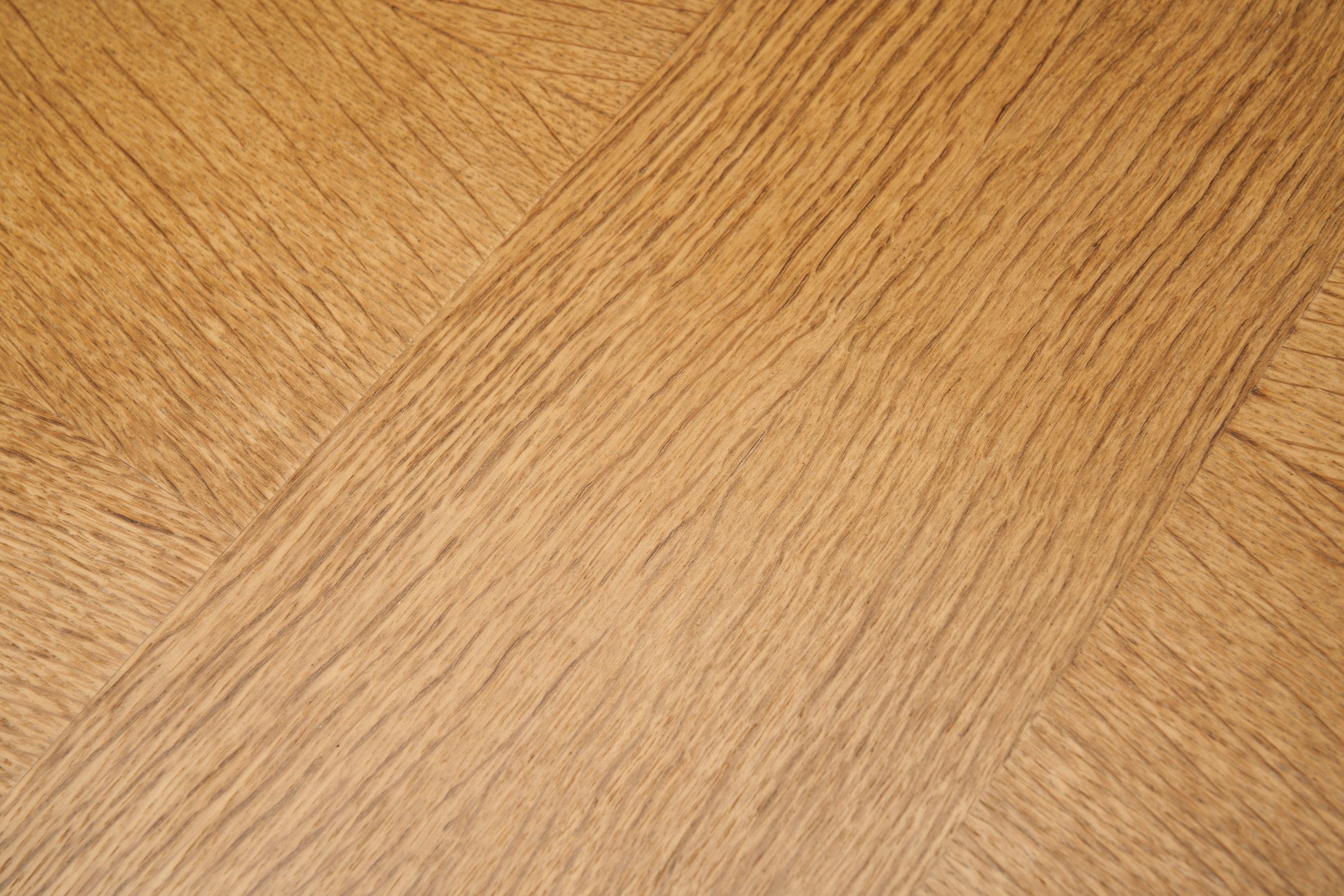
"Gustave" Dining Table by Guillerme et Chambron for Votre Maison, France 1970s (sold)


"Gustave" Dining Table by Guillerme et Chambron for Votre Maison, France 1970s (sold)
This gorgeous dining table is the two legged version of the “Gustave” model designed in 1975. Technical ingenuity and mastery are indispensable and fuel each other to achieve equally sublime and atmospheric results in Guillerme et Chambron’s furniture pieces. This rare oak dining table is an exceptional piece that is just as stunning as it is hard to come by.
With a robust build and a smart extension providing extra space on the top, this model is in many ways representative of the French duo’s artistic ideals. Crafted from their signature material, blonde oak, this table features a clean, rectangular top with inlaid pieces of wood arranged so that the grain of the wood forms an interesting pattern. On one side, the top can be easily extended to provide additional space. The top is held by an elaborate lower structure composed of four carved legs connected by a stretcher and sculptural elements. The conical legs taper towards the end, resulting in a light look that accentuates the shape and the smooth surface. On the horizontal middle stretcher rests a “bridge” that supports the top, adding to the elements with a double - functional and aesthetic - role.
This table full of character and offers expressive and sculptural functionalism. Guillerme et Chambron’s table designs are well-known for their distinctive appearance and multifunctionality; this model in particular shows how decorative design and functionality were equally important for the designers, being as sensitive to the use of furniture in everyday life as to the creation of innovative design.
SOLD
Condition:
In very good vintage condition. Wear consistent with age and use. Some small marks and scratches on the oak. The table includes one extension leaf.
Dimensions:
74.4 in W x 36.81 in D x 29.33 in H
189 cm W x 93.5 cm D x 74.5 cm H
About the Designers:
Robert Guillerme graduated in 1934 from the École Boulle where he excelled in architecture and furniture design. After the Second World War he moved to Lille, in the north of France, where he decorated homes and designed furniture for the well regarded Rogier workshops.
In 1948, Guillerme was joined by his long-time friend, decorator Jacques Chambron in Lille. The following year Guillerme and Chambron met master cabinetmaker Émile Dariosecq, owner of a woodworking shop and the company Votre Maison was born. Together, they defined and imposed a new furniture concept. Thanks to their distinctive creativity, originality, and quality, the Votre Maison quickly became well-known.
The Votre Maison marked the history of French design. Guillerme drew the furniture designs while Chambron played the part of salesman, welcoming and advising clients. The power duo was complemented by Dariosecq, whose workshop took charge of the manufacturing. Together, they defined new furnishings concepts. Well-crafted chair back, polished wood and thick cushions make the reputation of their armchairs and sofas. Votre Maison continued to produce furniture right into the 20th century, with Jacques’s son Hervé Chambron, a designer and graduate of the École Boulle, having taken the over in 1983. ~H.
REQUEST PRICE HERE
Price category: 7,500 - 10,000 usd / eur
This rare “AT-309” dining table was designed by Hans Wegner in 1955 and its title of ‘iconic’ is well deserved. As it is no longer produced, this model has become a collector’s item created by a designer who is credited as one of the main driving forces of the mid-century Danish modern movement.
The “AT-309” model is also commonly referred to as the “saw-horse” for its trestle base. In woodworking, a saw-horse is a trestle structure used to support a board similarly to this model’s case. While Hans J. Wegner became world-renowned for his chairs, he also designed a broad range of tables, where he was just as thorough and artistic about the proportions, construction, function, and style. With a clear statement of simplicity, quality and respect for materials, this table is a great example of Danish Modern design. The massive teak tabletop with drop-leafs is stunning on its own, showcasing the wood’s grain and offering plenty of space with the extendable solution. However, to Wegner, the most important part of his tables was not the top, but rather what was underneath. For the supporting structure he used the distinctive saw-horse look with crossed legs and brass braces. The diagonal brass reinforcement is not only a significant structural feature, it is also a visually appealing detail that gives character to this dining table. Looking beneath the top, the elaborate oak structure becomes visible, showing both Wegner’s and the manufacturer’s expert skill and knowledge.
Over the course of his career, the designer collaborated with several renowned manufacturers, including Andreas Tuck. The company was one of the greatest Danish furniture design companies of the mid-20th century, producing pieces that epitomize classic Danish craftsmanship. Wegner worked with the company for many years, creating iconic designs such as this “AT-309” table.
Condition:
In good vintage condition. Wear consistent with age and use. The tabletop has been refinished.
Dimensions:
51.96 in W (89.76 in when extended) x 33.66 in D x 28.14 in H
132 cm W (228 cm when extended) x 85.5 cm D x 71.5 cm H
About the designer:
Hans Wegner (1914–2007) is considered as one of the most influential designers of Scandinavian design. Danish-born Wegner became a national and international design idol for shaping the history of design in the 1950s and ‘60s.
In his designs, the sharp edges defining Modernism were smoothened, creating his iconic chairs. As a pioneer of the modernist style, often described as “organic functionality”, Wegner described his method as “stripping the old chairs of their outer style and letting them appear in their pure construction.”.
At 14 years old, he began his apprenticeship with Danish master cabinetmaker H. F. Stahlberg. After serving in the military he moved to Copenhagen, and attended the School of Arts and Crafts, before setting out as a furniture designer. In 1943, he established his own studio, producing designs for manufacturers like AP Stolen, Fredericia Stolefabrik, and in later years, PP Møbler.
Wegner designed more than 500 chairs in his lifetime, refining an approach that combined a variety of natural materials and pushed traditional joinery techniques to extreme tolerances and distillations. Wegner’s background as a cabinetmaker gave him a deep understanding of how to integrate exacting joinery techniques with exquisite form, realizing the perfect combination with form and purpose.
The core of Wegner’s legacy remains his focus on showing the inner soul of furniture pieces through a simple and functional exterior. ~H.
REQUEST PRICE HERE
Price category: 2,500 - 5,000 usd / eur
This oak and teak “AT-312” dining table was designed by Hans Wegner in the 1950s and its title of ‘iconic’ is well deserved. Created by a designer who is credited as one of the main driving forces of the mid-century Danish modern movement, this table is the epitome of functional modernity.
While Hans J. Wegner became world-renowned for his chairs, he also designed a broad range of tables, where he was just as thorough and artistic about the proportions, construction, function, and style. With a clear statement of simplicity, quality and respect for materials, this table is a great example of Danish Modern design, and is a reference in Scandinavian table design on a broader scale. The design of this table model boasts an ingeniously functional and well-thought-out structure crafted from quality wood. Two pull-out leaves “hide” under the teak top and integrate beautifully with it until extended; not only is this a highly functional solution, it also contributes to delineate the characteristic profile of the design. The extension mechanism also serves as a decorative element, which shows why Wegner is in many ways in his own league in Danish Modern design. The massive teak tabletop with drop-leafs is stunning on its own, showcasing the wood’s grain and offering plenty of space even without the extensions. The lower oak structure received just as much attention with elegant slim legs that are slightly tapered and splayed, balancing the large rectangular top.
Looking beneath the top is also a special experience, the elaborate oak structure becomes visible, showing both Wegner’s and the manufacturer’s expert skill and knowledge. Andreas Tuck created several of Wegner’s table models, but the company closed down in 1972, making original models such as this table collectors’ pieces. This table is stamped: “Fabrikat: Andr Tuck Arkitekt: Hans J Wegner Denmark”.
Condition:
In good vintage condition. Wear consistent with age and use. Some marks and scratches.
Dimensions:
94.48 in W (when extended) x 35.43 in D x 28.34 in H
240 cm W (when extended) x 90 cm D x 72 cm H
About the designer:
Hans Wegner (1914–2007) is considered as one of the most influential designers of Scandinavian design. Danish-born Wegner became a national and international design idol for shaping the history of design in the 1950s and ‘60s.
In his designs, the sharp edges defining Modernism were smoothened, creating his iconic chairs. As a pioneer of the modernist style, often described as “organic functionality”, Wegner described his method as “stripping the old chairs of their outer style and letting them appear in their pure construction.”.
At 14 years old, he began his apprenticeship with Danish master cabinetmaker H. F. Stahlberg. After serving in the military he moved to Copenhagen, and attended the School of Arts and Crafts, before setting out as a furniture designer. In 1943, he established his own studio, producing designs for manufacturers like AP Stolen, Fredericia Stolefabrik, and in later years, PP Møbler.
Wegner designed more than 500 chairs in his lifetime, refining an approach that combined a variety of natural materials and pushed traditional joinery techniques to extreme tolerances and distillations. Wegner’s background as a cabinetmaker gave him a deep understanding of how to integrate exacting joinery techniques with exquisite form, realizing the perfect combination with form and purpose.
The core of Wegner’s legacy remains his focus on showing the inner soul of furniture pieces through a simple and functional exterior. ~H.
REQUEST PRICE HERE
Price category: 2,500 - 5,000 usd / eur
The “C35 FDB” table series was designed by Poul M. Volther in 1957 for Danish Furniture co-operative FDB. The company, FDB Møbler was founded in 1942 with architect, Børge Mogensen heading the studio. According to their philosophy, every new piece of FDB Møbler is born as an heirloom. This ash dining table is no exception.
First trained as a cabinetmaker, Poul Volther studied furniture design at the Arts and Crafts School in Copenhagen. A believer in Functionalism, he avoided short-lived aesthetic trends, concentrating on the simple crafting with quality materials. This dining table is characterized by its functionalism combined with a modern expression – the epitome of FDB Furniture’s design philosophy. The table frame is made of solid ash wood, which has a light shade and spectacular pattern. However, this model’s standout feature is definitely its large, green laminated top. This rectangular inlay is framed by the ash frame. The legs of the table slope slightly outward, providing optimal legroom and a more stable surface. The lower structure also features stretchers and cross railing, assuring structural stability. These elements also serve an aesthetic role, adding to the clean, architectural precision of the table.
FD Møbler’s philosophy was focused on creating beautiful, functional and exceptionally crafted furniture that makes room for everyday living at home and can withstand everyday wear and tear to age gracefully with those who use them. Accordingly, this C35 table perfectly complements different interiors and styles with its classic, quality design. Today it remains as contemporary as it was 60 years ago.
Condition:
In good vintage condition. Wear consistent with age and use. The top has some scratches and marks of wear.
Dimensions:
70.86 in W x 35.43 in D x 28.74 in H
180 cm W x 90 cm D x 73 cm H
About the designer:
Born in 1923, designer Poul M. Volther belonged to a generation of Danish creatives rooted in Scandinavian functionalism. Volther’s work is characterized by a mastery of form, as evidenced by his iconic EJ5 Corona Chair for Erik Jørgensen (1961/64). Highly collectible today, this singular piece has left an indelible mark on design history.
Volther originally trained as a cabinetmaker before studying at the Royal Danish Academy School of Arts & Crafts in Copenhagen. Over the years, Volther also taught at the Royal Danish Academy School of Design, influencing hundreds of young designers along the way. In 1949, legendary architect-designer Hans Wegner introduced Volther to the FBD, a Danish national cooperative association for producers of consumer goods. There, Volther worked under another Danish design great, Børge Mogensen, and went on to become FDB’s design director when Mogensen left in 1959. During his tenure at FDB, Volther created a range of chairs and sofas that can still be found in homes across Denmark.
In 1962, Volther found a partner in the then-new furniture manufacturer Erik Jørgensen. The company agreed to produce the Corona Chair with a chrome-plated steel frame. Despite the investment, this chair would not find a significant audience until 1997, when Erik Jørgensen re-launched it at the Cologne Furniture Fair in Germany, followed by the Scandinavian Furniture Fair in Denmark. One year after Volther’s death in 2001, the chair was used at the EU Summit in Copenhagen.
Volther’s designs have been produced by many design companies, such as Munch Furniture and Frem Røjle. However, his Corona Chair is considered his most memorable design contribution. It’s been featured in countless movies, fashion shoots, and music videos. ~H.
REQUEST PRICE HERE
Price category: 1,000 - 2,500 usd / eur
This gorgeous extendable dining table model by the Danish furniture maker, Bernhard Pedersen og Søn was inspired by classic Danish furniture design and simplicity. The period between 1950 and 1970 in particular was characterized by some of the most stunning and well-executed pieces in the company’s history, including this table.
This elegant dining table features two large leaves, stored underneath the tabletop, that slide out and allow the table to be easily extended to accommodate extra diners. This clever design element makes the table not only greatly functional, it is also a design element that is aesthetically pleasing. When extended, the veneered exotic wood becomes visible with a much darker colour and distinct pattern variation. The gently rounded edges complement the display of the patterns, while also providing contrast to the sleek, tapered legs. However, the most interesting part of the design remains invisible as it is right under the tabletop. The metal rods and the elaborate wooden system that allows the top to almost double in size shows why many of the era’s most renowned Danish designers worked together with Bernhard Pedersen & Son. The family owned furniture maker has had an exceptionally strong tradition in high quality cabinetmaking since their start in 1902.
This dining table has the characteristics of the prized Scandinavian idea of “honest” design that Bernhard Pedersen and Son is also known for. The sleek look resulting from the clean lines, functional design and expert craftsmanship makes this table a perfect functional piece and stylish addition to any dining area.
Condition:
In good vintage condition. Wear consistent with age and use.
Dimensions:
55.11 in W x 37.4 in D x 28.85 in H
140 cm W x 95 cm D x 73.3 cm H
About the designer:
Bernhard Pedersen & Søn, is a Danish furniture maker company with a long and strong tradition in furniture and cabinetmaking, stretching all the way back to the company’s start in 1902. Through three generations the family firm has created and sold classic Danish furniture to many parts of the world.
The period between 1950 and 1970 in particular was characterized by some of the most stunning and well-executed pieces in Bernh. Pedersen & Søn’s history. Especially the classic mid-century sideboards and daybeds designed by Danish furniture designers, including the world-renowned Johannes Andersen, Svend Aage Madsen and Kurt Østervig who were – and still are – highly valued by customers worldwide.
Every piece of furniture is made in the same factory that was built by the Bernhard Pedersen family in 1902, located in a small community in the Danish countryside. The workshop and its skilled cabinetmakers are known for their exquisite and dedicated work based on strong Danish craft traditions; traditions recognized around the world for timeless design, high-quality craftsmanship and outstanding longevity. Unique techniques, special tools and original machinery are maintained and used to produce the sideboards in keeping with the first original pieces. The sum of it all is captured in the phrase: Made in Denmark.
Today, the fourth generation in the family, Thomas Bernhard Pedersen is focusing on an exclusive selection of the company’s most exquisite sideboards designed by Danish furniture designers, including the world-renowned architect Johannes Andersen. Every piece of furniture is made in Denmark by skilled cabinetmakers and in keeping with the strong Danish craft traditions. In 2015, great-grandson Thomas Bernhard Pedersen re-established the company and started focusing exclusively on relaunching some of the exquisite furniture designed in the 1950s and 1960s. ~H.
REQUEST PRICE HERE
Price category: 2,500 - 5,000 usd / eur
Precious woods and hand finishing define the furniture pieces made by the Danish company, Dyrlund. As this stunning solid wood table shows, great emphasis is placed on skilled craftsmanship with experts who work in the old craftsmanship style.
Using only traditional Danish cabinetmaking methods from start to finish is Dyrlund’s policy. This versatile table showcases not only this strict mentality about quality, but also the user-centred design that has long defined Danish design. As such, this table can serve both as a side table or extended to a dining table to comfortably seat four to six people. This table is a variation of the “9276” table line with straight pillar legs and no stretcher between the V-shaped feet. This results in an airier, lighter look that goes seamlessly with the heavy grain and pattern of the wood. The table has two additional leaves that can be secured to the table via metal hooks under the oval table-top. The metal sliding system makes it easy to revert the table back into a smaller size. It is these solutions that show the famous functionality of Danish design paired with the exquisite material. The wood has an attention grabbing pattern and colour variation that is even more apparent when the table is extended. Like all other models, this table was manufactured at Dyrlund’s own factory in Denmark.
Common to all their models is practicality, solid construction, detailing to perfection, and classic design. Because of the special care taken with the finish, all pieces grow more beautiful with time, becoming, as Dyrlund boasts, “the antiques of tomorrow.”
Condition:
In good vintage condition. Wear consistent with age and use. Due to the nature and age of the material, the item may have mark, scratches, and discolouration.
Dimensions:
47.24 in ø x 66.92 in W (extended) x 28.54 in H
120 cm ø x 170 cm W (extended) x 72.5 cm H
REQUEST PRICE HERE
Price category: 1,000 - 2,500 usd / eur
An exquisitely crafted Scandinavian Modern table. Made out of wood in cognac brown tones. This table has a thick top with a beautiful pattern that plays with vertical and horizontal lines creating a mosaic effect. The thick edge of the cover is decorated with a carved detail of vertical lines surrounding the edge. A molded like frame connects the top of the table to the straight and delicately rounded legs.
Condition:
Wear consistent with age and use. Item has some marks, scratches, small chips and discoloration. One leg has a bigger chip.
Dimensions:
57.87 in W x 32.68 in D x 28.94 in H
147 cm W x 83 cm D x 73.5 cm H
About the designer:
Carl-Axel Acking (1910 – 2001) was a Swedish architect, interior and industrial designer. He was born in 1910 in Helsingborg, Sweden. Acking’s studied at the National College of Art in Stockholm and Art School and the Royal Institute of Technology in Stockholm. He worked together with talented architect Sven Hesselgren, and cofounded an architect's firm in 1939.
Acking focused mainly on seating and storage furniture. Some of his most famous pieces are the Anette dressing table (1943) for Nordiska Kompaniet (NK), the Bentwood Chair (1944), the Trienna Chair (1957) for NK exhibited in Milan’s Triennale, and the Tokyo Chair (1959). He won the Lunning Prize in 1952. ~ H.
REQUEST PRICE HERE
Price category: 1,000 - 2,500 usd / eur
This “Svensk Fur” or ‘Swedish Pine’ dining table is a nod to modernist design with traditional Swedish craftsmanship. The design relays an insight about the society and culture in which it was produced: closeness to nature, the appreciation of a clutter-free environment and the value of quality handiwork.
The Malmvall pieces that appeal to most are the models designed for Karl Andersson & Söner, for the sheer fact that they seem completely contemporary and undated. The pieces of the line, such as this table, are often compared to the designs of Axel Einar Hjorth, even though Malmvall’s designs are exceptional on their own merit. Self-taught, Göran Malmvall was a highly skilled cabinetmaker with considerable technical expertise and was renowned for the boldness of his innovations. This table holds a natural expression with its airy and organic design, which is dominated by the natural beauty of the material and the creative use of the tenon and mortise joinery. The rectangular tabletop showcases the solid pine’s pattern, reinforcing the rustic feel. The legs have carved out vertical lines, a smart detail that elongates them optically. Göran Malmvall, the youngest son of Karl Andersson, was a highly skilled cabinetmaker with considerable technical expertise and was renowned for the boldness of his innovations. His expertise can be traced not only in this detail, but also in the legs’ joinery technique.
Swedish modern – despite its name – in many ways transcends the word ‘modern’, and so does Malmvall. Like the style, the Svensk Fur pieces can be incorporated successfully into contemporary and traditional interiors alike, lending themselves to a timeless and universal appeal.
Condition:
In good vintage condition. Wear consistent with age and use. Some minor scratches and marks on the wood.
Dimensions:
51.18 in W x 31.1 in D x 28.34 in H
130 cm W x 79 cm D x 72 cm H
About the Designer:
Göran Malmvall (1917–2001) was the youngest son of the manufacturing company’s founder, Karl Andersson. He studied furniture design under Carl Malmsten and was involved with the family business from an early age until 1982, mainly in the capacity of an in-house furniture designer.
Self-taught, he was a highly skilled cabinet-maker with considerable technical expertise, and was renowned for the boldness of his innovations. His most notable designs include Svensk Fur, Svitjod and, not least, the KA 72 cabinet series, first created in 1972 and already a modern classic.
The manufacturer, Karl Andersson & Söner was established in 1898, when carpentry master Karl Andersson started to produce “durable and sustainable furniture” in his parents' home in the village of Berghem between Huskvarna and Gränna. Over a hundred years later, the historic company still manufactures quality furniture and designer furniture in their own modern factory in Huskvarna. ~H.
REQUEST PRICE HERE
Price category: 30,000 - 40,000 usd / eur
Swedish architect and furniture designer Axel Einar Hjorth served as the lead designer for Nordiska Kompaniet from 1926 to 1938. During this time, Hjorth designed the “Skoga” series in the early 1930s.
The “Skoga” series was crafted as part of a broader collection of summer-house furniture, intended to be both practical and aesthetically harmonious with the rugged beauty of the Swedish landscape. Despite its utilitarian roots, the series, as well as this table, exudes quiet sophistication and a timeless appeal focusing on simple lines and the material itself. Made of pine wood, this table is strong, reflecting Hjorth’s principles according to which he mixed the ideals of the modernist movement with provincial Swedish traditions, producing a unique and primitive modernism. It is quite robust without being intrusive, naturally standing to be the centre of the room. The legs and stretch-bar base emphasize structural clarity and durability, while the rounded corners and visible joinery express a handcrafted, almost sculptural quality. The rectangular tabletop is comprised of three planks of wood, yet it has a light impression. The large surface shows off the pattern of the wood and colour variation. The absence of heavy ornamentation is also in service of enhancing the organic, simple look that defined Swedish design of the era. Each element, joint and line is well crafted and solid, the attention given to every construction and finishing detail is obvious.
This table doesn’t depend on its details, rather, it is just as arresting from afar as from a proximity. The joinery and woodworking reveal the quality craftsmanship of the experts at Nordiska Kompaniet. The most charming thing about this table however, is that it showcases classic elements and so much history, but it lends itself easily to a modern interior.
Condition:
In good vintage condition. Wear consistent with age and use. Some marks and scratches on the wood.
Dimensions:
70.86 in W x 23.62 in D x 27.55 in H
180 cm W x 60 cm D x 70 cm H