Glashütte Limburg Brass and Glass Flush Mount Light, Germany 1970s (sold)


Glashütte Limburg Brass and Glass Flush Mount Light, Germany 1970s (sold)
The interior luminaires from Glashütte Limburg have been part of their range for almost six decades. The company has been known for their impeccable craftsmanship in the production process and therefore, the high-quality end products, such as this rare flush mount light.
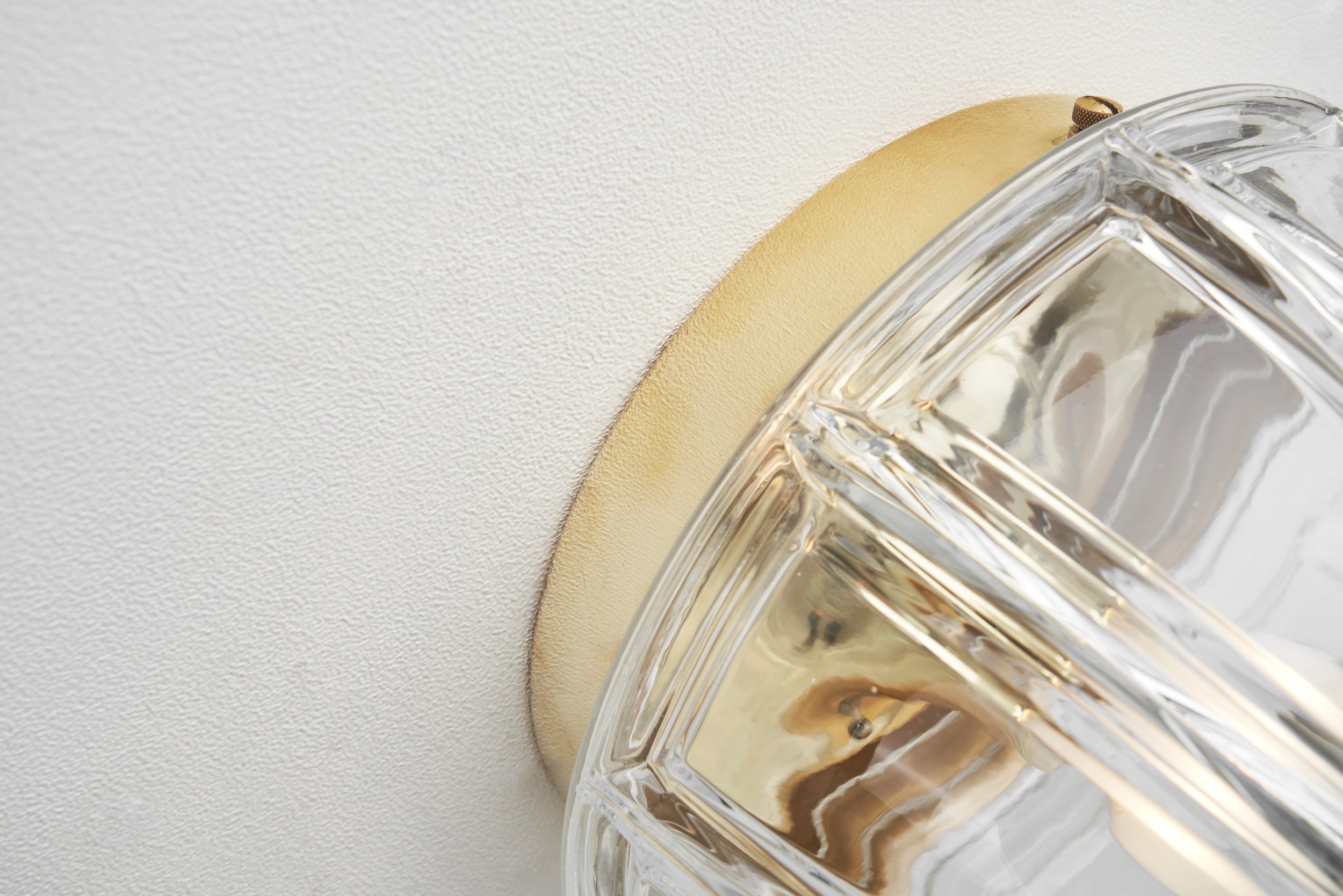
Often mentioned shortly as ‘Limburg’, the company’s designs are quite versatile, ranging from streamlined modern pieces to models with more organic forms, such as this flush mount. This model is mounted so that the body of the fixture is inside the wall, leaving only a cover plate on top of the surface. The glass dome’s shape truly stands out thanks to this, especially when illuminated. With a focus on its materials, this model has a rounded glass diffuser that diffuses a wonderful 360° openwork beam that brings warmth and style. The sectioned glass creates an appealing look even when the light is turned off. The round brass middle part stands out against the glass, bringing the focus to the middle. The design rests on a brass base that lifts the shade off the wall just enough to lighten the look and shines beautifully when lit. Glashütte Limburg is a true manufacturer, where impeccable craftsmanship remained in the focus throughout the past decades. While the designer of this model is unknown, many lamps of the company were designed by the Designabteilung Glashütte Limburg (design department) or Atelier Glashütte Limburg.
This flush mount combines a traditional shape with innovative, modern touches, and the result is a look that has a both timeless and contemporary feel to it. It is a little jewel that is sure to bring interest to any wall surface and a cosy, atmospheric lighting.
SOLD
Condition:
In good vintage condition. Wear consistent with age and use.
Dimensions:
9.05 in Ø x 7.08 in D
23 cm Ø x 18 cm D
About the designer:
Three months after the end of the Second World War in August 1945, graduate engineer Dr Walter Heinrich submitted his first plans for setting up a glass-works to the American military authorities in Limburg an der Lahn in Germany. Approval for building the factory was issued rapidly because the country urgently needed all types of glass. As a result, the ground was broken for Glashütte Limburg as early as 28 September 1945.
Initially, the company was called Glasshüttenwerke Limburg GmbH and employed 80 people. The production range covered drinking vessels, mugs and many other types of catering glasses. Production capacities were increased, and Glashütte Limburgbecame Europe’s largest lighting glass specialist within just a few years, employing almost 1000 people.
In 1962, the company succeeded in winning BEGA Gantenbrink-Leuchten OHG, founded in 1945 – which was at that time already one of the largest companies in the German lighting industry – as its ideal partner. The very first lighting catalogue of Glashütte Limburg appeared in 1963.
The Glashütte Limburg company received the state prize for “Gute Form 1982” (good design 1982) and the “Corporate Design Award 1985”. Glashütte Limburg received 160 iF Design Awards in total.
REQUEST PRICE HERE
Price category: 9,000 - 12,500 usd / eur
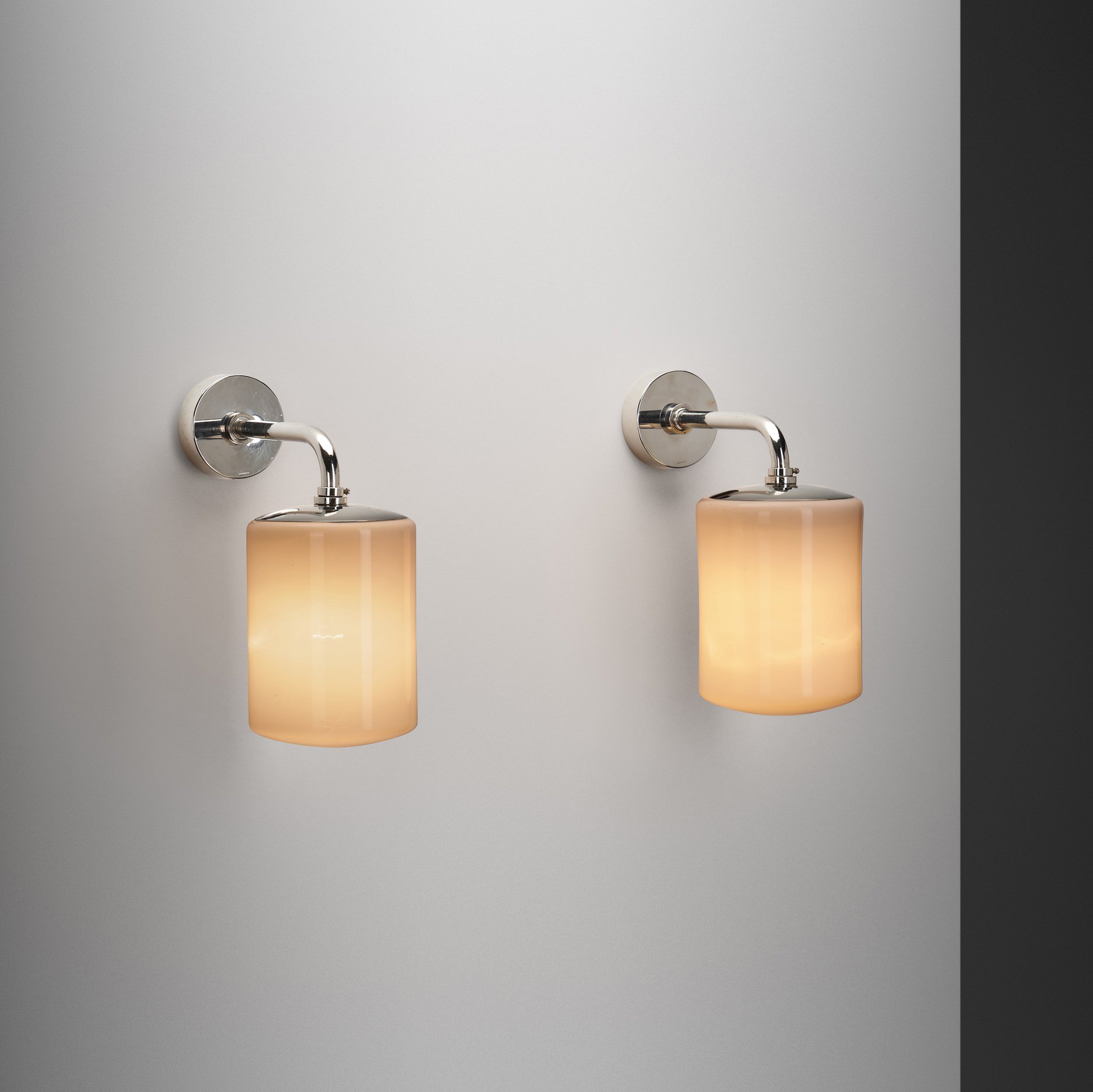
Paavo Tynell was one of the central figures in the development of modern Finnish lighting. Trained as a metalworker, he co-founded the company Taito Oy in 1918, where he served as managing director and chief designer for several decades. By the 1930s, Tynell was designing lighting for major architectural projects and working alongside figures such as Alvar Aalto, developing an approach in which precise metalwork, simple forms and carefully diffused light came together.
Model “7239” is composed around cylindrical opal glass shades suspended from compact nickel-plated metal structures. Each fixture begins with a circular wall plate, from which a short arm projects horizontally before bending downward at a clean right angle toward the shade. This simple curve gives the lamps a clear architectural profile, while the reflective metal introduces a sharp contrast against the softly luminous glass. The shades have an elongated cylindrical form with gently rounded corners, through which light passes evenly thanks to the opal glass. When lit, the shades turn into warm glowing volumes while keeping the bulb concealed. A shallow metal cap closes the upper part of each shade and visually connects it to the arm above, giving the fixture a particularly resolved transition between glass and metal. The proportions are carefully controlled: the round backplate echoes the width of the shade without competing with it, while the short projecting arm holds the glass just far enough from the wall for its full shape to remain visible.
Seen as a pair, the repeated circles, curved arms and vertical glass forms create a strong rhythm. These model “7239” lamps are particularly effective beside a bed, a mirror or artwork, or arranged along a hallway, as they are perfect for adding warmth without dominating the space.
Condition:
In good vintage condition. Wear consistent with age and use. The lamps have recently been rewired and reconditioned. Due to the nature and age of the materials, the items have minor marks, scratches, chips and discolouration. Additional imperfections on the glass may be present due to manufacturing inconsistencies and age. All lighting can be converted for US usage.
Dimensions:
5.51 in W x 9.64 in D x 11.81 in H
14 cm W x 24.5 cm D x 30 cm H
REQUEST PRICE HERE
Price category: 2,500 - 5,000 usd / eur
The Art Deco movement, which emerged in the early 20th century, is known for its bold geometric shapes, luxurious materials, and an emphasis on streamlined forms. Art Deco came as a reaction against the flowing, organic lines of Art Nouveau, thus opting for symmetry, order, and elegance. Influenced by modernity and industrialisation, Art Deco pieces often features polished finishes, and an overall sense of opulence, designed to elevate everyday spaces.
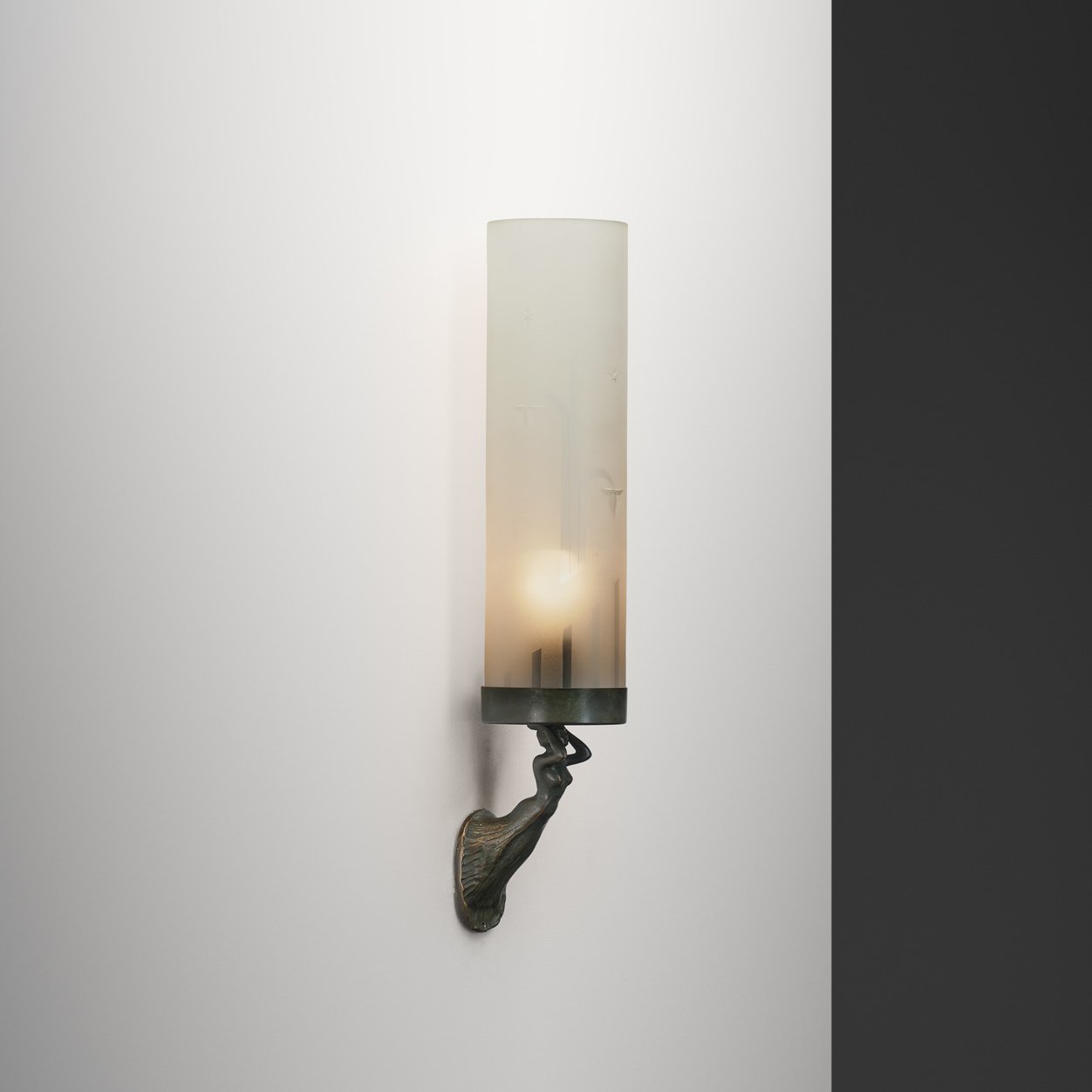
This lamp exemplifies the refined geometry and material richness characteristic of the movement. The piece is constructed from patinated bronze and frosted glass, and the materials’ tones elegantly highlight both the age and craftsmanship. The interplay between the rich patina of the bronze and the milk-white shade creates a harmonious contrast. The visual interest of this lamp is accentuated by the form of the female figurine that is suspended from the wall, mounting to the shade. Wall lamps such as this are a timeless example of how thoughtful craftsmanship can result in lighting fixtures that transcend their utilitarian purpose, becoming works of art in their own right. Today, we consider Art Deco and the early 20th century era a golden age for lighting design. During these decades, some of the most significant luminaries were created, and remain highly sought-after today.
This wall lamp bridges sculptural presence and domestic functionality. It embodies the enduring qualities of the Art Deco movement in Europe: geometric refinement, tonal richness, and atmospheric light. The qualities transform it into a bold design statement, while still able to complement a modern space.
Condition:
In good vintage condition. Wear consistent with age and use. The lamp has recently been reconditioned and rewired. Due to the age and nature of the materials, the item may have marks, scratches, and discolouration. Imperfections on the glass may also be present due to age and manufacturing inconsistencies. This lamp is compatible with an E26 / E27 (standard) fitting.
Dimensions:
3.94 in W × 4.33 in D × 19.88 in H
10 cm W x 11 cm D x 50.5 cm H
REQUEST PRICE HERE
Price category: 2,500 - 5,000 usd / eur
Danish lighting of the 1950s was closely tied to the functional principles of Scandinavian modernism, with designers giving increasing attention to flexibility, compact construction and the quality of light within an interior. Wall-mounted fixtures were particularly suited to this approach, freeing surrounding surfaces while allowing illumination to be positioned where needed.
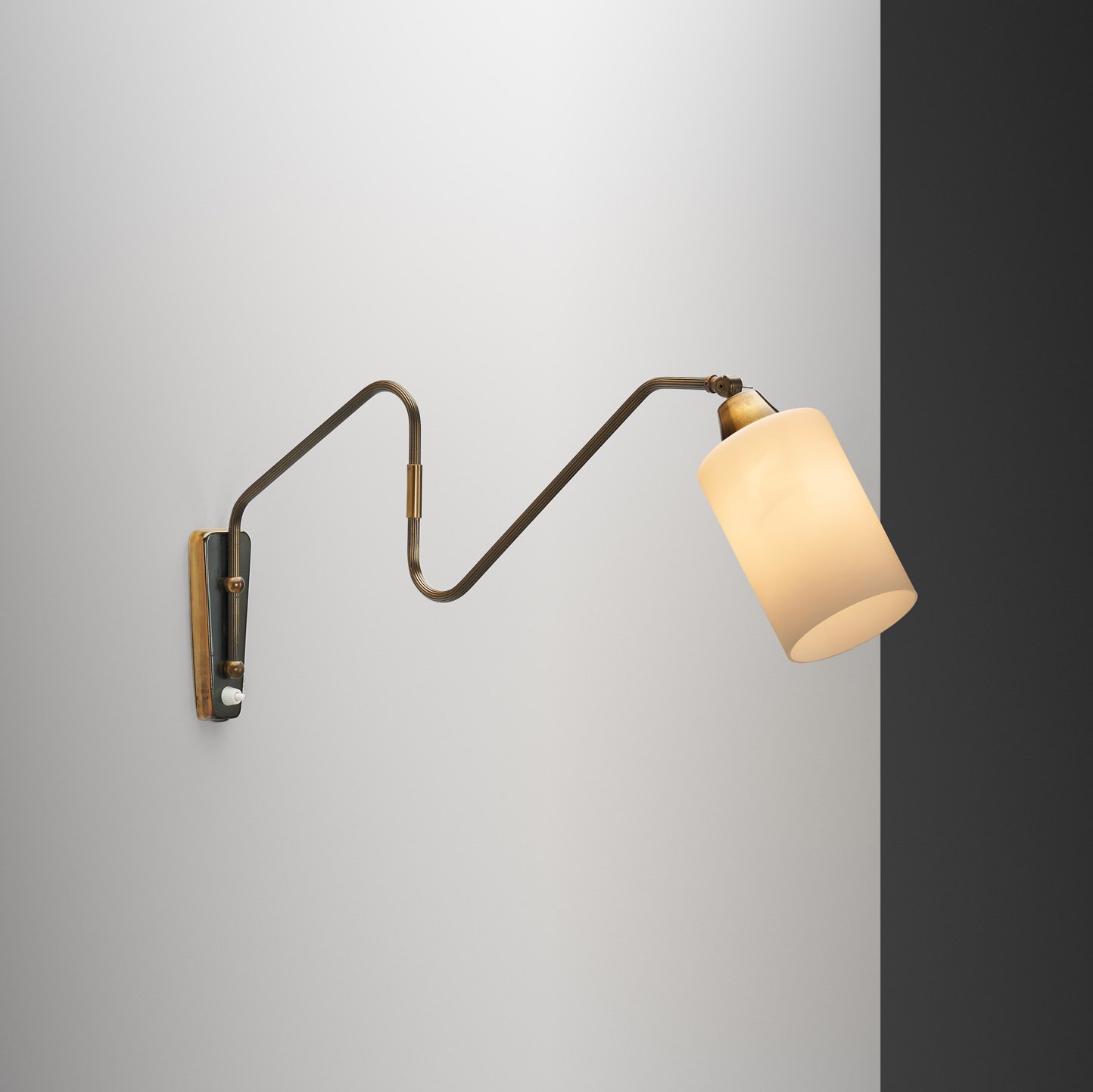
This wall lamp develops that idea through a long articulated arm constructed in fluted brass. From a narrow vertical wall mount, the arm extends upward through a sequence of bends, creating a pronounced zigzag silhouette before reaching the shade. Along the arm there are multiple pivot points, making the changing geometry of the arm one of the lamp’s most distinctive visual features. The fluting runs along the brass tubing, catching the light across its ridged surface and giving depth to a component that might otherwise appear purely mechanical. At the end, an adjustable fitting supports a simple cylindrical fabric shade, whose soft surface and warm illumination contrasts with the harder, darker character of the metal. The shade is angled downward, directing light toward a specific area while remaining independently adjustable from the larger swing-arm mechanism. The composition is especially effective when seen from the side, while from the front the narrow wall plate almost disappears against the wall, leaving the long brass line to project freely into the surrounding space.
The generous reach and the adjustments make this lamp particularly appealing beside a sofa, reading chair or bed, where it can provide focused illumination without occupying any floor or table space. At the same time, the articulated brass arm gives it a strong graphic presence even when switched off. Its combination of flexibility, warm light and expressive metalwork gives the lamp both the practicality and character associated with Danish mid-century lighting.
Condition:
In good vintage condition. Wear consistent with age and use. The wall lamp has recently been reconditioned and rewired. The shade is a later replacement. The brass is patinated. There are minor dents and scratches in the metal. Due to the age and nature of the brass, the lamp may have marks, and discolouration. Additional imperfections on the glass may be present due to manufacturing inconsistencies and age. All lighting can be converted for US usage.
Dimensions:
3.94 in W x 26.97 in D x 10.04 in H
10 cm W x 68.5 cm D x 25.5 cm H
REQUEST PRICE HERE
Price category: 2,500 - 5,000 usd / eur
Swedish lighting designers were experts of creating pieces with great textural variety as this table lamp shows. Like many of the decade’s designs, this piece masterfully pairs materials. The mix of glass, metal and textile creates an interesting visual effect, where an elegant and traditional look meets modern aesthetics.
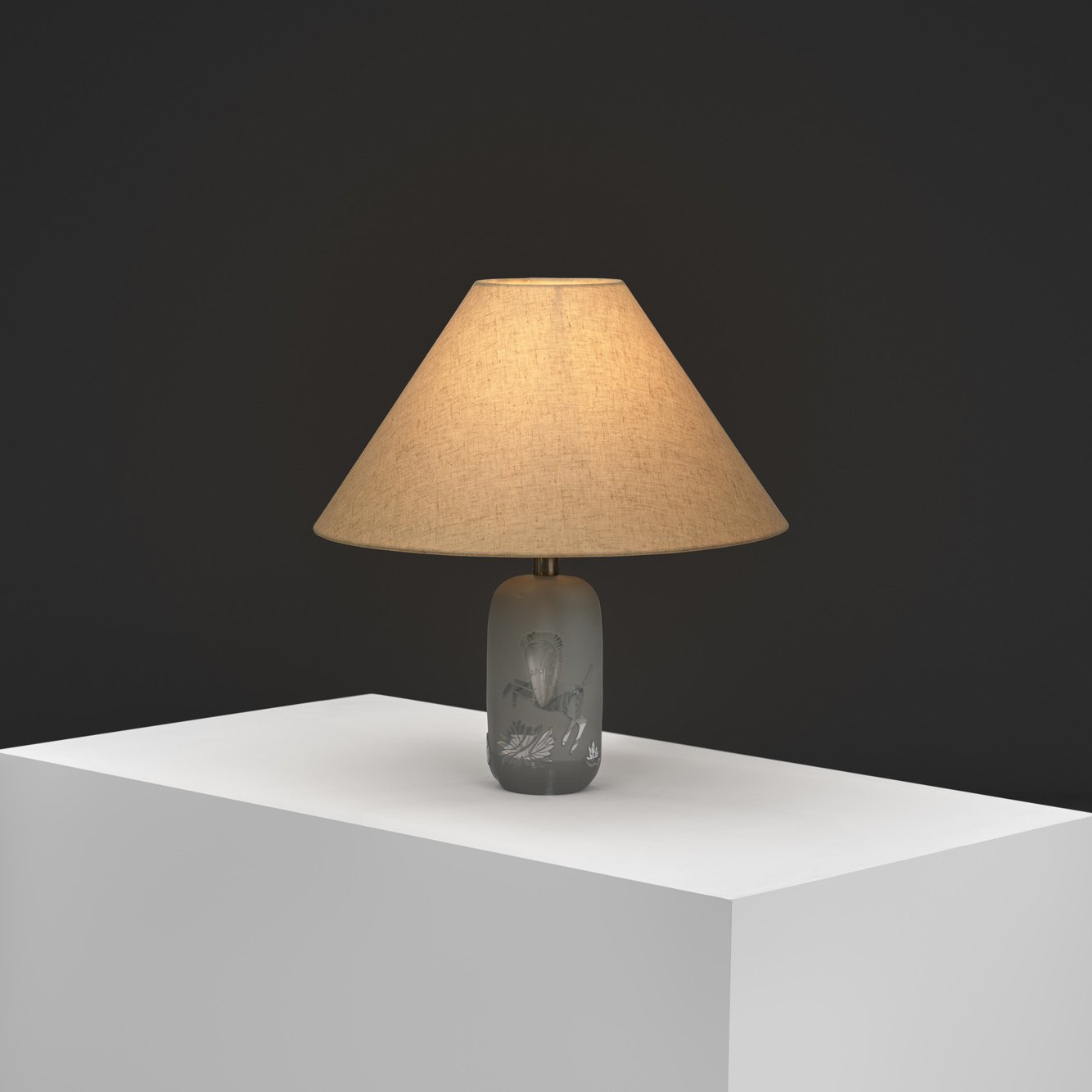
Swedish decorative elements from the 1930s often combined restrained modern forms with natural motifs, reflecting the country's longstanding tradition of bringing the organic world into everyday objects. This lamp incorporates an animal subject, a stylised horse, as well as foliage. These details stand out against the frosted glass that makes up the rest of the body, and allow light to pass through the surface, avoiding the need for applied colour or ornament. The simple cylindrical form allows the decoration to remain the focal point, while a brass collar creates the transition to the socket. To complete the model, a warm textile shade complements the softness of the frosted glass and provides a balanced, harmonious silhouette. The restrained combination of etched glass, natural imagery, and clean proportions results in a piece that is decorative without overpowering a space.
Both functional and artistic, the lamp reflects the close relationship between Swedish glassmaking and interior design during the interwar period. Its timeless elegance and restrained palette make it an elegant example of decorative lighting from the 1930s.
Condition:
In good vintage condition. Wear consistent with age and use. The table lamp has recently been reconditioned and rewired. The shade is a later replacement. Due to the age and nature of the glass, the lamp may have marks, and discolouration. This lamp is compatible with an E27 / E26 standard fitting. All lighting can be converted for US usage.
Dimensions:
15.94 in ø × 17.32 in H
40.5 cm ø x 44 cm H
REQUEST PRICE HERE
Price category: 2,500 - 5,000 usd / eur
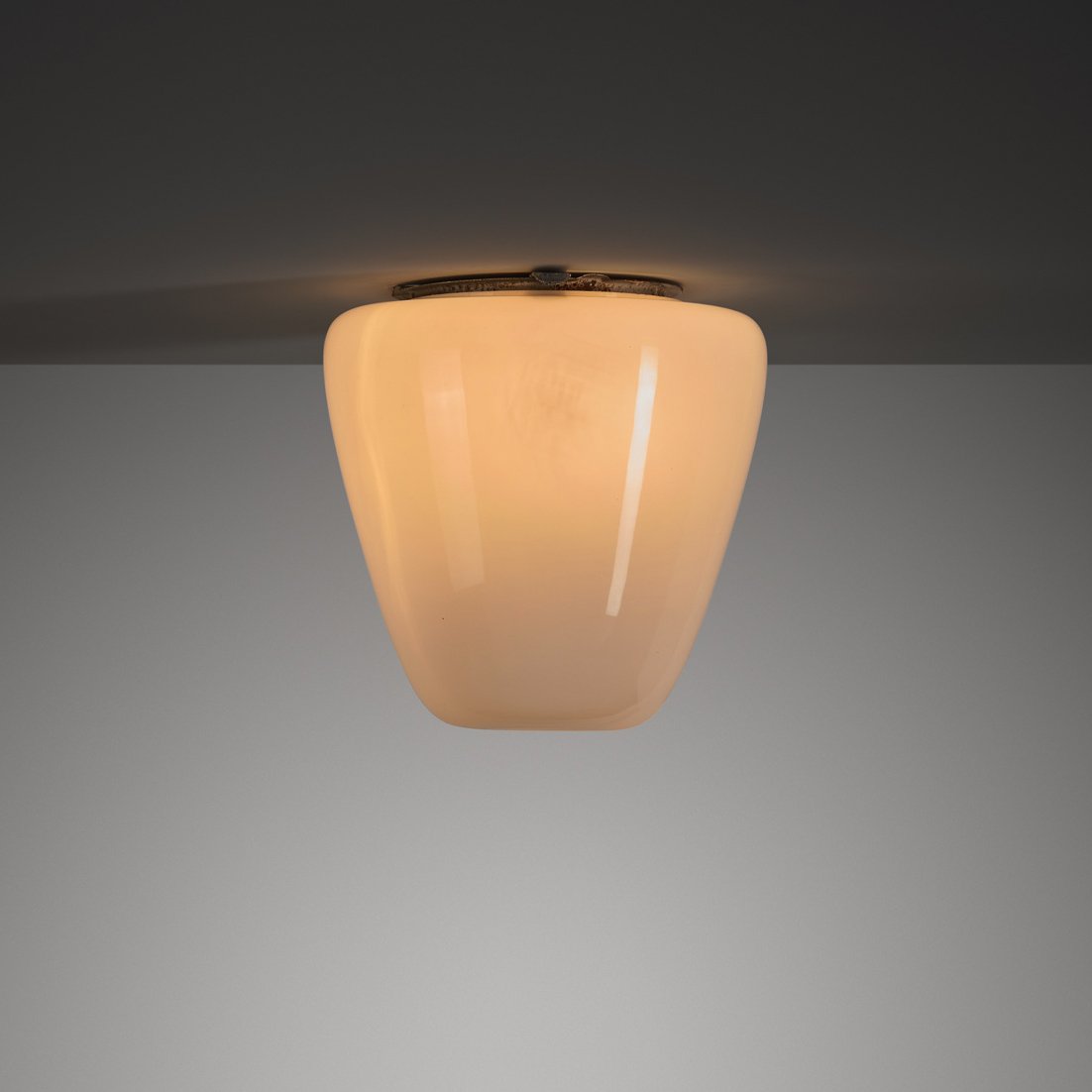
By the mid-20th century, Finland had emerged as a quiet force in modern design, defined not by spectacle but by sensitivity to light, material, and atmosphere. Finnish designers often pursued a dialogue between illumination and interior space. Among the most influential voices in this movement was Gunnel Nyman, a pioneer of modern glass design who collaborated with manufacturers such as Idman.
Gunnel Nyman (19 September 1909 – 7 October 1948) was a Finnish glass and metal artist, and one of the leading figures of modern Finnish glass design. During the post-war era she transitioned to glassware and collaborated or worked on commission with various glassworks including Riihimäki, Karhula-Iittala and Nuutajärvi. She was also an advocate of early mass-produced glassware, with her work featuring organic lines and focusing on the characteristics of glass itself. This "80115" ceiling lamp embodies the sleek and simple aesthetic that characterised Finnish design in the mid-20th century. Even in the absence of ornamentation, there was always an emphasis on interesting materials. Milk glass, the material of this piece, was appropriately named for its opaque or transparent ivory white tone. It was first created in Venice in the 16th century, and was known as Lattimo. At that time, it was widely used for decorative purposes and continued to be popular during the 20th century, when the material was used for home accents to decorate households. This lamp has an eye-catching rounded cone shape, with a blunted end and soft edges. Thanks to the concealed ceiling holder, the piece is flush mounted, staying close to the ceiling and allowing the glass shade to remain the focal point. Nyman was a master of working with milk glass, and her lamps of this material are some of her most sought-after designs.
Although Gunnel Nyman’s career was cut short by an untimely death, she had enough time to give a new direction to Finnish glass design. At the Milan Triennial in 1951, Nyman was awarded the gold medal for glass posthumously.
Condition:
In good vintage condition. Wear consistent with age and use. The lamp has recently been reconditioned and rewired. The metal has marks and scratches. Due to the age and nature of the materials, the lamp may have marks, and discolouration. Additional imperfections on the glass may be present due to manufacturing inconsistencies and age. All lighting can be converted for US usage.
Dimensions:
9.45 in ø x 9.65 in H
24 cm ø x 24.5 cm H
REQUEST PRICE HERE
Price category: 1,000 - 2,500 usd / eur
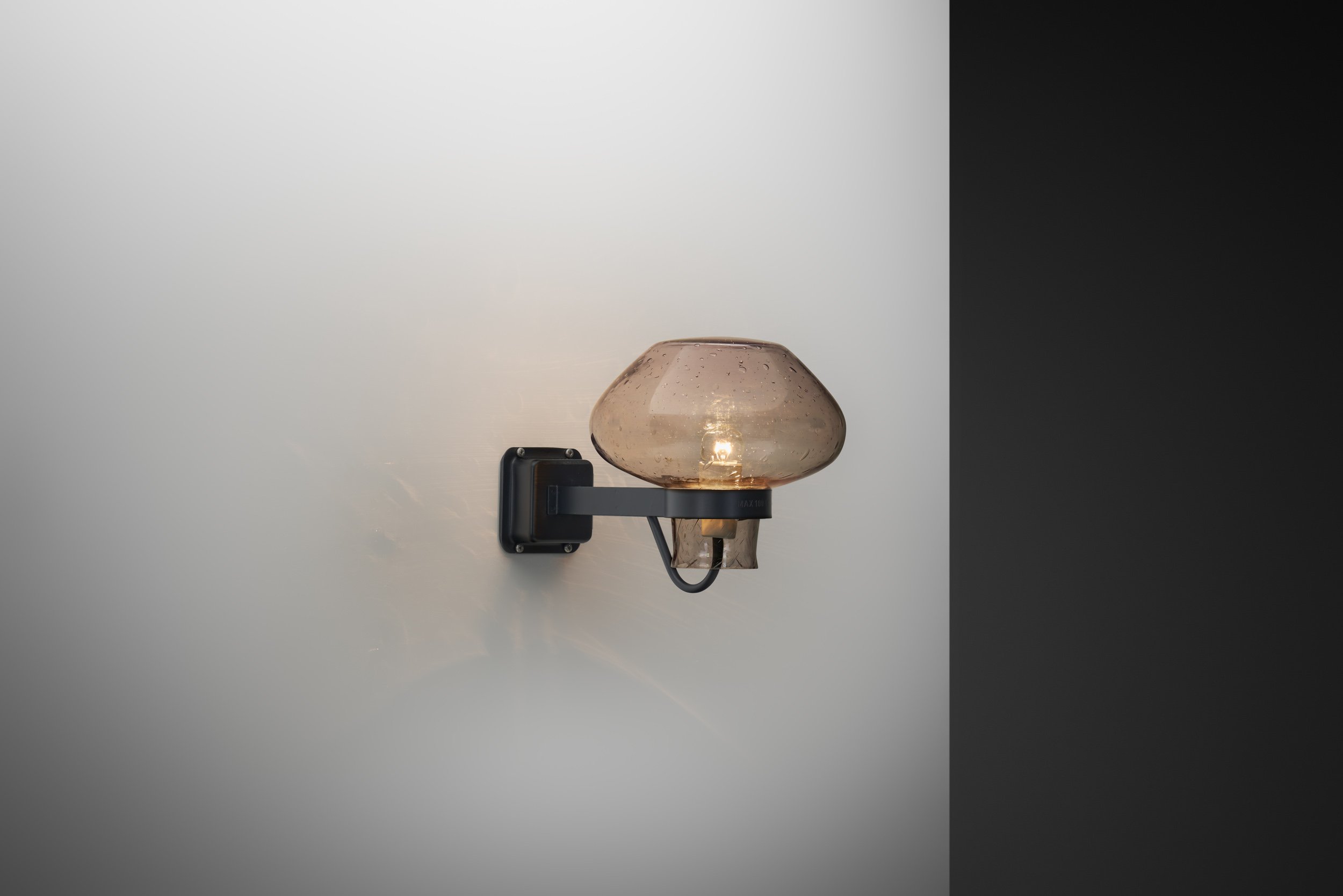
In the annals of mid-century modern design, the Swedish designer and architect, Gunnar Asplund stood out as a luminary, and his delicately sculptural creations, such as this "GA9" wall lamp, epitomises the era's sophistication and functional beauty. Erik Gunnar Asplund is celebrated as the godfather of functionalist design in Sweden. His meticulous attention to detail and penchant for marrying form with function is evident in this wall lamp.
This model emphasises geometric simplicity and clarity of form. The “GA9” appears to be inspired by a droplet or floating jellyfish. The mouth blown glass with bubbles creates an intricate play between light and shadow, giving the appearance of light travelling through water. The construction of this model is ingenious, with a bent arm holding the socket in the centre of the luminaire, and another arm supporting the shade. The black metal bends organically into a sinuous form, while the back-plate has a square shape. Pairing the geometric elements with the more organic ones shows Asplund’s great eye for design that was well ahead of his time. The glass shade has a faint violet tone, visible when the light is turned off. The atmospheric glow makes sure to enhance its surroundings, which is the most basic and fundamental of all lighting principles. Asplund’s life and work served as inspiration to a number of Scandinavian design luminaries, such as lifelong friend and mentee Alvar Aalto, as well as Erik Bryggman and Arne Jacobsen.
An acronym for Allmänna Svenska Elektriska Aktiebolaget (“General Swedish Electrical Limited Company”), ASEA was a Swedish manufacturer of electrical products and industrial infrastructure. The company endures in the hearts of design lovers for their lighting collections, and this “GA9” Gunnar Asplund lamp demonstrates why.
Condition:
In good vintage condition. Wear consistent with age and use. The lamp has recently been rewired and reconditioned. The metal structure has some marks and scratches. Due to the nature and age of the materials, the item may have discolouration and imperfections. All lighting can be converted for US usage.
Dimensions:
10.23 in W x 15.74 in D x 8.66 in H
26 cm W x 40 cm D x 22 cm H
REQUEST PRICE HERE
Price category: 2,500 - 5,000 usd / eur
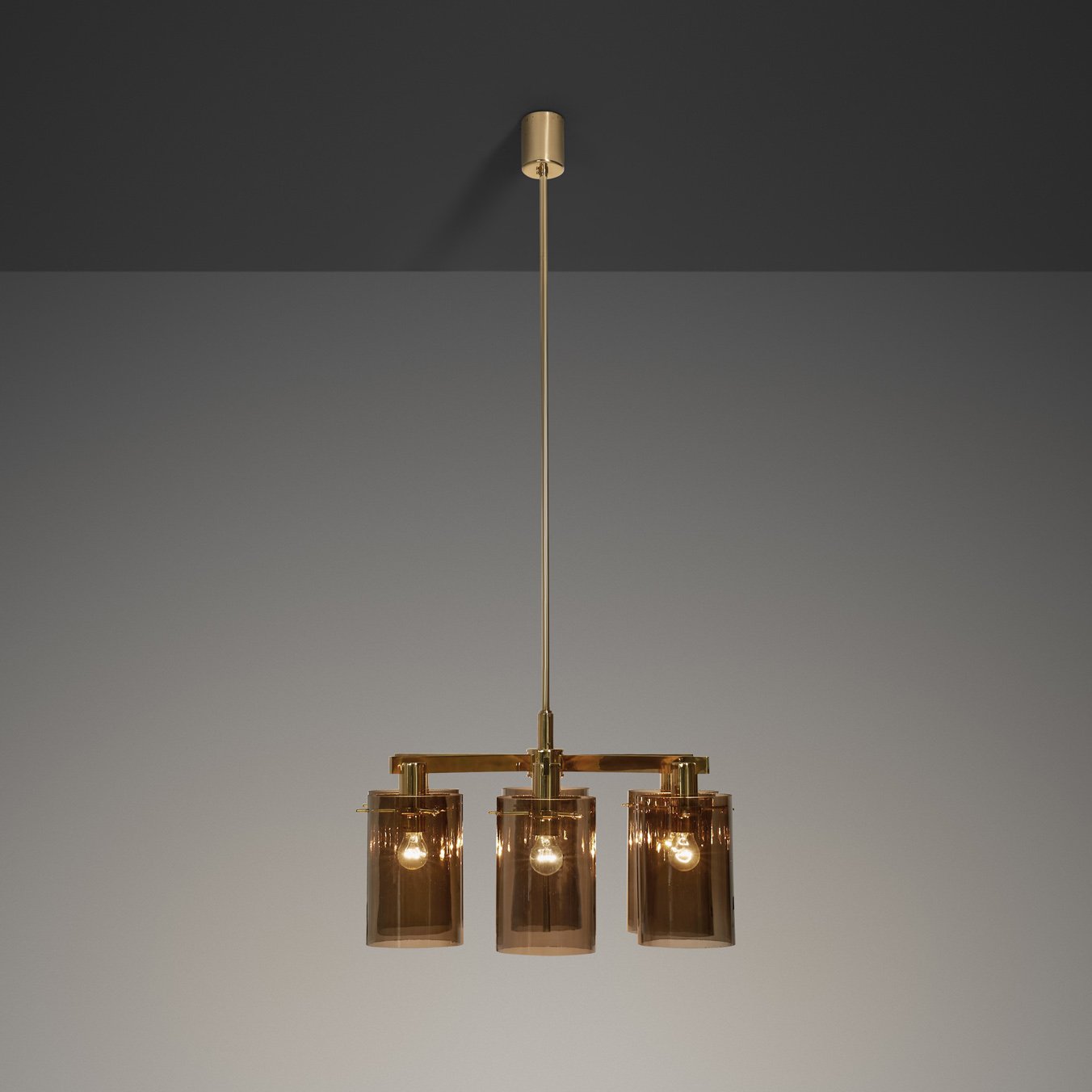
This model "C2293/6" chandelier was created in what we now call “the golden age of Scandinavian design”. Hans-Agne Jakobsson was the great Swedish master of lighting, creating some of the most recognizable mid-century modern lamps of Scandinavia. This incredible chandelier is no exception.
The design of this "C2293/6" hanging light clearly shows the Swedish designer’s studies in architecture, with beautiful geometric forms and symmetry dominating the structure. The three cylindrical shades hang from the brass pole like fruits, enhancing the organic forms that influenced Jakobsson. The smoked glass shades look equally appealing when the light is on or off, but when lit, the brass base truly stands out. The prowess of the designer becomes evident as this model stands as a statement piece despite its minimalism. Since the two materials - brass and tinted glass - dictate the look, much attention was paid to their quality and to the craftsmanship that united them into the cylindrical shape to create a timelessly modern look. The design has great proportions, and when lit, it creates an exceptionally atmospheric light, giving the brass a vivid colour as well.
This lamp is truly a testament to the enduring appeal of Swedish modern design and to Hans-Agne Jakobsson's lasting legacy as one of the movement's most significant designers.
Condition:
In good vintage condition. Wear consistent with age and use. The lamp has recently been rewired and reconditioned. Due to the nature and age of the materials the item has minor marks and chips and may have scratches and discolouration. Additional imperfections may also be present due to manufacturing inconsistencies. The stem length is 198 cm and can be customised by our in-house workshop to a desired length. Please reach our for more information.
Dimensions:
28.35 in W x 25.59 in D x 101.18 in H
72 cm W x 65 cm D x 257 cm H
REQUEST PRICE HERE
Price category: usd / eur
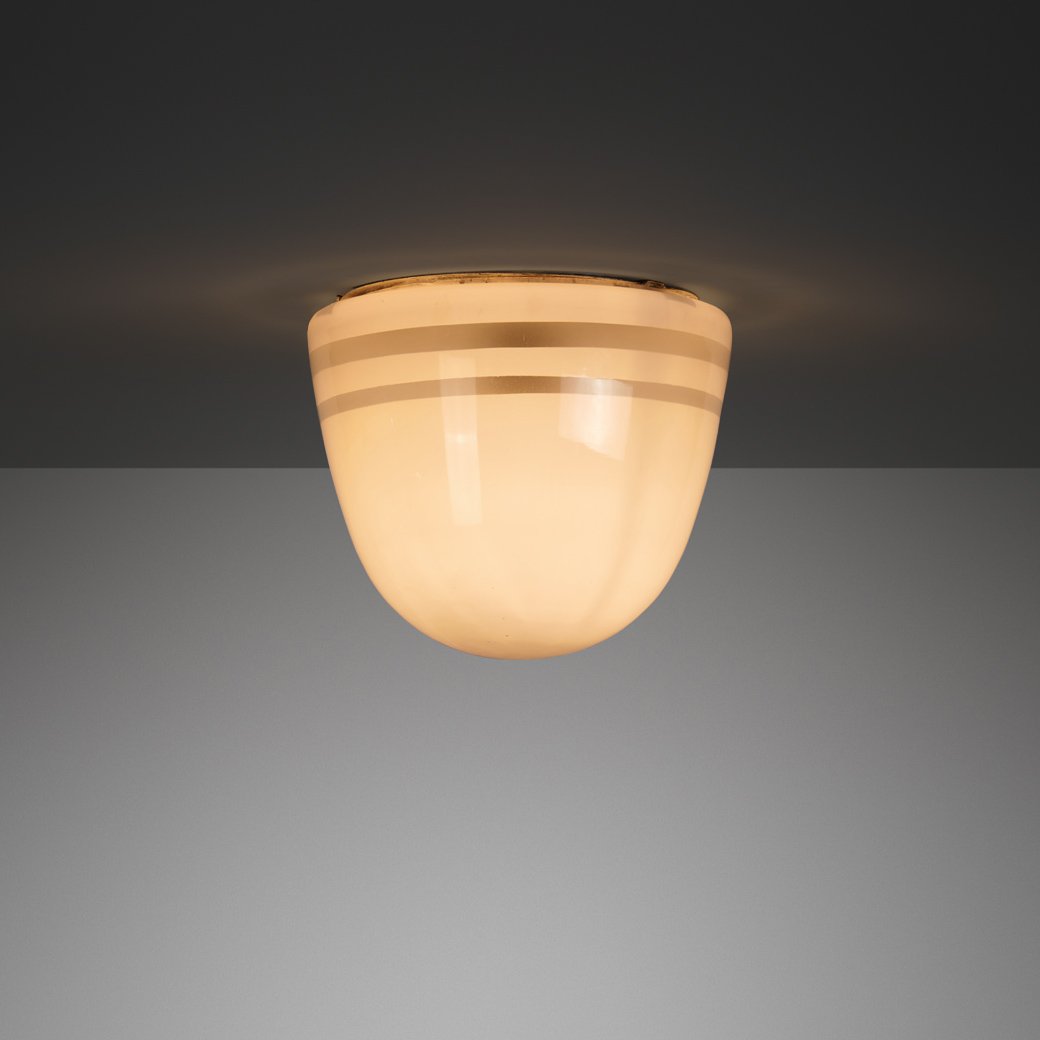
Harald Notini was a Swedish designer and sculptor, and the artistic director at Arvid Böhlmarks Lampfabrik. After becoming creative director in 1916, Notini played an important role in shaping the company’s distinctive visual identity, guiding the company toward producing innovative and unique lighting designs. Between the 1920s and 1950s, Böhlmarks was one of the leading names in Swedish lighting and a significant force within the country’s design movement.
This ceiling lamp embodies the sleek and simple aesthetic that characterised Finnish design during the 1950s. Even in the absence of ornamentation, there was always an emphasis on interesting materials, in this case, milk glass. Milk glass, appropriately named for its opaque or translucent ivory-white tone, was first created in Venice in the 16th century, where it was known as Lattimo. It remained popular throughout the 20th century, when it became a favoured material for lighting and home accents. What sets this piece apart from other timeless lamps of the same material is the striped detail. This element once again highlights the versatility of glass, as well as the ability of its maker. This flush mount features an eye-catching rounded form with a gently blunted top and soft edges. Thanks to its concealed ceiling holder, the piece sits close to the ceiling, allowing the glass shade to remain the focal point of the design.
At the company’s 75th anniversary in 1947, Böhlmarks was still regarded as Sweden’s largest company within its category, and this lamp shows why. The Scandinavian design blueprint established during the first decades of the 20th century can be clearly traced in this model: functionality, an understated and unornamented aesthetic, high-quality materials and, above all, the skill of the craftsperson.
Condition:
In good vintage condition. Wear consistent with age and use. The ceiling lamp has recently been rewired and reconditioned. Due to the age and nature of the glass, the lamp may have marks, scratches and discolouration. Minor chips on the glass, the chips are not visible when the lamp is mounted. Additional imperfections on the glass may be present due to manufacturing inconsistencies and age. All lighting can be converted for US usage.
Dimensions:
8.86 in ø x 8.07 in H
22.5 cm ø x 20.5 cm H
REQUEST PRICE HERE
Price category: 5,000 - 7,500 usd / eur
Floor lamps produced across Europe in the mid twentieth century often explored new material combinations while maintaining the restrained forms associated with modern design. During this period, artists frequently experimented with metals, finishes, and details to create lighting that felt contemporary while remaining practical for everyday interiors. The combination of the brass body and rattan shade of this floor lamp represents the period.
The lamp’s material choice gives the piece a subtle warmth and sophistication, creating a timeless aesthetic that blends understated luxury with functional craftsmanship. The piece strikes a great balance: while the metal structure provides strength and stability, natural materials soften the overall appearance. The circular brass base transitions into the stem, gracefully curving to support the striking shade. Not only is the brass durable but it develops a beautiful patina over time, adding to the aesthetic value. The adjustable rattan empire lampshade creates a cosy effect when the lamp is lit, as the light peeks through the woven gaps. Since the head of the lamp is adjustable, it allows the user to tailor the light direction, making it a versatile piece. This technical detail allows the expressive structure to combine functionality with visual appeal.
This floor lamp is the perfect way to add a touch of elegance to any space without being overwhelming. Its expert craftsmanship and unique character showcase the beauty obtained when industrial manufacture meets traditional crafts such as rattan weaving.
Condition:
In good vintage condition. Wear consistent with age and use. The lamp has recently been reconditioned and rewired. Minor dents on the brass base. Due to the age and nature of the materials, the item may have marks, scratches, and discolouration. The lamp is compatible with an E26 / E27 (standard) fitting. All lighting can be converted for US usage.
Dimensions:
22.05 in W x 19.69 in D x 56.30 in H
56 cm W x 50 cm D x 143 cm H