
Kerstin Hörlin-Holmquist "Little Adam" Armchair for Nordiska Kompaniet, Sweden 1950s


Kerstin Hörlin-Holmquist "Little Adam" Armchair for Nordiska Kompaniet, Sweden 1950s
REQUEST PRICE HERE
Price category: 2,500 - 5,000 usd / eur
The “Little Adam” chair model is from the timeless and iconic Paradise Collection from the Triva Series, which was created in 1958 by Kerstin Hörlin-Holmquist during her time as a designer at Nordiska Kompaniet. The name is inspired by “Paradiset” – the Swedish name for Eden.
This armchair holds a soft simplicity and a uniqueness in its appearance - light, clean lines with an air of romance. Without worrying about short-lived trends and what other people thought, Kerstin Hörlin-Holmquist created the gentle, peculiar shape of this armchair that is only increasing in popularity even today. Thanks to her unique vision, this “Little Adam” has an unmistakeable backrest that flows down to form the armrests. While the armrests sit low, therefore opening the seat, the chair still has the impression of hugging the sitter. The fully upholstered body elevates the visual comfort, with a stitch tufted backrest that is festooned with buttons arranged in a hill shape. This subtle form of decoration highlights the shape of the back by mirroring it, while also accentuating the light fabric by giving it extra depth. The stained and tapered wood legs pair perfectly with the organic form of the body. Contrasting the front legs, the back ones are lightly splayed to provide great structural stability.
Kerstin Hörlin-Holmquist had a unique and humanistic design vision, and thanks to her uncompromising attitude, this “Little Adam” armchair has become iconic. Thanks to the upholstery’s soft touch that complements the aesthetic of Hörlin-Holmquist’s design, this armchair is a perfect example of the gentle mid-century modernism Swedish design of the era is beloved for.
Condition:
In good vintage condition. Wear consistent with age and use. The chair has been reupholstered recently in a premium fabric. Each of our items can be re-upholstered by our in-house atelier in a fabric of choice. Please reach out for more information.
Dimensions:
27.95 in W x 29.13 in D x 29.13 in H; Seat Height 14.96 in; Arm height 20.87 in
71 cm W x 74 cm D x 74 cm H; Seat height 38 cm; Arm height 53 cm
About the Designer:
Kerstin Hörlin-Holmquist was born on May 30, 1925 in Arvika, Sweden. She was a Swedish modernist architect and designer. Hörlin-Holmquist graduated from Stockholm’s Konstfack in 1952, and before that she studied and worked in England.
She often worked with her husband Erik Holmquist, and together they modelled and created the pieces together. A key aspect for the couple was always to test their designs in their own home before completing a project.
"I think both furniture and textiles, wherever they end up, must be kind, gentle, and courteous, but without losing their character. They should have human qualities, not be pompous and only stand alone, but be able to adapt to the environment they end up in."
Hörlin-Holmquist worked and studied in England from 1946-1947 immediately after the war, where she also studied art history and became fascinated with the classic English upholstered furniture and style. Something that without a doubt inspired her own creations later in life while she still developed her own expression. She returned to Sweden where she attended Konstfack from 1948 and graduated from the school in 1952. She started working with Nordiska Kompaniet shortly after her graduation and became a lead designer. Her timeless and iconic ‘Paradiset Collection’ was created during her employment with Nordiska Kompaniet in 1956-1957 and holds a soft simplicity and a uniqueness in its appearance - light, clean lines and yet gracious with an air of romance.
Today, her designs are highly treasured collectibles. She is primarily remembered, for her ability to create designs for the modern home in the 1950s without worrying about short-lived trends and what other people thought - to stay true to her own unique and humanistic design vision. ~H.
REQUEST PRICE HERE
Price category: 5,000 - 7,500 usd / eur
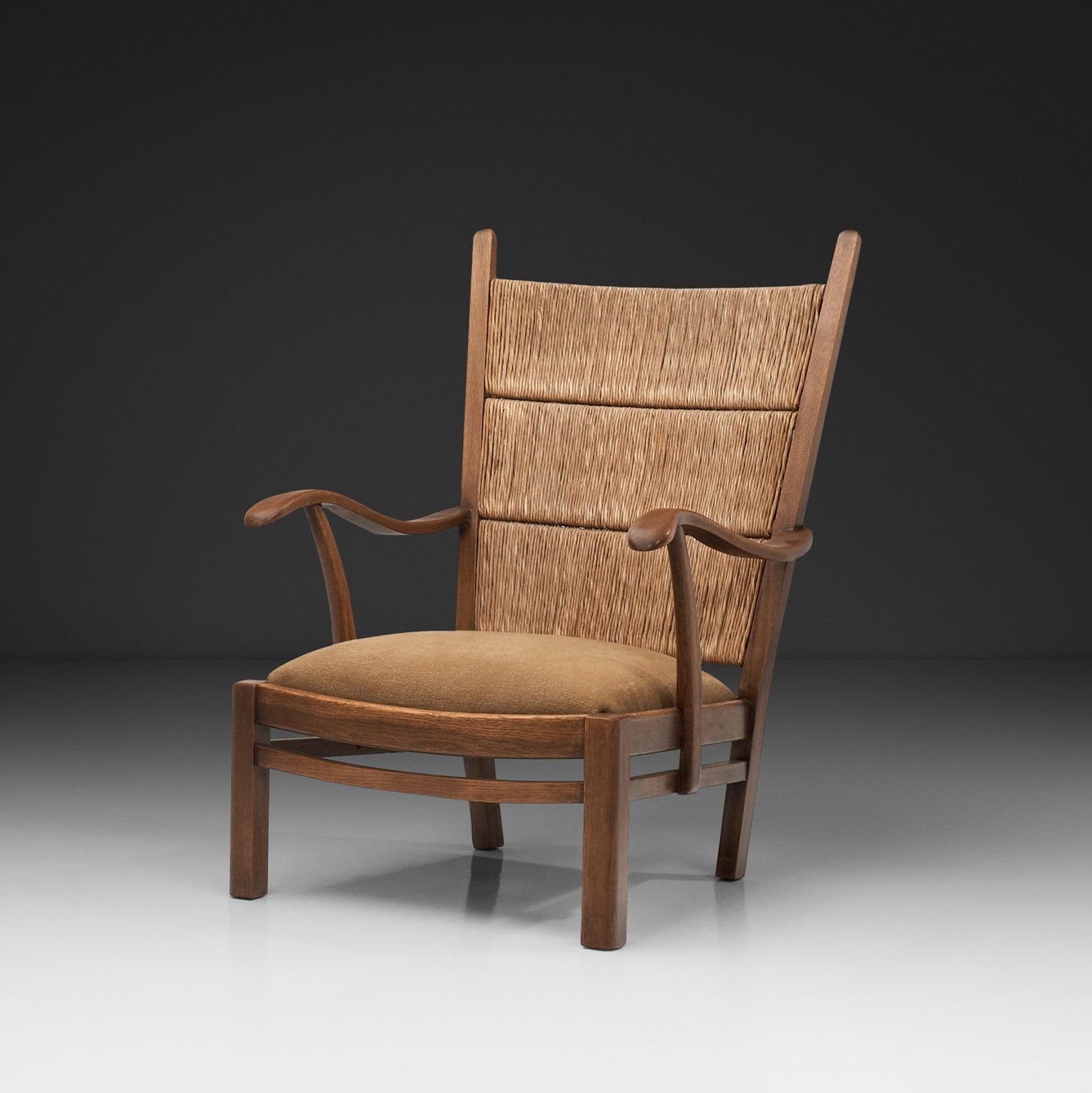
Bas van Pelt (1900–1945) was a Dutch furniture and interior designer whose work combined traditional craftsmanship with the principles of early modernism. While Van Pelt's creative work was primarily dominated by the Hague School, this armchair is the result of his more mature design period, characterised by natural materials, in order to create a friendly and inviting appearance that combines the warmth of solid oak with the distinctive texture of woven rush.
The construction of this model is simple at its core, but thanks to certain details, it is a playful representation of early Dutch modernism. While made of solid oak, this armchair has an open feel to it thanks to the horizontal spaces on the back that divide the three rush panels. The tall, slightly inclined backrest is framed by two straight wooden uprights, creating a strong vertical outline that contrasts with the more fluid shape of the armrests. The curved lines of the arms contrast nicely with the straight lines of the frame and clearly show wonderful craftsmanship. Each armrest extends outward in a gentle wave, giving the chair a particularly individual character. The rush weaving on the back adds textural interest, bringing the appealing roughness of nature to the design. Its closely arranged vertical strands create a warm, sandy surface, beautifully complemented by the oak's rich brown colour and the similar tone of the upholstery. The legs and stretchers are simple in their design, serving a primarily structural role and allowing the rush weaving and the wooden construction to stand out. The legs are connected by a gently curved wooden rail beneath the seat, while the rear supports continue naturally from the backrest. Thanks to the well-chosen proportions and the combination of natural materials, this armchair provides great comfort while maintaining a remarkable appearance.
Bas van Pelt's progressive designs were, in many ways, ahead of his time. The Dordrecht-born designer's furniture models are quite rare, with examples preserved in the collection of the Stedelijk Museum Amsterdam. Furniture pieces like this easy chair stand out through their unique textures and materials, as well as their classic charm. Its generous backrest and comfortable seat make it particularly suitable for a living room, library or reading area, where the craftsmanship can be appreciated from every angle.
Condition:
In good vintage condition. Wear consistent with age and use. The chair has recently been reconditioned. Due to the nature and age of the wood, the item has minor marks, scratches, dents and discolouration. The seat cushion has recently been reupholstered in a premium fabric. Each of our items can be reupholstered by our in-house atelier in a fabric of choice. Please reach out for more information.
Dimensions:
24.8 in W x 29.13 in D x 38.18 in H; Seat height 14.96 in; Seat depth 22.44 in; Arm height 22.83 in
63 cm W x 74 cm D x 97 cm H; Seat height 38 cm; Seat depth 57 cm; Arm height 58 cm
REQUEST PRICE HERE
Price category: 9,000 - 12,500 usd / eur
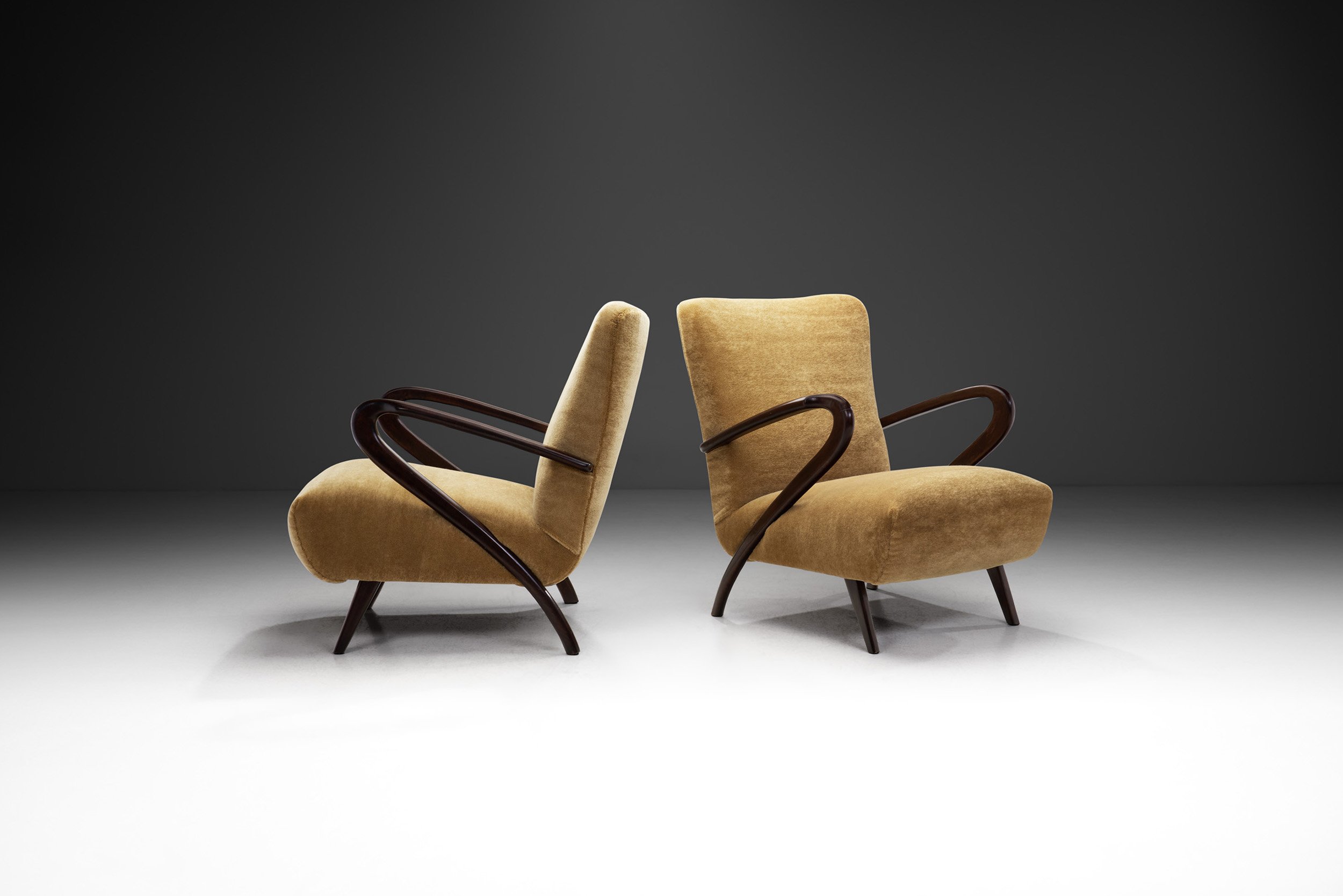
The Italian architect, painter and furniture designer, Guglielmo Ulrich, descended from a noble family with Danish origins. He quickly became a very influential figure in modern Italian design and his models are real delicacies today.
As this pair of 1950s lounge chairs show, Ulrich’s work is elegant and rich in detail. Although his work does not quite conform with the strict norms of simplicity of the time, it fits the prevalent aesthetics of Modernism. In the case of these chairs, the fully upholstered bodies show the general mid-century modern characteristics with an ergonomic and functional design. The seats are slightly raised, and the backs tilted, creating an angle that supports the sitter and the lounging experience. The wooden arms transcending to form the back legs however, truly stand out. The sharp curvature of the armrests and front legs define the look and create an interesting effect, as if the upholstered seats and backs were connected to them without joinery. The carved, dark wood and soft upholstery make them even more pronounced. There are more, subtler features to these chairs, including the wider armrests and the curved backrests, both in service of comfortable lounging. Thanks to the quality of his furnishings, that Ulrich designed and made personally, he became the trusted architects of many upper-class Milanese families. He participates in the furnishing of the most prestigious Italian ships: Cristoforo Colombo, Raffaello, etc.
“A nobleman of yesteryear, with sudden jokes and twists, such as a pipe with an egg in his mouth and a very concrete sense of doing” is how he was often described. This pair of chairs is much like this description with a playful, elegant design completed by quality materials and craftsmanship.
Condition:
In good vintage condition. Wear consistent with age and use. The chair has been reupholstered recently in a premium fabric. Each of our items can be re-upholstered by our in-house atelier in a fabric of choice. Please reach out for more information.
Dimensions:
24.4 in W x 31.69 in D x 31.49 in H; Seat height 14.17 in; Arm height 23.42 in
62 cm W x 80.5 cm D x 80 cm H; Seat height 36 cm; Arm height 59.5 cm
About the designer:
Guglielmo Ulrich (born 1904, Milan–died 1977) was an Italian architect, furniture designer, and painter. He was born to a notable family of Danish origin. In 1924, Ulrich enrolled in the Scuola Speciale di Architettura at the Accademia di Belle Arti di Brera. He finished his studies at Politecnico di Milano in 1927 and soon became a very influential figure in modern Italian design.
In 1930, along with Scaglia and Wild, Guglielmo Ulrich founded and became head designer of home furnishing company Arca (Arredamento casa, or Home Furnishing), a company engaged in the creation of high-quality furnishing accessories characterized by craftsmanship and the use of premium materials. In the 1950s, he participated in several editions of the Triennale di Milano and concentrated on designing buildings, offices, and retail shops throughout Italy.
Most of Ulrich’s furniture designs from this era, and especially his chairs and chaise lounges, resemble simplified and streamlined design versions of late 19th century pieces and do not necessarily conform to modern designs prevalent in Northern Europe and the U.S. in the 1950s. In the 1960s, Ulrich focused his work toward industrial design and was able to create original and impactful objects. His talent was rewarded on many occasions. In 1961, he won the Fiera di Trieste award for his Trieste chair, produced by furniture maker Saffa.
REQUEST PRICE HERE
Price category: 2,500 - 5,000 usd / eur
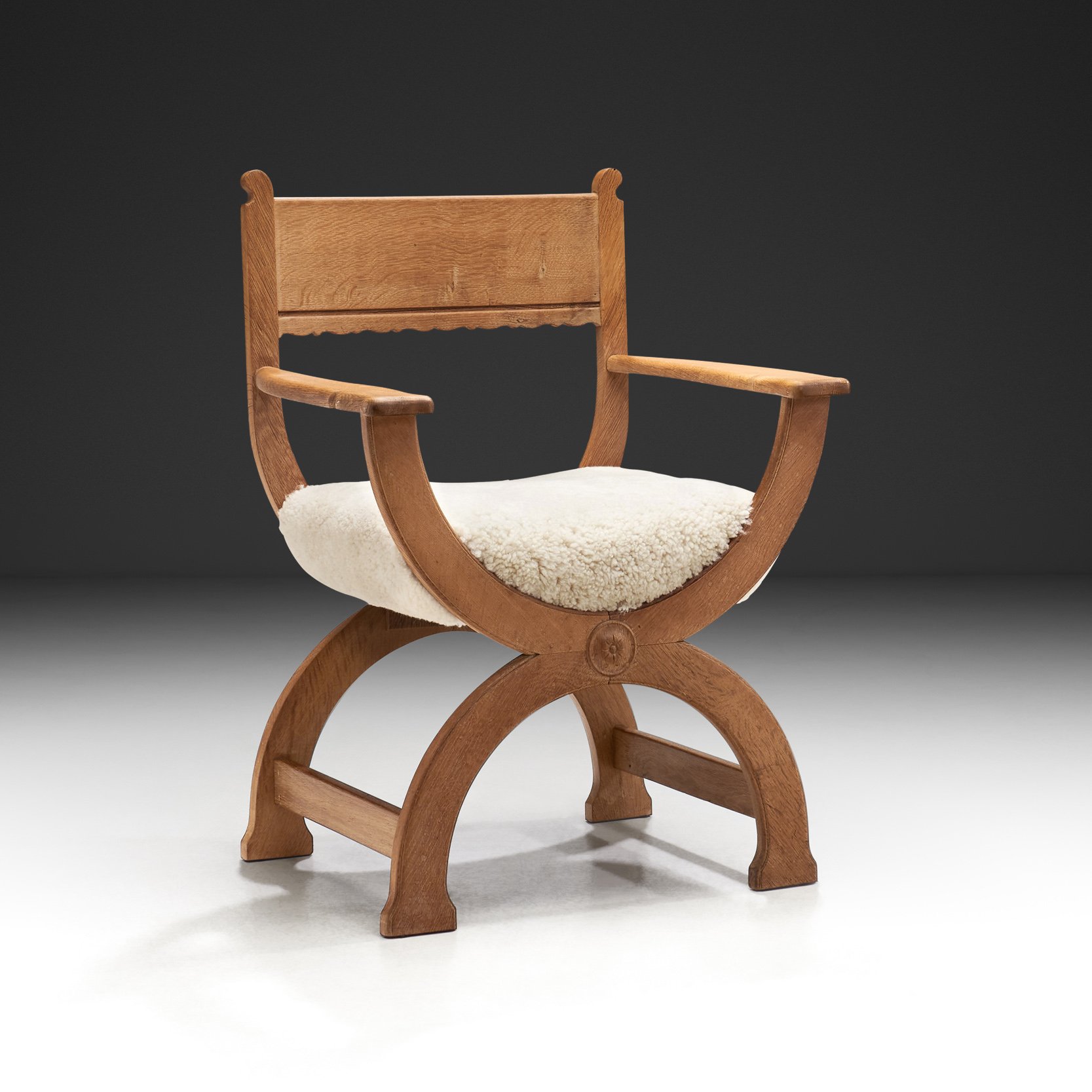
This so-called “kurulstol” or kurul chair, is an iconic model by Danish designer, Henning Kjærnulf. The Kurul chair is an ancient folding chair, originally a folding stool with straight or curved legs. Among the Romans, in addition to being an ordinary utility chair, it was symbolically linked to officials, often within the judiciary.
This armchair combines the traditional kurul structure with a rounded and curved appearance, with an upholstered seat and backrest that gives the historic look a modern edge. The oak frame is carved and sculpted in an unmistakeable way, showing the skills of both the designer and the manufacturer. The body is composed of two slats of wood of equal length in the front and back, fastened together in a saltire formation (resembling the letter X) which are extended up at the top and back to form the armrests and the backs as well. The seat, upholstered in soft sheepskin, is stretched between the front and back slats connecting the two. Kjærnulf removed the folding function of the historic design, giving his model a more stable, organic look. This impression is further enhanced by the solid oak, which is carved with great precision into straight and curving lines. The rich sheepskin melts these carved and straight lines together, contrasting to the oak’s smoothness. While the historic kurul chair was often decorated with intarsia, this model only showcases subtle decor elements, such as the charming sculpted mark in the front with a flower (or the sun) carved into the wood.
While the kurulstol is a Renaissance classic originating from ancient Rome, thanks to Kjaernulf, Scandinavian modernism remains at the core of the design. Kjærnulf’s designs are easy to spot in a crowd thanks to his originality, making his pieces like the razorblade chair and this kurulstol eternally unique. This chair was manufactured by EG Kvalitetsmobel in Denmark during the 1960s.
Condition:
In good vintage condition. Wear consistent with age and use. The chair has recently been reconditioned. Some minor scratches and marks on the wood. The chair’s seat has been reupholstered recently in premium sheepskin. Each of our items can be re-upholstered by our in-house atelier in a fabric of choice. Please reach out for more information.
Dimensions:
24.8 in W x 26.77 in D x 31.29 in H; Seat height 17.32 in; Arm height 26.18 in
65 cm W x 55 cm D x 88 cm H ; Seat height 49 cm; Arm height 63.5 cm
About the designer:
Danish mid-century designer and architect, Henning Kjaernulf, is somewhat of a mystery. A lot more is known about his designs than Kjaernulf himself. His wooden designs, crafted to perfection, speak for themselves. Kjaernulf mainly designed for the Danish manufacturers EG Kvalitetsmøbel, Nyrup Møbelfabrik, and Vejle Stole Møbelfabrik. The latter produced the designer’s well-known teak extending dining table design. The historic archives of the Danish municipality, Stenlille, reveal the history of Nyrup Møbelfabrik, mentioning Kjaernulf’s architectural designs for the company’s factory, referring to him as an architect based in Odense, Denmark.
Kjaernulf’s works reveal quality craftsmanship throughout, featuring clean Danish modern era lines with sculpted edges and shapes. The unique shapes, like his razorblade chair backrests, distinguish the designer from other Danish mid-century designers.
In light of how sought after his dining sets and lounge chairs are, it remains a mystery why so little is known about the designer. The curious background of Kjaernulf if anything, adds more charm to his pieces. ~H.

REQUEST PRICE HERE
Price category: 2,500 - 5,000 usd / eur
This remarkable armchair was designed by German artist, Willi Ohler. The so-called “Worpsweder” either denote chairs made at the Worpsweder Kunsthütten (Worpsweder arts huts) in Germany, or a specific style of German chairs with solid wood frames, broad armrests, often from tall wood, with woven seats and backs. This piece features all of those characteristics.
Crafted during a time when movements like Modernism were reshaping design worldwide, this early 20th-century armchair reflect a transitional style rooted in both simplicity and elegance. This era emphasises clean lines, unique shapes, and high-quality craftsmanship to achieve timeless pieces like this one. The honey-toned wood highlights the warm patina that has developed over decades. The softly sculpted armrests framing the chair bring both elegance and ergonomic comfort to the overall form. Woven wicker is the main highlight of the piece. The material is used to construct the seat and tall backrest. The beautifully symmetrical pattern showcases the timeless artistry of artisanal furniture. The rectangular, slim legs create a sleek structure while not abandoning sturdiness. This chair preserves the value and beauty of master craftsmanship and exquisite materials.
Worpswede in Lower Saxony is famous nationwide for its long tradition as an artists' colony. Nowadays, about 130 artists and craftsmen and women live there permanently. The artists who created the so called "Worpsweder Kuentlerkolonie" were looking for the simple and original in art and life. The traditional reed and rush woven chairs of this region were greatly appreciated by the artists of the colony, and some of them were still produced around 1900-1920. They have become collectors’ pieces thanks to the craftsmanship that went into each chair’s creation.
Condition:
In good vintage condition. Wear consistent with age and use. The chair has recently been reconditioned. Due to the nature and age of the materials the item has minor scratches and discolouration.
Dimensions:
34.64 in W x 33.07 in D x 46.45 in H; Seat height 16.53 in; Seat depth 19.68 in; Arm height 24.80 in
88 cm W x 84 cm D x 118 cm H; Seat height 42 cm; Seat depth 50 cm; Arm height 63 cm
REQUEST PRICE HERE
Price category: 2,500 - 5,000 usd / eur
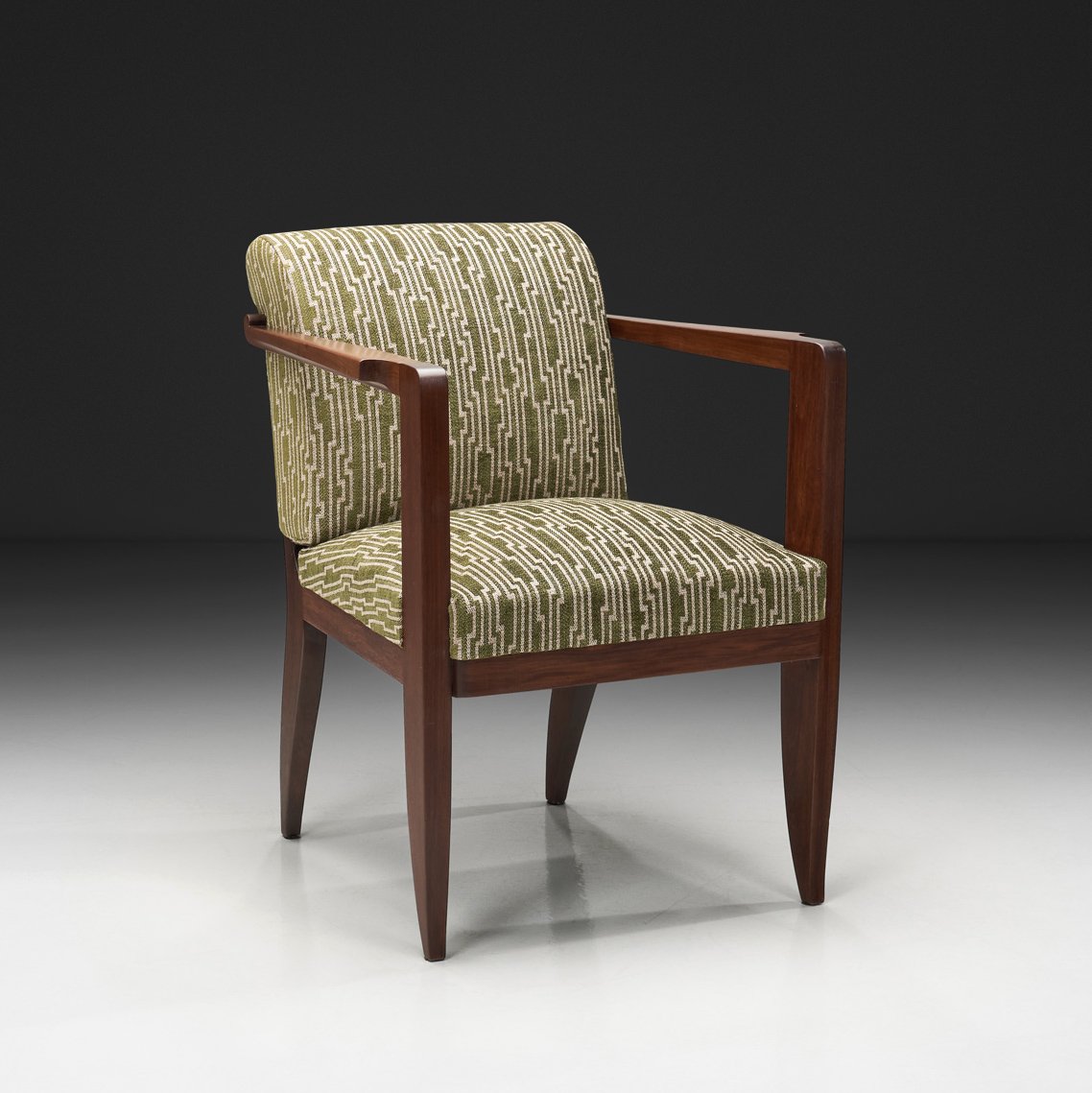
Christian Krass (1868–1957) was a French cabinetmaker and furniture designer based in Lyon, he became an important figure in the city’s decorative arts during the first half of the 20th century. His work included seating, tables, desks and cabinets, often combining carefully worked woods with the geometric forms and refined materials associated with Art Deco. This armchair, which dates back to circa 1930s, applies Krass’s skill to a compact and elegant seating design.
The armchair is defined by its exposed wooden frame, which combines straight lines with subtle curves. Four tapered legs support the upholstered seat, with the front legs continuing upward to meet the armrests and creating a clear structural outline. The armrests have a particularly interesting shape, extending horizontally into a carved element before turning downward. Their broad wooden surfaces and warm reddish-brown tone contrast with the patterned upholstery while keeping the construction clearly visible. The backrest is generously upholstered and slightly curved, with rounded upper corners that soften the otherwise geometric frame. Its shape follows naturally into the broad seat below, creating comfortable proportions within a relatively compact structure. The green and cream upholstery introduces a small repeating geometric pattern that complements the straight lines of the wood while adding texture and visual depth. The clean junctions between the legs, seat rails, arms, and back show the quality of the woodworking, with each element contributing equally to the overall composition.
The chair captures the more restrained side of French Art Deco, where decorative effect could be achieved through proportion, material and carefully controlled lines. Its scale makes it particularly suitable as a desk chair, side chair or additional seating in a living room or bedroom. It represents an interesting example of French furniture design from the 1930s.
Condition:
In good vintage condition. Wear consistent with age and use. The chair has recently been reconditioned. The armrests have minor marks and scratches. Due to the nature and age of the materials, the item may have some discolouration. The chair has recently been reupholstered in a premium fabric. Each of our items can be reupholstered by our in-house atelier in a fabric of choice. Please reach out for more information.
Dimensions:
23.42 in W x 25.98 in D x 30.70 in H; Seat height 18.70 in; Seat depth 17.12 in; Arm height 26.77 in
59.5 cm W x 66 cm D x 78 cm H; Seat height 47.5 cm; Seat depth 43.5 cm; Arm height 68 cm

REQUEST PRICE HERE
Price category: 12,500 - 15,000 usd / eur
Mid-century modern furniture introduced new approaches to seating, with designers exploring rounded silhouettes and chairs shaped closely around the sitter. This pair of European armchairs belongs to this direction, combining generous upholstery with a compact profile and short wooden legs.
Their continuous curved bodies give them a particularly soft appearance, while the low seating position creates the relaxed character associated with lounge furniture of the period. The shape of these armchairs creates an inviting and enveloping appearance. Each chair has a broad, deep seat framed by substantial upholstered arms that rise gently towards the backrest. The back is formed as a wide panel with softly rounded upper corners, curving around the sitter before flowing directly into the sides of the chair. This continuous transition between the back and arms is particularly effective when the chairs are viewed from behind, where the upholstery creates an uninterrupted curved silhouette. The olive-green fabric covers the entire body, allowing the proportions and shape to remain the focus of the design. Its textured surface gives the colour additional depth. A rectangular seat cushion sits within the upholstered body to ensure comfort for its user. Four short tapered wooden legs lift each chair just above the floor. Their warm brown tone of the wood provides a restrained contrast to the green upholstery, while their outward angle secures the broad stance of the chairs.
The designer ensured to make these chairs attractive from every direction, allowing the option to be positioned away from a wall and used more freely within a larger seating arrangement. Comfortable, compact and visually distinctive, the pair offers an appealing example of the softer forms found in European mid-century seating.
Condition:
In good vintage condition. Wear consistent with age and use. The armchairs have recently been reconditioned. Due to the nature and age of the materials, the items have marks, scratches, and discolouration. The pair have recently been reupholstered in a premium fabric. Each of our items can be reupholstered by our in-house atelier in a fabric of choice. Please reach out for more information.
Dimensions:
29.52 in W × 34.64 in D × 30.7 in H; Seat height 14.56 in; Seat depth 21.65 in; Arm height 18.5 in
75 cm W x 88 cm D x 78 cm H; Seat height 37 cm; Seat depth 55 cm; Arm height 47 cm

REQUEST PRICE HERE
Price category: 50,000+ usd / eur
Swedish architect and furniture maker Axel Einar Hjorth worked as the lead designer for Sweden’s Nordiska Kompaniet department store from 1926 to 1938. While combining the simple, honest forms of the traditional nordic “allmoge” furniture common in Swedish rural culture, with the international 20th century Modernist movement, Hjorth designed the “Sportstugemöbler” series, (“sports cabin furnishings”) a collection of wooden furniture designed for country homes.
The “Lovö” chair was initially launched by Nordiska Kompaniet in 1932. The series was a response to a new, growing demand for furnishings for leisure houses, thus Hjorth used local pine to create a model that unites the robust and straightforward Nordic style with skilful handcrafting. The result is a modest, yet visually interesting presence with a strong and tall outline. These chairs are crafted from local pine wood, while the backrests feature iron rivets. The juxtaposition between the pine and iron provides a rustic, sturdy and resilient feel, elevating the timeless look of the model. The chairs combine simple and honest forms of the handcrafted style of traditional Nordic “allmoge” furniture, and the international 20th century Modernist movement. The seats feature loose, removable cushions, upholstered in a textured fabric. The cushions further increase the chairs’ special character, increasing both comfort and charm. The design is completed by four square, straight legs.
The “Sportstugemöbler” series had a lasting influence on Hjorth’s contemporaries, inspiring other big names within Nordic design, such as Carl Malmsten. From an international perspective, this series is the forerunner of later pioneering designs, so it comes as no surprise that these “Lovö” chairs became part of modernist design history.
Condition:
In good vintage condition. Wear consistent with age and use. The chairs have recently been reconditioned. The chairs show marks and dents Due to the age and nature of the materials, the chairs may have additional scratches or discolouration. The pillows were costum made by our in-house atelier in a premium fabric. In addition, the chairs can be purchased including their original striped cushions. Each of our items can be reupholstered by our in-house atelier in a fabric of choice. Please reach out for more information.
Dimensions:
18.5 in W x 20.86 in D x 37.4 in H; Seat height 17.71 in; Seat depth 16.54 in
47 cm W x 53 cm D x 95 cm H; Seat height 45 cm; Seat depth 42 cm
REQUEST PRICE HERE
Price category: 7,500 - 10,000 usd / eur
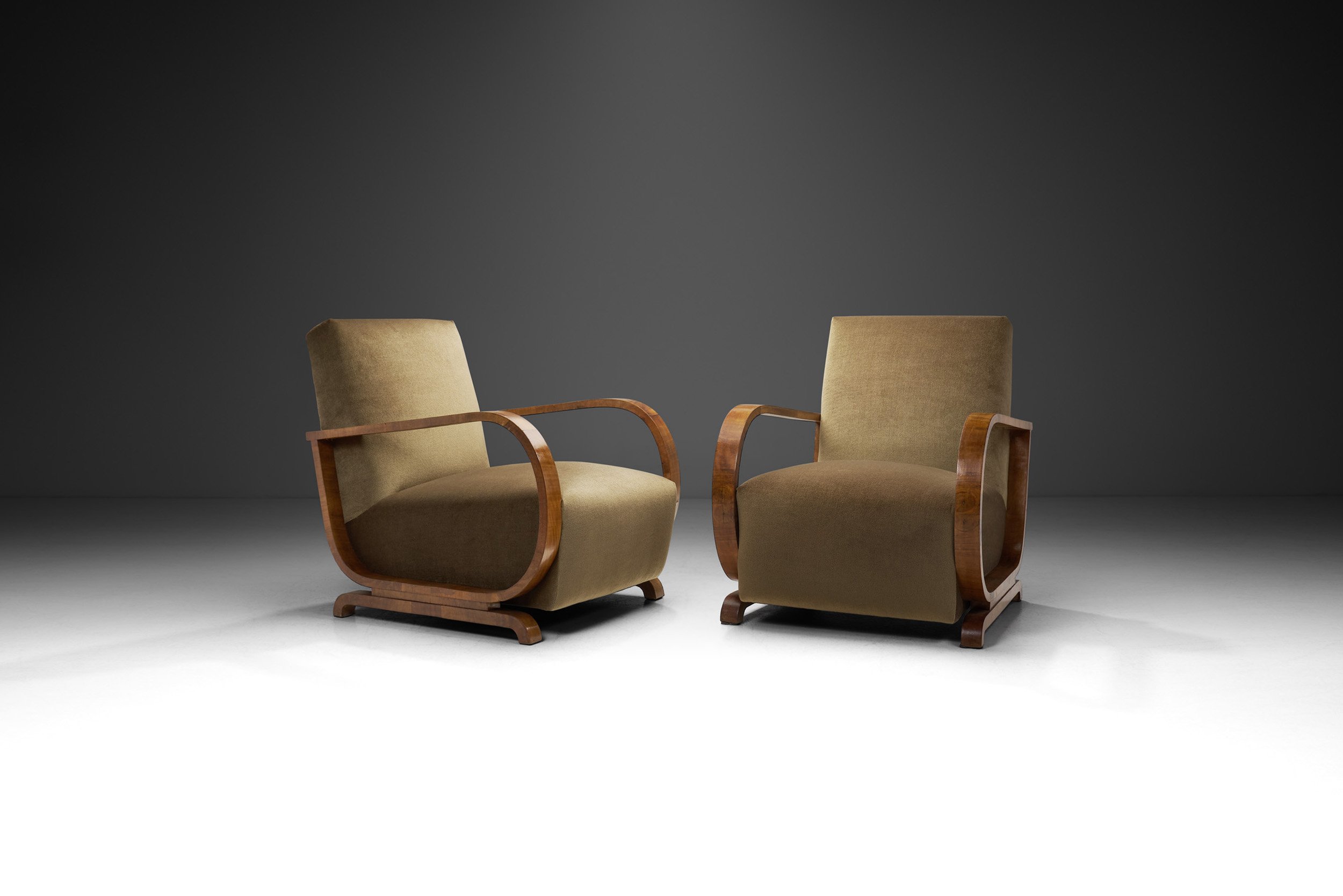
Art Deco was an era-defining movement in furniture design. These chairs were created during an age of aesthetic creativity and instantly recognisable design. As these armchairs show, European furniture designers’ artistic approach was anchored by characteristic Art Deco refinement, expressed through graceful forms and traditional methods.
Though elements of Art Deco and mid-century modern are markedly different, both styles value beauty, shape, and colour. This is evident in the pronounced curve of the arms that define the overall look. Since the arms create a hollow form, the beautiful upholstery is visible from the sides as well, further complementing the gentle curvature. To keep the visual balance, the backs and the lower structures feature straighter lines. The veneered wood’s beautiful grain and colour variation stands out thanks to the upholstery’s restrained, elegant colour. The tightly upholstered seats and backs - while adding plenty of comfort and cosiness to the design - don’t take the attention away from the wooden structures, which shows the design skill of the maker. The pedestal-like legs connect directly to the arms and hold the bodies in an almost gravity defying way. This feature shows the high-level craftsmanship of the era. This chair model was a popular style in Austria and Italy in the first half of the 20th century, it is also reminiscent of works crafted at Heal’s in the 1930s. Heal's was a renowned British furniture retailer founded in 1810 by John Harris Heal.
Perfect for those looking to add some vintage glamour to a space, this pair will bring timeless allure to any room. The design offers a perfect blend of style and comfort, which will endure through the ages while exemplifying Art Deco craftsmanship.
Condition:
In good vintage condition. Wear consistent with age and use. The chairs have recently been reconditioned. Due to the nature and age of the materials, minor marks and scratches are present on the wood. The chairs have been reupholstered recently in a premium fabric. Each of our items can be re-upholstered by our in-house atelier in a fabric of choice. Please reach out for more information.
Dimensions:
25.59 in W x 31.88 in D x 29.92 in H; Seat height 14.56 in; Arm height 22.44 in
65 cm W x 81 cm D x 76 cm H; Seat height 37 cm; Arm height 57 cm
REQUEST PRICE HERE
Price category: 7,500 - 10,000 usd / eur
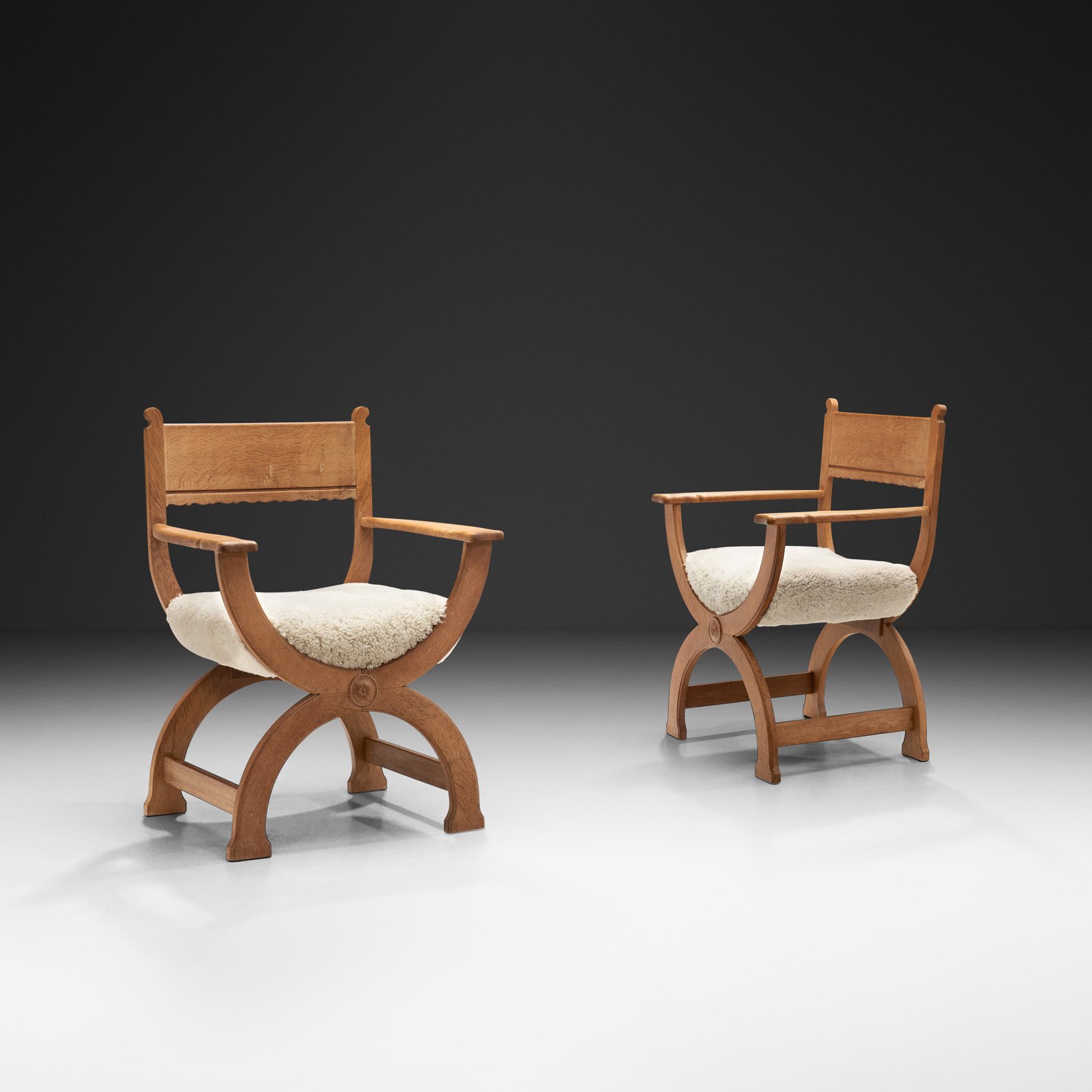
The so-called “Kurulstol” or “Kurul” chair, is an iconic model by Danish designer, Henning Kjærnulf. The Kurul chair is an ancient folding chair, originally a folding stool with straight or curved legs. Among the Romans, in addition to being an ordinary utility chair, it was symbolically linked to officials, often within the judiciary.
This pair of chairs combine the traditional kurul structure with a rounded and curved appearance, with an upholstered seat and backrest that gives the historic look a modern edge. The oak frames are carved and sculpted in an unmistakeable way, showing the skills of both the designer and the manufacturer. The bodies are composed of two slats of wood of equal length in the front and back, fastened together in a saltire formation (resembling the letter X) which are extended up at the top and back to form the armrests and the backs as well. The seats are upholstered in soft sheepskin, stretched between the front and back slats connecting the two. Kjærnulf removed the folding function of the historic design, giving his model a more stable, organic look. This impression is further enhanced by the solid oak, which is carved with great precision into straight and curving lines. The rich sheepskin melts these carved and straight lines together, contrasting to the oak’s smoothness. While the historic kurul chair was often decorated with intarsia, this model only showcases subtle decor elements, such as the charming sculpted mark in the front with a flower (or the sun) carved into the wood.
While the kurulstol is a Renaissance classic originating from ancient Rome, thanks to Kjaernulf, Scandinavian modernism remains at the core of the design. Kjærnulf’s designs are easy to spot in a crowd thanks to his originality, making his pieces like the razorblade chair and this kurulstol eternally unique. This chair was manufactured by EG Kvalitetsmobel in Denmark during the 1960s.
Condition:
In good vintage condition. Wear consistent with age and use. Some scratches and marks on the wood. The pair has been reupholstered recently in premium sheepskin. Each of our items can be re-upholstered by our in-house atelier in a fabric of choice. Please reach out for more information.
Dimensions:
24.8 in W x 26.77 in D x 31.29 in H; Seat height 17.32 in; Arm height 26.18 in
65 cm W x 55 cm D x 88 cm H ; Seat height 49 cm; Arm height 63.5 cm
REQUEST PRICE HERE
Price category: 9,000 - 12,500 usd / eur
Finnish designer, Carin Lisa Johansson-Pape, was among the most significant Finnish designers in the second half of the 1900s. She designed made for Stockmann and participated in New York’s World Fair of 1939 and the Milan Triennial IX. The 1940s marked a golden era for interior design, amidst a booming economy and a newfound sense of optimism. Designers like Johansson-Pape sought to create furniture that felt both modern and human, moving away from the stark metal and glass of the machine age toward objects that could bring warmth and comfort to domestic life.
The design of this pair is full of modern energy that has, and surely will continue to endure for generations thanks to its classic look, quality materials and evident quality of the craftsmanship. Chairs are often considered especially revealing of a designer's skill because of the strict limits placed on their design by the demands of the human body. With these chairs, Johansson-Pape arrived at a clearly-structured solution in which a high degree of coherence is maintained while the chairs appear visually light and open. She followed the mid-century modern philosophy guided by functionality and simplicity. The elegance and honesty of the frames is enhanced by the upholstery which complements both the shape and wooden legs gracefully. The streamlined body and soft fabric create not only a modern and elegant look, but also allows great comfort. The dark colour of the wood contrasts with the sheepskin upholstery creating visual interest while maintaining the perfect aesthetic balance of the chairs. This complementing nature can also be felt on a textural level, with sheepskin adding a tactile dimension through its soft, fluffy appearance, while the tapered legs add a modern, smooth feel.
Quality materials, organic curvature and innovative shape define the design of this pair. With the power to offer feelings of cosiness and comfort, these timeless chairs sit as well in contemporary spaces as they did in 1940s Finnish homes.
Condition:
In good vintage condition. Wear consistent with age and use. The lounge chairs have recently been reconditioned. The wood has some scratches and stains. Due to the age and nature of the sheepskin, the chairs may have marks and discolouration. The chairs have recently been reupholstered in a premium fabric. Each of our items can be reupholstered by our in-house atelier in a fabric of choice. Please reach out for more information.
Dimensions:
29.92 in W x 29.53 in D x 29.53 in H; Seat depth 22.05 in
76 cm W x 75 cm D x 75 cm H; Seat depth 56 cm

REQUEST PRICE HERE
Price category: 12,500 - 15,000 usd / eur
Robert Guillerme and Jacques Chambron established Votre Maison in 1949 together with cabinetmaker Émile Dariosecq, and developed a distinctive body of French furniture during the post-war decades. Their work is particularly associated with solid oak, sculptural woodworking and upholstered seating, with the wooden structure often remaining clearly visible as an important part of the design. This pair of armchairs from the 1960s brings these characteristics together through expressive oak frames and generously upholstered seats and backs.
The chairs are built from solid oak frames with a particularly distinctive construction at the back. A series of vertical wooden spindles follows the curved outline of each backrest, creating an open framework that remains fully visible from behind. The spindles vary in their angle and position, giving the rear of the chairs a strong architectural rhythm while supporting the wide upholstered back cushions. These cushions curve along the backs and are finished with button tufting, adding depth to the textured striped fabric. Broad seat cushions sit above the upholstered lower sections, creating a comfortable body within the exposed wooden structure. The armrests have a gently shaped profile and extend forward to meet thick upright supports, which continue downward into curved front legs. Their rounded surfaces highlight the natural grain and warm tone of the oak. At the rear, the lower ends of the frame curve outward into small feet, adding another carved detail to the silhouette. The muted red, beige and cream tones of the upholstery complement the oak while allowing the elaborate woodworking to remain in focus.
The pair shows why Guillerme et Chambron’s seating is so recognisable within French design of the period. Their furniture gave traditional cabinetmaking a highly individual character through carved oak, unusual structural solutions and an emphasis on comfort. These armchairs are particularly effective as a pair as their open spindle backs make them interesting from every direction.
Condition:
In good vintage condition. Wear consistent with age and use. The chairs have recently been reconditioned. Due to the age and nature of the materials, the items have minor marks, scratches, dents and discolouration. The cushions have recently been reupholstered in in a premium fabric. Each of our items can be reupholstered by our in-house atelier in a fabric of choice. Please reach out for more information.
Dimensions:
30.31 in W x 29.92 in D x 33.46 in H; Seat height 16.14 in; Seat depth 20.07 in; Arm height 21.25 in
77 cm W x 76 cm D x 85 cm H; Seat height 41 cm; Seat depth 51 cm; Arm height 54 cm
REQUEST PRICE HERE
Price category: 9,000 - 12,500 usd / eur
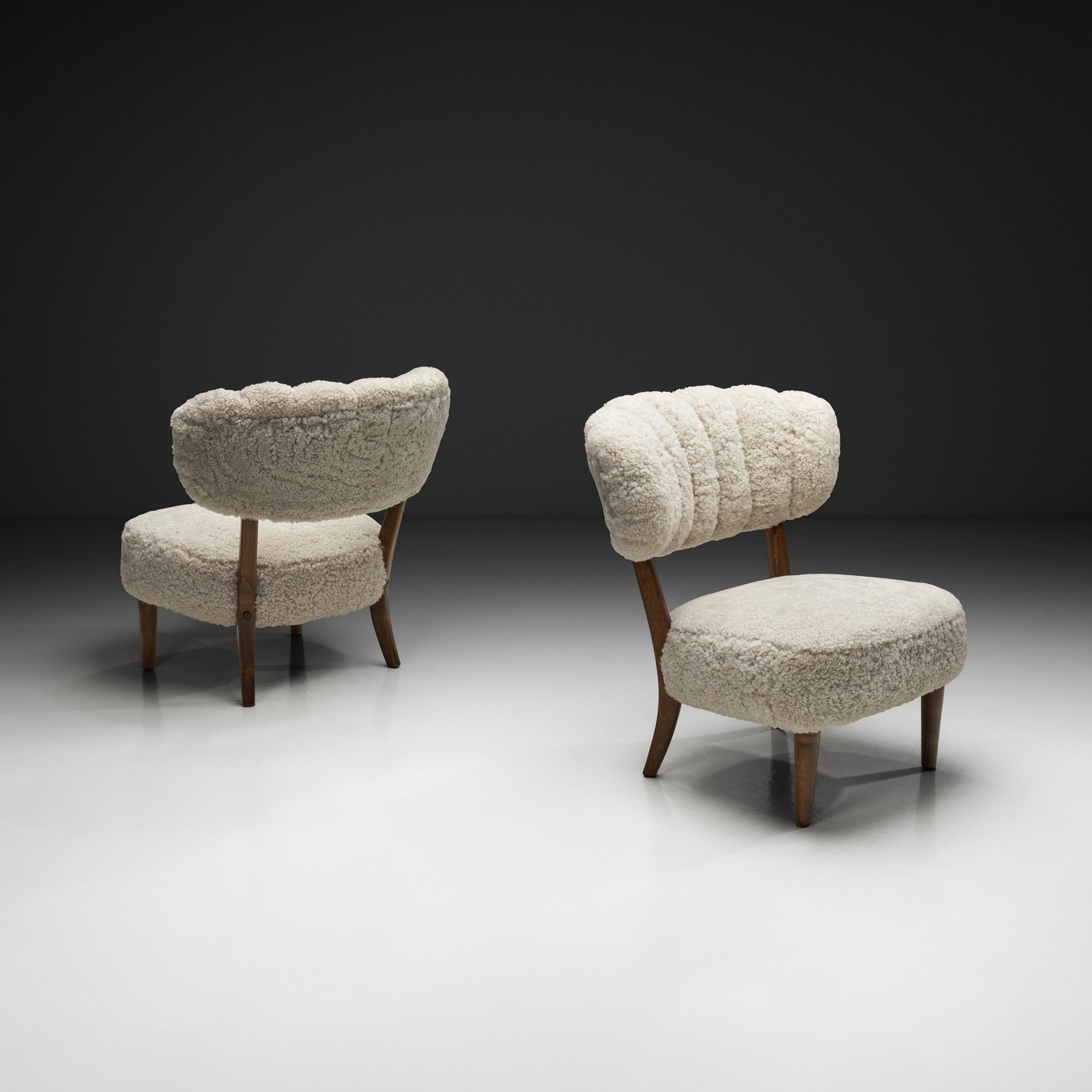
The 20th century saw the rise of brilliant designers, like Steen Østergaard, working to create furniture of the highest quality that explored truly modern shapes and forms. Østergaard sought to combine comfort and elegance to achieve timeless designs that remain iconic examples of style and skill to this day.
Immediately, these chairs captivate with their cosy and stylish silhouette. The shell bodies cradle the occupant, providing a sense of intimacy and comfort that transcends mere functionality. The mid-century modern aesthetic is elegantly expressed through clean lines and organic curves, creating a harmonious balance between form and function. The designer managed to create pieces that seamlessly integrate into contemporary living spaces while preserving the warmth and character of natural materials, ideals deeply rooted in the Danish tradition. The wooden frames of these chairs showcase the skillful artistry of Steen Østergaard. The tripod legs, with beautiful joinery, not only add a touch of sophistication but also exemplify the meticulous attention to detail and aesthetic balance. The upholstery of the pair further enhances the allure. Meticulously chosen fabrics not only contribute to the overall aesthetic appeal but also emphasise the commitment to creating pieces that age gracefully.
Danish modern chairs have not only stood the test of time but continue to inspire contemporary designers and homeowners worldwide. Their enduring popularity is a testament to the genius of Danish modern design, based on both form and function, resulting in pieces that are as comfortable as they are stylish.
Condition:
In good vintage condition. Wear consistent with age and use. The chairs have recently been reconditioned. Due to the age and nature of the materials, the chairs have minor scratches, dents, and discolouration. The chairs have recently been reupholstered in a premium fabric. Each of our items can be reupholstered by our in-house atelier in a fabric of choice. Please reach out for more information.
Dimensions:
27.2 in W x 22.8 in D x 25.8 in H; Seat height 14.4 in
69 cm W x 58 cm D x 65.5 cm H; Seat height 36.5 cm