
Folke Ohlsson "Frisco" Side Table for Tingströms, Sweden 1960s


Folke Ohlsson "Frisco" Side Table for Tingströms, Sweden 1960s
REQUEST PRICE HERE
Price category: 2,500 - 3,000 usd / eur
This side table is a classic piece of Scandinavian modern design, therefore it comes as no surprise that this model was awarded the Gold Medal at the California Fair in 1960. Folke Ohlsson was a decorated designer, he won a Gold Medal at the 1951 Milan Triennale and was given the Good Design Award by the Museum of Modern Art in New York. His furniture was also one of the first exhibits featured at Stanford’s art museum.
“Frisco” was part of the 'Bra Bohag' production from Tingströms Furnitures, Sweden. ‘Bra bohag’ means‘ good furniture in Swedish, and behind the expression was the lobby organization for better-designed everyday furniture for Swedish homes in the 1950-60s. It consisted of several furniture designers and producers, among them Tingströms AB. This solid wood model has a beautiful veneer that stands out thanks to the simple, uncluttered design. The top features a raised “lip” or edge, a playful and practical design element. Early in his design career Ohlsson almost exclusively designed in natural beech blond wood until critics quickly forced him to move to darker walnut and teak woods. This model was also influenced by this, breaking with the light Swedish modern aesthetic. However, the structure with stretchers set parallel on the legs is still very characteristic of Swedish mid-century modern design, not to mention the top quality.
Folke Ohlsson was one of the first Swedish designers who managed to bring “Swedish Modern” design to the United States’ market successfully. According to the story, when Ohlsson arrived in the United States, he took his suitcase and cardboard to hotels all over the country inviting salesmen, department stores, and decorators to view his miniature designs and watch as he disassembled and reassembled his chair design. He quickly became notorious for his patented “knock-down” construction that reduced shipping and storage costs and helped to make the Swedish company Dux a household name in the USA.
Condition:
In good vintage condition. Wear consistent with age and use.
Dimensions:
30.11 in W x 22.04 in D x 20.86 in H
76.5 cm W x 56 cm D x 53 cm H
About the designer:
Folke Ohlsson was a born in Malmö, Sweden in 1919 and died in Atherton California in 2003. Folke studied at the School of the Gothenburg Society of Industrial Design before he began working for the Swedish furniture and bedding manufacturer, Dux. In 1950, he moved to the United States with only a suitcase full of clothes and an exact miniature scaled model furniture of his own design. He also carried a cardboard that contained the broken-down components of one of his chairs.
Many other Swedish designers tried to bring “Swedish Modern” design to the United States market, most notably at the 1939 World’s Fair, but all doing so “haphazardly” Ohlsson once claimed in the Vestkusten newspaper. According to Ohlsson, when he arrived in the United States he took his suitcase and cardboard to hotels all over the country inviting salesmen, department stores, and decorators to view his miniature designs and watch as he disassembled and reassembled his chair. He quickly became notorious for his patented “knock-down” construction that reduced shipping and storage costs and helped to make Dux a household name in the USA. Early in his design career Ohlsson almost exclusively designed in natural beech blond wood until critics quickly forced him to move to darker walnut and teak woods.
At its peak production in 1955, the Dux line was sold in all 50 states including Alaska and Hawaii and grossed upwards of $1,000,000. Folke Ohlsson won a Gold Medal at the 1951 Milan Triennale and was given the Good Design Award by the Museum of Modern Art in New York. His furniture was one of the first exhibits featured at Stanford’s art museum. Ohlsson’s pioneering knock-down concept revolutionized furniture production and transportation and lead to the birth of global companies such as IKEA today.
REQUEST PRICE HERE
Price category: 12,500 - 15,000 usd / eur
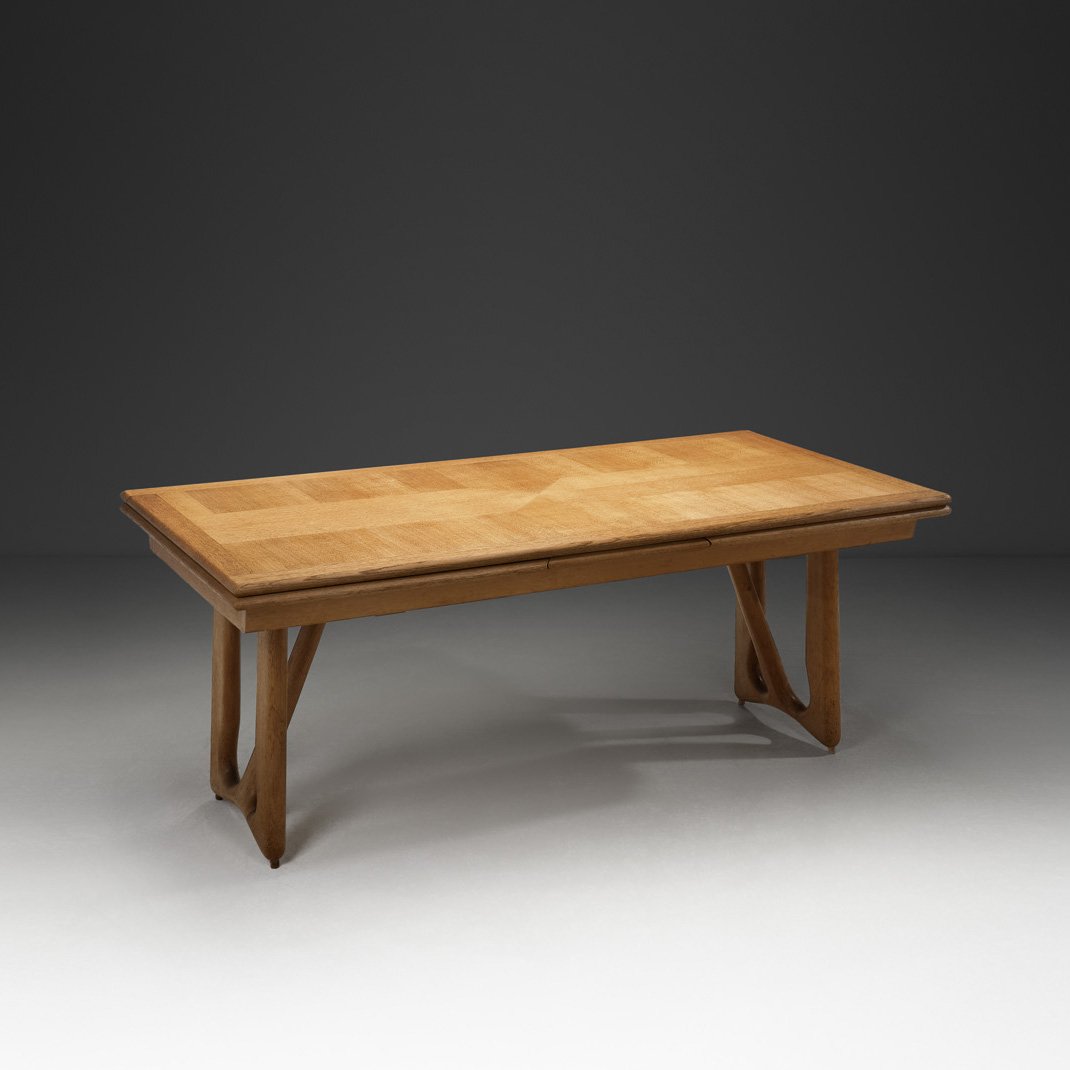
This stunning "L'Italienne" dining table, designed by the renowned French duo Guillerme et Chambron, showcases an exquisite blend of elegant aesthetics and rustic design elements. Crafted in the 1960s by Votre Maison, the table reminds us how form and elegance blend together in the duo's exceptional distinctive craftsmanship style.
At the heart of the construction of this model is the use of oak, a material renowned for its durability and timeless aesthetic qualities. Oak was the preferred material for Guillerme et Chambron, and this piece expertly showcases its rich and robust character, resulting in a solid, functional, and visually captivating work of art. Compared to the duo’s other models, this table is more pared down, relying mostly on the natural appeal of the oak, and its decorative legs. Unlike in most mid-century models, ornamentation was an important part of the duo’s creations, and while apparent, they were never overwhelming. This balance kept the pieces’ elegance, like in the case of this dining table. Furthermore, this piece is full of character and offers expressive and sculptural functionalism. Guillerme et Chambron’s table designs are well-known for their distinctive appearance and multi-functionality; this model is extendable and shows how decorative design and functionality were equally important for the designers, being as sensitive to the use of furniture in everyday life as to the creation of innovative design.
The table's form is clean, geometric, and is a testament to Guillerme et Chambron's dedication to modernism, while staying rooted in traditional craftsmanship and joinery techniques. Their work not only represents the fusion of function and form, but also exemplifies the mid-century modern aesthetic, which they played a pivotal role in actively shaping. Their emphasis on quality craftsmanship and the use of noble materials - like oak - has undeniably left a lasting imprint in the world of furniture making, solidifying their legacy in the French design landscape during the mid-century era.
Condition:
In good vintage condition. Wear consistent with age and use. The item has recently been reconditioned. Due to the nature and age of the wood, the item may have some marks, scratches, and discolouration.
Dimensions:
70.87 in W x 34.45 in D x 28.54 in H
180 cm W x 87.5 cm D x 72.5 cm H
REQUEST PRICE HERE
Price category: 12,500 - 15,000 usd / eur
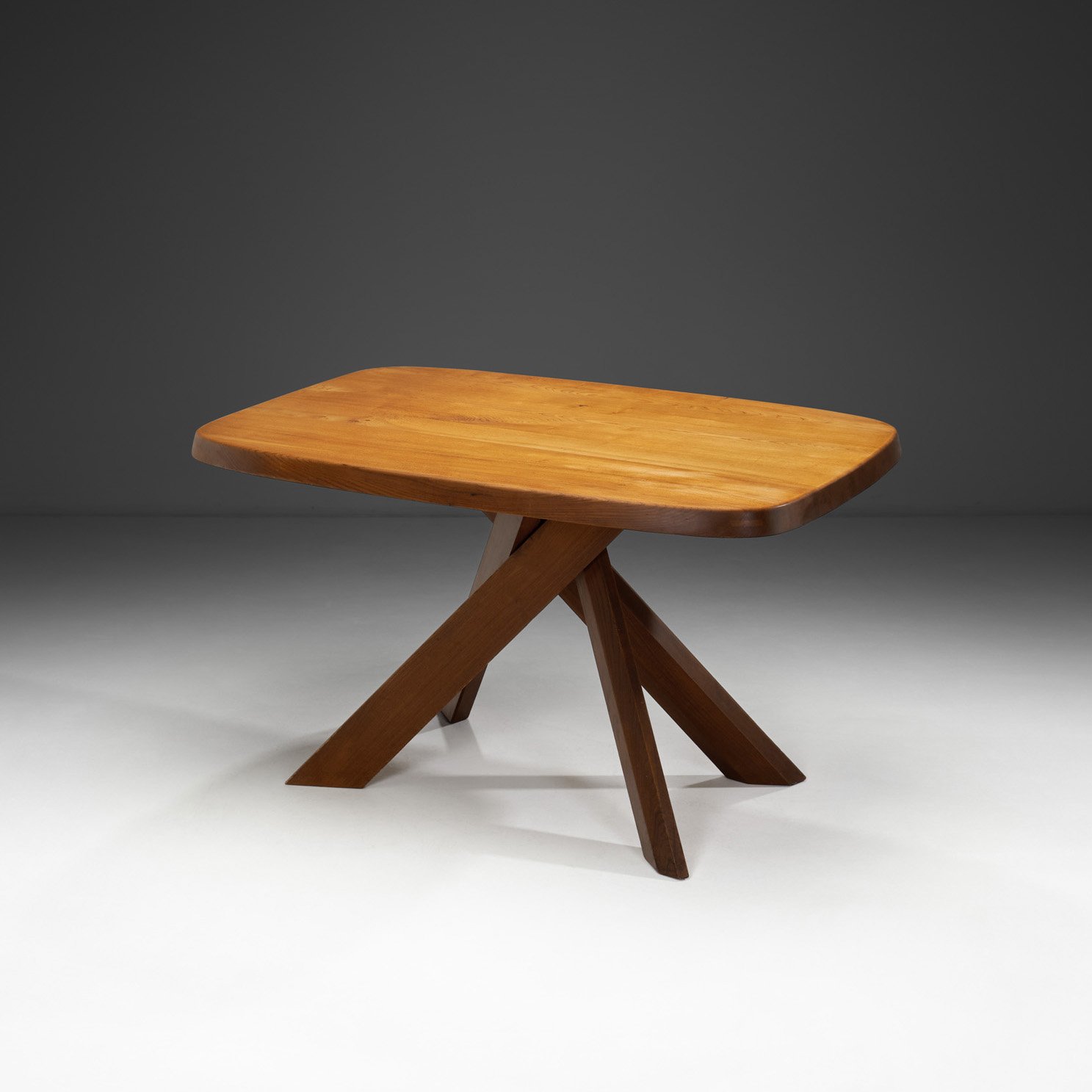
This dining table is a compelling embodiment of Pierre Chapo’s distinctive style. He always paired his creative and elegant designs with impeccable craftsmanship that gained him worldwide fame and love. This model “T35A” is a rare and beautiful example of Chapo’s designs, a piece that truly stands the test of time, bringing lasting form and quality to any interior.
Crafted entirely from solid elm, this dining table demonstrates exceptional craftsmanship and masterful joinery. Renowned for its striking grain patterns and long-lasting durability, elm is an ideal choice for larger pieces of furniture. This table’s vast flat surface, composed of carefully selected elm planks, beautifully highlights the wood's natural beauty, allowing the material to take center stage and speak for itself. The generous shape coupled with its warm honey tones, ensures that this table will be a focal point in any style of dining room or other large gathering area and is sure to be a conversation starter. The central quadripode base was designed with Chapo’s signature architectural legs, arranged in a dynamic way with the four pillars collapsing and balancing on each other at the same time, creating a striking visual rhythm.
Chapo’s designs reflect the architectural philosophies of Le Corbusier, as well as the commitment to the honest use of quality materials of Frank Lloyd Wright. His work is grounded in the simple harmony of form, function, and material, principles carried out in his works, enabling him to produce grand scale items, while preserving an underlying sense of warmth and simplicity. This dining table adds character to any interior with its uniquely structured leg composition, reflecting the influence of mid-century modernism.
Condition:
In good vintage condition. Wear consistent with age and use.
Dimensions:
50.19 in W x 32.67 in D x 28.74 in H
127.5 cm W x 83 cm D x 73 cm H

REQUEST PRICE HERE
Price category: 5,000 - 7,500 usd / eur
Firm believers in Functionalism, Danish designers and cabinetmakers avoided short-lived aesthetic trends, instead they concentrated on crafting with quality materials. This model "200" desk by Svend Aage Madsen is characterised by its functionalist design combined with a modern expression – the epitome of the Danish mid-century modern design philosophy.
With a clear statement of simplicity, quality and respect for materials, this table is a great example of Danish mid century design. The rectangular tabletop is made of wood, yet it maintains a light impression. The surface shows off the grain of the wood, including a beautiful colour variety ranging from light to dark brown. The tabletop also offers plenty of functional space with tapering sides and two drawers. This use of the drawers’ evidences the functionalist mindset that can be traced in almost every element of the lower structure. The warm, honey tone of the wood further enhances its sculptural simplicity, capturing the sense of connection to nature that defined Scandinavian design of the 20th century.
This model “200” desk preserves the value and beauty of master craftsmanship and exquisite materials. Danish designers like Svend Aage Madsen were and still are world-renowned for their unmatched skill that distinguishes mid-century furniture.
Condition:
In good vintage condition. Wear consistent with age and use. The item has recently been reconditioned. Due to the nature and age of the wood, the item may have some marks, scratches, and discolouration.
Dimensions:
40.95 in W x 27.55 in D x 30.31 in H
104 cm W x 70 cm D x 77 cm H

REQUEST PRICE HERE
Price category: 5,000 - 7,500 usd / eur
The period between 1950 and 1970 was characterised by some of the most stunning and well-executed furniture designs of the 20th century. As with the UK and much of Europe, there was something of a design renaissance in France in the 1950s, due to developments in materials and technology after the war. In France, designers were often also architects, whose focus on functionality and quality resulted in pieces such as this stunning dining table.
This model is all about the gorgeous wooden structure. The discreet joinery and seamless construction reflect the French emphasis on detail and quality, elevating the piece beyond just functional to an object of aesthetic value. The design is dominated by the rectangular tabletop; it features a rich, dark wood veneer that showcases the grain and deep tones of the wood, which can add a sense of warmth and sophistication to any dining space. To support the top are four legs with impeccable joinery that is visible under the tabletop. Since this piece was made in the heyday of mid-century design, the legs - and the table as a whole - lack heavy ornamentation, and instead the focus is on the beauty of the material. The mid-century pieces that appeal to most are the models that were designed with both nature and function in mind, which appear completely contemporary and undated, making this dark wood dining table an exceptional example of the ideals of the era. Overall, the clean lines and balanced proportions create a streamlined silhouette, while the dark finish lends a timeless quality that complements both classic and contemporary interiors.
Wood has never gone out of style, and interior design with an emphasis on natural materials is only gaining popularity today. This dining table will make a striking addition to a variety of interiors.
Condition:
In good vintage condition. Wear consistent with age and use.
Dimensions:
66.93 in W x 33.46 in D x 29.92 in H
170 cm W x 85 cm D x 76 cm H

REQUEST PRICE HERE
Price category: 2,500 - 5,000 usd / eur
This extraordinary sculptural round dining table has strong lines and proportions and was made in very small numbers.
The table consists of eight beech elements that have a petal like shape. The elements are connected with eight black metal round inlays to which the eight legs are connected at the bottom side. This table is the luxury model that holds a "Lazy Susan" (turntable) in the middle; the large black lacquered metal disc in the centre runs on ball bearings and is rotatable so that you can, for example, share food without having to rise. The slender cylindrical legs are made out of black lacquered metal with tapered solid beech feet.
Manufactured and marked by Nissen, Langå Denmark.
Condition:
In good vintage condition. Wear consistent with age and use. Item has some small marks and scratches. The table can be purchased with two additional legs.
Dimensions:
53.54 in Ø x 29.33 in H
136 cm Ø x 74.5 cm H

REQUEST PRICE HERE
Price category: 7,500 - 10,000 usd / eur
This rare “AT-309” dining table was designed by Hans Wegner in 1955 and its title of ‘iconic’ is well deserved. As it is no longer produced, this model has become a collector’s item created by a designer who is credited as one of the main driving forces of the mid-century Danish modern movement.
The “AT-309” model is also commonly referred to as the “saw-horse” for its trestle base. In woodworking, a saw-horse is a trestle structure used to support a board similarly to this model’s case. While Hans J. Wegner became world-renowned for his chairs, he also designed a broad range of tables, where he was just as thorough and artistic about the proportions, construction, function, and style. With a clear statement of simplicity, quality and respect for materials, this table is a great example of Danish Modern design. The massive teak tabletop with drop-leafs is stunning on its own, showcasing the wood’s grain and offering plenty of space with the extendable solution. However, to Wegner, the most important part of his tables was not the top, but rather what was underneath. For the supporting structure he used the distinctive saw-horse look with crossed legs and brass braces. The diagonal brass reinforcement is not only a significant structural feature, it is also a visually appealing detail that gives character to this dining table. Looking beneath the top, the elaborate oak structure becomes visible, showing both Wegner’s and the manufacturer’s expert skill and knowledge.
Over the course of his career, the designer collaborated with several renowned manufacturers, including Andreas Tuck. The company was one of the greatest Danish furniture design companies of the mid-20th century, producing pieces that epitomize classic Danish craftsmanship. Wegner worked with the company for many years, creating iconic designs such as this “AT-309” table.
Condition:
In good vintage condition. Wear consistent with age and use. The tabletop has been refinished.
Dimensions:
51.96 in W (89.76 in when extended) x 33.66 in D x 28.14 in H
132 cm W (228 cm when extended) x 85.5 cm D x 71.5 cm H
About the designer:
Hans Wegner (1914–2007) is considered as one of the most influential designers of Scandinavian design. Danish-born Wegner became a national and international design idol for shaping the history of design in the 1950s and ‘60s.
In his designs, the sharp edges defining Modernism were smoothened, creating his iconic chairs. As a pioneer of the modernist style, often described as “organic functionality”, Wegner described his method as “stripping the old chairs of their outer style and letting them appear in their pure construction.”.
At 14 years old, he began his apprenticeship with Danish master cabinetmaker H. F. Stahlberg. After serving in the military he moved to Copenhagen, and attended the School of Arts and Crafts, before setting out as a furniture designer. In 1943, he established his own studio, producing designs for manufacturers like AP Stolen, Fredericia Stolefabrik, and in later years, PP Møbler.
Wegner designed more than 500 chairs in his lifetime, refining an approach that combined a variety of natural materials and pushed traditional joinery techniques to extreme tolerances and distillations. Wegner’s background as a cabinetmaker gave him a deep understanding of how to integrate exacting joinery techniques with exquisite form, realizing the perfect combination with form and purpose.
The core of Wegner’s legacy remains his focus on showing the inner soul of furniture pieces through a simple and functional exterior. ~H.

REQUEST PRICE HERE
Price category: 2,500 - 5,000 usd / eur
Firm believers in Functionalism, Danish designers and cabinetmakers avoided short-lived aesthetic trends alike, concentrating on crafting with quality materials instead. This desk is characterized by its functionalist design combined with a modern expression – the epitome of Danish mid-century modern design philosophy.
Danish cabinetmakers were just as thorough and artistic about the proportions, the construction, the function, and about the style. With a clear statement of simplicity, quality and respect for materials, this table is a great example of Danish Modern design. The structure is composed of oak with a gorgeous grain and colour. The tabletop offers plenty of functional space with tapering sides and two drawers with two compartments that can be opened from both sides. This feature of the drawers’ evidences the functionalist mindset that can be traced in almost every element of the lower structure. The slanted support braces are attached to the top and to the side stretchers that are placed at the middle of the legs. As a result, the sleek tapered legs stand out, creating a stylish, light look. Cabinetmakers were masters of creating light looking designs from solid wood, showcasing their mastery.
The functional elements aiding stability and utilitarian use also serve an aesthetic role, adding to the clean, architectural precision of this desk. From the teak top to the oak lower structure, each element shows the manufacturer’s expert skill and knowledge in woodworking.
Condition:
In good vintage condition. Wear consistent with age and use.
Dimensions:
62.99 in W x 31.49 in D x 28.54 in H
160 cm W x 80 cm D x 72.5 cm H

REQUEST PRICE HERE
Price category: 2,500 - 5,000 usd / eur
The materials and techniques used by mid-century French cabinetmakers were directly derived from the possibilities offered by industrial production at the time. Oak has never gone out of style, and pieces with an emphasis on the unfinished or natural look are once again gaining popularity today. This desk is an example of a piece that is equally striking standing alone, or as part of an interior with a medley of styles.
The design of this table model boasts an ingeniously functional and well-thought-out structure, crafted from quality limed oak. It holds a natural expression with its airy design, which is dominated by the beauty of the material. The use of liming was traditionally used to highlight the natural grain of the oak, while also creating a protective layer that would prevent the wood from absorbing dirt and moisture. Unlike traditional paint that leaves a topical plastic finish on top of wood, lime wash absorbs into the wood, leaving a natural contour. Limed oak furniture is often seen as a classic and timeless design element that can add a touch of elegance and sophistication to any space. The wide top is rectangular, with sharp edges, and showcases the limed oak’s beautiful pattern, reinforcing a modernistic look with a rustic feel. The legs are gently tapered and tilted to support stability. The design of this table recalls the works of French designer René Gabriel, whereby the sobriety of his furniture is still a source of inspiration today.
The imperfections of the wood and the simple, functional design makes this table stand out with a timeless appeal. Its light colour makes it easy to adapt to almost any interior, and the design is perfect to add that coveted mid-century flair.
Condition:
In good vintage condition. Wear consistent with age and use.
Dimensions:
51.18 in W x 28.35 in D x 30.32 in H
130 cm W x 72 cm D x 77 cm H

REQUEST PRICE HERE
Price category: 2,500 - 5,000 usd / eur
This oak and teak “AT-312” dining table was designed by Hans Wegner in the 1950s and its title of ‘iconic’ is well deserved. Created by a designer who is credited as one of the main driving forces of the mid-century Danish modern movement, this table is the epitome of functional modernity.
While Hans J. Wegner became world-renowned for his chairs, he also designed a broad range of tables, where he was just as thorough and artistic about the proportions, construction, function, and style. With a clear statement of simplicity, quality and respect for materials, this table is a great example of Danish Modern design, and is a reference in Scandinavian table design on a broader scale. The design of this table model boasts an ingeniously functional and well-thought-out structure crafted from quality wood. Two pull-out leaves “hide” under the teak top and integrate beautifully with it until extended; not only is this a highly functional solution, it also contributes to delineate the characteristic profile of the design. The extension mechanism also serves as a decorative element, which shows why Wegner is in many ways in his own league in Danish Modern design. The massive teak tabletop with drop-leafs is stunning on its own, showcasing the wood’s grain and offering plenty of space even without the extensions. The lower oak structure received just as much attention with elegant slim legs that are slightly tapered and splayed, balancing the large rectangular top.
Looking beneath the top is also a special experience, the elaborate oak structure becomes visible, showing both Wegner’s and the manufacturer’s expert skill and knowledge. Andreas Tuck created several of Wegner’s table models, but the company closed down in 1972, making original models such as this table collectors’ pieces. This table is stamped: “Fabrikat: Andr Tuck Arkitekt: Hans J Wegner Denmark”.
Condition:
In good vintage condition. Wear consistent with age and use. Some marks and scratches.
Dimensions:
94.48 in W (when extended) x 35.43 in D x 28.34 in H
240 cm W (when extended) x 90 cm D x 72 cm H
About the designer:
Hans Wegner (1914–2007) is considered as one of the most influential designers of Scandinavian design. Danish-born Wegner became a national and international design idol for shaping the history of design in the 1950s and ‘60s.
In his designs, the sharp edges defining Modernism were smoothened, creating his iconic chairs. As a pioneer of the modernist style, often described as “organic functionality”, Wegner described his method as “stripping the old chairs of their outer style and letting them appear in their pure construction.”.
At 14 years old, he began his apprenticeship with Danish master cabinetmaker H. F. Stahlberg. After serving in the military he moved to Copenhagen, and attended the School of Arts and Crafts, before setting out as a furniture designer. In 1943, he established his own studio, producing designs for manufacturers like AP Stolen, Fredericia Stolefabrik, and in later years, PP Møbler.
Wegner designed more than 500 chairs in his lifetime, refining an approach that combined a variety of natural materials and pushed traditional joinery techniques to extreme tolerances and distillations. Wegner’s background as a cabinetmaker gave him a deep understanding of how to integrate exacting joinery techniques with exquisite form, realizing the perfect combination with form and purpose.
The core of Wegner’s legacy remains his focus on showing the inner soul of furniture pieces through a simple and functional exterior. ~H.

REQUEST PRICE HERE
Price category: 2,500 - 5,000 usd / eur
The “C35 FDB” table series was designed by Poul M. Volther in 1957 for Danish Furniture co-operative FDB. The company, FDB Møbler was founded in 1942 with architect, Børge Mogensen heading the studio. According to their philosophy, every new piece of FDB Møbler is born as an heirloom. This ash dining table is no exception.
First trained as a cabinetmaker, Poul Volther studied furniture design at the Arts and Crafts School in Copenhagen. A believer in Functionalism, he avoided short-lived aesthetic trends, concentrating on the simple crafting with quality materials. This dining table is characterized by its functionalism combined with a modern expression – the epitome of FDB Furniture’s design philosophy. The table frame is made of solid ash wood, which has a light shade and spectacular pattern. However, this model’s standout feature is definitely its large, green laminated top. This rectangular inlay is framed by the ash frame. The legs of the table slope slightly outward, providing optimal legroom and a more stable surface. The lower structure also features stretchers and cross railing, assuring structural stability. These elements also serve an aesthetic role, adding to the clean, architectural precision of the table.
FD Møbler’s philosophy was focused on creating beautiful, functional and exceptionally crafted furniture that makes room for everyday living at home and can withstand everyday wear and tear to age gracefully with those who use them. Accordingly, this C35 table perfectly complements different interiors and styles with its classic, quality design. Today it remains as contemporary as it was 60 years ago.
Condition:
In good vintage condition. Wear consistent with age and use. The top has some scratches and marks of wear.
Dimensions:
70.86 in W x 35.43 in D x 28.74 in H
180 cm W x 90 cm D x 73 cm H
About the designer:
Born in 1923, designer Poul M. Volther belonged to a generation of Danish creatives rooted in Scandinavian functionalism. Volther’s work is characterized by a mastery of form, as evidenced by his iconic EJ5 Corona Chair for Erik Jørgensen (1961/64). Highly collectible today, this singular piece has left an indelible mark on design history.
Volther originally trained as a cabinetmaker before studying at the Royal Danish Academy School of Arts & Crafts in Copenhagen. Over the years, Volther also taught at the Royal Danish Academy School of Design, influencing hundreds of young designers along the way. In 1949, legendary architect-designer Hans Wegner introduced Volther to the FBD, a Danish national cooperative association for producers of consumer goods. There, Volther worked under another Danish design great, Børge Mogensen, and went on to become FDB’s design director when Mogensen left in 1959. During his tenure at FDB, Volther created a range of chairs and sofas that can still be found in homes across Denmark.
In 1962, Volther found a partner in the then-new furniture manufacturer Erik Jørgensen. The company agreed to produce the Corona Chair with a chrome-plated steel frame. Despite the investment, this chair would not find a significant audience until 1997, when Erik Jørgensen re-launched it at the Cologne Furniture Fair in Germany, followed by the Scandinavian Furniture Fair in Denmark. One year after Volther’s death in 2001, the chair was used at the EU Summit in Copenhagen.
Volther’s designs have been produced by many design companies, such as Munch Furniture and Frem Røjle. However, his Corona Chair is considered his most memorable design contribution. It’s been featured in countless movies, fashion shoots, and music videos. ~H.

REQUEST PRICE HERE
Price category: 1,000 - 2,500 usd / eur
This gorgeous extendable dining table model by the Danish furniture maker, Bernhard Pedersen og Søn was inspired by classic Danish furniture design and simplicity. The period between 1950 and 1970 in particular was characterized by some of the most stunning and well-executed pieces in the company’s history, including this table.
This elegant dining table features two large leaves, stored underneath the tabletop, that slide out and allow the table to be easily extended to accommodate extra diners. This clever design element makes the table not only greatly functional, it is also a design element that is aesthetically pleasing. When extended, the veneered exotic wood becomes visible with a much darker colour and distinct pattern variation. The gently rounded edges complement the display of the patterns, while also providing contrast to the sleek, tapered legs. However, the most interesting part of the design remains invisible as it is right under the tabletop. The metal rods and the elaborate wooden system that allows the top to almost double in size shows why many of the era’s most renowned Danish designers worked together with Bernhard Pedersen & Son. The family owned furniture maker has had an exceptionally strong tradition in high quality cabinetmaking since their start in 1902.
This dining table has the characteristics of the prized Scandinavian idea of “honest” design that Bernhard Pedersen and Son is also known for. The sleek look resulting from the clean lines, functional design and expert craftsmanship makes this table a perfect functional piece and stylish addition to any dining area.
Condition:
In good vintage condition. Wear consistent with age and use.
Dimensions:
55.11 in W x 37.4 in D x 28.85 in H
140 cm W x 95 cm D x 73.3 cm H
About the designer:
Bernhard Pedersen & Søn, is a Danish furniture maker company with a long and strong tradition in furniture and cabinetmaking, stretching all the way back to the company’s start in 1902. Through three generations the family firm has created and sold classic Danish furniture to many parts of the world.
The period between 1950 and 1970 in particular was characterized by some of the most stunning and well-executed pieces in Bernh. Pedersen & Søn’s history. Especially the classic mid-century sideboards and daybeds designed by Danish furniture designers, including the world-renowned Johannes Andersen, Svend Aage Madsen and Kurt Østervig who were – and still are – highly valued by customers worldwide.
Every piece of furniture is made in the same factory that was built by the Bernhard Pedersen family in 1902, located in a small community in the Danish countryside. The workshop and its skilled cabinetmakers are known for their exquisite and dedicated work based on strong Danish craft traditions; traditions recognized around the world for timeless design, high-quality craftsmanship and outstanding longevity. Unique techniques, special tools and original machinery are maintained and used to produce the sideboards in keeping with the first original pieces. The sum of it all is captured in the phrase: Made in Denmark.
Today, the fourth generation in the family, Thomas Bernhard Pedersen is focusing on an exclusive selection of the company’s most exquisite sideboards designed by Danish furniture designers, including the world-renowned architect Johannes Andersen. Every piece of furniture is made in Denmark by skilled cabinetmakers and in keeping with the strong Danish craft traditions. In 2015, great-grandson Thomas Bernhard Pedersen re-established the company and started focusing exclusively on relaunching some of the exquisite furniture designed in the 1950s and 1960s. ~H.
REQUEST PRICE HERE
Price category: 7,500 - 10,000 usd / eur
A drafting table or architect's table is, in its antique form, a kind of multipurpose desk which can be used for any kind of drawing, writing or impromptu sketching or for drafting technical illustrations. Many designs from the mid-century period adopted an almost structural logic, reflecting a broader interest in honest materials and visible craftsmanship, where the making of the object was never concealed but instead highlighted as an integral part of the design.
This worktop desk was made in France around the 1960s. It embodies rustic modernism and brutalist aesthetics through the robust yet carefully considered construction. The solid oak top is thick and slightly contoured, with softened edges that introduce a subtle organic quality to an otherwise rectilinear form, and an ergonomic cutout. Beneath, the base is composed of vertical supports connected by horizontal stretchers, creating a grounded structure. The architectural portico base is connected by solid crossbeams, where the joinery is clearly expressed, each connection contributing to both the strength and the visual identity of the piece. This detail is a testament to the high level of craftsmanship and brutalist influences. At the same time, the open space between these elements ensures that the design does not feel heavy, despite the mass of the material. The natural grain of the oak remains visible across all surfaces, adding depth to the otherwise restrained composition.
This desk maintains a strong presence rooted in its quality, but most of all, it represents a deeply functional piece of furniture. It balance of weight and refinement makes it perfect to serve a practical but elegant workspace.
Condition:
In good vintage condition. Wear consistent with age and use. The desk has recently been reconditioned and showcases a beautiful grain pattern. Due to the nature and age of the wood, the item has minor marks and scratches, and may show slight discolouration.
Dimensions:
49.40 in W × 32.67 in D × 30.31 in H
125.5 cm W x 83 cm D x 77 cm H