
European Artisan Coffee Table with Carved Legs, Euope first half of the 20th century (sold)





European Artisan Coffee Table with Carved Legs, Euope first half of the 20th century (sold)
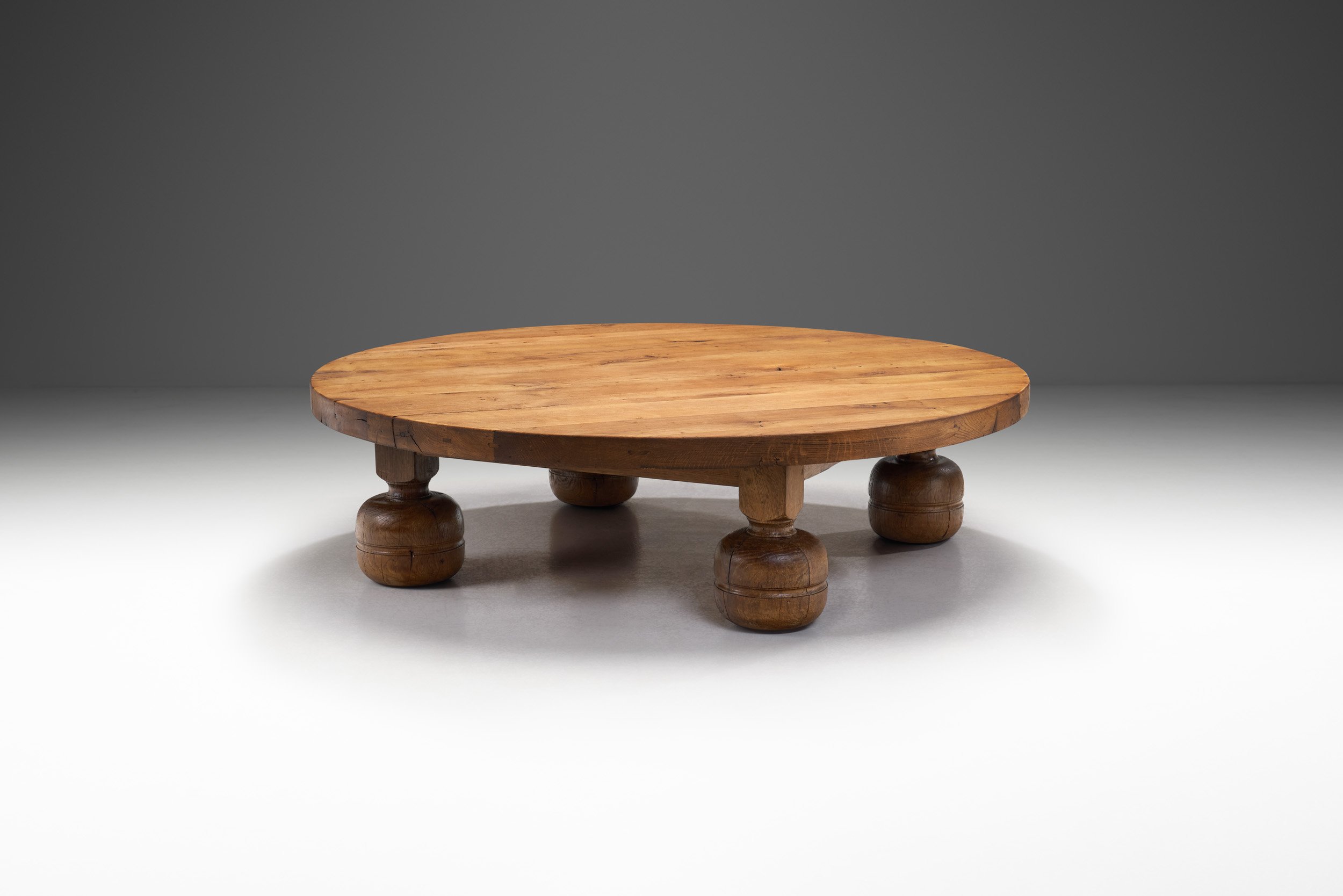
In European mid-century design, there are some common elements that define the continent’s furniture design of the era. Most importantly, there was an early emphasis on wood as it connected everyday objects, such as furniture, to nature. This beautiful, solid wood coffee table is a perfect example of this sentiment, and the visual benefits of understated, uncluttered design.
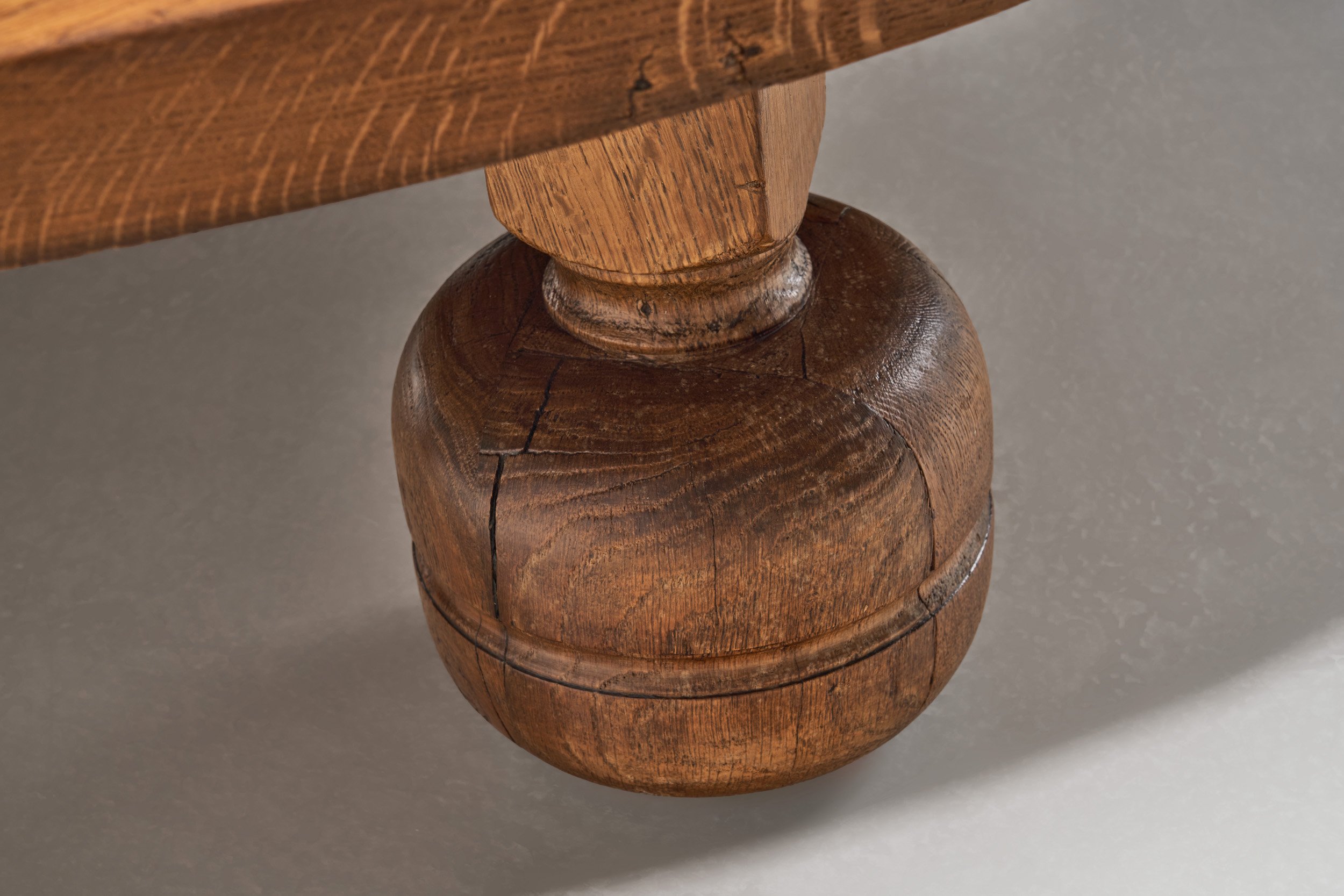
The 20th century’s design movements represented a break with the traditional past: design-wise, furnishings were often a rejection of Victorian, Colonial, and other historical influences, especially the pseudo-historical use of ornamentation. In comparison, furniture from after the ARt Deco era is generally more pared-down and uncluttered with unnecessary ornament: on this front, the movement shared qualities with the efforts of the Bauhaus designers’ vehement rejection of ornamentation. This coffee table has a strong elemental feel to it, which is a result of its thick round tabletop and unique, eye-catching carved legs. The focus is on the material, letting the beautiful qualities of the wood stand out. The top is composed of individual planks, therefore the wood’s versatility is fully shown off. The colour variations, grains, and patterns decorate the surface, creating a strong organic impression. The main decorative element, however, are the carved legs and feet. The straight lines of the legs end in spherical feet with a deeply carved ring on each one. As there are strong and distinctive details, this model is a perfect accent table, while also being capable to complement its surroundings. It could fit well in an organically styled interior, as well as in a minimalist space.
The simple design serves the purpose of showing the understated, natural beauty of the wood and the legs and feet. The decorative elements are apparent yet not over the top, which is also where the appeal lies. This table is a beautiful example of traditional woodworking’s endless possibilities under the hands of an artisan craftsman.
SOLD
Condition:
In good vintage condition. Wear consistent with age and use. Some marks and cracks on the patinated wood.
Dimensions:
54.33 in ⌀ x 14.96 in H
138 cm ⌀ x 38 cm H

REQUEST PRICE HERE
Price category: 40,000 - 50,000 usd / eur
This peculiar “T22” table model is also referred to as the “Eye”. While the name needs no further explanation, the ingenious design certainly does. Pierre Chapo always paired his creative and elegant designs with impeccable craftsmanship that gained him worldwide fame and love.
The “T22” is formed by two arcs, each resting on three cylindrical leg and a central oval module attached to one of the arcs by a sliding system. Placed together, the design forms an “eye”. Not a lot of designs receive a nickname by which they are immediately recognised, but this table is one of those. With its distinctive structure, it epitomises Chapo's research for new systems of joinery, in which the material and the design would be the lead factors in achieving stability, durability, and of course, an aesthetically pleasing outcome. Here, the smaller middle module can be adjusted or removed freely, allowing the table’s modules to be arranged in a variety of ways, for example, it can also be arranged to form a long undulating console. The immense functionality is accompanied by Chapo’s precise joinery techniques and woodworking. Pierre Chapo worked largely in elm wood and has a couple of signature design elements like the visible spline joint and the cylindrical legs as seen here as well. The solid elm has a stunning grain and various patterns that especially stand out on the curvatures of the table.
Chapo’s organic approach to arts and crafts and both designers resisted the stark industrial look that was dominant in the post-war period under the influence of socialism. This coffee table is undoubtedly an emblematic model of post-war French decorative arts and design.
Condition:
In good vintage condition. Wear consistent with age and use. Some small marks. The elm wood has a beautiful patina. Due to the nature and age of the material, the item may have some additional scratches, and discolouration.
Dimensions:
69.48 in W x 51.18 in D x 12.99 in H
176.5 cm W x 130 cm D x 33 cm H
About the designer:
Pierre Chapo, born in Paris in July 1927, was initially interested in becoming a professional painter. However, after a chance meeting with a shipbuilder who introduced him to wood and wood crafts, Chapo changed his focus and decided to study architectural studies at the prestigious École Nationale Supérieure des Beaux-Arts in Paris.
After graduation, Chapo and his wife, the sculptor, and painter Nicole Lormier, started to travel extensively through Scandinavia and Central America. Among the many places the couple visited was the home and studio of Frank Lloyd Wright in Taliesin West. A visit that had a lasting influence on Chapo’s future work and designs. Read more about Pierre Chapo. ~H.

REQUEST PRICE HERE
Price category: 2,500 - 5,000 usd / eur
This coffee table is a stunning example of Modernism in design: clear forms without exaggeration with the high-quality work of a Danish cabinetmaker. Humble in its material and size, this table still draws attention thanks to its distinctive look and personality.
Early on, many of the Danish cabinetmakers’ workshops had been producing historical furniture; master cabinetmakers had been renowned for their solid wooden furniture rendered in various styles of the past. This coffee table, while not specifically historical in style, shows some restrained decorative elements that are generally rather sparse in Scandinavian mid-century furniture. However, accordingly to the design ideals of Danish designers, the scalloping pattern is not overwhelming the table, nor does it demand attention, rather, it is an understated but clever addition to the design. The scalloped patterns on the tabletop and legs differ slightly; the scallops on the legs are more pronounced with straight lines between each scallop, while under the tabletop, it is in a more traditional, round shape.
The wavy effect is even more pronounced thanks to the beautiful grain and colour of the solid oak that is most apparent on the wide, circular top. As it can be expected from Danish design and craftsmanship, visually appealing elements usually serve a functional role as well. In this case, the wooden elements under the table reinforce the stability of the structure in this ingenious manner.
Condition:
In good vintage condition. Wear consistent with age and use. Due to the nature and age of the material, the item may have some marks, scratches, and discolouration.
Dimensions:
35.03 in W x 35.03 in D x 22.04 in H
89 cm W x 89 cm D x 56 cm H
About the Designer:
The practical and comfortable designs of Danish cabinetmakers defined mid-20th century modern seating. The Danish Cabinetmakers focused on minimalist design executed by expertly skilled craftsmen.
Works from the Danish Cabinetmakers' Guild is a concept of its own in collectible design. The Cabinet-Makers' Guild began annual exhibitions in 1927 in Copenhagen. The group formed an exhibit showing each year in October the quality furniture made to drawings by gifted architects. The exhibition took place each year, without interruption, for forty years. A number of successful Danish Design collaborations were formed during this time between cabinetmakers and architects.
Danish Modernism has influenced Scandinavian furniture to a great degree, defined by minimalism, simplicity, and functionality. The muted colours and gentle designs make Danish mid-century furniture an ideal addition to contemporary living spaces. Additionally, master cabinetmakers were highly aware of body proportions, prioritizing comfort just as much as the visual qualities.
The works of master cabinetmakers – such as this chair – are of the highest quality, both in terms of materials and craftsmanship. Cabinetmakers take the art of working with wood one step further, and focus on the finer details of what can be created with the material. Therefore, it comes as no surprise that numerous master cabinetmakers are part of the renowned Danish Culture Canon (Danish: Kulturkanonen). The canon contains no more than 108 works of cultural excellence, based on works with a useful function and that are still recognisable today. These lounge chairs are the perfect illustrations of Danish design, and the work of a true cabinetmaker. ~H.
REQUEST PRICE HERE
Price category: 2,500 - 5,000 usd / eur
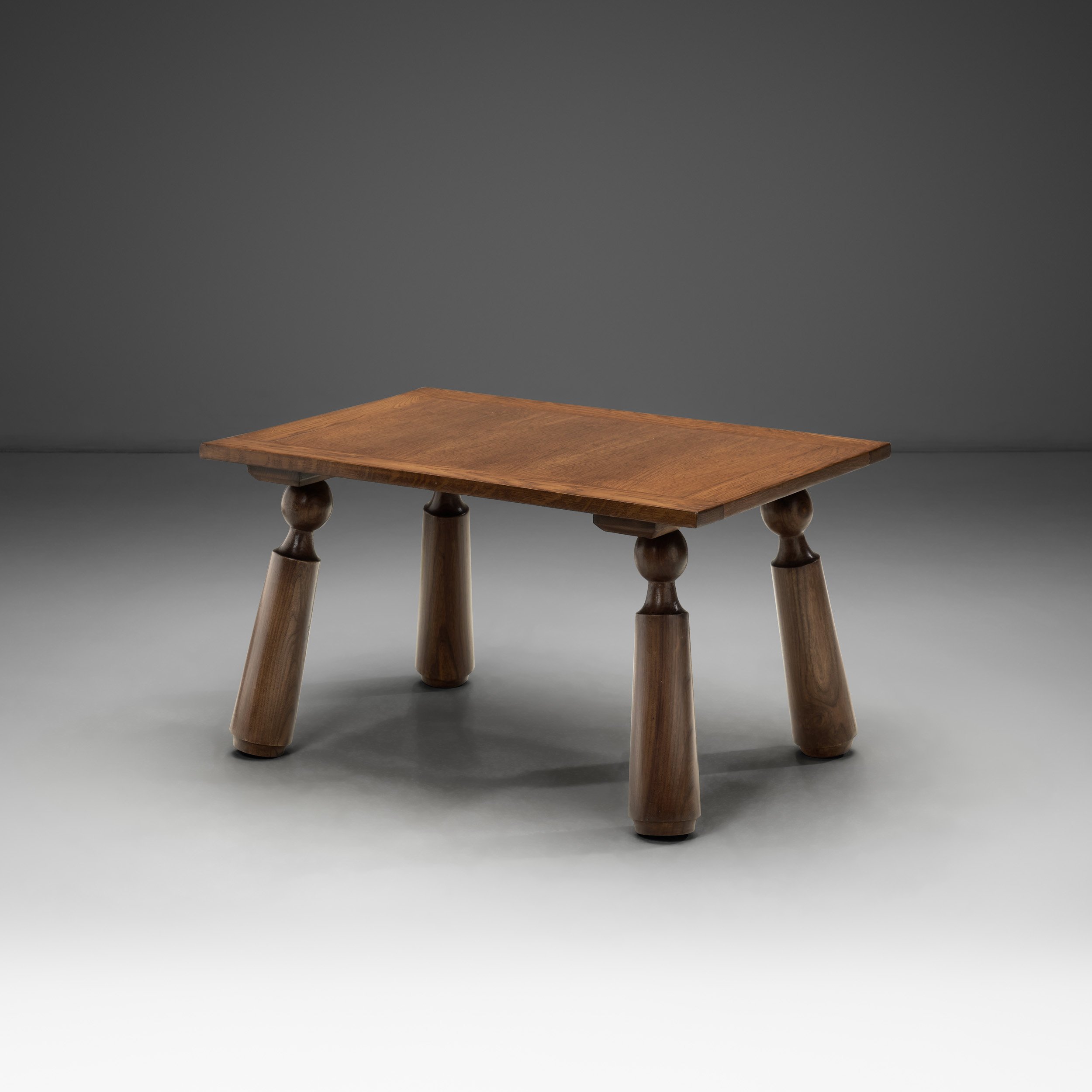
This wooden coffee table, crafted in France in the first half of the 20th century, is designed in the manner of Charles Dudouyt, one of the most distinctive figures in French decorative arts of the interwar period. Dudouyt’s work is often celebrated for its rustic charm, and masterful handling of wood, bridging tradition with the evolving aesthetics of Art Deco and modern design.
This table embodies those qualities through its sculptural presence and confident use of material. The piece is defined by its sturdy rectangular top and striking turned legs, which taper outward with bold, geometric proportions. Each leg features carved and rounded detailing, lending rhythm and visual weight to the structure. This play between solidity and ornamentation is characteristic of French designs of the era, where pieces were not only functional but also a statement of craftsmanship and artistic individuality. The warm stain of the wood enhances the visual richness of the table, highlighting its grain and natural imperfections. Its compact scale makes it ideal for daily use, while not overpowering a room. At the same time, the architectural quality of the legs gives it a charmingly unique character that anchors a space.
The essence of early 20th century French design is beautifully captured by this table. Functional yet sculptural, rustic yet refined, this piece stands as an enduring testament of the striking balance only master woodworkers are able to create.
Condition:
In good vintage condition. Wear consistent with age and use. The surface of the wood has been refurbished. Item may have some marks, scratches, and discolouration.
Dimensions:
31.29 in W x 21.45 in D x 17.71 in H
79.5 cm W x 54.5 cm D x 45 cm H

REQUEST PRICE HERE
Price category: 2,500 - 5,000 usd / eur
Danish design is known for its meticulous balance of classic and timeless appearance. This coffee table showcases exactly that - the top with a beautiful design reflecting an enduring appeal, together with the combination of the traditional arrangement of the legs. The work of Søren Jean Larsen displays excellent craftsmanship, with his ability to balance out heavy materials that in the end display a serene and light vision.
Hemmed around by a beautiful oak border, at the heart of the piece lies its true charismatic point: a circular stoneware inlay, composed of glazed ceramic tiles. Contributing to its organic look, the unique tabletop features abstract forms shimmering in earthy tones of deep olive green, amber, and hazelnut colours, all adding to the warm, autumnal atmosphere of the table. The asymmetry of the forms becomes apparent in the varying shades and textures of the inlay, the contrast of materials creating visual interest and a striking, unique character. While somewhat abstract, the conscious placement of the ceramic pieces is palpable in the composition of the colours and forms. The swirls of the glazed ceramic are especially visible with the amber colours emerging from the centre outwards. Underneath the top, the weight of the table is balanced out in four, slightly inward-tilted legs that end in a stable and distinctive X-shape. The construction of the frame, made of solid oak, demonstrates a lovely grain within the wood that has aged beautifully.
This table by Søren Jean Larsen is a distinguished example of Scandinavian design, perfect for both modern and eclectic interiors with a strong emphasis on practicality as well as exceptional craftsmanship. Its durable stoneware top ensures longevity as does its solid wood structure, making sure to lighten spaces and cater to heartwarming times over coffee and tea in the early afternoons for years to come.
Condition:
In good vintage condition. Wear consistent with age and use.
Dimensions:
50.98 in ⌀ x 20.27 in H
129.5 cm ⌀ x 51.5 cm H

REQUEST PRICE HERE
Price category: 2,500 - 5,000 usd / eur
Swedish mid-century modern design remains popular today due to its clean lines, functionalism, and timeless aesthetic. Ultimately, Swedish mid-century modern design offers a combination of beauty and practicality that remains highly sought after even in contemporary design.
With its distinctive structure, this table epitomizes the research for new systems of joinery during the mid-century era, when the material and the design would become the lead factors in achieving stability, durability, and of course, an aesthetically pleasing outcome. Therefore, the proportions of this table are finely tuned to successfully combine a perfect angle of inclination between the legs and the top. Lodged in the heart of the oblique legs, a hexagonal piece of wood maintains the structure with brass fittings. The use of the sizeable pieces of wood gives this table an elemental feeling, showing off its beautiful grain and colour variety. Furthermore, the combination of the materials - wood and stone - creates a stunning contrast that makes this piece stand out. The wood’s warm tone creates a sense of elegance and sophistication, while the modern stone top is smooth to the touch, adding a sense of solidity and durability to the overall design. Still, the most striking feature of this table is its oblique legs. They dominate the overall impression of the piece as they are angled to create a sense of movement and dynamism, while also providing excellent stability and support for the tabletop.
Swedish designers of this era aimed to create furniture and home decor that was both aesthetically pleasing and practical, with a strong emphasis on the user experience. This style has become synonymous with Scandinavian design and is still sought after today for its timeless appeal and quality.
Condition:
In good vintage condition. Wear consistent with age and use. The tabletop is a later addition to the base.
Dimensions:
39.37 in W x 24.6 in D x 25.19 in H
100 cm W x 62.5 cm D x 64 cm H

REQUEST PRICE HERE
Price category: 1,000 - 2,500 usd / eur
Danish furniture design possesses a homely tone in nature and character. The best works are characterized by the will to produce genuine, technical workmanship, a sound critical attitude to untimely modernism. There is also a natural desire to take up the problems for renewed investigation and solutions in accordance to the exigencies of the times.
Thanks to these characteristics and attitudes, Danish pieces like this coffee table have an outstanding balance with a classic, timeless design. With a clear statement of simplicity, quality and respect for materials, this table is a great example of Danish Modern design. The rectangular tabletop is made of exotic wood, yet it has a light impression. The large surface shows off the pattern of the wood, including diverse swirls and a large colour variety ranging from light to dark brown. Countering the restrained shape of the top, the legs, and feet have an intricate structure with gently rounded edges. The feet are connected thus the look resembles the sledge style. The standout feature however, is the pair of brass braces; this diagonal reinforcement is not only an important structural feature, it is also a visually appealing detail that gives character to this coffee table. Looking beneath the top, the elaborate wooden structure becomes visible, showing the cabinetmaker’s expert skill and knowledge.
The combination of the beautiful exotic wood and the brass creates the modern look that Danish Mid-Century design is coveted for. The quality of the execution leaves no questions behind, making this table a stylish and timeless piece ideal for any interior.
Condition:
In good vintage condition. Wear consistent with age and use.
Dimensions:
54.92 in W x 19.48 in D x 18.89 in H
139.5 cm W x 49.5 cm D x 48 cm H

REQUEST PRICE HERE
Price category: 5,000 - 7,500 usd / eur
Designed by Roland Wilhelmsson, this “Kvadrat” table is from the era when Swedish design and culture started attracting design-conscious international buyers on a large scale. The model’s design is dated to 1972, and this particular table was manufactured in Huskvarna, where the manufactory still operates, for more than four generations now.
Swedish furniture and interior design culture went through dramatic changes during the 1970s. The effects of the late 1960s’ rebellious view of design, production and consumption had an impact in the form of freer furnishings and resource-efficient furniture in simpler materials. In the mid-1970s, rustic pine furniture often in oversized dimensions - such as this table - suddenly became the highest fashion. Therefore, the local and resource-efficient craft received a renaissance. This “Kvadrat” coffee table has a look that is rustic, crisp, and geometric at the same time, which is a rare feat to behold. Essentially made of five rectangular solid pine parts, the structure is very minimalistic at first sight. It is so paired down and minimal, that it is as close to perfection as any piece of furniture can be. With minimalism comes timelessness, a guarantee that this coffee table will never go out of style. Organic and natural materials often take pride of place in Scandinavian design, reflecting the Scandinavian and Nordic countries’ relationship to nature. The solid pine wood of this table is not overworked, its natural grain stands out and serves as ornamentation in itself.
Karl Andersson & Söner has been manufacturing quality, designer furniture since 1898. Karl Andersson was known for his creativity, boundless enthusiasm and dynamism, and solemnly undertook to manufacture nothing but "well-made furniture, durable and sustainable". Combining a stark and precise minimalism with a high degree of functionality, this Kvadrat coffee table can be introduced into any environment, either by blending in amongst an overall minimalist interior or standing out as an interesting contrast to something more maximalist or periodic.
Condition:
In good vintage condition. Some minor scratches and marks on the wood. Wear consistent with age and use.
Dimensions:
38.77 in W x 38.77 in D x 17.32 in H
98.5 cm W 98.5 cm D 44 cm H
REQUEST PRICE HERE
Price category: 2,500 - 5,000 usd / eur
During the 1950s, Danish Modern furniture placed equal emphasis on structural clarity and refined craftsmanship. Rather than treating tables as purely functional objects, designers created furniture that integrated beauty into day-to-day life. Thanks in great part to an early emphasis on wood and a resistance to certain modernist currents by influential designers, Danish Modern has avoided associations with cold industrialisation and machine aesthetics.
The movement's preference for fine cabinetmaking and expressive timber is evident in this coffee table, whose elegant silhouette is achieved through a restrained combination of curves and expressive wood. The long, rectangular top displays a dramatic grain pattern, with tonal variations across the surface. Supporting it is an elegant, trestle-like base. The designer strayed away from the bulky, robust versions of this iconic base style, opting instead for two sweeping curved side supports connected by a single stretcher, creating an open architectural framework beneath the tabletop. The contrast between the crisp horizontal plane of the top and the flowing curves of the base creates a dynamic, yet balanced, composition. Danish modern designs are, at their core, utilitarian objects; as a result, this table’s form follows function, offering both a generous surface area and great stability. The absence of unnecessary detailing directs attention to the quality of the timber, the precision of the joinery, and the graceful geometry of the structure.
Elegant from every angle, the table demonstrates why Danish Cabinetmakers and their designs are some of the most thoughtful pieces of furniture. Its understated design and versatile character allow it to complement a wide range of interiors while showcasing the enduring appeal of the Danish modern period.
Condition:
In good vintage condition. Wear consistent with age and use. The table has recently been reconditioned. Due to the nature and age of the material, the item has some marks and scratches on the tabletop.
Dimensions:
59.25 in W x 25.59 in D x 21.65 in H
150.5 cm W x 65 cm D x 55 cm H