
Michel & Denise Pointu French Mid-Century Stoneware, France ca 1960s (sold)









Michel & Denise Pointu French Mid-Century Stoneware, France ca 1960s (sold)
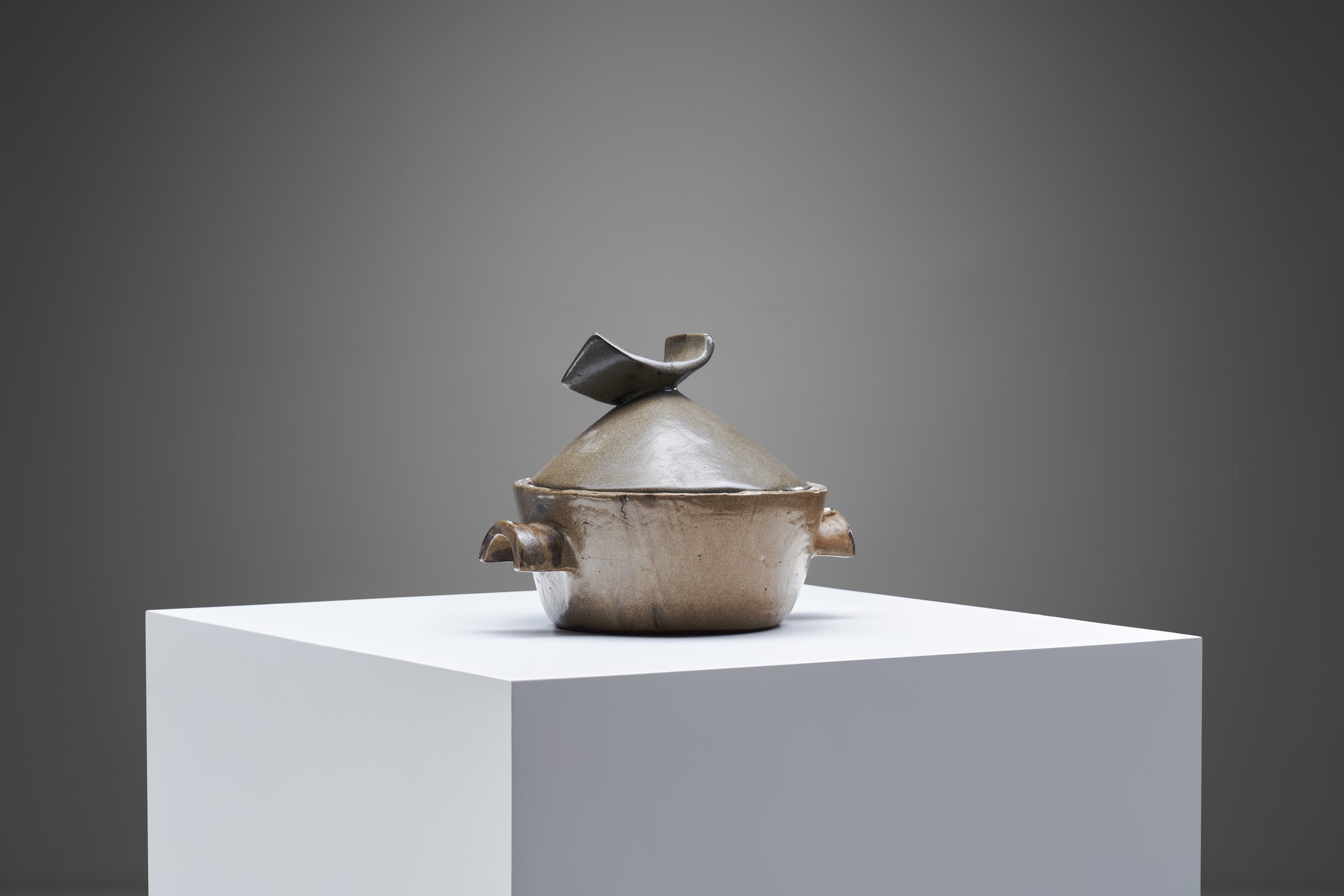
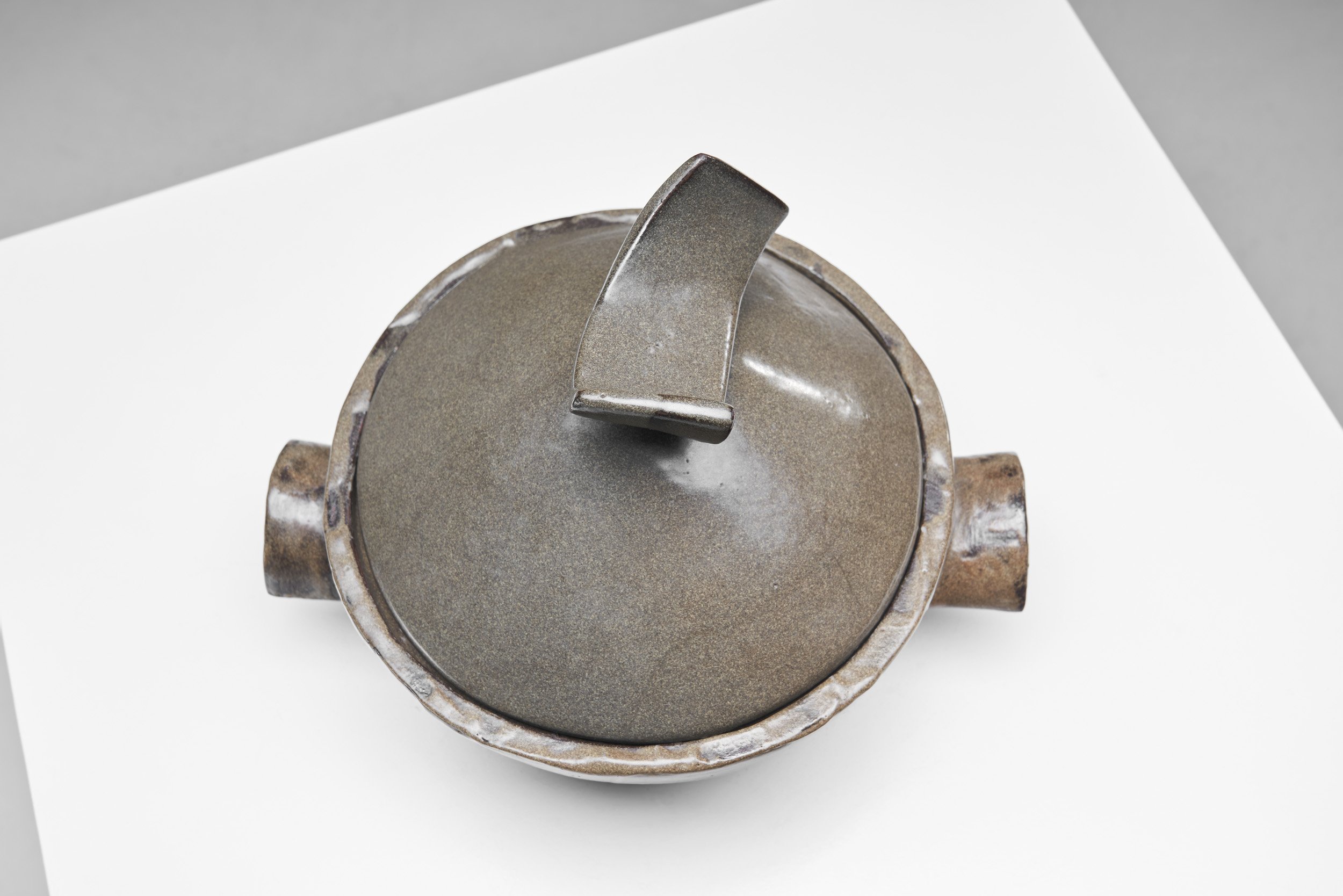
This piece was made by Michel and Denise Pointu in the 1960s and is a special piece in itself and in our gallery’s collection as well. Thanks to the technique and other unique qualities of the creation process, this piece is one of a kind in every sense of the expression.
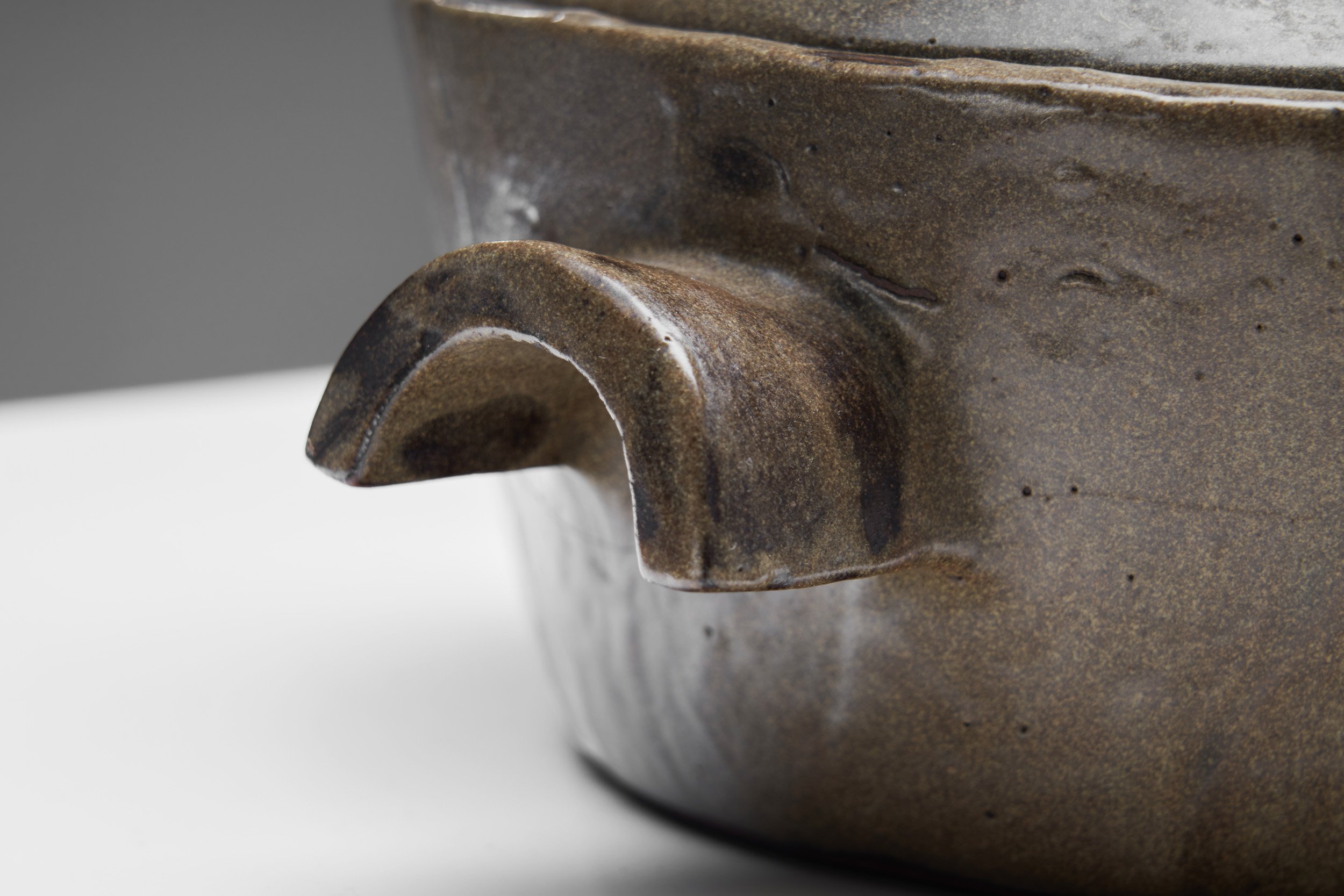
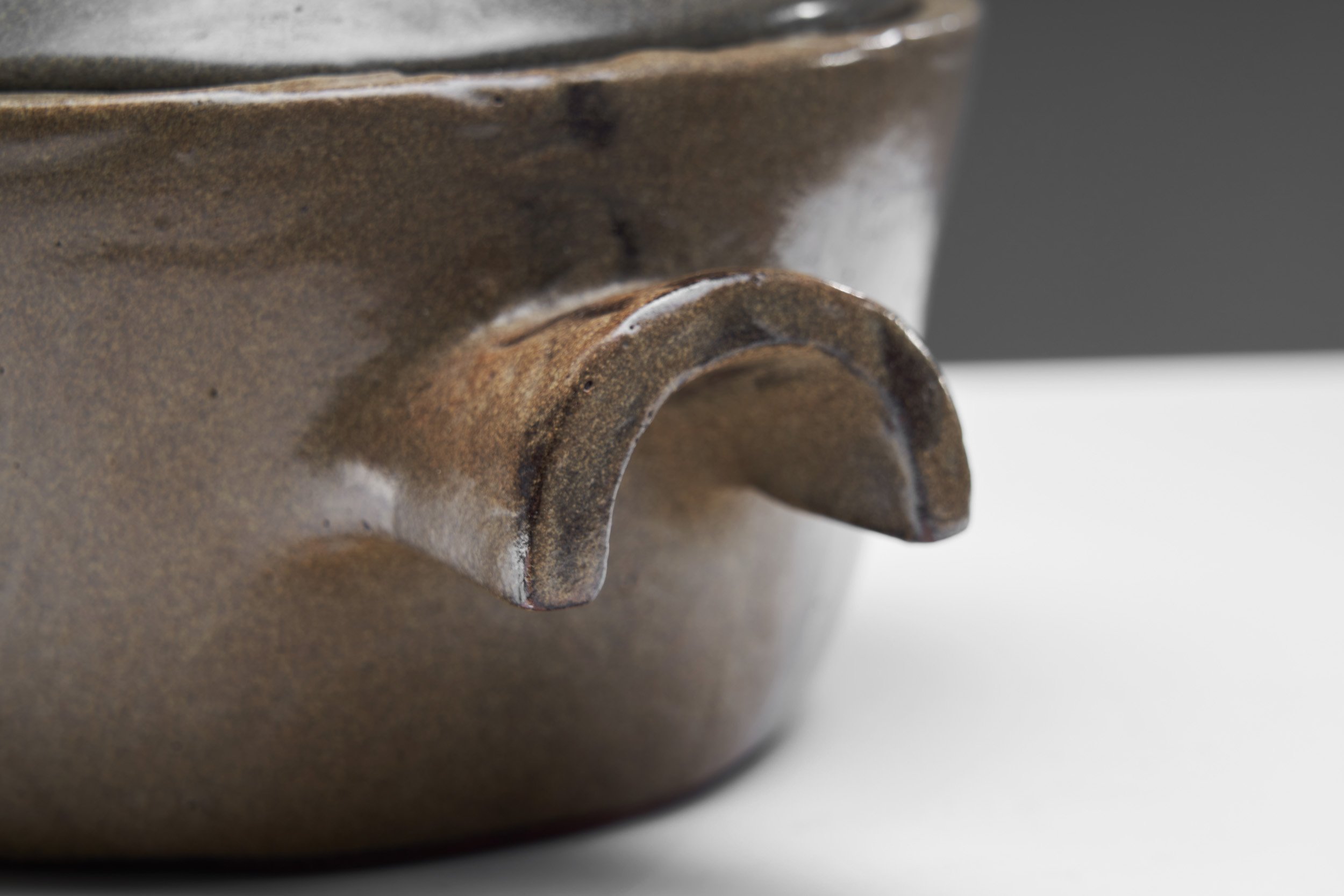
This model originates from Saint-Amand-en-Puisaye, a commune in the Nièvre department in central France. In Saint-Amand-en-Puisaye, pottery is a secular tradition dating back to the Middle Ages and several sites, open to the public, display this ancestral skill. The area is rich in ochre and clay, so it is hardly surprising that pottery is the top craft of the region. The many styles include the utilitarian and decorative stoneware pieces from the Carriès school as well. This glazed, enamelled sandstone piece has an unusual, modern shape. Thanks to this, it can easily be placed in both a vintage or contemporary interior and is sure to stand out from its surroundings. The Puisaye sandstone is a unique material with versatile colour schemes, mostly earth tones as seen in this piece. The half circle handles are especially notable, and the curving shape is repeated on the top as a form of ornamentation. The brownish colour of the sandstone is characteristic of the workshop and creates a calm, cosy impression. The glaze highlights the uneven surface and colour, recalling the Japanese ideal of wabi sabi, the beauty in the unperfect.
At the height of the activity, Puisaye stoneware was used in homes and farms from the Loire valley to Paris, and even as far away as Quebec and Louisiana. This outstanding piece of pottery was made in a town famous for a 500-year-old stoneware tradition – and for sparking off a French ceramics revival. Its peculiar shape holds not only history and tradition in it, but also provides plenty of visual appeal that is sure to bring character to any space.
SOLD
Condition:
In good vintage condition. Wear consistent with age and use. Some small pinholes in the glaze.
Dimensions:
9.44 in W x 9.44 in D x 7.87 in H
24 cm W x 24 cm D x 20 cm H
REQUEST PRICE HERE
Price category: 1,000 - 2,500 usd / eur
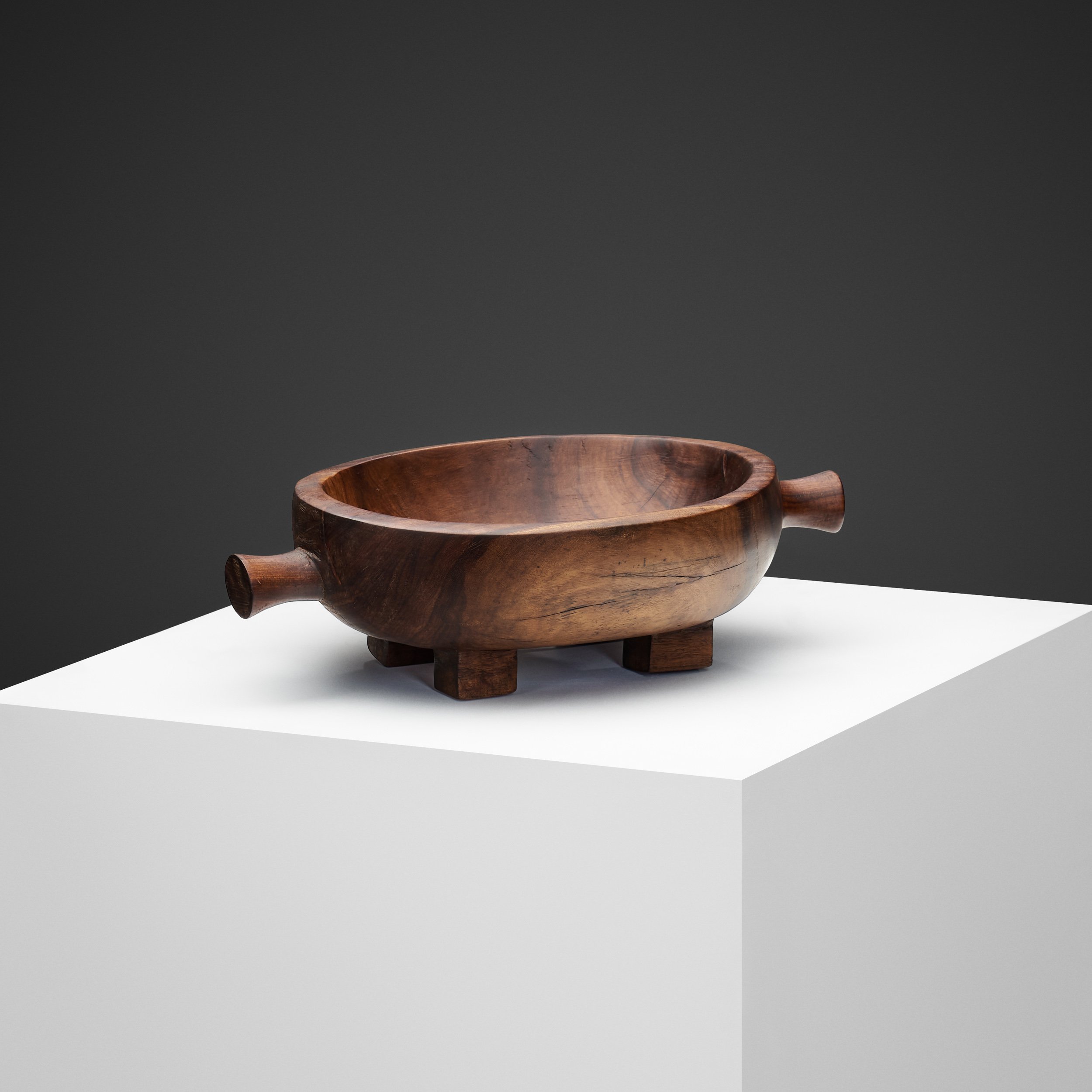
Carved wooden vessels occupy a unique position between utility and sculpture. Across many African woodworking traditions, everyday objects such as bowls, trays, and serving vessels were shaped directly from solid trunks, allowing the natural characteristics of the timber to determine both the appearance and final form. The resulting pieces often possess a quiet power, where simple gestures and careful craftsmanship create a lasting visual impact.
The silhouette of this tray is bold and compact. Hollowed from a single section of wood, the bowl rests on four short feet that lift it subtly from the surface below. Cylindrical handles project from either side, introducing a horizontal dimension that balances the rounded volume of the vessel. The uninterrupted grain flows across the piece, revealing shifts in colour due to the single-trunk construction. Subtle tool marks and natural variations in the wood lend depth to the surface, while the smooth interior highlights the skill required to create such a form from a solid block of timber. Despite its modest scale, the tray possesses a distinctly architectural quality, built from a combination of shapes and carefully proportioned volumes.
Objects of this kind demonstrate how functional forms can achieve a sculptural presence through material alone. Whether used as a catchall or decorative centrepiece, the tray draws attention to the richness of the wood and the clarity of its construction. Its enduring appeal lies not in elaborate decoration but in the confidence of its form, where every element serves a purpose and contributes to a sense of permanence.
Condition:
In good vintage condition. Wear consistent with age and use. The accent tray has recently been reconditioned. Due to the nature and age of the material, the item may have minor marks, scratches, and discolouration. The piece features an exceptional wood grain.
Dimensions:
14.56 in W x 10.23 in D x 4.33 in H
37 cm W x 26 cm D x 11 cm H
REQUEST PRICE HERE
Price category: 2,500 - 5,000 usd / eur
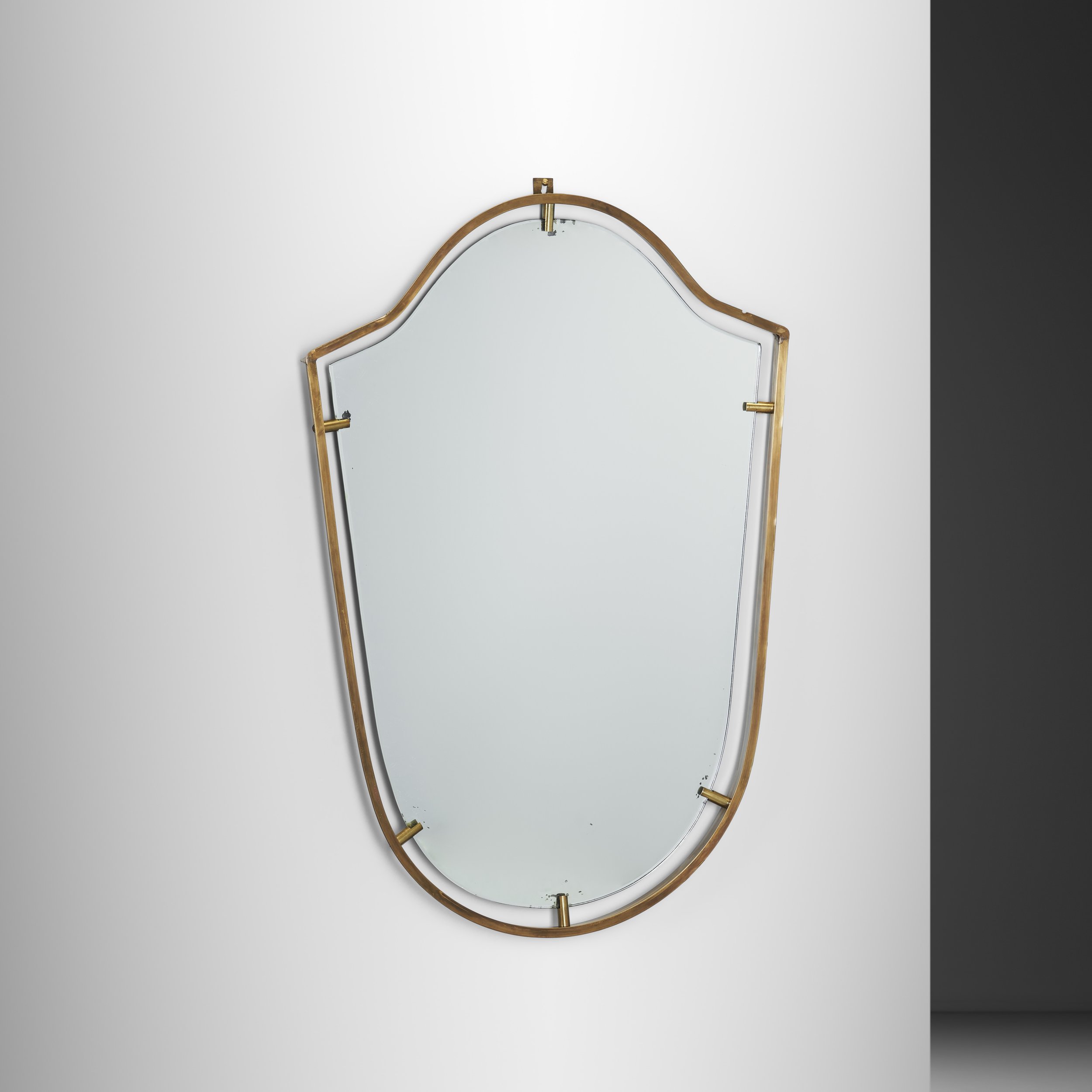
Mirrors are versatile pieces of interior décor with several functions and advantages; they create depth, increase light coverage, and add a statement to any space. Fusing function and form, mirrors offer useful reflection while also providing an eye-catching focal point in any room. This rare and beautiful Italian mirror has a stylish, defined look that is sure to stand out in any space.
In the early days, mirrors were made from obsidian, a smooth black stone, and metals, such as copper and bronze. The use of glass in mirror-making was initially developed during the rise of the glass industry, and later revolutionised by Murano glass-makers. This Italian model has a stylish, refined look that is certain to add refinement to any room’s ambiance. Wall mirrors, such as this one, are practical at their core, while also adding personality wherever they are placed. The play on materials and geometry, with the mirror’s clean and symmetrical lines, creates a neat, modern look. The patinated brass, the ultimate material of 20th century design is balanced out by the glass surface. Mirrors have long been used to make rooms feel bigger and brighter by reflecting light and creating an illusion of additional space, but there is much more beyond functionality. As this model shows, an accent mirror can incorporate a classic touch into a home, while reflecting timeless Italian style.
The design and materials provide simple elegance, making this mirror perfect to bring some understated modernism to any interior. It can serve equally well in a hallway, bathroom or living room, either mounted on a wall or spontaneously leaned against it. It adds depth, reflects light, and expands horizons as a statement piece.
Condition:
In good vintage condition. Wear consistent with age and use. Marks, scratches, and imperfections may be present on the glass due to manufacturing inconsistencies and the age of the item.
Dimensions:
19.68 in W x 0.98 in D x 29.33 in H
50 cm W x 2.5 cm D x 74.5 cm H
REQUEST PRICE HERE
Price category: 2,500 - 5,000 usd / eur
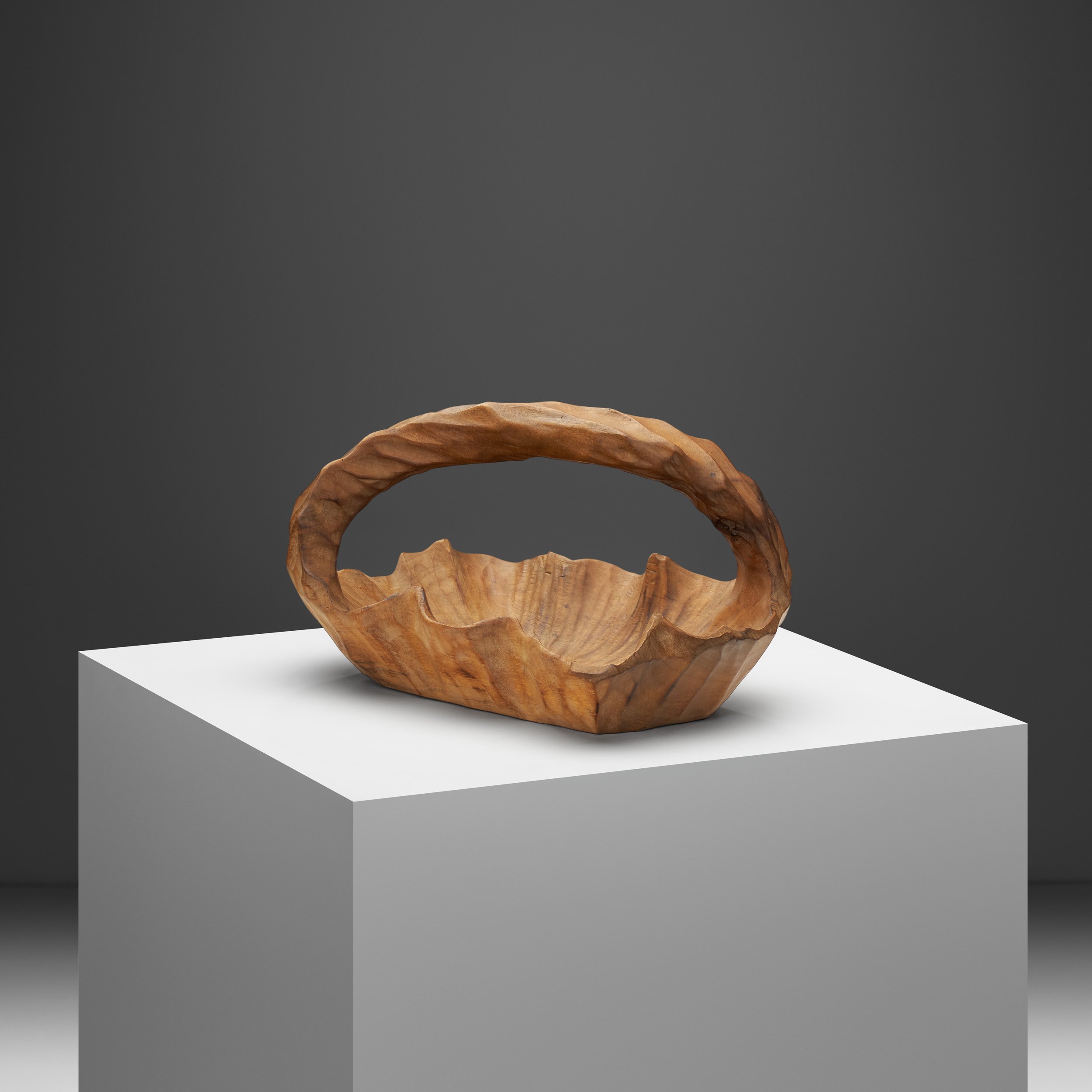
This bowl’s origins can be traced back to Rudolf Steiner’s circle and was made in the so-called Anthroposophic style. Aesthetically, the movement took established silhouettes and morphed them into warped geometries often comprised of multifaceted angular surfaces.
Anthroposophy was originally a school of thought that combined spirituality and materiality for a better humanity. According to Steiner, the thought can also be translated into forms and colours. Everything by which we are immediately surrounded in life takes on an artistic form, therefore furniture is capable of vivifying the environment and like this bowl, its approach to design is organic functionalism. The shape, lines and material of this piece show strength and dynamism, while still staying light and stylish. The bowl’s form is stylistically closer to the organic elegance of modernism, therefore it is guaranteed to fit into, and stand out in any style and type of space. The inherent organicity is also apparent in the shape that doesn’t follow strict geometric principles, instead, has a natural flow to it. Swirling grain patterns further provide a striking visual dimension, highlighting a contrast of tone and texture. The form shifts subtly depending on the viewer’s angle, inviting exploration and offering a sense of balance between lightness and strength. Whether used as a functional centerpiece or simply admired as an object of form and shadow, it draws the eye through its quiet complexity and sculptural quality.
Adding pieces like this to a modern interior not only creates a diverse and interesting aesthetic, it also reminds that perfection cannot be reached and perhaps should not even be the goal. Instead, recognising the beauty of the imperfect created by nature and reformed by a craftsman can bring happiness into everyday life.
Condition:
In good vintage condition. Wear consistent with age and use. Due to the nature and age of the material, item may have some marks, scratches, and discolouration.
Dimensions:
13.78 in W x 10.04 in D x 8.07 in H
35 cm W x 25.5 cm D x 20.5 cm H
REQUEST PRICE HERE
Price category: 2,500 - 5,000 usd / eur
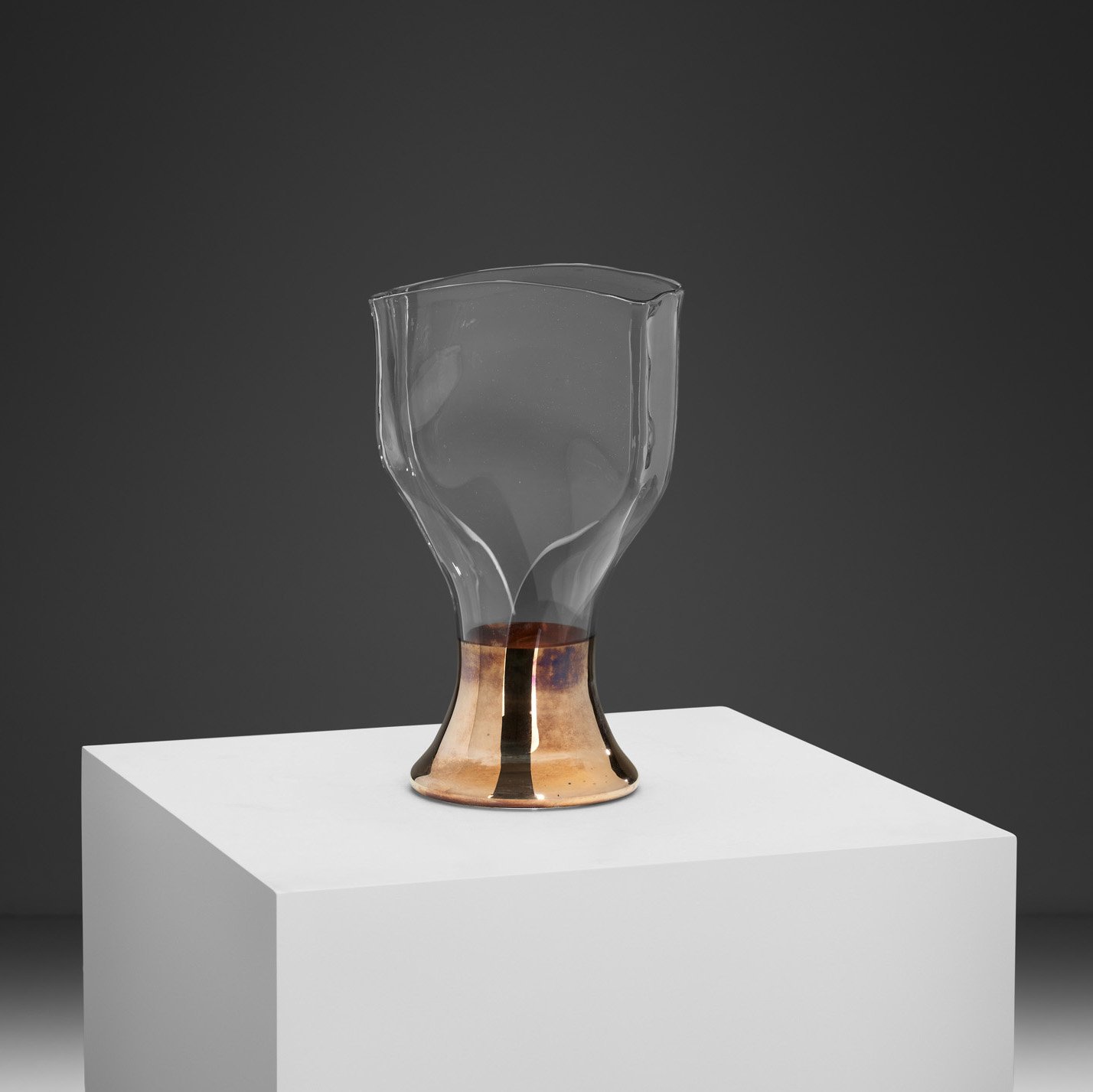
This vase was made by Richard Meitner and displays an understated elegance and timeless appeal. With an emphasis on balance and harmony, it blends traditional craftsmanship with modern aesthetics. Richard Meitner is an artist that has worked extensively with glass and has been exhibiting his works worldwide to this day.
The vase features a round brass base and extends up to a neck that connects seamlessly to the glass. The striking translucent sculptural glass is the focal point of the structure. Crafted with quality in mind, this vase is sturdy and built to last. Its base provides stability and a contemporary touch, while the glass adds a sense of mystery and sophistication to the overall design. The design embraces the allure of both the mid-century modern and space age era’s design characteristics with a result that is mature, well-thought-out, and timelessly stylish. On a side table or a sideboard, this vase will quickly find its marks in any interior. To accompany the stylish look, the brass has beautiful patina that adds vintage charm to the otherwise modern aesthetic of the design.
Adding pieces like this to a contemporary interior not only creates a diverse and interesting aesthetic, it also reminds that perfection cannot be reached and perhaps should not even be the goal. Instead, recognising the beauty of the imperfect can bring happiness into everyday life.
Condition:
In good vintage condition. Wear consistent with age and use. The item has recently been reconditioned. Some visible discolouration on the base. Additional marks, scratches, and imperfections on the glass may be present due to manufacturing inconsistencies and age of the item.
Dimensions:
8.66 in W x 6.10 in D x 13.38 in H
22 cm W x 15.5 cm D x 34 cm H

REQUEST PRICE HERE
Price category: 2,500 - 5,000 usd / eur
In her works, Kati Tuominen-Niittylä explores the concept of the container, interpreting it with natural colours and timeless, clean lines. This allows her to rediscover the beauty of both simplicity and archaic forms. The surfaces, meticulously treated as a sort of meditative practice, recall the light and landscapes of the Nordic forests.
Her minimalistic and timeless language of forms appears in every inch of this bowl that is in the field between art, design, and handicraft. This model blends multiple techniques with extraordinary skill alternating between wheel-throwing, casting, and hand-building with a prevalence of textured, carved surfaces, all of which are high-fired. The result is a uniquely textured look that is influenced by the various ceramic masses, clay slurries, glazings, and surface structures the artist uses. The bowl is just as interesting from inside as it is from the outside, with darker colours that enhance the texture and patterns. The inherent organicity is also apparent in the shape that doesn’t follow strict geometric principles, instead, has a natural flow to it. As a designer, Tuominen-Niittylä has been one of those postmodernists who softened the worst edges of the style into a more user-friendly form. Or as she put it: “I like the quiet movement.” This bowl is signed with “KTN” at its neck.
Kati Tuominen-Niittylä’s works do not fit directly under any ready definition. They have the kind of archaic timelessness that is recognizable throughout the long period of human history as we know art objects. This bowl is stylistically closer to the elegance of modernism than the playfulness of postmodernism, guaranteed to stand out in any style and type of space.
Condition:
In good condition.
Dimensions:
16.3 in W x 10.23 in D x 10.43 in H
41.5 cm W x 26 cm D x 26.5 cm H
About the designer:
Kati Tuominen-Niittylä (Finish, b. 1947) is an internationally acclaimed ceramic artist living and working in Helsinki, Finland. Her elegant minimalist works blend multiple techniques with extraordinary skill alternating between wheel-throwing, casting, and hand-building with a prevalence of textured, carved surfaces, and all of which are high-fired.
Evoking archetypal silhouettes reminiscent of functional vessels such as buckets and basketry, as well as shapes found in nature, Tuominen-Niittylä creates objects that are refined and sophisticated yet with a rough plainness that is further emphasized by the earthy neutral hues. The objects appear almost ancient or geological. The interchanging of techniques also affords a uniqueness to each piece, and it often leads to new details and finishes. Although the works are suggestive of ancient functional forms, Tuominen-Niittylä creates each piece purely with artistic purpose.
Tuominen-Niittylä studied at the Aalto University School of Arts, Architecture and Design. She is a member of the Arabia Art Department Society and has designed for Arabia Studios. Her work is in the permanent collections of numerous public institutions including the Victoria & Albert Museum in London, the Finnish State Collections, and the Shigaraki Cultural Park Museum in Japan.

REQUEST PRICE HERE
Price category: 1,000 - 2,500 usd / eur
In 1934, Josef Frank made his first attempt at modernizing the classic candelabra. With softly swaying forms, he eliminated the base in the middle, placing the branches of this model directly on the tabletop. This candelabra emits a pleasant light and its special design makes it a perfect centrepiece.
Candlesticks and candle holders are appreciated decoration details that bring warmth and spread a soft glow in the room. In the case of this model, the body itself spreads a soft glow thanks to its bright brass structure. This model predates the famous Knot of Friendship, but already showcases the looping calligraphic design. The six branches share the same curve but are arranged asymmetrically so that the candles stand at different heights. This allows the design to look different from each angle. The candles elongate the otherwise busy design and keep the upper part light and airy while also highlighting the elaborate brass structure. The candles are held by brass cups that have so-called chambersticks, small pans to catch dripping wax. The cups have removable extra cups in an organic, flower-like shape. The glass has a golden rim to accentuate the shape and elevate the aesthetic of the whole candle holder.
The Austrian designer and architect, Josef Frank was the most prestigious designer in the Stockholm design company Svenskt Tenn (Swedish Pewter), recruited by the founder of the company, Estrid Ericson herself. Svenskt Tenn hired Josef Frank in 1934, the same year he created the design of this model, making it one of his earliest designs at the company.
Condition:
In good vintage condition. Wear consistent with age and use. The brass has a beautiful patina with some marks.
Dimensions:
11.81 in W x 11.81 in D x 8.66 in H
30 cm W x 30 cm D x 22 cm H
About the designer:
Josef Frank (July 15, 1885 – January 8, 1967) was an Austrian-born architect, artist, and designer who adopted Swedish citizenship in the latter half of his life. Together with Oskar Strnad, he created the Vienna School of Architecture, and its concept of Modern houses, housing, and interiors.
Josef Frank was one of early Vienna modernism’s foremost figures, but already in the beginning of the 1920s he started to question modernism’s growing pragmatism. He had little appreciation for the French architect Le Corbusier’s belief that a house should be “a machine for living in”. He was against puritanical principles and on the contrary, feared that standardized interiors would make people all too uniform. Josef Frank represented a freer, more artistic style ideal, and he developed his own type of modernism where values like comfort, hominess, and a wealth of colour were at its core. He resisted limitations and models for his furniture and textiles came from across all boundaries both in time and space.
Josef Frank began working at Svenskt Tenn in 1934 and just a few years later, the Frank-Ericson duo made their international breakthrough. Svenskt Tenn’s exhibition room at the World Expositions in Paris in 1937 and New York in 1939 was completely contrary to the ideal of the time with its bold contrasts in materials, colours, and prints. The duo received a great deal of attention and became, somewhat paradoxically, the model for the expression “Swedish Modern”. Although he was already 50 years old when he left Vienna for Sweden, Frank is considered one of Sweden’s most important designers.

REQUEST PRICE HERE
Price category: 1,000 - 2,500 usd / eur
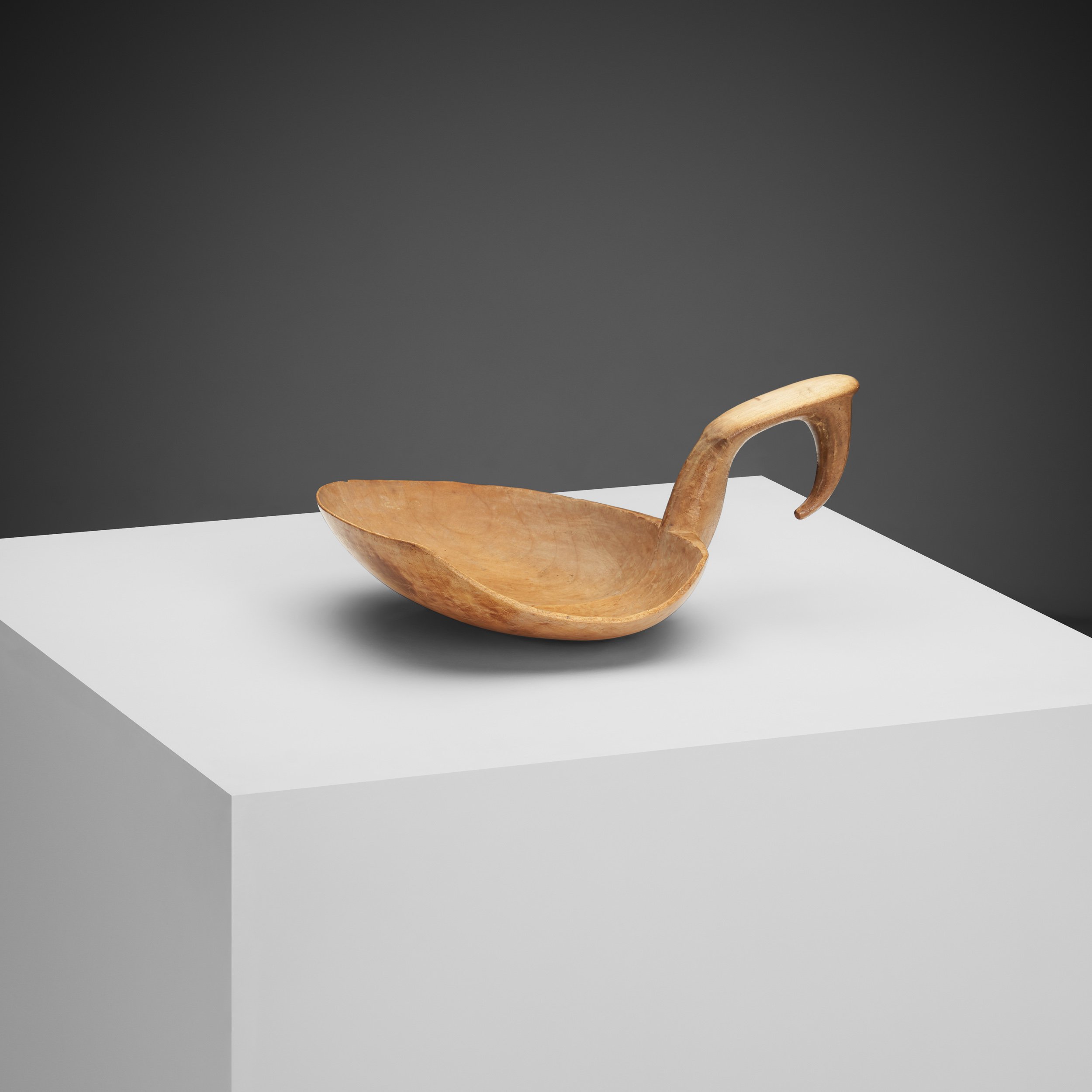
This carved birch ladle originates from Sweden in the early 19th century, a period when everyday domestic objects were shaped by strong folk traditions and regional craftsmanship. In rural Scandinavian culture, utilitarian items were often carved by hand and given expressive forms that reflected both practicality and artistry. Birch, widely available and valued for its durability and fine grain, was a preferred material for household items, allowing makers to combine function with subtle decorative character.
This ladle is carved from a single piece of birch wood, its bowl smoothly hollowed and gently rounded to create a balanced, organic form. The handle extends fluidly from the body, curving upward into a sculptural hook-like shape that allows it to be hung if needed. Tool marks and natural variations in the wood grain remain visible, giving the surface warmth and authenticity while highlighting the hand-carved process. The proportions are carefully considered, with the broad bowl contrasting with the slender handle in a harmonious way. The soft patina suggests long use, adding depth and character without obscuring the clarity of the original carving. Subtle asymmetries further reinforce its handmade nature, making each angle slightly different and visually engaging.
Today, this early 19th century Swedish ladle stands as both a functional and a sculptural object. Whether displayed as part of a folk art collection, styled in a contemporary interior, or appreciated for its material honesty, it offers a connection to traditional Scandinavian craftsmanship. Its restrained elegance, tactile surface, and expressive silhouette make it a compelling example of how simple tools were elevated through skill and intention.
Condition:
In good vintage condition. Wear consistent with age and use. The sculpture has recently been reconditioned. Due to the nature of the material, the item may have some marks, scratches, and discolouration.
Dimensions:
7.87 in W x 10.62 in D x 5.90 in H
20 cm W x 27 cm D x 15 cm H
REQUEST PRICE HERE
Price category: 2,500 - 5,000 usd / eur
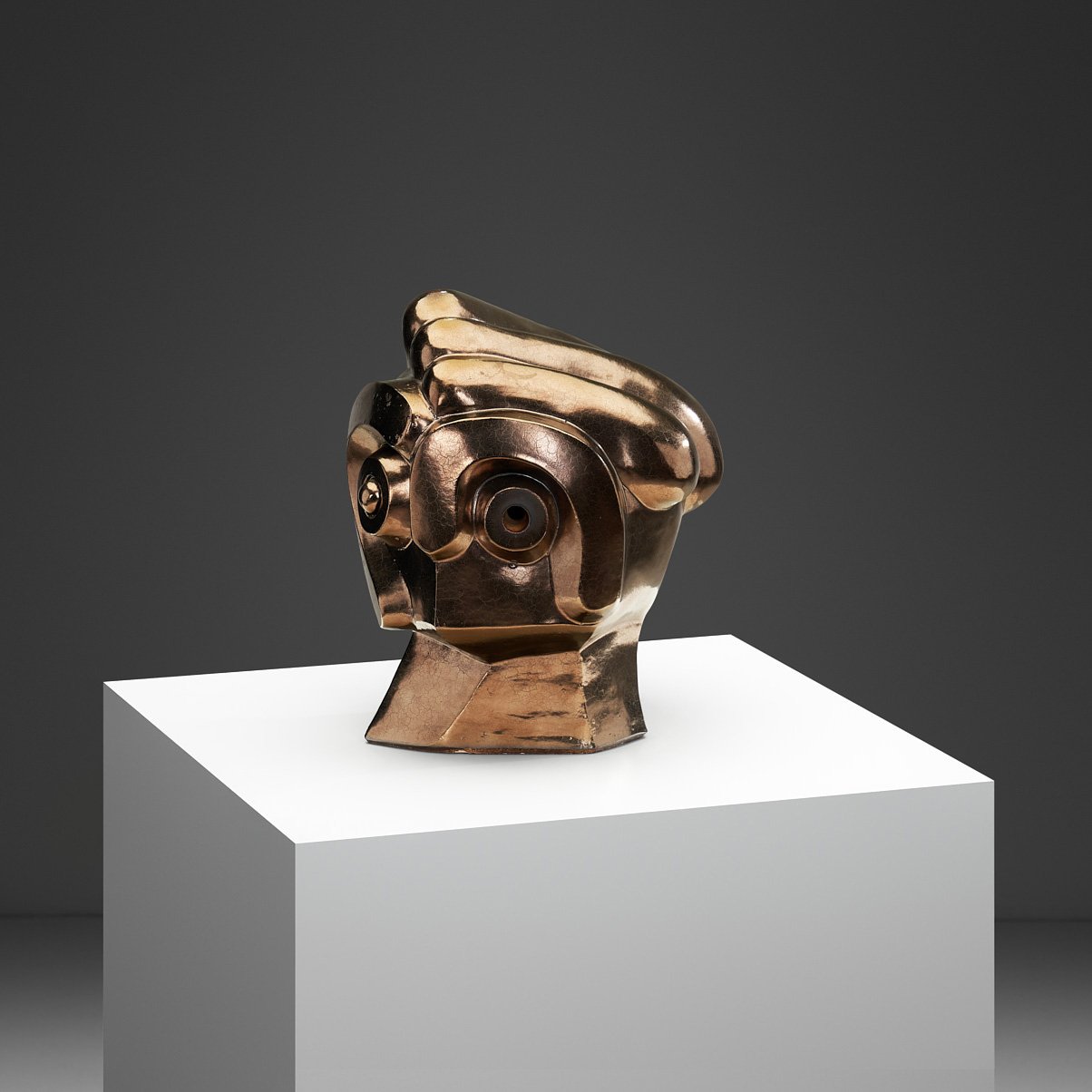
This ceramic sculpture presents an abstract human head formation, made by Roy Terbeek in 1994 in the Netherlands. The piece features a modeling of facial features. There is a sense of harmony in the proportions: the neck strong yet graceful, and the overall shape flows naturally from crown to neckline. With vibrant detail, the shape itself speaks of an artist well aware of the interplay between light and form.
Created in the early 1990s, it reflects a period in which many artists were exploring personal identity and quiet presence rather than overt statement. This unique sculpture is intriguing and exudes an air of antiquity and natural physicality. Its form commands attention with its abstract and textured surface. At first glance, the shape of the sculpture draw the viewer in, with its irregularities. The glazing is a central expressive element, with its earthy-bronze tone. It offers a glass-like surface that catches light across its curvature, increasing the visual depth. Instead of creating tension, the shape and material bring the piece into perfect balance thanks to the unique design. This sculpture is undoubtedly as captivating from afar as it is up close. This work invites viewers to engage with the interplay of tradition and innovation, celebrating the enduring appeal of glazed ceramic as a medium for artistic expression.
Beyond its technical and aesthetic qualities, the sculpture evokes a contemplative mood. It is a work that rewards close viewing. This piece is also a rare representation of Dutch Post-Modernist design, an interesting phase of cultural, social impacts with artists and designers trying to figure out their way towards leaving their marks.
Condition:
In good vintage condition. Wear consistent with age and use. Due to the nature of the material, item may have some marks, scratches, and discolouration.
Dimensions:
9.25 in W x 11.61 in D x 12.20 in H
23.5 cm W x 29.5 cm D x 31 cm H

REQUEST PRICE HERE
Price category: 2,500 - 5,000 usd / eur
The second half of the 20th century saw a renewed fascination with organic form and material integrity. Across Europe, the postwar years brought a quiet resistance to industrial uniformity, artists and designers returned to the tactile immediacy of natural materials. Studio craftsmen began to treat wood, clay, and metal as expressive mediums rather than mere functional matter. The result was an era that celebrated the imperfect, the handmade, and the quietly sculptural, where design and art began to intertwine with new intimacy.
Carved from a single piece of richly grained wood, the elongated bowl reveals a deep respect for both material and skill. Its shape, stretching gracefully from end to end, feels fluid and intentional, while the gently arched handle gives the object a structural balance. The surface bears traces of the maker’s hand, with soft ridges and natural irregularities that add a tactile rhythm to its form. Swirling grain patterns further provide a striking visual dimension, highlighting a contrast of tone and texture. The form shifts subtly depending on the viewer’s angle, inviting exploration and offering a sense of balance between lightness and strength. Whether used as a functional centerpiece or simply admired as an object of form and shadow, it draws the eye through its quiet complexity and sculptural quality.
As with much of European studio craftsmanship from this era, this piece speaks to a time that valued authenticity and material truth above decoration or excess. The maker’s hand is evident yet never dominant, allowing the natural form of the wood to guide the design.
Condition:
In good vintage condition. Wear consistent with age and use. Due to the nature and age of the material, item may have some marks, scratches, and discolouration.
Dimensions:
41.92 in W x 15.74 in D x 8.26 in H
106.5 cm W x 40 cm D x 21 cm H
REQUEST PRICE HERE
Price category: 5,000 - 7,500 usd / eur
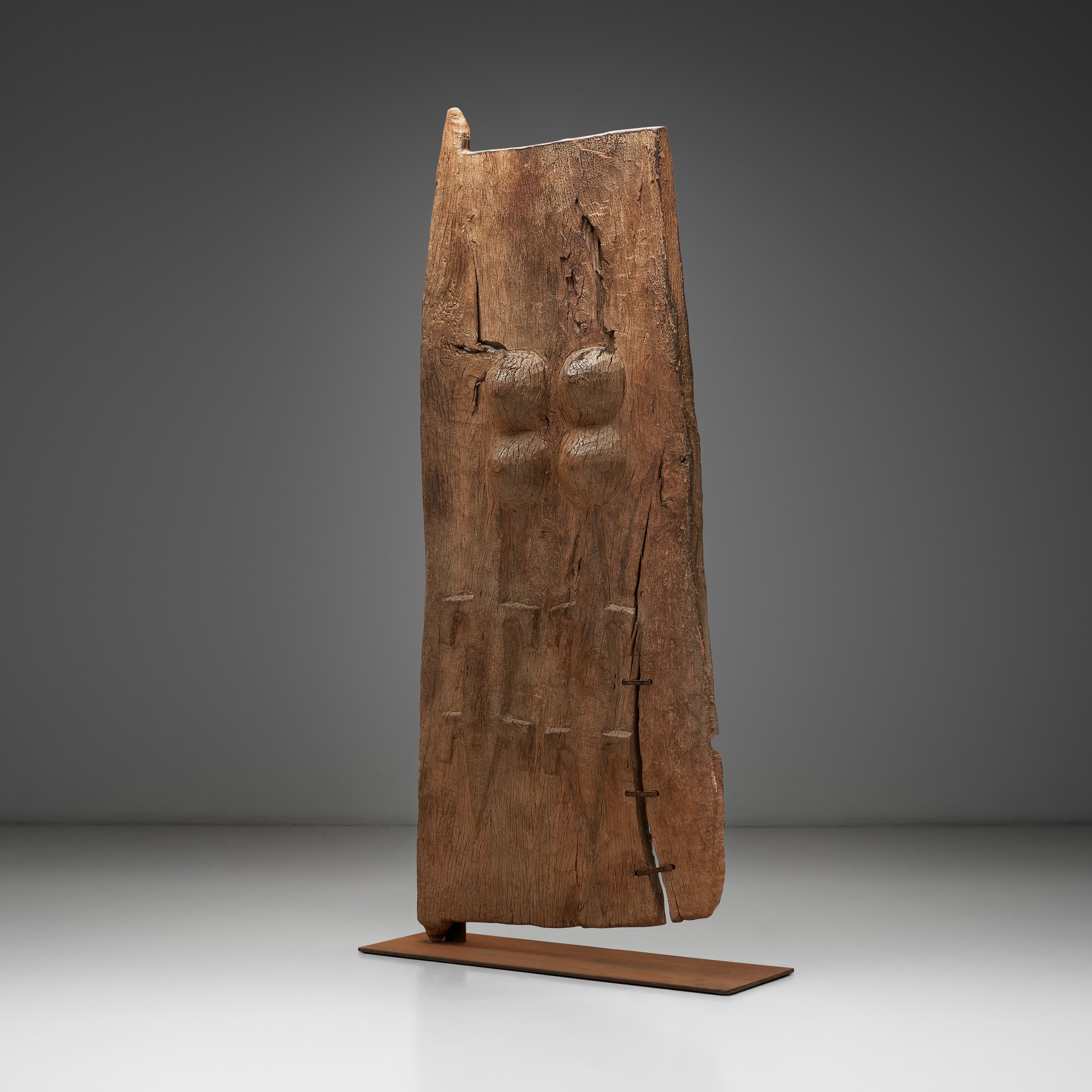
Nature has been a source of inspiration for artists, craftsmen, and to people of all trades since the dawn of time. This traditional Dogon door from Mali is ideal to bring a piece of history into any space to marvel at the art of nature.
Dogon doors are carved wooden panels that have been used in Mali, West Africa by the Dogon people. The purpose of these doors was two-fold; to provide physical security for stored goods and to offer spiritual protection by warding off evil spirits. Many of these doors featured beautiful relief carvings, like the carvings present on this piece. This type of door was often crafted by a high-ranking blacksmith, since the Dogon door was considered more than just functional objects, but rather sacred. The motifs found on this piece symbolise fertility and life, as well as spirituality, wisdom and protection. Moreover, in the absence of modern polished surfaces, this door has textural, rough edges and surfaces, the wood takes pride in its qualities. The construction strips back the unnecessary, showcasing only its essential elements. The wood is left in its natural form as much as possible, while also prioritising functionality and longevity. In contemporary spaces, this door or room divider is the perfect furniture type to introduce organicity to an interior. This piece is sure to stand out for all the right reasons and spark interesting conversations.
As nature does not mass produce identically, this piece is truly one of a kind, with intense visual qualities, therefore it cannot be reproduced. This Dogon door can be a unique decoration for modern interiors, and here, the quality of timelessness isn’t even a question.
Condition:
In good vintage condition. Wear consistent with age and use. Item may have some marks, scratches, and discolouration.
Dimensions:
29.92 in W x 9.84 in D x 61.02 in H
76 cm W x 25 cm D x 155 cm H
REQUEST PRICE HERE
Price category: 1,000 - 2,500 usd / eur
Josef Frank designed Vänskapsknuten (the Knot of Friendship) as a symbol of friendship and peace at a time when Europe was filled with turmoil. The very first sketch of the candelabra dates back to 1938, just a year before the outbreak of the Second World War, but it is as relevant now as it was then.
The Austrian designer and architect may be best known for his vivid textiles for Swedish firm Svenskt Tenn, but his artistic touch reached far beyond textiles and created iconic objects such as this candle holder. The elaborate brass structure intertwines at multiple points, but the brass rods only meet in the middle where a small sphere connects them. Each of the three brass cup have so-called chambersticks, small pans to catch dripping wax. The looping calligraphic design gives this piece a weightless grace that is stunning even without the symbolism behind it. The body’s busy look is completed and balanced by the long candles. The design changes from angle to angle and shows Frank’s sensitive touch. The Knot of Friendship has become an iconic object not only in Svenskt Tenn’s range, but also of Sweden. The production traditionally required a process of thorough methodology and great craftsmanship. Josef Frank was the most prestigious designer in the Stockholm design company Svenskt Tenn (Swedish Pewter), recruited by the founder of the company, Estrid Ericson herself.
Since 2018, after a careful assessment of Josef Frank’s original drawing, the candelabra regained its original form from 1938 under the hands of Svenskt Tenn. However, the production of this well-known and widely-loved candle holder now takes place at Humstorp Metal in Västergötland. This piece however, is from the original production from the post-war era.
Condition:
In good vintage condition. Wear consistent with age and use. The brass has a beautiful patina with some marks. Due to the nature and age of the material, the item may have some scratches and discolouration.
Dimensions:
8.85 in W x 7.48 in D x 6.29 in H
22.5 cm W x 19 cm D x 16 cm H
About the designer:
Josef Frank (July 15, 1885 – January 8, 1967) was an Austrian-born architect, artist, and designer who adopted Swedish citizenship in the latter half of his life. Together with Oskar Strnad, he created the Vienna School of Architecture, and its concept of Modern houses, housing, and interiors.
Josef Frank was one of early Vienna modernism’s foremost figures, but already in the beginning of the 1920s he started to question modernism’s growing pragmatism. He had little appreciation for the French architect Le Corbusier’s belief that a house should be “a machine for living in”. He was against puritanical principles and on the contrary, feared that standardized interiors would make people all too uniform. Josef Frank represented a freer, more artistic style ideal, and he developed his own type of modernism where values like comfort, hominess, and a wealth of colour were at its core. He resisted limitations and models for his furniture and textiles came from across all boundaries both in time and space.
Josef Frank began working at Svenskt Tenn in 1934 and just a few years later, the Frank-Ericson duo made their international breakthrough. Svenskt Tenn’s exhibition room at the World Expositions in Paris in 1937 and New York in 1939 was completely contrary to the ideal of the time with its bold contrasts in materials, colours, and prints. The duo received a great deal of attention and became, somewhat paradoxically, the model for the expression “Swedish Modern”. Although he was already 50 years old when he left Vienna for Sweden, Frank is considered one of Sweden’s most important designers.