
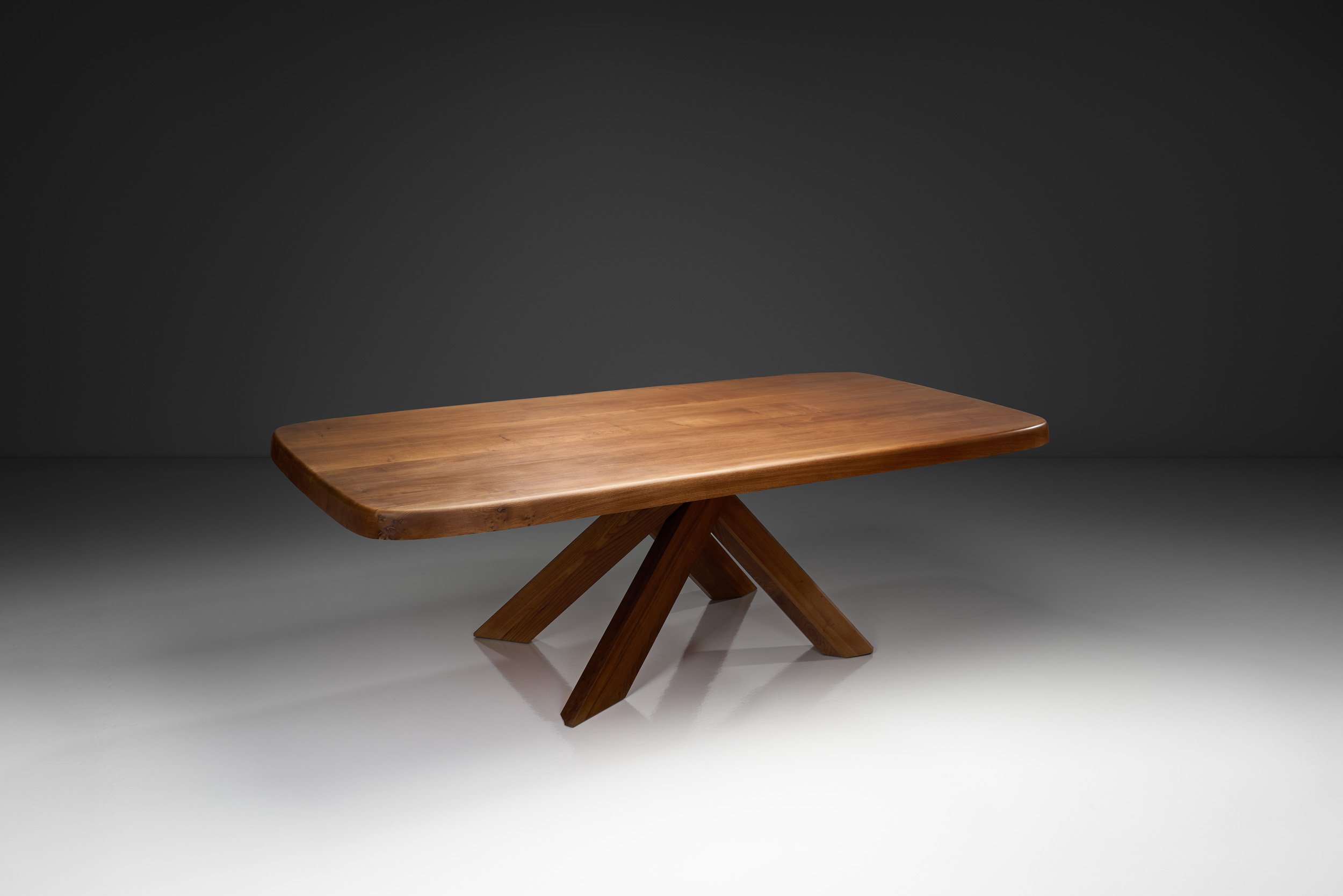
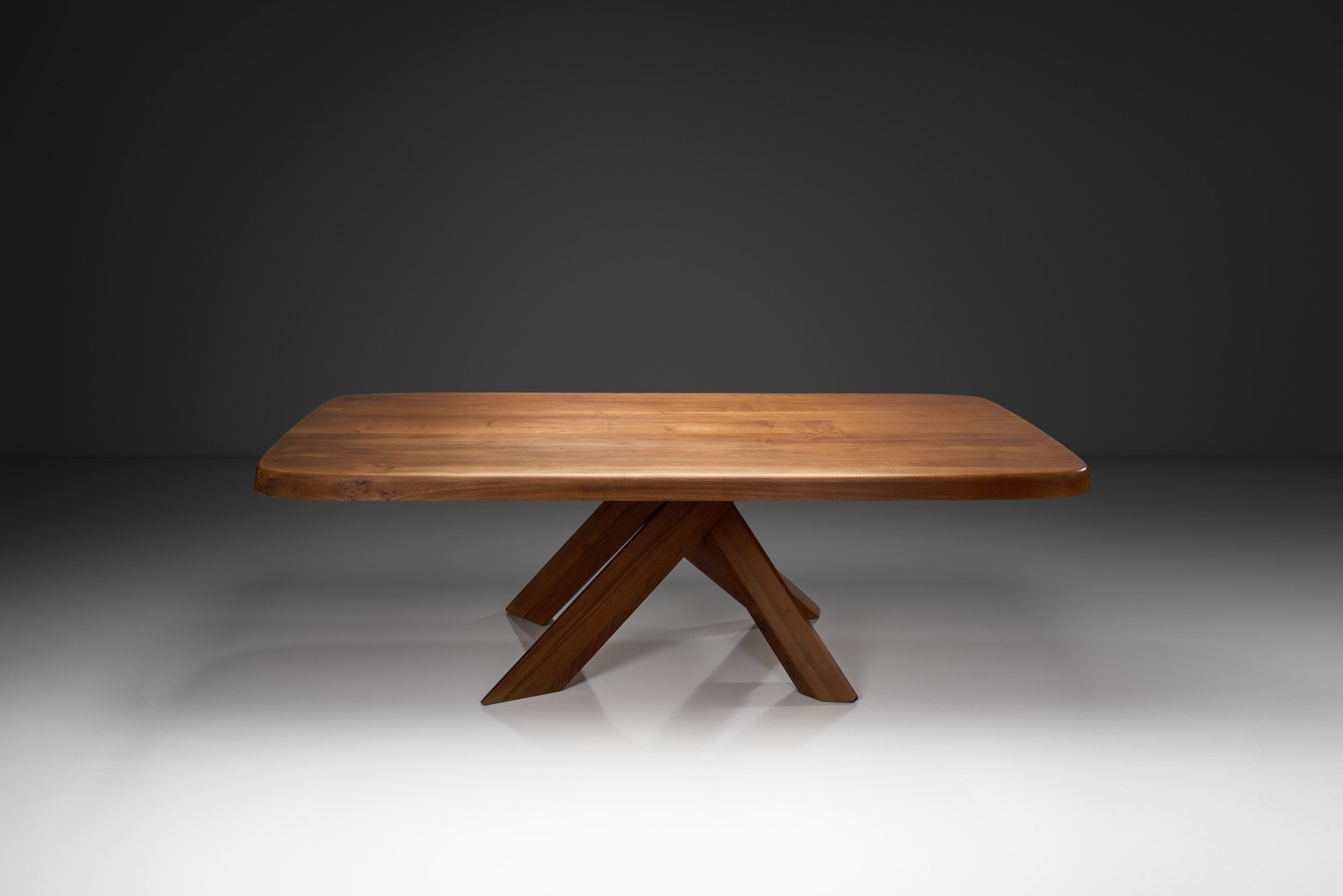
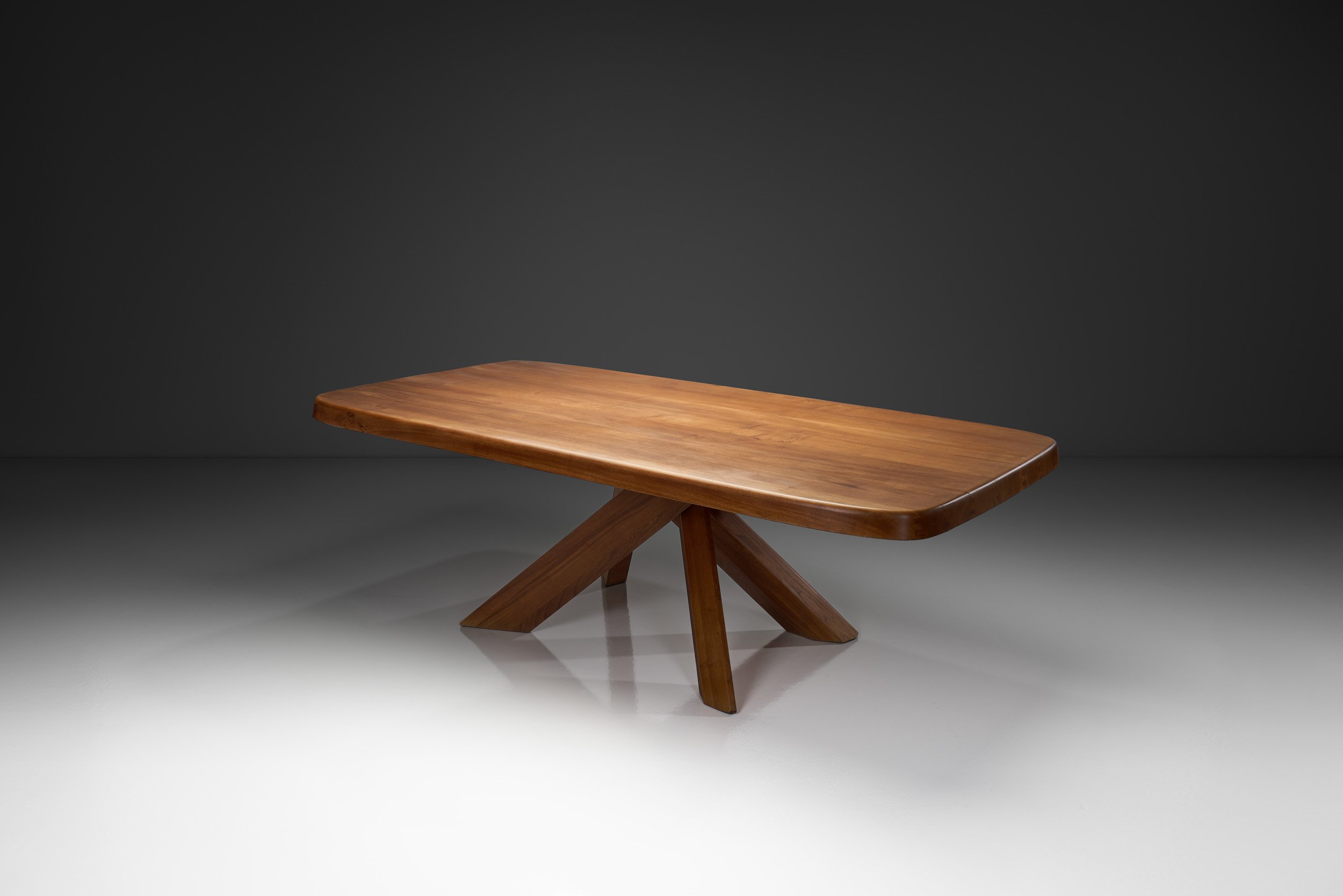
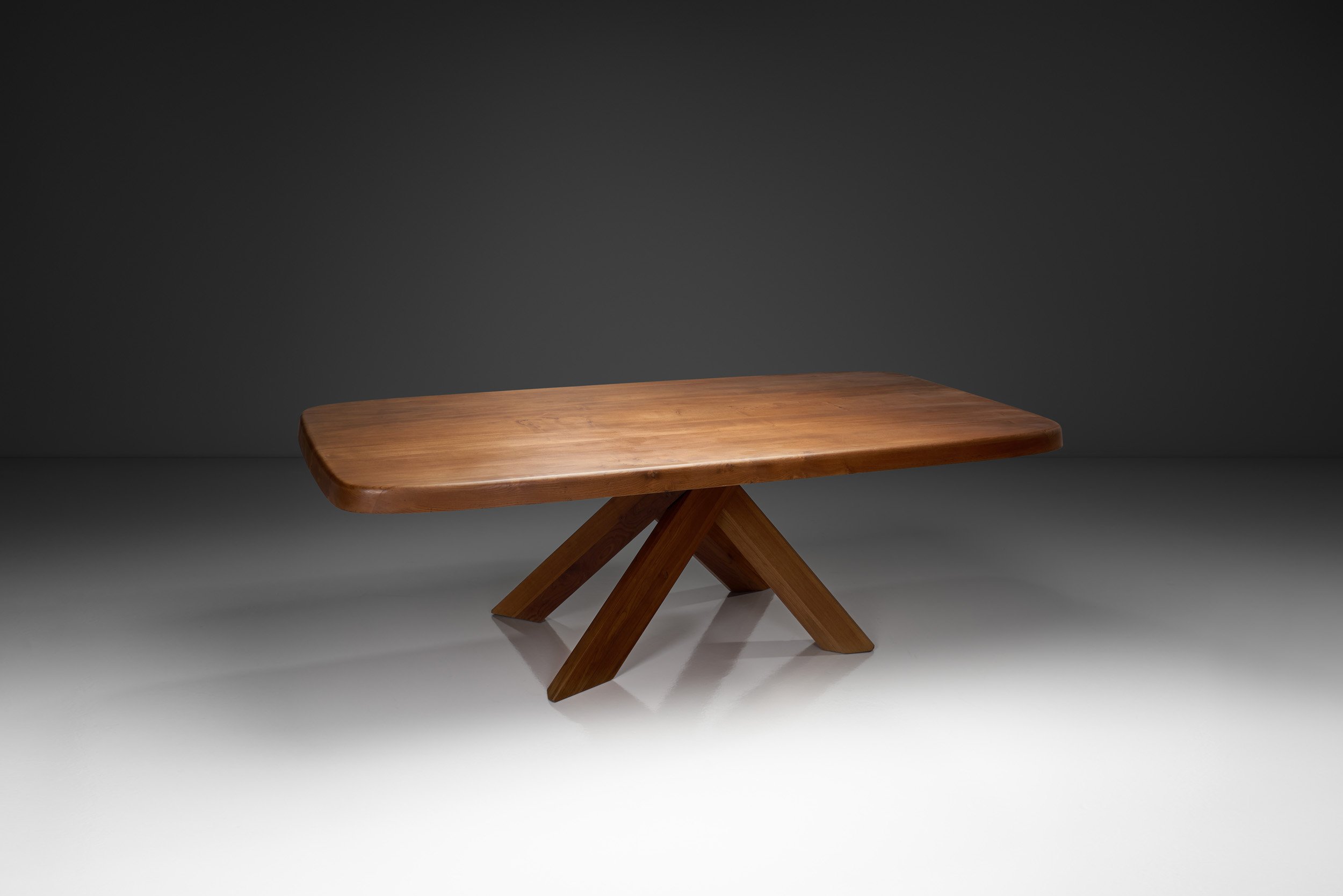
Pierre Chapo “T35D” Large Elm Dining Table with Bundled Base, France 1973 (sold)
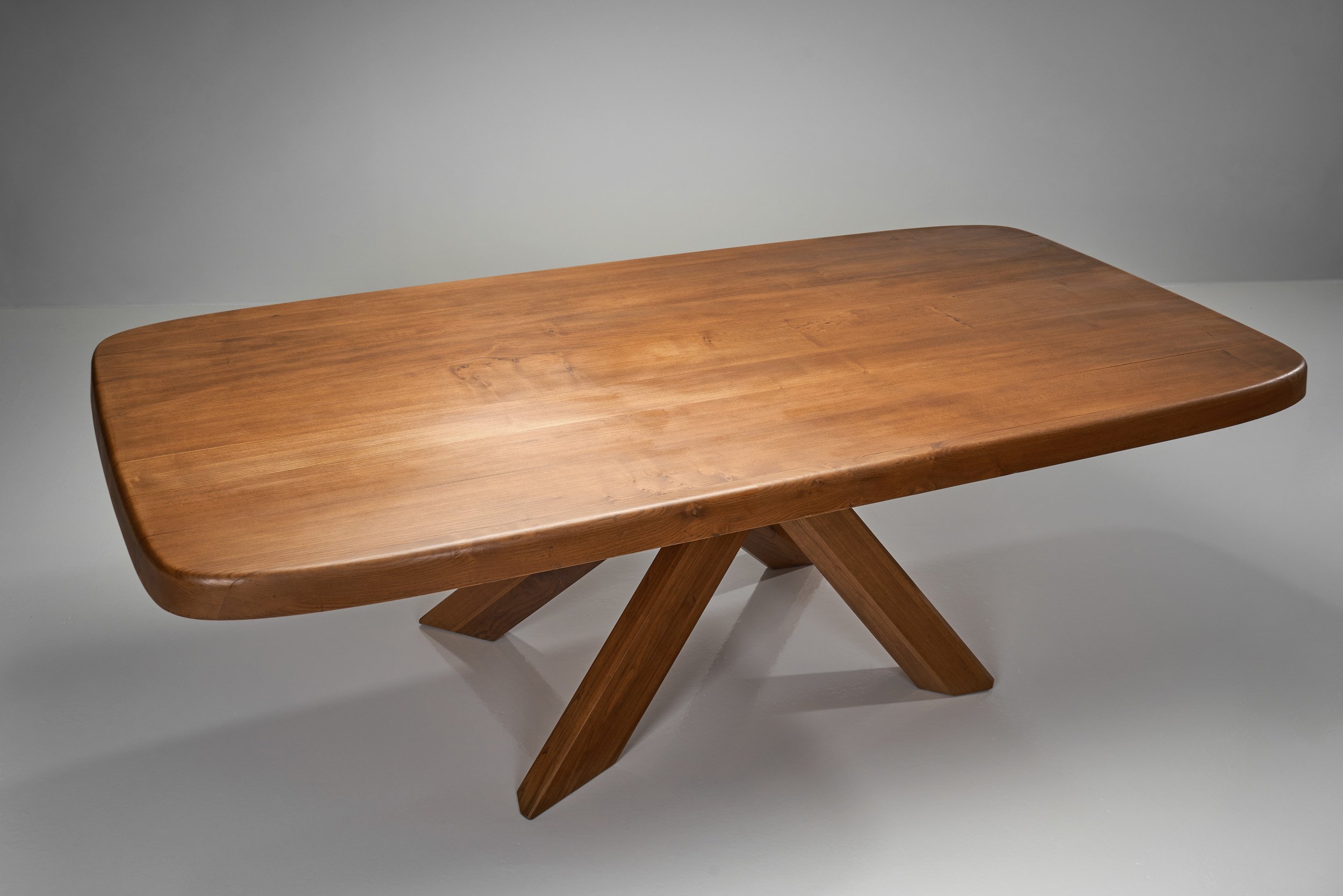
Pierre Chapo “T35D” Large Elm Dining Table with Bundled Base, France 1973 (sold)
Pierre Chapo, the celebrated French designer, was renowned for his meticulous craftsmanship and innovative approach to woodworking. Trained as an architect in Paris, Chapo was deeply influenced by the principles of proportion, form, and the natural beauty of wood. His work often features bold, architectural lines and a reverence for traditional joinery, seamlessly blending structural integrity with visual elegance. This dining table is a compelling embodiment of his distinctive style.
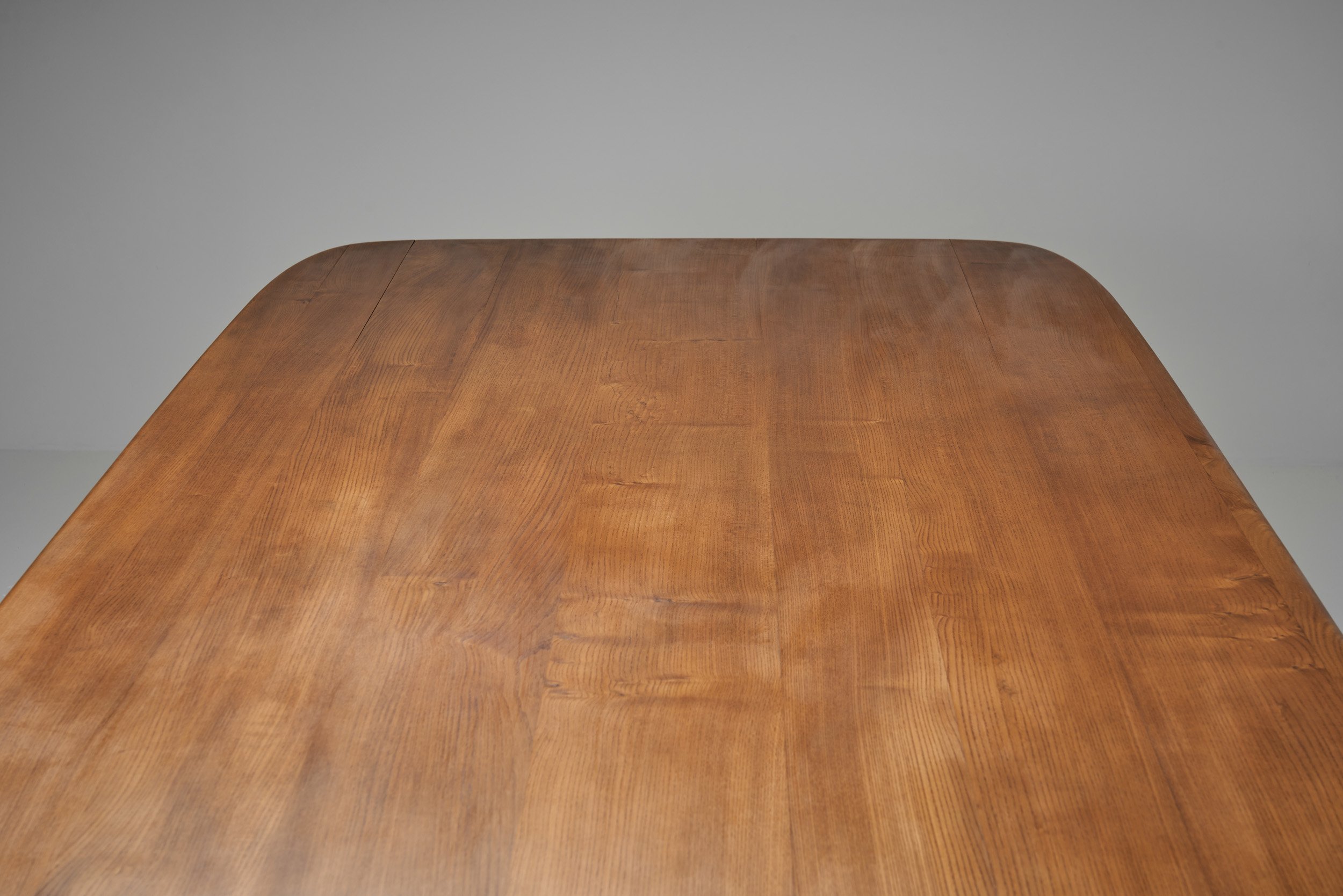
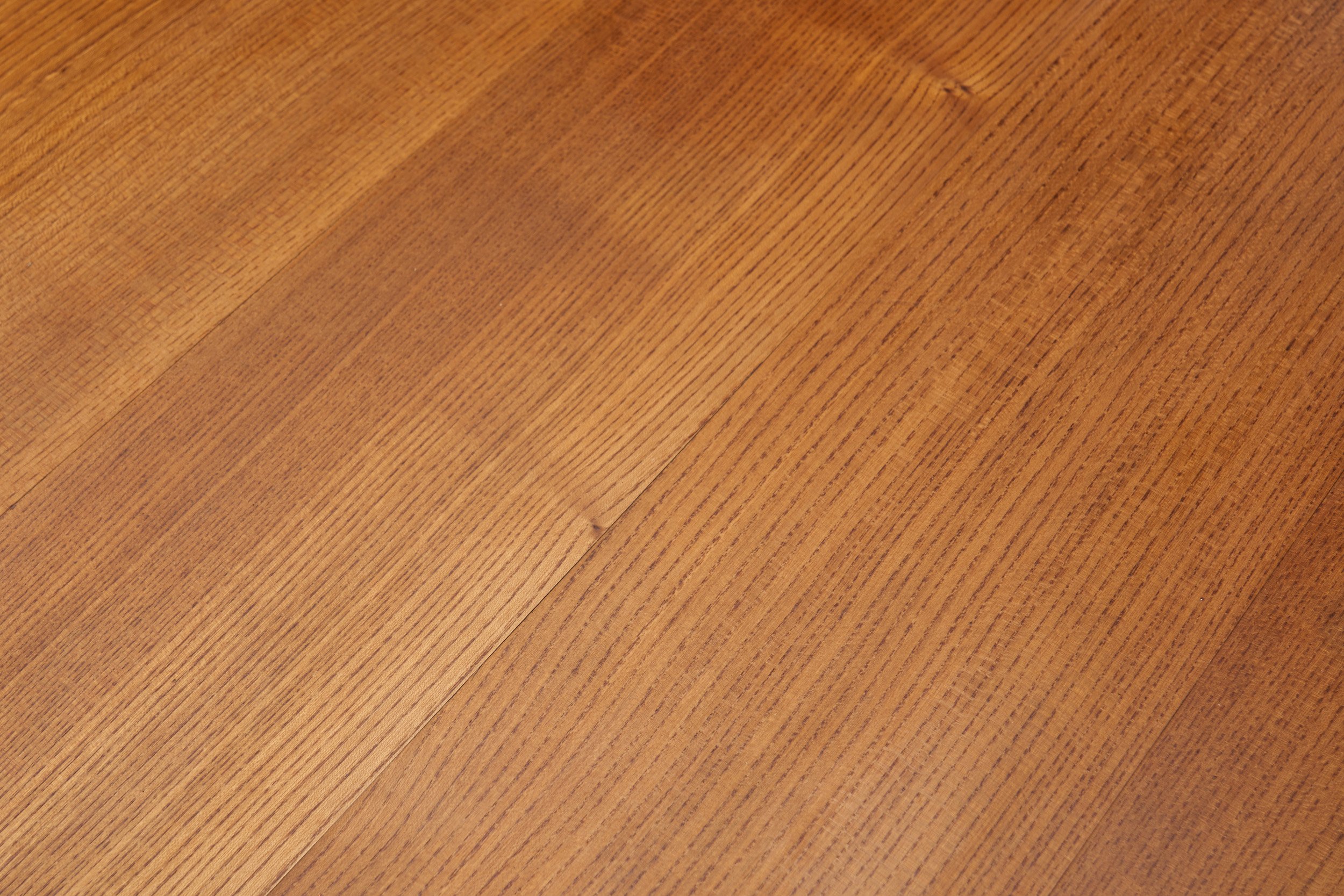
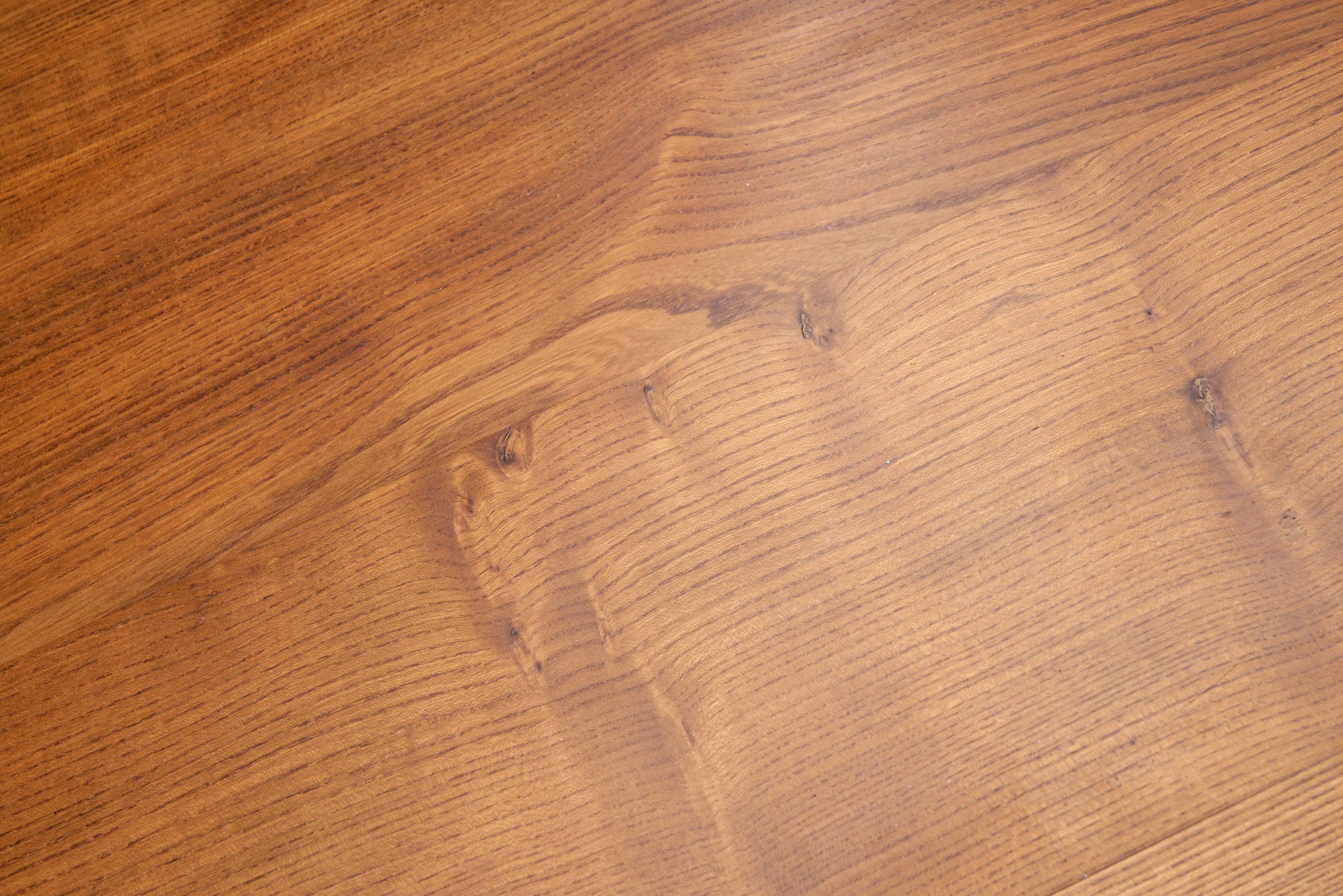
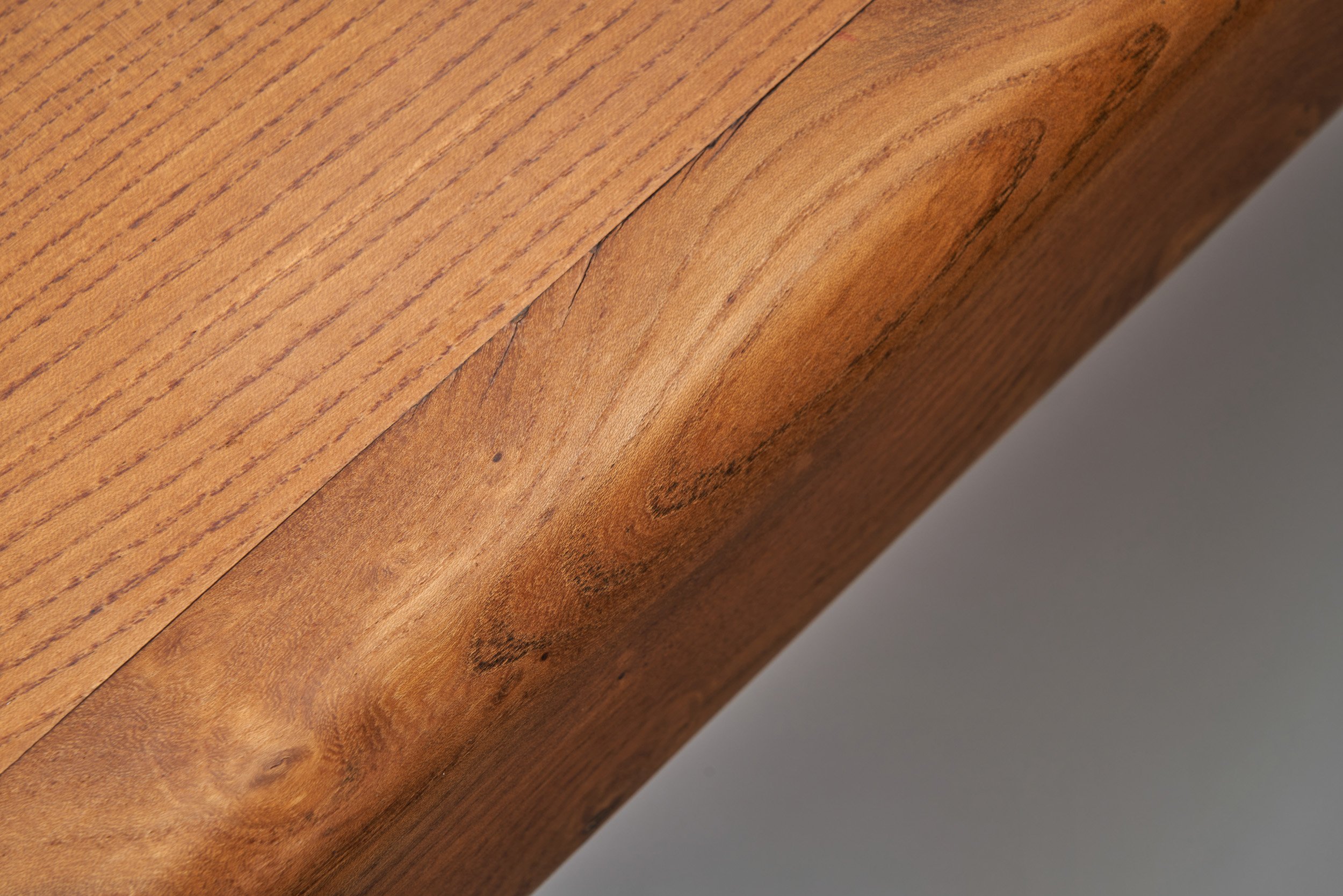
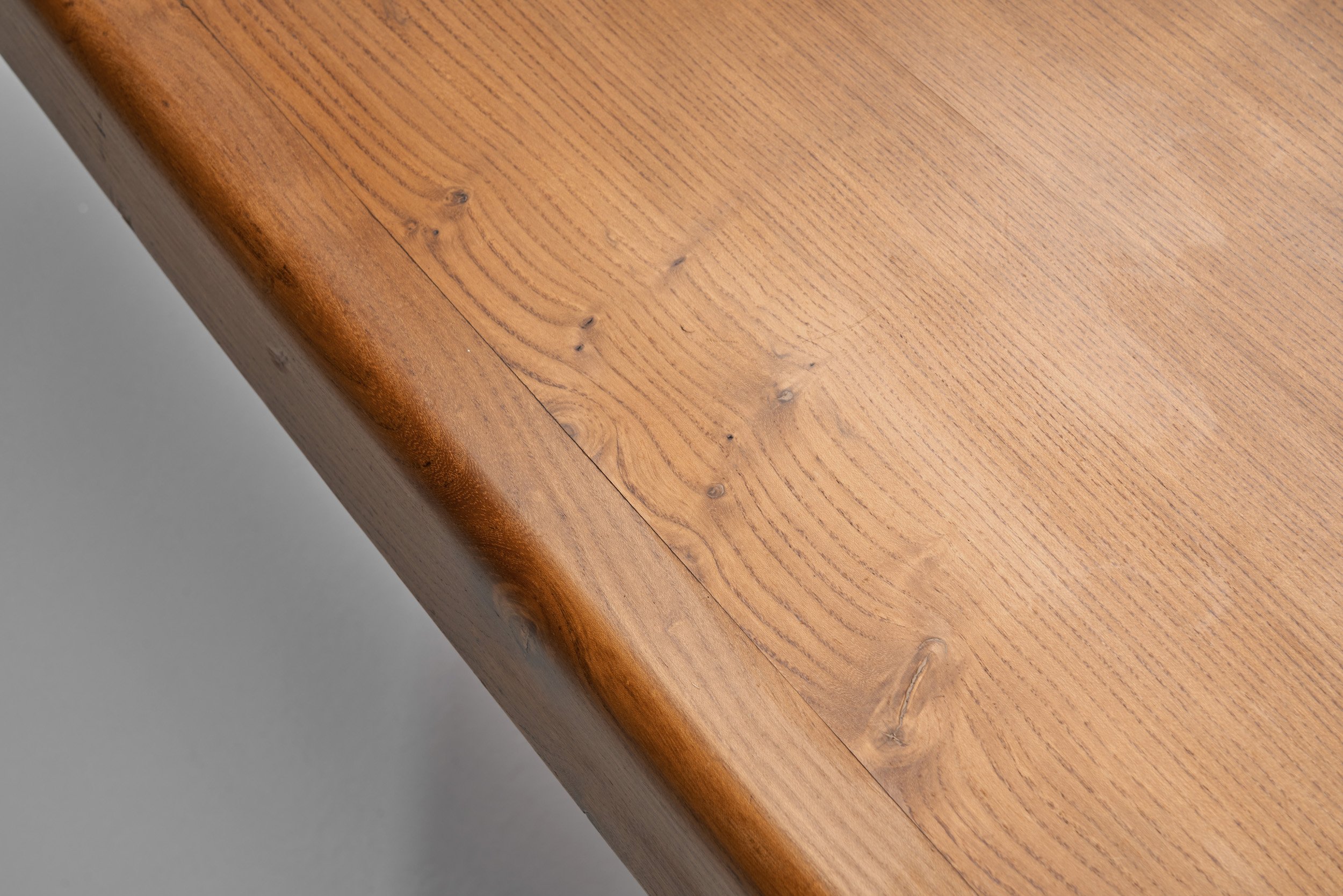
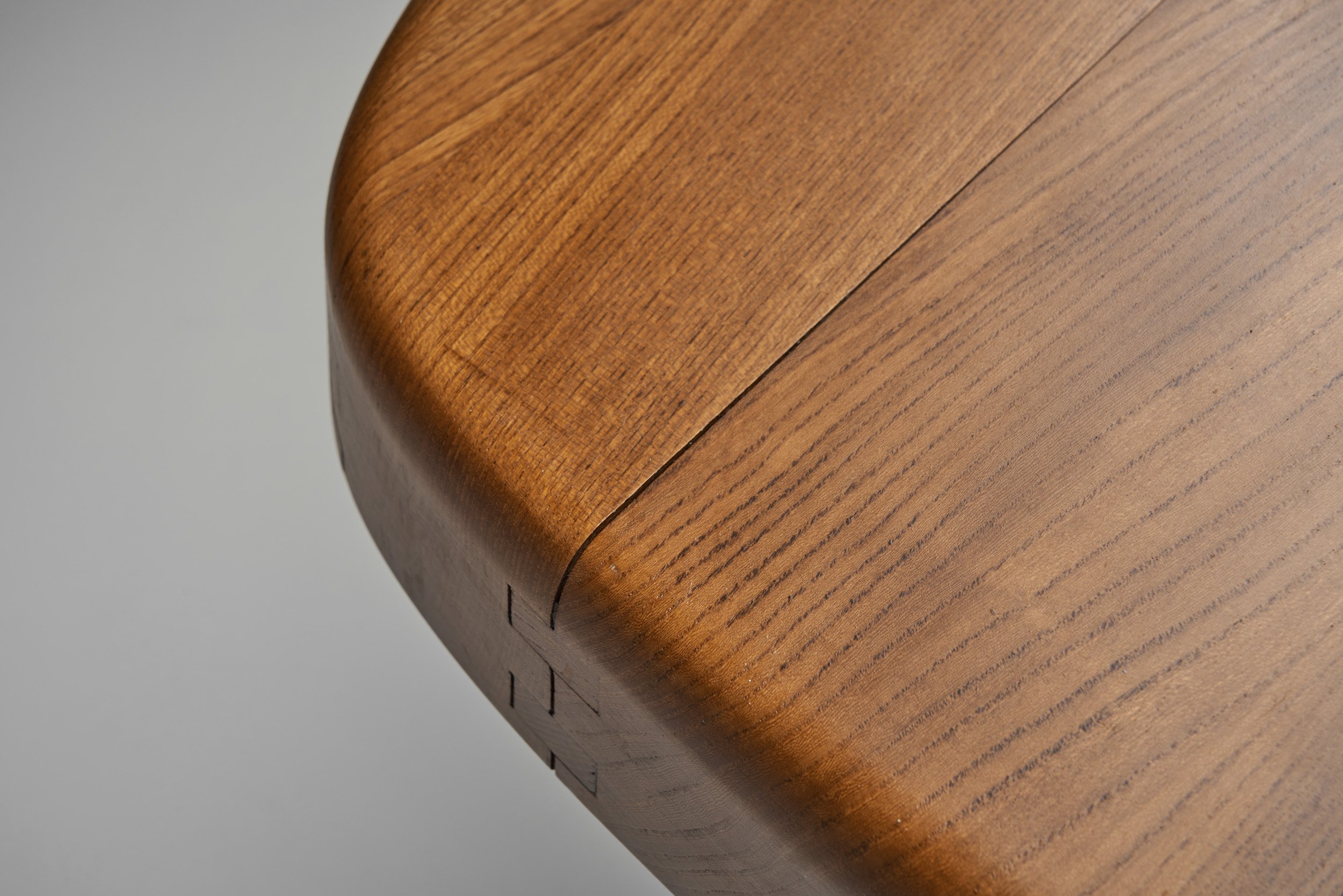
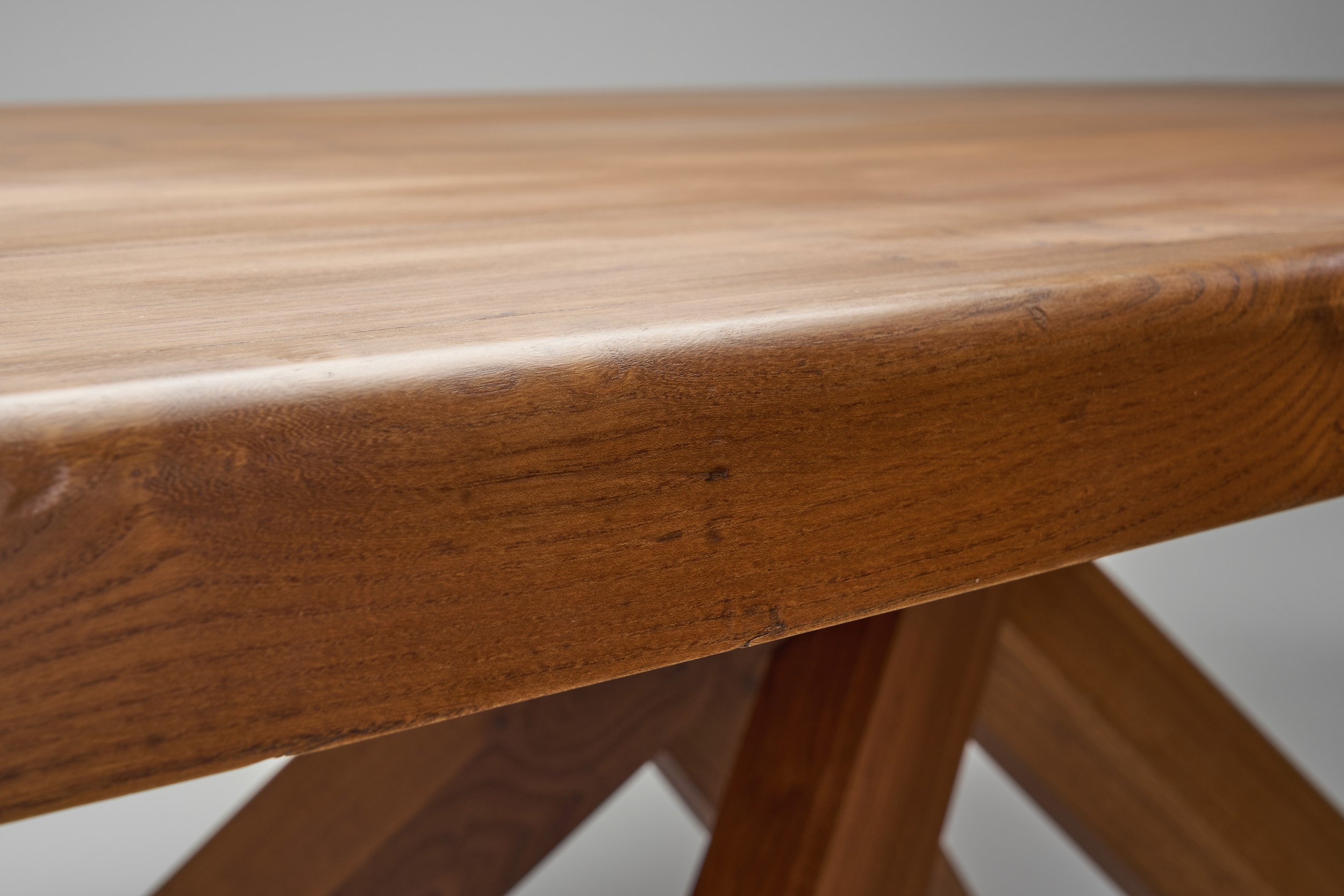
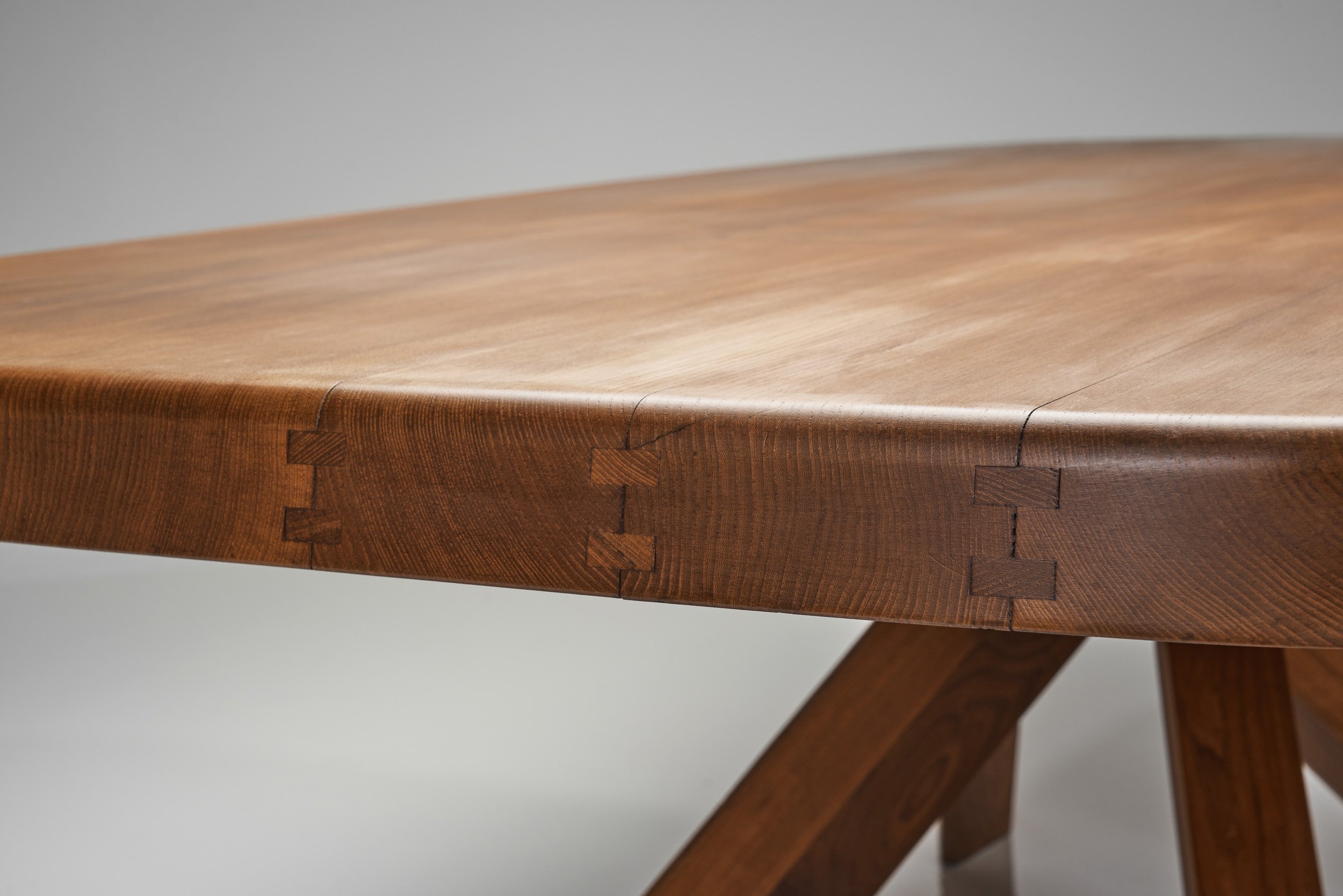
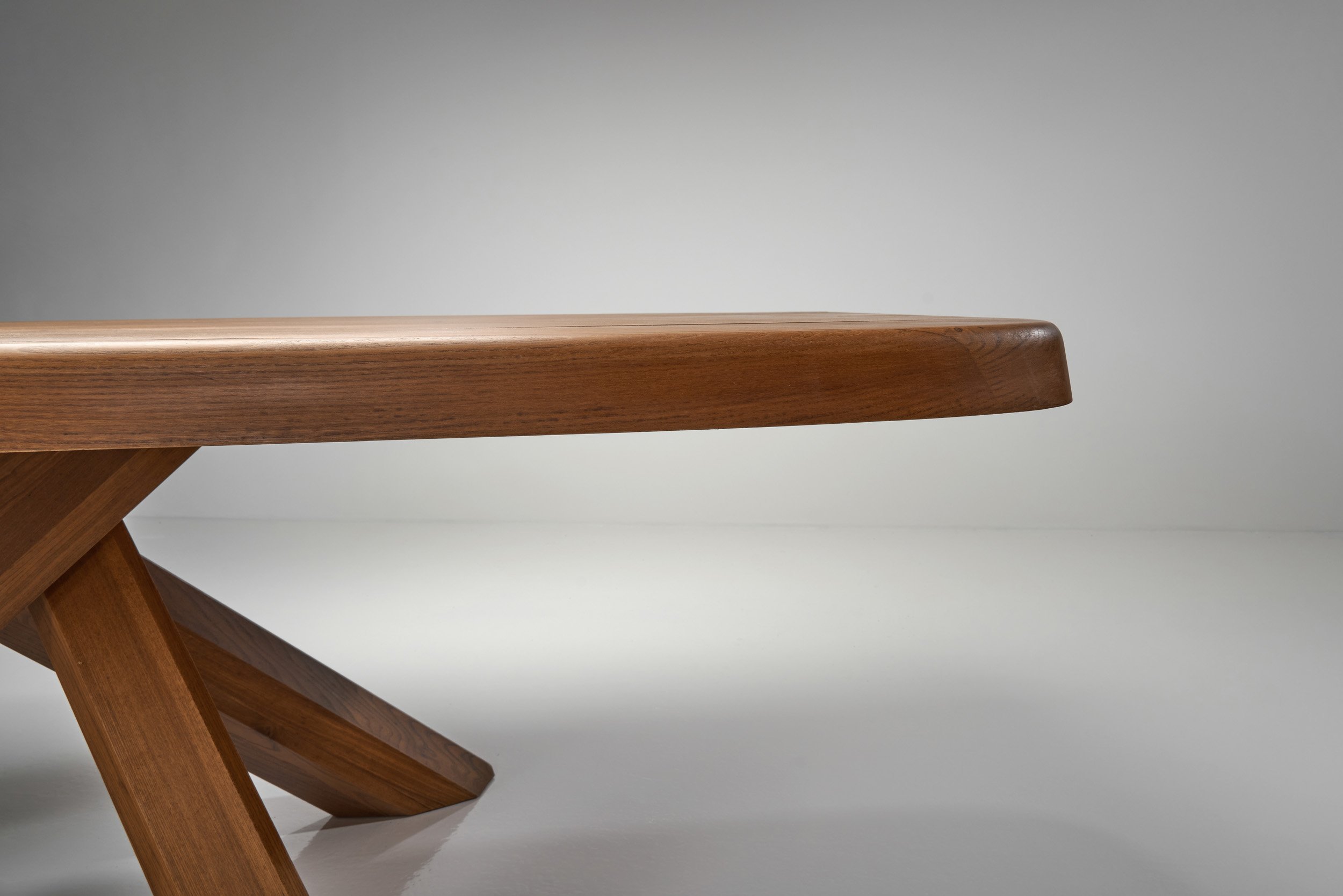
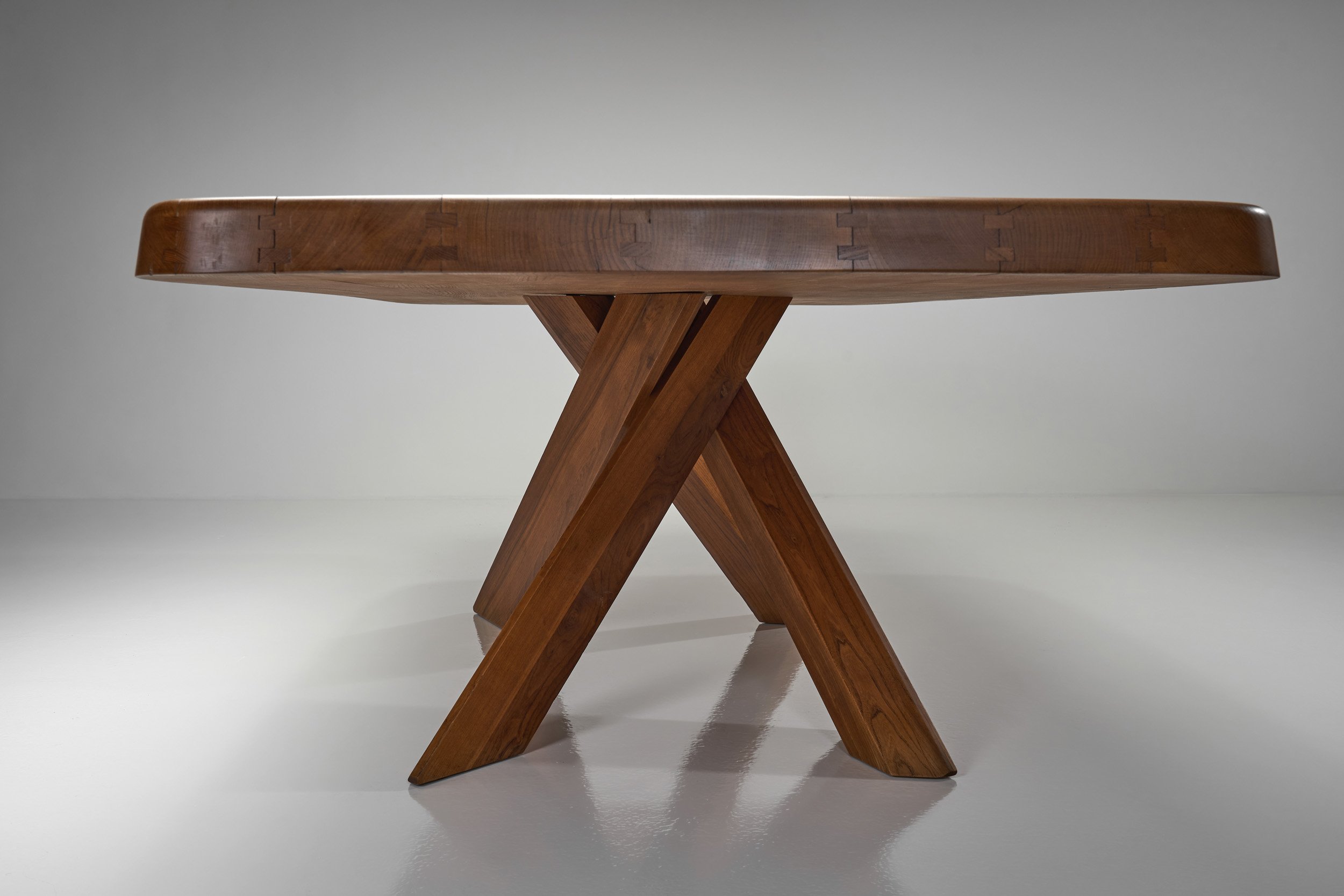
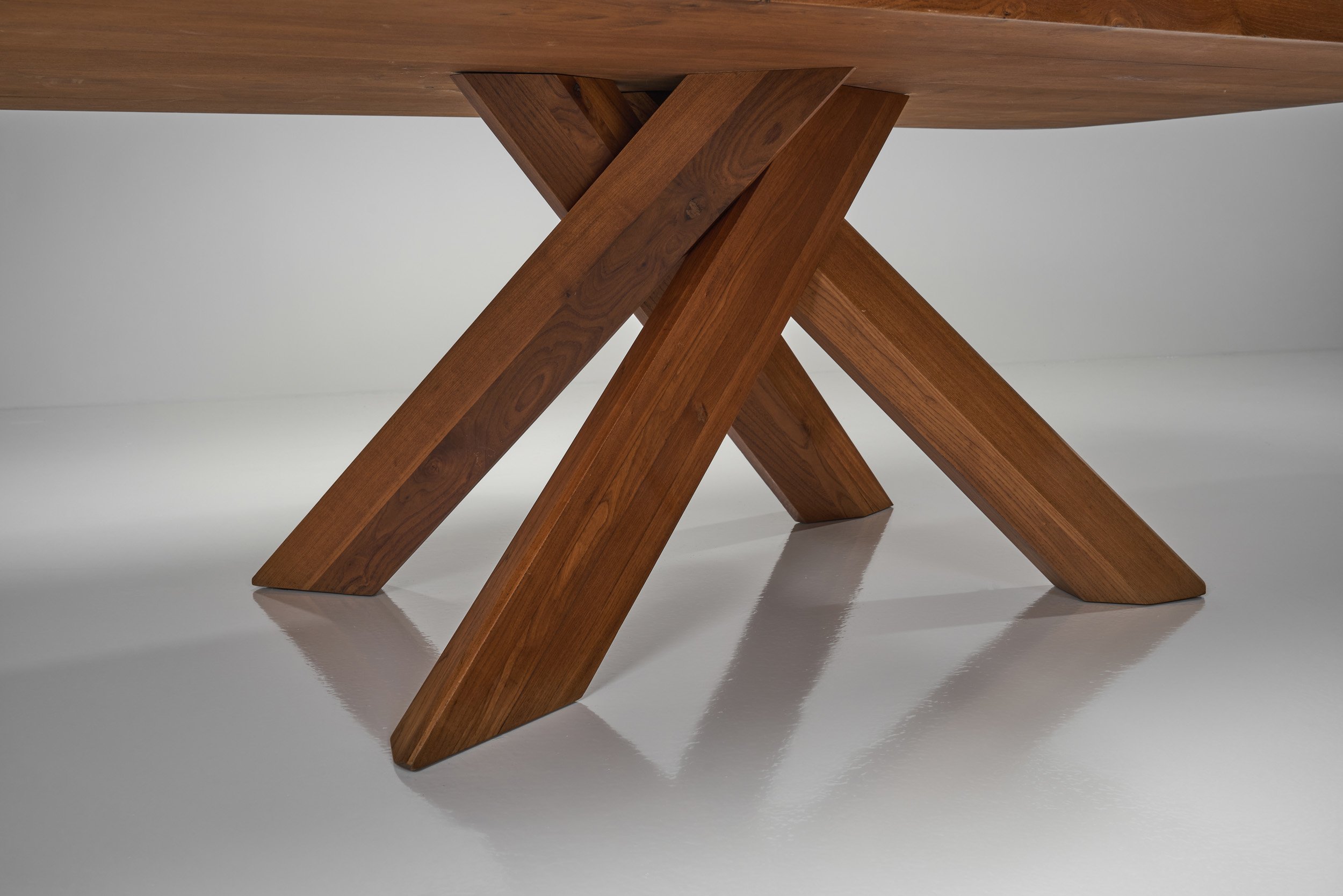
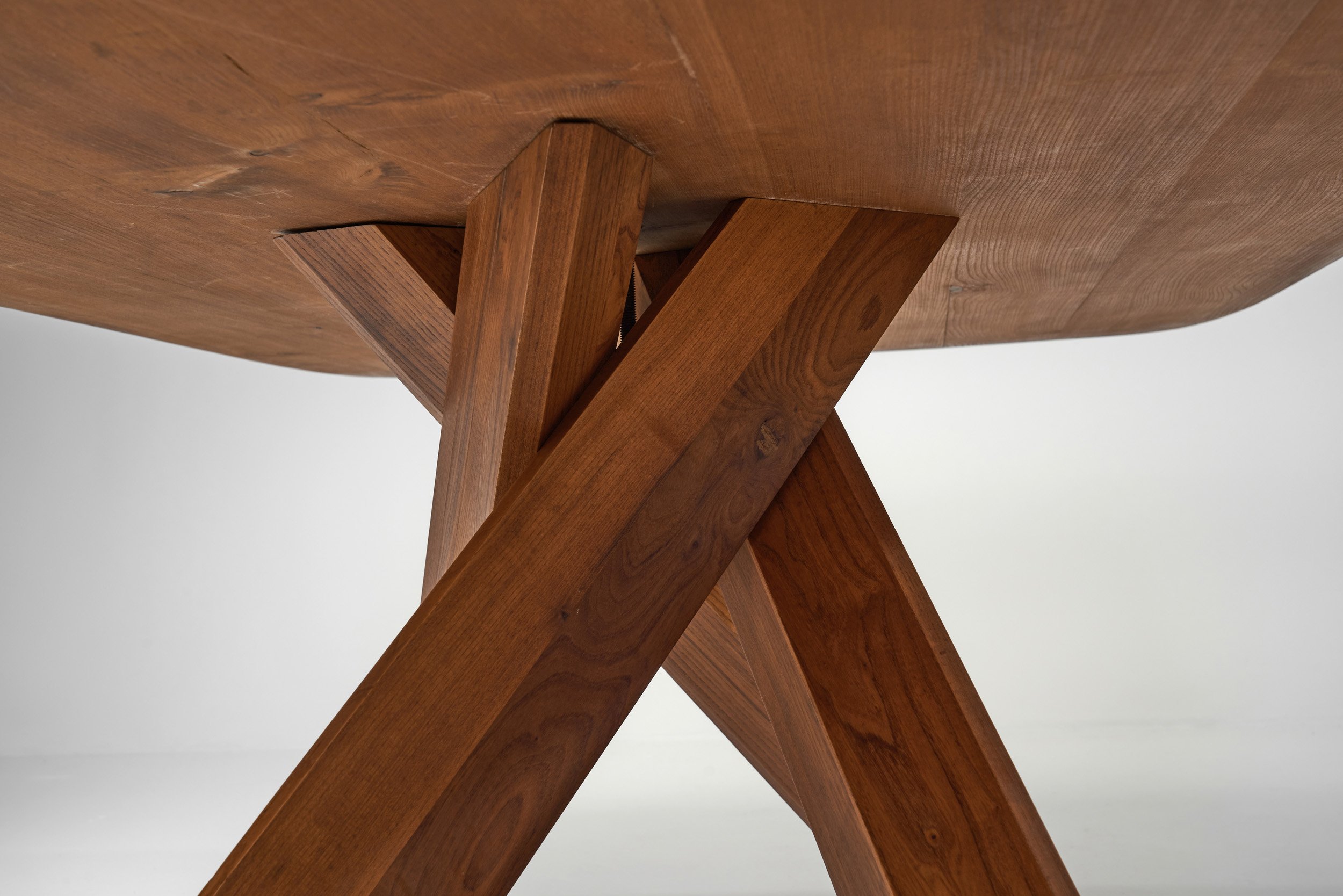
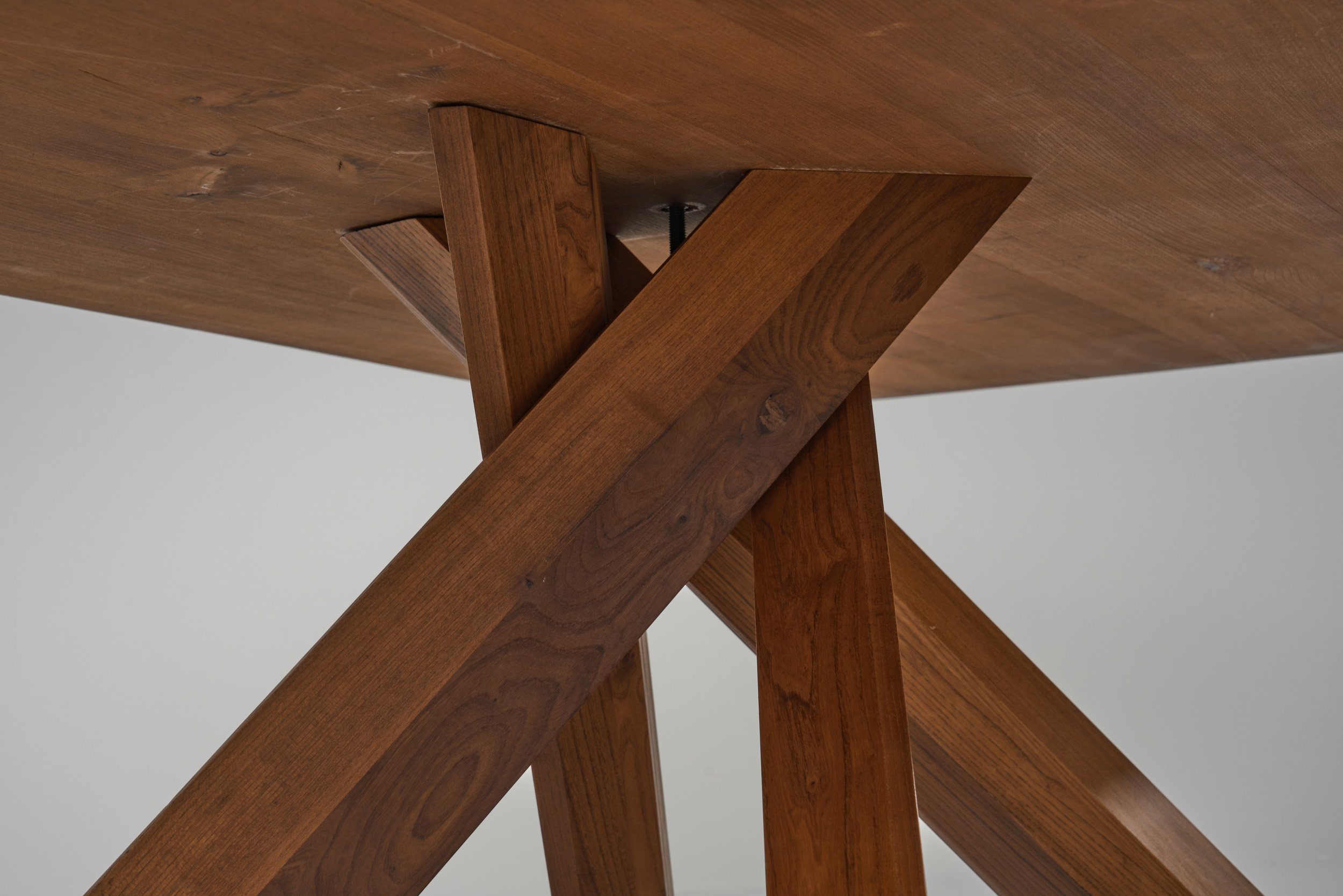
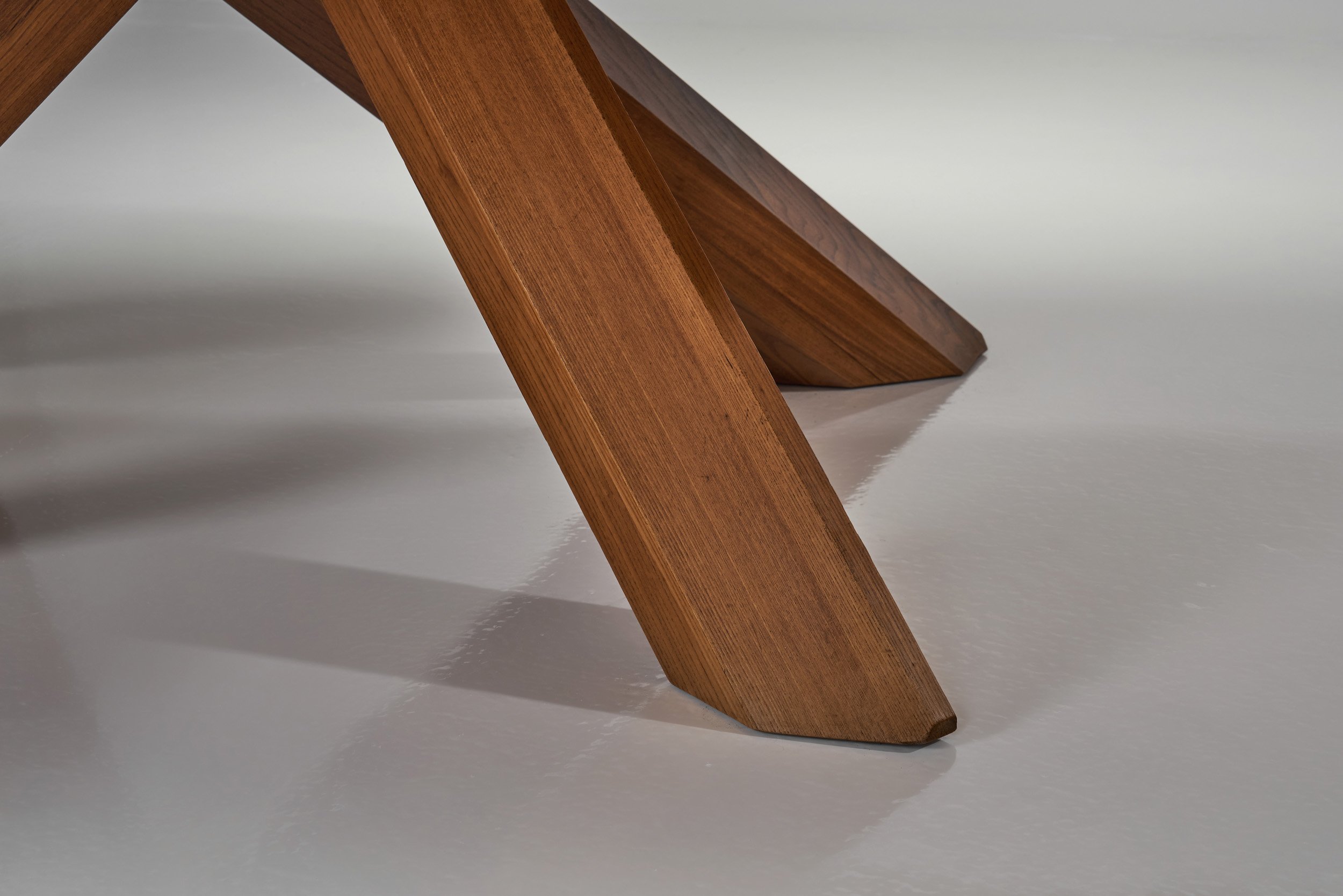
Pairing a creative design with impeccable craftsmanship is what resulted in a table model that truly stands the test of time, bringing lasting form and quality to any interior. Crafted entirely from solid elm, this “T35D” dining table demonstrates exceptional skill. Renowned for its striking grain patterns and long-lasting durability, elm is an ideal choice for larger pieces of furniture. This table’s vast flat surface, composed of carefully selected elm planks, beautifully highlights the wood's natural beauty, allowing the material to take center stage. The generous shape coupled with its warm honey tones, ensures that this table will be a focal point in any style of dining room or other large gathering area and is sure to be a conversation starter. The central quadripode base was designed with Chapo’s signature architectural legs, arranged in a dynamic way with the four pillars collapsing and balancing on each other at the same time, creating a striking visual rhythm.
Chapo’s designs reflect the architectural philosophies of the likes of Le Corbusier, as well as the commitment to the honest use of quality materials of Frank Lloyd Wright. His work is grounded in the simple harmony of form, function, and material. The principles carried out in his works, enabling him to produce grand scale items, while preserving an underlying sense of warmth and simplicity. This dining table adds character to any interior with its uniquely structured leg composition, reflecting the influence of mid-century modernism.
SOLD
Condition:
In good vintage condition. Wear consistent with age and use. The table has recently been reconditioned. Minor marks and scratches. Due to the nature of the wood, the table may have some additional discolouration.
Dimensions:
91.73 in W x 43.70 in D x 28.34 in H
233 cm W x 111 cm D x 72 cm H
About the designer:
Pierre Chapo, born in Paris on July 1927, was initially interested in becoming a professional painter. However, after a chance meeting with a shipbuilder who introduced him to wood and wood crafts, Chapo changed his focus and decided to study architectural studies at the prestigious École Nationale Supérieure des Beaux-Arts in Paris.
After graduating Chapo and his wife, the sculptor and painter Nicole Lormier, started to travel extensively through Scandinavia and Central America. Among the many places the couple visited was the home and studio of Frank Lloyd Wright in Taliesin West. A visit that had a lasting influence on Chapo’s future work and designs.
REQUEST PRICE HERE
Price category: 12,500 - 15,000 usd / eur
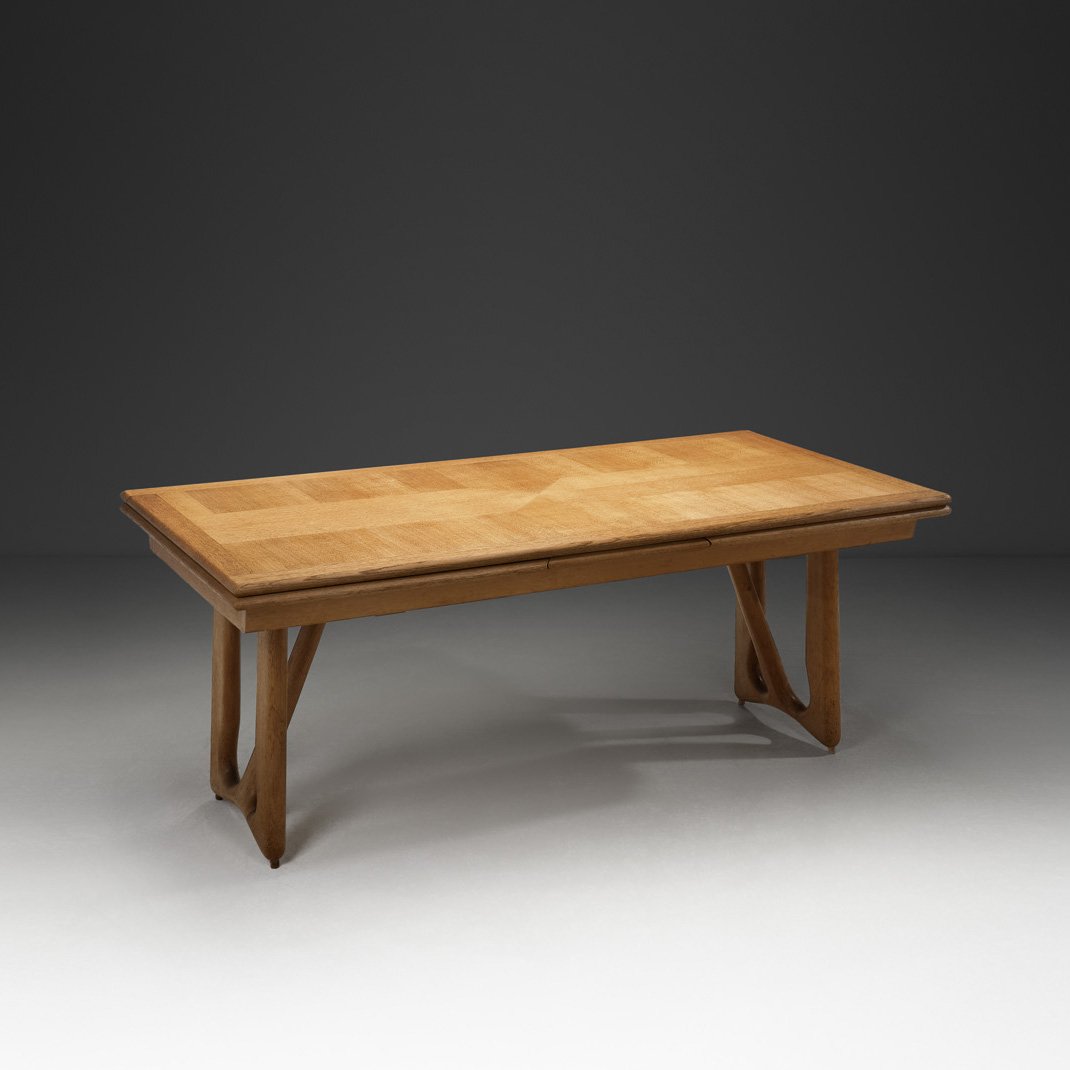
This stunning "L'Italienne" dining table, designed by the renowned French duo Guillerme et Chambron, showcases an exquisite blend of elegant aesthetics and rustic design elements. Crafted in the 1960s by Votre Maison, the table reminds us how form and elegance blend together in the duo's exceptional distinctive craftsmanship style.
At the heart of the construction of this model is the use of oak, a material renowned for its durability and timeless aesthetic qualities. Oak was the preferred material for Guillerme et Chambron, and this piece expertly showcases its rich and robust character, resulting in a solid, functional, and visually captivating work of art. Compared to the duo’s other models, this table is more pared down, relying mostly on the natural appeal of the oak, and its decorative legs. Unlike in most mid-century models, ornamentation was an important part of the duo’s creations, and while apparent, they were never overwhelming. This balance kept the pieces’ elegance, like in the case of this dining table. Furthermore, this piece is full of character and offers expressive and sculptural functionalism. Guillerme et Chambron’s table designs are well-known for their distinctive appearance and multi-functionality; this model is extendable and shows how decorative design and functionality were equally important for the designers, being as sensitive to the use of furniture in everyday life as to the creation of innovative design.
The table's form is clean, geometric, and is a testament to Guillerme et Chambron's dedication to modernism, while staying rooted in traditional craftsmanship and joinery techniques. Their work not only represents the fusion of function and form, but also exemplifies the mid-century modern aesthetic, which they played a pivotal role in actively shaping. Their emphasis on quality craftsmanship and the use of noble materials - like oak - has undeniably left a lasting imprint in the world of furniture making, solidifying their legacy in the French design landscape during the mid-century era.
Condition:
In good vintage condition. Wear consistent with age and use. The item has recently been reconditioned. Due to the nature and age of the wood, the item may have some marks, scratches, and discolouration.
Dimensions:
70.87 in W x 34.45 in D x 28.54 in H
180 cm W x 87.5 cm D x 72.5 cm H
REQUEST PRICE HERE
Price category: 5,000 - 7,500 usd / eur
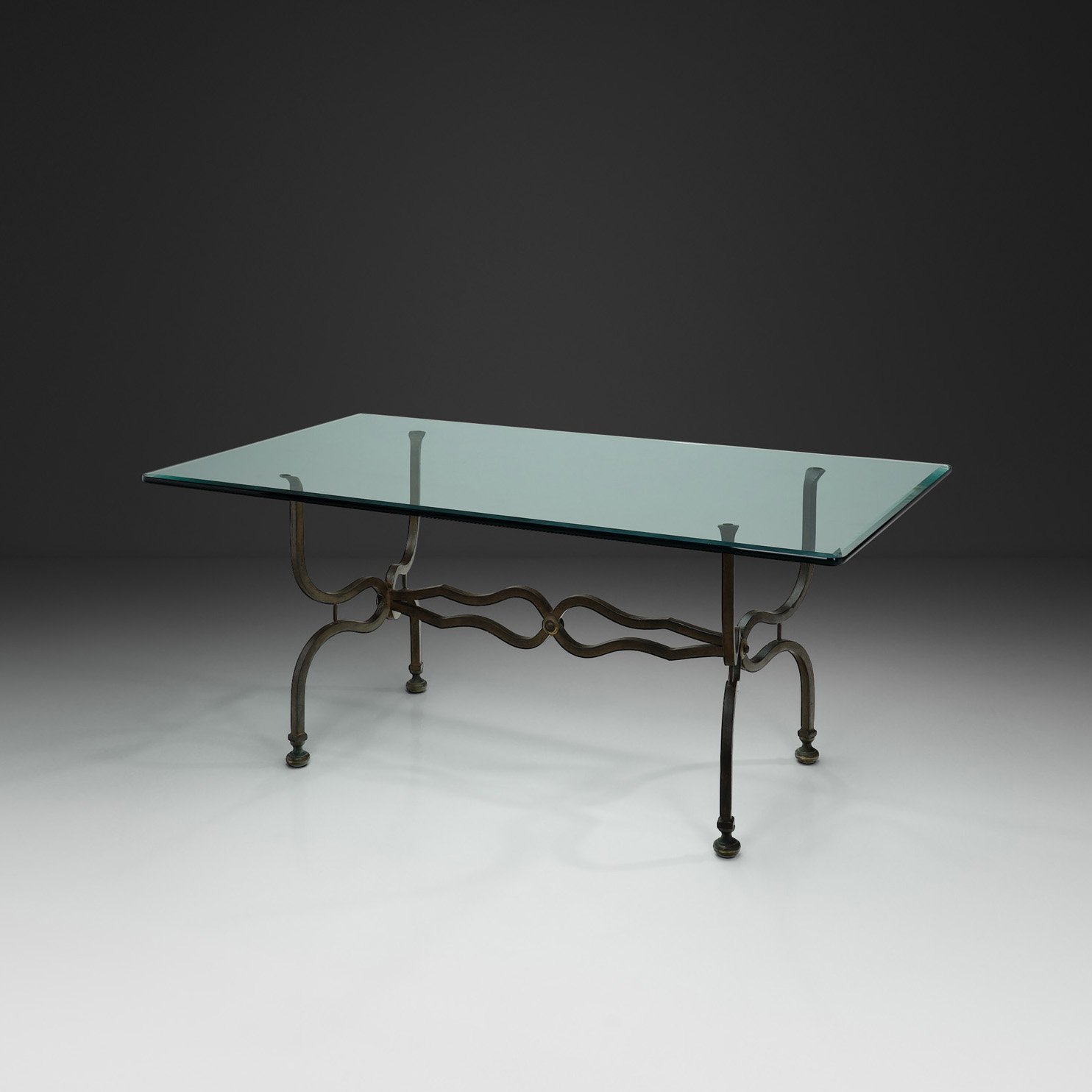
The Savonarola originates from a chair found in the convent of San Marco in Florence which was used by the 15th century Italian Dominican priest Girolamo Savonarola. Savonarola-style pieces feature a lower structure built from intersecting or flowing supports. In Italian design, it was often constructed from wrought iron, where curved elements replace rigid straight lines and create a sense of movement within the structure.
This dining table reflects that sentiment through its wrought iron base. The structure is made up of slender metal supports that curve and connect across the underside of the table. These elements distribute weight across the base to offer stability while also supporting the glass top above. The glass top introduces a strong contrast to the expressive base. It is flat, clear, and clearly geometrical, allowing the structure beneath to remain fully visible. This transparency turns the base into the focal point of the design rather than hiding it. The table feels balanced, from the mix of juxtaposing materials and shapes. The iron base is strong and bold, yet its curved lines prevent it from appearing rigid. The glass top, in turn, helps avoid visual clutter and makes the table easier to place in a room without overwhelming the space.
Overall, the piece works as both a functional dining table and a sculptural object. The combination of materials highlights the contrast between structure and transparency, while the flowing base connects the design to earlier Italian furniture traditions in a modern form.
Condition:
In good vintage condition. Wear consistent with age and use. Marks and scratches are present on the glass. Due to the nature and age of the iron, the item may have some marks, scratches, and discolouration. Additional imperfections on the glass may be present due to age and manufacturing inconsistencies.
Dimensions:
70.86 in W x 39.37 in D x 29.52 in H
180 cm W x 100 cm D x 75 cm H
REQUEST PRICE HERE
Price category: 12,500 - 15,000 usd / eur
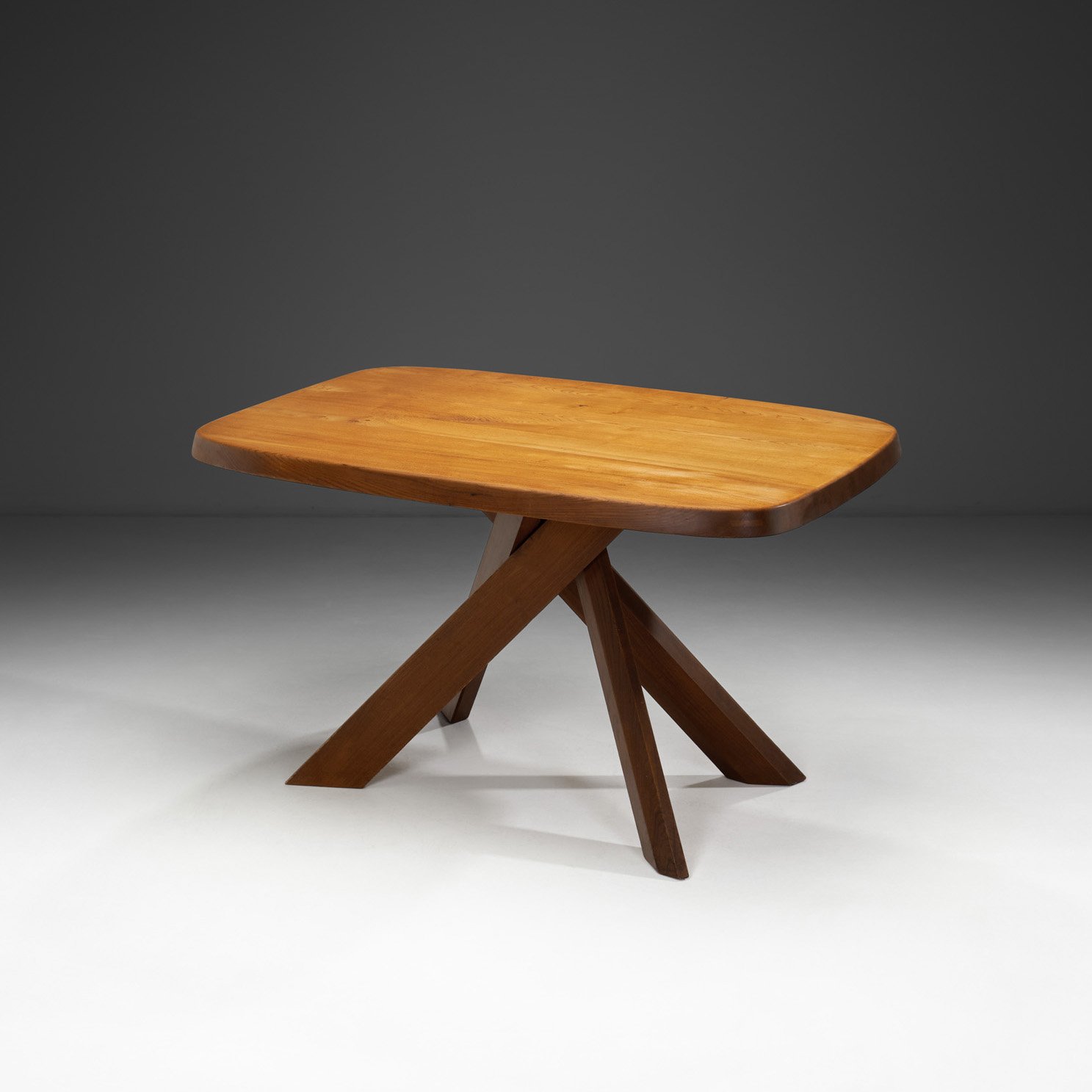
This dining table is a compelling embodiment of Pierre Chapo’s distinctive style. He always paired his creative and elegant designs with impeccable craftsmanship that gained him worldwide fame and love. This model “T35A” is a rare and beautiful example of Chapo’s designs, a piece that truly stands the test of time, bringing lasting form and quality to any interior.
Crafted entirely from solid elm, this dining table demonstrates exceptional craftsmanship and masterful joinery. Renowned for its striking grain patterns and long-lasting durability, elm is an ideal choice for larger pieces of furniture. This table’s vast flat surface, composed of carefully selected elm planks, beautifully highlights the wood's natural beauty, allowing the material to take center stage and speak for itself. The generous shape coupled with its warm honey tones, ensures that this table will be a focal point in any style of dining room or other large gathering area and is sure to be a conversation starter. The central quadripode base was designed with Chapo’s signature architectural legs, arranged in a dynamic way with the four pillars collapsing and balancing on each other at the same time, creating a striking visual rhythm.
Chapo’s designs reflect the architectural philosophies of Le Corbusier, as well as the commitment to the honest use of quality materials of Frank Lloyd Wright. His work is grounded in the simple harmony of form, function, and material, principles carried out in his works, enabling him to produce grand scale items, while preserving an underlying sense of warmth and simplicity. This dining table adds character to any interior with its uniquely structured leg composition, reflecting the influence of mid-century modernism.
Condition:
In good vintage condition. Wear consistent with age and use.
Dimensions:
50.19 in W x 32.67 in D x 28.74 in H
127.5 cm W x 83 cm D x 73 cm H

REQUEST PRICE HERE
Price category: 50,000+ usd / eur
"I can't live well with too much rigidity. The 90-degree angle, for example, is something I love, but I can't do it. The things I do end up being a little lyrical, a little sensual, in short, there is always an element that does not come from purity or cleanliness."
This beautiful pedestal table visualizes the above quote from Jorge Zalszupin. It was designed in 1959 and produced by his own company, L'atelier. Essentially, the sizeable top rests on one concrete base finished with soft leather. The solid wood patchwork on the tabletop is mesmerizing, showcasing the many shades of Brazilian hardwood. This was not a purely aesthetic choice, but also an initiative for the rationalization and use of leftover scraps of wood available at the factory, allowing at the same time a combination of their different colourings. The way the large top is supported by the thick metal structure shows architectural precision and the use of materials of the highest quality. At the time of its creation, this table was presented as a dynamic piece that could be used in both the corporate and the domestic places thanks to its casual elegance. Today, its versatility is still recognized, a mark of good design. Zalszupin’s L’Atelier was a design collective comprised of architects, engineers, craftsmen and a full-scale team of professionals who did everything from researching materials to finalizing the product. Therefore, the quality of L’Atelier furniture has transcended time and his pieces have become timeless.
The name is said to be a reference to the famous Baia de Guanabara, a traditional postcard image of Rio de Janeiro. Zalszupin's production established a dialogue very close to the artisanal traditions of working with wood, ensuring quality in the aesthetics and manufacturing of his work.
Condition:
In good vintage condition. Wear consistent with age and use. Some minor scratches on the wooden tabletop. The leather covering on the base is a later replacement.
Dimensions:
98.82 in W x 49.21 in D x 29.13 in H
251 cm W x 125 cm D x 74 cm H
Literature :
Jorge Zalszupin, Design Moderno no Brasil – Maria Cecilia Loschiavo dos Santos, Olhares Edition, São Paulo, 2014, p. 142
About the designer:
Jorge Zalszupin was born in Warsaw, Poland, in 1922. He graduated as an architect in Romania in 1945. His importance for Brazilian design has been articulated in several publications so far. In addition to being the owner of the l'Atelier furniture factory of modern furniture, Zalszupin led a unique initiative: he coordinated a team of designers working for four different factories in the same business group, the Forsa Group.
Zalszupin immigrated to Brazil in 1949 and after a brief stay in the capital, he settled in São Paulo, a city that was then entering a cycle of great industrial growth and great cultural transformations. In the first half of the 1950s, he opened an architecture office, having José Gugliota as a partner. When he got tired of designing exclusive furniture manufactured for his clients' homes, he decided to join a group of woodworkers and started to produce smaller series. This was how l'Atelier came into being, which eventually began to manufacture office furniture and went from a carpentry shop with handcrafted products to an industry with serial production. The first piece in this series was an armchair nicknamed 'Danish' by employees. It was first created in 1959.
After the crisis of the 1980s, Jorge Zalszupin dedicated himself exclusively to architecture, an activity he had never abandoned. From 2005, the company Etel Marcenaria started to produce several of the items designed by Zalszupin for l'Atelier - among them the 'Danish' armchair -, privileging the objects of the company's artisanal phase. ~H.

REQUEST PRICE HERE
Price category: 5,000 - 7,500 usd / eur
The period between 1950 and 1970 was characterised by some of the most stunning and well-executed furniture designs of the 20th century. As with the UK and much of Europe, there was something of a design renaissance in France in the 1950s, due to developments in materials and technology after the war. In France, designers were often also architects, whose focus on functionality and quality resulted in pieces such as this stunning dining table.
This model is all about the gorgeous wooden structure. The discreet joinery and seamless construction reflect the French emphasis on detail and quality, elevating the piece beyond just functional to an object of aesthetic value. The design is dominated by the rectangular tabletop; it features a rich, dark wood veneer that showcases the grain and deep tones of the wood, which can add a sense of warmth and sophistication to any dining space. To support the top are four legs with impeccable joinery that is visible under the tabletop. Since this piece was made in the heyday of mid-century design, the legs - and the table as a whole - lack heavy ornamentation, and instead the focus is on the beauty of the material. The mid-century pieces that appeal to most are the models that were designed with both nature and function in mind, which appear completely contemporary and undated, making this dark wood dining table an exceptional example of the ideals of the era. Overall, the clean lines and balanced proportions create a streamlined silhouette, while the dark finish lends a timeless quality that complements both classic and contemporary interiors.
Wood has never gone out of style, and interior design with an emphasis on natural materials is only gaining popularity today. This dining table will make a striking addition to a variety of interiors.
Condition:
In good vintage condition. Wear consistent with age and use.
Dimensions:
66.93 in W x 33.46 in D x 29.92 in H
170 cm W x 85 cm D x 76 cm H

REQUEST PRICE HERE
Price category: 2,500 - 5,000 usd / eur
This extraordinary sculptural round dining table has strong lines and proportions and was made in very small numbers.
The table consists of eight beech elements that have a petal like shape. The elements are connected with eight black metal round inlays to which the eight legs are connected at the bottom side. This table is the luxury model that holds a "Lazy Susan" (turntable) in the middle; the large black lacquered metal disc in the centre runs on ball bearings and is rotatable so that you can, for example, share food without having to rise. The slender cylindrical legs are made out of black lacquered metal with tapered solid beech feet.
Manufactured and marked by Nissen, Langå Denmark.
Condition:
In good vintage condition. Wear consistent with age and use. Item has some small marks and scratches. The table can be purchased with two additional legs.
Dimensions:
53.54 in Ø x 29.33 in H
136 cm Ø x 74.5 cm H

REQUEST PRICE HERE
Price category: 7,500 - 10,000 usd / eur
This rare “AT-309” dining table was designed by Hans Wegner in 1955 and its title of ‘iconic’ is well deserved. As it is no longer produced, this model has become a collector’s item created by a designer who is credited as one of the main driving forces of the mid-century Danish modern movement.
The “AT-309” model is also commonly referred to as the “saw-horse” for its trestle base. In woodworking, a saw-horse is a trestle structure used to support a board similarly to this model’s case. While Hans J. Wegner became world-renowned for his chairs, he also designed a broad range of tables, where he was just as thorough and artistic about the proportions, construction, function, and style. With a clear statement of simplicity, quality and respect for materials, this table is a great example of Danish Modern design. The massive teak tabletop with drop-leafs is stunning on its own, showcasing the wood’s grain and offering plenty of space with the extendable solution. However, to Wegner, the most important part of his tables was not the top, but rather what was underneath. For the supporting structure he used the distinctive saw-horse look with crossed legs and brass braces. The diagonal brass reinforcement is not only a significant structural feature, it is also a visually appealing detail that gives character to this dining table. Looking beneath the top, the elaborate oak structure becomes visible, showing both Wegner’s and the manufacturer’s expert skill and knowledge.
Over the course of his career, the designer collaborated with several renowned manufacturers, including Andreas Tuck. The company was one of the greatest Danish furniture design companies of the mid-20th century, producing pieces that epitomize classic Danish craftsmanship. Wegner worked with the company for many years, creating iconic designs such as this “AT-309” table.
Condition:
In good vintage condition. Wear consistent with age and use. The tabletop has been refinished.
Dimensions:
51.96 in W (89.76 in when extended) x 33.66 in D x 28.14 in H
132 cm W (228 cm when extended) x 85.5 cm D x 71.5 cm H
About the designer:
Hans Wegner (1914–2007) is considered as one of the most influential designers of Scandinavian design. Danish-born Wegner became a national and international design idol for shaping the history of design in the 1950s and ‘60s.
In his designs, the sharp edges defining Modernism were smoothened, creating his iconic chairs. As a pioneer of the modernist style, often described as “organic functionality”, Wegner described his method as “stripping the old chairs of their outer style and letting them appear in their pure construction.”.
At 14 years old, he began his apprenticeship with Danish master cabinetmaker H. F. Stahlberg. After serving in the military he moved to Copenhagen, and attended the School of Arts and Crafts, before setting out as a furniture designer. In 1943, he established his own studio, producing designs for manufacturers like AP Stolen, Fredericia Stolefabrik, and in later years, PP Møbler.
Wegner designed more than 500 chairs in his lifetime, refining an approach that combined a variety of natural materials and pushed traditional joinery techniques to extreme tolerances and distillations. Wegner’s background as a cabinetmaker gave him a deep understanding of how to integrate exacting joinery techniques with exquisite form, realizing the perfect combination with form and purpose.
The core of Wegner’s legacy remains his focus on showing the inner soul of furniture pieces through a simple and functional exterior. ~H.

REQUEST PRICE HERE
Price category: 7,500 - 10,000 usd / eur
Giuseppe Scapinelli was known as a designer who successfully combined “the classic” with “the modern”, and this table stands as evidence. Scapinelli was a Brazilian designer from São Paulo who did not use any means of mass production. His furniture alternated and combined elements from Italian classicism, innovative aerodynamic lines, and biomorphic shapes.
This rare circular table has an amazing construction that praises the firm, Angelini & Delneri. Upon first sight, this model is an elegant circular table made of beautifully grained wood. However, when the table is extended, the elaborate system is revealed by which the extra wooden leaves can be added to extend the length. The artisanal level craftsmanship is as stunning as the design itself, with traditional joinery techniques such as pegs and so-called ‘biscuit’ joints. Besides the extension system, the craftsmanship is also evident in every edge and angle, such as the legs’ curve and the ring strengthening them. This table is very successful at balancing large volumes with clean lines. The legs have rounded edges and are slightly splayed below the wooden ring.
This memorable design is from a designer committed to pushing the boundaries of modernist design in Brazil. The form is functional and elegant with subtle flourishes like intricate wooden details and the evident emphasis on functionality. This dining table is a grand piece that will stand out and add character to any interior.
Condition:
In good vintage condition. Wear consistent with age and use.
Dimensions:
47.24 in Ø x 28.34 in H
120 cm Ø x 72 cm H
About the designer:
Giuseppe Scapinelli was born in Reggio Emilia in Italy on the 2nd of July 1911 and was the 6th of thirteen sons. He graduated after studying architecture in 1941. However, just as his career was starting, it was abruptly interrupted by WW2, and he was forced to live in seclusion in an antique furniture shop, where he further studied the styles and production methods of old furniture. After the devastations of the war, the promise of a better life in South America oriented Scapinelli towards the continent. Finally, in 1948, Scapinelli decided to leave for Brazil, more specifically to the metropolis of São Paulo.
At first Scapinelli worked for the architect and well-known “Paulista” Francesco Matarazzo, who opened many doors for him and other Italian refugees. Later, in 1950, Scapinelli opened his own studio. Because of his modern and complete style in interior decoration, he soon settled as an architect / decorator backed by a great team of skilled Italian woodworkers.
Scapinelli was constantly studying all forms of visual arts and frequently integrated ceramics in his works. He was described in Brazil’s Casa e Jardim magazine at the time as: "{…} a classic who does not forget to be modern - or if you prefer - a modernist who does not forget to be classic". After a fruitful life, Giuseppe Scapinelli died in São Paulo in 1982, at the age of 71.
Today Scapinelli's style is still easily recognizable because of the curvy lines and soft sensual shapes, very much away from the mainstream works of his fellow designers at the time. With works beautifully crafted from traditional Brazilian woods like caviuna and jacaranda, he is remembered for his unique works combining the classic with the modern. ~H.

REQUEST PRICE HERE
Price category: 7,500 - 10,000 usd / eur
During the early 20th century, Europe was experiencing a dramatic shift in design sensibilities. Art Deco emerged as a response to the austerity of the previous era, blending modernist ideals with a love for luxury and ornamentation. It was an era that celebrated geometric forms, rich materials, and innovative craftsmanship, often incorporating bold contrasts of textures and colours.
This striking Art Deco table, dating from the 1930s, epitomises the elegance and boldness of the period. The table itself is a perfect example of Art Deco’s lavish but structured aesthetic. The piece’s large, commanding presence makes an immediate impact, yet its sleek, elegant design ensures it remains visually balanced. The choice of Macassar ebony veneer as the primary material is particularly significant; this wood is prized for its dense, dark texture, and its dramatic, visibly pronounced grain pattern. It is considered a highly valuable wood for turning, fine cabinet work, and joinery. The tabletop is supported by two grand, rounded legs. These legs are connected by a pair of brass bars, which serve as spacers. The brass bars do not only provide structural integrity but also serve as an aesthetic feature, adding a touch of refinement to the piece. The golden accents evoke the luxurious nature of the Art Deco movement, while the fluid lines of the legs inject a sense of modernity and elegance. The rich brown and almost black hues of the ebony contrast beautifully with the golden brass accents, creating a striking interplay of natural and industrial elements.
This table embodies the spirit of 1930s Europe—where form and function merged seamlessly, and craftsmanship was revered. As a statement piece, it captures the essence of Art Deco’s timeless appeal, making it a standout addition to any space.
Condition:
In good vintage condition. Wear consistent with age and use.
Dimensions:
78.93 in W x 41.33 in D x 29.92 in H
200.5 cm W x 105 cm D x 76 cm H

REQUEST PRICE HERE
Price category: 5,000 - 7,500 usd / eur
During the 20th century, Italian mid-century design embraced innovation, blending traditional craftsmanship with modern aesthetics. This period became renowned for merging function with artful form, creating pieces that were as visually striking as they were practical. This Italian dining table epitomises that era, embodying both the timeless elegance and forward-thinking spirit that defined mid-century design.
Without heavy ornamentation, the viewer's eyes fall on the beautiful design and quality materials. From the use of walnut wood to the shiny glass top, the piece shows intention and proves experienced decision making. Walnut is oftentimes a woodworker’s preferred material, ensuring durability while showcasing a beautiful natural grain. Complementing the table's body, the piece features an overlaying glass surface, which sets it apart from most similar items. The dark stain of the wood complements both the glossy sheen, which reflects the light off the table's surface when looked at from certain angles, as well as the black top. The angular, almost sculptural shape of the beautifully tapered legs lends a light and airy feel to the piece, in juxtaposition with the dark tones. The stability and firmness of this piece is reinforced on two levels, on one hand through the metal capped feet, and on the other through the addition of a stretcher at the upper part of the legs, together offering ample reinforcement. The mix between aesthetically and functionally driven design decisions transforms this table from ordinary dining furniture into a statement of effortless elegance.
From the blend of materials including the walnut frame, glass top and metal details, this dining table showcases the mid-century appeal that popularised the Italian Modern movement. With its admirable proportions and subtle details, the mix between form and function meets classic Italian design to arrive at this eye-catching addition to any interior.
Condition:
In good vintage condition. Wear consistent with age and use. Glass panel is a later addition by a previous owner. Visible restoration work by a previous owner. Further restoration work can be carried out by our in-house atelier to improve the look of the piece. Please reach out for more information.
Dimensions:
69.9 in W x 35.83 in D x 31.89 in H
175.5 cm W x 91 cm D x 81 cm H

REQUEST PRICE HERE
Price category: 2,500 - 5,000 usd / eur
In most mid-century European design, there was an early emphasis on wood as it connected everyday objects, such as furniture to nature. This rustic, solid wood table is a perfect example of this sentiment, and the visual benefits of an understated, organic design. The natural texture of the wood, left largely untreated, adds to the table's robust character. The base of the table is a marvel of fine detailing, showcasing carved ornaments that underscore the artisan's dedication to craftsmanship.
Functional wedge joints contribute not only to the table's stability but also serve as aesthetic elements, blending seamlessly with the overall organic appeal. One cannot overlook and appreciate the meticulous joinery that characterizes the construction of this dining table. The craftsmanship involved in creating seamless connections between elements underscores the cabinetmaker’s commitment to precision and attention to detail. The joinery serves both functional and aesthetic purposes, reinforcing the overall integrity of the piece.
In rustic pieces, the wood is not overworked, its raw surface and edges are kept to show off the beautiful grain and texture, serving the purpose of showing the understated beauty of natural materials and their endless possibilities. The wood has aged beautifully and displays a beautiful grain within the wood. This table has a startling rawness, but with its warm-toned, carved body, it is a greatly-balanced piece.
Condition:
In good vintage condition. Wear consistent with age and use. Some marks and scratches on the wood.
Dimensions:
70.87 in W x 30.71 in D x 29.92 in H
180 cm W x 78 cm D x 76 cm H
REQUEST PRICE HERE
Price category: 30,000 - 40,000 usd / eur
Swedish architect and furniture designer Axel Einar Hjorth served as the lead designer for Nordiska Kompaniet from 1926 to 1938. During this time, Hjorth designed the “Skoga” series in the early 1930s.
The “Skoga” series was crafted as part of a broader collection of summer-house furniture, intended to be both practical and aesthetically harmonious with the rugged beauty of the Swedish landscape. Despite its utilitarian roots, the series, as well as this table, exudes quiet sophistication and a timeless appeal focusing on simple lines and the material itself. Made of pine wood, this table is strong, reflecting Hjorth’s principles according to which he mixed the ideals of the modernist movement with provincial Swedish traditions, producing a unique and primitive modernism. It is quite robust without being intrusive, naturally standing to be the centre of the room. The legs and stretch-bar base emphasize structural clarity and durability, while the rounded corners and visible joinery express a handcrafted, almost sculptural quality. The rectangular tabletop is comprised of three planks of wood, yet it has a light impression. The large surface shows off the pattern of the wood and colour variation. The absence of heavy ornamentation is also in service of enhancing the organic, simple look that defined Swedish design of the era. Each element, joint and line is well crafted and solid, the attention given to every construction and finishing detail is obvious.
This table doesn’t depend on its details, rather, it is just as arresting from afar as from a proximity. The joinery and woodworking reveal the quality craftsmanship of the experts at Nordiska Kompaniet. The most charming thing about this table however, is that it showcases classic elements and so much history, but it lends itself easily to a modern interior.
Condition:
In good vintage condition. Wear consistent with age and use. Some marks and scratches on the wood.
Dimensions:
70.86 in W x 23.62 in D x 27.55 in H
180 cm W x 60 cm D x 70 cm H