
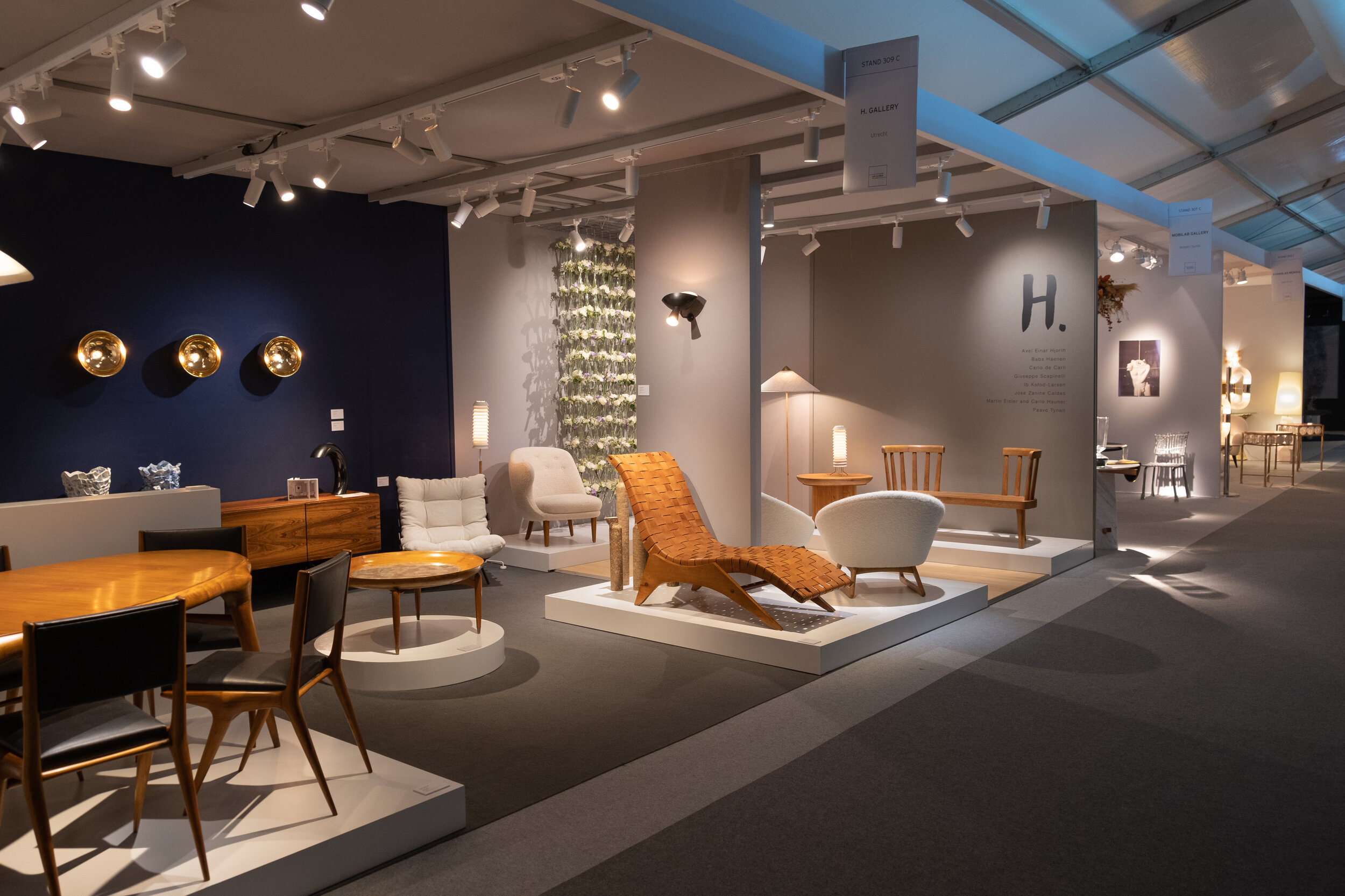
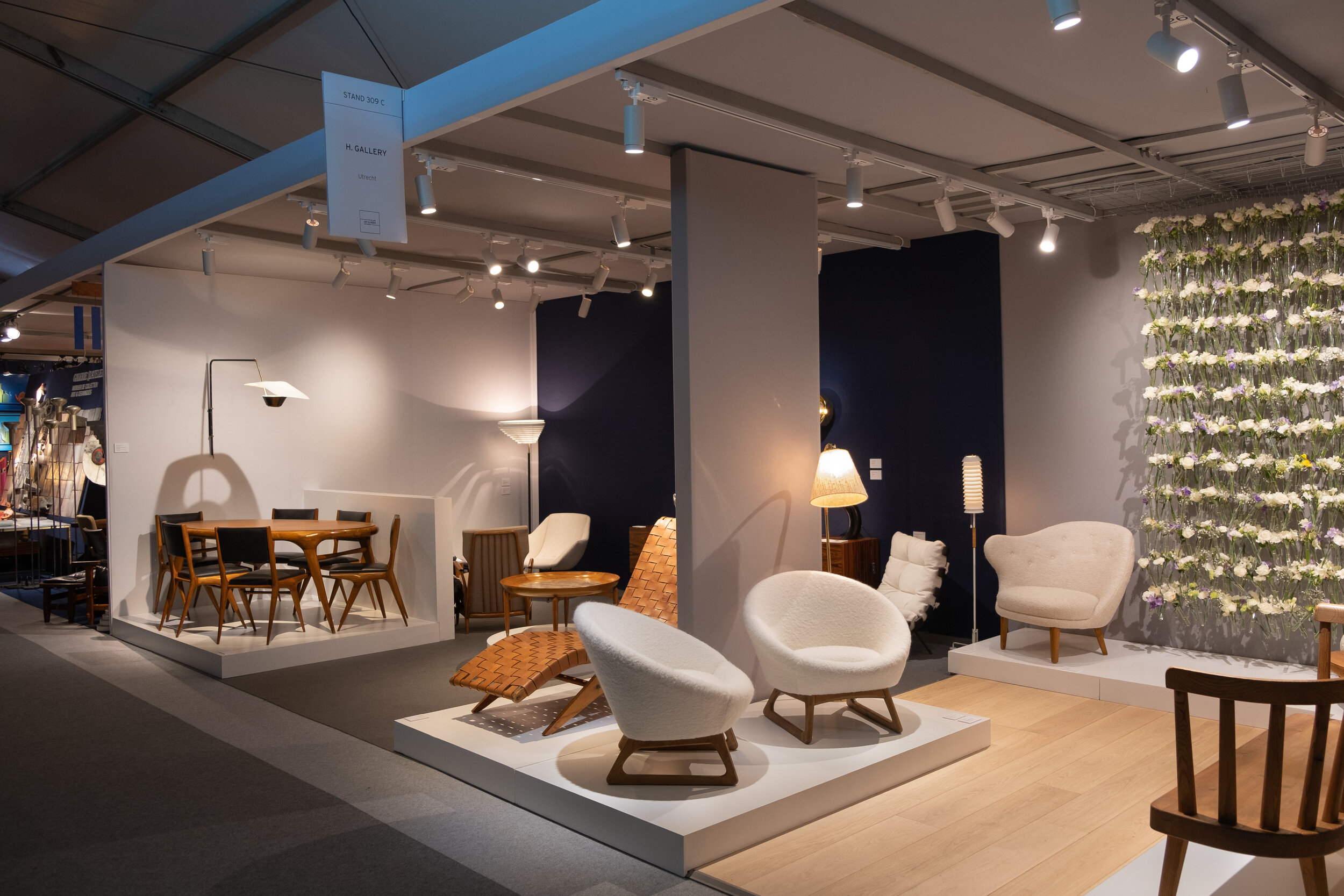
HIGHLIGHTS

This set of six chairs and a dining table show Carlo de Carli’s designs’ classic features: slender, angled legs and quality wooden material. According to de Carli’s philosophy, this set showcases the relationship between space, material and the human body. Each piece’s structure is influenced by nature, designed to fit around the lives of the home’s inhabitants. The black leather upholstery of the chairs and the solid wooden table constitute an elegant set that stands out in any surrounding.
About the designer:
Carlo de Carli (1910 – 1999) was a prolific Italian designer, architect and academic. De Carli graduated from the Politecnico di Milano in 1934, and later worked in the studio of Gio Ponti. As a designer, he became known for his mid-century modern furniture. De Carli created most of his architectural and design work between World War II and the early 1970s. His “Model 683” chair was awarded the Compasso d’Oro in 1954, while his “Balestra” armchair earned him the Triennale di Milano Grand Prix award. De Carli worked with the leading craft and industrial design companies of the time, such as Cassina, Singer & Sons and Gubi. Carlo de Carli’s architectural furniture had a profound impact on design in the 20th century and remain sought after to this day.~H.
Dimensions:
Chairs
17.72 in W x 22.05 in D x 28.74 in H
45 cm W x 56 cm D x 73 cm H
Table
71.26 in W x 36.22 in D x 29.92 in H
181 cm W x 92 cm D x 76 cm H
Literature:
Architettura, spazio primario - Carlo De Carli, Hoepli Editore 1982 p. 536, p 712 (for similar chair), p720 (for table with similar characteristics).
Made in Cassina, Giampiero Bossoni, Milano, Skira 2008, p. 161 (for similar chair)
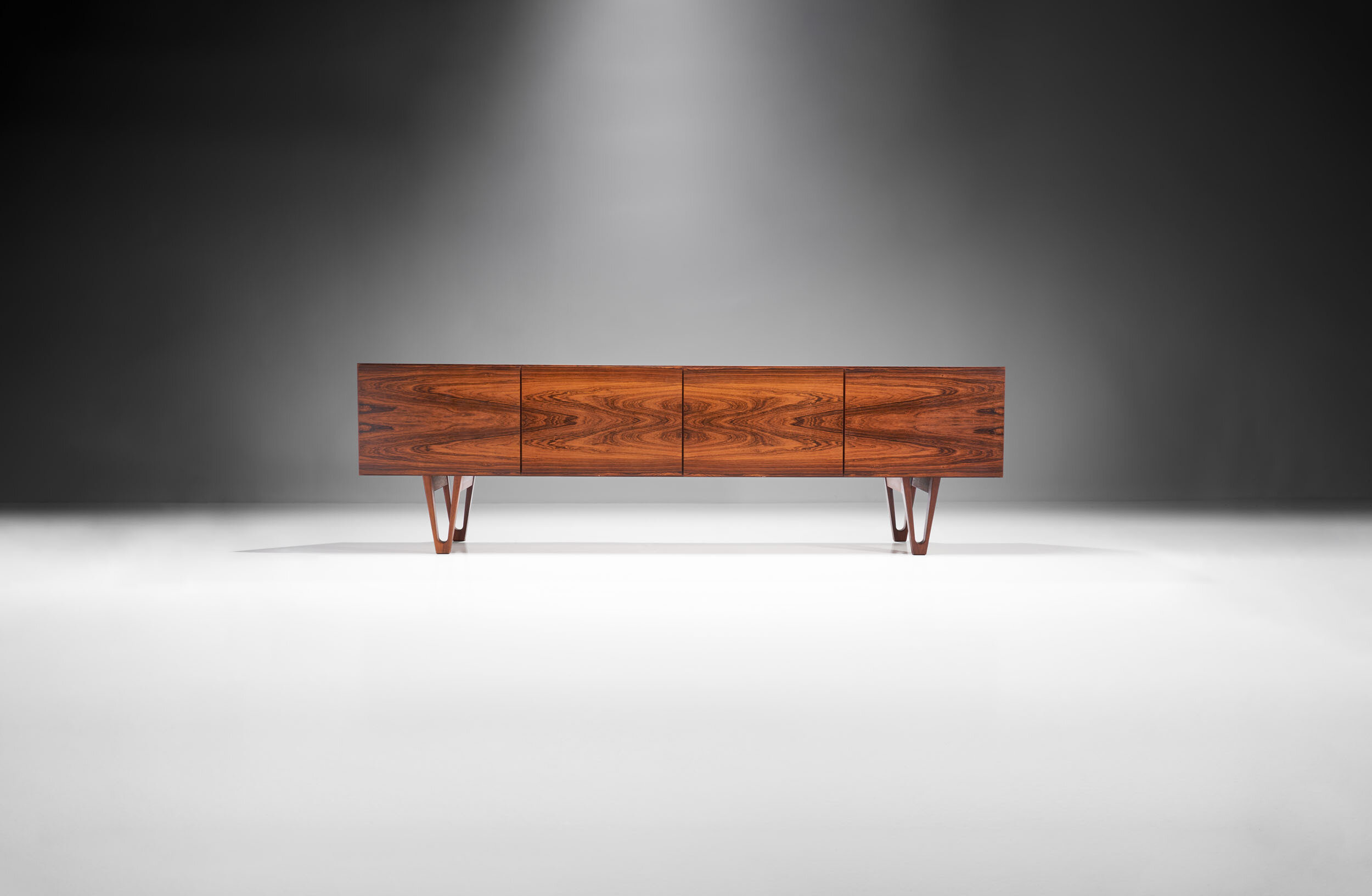
This rare and stylish palisander sideboard was produced by Swedish manufacturer Säffle Möbelfabrik in cooperation with Danish designer Ib Kofod-Larsen in 1958.
This very sought after model features distinctive V-shaped legs that compliment the otherwise strict lines. The palisander veneer has a grain that has come out beautifully over time, and gives the sideboard a striking look.
With its size and four doors, this piece offers a lot of shelving space. The first three doors cover height adjustable shelves, while the fourth covers four white, unevenly sized drawers. Each door has a small oval notch on the top, enabling easy opening while maintaining a clean and uncluttered front.
Presumably only 40 or 50 of these have been made when the Säffle factory bought a leftover stack of veneer from another factory. It’s made with outstanding production quality and attention to detail. Kofod-Larsen's work became increasingly sought-after during the 1950s and 1960s, typically featuring organic and minimal pieces made specifically for the Swedish market.
SOLD
Condition:
In good condition. Wear consistent with age and use. Veneer has some minor marks and a little chip on the back right corner.
Dimensions:
96.07 in W x 18.51 in D x 28.3 in H
244 cm W x 47 cm D x 72 cm H
Literature:
Mobilia Magazine n°106, may 1964
About the designer:
Ib Kofod-Larsen was born in 1921 in Denmark. Kofod-Larsen was trained as a cabinetmaker with the highest honours in 1944, and later completed his education as an architect from the Royal Danish Academy of Fine Arts in 1948.
His first recognition as a designer came when he won the Holmegaard Glass Competition and received the Danish Cabinetmakers Guild’s annual award. These awards attracted the attention of the Danish furniture manufacturer Faarup Møbelfabrik.
During his time at Faarup, he created some of his most beautiful works, like the rosewood Model 66 sideboard, and established himself as a furniture designer. Learn more about Ib Kofod-Larsen. ~H.
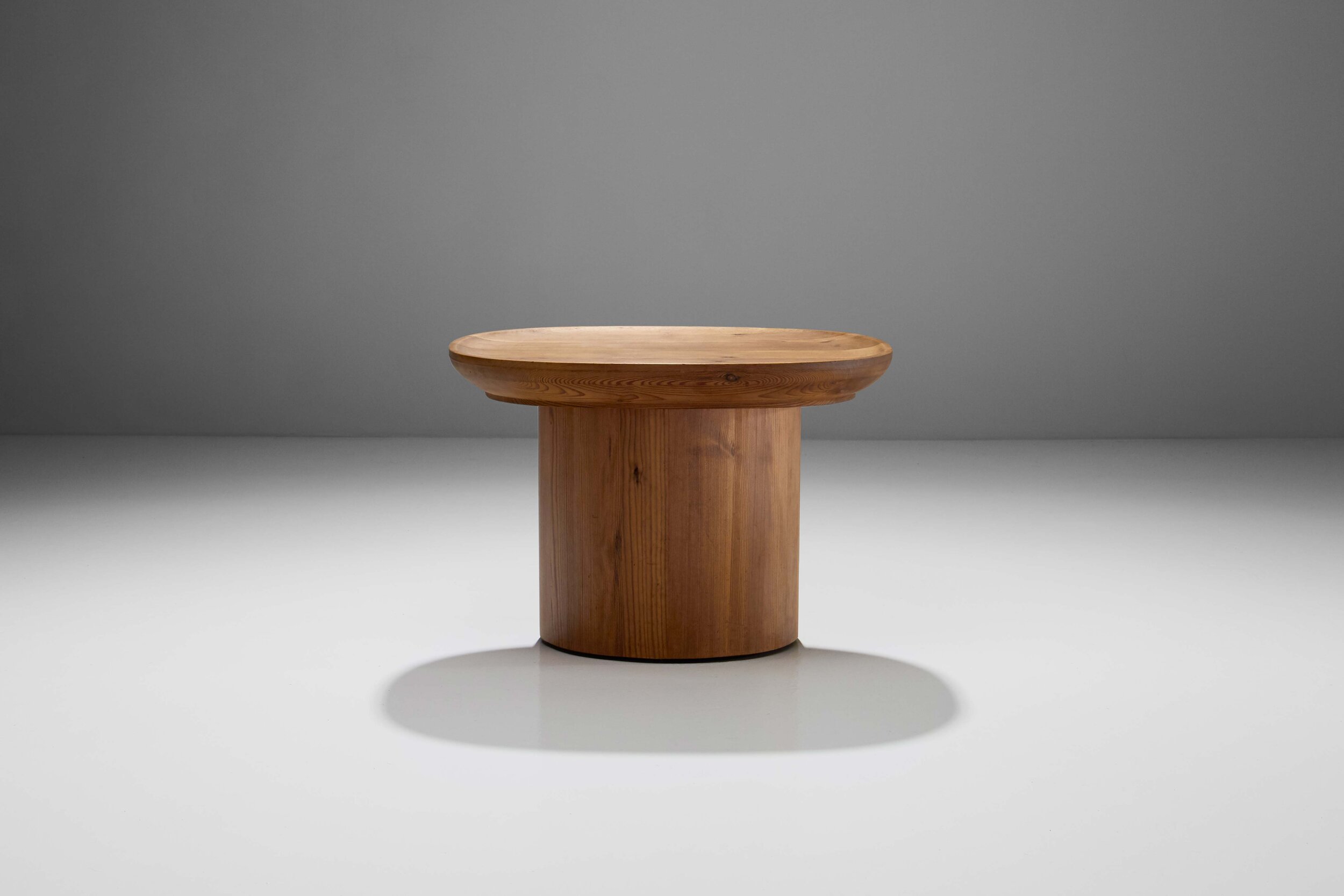
The ‘Utö’ coffee table designed by Axel Einar Hjorth is striking in balancing large volumes with clean geometrical lines. The tabletop has a thick and oval shaped shallow bowl with a well-defined rim on the top and bottom. The pine wood has aged beautifully and displays a strong patina. The wide and robust foot follows the shape of the tabletop and encompasses a beautiful grain within the wood. The coffee table was also known as the Brancusi table, a name found on a drawing in the Nordiska Kompaniet archive and refers to Hjorth’s admiration of the modernist sculptor. Produced by Nordiska Kompaniet, Sweden 1930s ~ H.
About the designer:
The work of Swedish architect and designer Axel Einar Hjorth was an early example of contemporary Swedish design, with its emphasis on minimalism and functionality. The sculptural quality of his work is easy to be seen in the Utö coffee table which originated from the Sportstugemöbler line, or weekend house furniture. The designs consisted of simple lines and construction rendered in pine that mixed aesthetics from rural handicraft with international modernism. Hjorth named these furniture lines after islands in the archipelago near Stockholm: ‘Utö’, ‘Blidö’, and ‘Torö’. ~ H.
Condition:
In good vintage condition. Wear consistent with age and use.
Dimensions:
27.72 in. W x 21.46 in. D x 19.1 in. H
70,4 cm W x 54,5 cm D x 48,5 cm H
Literature:
Axel Einar Hjorth (Svenska arkitekter och formgivare), Eric Ericson, Christian Björk, Thomas Ekström, 2011, p. 123.
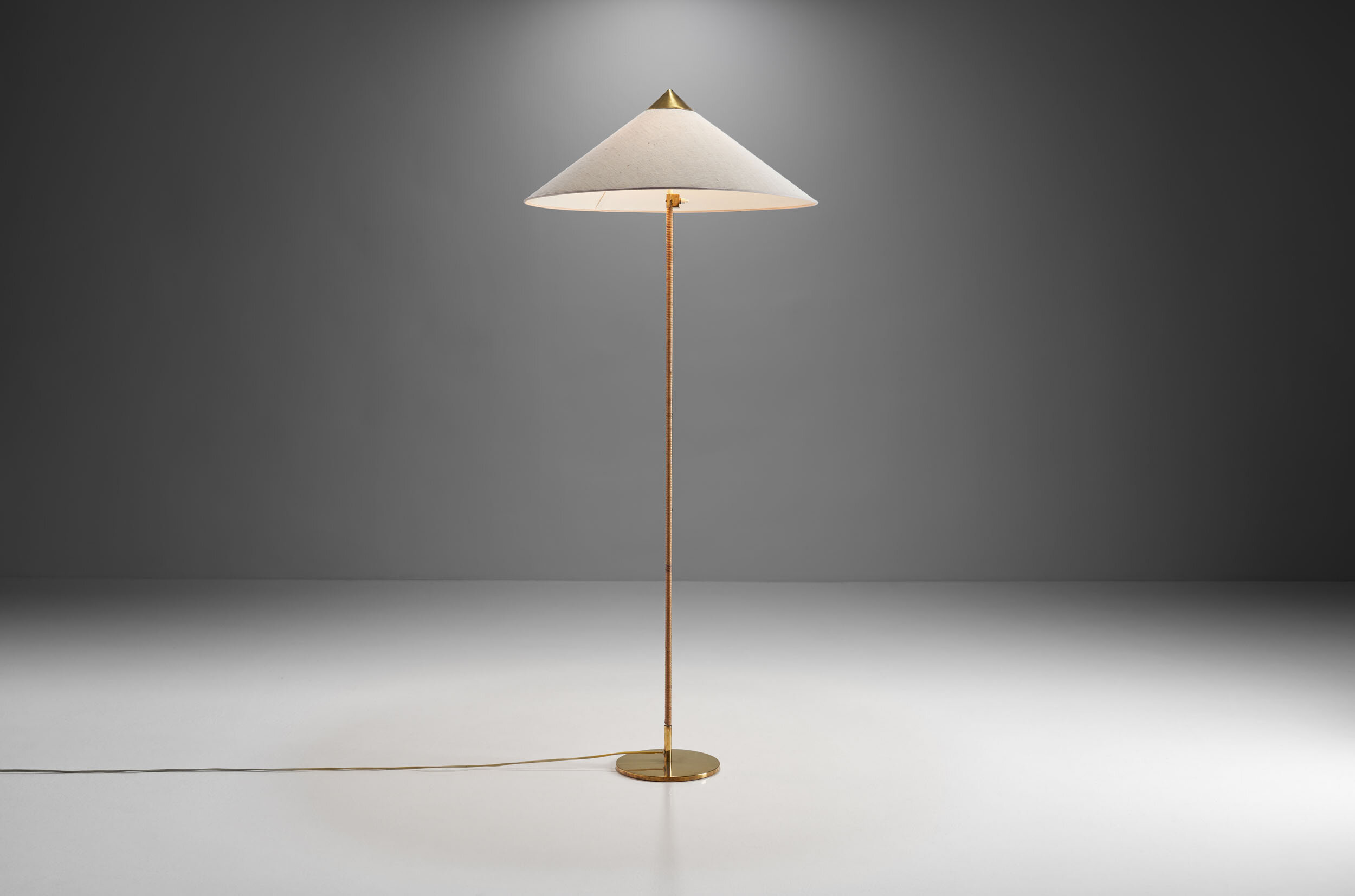
This “Model 9602” floor lamp, also known as the “Chinese Hat” was originally designed for Hotel Aulanko in Finland by “the man who illuminated Finland”, Paavo Tynell .
The lamp features an interesting play of materials. The base is made of brass, the lampshade is in an off-white fabric, but the most interesting part in term of materials, is undoubtedly the stem, which is covered in cane . The top - that inspired the nickname of this model - has a playful and light quality with a subdued texture in the shade. The brass cap is a simple, yet important design element that gives it a modern look. The top is balanced out by the elegant, but static form of the base. The lamp gives a warm ambient light to any environment.
This version with the flat foot was produced circa the 1950s. The switch box is marked “Taito Oy”, which is the name of Tynell’s own company.
Condition:
Item is in good vintage condition that is consistent with its age and use; paint missing on stem on the inside, rattan has a little wear. Brass foot has a some wear and a dozen dimples. Brass has some weather marks.
Dimensions:
25.6 in Ø x 59.85 in H
65 cm Ø x 152 cm H
Literature:
Idman: Koristevalaisinluettelo ("Idman lighting catalogue"), sales catalogue, Helsinki 1954, n° 136. Similar item, p. 58
"Finland House Lighting: harmony in lighting for harmony in living, original designs by Paavo Tynell", New York. Similar item, p. 11 and p. 26.
T. Poutasuo, "Paavo Tynell ja Taito Oy", Helsinki, 2005. Similar item, p. 22.
About the designer:
Paavo Tynell (1890-1973) was an industrial designer, known as the great pioneer of Finnish lighting design and fondly dubbed as “the man who illuminated Finland”.
Tyne was one of the founders and chief designers of Taito Oy – the first industrial producer of lighting fixtures in Finland. With the innovation of electricity in the beginning of the 20th century, Taito Oy and Tynell expanded the thinking and manufacturing of modern lighting solutions in Europe and abroad.
Paavo Tynell rose to prominence in the 1930s and 40s where he collaborated with some of the most renowned Finnish architects, Alvar Aalto being the most notable one. Working to incorporate artificial lighting into modern environments, Tynell’s company Taito Oy produced fixtures for all of Alvar Aalto’s major projects including the Paimio Sanatorium and the Viipuri Library.
Tynell was especially appraised through his involvement with the Finland House, a design atelier in New York that showcased the work of Finnish designers and craftspeople. His elegant brass designs became an instant success in North America, and he began creating lighting designs for the prestigious American company Lightolier.
A master craftsman himself, Tynell’s designs were derivative of a traditional aesthetic with a modern sensibility, mixed with an extensive use of perforated and polished brass as material. Marked by delicacy and softness, his most famous forms in lightning echo the structures of nature; he adroitly created sculptural shapes reminiscent of the branches of trees, swirling snowflakes and seashells. ~H.

This iconic set of armchairs was designed by Axel Einar Hjorth in the 1930s and belong to his Lovö series. Combining both straight lines with round curves, these armchairs ensure an aerial and balanced effect, this effect is further highlighted with an elevated seat. With heightened armrests and curved panels on either side of the back, these chairs bestow a sense of privacy and comfort while sitting. An intricate grain can be seen in the wood, giving both armchairs an authentic and subtle appearance. The loose reupholstered pillows add a soft and delicate touch to the chair yet provide for an elegant and sophisticated appeal. Produced by AB Nordiska Kompaniet.
Condition:
In very good vintage condition. Wear consistent with age and use.
Dimensions:
23.63 in W. x 25.6 in. D x 36.23 in. H ; Seat height: 18.5 in.
60 cm W x 65 D x 92 cm H ; Seat height: 47 cm
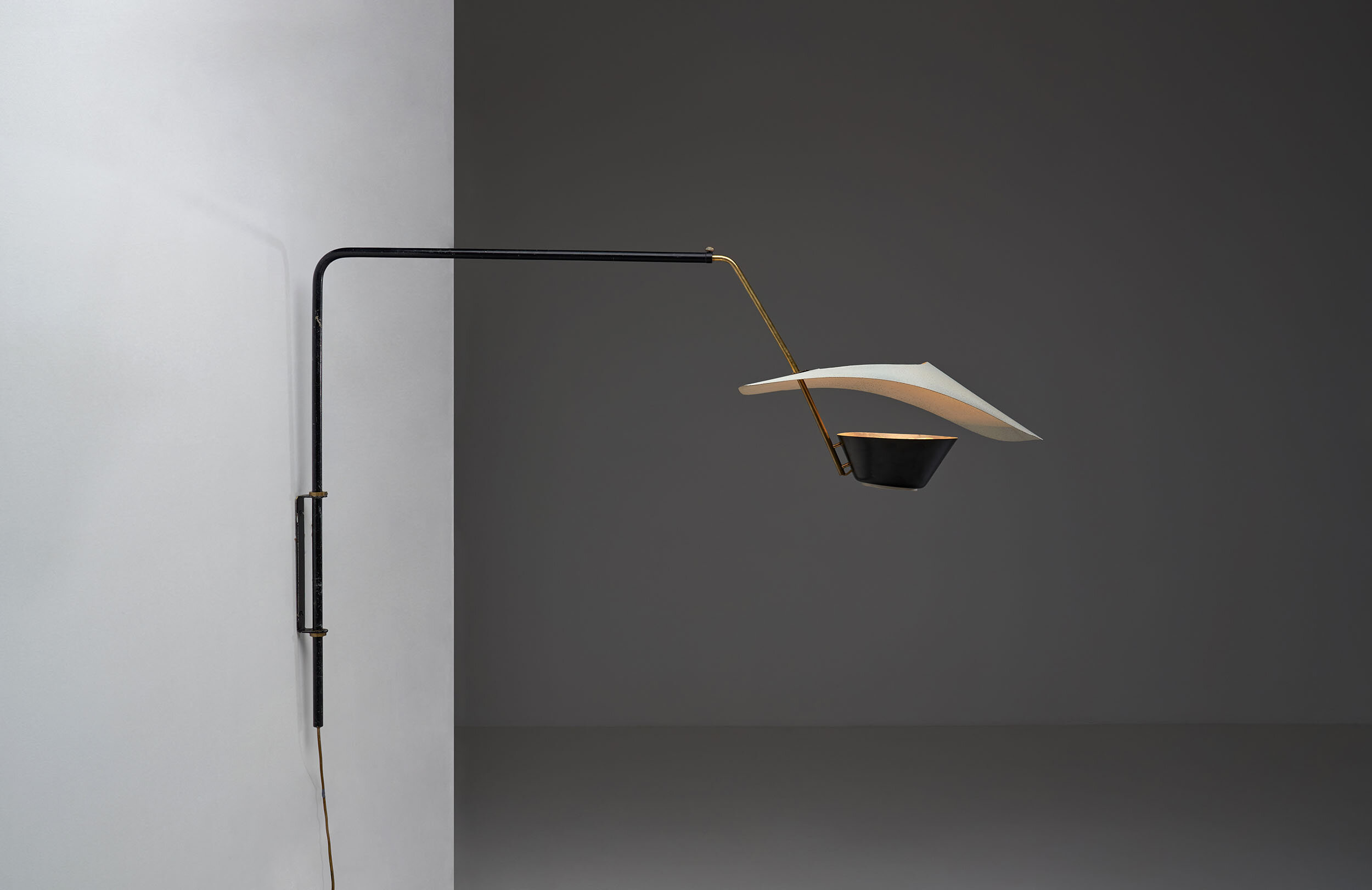
A Cerf-Volant sconce (or wall lamp) by Pierre Guariche. Produced by Pierre Disderot in France, 1953.
When we talk about Pierre Guariche's work, two of his creations immediately come to mind: the famous “Amsterdam” chair called “barrel” in molded plywood (edition Steiner, 1950s) and the elegant Cerf-Volant lamps designed for French lighting manufacturer Pierre Disderot in the 1950s. His lamps of the period are likely his best-known works. They include delicate compositions of slender steel tubes, and more flamboyant pieces such as the Kite lamp, with its curved metal reflector panel. Cerf-Volant translates to “kite”, referencing the shade of the lamp in its aerodynamic design. The elegant lines and precision of the wall lamp reflect Gauriche’s architectural talent.
The lights of Guariche like the Cerf-Volant, incorporate a counterbalance to create perfect harmony. The brass sphere of the lamp act as counterweight, therefore it can be moved by the user into any position. The lamp is made out of a black lacquered metal and brass stem, with a delicate white perforated shade. The shade resembling a kite softly dims the lamp’s light to create the illusion of a sconce with burning candles.
SOLD
Condition:
In good vintage condition. Wear consistent with age and use; The shade has minor marks, some discoloration. Stem has some marks and scratches. Item is newly wired.
Dimensions:
13.58 in W x 52.56 in D x 32.28 in H
34.5 cm W x 133.5 cm D x 82 cm H
Literature:
Art Et Décoration, septembre-octobre 1957. Similar model. p. 26
Les Décorateurs des Années 50, P. Favardin. Similar model. p. 166
1000 lights: 1960 to present, C. Fiell and P. Fiell, Taschen 2005. p. 453
The Complete Designers’ Lights II: 35 Years of Collecting. – Clémence et Didier Krzentowski. p. 106
About the designer:
A key figure in French post-war creation, Pierre Guariche trained at the School of Decorative Arts in Paris under the pioneering French Modernist René Gabriel. Guariche inscribed his approach and his achievements in a vocabulary perfectly suited to the needs of his time. Subsequently, he developed his own unique modern style, which has now become evocative of the 1950’s French lighting. ~H.

This rare coffee table was designed by Axel Einar Hjorth in January 1937 and was manufactured by Nordiska Kompaniet (lit. The Nordic Company) in Stockholm, Sweden.
Stockholm based furniture manufacturer and department store, Nordiska Kompaniet (1902-) produced many of the 20th century’s now iconic Swedish works, including many of Hjorth’s furniture designs. Hjorth was the head of the furniture department and designed this table for the 1937 "Spring Show" of the department store.
The table base is made of solid wood. The round tabletop is veneered and is supported by four spider-like legs in the style of Swedish Grace. Elegant and refined, yet delightfully simple is the core of this style. The brief, but remarkable period in Swedish design history, Swedish Grace’s pieces were all hand-made with extraordinary craftsmanship. The most representative designs of Swedish Grace include Hjorth’s designs such as this table. It is one of Hjorth’s most slender works and together with his more common “Utö” and “Lovö” series belongs to the best of his oeuvre.
Along with Bruno Mathsson, Hjorth was one of few designers to be honoured with the privilege to be an exhibitor at the Swedish Pavilion during the 1937 “Exposition Internationale des Arts et Techniques dans la Vie Moderne, Paris”. It is suggested that this table was part of the Swedish Pavilion’s interior, but unfortunately very few photos were taken by officials at the time, so for now, this shall stay a hypothesis.
The table has a label marked NK R 40275 - C 7637.
SOLD
Condition:
In good vintage condition. Wear consistent with age and use. The top has some marks, light scratches and discolouration.
Dimensions:
27.56 in Ø x 21.86 in H
70 cm Ø x 55.5 cm H
Literature:
Nordiska Museet’s Digital Catalogue
About the designer:
Axel Einar Hjorth was born March 7, 1888 in Krokek outside Norrköping. From 1908, he studied in Stockholm at the Högre Konstindustriella Skolan (University of Arts, Crafts and Design later to be "Konstfack"). His career in furniture design started around 1920, when Hjorth started working at Nordiska Kompaniet under the architect and designer Carl Bergsten.
Hjorth worked as the head of the assembly section of Jubileumsutställningen (the Jubilee Exhibition) in Gothenburg 1923. The English critic P. Morton Shand has characterized this exhibition as the be- ginning of the breakthrough of Swedish decorative arts. "The Gothenburg Exhibition of 1923 revealed [...] that [Sweden was] almost the only one that really counted as far as design and craftmanship were concerned."
For more than 10 years, from October 1927, Axel Einar Hjorth acted as the chief designer/architect at Nordiska Kompaniet. During the years between the wars, Nordiska Kompaniet was one of the most important furniture producers in Sweden and above all, the most exclusive one. Nordiska Kompaniet and Axel Einar Hjorth took part in most of the important national as well as international exhibitions of that time.
The position as chief architect at Nordiska Kompaniet also meant that he received quite a few commissions to create interiors although the company had a separate department for this purpose. Among the most striking commissions performed by Axel Einar Hjorth were the railway trains of the Shah of Persia and Nordiska Kompaniet's Paris shop. Axel Einar Hjorth left Nordiska Kompaniet in order to start his own business in February 1938.
Hjorth’s work that oftentimes mixed Art Deco and Modernist influences, remains highly relevant even sixty years after his death. ~H.

This Giuseppe Scapinelli round coffee table is made of caviuna wood and features a unique marble inlay. Scapinelli often combined ceramics and wood, and this table is among the most beautiful examples.
This rare circular coffee table has a curvy and elegant design that is typical for Brazilian designer GiuseppeScapinelli. Four cylindrical, sensual tapered legs support the sculptural, bowl-shaped tabletop. The Brazilian caviuna wood has a beautiful grain that - along with the pattern of the marble - creates a one-of-a-kind table. The table’s thick marble inset has patterned patches in maroon and grey tones, that further add to the subtle, elegant appearance.
Scapinelli was known as a designer who successfully combined “the classic” with “the modern”, and this table stands as evidence. The table is marked with the designer’s label on the bottom.
SOLD
Condition:
In good vintage condition. Wear consistent with age and use. The wooden frame has a chip that has been repaired in the past. The marble has some small damp marks.
Dimensions:
33.27 in Ø x 16.15 in H
84.5 cm Ø x 41 cm H
About the designer:
Giuseppe Scapinelli was born in Reggio Emilia in Italy on the 2nd of July 1911 and was the 6th of thirteen sons. He graduated after studying architecture in 1941. However, just as his career was starting, it was abruptly interrupted by WW2 and he was forced to live in seclusion in an antique furniture shop, where he further studied the styles and production methods of old furniture. After the devastations of the war, the promise of a better life in South America oriented Scapinelli towards the continent. Finally, in 1948, Scapinelli decided to leave for Brazil, more specifically to the metropolis of São Paulo.
At first Scapinelli worked for the architect and well-known “Paulista” Francesco Matarazzo, who opened many doors for him and other Italian refugees. Later, in 1950, Scapinelli opened his own studio. Because of his modern and complete style in interior decoration, he soon settled as an architect / decorator backed by a great team of skilled Italian woodworkers.
Scapinelli was constantly studying all forms of visual arts and frequently integrated ceramics in his works. He was described in Brazil’s Casa e Jardim magazine at the time as: "{…} a classic who does not forget to be modern - or if you prefer - a modernist who does not forget to be classic". After a fruitful life, Giuseppe Scapinelli died in São Paulo in 1982, at the age of 71.
Today Scapinelli's style is still easily recognizable because of the curvy lines and soft sensual shapes, very much away from the mainstream works of his fellow designers at the time. With works beautifully crafted fromtraditional Brazilian woods like caviuna and jacaranda, he is remembered for his unique works combining the classic with the modern. ~H.
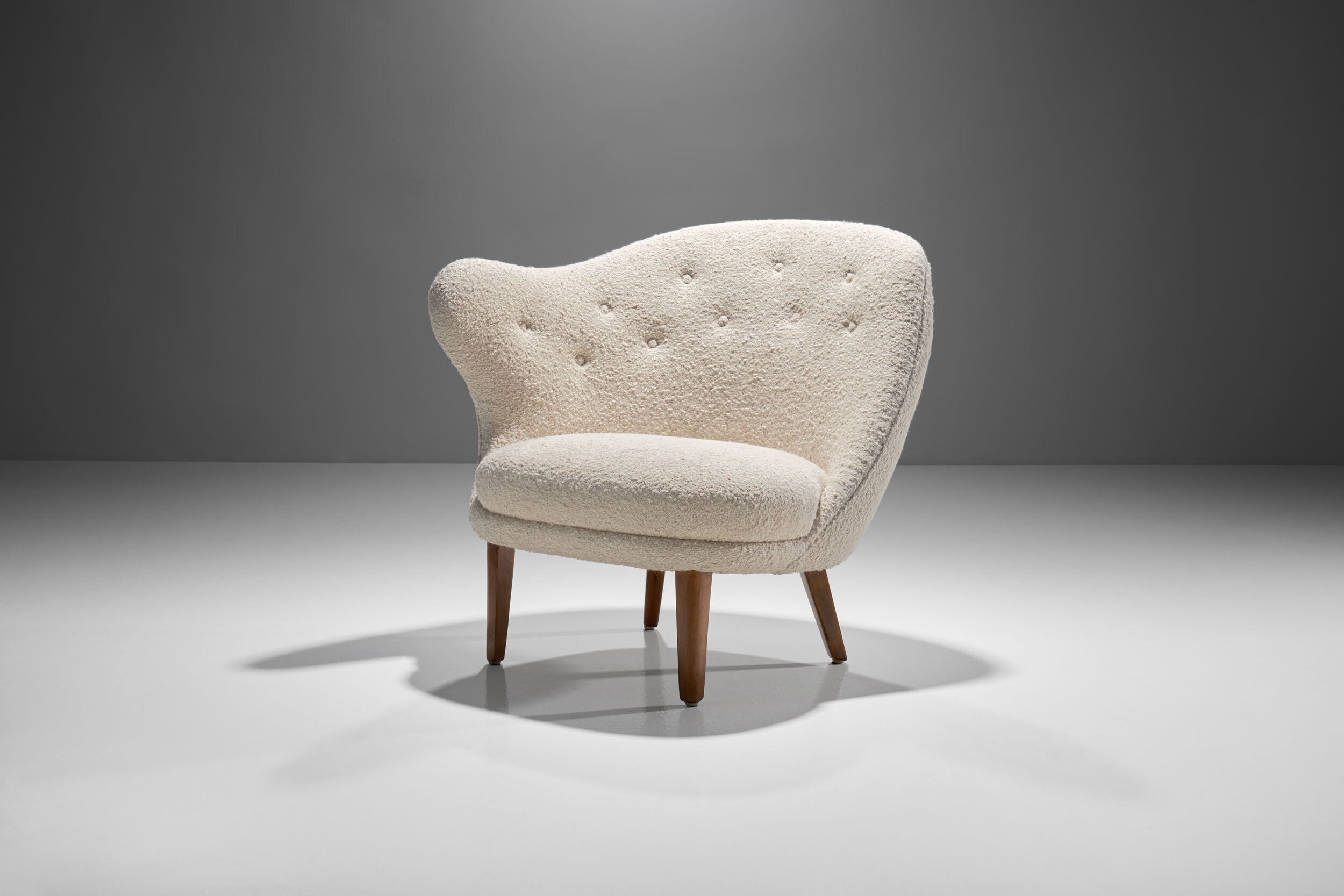
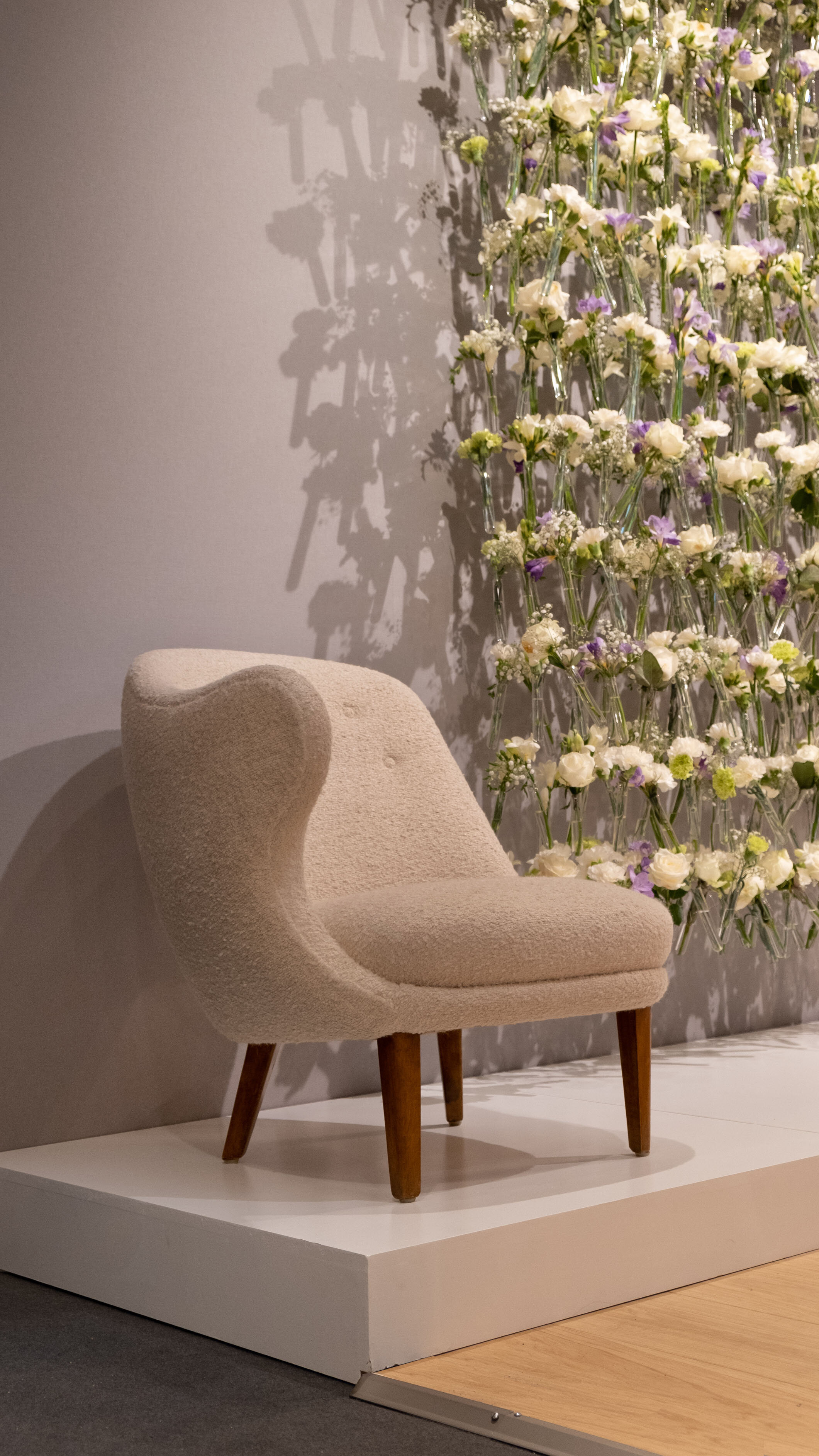
This "Thumb" Chair is one of the most recognisable designs of the Swedish designer, Arne Norell.
The thumb-shaped backrest immediately stands out, giving the chair its distinctive shape and name. The one-of-a-kind curved back, decorated with ten tufted buttons, rests on four beech wooden legs. The back legs are slightly tilted, while the front ones stand straight, enhancing the distinctiveness of the design.
As it can be expected from Scandinavian design, functionality and comfort do not fall short. The curved back with the extended “thumb” ensures great comfort, while the upholstered cushion adds to the overall sitting comfort. The chair has been reupholstered in a premium bouclé fabric.
SOLD
Condition:
In very good vintage condition. Newly upholstered in premium bouclé fabric. Each of our items can be re-upholstered by our in-house atelier in a fabric of choice. Please reach out for more information.
Dimensions:
28.34 in W x 30.9in D x 31.3in H; Seat height 16.3 in
72 cm W x 78.5 cm D x 79.5 cm H; Seat height 41.5 cm
Literature:
Andreas Siesing, "Svenska möbler - folkhemsform i ull, jakaranda, furu och bok 1949-1970", Atlantis, Stockholm 2015, p 8, advert.
About the designer:
Arne Norell (1917 - 1971) started his practice in 1954 with just two employees. In a small workshop in Sundbyberg the versatile designer made the first steps to what would become one of Sweden’s leading manufacturers of seating furniture. Until this day the business is still family owned, and the family continues to produce a selection of the large oeuvre drawn by Arne Norell. ~H.
Exhibitions:
Presented at the "Önskehemsutställningen" in 1952.
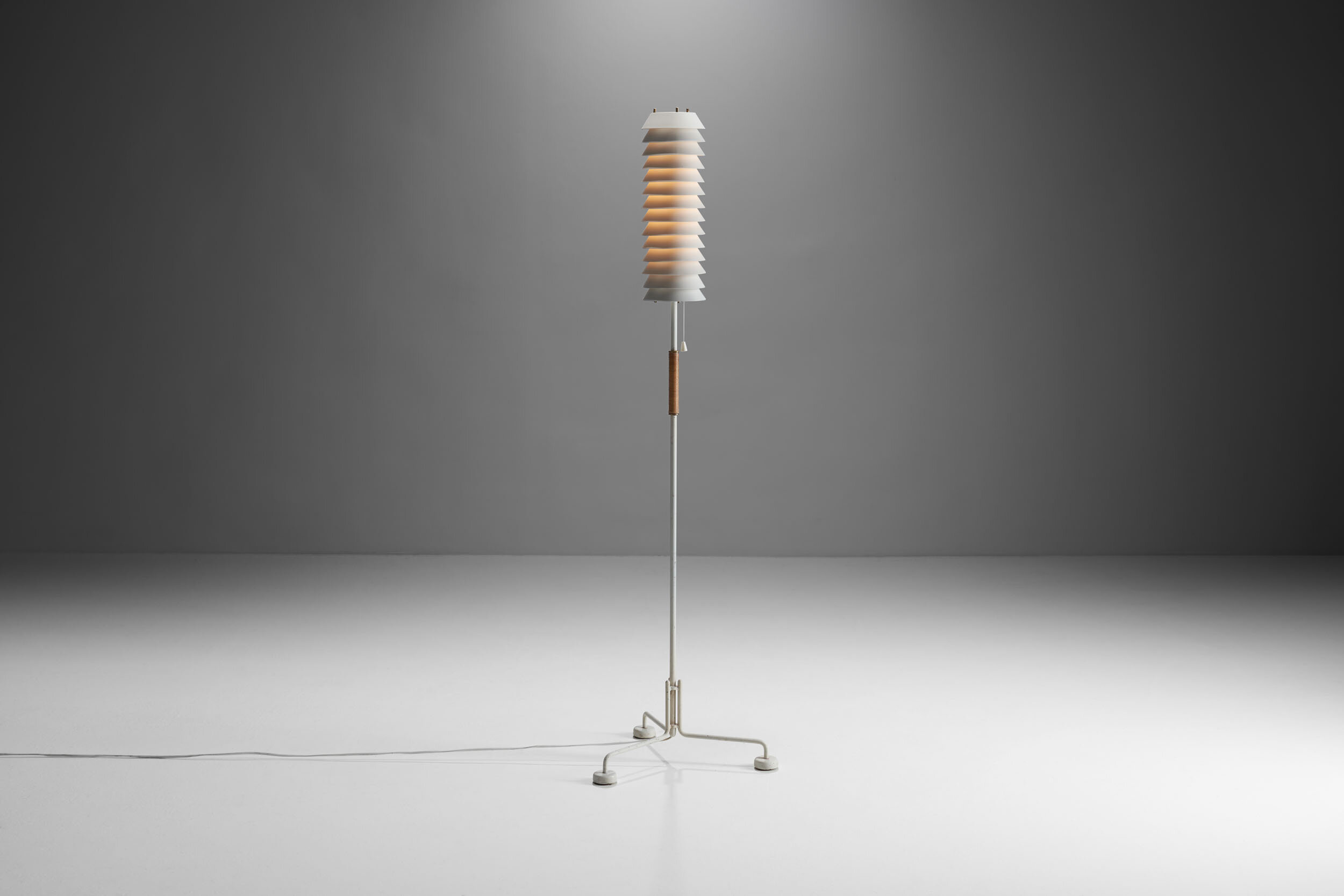
Designed in 1955, this Maija Mehiläinen (Maya the Bee) floor lamp is a simple, yet elegant piece. Tapiovaara's inspiration for this household lamp came from Maya the Bee herself, a friendly character from a 1912 German children’s book, that was also the basis to the widely acclaimed and loved comic strips.
In his clear and simple design style, Tapiovaara created a column of small metal superimposed discs from which the light glows as if coming from a shimmering beehive. Thin brass knobs and tubes fixate the discs arranged in a symmetric and rhythmic way. The partially cane wrapped stem and brass rings just underneath the shades form a nice contrast with the white lacquered aluminium. The lamp is kept in place by its three-legged base with round shoes. The original long-tube incandescent bulb, spreading diffused warm light, can be turned on by pulling the small drawstring. This lamp was manufactured by Asko/Hienoteräs Finland.
The interior is impressed with the manufacturer’s name: “HIENOTERAS”.
SOLD
Condition:
In good vintage condition. Wear consistent with age and use. Some minor scratches on the base of the lamp.
Dimensions:
5.12 in/ Ø x 18.11 in Ø x 54.73 in H
13 cm Ø /46 cm Ø x 139 cm H
Literature:
Asko: Satojen Mahdollisuuksien Mallistoa Tavoite Kotiin, sales catalogue, n.p. for the standard and table lamp
Ornamo: Finsk Konst Industri, Helsinki, 1962, p. 50, fig. 200 for the table lamp
About the designer:
Ilmari Tapiovaara graduated in 1937 as interior architect from the department of furniture design of the Central School of Arts and Crafts. Even before graduating, Tapiovaara went abroad to work for Alvar Aalto in Artek's London office in 1935. Right after completing his education Tapiovaara got a position of assistant at the office of Le Corbusier, in France. These were not the only times he learned from international masters; he also worked with Ludwig Mies van der Rohe in Chicago, in 1953. Read more about Ilmari Tapiovaara. ~H.

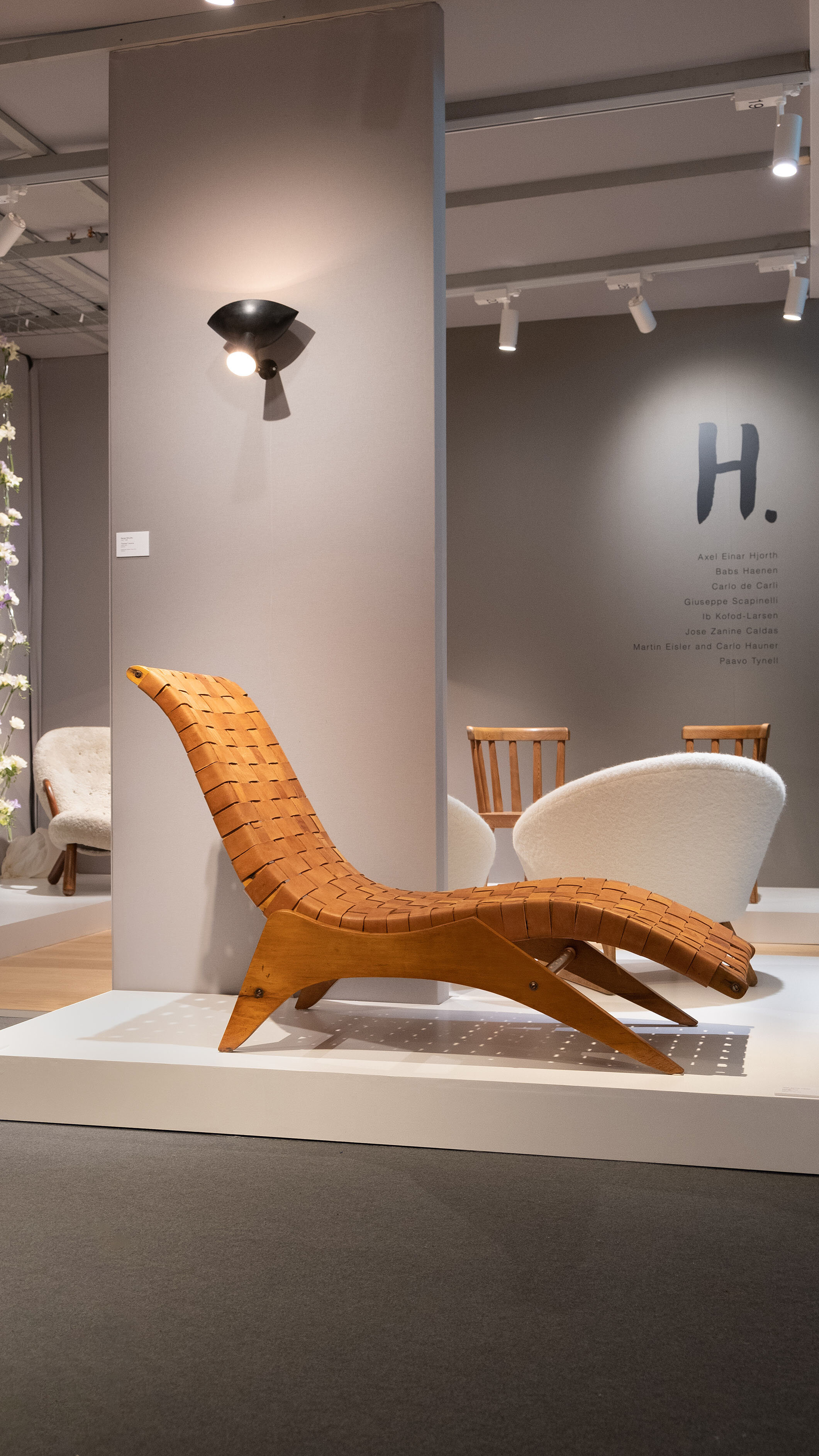
This rare José Zanine Caldas lounge chair is an exceptional example of Brazilian design of the 1950s. The woven leather straps and the organic shape is unmatched.
This large lounge chair is made of plywood and features a distinctive, curved shape. The gracefully curved seat is supported by sculpted legs, which enhances the organic feel and soft lines of the chair. With its great graphic expression, this piece is iconic of the pioneering Brazilian designer. It was created by Mòveis Artisticos Z, the factory Zanine Caldas founded in São José dos Campos in 1948.
Besides the wooden frame, the original leather upholstery is the stand-out element of this chair both in terms of visual and technical terms. Most of Zanine Caldas’s designs - especially the present lounge chair - tap into the modernist aesthetic while bearing exceptionally unique shapes: form and function revisited with a twist.
SOLD
Condition:
In good vintage condition. Wear consistent with age and use.
Dimensions:
24.4 in. W x 58.3 in. D x 36. 2 in. H ; Seat height 13.18 in.
62 cm W x 148 cm D x 92 cm H ; Seat height 33.5 cm
Literature:
Marcello Vasconcellos, Maria Lúcia Braga, Juliana Gagliardi, móvel brasiliero moderno, Rio de Janiero, 2011, p. 138
Variant of this model referenced in Móvel brasileiro moderno, Marcelo Vasconcellos et Maria Lúcia Braga. Rio de Janeiro: FGV/Aeroplano, 2011. p.138
About the designer:
José Zanine Caldas was born in Belmonte, at the southern coast of Bahia, in 1919. Son to a doctor, Zanine was an autodidact who, from a young age, was fascinated with his environment, especially with trees.
While most architects of his generation studied extensively, Zanine developed his own style through doing and making, and at the age of 20 decided to exchange Bahia for Rio de Janeiro. There he opened up a workshop for architectural scale-models and had the chance to work with pioneering modern architects like Lucio Costa and Oscar Niemeyer.
Large scale furniture with modern design and affordable prices. This was the great advantage of the joinery Móveis Artístico Z founded in 1948 by the architect Zanine Caldas, in partnership with Sebastião Pontes and Paulo Mello, was a great success at the time. Headquartered in São José dos Campos (SP), it maintained its production for almost two decades. The form of creation, idealized by Zanine, was opposed to the market of the time, which was either based on the production of handmade furniture, in solid wood, or in pieces produced in series with an unattractive design. Breaking these paradigms, Móveis Artísticas Z revolutionized manufacturing pieces with improved design and great popular appeal.
Inspired by the local craftsmen who carved boats and furniture from fallen trees, Zanine began experimenting with chiselling and carving large, sculptural works, which became the focus of his later career. Zanine became a big advocate for preservation and in the 1980's, he established the Foundation Center for the Development of the Application of Brazilian Woods (DAM), in an effort to educate and attempt to reverse the rampant destruction of Brazilian rainforests.
Up until his death in 2001, Zanine kept his natural visions alive, and would plant a new tree in place of any tree that was taken down for one of his projects. ~H.
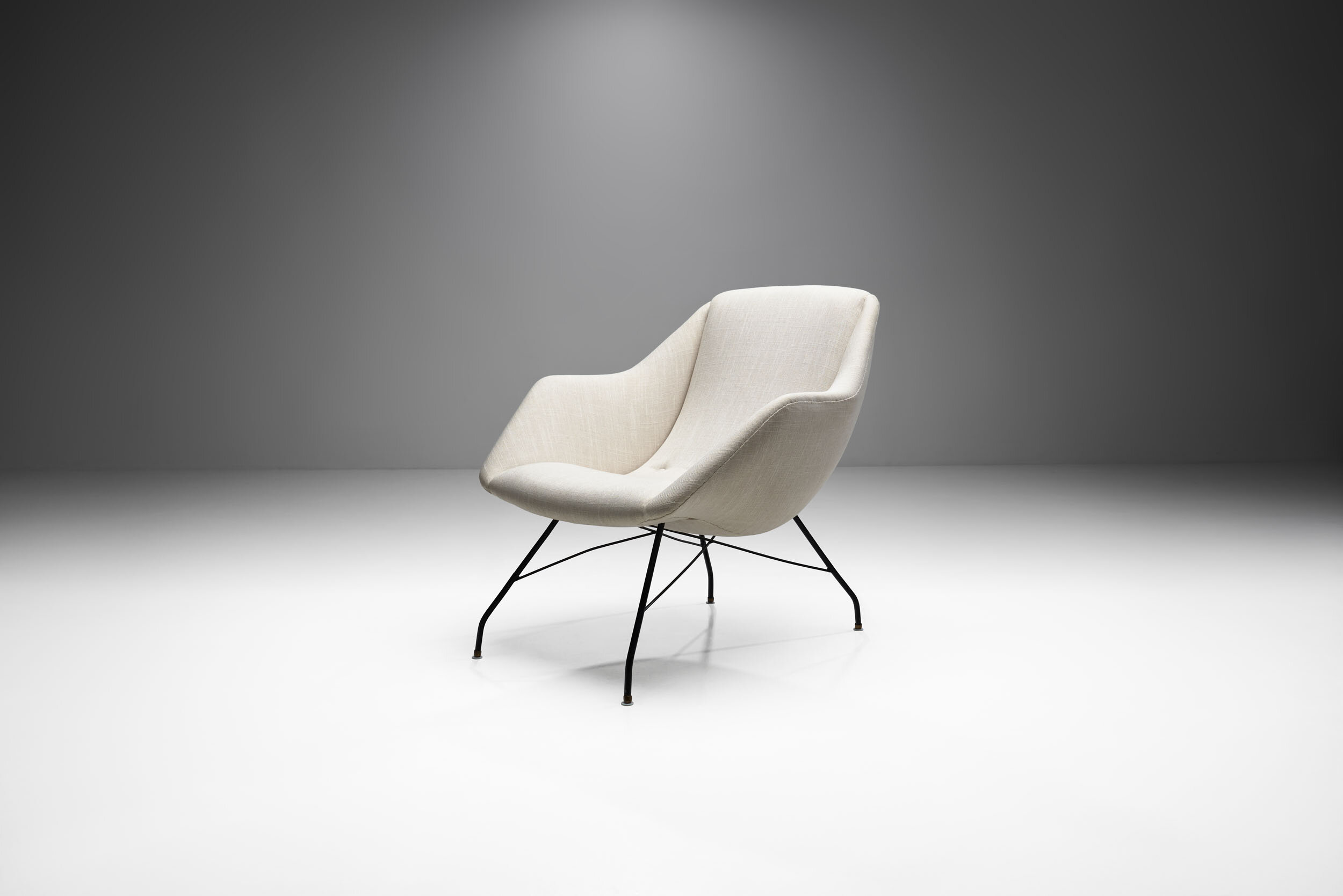
“Shell” lounge chair designed by Carlo Hauner and Martin Eisler, ca 1955. The frame is made of black painted iron. The upholstery is in a light linen blend fabric. Due to the diagonal lines and the thinness of the frame, the shell has an almost floating appearance. Especially outside of Brazil these chairs are quite rare.
SOLD
Condition:
In very good vintage condition. Original brass caps. The chair has been reupholstered recently in a premium fabric. Each of our items can be re-upholstered by our in-house atelier in a fabric of choice. Please reach out for more information.
Dimensions:
29.14 in W x 30.52 in D x 30.71 in H; seat height 14.96 in
74 cm W x 77.5 cm D x 78 cm H; seat height 38 cm
Literature:
Móvel moderno Brasileiro, Marcelo Vasconcellos, Aeroplano, P. 201
Desenho da Utopia, Brazilian Modern Furnitures, Éditions Olhares, São Paulo 2016, p 20.
Brazil Modern, the rediscovery of 20th century Brazilian furniture - Aric Chen, 2016
About the designer:
Born in Brescia in 1927, Carlo Hauner studied technical drawing and drawing at the Brera Academy in Milan, Italy. In 1948 he successfully participated in the Venice Biennale after which he moved to Brazil, where he dedicated himself to the design of textile, ceramics, furniture and architecture. In only a very short time he founded a furniture production company and purchased a factory from Lino Bo Bardi and her husband Pietro Bardi, renaming it to Móveis Artesanal.
In 1953 Hauner met Martin Eisler and the rest is history. The two connected and opened Galeria Artesanal on a busy street in São Paulo. Móvies Artesanal later changed into Forma and together with Oca, it became one of the biggest names in Brazilian furniture production.
Hauner and Eisler’s designs are characterized by the use of Brazilian woods, thin tubular frames and range from furniture, to ceramics and textiles. Forma prospered during the 60’s and 70’s. Although Hauner and Eisler designed and produced many pieces, the depth and quality of their work that is reaching the waterfront is still only the tip of the iceberg. We are sure many more interesting pieces will find the spotlight during the coming years. ~H.
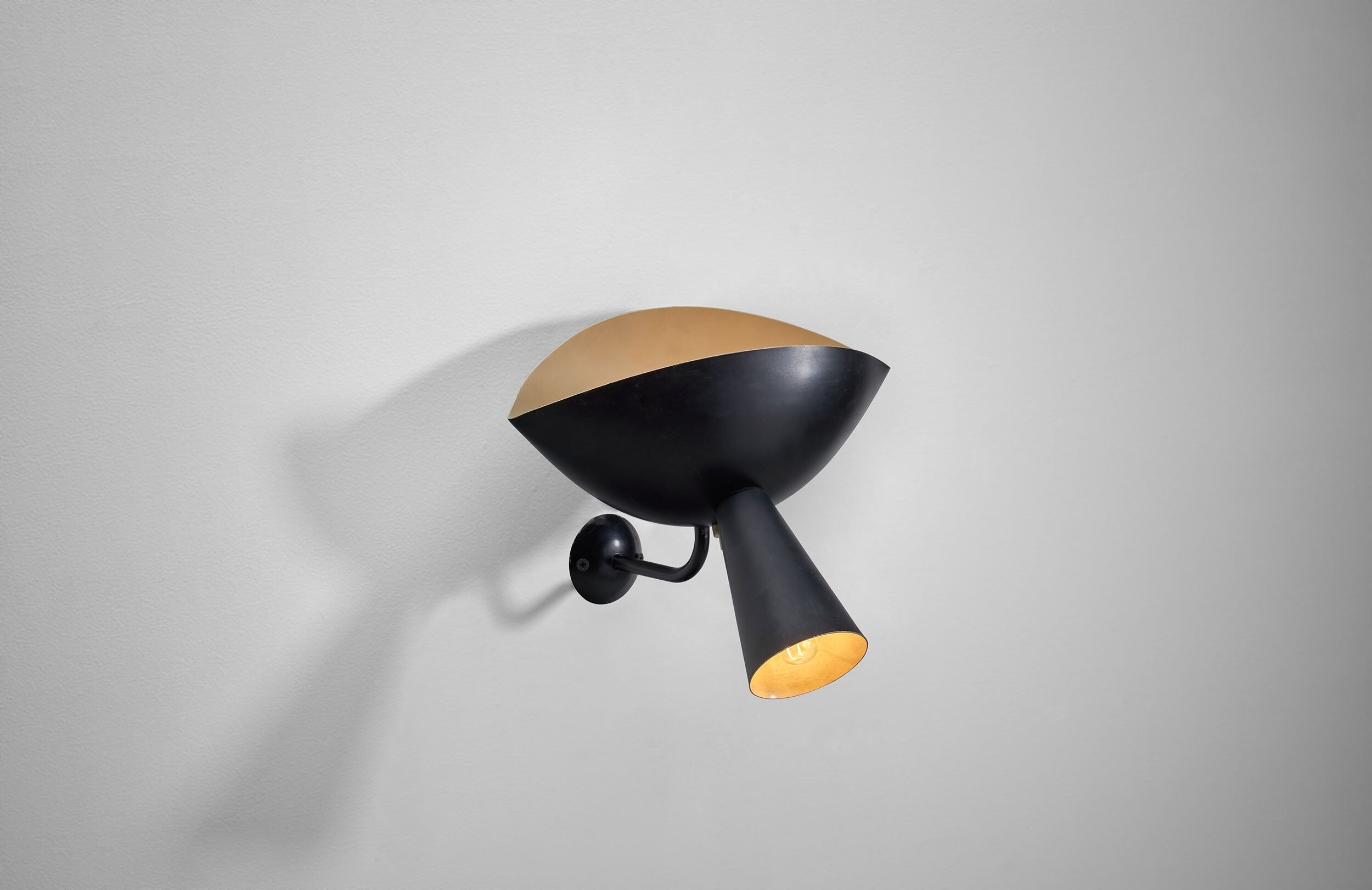
Original Serge Mouille "Cachan" wall sconce, France, 1957.
This lamp is an original from the 1950s and not one of the many later reproductions. The Cachan wall sconce comprises both an upper sphere, which casts an ambient glow, and a cone-shaped task light. One "eye" softly illuminates the ceiling while the cone-shaped reflector directs light to the floor. Large and graphic, the Cachan’s contorted black-painted metal forms, evoke the kinetic mobiles of Alexander Calder.
Originally, it was designed exclusively for the bedrooms of a housing unit for the Young Workers Housing Association in Cachan near Paris, and used only there. Mouille produced these lights for only a brief period and never marketed them, making them a rare model. As a result of its limited production, approximately only two hundred of this model exists from the 1950s.
SOLD
Condition:
In good vintage condition. Wear consistent with age and use. The shade, stem and base have small marks and scratches. The white inside of the shade has a nice yellow-greyish patina.
Dimensions:
11.02 in W x 10.24 in D x 28 in H
28 cm W x 26 cm D x 28 cm H
Literature:
Pierre Émile Pralus, Serge Mouille: A French Classic, Saint Cyr au Mont d’Or, 2006, p. 181.
About the designer:
Born and raised in Paris, iconic lighting designer Serge Mouille (French, 1922-1988) is best known as an industrial designer and goldsmith. His lighting designs featuring minimalistic, functional designs are particularly acclaimed and sought after. Mouille began his career creating silverware, however, by the early 1950s he had shifted his focus to light fixtures. He saw his own practice as a corrective to the “too complicated” Italian models that by that point were all but flooding the market. Following his studies in metallurgy and silversmithing at the École des Arts Appliqués, Mouille began designing light fixtures in 1953 and soon, in 1955, he was inducted into the Société des Artistes Décorateurs ("the Interior Decorators' Society"). When Steph Simon opened a design gallery in Paris in 1956, he soon began exhibiting Mouille’s works alongside those of designers such as Jean Prouve. Mouille definitively stopped producing light fixtures in 1961. ~ H.

Originally designed by Alvar Aalto for the National Pensions Institute in Helsinki in 1954, the A805 model, better known as the “Angel Wing” floor lamp, is a true modern icon.
The A805's asymmetrical louvred shade is reminiscent of wings, which is why it became commonly known as the “Angel Wing” floor lamp. The cascading shade is even more emphasized when the lamp is lit. The hand-riveted shade is formed from lacquered, thin metal strips, diffusing the light evenly, both upwards and through its white painted strips. The white painted shade is contrasted by the polished brass collar and the black leather-wrapped stand which was hand-sewn in Finland.
Founded in 1952 in Helsinki, Valaistustyö Ky has been the main manufacturer of luminaires designed by Alvar Aalto since its establishment. The stem of the lamp is engraved with the mark: Valaistustyö A805, which shows that this is on older version of the lamp and not a later reproduction by Artek.
SOLD
Condition:
In vintage condition. Wear consistent with age and use. The shade has its original paint with some small retouches, some small stains. Leather and brass have minor wear.
Dimensions:
20.48 in W x 13.78 in D x 67.72 in H
52 cm W x 35 cm D x 172 cm H
Literature:
Alvar & Aino Aalto Design, Collection Bischofsberger, Kellein, Hatje Cantz, 2005, p. 186 and 187
About the designer:
Hugo Alvar Henrik Aalto, (1898, Kuortane, Fin., Russian Empire - 1976, Helsinki, Fin.) was a Finnish architect, city planner, and furniture designer. Aalto achieved an international reputation as a furniture designer and architect. Through his more than 200 buildings and projects, ranging from factories to churches, (a number of them built outside Finland), Aalto remains the most renowned Finnish architect and designer.
Alvar Aalto’s architectural studies at the Technical Institute of Helsinki were disrupted by the Finnish War of Independence, in which he also participated. Ultimately, he graduated in 1921 and began working in Jyväskylä, in central Finland. In 1927 Aalto moved his studio to Turku, and in 1933 to Helsinki, where he collaborated with his wife, Aino Marsio until 1949.
The first experiments with furniture date from the early 1930s, when he took charge of the interior of the Paimio Sanatorium. At the time, Aalto’s furniture was known for its use of laminated wood and original, structural forms. In 1935 the Artek Company was established by Aalto and Maire Gullichsen, the wife of the industrialist and art collector Harry Gullichsen, to manufacture and market his furniture. His distinctive style is a blend of modernist refinement and indigenous materials, which eventually earned him world-wide recognition.
Throughout his long career, Alvar Aalto received several prizes and honours. He was a member of the Academy of Finland (Suomen Aketemia) and was its president from 1963 to 1968 as well as a member of the Congrès Internationaux d’Architecture Moderne from 1928 to 1956. In 1957, he received the Royal Gold Medal for Architecture from the Royal Institute of British Architects and the Gold Medal from the American Institute of Architects (1963).
Today, the Alvar Aalto Museum keeps the legacy of the designer alive. It was designed by Aalto himself, and is located in the Finnish town of Jyväskylä. ~H.
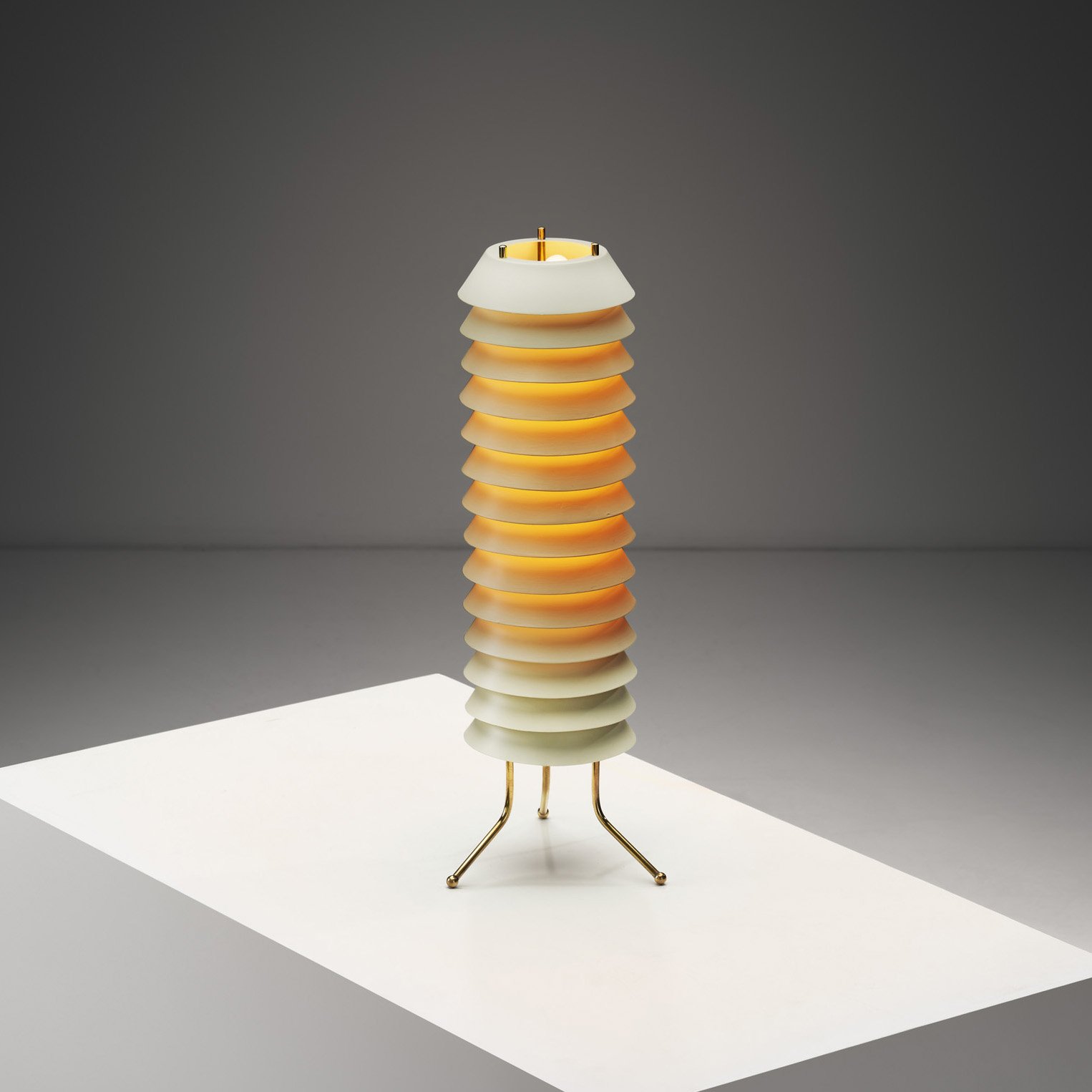
Designed in 1955 the Maija Mehiläinen (Maya the bee) table lamp is a deliciously simple and elegant piece. Tapiovaara's inspiration for his only household lamp came from Maya the Bee, a friendly character from a 1912 German children’s book, that also was the basis to the widely acclaimed comic strips and translated as Maija in Finland.
In his clear and simple design style Tapiovaara created a column of small metal superimposed discs from which the light glows as if coming from a shimmering beehive. Manufactured by Asko/Hienoteräs, Finland.
Interior impressed with ‘HIENOTERAS’.
About the designer:
Ilmari Tapiovaara graduated in 1937 as interior architect from the department of furniture design of the Central School of Arts and Crafts. Even before graduating, Tapiovaara went abroad to work for Alvar Aalto in Artek's London office in 1935. Right after completing his education Tapiovaara got a position of assistant at the office of Le Corbusier, in France. These were not the only times he learned from international masters; he also worked with Ludwig Mies van der Rohe in Chicago, in 1953. Read more about Ilmari Tapiovaara.
Condition:
In good vintage condition. Wear consistent with age and use.
Dimensions:
7.49 in. Ø x 19.69 in. H
19 cm Ø x 50 cm H
Origin:
Finland, 1955
Literature:
- Pekka Korvenmaa, Ilmari Tapiovaara, Salamanca, 1997, front cover and p. 415, figs. 407-408, and p. 195, fig. 471
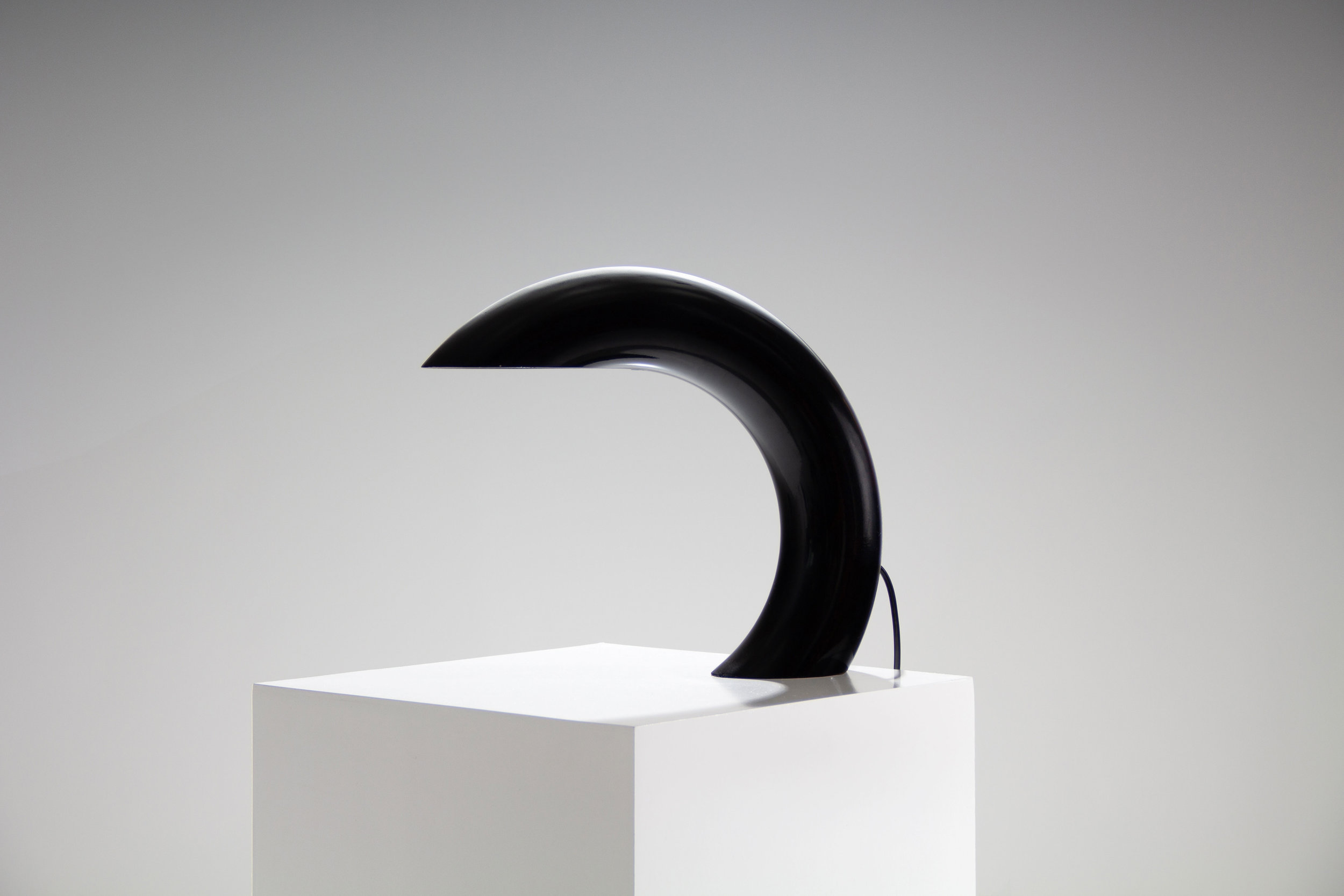
This sculptural table lamp was designed in the 1970s Italy by a little-known company named Alfredo Bianchi. As a design piece, it represents as an organic mix of aesthetics and functionality.
This table lamp designed by Alfredo Bianchi is entrancing in its minimalistic and elemental shape. The geometrical lamp shape is formed from a single circular tube that is skillfully made of cast aluminium and finished with a black high gloss lacquer. On the end of the cylindrical tube is a socket that shines the light downward, thus, through its design, the lamp emits a soft, directional light. The black colour of the lamp balances the unique shape, by allowing the design to shine without overpowering it or visually disturbing the organic flow of the curves. Due to it’s well sized proportions the lamp is a bold statement which commands the attention in any room in which it is placed.
Ideal for illuminating specific areas of a space or creating ambient lighting, this Italian table lamp represents the perfect visual addition to a room, as it serves as a piece of functional decor.
SOLD
Condition:
In good vintage condition. Wear consistent with age and use. The lamp has some scratches and small dimples.
Dimensions:
18.11 in. W x 3.94 in. D x 15.35 in. H
46 cm W x 10 cm D x 39 cm H
Pair of Kurt Østervig 57A Lounge Chairs, Denmark 1958. Produced by Rolschau Møbler, Vejen.
This pair of rotund easy chairs have a simplistic design that features a striking combination of a soft and rounded basin with slender runner legs.
The seat shell forms the sloping armrests as well as the backrest, embracing the sitter comfortably.
The patinated oak, sled base consists of slim lines that give the chair an uplifting and spacious appearance. The chair and loose cushions have been reupholstered in a premium light alpaca and wool blend fabric. The combination of the light upholstery with the darker base creates a nice contrast and gives the shell a somewhat floating appearance.
Kurt Østervig worked for E. Knudsen before deciding to open his own studio. Østervig continued to do freelance work and stuck to using three materials: oak, teak and rosewood.
Exhibition:
Presented at 'Købestævnet', Fredericia 1958.
SOLD
Condition:
Wear consistent with age and use. Items have been reupholstered in a premium alpaca and wool blend fabric.
Dimensions:
32.3 in. W x 29.15 in. D x 27.16 in. H ; Seat height 14.8 in.
82 cm W x 74 cm D x 69 cm H ; Seat height 37.5 cm
Literature:
Exhibition catalogue “God Form”. Det 48. Danske Købestævne 1958, Fredericia, p. 34.
About the designer:
Kurt Ejvind Ostervig was born in 1912 in Odense, Denmark. He was originally trained and worked as a shipbuilding engineer. However, by the 1930s Ostervig shifted to furniture design because of his passion of woodworking.
His career as a furniture designer began at E. Knudsen’s architectural design studio in Odense. In 1947, Ostervig opened his first own studio as a freelance furniture designer, with a focus on modern design. In the following decades Ostervig worked with many of the leading Scandinavian furniture producers of the period.
He was exceptionally versatile, designing furniture for hotels, cinemas, and won numerous design competitions during his career. He won at the Milan Triennale in 1953 and in 1960. In the 1960s, one of Ostervig’s designs was selected for an exhibition at the MoMA in New York.
Ostervig had a flair for the dramatic, infusing his furnishings with unique elements that stood out. From elegant, organic to coarse and purely functional furniture, his versatility earned him recognition. ~H.