
Stained Elm Dining Table with Mortise and Tenon Joints Edition Aranjou, France 1950s (sold)





Stained Elm Dining Table with Mortise and Tenon Joints Edition Aranjou, France 1950s (sold)
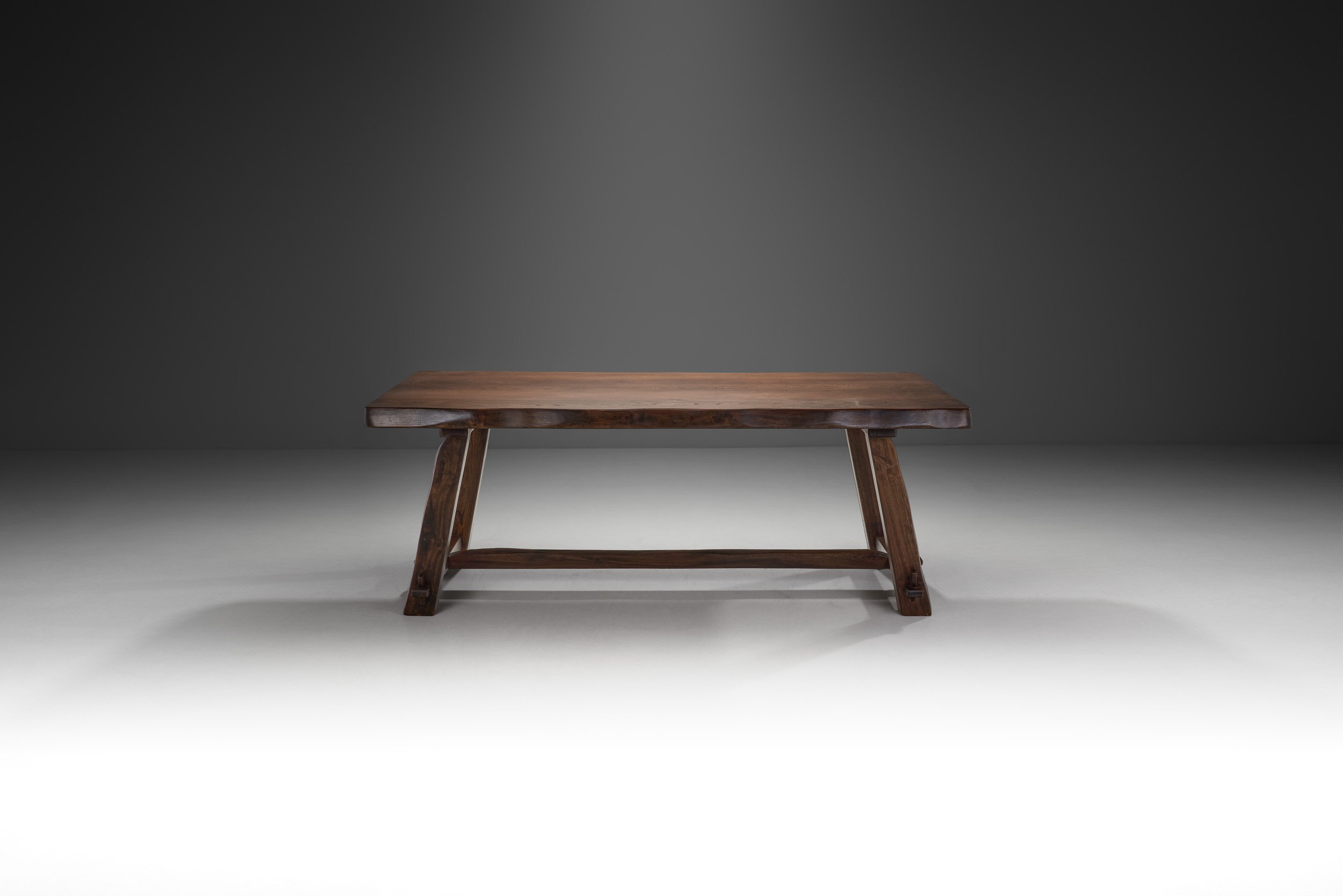
The 1950s in France was a very versatile decade, the era’s design projects had a wide range both aesthetically and material wise. The modernist solid wood models were mostly created by hand, including this table, showing the organic and modern approach to design.
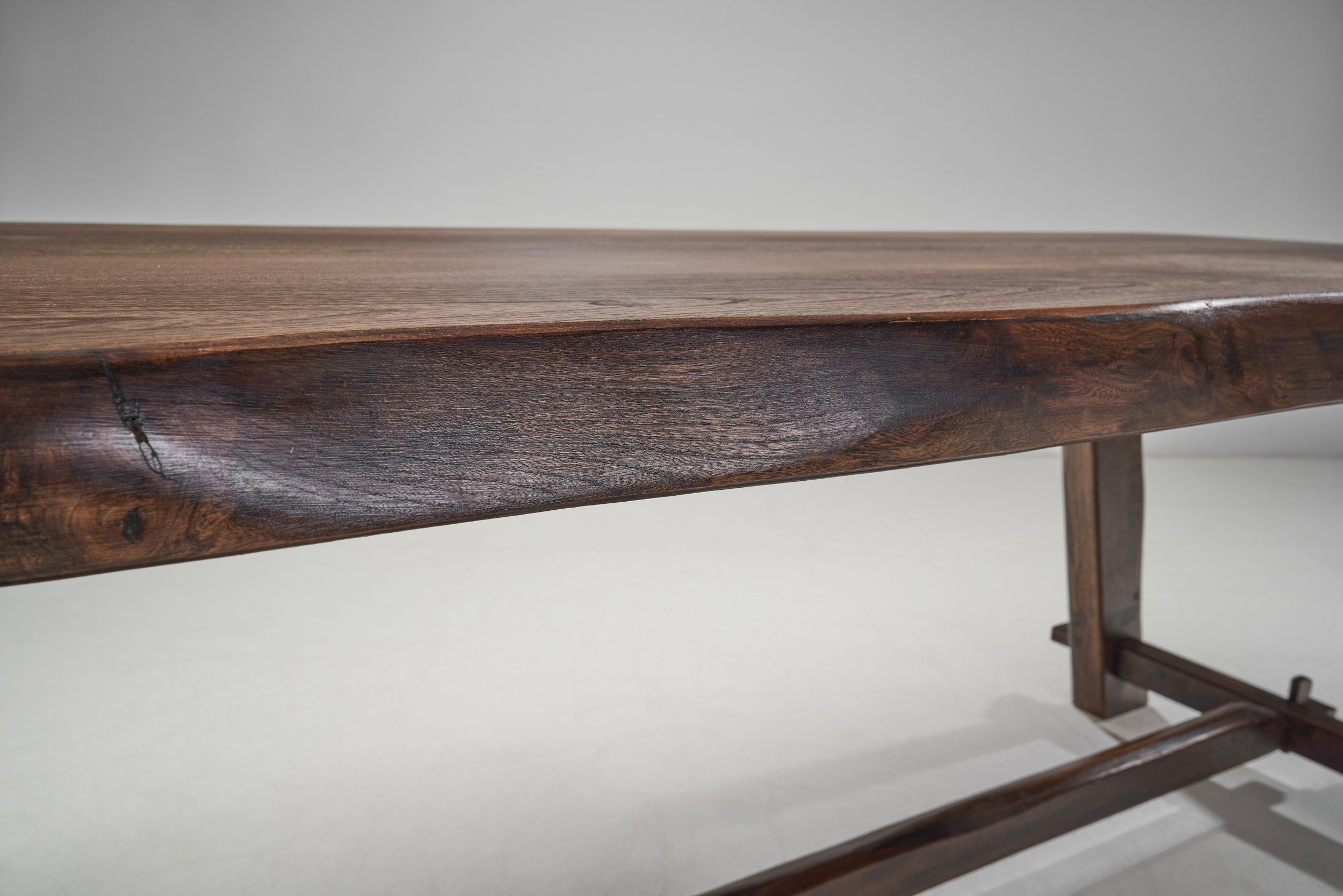
This dining table has an almost brutalist look that allows the distinctive back and the stained elm wood to guide the design. This piece was created with considerable technical expertise and holds a natural expression with its airy and organic design, which is dominated by the natural beauty of the material and the creative use of the tenon and mortise joinery. The hand carved rectangular tabletop showcases the elm wood’s pattern and grain. The uneven sides of the top are enhanced, reinforcing the rustic and elemental feel. The base with its long stretchers showcases the beautiful mortise and tenon joinery connecting the three stretchers to the legs and to each other. The cabinetmaker’s expertise can be easily traced in this traditional joinery technique. This shall come as no surprise as French furniture manufacturers are still regarded as some of the best of the mid-century era and are especially known for impeccable joinery and woodwork (think Guillerme et Chambron or Pierre Chapo for example).
The designer generation active during the mid-20th century created some of the most iconic wooden furniture designs of the whole century. This Aranjou edition table is a beautiful example of how successfully they managed to merge traditional craftsmanship and materials with an essentially modern approach to design.
SOLD
Condition:
In good vintage condition. Wear consistent with age and use. Some small marks on the wood.
Dimensions:
78.54 in W x 35.03 in D x 29.92 in H
199.5 cm W x 89 cm D x 76 cm H
REQUEST PRICE HERE
Price category: 30,000 - 40,000 usd / eur
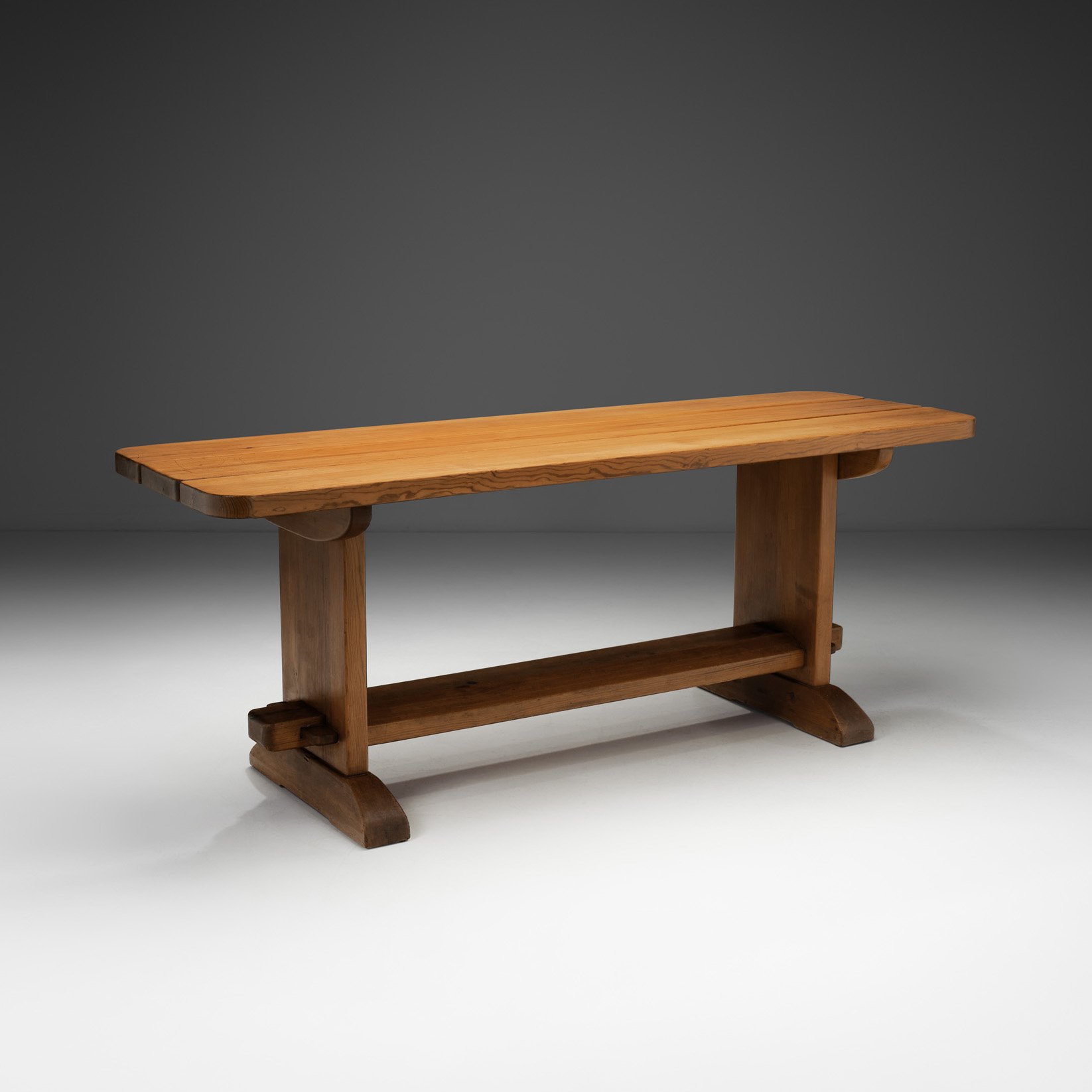
Swedish architect and furniture designer Axel Einar Hjorth served as the lead designer for Nordiska Kompaniet from 1926 to 1938. During this time, Hjorth designed the “Skoga” series in the early 1930s.
The “Skoga” series was crafted as part of a broader collection of summer-house furniture, intended to be both practical and aesthetically harmonious with the rugged beauty of the Swedish landscape. Despite its utilitarian roots, the series, as well as this table, exudes quiet sophistication and a timeless appeal focusing on simple lines and the material itself. Made of pine wood, this table is strong, reflecting Hjorth’s principles according to which he mixed the ideals of the modernist movement with provincial Swedish traditions, producing a unique and primitive modernism. It is quite robust without being intrusive, naturally standing to be the centre of the room. The legs and stretch-bar base emphasize structural clarity and durability, while the rounded corners and visible joinery express a handcrafted, almost sculptural quality. The rectangular tabletop is comprised of three planks of wood, yet it has a light impression. The large surface shows off the pattern of the wood and colour variation. The absence of heavy ornamentation is also in service of enhancing the organic, simple look that defined Swedish design of the era. Each element, joint and line is well crafted and solid, the attention given to every construction and finishing detail is obvious.
This table doesn’t depend on its details, rather, it is just as arresting from afar as from a proximity. The joinery and woodworking reveal the quality craftsmanship of the experts at Nordiska Kompaniet. The most charming thing about this table however, is that it showcases classic elements and so much history, but it lends itself easily to a modern interior.
Condition:
In good vintage condition. Wear consistent with age and use. Some marks and scratches on the wood.
Dimensions:
70.86 in W x 23.62 in D x 27.55 in H
180 cm W x 60 cm D x 70 cm H
REQUEST PRICE HERE
Price category: 2,500 - 5,000 usd / eur
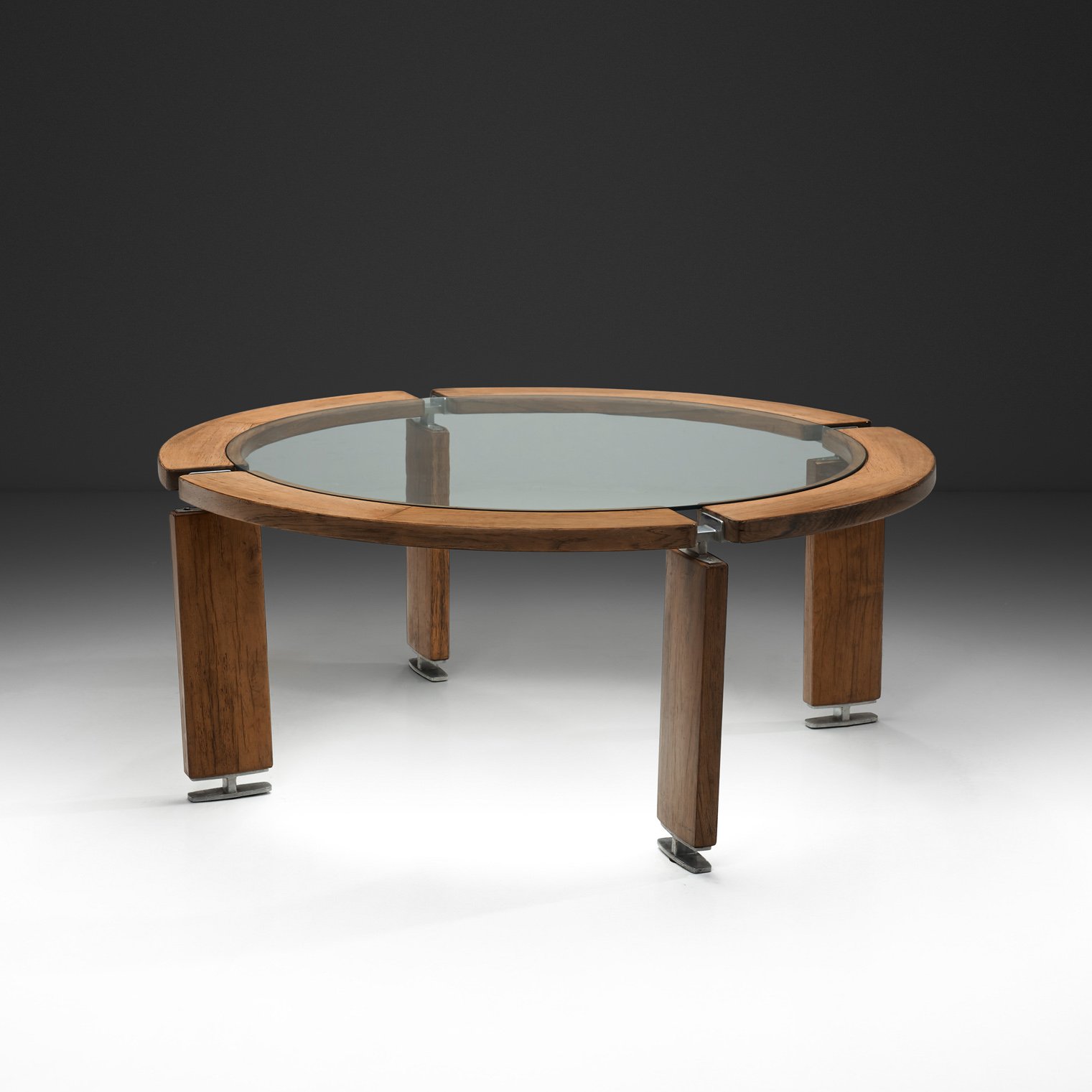
In Finland, the second half of the 20th century saw the use of new materials like plastic, synthetics, and fibreglass being combined with advances in manufacturing technologies, allowing designers in Finland to expand their range of colours and forms in mass production. However, this coffee table model still gives preference to natural materials, primarily to its wooden frame.
Utilising and highlighting the qualities of the materials used, combined with the expertise of Esko Pajamies, this coffee table is a beautiful piece that can both define and complement a modern space. The coffee table's round glass top showcases an appealing look. The dark colour of the solid wood that forms the structure of the table contrasts beautifully with the top, as its robustness grounds the design. The combination of materials make this table a stylish example of the period’s design versatility. Coffee tables, in general, serve as design staples in living spaces for a multitude of reasons: beyond their utilitarian function of providing a surface for drinks and books, they anchor a room, creating a focal point around which furniture and conversation revolve. Overall, this table equally emphasises function and visual interest, creating an instantly arresting aesthetic.
The overall form of the table has a light and airy feel, enhancing the 20th century aesthetic which it represents. With its elegant shape and careful design, this piece rises above the endless passing of trends, establishing itself as a modern classic in the realm of interior design.
Condition:
In good vintage condition. Wear consistent with age and use. The item has recently been reconditioned. Due to the age and nature of the wood, the coffee table may have minor marks, scratches, and discolouration.
Dimensions:
47.24 in ø x 19.68 in H
120 cm ø x 50 cm H

REQUEST PRICE HERE
Price category: 7,500 - 10,000 usd / eur
Swedish architect David Rosén worked alongside renowned designers such as Axel Einar Hjorth and Josef Frank at Nordiska Kompaniet (NK), one of Sweden’s most respected design houses. Rosén crafted this beautiful table for NK in 1938.
Made from pine, this table exudes a lovely charm and robust aesthetic that is characteristic of the era. In early 20th century design, the use of wood held a special significance; it was not merely a material choice, but a philosophy that emphasized the natural and organic over the ornate and extravagant. Moreover, in a rather distinctive way, softness and tradition merge in this coffee table. While it is elemental thanks to the solid pine and interesting construction, the roundness of its top and its elegantly sculpted base still provide a sense of gentleness. It is this well measured tension between the shapes that make the design eye-catching and infinitely interesting. Organic and natural materials often take pride of place in Swedish design, reflecting the Scandinavian and Nordic countries’ relationship to nature. The solid pine wood of this table is not overworked, its natural grain stands out and serves as ornamentation in itself. With minimalism comes timelessness, a guarantee that this coffee table will never go out of style.
With its strong and distinctive details, this table model is a perfect accent table, while also being capable to complement its surroundings. This piece could fit well in a modern interior, as well as in a minimalist or rustic space.
Condition:
In good vintage condition. Wear consistent with age and use.
Dimensions:
28.74 in W x 21.65 in D x 23.62 in H
73 cm W x 55 cm D x 60 cm H

REQUEST PRICE HERE
Price category: 2,500 - 5,000 usd / eur
This coffee table is a stunning example of Modernism in design: clear forms without exaggeration with the high-quality work of a Danish cabinetmaker. Humble in its material and size, this table still draws attention thanks to its distinctive look and personality.
Early on, many of the Danish cabinetmakers’ workshops had been producing historical furniture; master cabinetmakers had been renowned for their solid wooden furniture rendered in various styles of the past. This coffee table, while not specifically historical in style, shows some restrained decorative elements that are generally rather sparse in Scandinavian mid-century furniture. However, accordingly to the design ideals of Danish designers, the scalloping pattern is not overwhelming the table, nor does it demand attention, rather, it is an understated but clever addition to the design. The scalloped patterns on the tabletop and legs differ slightly; the scallops on the legs are more pronounced with straight lines between each scallop, while under the tabletop, it is in a more traditional, round shape.
The wavy effect is even more pronounced thanks to the beautiful grain and colour of the solid oak that is most apparent on the wide, circular top. As it can be expected from Danish design and craftsmanship, visually appealing elements usually serve a functional role as well. In this case, the wooden elements under the table reinforce the stability of the structure in this ingenious manner.
Condition:
In good vintage condition. Wear consistent with age and use. Due to the nature and age of the material, the item may have some marks, scratches, and discolouration.
Dimensions:
35.03 in W x 35.03 in D x 22.04 in H
89 cm W x 89 cm D x 56 cm H
About the Designer:
The practical and comfortable designs of Danish cabinetmakers defined mid-20th century modern seating. The Danish Cabinetmakers focused on minimalist design executed by expertly skilled craftsmen.
Works from the Danish Cabinetmakers' Guild is a concept of its own in collectible design. The Cabinet-Makers' Guild began annual exhibitions in 1927 in Copenhagen. The group formed an exhibit showing each year in October the quality furniture made to drawings by gifted architects. The exhibition took place each year, without interruption, for forty years. A number of successful Danish Design collaborations were formed during this time between cabinetmakers and architects.
Danish Modernism has influenced Scandinavian furniture to a great degree, defined by minimalism, simplicity, and functionality. The muted colours and gentle designs make Danish mid-century furniture an ideal addition to contemporary living spaces. Additionally, master cabinetmakers were highly aware of body proportions, prioritizing comfort just as much as the visual qualities.
The works of master cabinetmakers – such as this chair – are of the highest quality, both in terms of materials and craftsmanship. Cabinetmakers take the art of working with wood one step further, and focus on the finer details of what can be created with the material. Therefore, it comes as no surprise that numerous master cabinetmakers are part of the renowned Danish Culture Canon (Danish: Kulturkanonen). The canon contains no more than 108 works of cultural excellence, based on works with a useful function and that are still recognisable today. These lounge chairs are the perfect illustrations of Danish design, and the work of a true cabinetmaker. ~H.
REQUEST PRICE HERE
Price category: 2,500 - 5,000 usd / eur
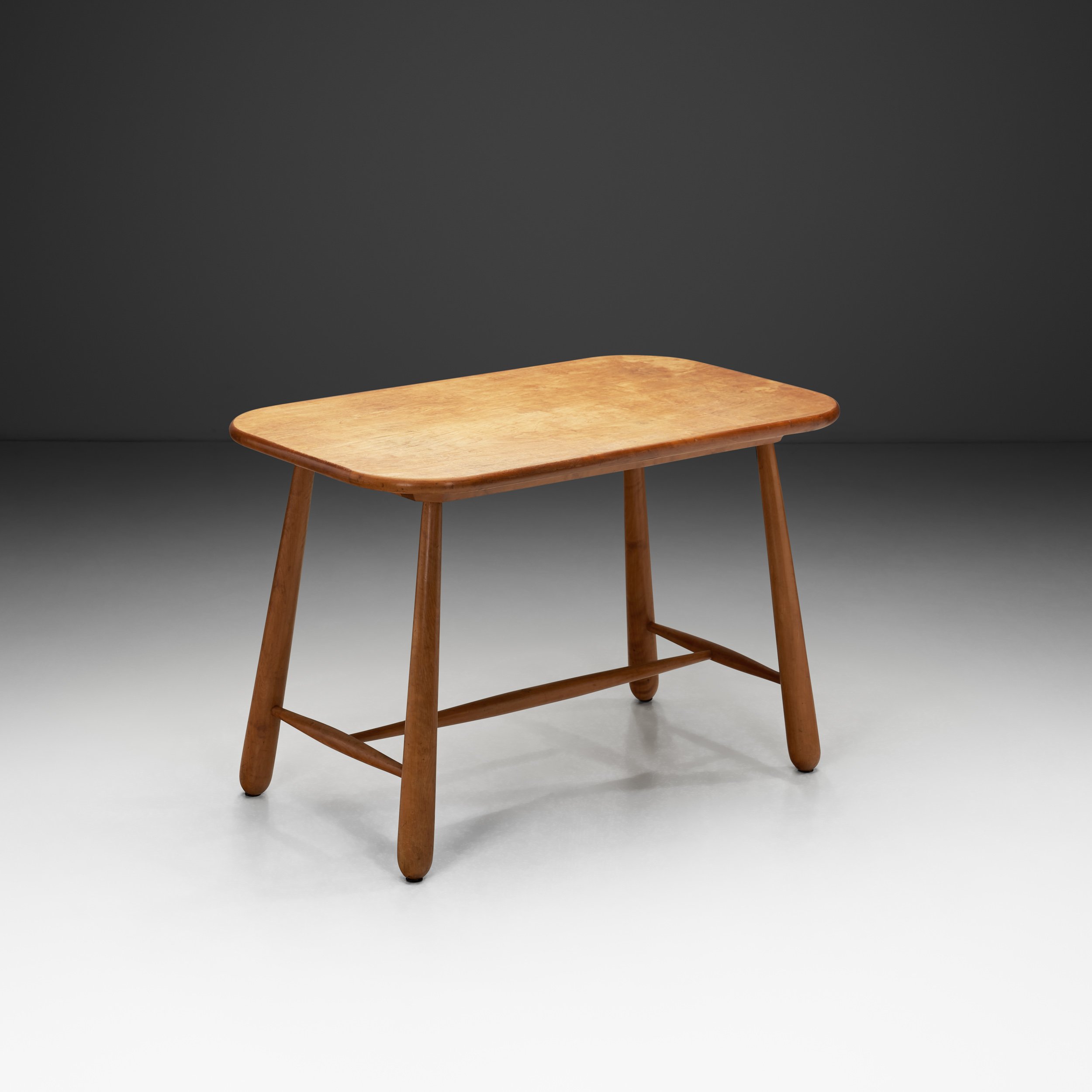
The 1940s in Sweden were defined by a quiet but deliberate design philosophy rooted in function, clarity, and craftsmanship. As the country transitioned through wartime austerity into postwar renewal, designers and cabinetmakers turned toward a more humanist modernism that emphasized warmth over severity. This approach is exemplified by Swedish Modern design movement, which focused on creating durable, accessible, and elegant furniture for the masses.
This birch side table showcases sensibility through its simple yet perfectly balanced construction. Furniture of this period often showcased the natural qualities of woods. Birch, with its golden hue and intricate grain, became a central material in this movement, prized for its ability to bring light and texture into the Scandinavian home. This table’s top features softly rounded corners and edges. The turned legs are slightly splayed to provide stability, connected by stretchers that form a low geometric rhythm beneath the tabletop. The craftsmanship is evident in the way each joint is fitted cleanly, while the organic character of the wood is emphasized. The table reflects the Swedish preference for comfort and approachability. The warm, honeyed tone of the wood further enhances its sculptural simplicity, capturing the sense of connection to nature that defined Scandinavian design of the 20th century.
Beyond its function, the table represents the enduring values of Swedish Modernism, where honesty of material and attention to human use were paramount. In its restraint and balance, this table embodies the essence of that philosophy, an object both utilitarian and timeless, made to age gracefully within everyday life.
Condition:
In good vintage condition. Wear consistent with age and use. The table has recently been reconditioned. Due to the nature and age of the wood, the table may have some marks, scratches, and discolouration.
Dimensions:
33.46 in W x 20.87 in D x 22.83 in H
85 cm W x 53 cm D x 58 cm H

REQUEST PRICE HERE
Price category: 7,500 - 10,000 usd / eur
This rare “AT-309” dining table was designed by Hans Wegner in 1955 and its title of ‘iconic’ is well deserved. As it is no longer produced, this model has become a collector’s item created by a designer who is credited as one of the main driving forces of the mid-century Danish modern movement.
The “AT-309” model is also commonly referred to as the “saw-horse” for its trestle base. In woodworking, a saw-horse is a trestle structure used to support a board similarly to this model’s case. While Hans J. Wegner became world-renowned for his chairs, he also designed a broad range of tables, where he was just as thorough and artistic about the proportions, construction, function, and style. With a clear statement of simplicity, quality and respect for materials, this table is a great example of Danish Modern design. The massive teak tabletop with drop-leafs is stunning on its own, showcasing the wood’s grain and offering plenty of space with the extendable solution. However, to Wegner, the most important part of his tables was not the top, but rather what was underneath. For the supporting structure he used the distinctive saw-horse look with crossed legs and brass braces. The diagonal brass reinforcement is not only a significant structural feature, it is also a visually appealing detail that gives character to this dining table. Looking beneath the top, the elaborate oak structure becomes visible, showing both Wegner’s and the manufacturer’s expert skill and knowledge.
Over the course of his career, the designer collaborated with several renowned manufacturers, including Andreas Tuck. The company was one of the greatest Danish furniture design companies of the mid-20th century, producing pieces that epitomize classic Danish craftsmanship. Wegner worked with the company for many years, creating iconic designs such as this “AT-309” table.
Condition:
In good vintage condition. Wear consistent with age and use. The tabletop has been refinished.
Dimensions:
51.96 in W (89.76 in when extended) x 33.66 in D x 28.14 in H
132 cm W (228 cm when extended) x 85.5 cm D x 71.5 cm H
About the designer:
Hans Wegner (1914–2007) is considered as one of the most influential designers of Scandinavian design. Danish-born Wegner became a national and international design idol for shaping the history of design in the 1950s and ‘60s.
In his designs, the sharp edges defining Modernism were smoothened, creating his iconic chairs. As a pioneer of the modernist style, often described as “organic functionality”, Wegner described his method as “stripping the old chairs of their outer style and letting them appear in their pure construction.”.
At 14 years old, he began his apprenticeship with Danish master cabinetmaker H. F. Stahlberg. After serving in the military he moved to Copenhagen, and attended the School of Arts and Crafts, before setting out as a furniture designer. In 1943, he established his own studio, producing designs for manufacturers like AP Stolen, Fredericia Stolefabrik, and in later years, PP Møbler.
Wegner designed more than 500 chairs in his lifetime, refining an approach that combined a variety of natural materials and pushed traditional joinery techniques to extreme tolerances and distillations. Wegner’s background as a cabinetmaker gave him a deep understanding of how to integrate exacting joinery techniques with exquisite form, realizing the perfect combination with form and purpose.
The core of Wegner’s legacy remains his focus on showing the inner soul of furniture pieces through a simple and functional exterior. ~H.

REQUEST PRICE HERE
Price category: 2,500 - 5,000 usd / eur
Danish design is known for its meticulous balance of classic and timeless appearance. This coffee table showcases exactly that - the top with a beautiful design reflecting an enduring appeal, together with the combination of the traditional arrangement of the legs. The work of Søren Jean Larsen displays excellent craftsmanship, with his ability to balance out heavy materials that in the end display a serene and light vision.
Hemmed around by a beautiful oak border, at the heart of the piece lies its true charismatic point: a circular stoneware inlay, composed of glazed ceramic tiles. Contributing to its organic look, the unique tabletop features abstract forms shimmering in earthy tones of deep olive green, amber, and hazelnut colours, all adding to the warm, autumnal atmosphere of the table. The asymmetry of the forms becomes apparent in the varying shades and textures of the inlay, the contrast of materials creating visual interest and a striking, unique character. While somewhat abstract, the conscious placement of the ceramic pieces is palpable in the composition of the colours and forms. The swirls of the glazed ceramic are especially visible with the amber colours emerging from the centre outwards. Underneath the top, the weight of the table is balanced out in four, slightly inward-tilted legs that end in a stable and distinctive X-shape. The construction of the frame, made of solid oak, demonstrates a lovely grain within the wood that has aged beautifully.
This table by Søren Jean Larsen is a distinguished example of Scandinavian design, perfect for both modern and eclectic interiors with a strong emphasis on practicality as well as exceptional craftsmanship. Its durable stoneware top ensures longevity as does its solid wood structure, making sure to lighten spaces and cater to heartwarming times over coffee and tea in the early afternoons for years to come.
Condition:
In good vintage condition. Wear consistent with age and use.
Dimensions:
50.98 in ⌀ x 20.27 in H
129.5 cm ⌀ x 51.5 cm H

REQUEST PRICE HERE
Price category: 2,500 - 5,000 usd / eur
Firm believers in Functionalism, Danish designers and cabinetmakers avoided short-lived aesthetic trends alike, concentrating on crafting with quality materials instead. This desk is characterized by its functionalist design combined with a modern expression – the epitome of Danish mid-century modern design philosophy.
Danish cabinetmakers were just as thorough and artistic about the proportions, the construction, the function, and about the style. With a clear statement of simplicity, quality and respect for materials, this table is a great example of Danish Modern design. The structure is composed of oak with a gorgeous grain and colour. The tabletop offers plenty of functional space with tapering sides and two drawers with two compartments that can be opened from both sides. This feature of the drawers’ evidences the functionalist mindset that can be traced in almost every element of the lower structure. The slanted support braces are attached to the top and to the side stretchers that are placed at the middle of the legs. As a result, the sleek tapered legs stand out, creating a stylish, light look. Cabinetmakers were masters of creating light looking designs from solid wood, showcasing their mastery.
The functional elements aiding stability and utilitarian use also serve an aesthetic role, adding to the clean, architectural precision of this desk. From the teak top to the oak lower structure, each element shows the manufacturer’s expert skill and knowledge in woodworking.
Condition:
In good vintage condition. Wear consistent with age and use.
Dimensions:
62.99 in W x 31.49 in D x 28.54 in H
160 cm W x 80 cm D x 72.5 cm H

REQUEST PRICE HERE
Price category: 2,500 - 5,000 usd / eur
Danish sculptor and industrial designer Jens Quistgaard (1919–2008) had a distinguished career in Denmark and the United States, and was especially active during the 1950s and '60s. Initially trained as a sculptor by his father, Jens Quistgaard expanded his skills by learning from carpenters and metal smiths, all contributing to his versatility as a master craftsman with the expertise to combine materials and techniques in novel ways. Quistgaard quickly became known for his fluid lines and for using unusual materials, often in combination. His most renowned and commercially successful works were created for the American company Dansk Designs. The company introduced Quistgaard and his minimalist Nordic design aesthetic to the United States, significantly contributing to the American appreciation of Danish Modern design. By the late 1950s, Quistgaard's work was synonymous with modern living. This teak side table is a clear example of his philosophy and clear aesthetic choices.
Intriguing and fantastical, the variety of forms Jens Quistgaard created expanded the vocabulary of functional design, calling on an array of familiar references, including natural shapes. This side table has precise forms without ornamentation, showcasing Jens Quistgaard's high-quality craftsmanship skills. Humble in its material and size, this table draws attention thanks to its distinctive look and personality. It has a round reversible top, which is characterised by the wood's grain and warm colours. The circular pattern has a constant rhythm and visually creates a beautiful alternation between darker and lighter tones. The pattern does not overwhelm the table - instead, it is an understated but clever addition to the design. The four legs are joined together by cross stretchers, which also serve the purpose of holding the top in place, gently letting it rest with no need for additional joinery or screws. This manner of combining the two separate parts is a detail that certainly derives from Quistgaard's sculptural training. The legs are slightly larger at the bottom, providing stability and visual interest. As can be expected from Danish design and craftsmanship, visually appealing elements usually also serve a functional role. In this case, the wooden elements under the table reinforce the stability of the structure in this ingenious manner, with the table top being supported gently by the legs.
Throughout his career, Quistgaard received numerous awards, including the Lunning Prize in 1954, the Neiman Marcus Award for Distinguished Service in the Field of Fashion in 1958, and Munch's Der Goldene Löffel in 1962. His work has been exhibited in museums worldwide, such as the Danish Museum of Art and Design in Copenhagen, the Victoria & Albert Museum in London, and the National Museum in Stockholm. This teak side table showcases Quistgaard's skills and adds an elegant touch to any living space.
Condition:
In good vintage condition. Wear consistent with age and use.
Dimensions:
22.24 in ⌀ x 17.12 in H
56.5 cm ⌀ x 43.5 cm H

REQUEST PRICE HERE
Price category: 2,500 - 5,000 usd / eur
This oak and teak “AT-312” dining table was designed by Hans Wegner in the 1950s and its title of ‘iconic’ is well deserved. Created by a designer who is credited as one of the main driving forces of the mid-century Danish modern movement, this table is the epitome of functional modernity.
While Hans J. Wegner became world-renowned for his chairs, he also designed a broad range of tables, where he was just as thorough and artistic about the proportions, construction, function, and style. With a clear statement of simplicity, quality and respect for materials, this table is a great example of Danish Modern design, and is a reference in Scandinavian table design on a broader scale. The design of this table model boasts an ingeniously functional and well-thought-out structure crafted from quality wood. Two pull-out leaves “hide” under the teak top and integrate beautifully with it until extended; not only is this a highly functional solution, it also contributes to delineate the characteristic profile of the design. The extension mechanism also serves as a decorative element, which shows why Wegner is in many ways in his own league in Danish Modern design. The massive teak tabletop with drop-leafs is stunning on its own, showcasing the wood’s grain and offering plenty of space even without the extensions. The lower oak structure received just as much attention with elegant slim legs that are slightly tapered and splayed, balancing the large rectangular top.
Looking beneath the top is also a special experience, the elaborate oak structure becomes visible, showing both Wegner’s and the manufacturer’s expert skill and knowledge. Andreas Tuck created several of Wegner’s table models, but the company closed down in 1972, making original models such as this table collectors’ pieces. This table is stamped: “Fabrikat: Andr Tuck Arkitekt: Hans J Wegner Denmark”.
Condition:
In good vintage condition. Wear consistent with age and use. Some marks and scratches.
Dimensions:
94.48 in W (when extended) x 35.43 in D x 28.34 in H
240 cm W (when extended) x 90 cm D x 72 cm H
About the designer:
Hans Wegner (1914–2007) is considered as one of the most influential designers of Scandinavian design. Danish-born Wegner became a national and international design idol for shaping the history of design in the 1950s and ‘60s.
In his designs, the sharp edges defining Modernism were smoothened, creating his iconic chairs. As a pioneer of the modernist style, often described as “organic functionality”, Wegner described his method as “stripping the old chairs of their outer style and letting them appear in their pure construction.”.
At 14 years old, he began his apprenticeship with Danish master cabinetmaker H. F. Stahlberg. After serving in the military he moved to Copenhagen, and attended the School of Arts and Crafts, before setting out as a furniture designer. In 1943, he established his own studio, producing designs for manufacturers like AP Stolen, Fredericia Stolefabrik, and in later years, PP Møbler.
Wegner designed more than 500 chairs in his lifetime, refining an approach that combined a variety of natural materials and pushed traditional joinery techniques to extreme tolerances and distillations. Wegner’s background as a cabinetmaker gave him a deep understanding of how to integrate exacting joinery techniques with exquisite form, realizing the perfect combination with form and purpose.
The core of Wegner’s legacy remains his focus on showing the inner soul of furniture pieces through a simple and functional exterior. ~H.

REQUEST PRICE HERE
Price category: 2,500 - 5,000 usd / eur
Swedish mid-century modern design remains popular today due to its clean lines, functionalism, and timeless aesthetic. Ultimately, Swedish mid-century modern design offers a combination of beauty and practicality that remains highly sought after even in contemporary design.
With its distinctive structure, this table epitomizes the research for new systems of joinery during the mid-century era, when the material and the design would become the lead factors in achieving stability, durability, and of course, an aesthetically pleasing outcome. Therefore, the proportions of this table are finely tuned to successfully combine a perfect angle of inclination between the legs and the top. Lodged in the heart of the oblique legs, a hexagonal piece of wood maintains the structure with brass fittings. The use of the sizeable pieces of wood gives this table an elemental feeling, showing off its beautiful grain and colour variety. Furthermore, the combination of the materials - wood and stone - creates a stunning contrast that makes this piece stand out. The wood’s warm tone creates a sense of elegance and sophistication, while the modern stone top is smooth to the touch, adding a sense of solidity and durability to the overall design. Still, the most striking feature of this table is its oblique legs. They dominate the overall impression of the piece as they are angled to create a sense of movement and dynamism, while also providing excellent stability and support for the tabletop.
Swedish designers of this era aimed to create furniture and home decor that was both aesthetically pleasing and practical, with a strong emphasis on the user experience. This style has become synonymous with Scandinavian design and is still sought after today for its timeless appeal and quality.
Condition:
In good vintage condition. Wear consistent with age and use. The tabletop is a later addition to the base.
Dimensions:
39.37 in W x 24.6 in D x 25.19 in H
100 cm W x 62.5 cm D x 64 cm H
REQUEST PRICE HERE
Price category: 2,500 - 5,000 usd / eur
During the 1950s, Danish Modern furniture placed equal emphasis on structural clarity and refined craftsmanship. Rather than treating tables as purely functional objects, designers created furniture that integrated beauty into day-to-day life. Thanks in great part to an early emphasis on wood and a resistance to certain modernist currents by influential designers, Danish Modern has avoided associations with cold industrialisation and machine aesthetics.
The movement's preference for fine cabinetmaking and expressive timber is evident in this coffee table, whose elegant silhouette is achieved through a restrained combination of curves and expressive wood. The long, rectangular top displays a dramatic grain pattern, with tonal variations across the surface. Supporting it is an elegant, trestle-like base. The designer strayed away from the bulky, robust versions of this iconic base style, opting instead for two sweeping curved side supports connected by a single stretcher, creating an open architectural framework beneath the tabletop. The contrast between the crisp horizontal plane of the top and the flowing curves of the base creates a dynamic, yet balanced, composition. Danish modern designs are, at their core, utilitarian objects; as a result, this table’s form follows function, offering both a generous surface area and great stability. The absence of unnecessary detailing directs attention to the quality of the timber, the precision of the joinery, and the graceful geometry of the structure.
Elegant from every angle, the table demonstrates why Danish Cabinetmakers and their designs are some of the most thoughtful pieces of furniture. Its understated design and versatile character allow it to complement a wide range of interiors while showcasing the enduring appeal of the Danish modern period.
Condition:
In good vintage condition. Wear consistent with age and use. The table has recently been reconditioned. Due to the nature and age of the material, the item has some marks and scratches on the tabletop.
Dimensions:
59.25 in W x 25.59 in D x 21.65 in H
150.5 cm W x 65 cm D x 55 cm H