
Danish Upholstered Easy Chair with Stained Beech Frame, Denmark 1950s (sold)


Danish Upholstered Easy Chair with Stained Beech Frame, Denmark 1950s (sold)
Danish design is a remarkable combination of concern for comfort and materiality melded with a desire for Shaker-like clarity. Most notably, the vintage pieces of the 1950s, like this stylish easy chair, are an exciting collision of sensuality, usually evidenced in the materials, with the discipline of the design.
With a characteristic organic shape, this chair has soft curves, perched on tapered legs. Easy chairs – umbrella term for typically upholstered, comfortable chairs - in particular are expected to provide a design and level of comfort that assures relaxation. This is achieved by the slightly raised seat and bent backrest that guarantee these qualities. The sculptural armrests complement the rounded edges of the body and have unique decorative wooden pieces glued to them. These highlight the armrests’ curve and way in which they connect to the upholstered body. This decorative element immediately gives this chair a unique characteristic that separates it visually from the similar armchairs of the era. The premium green fabric accentuates the shape of the body, while the three buttons placed uniquely on the lower part separate the seat from the back visually. Finally, the simple, tapered legs highlight the stained beech wood, creating a balance between the materials and round and straight lines.
This easy chair revolves around high-quality materials, comfort and the mastery of Danish cabinetmakers. The body has been reupholstered recently in premium sheepskin, which not only elevates the beauty of the wooden frame, but also provides a look of elegant cosiness.
SOLD
Condition:
In good vintage condition. Wear consistent with age and use. This chair has been reupholstered recently in a premium green fabric. Each of our items can be re-upholstered by our in-house atelier in a fabric of choice. Please reach out for more information.
Dimensions:
23.42 in W x 30.11 in D x 33.46 in H; Seat height 15.35 in; Arm height 21.65 in
59.5 cm W x 76.5 cm D x 85 cm H; Seat height 39 cm; Arm height 55 cm
REQUEST PRICE HERE
Price category: 2,500 - 5,000 usd / eur
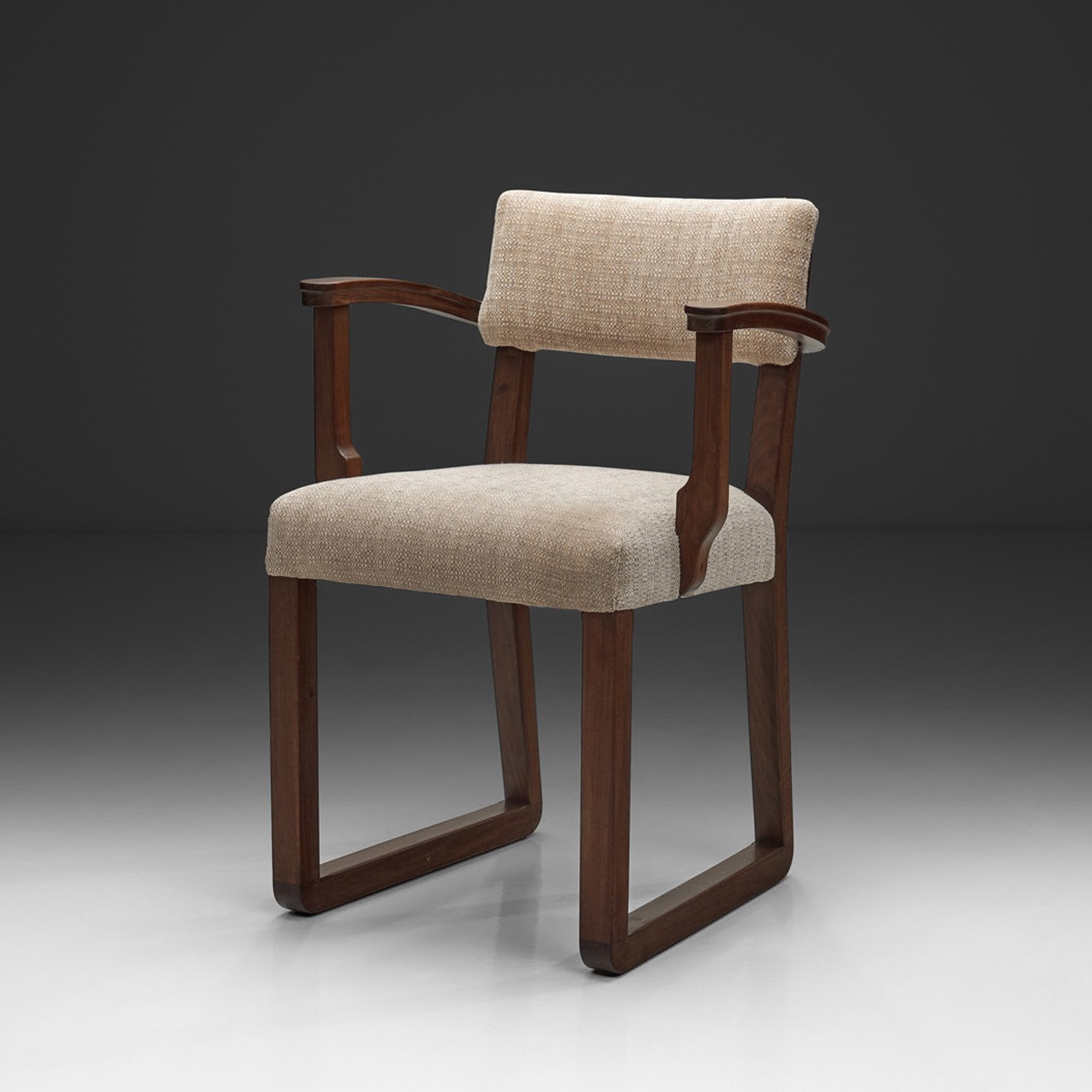
This armchair is rooted in the Dutch Art Deco movement of the 1930s. It was a period defined by confidence, structure, and a belief in modern luxury. Art Deco design emerged between the wars as a response to earlier ornament-heavy styles, favouring clarity of form, strong geometry, and refined materials. Furniture from this era often balanced comfort with a distinctly architectural presence, drawing inspiration from both classical proportion and the clean lines of modern industry. This chair reflects that mindset perfectly, presenting a strong and confident silhouette that feels intentional rather than decorative.
European designers believed that a chair should always be comfortable to sit on and beautiful to look at from all sides and angles and this piece is evidence of that. This elegantly constructed model combines comfort with style. From as early as the 1920s, cabinetmakers and architects frequently collaborated to produce exceptional furniture pieces like this. The chairs’ elegant curves, precise angles and structure all testify of this partnership’s success. Thanks to the design of the base, the form appears very grounded. With straight and curving lines following each other, the model has a dynamism rooted in organicity. Unlike pieces from outside the continent, Dutch designers’ products weren’t flashy but rather well-made to fit a warm, comfortable and welcoming home.
There is a subtle interplay of texture and tone present that allows the chair to seamlessly complement a range of interior styles, from classic vintage settings to contemporary spaces that value timelessness. This armchair is a striking example of the commitment to elegance and modernity, packaged in restrained sophistication.
Condition:
In good vintage condition. Wear consistent with age and use. Due to the nature and age of the materials, the item may have some marks, scratches, and discolouration. The item has recently been reupholstered in a premium fabric. Each of our items can be reupholstered by our in-house atelier in a fabric of choice. Please reach out for more information
Dimensions:
21.86 in W x 20.87 in D x 31.89 in H; Seat height 19.69 in; Seat depth 19.10 in; Arm height 28.15 in
55.5 cm W x 53 cm D x 81 cm H; Seat height 50 cm; Seat depth 48.5 cm; Arm height 71.5 cm
REQUEST PRICE HERE
Price category: 5,000 - 7,500 usd / eur
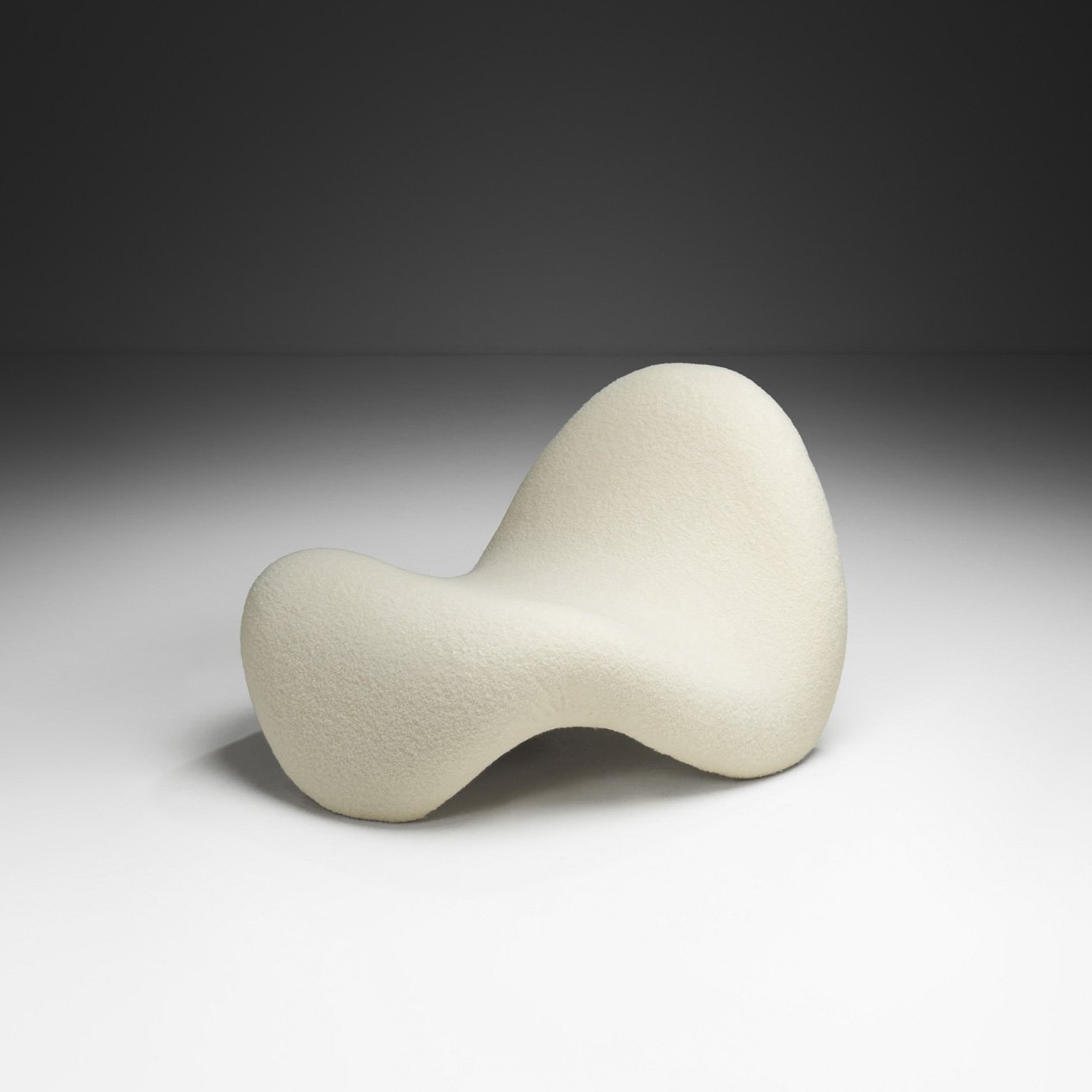
Artifort was founded in 1890, when Jules Wagemans started a business as an upholsterer in Maastricht. A great deal changed with the arrival of the interior and furniture designer Kho Liang Ie, and in 1959 he recruited the French designer Pierre Paulin, beginning a long and fruitful collaboration between Paulin and the Dutch manufacturer. Pierre Paulin’s model “577” lounge chair, also known as the “Tongue Chair” or “Langue” in French, represents a bold and fluid design language that emerged in the mid-20th century.
Designed in 1967, and produced by Artifort, the chair is a hallmark of Paulin’s sculptural approach to furniture. He believed that “a chair should be more than simply functional”. This "577" lounge chair model features a seamless, flowing form that echoes the curve of a human tongue. The lounge chair offers a fresh departure from traditional seating, embodying the futuristic and organic sensibilities of the 1960s. Constructed with a metal frame covered in foam and upholstered in a beautiful off-white textured fabric, the design prioritises both form and comfort. The low armless profile encourages a relaxed posture and makes it visually striking from all angles. Paulin’s innovative use of materials and emphasis on ergonomic design allowed this chair model to become a functional piece and a statement - ideal for modernist interiors that value design and experimentation.
Today, the “577”/ “Langue” chair stands as a timeless icon of modern design, revered for its originality and enduring appeal. Through this design, Pierre Paulin and Artifort captured a unique moment when comfort, form, and avant-garde aesthetics come together beautifully.
Condition:
In good vintage condition. Wear consistent with age and use. The chair has been reupholstered recently in a premium fabric. Each of our items can be reupholstered by our in-house atelier in a fabric of choice. Please reach out for more information.
Dimensions:
31.88 in W x 38.18 in D x 24.80 in H; Seat height 14.56 in; Seat depth 22.83 in
81 cm W x 97 cm D x 63 cm H; Seat height 37 cm; Seat depth 58 cm
REQUEST PRICE HERE
Price category: 2,500 - 5,000 usd / eur
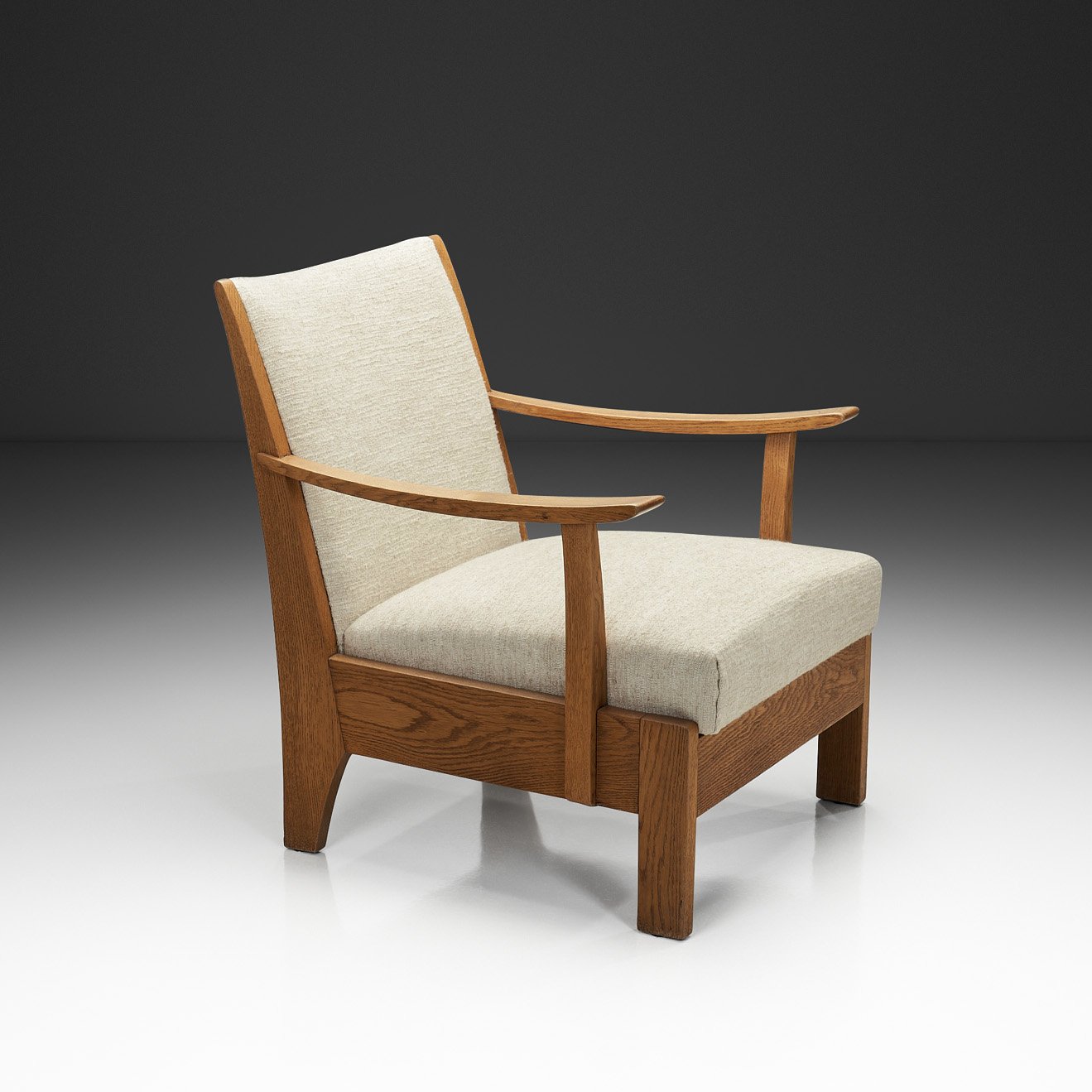
In the decades after World War II, furniture across Europe pursued a careful balance between simplicity and craftsmanship. In the Netherlands as well as in Scandinavia, there was a rejection of heavy ornament and instead the focus fell on materials like solid wood and textiles while keeping the overall form simple and purposeful. Chairs from this period often reflect a belief that good design should be both visually pleasant and functionally comfortable.
This modernist armchair, in the manner of Jan den Drijver, illustrates these principles through a straightforward yet thoughtful construction. The frame is built from solid wood, finished to reveal a warm, natural grain that highlights its organic beauty. The backrest rises with a gentle backward slope, providing ergonomic support without excess bulk, and the wide, flat armrests extend forward in a smooth and sleek line that aligns with the sitter’s posture. The seat and backrest surround the upholstery, a textured fabric that contrasts softly with the wood while maintaining a neutral palette. The cushions are padded to increase comfort. The legs are sturdy and substantial, ensuring support while not taking away from the rest of the design. This unadorned construction allows the quality of the piece to remain the focus - the clear form, the seamless joinery, and the dialogue between materials allows for the chair to feel timeless and considered rather than fleeting or overtly stylised.
Functionally and visually, this armchair demonstrates how mid-20th century European design could bridge tradition and modernity without sacrificing comfort or structural clarity. It is well suited to domestic living rooms, libraries, or quiet seating nooks while its understated modernism makes it versatile alongside both mid-century and contemporary interiors.
Condition:
In good vintage condition. Wear consistent with age and use. Minor scratches and discolouration. Due to the nature of the material, the item may have some additional marks. The chair has recently been reconditioned and reupholstered in a premium fabric. Each of our items can be reupholstered by our in-house atelier in a fabric of choice. Please reach out for more information.
Dimensions:
27.36 in W x 31.49 in D x 30.31 in H ; Seat height 16.33 in; Seat depth 21.85 in; Arm height 22.04 in
69.5 cm W x 80 cm D x 77 cm H ; Seat height 41.5 cm; Seat depth 55.5 cm; Arm height 56 cm
REQUEST PRICE HERE
Price category: 2,500 - 5,000 usd / eur
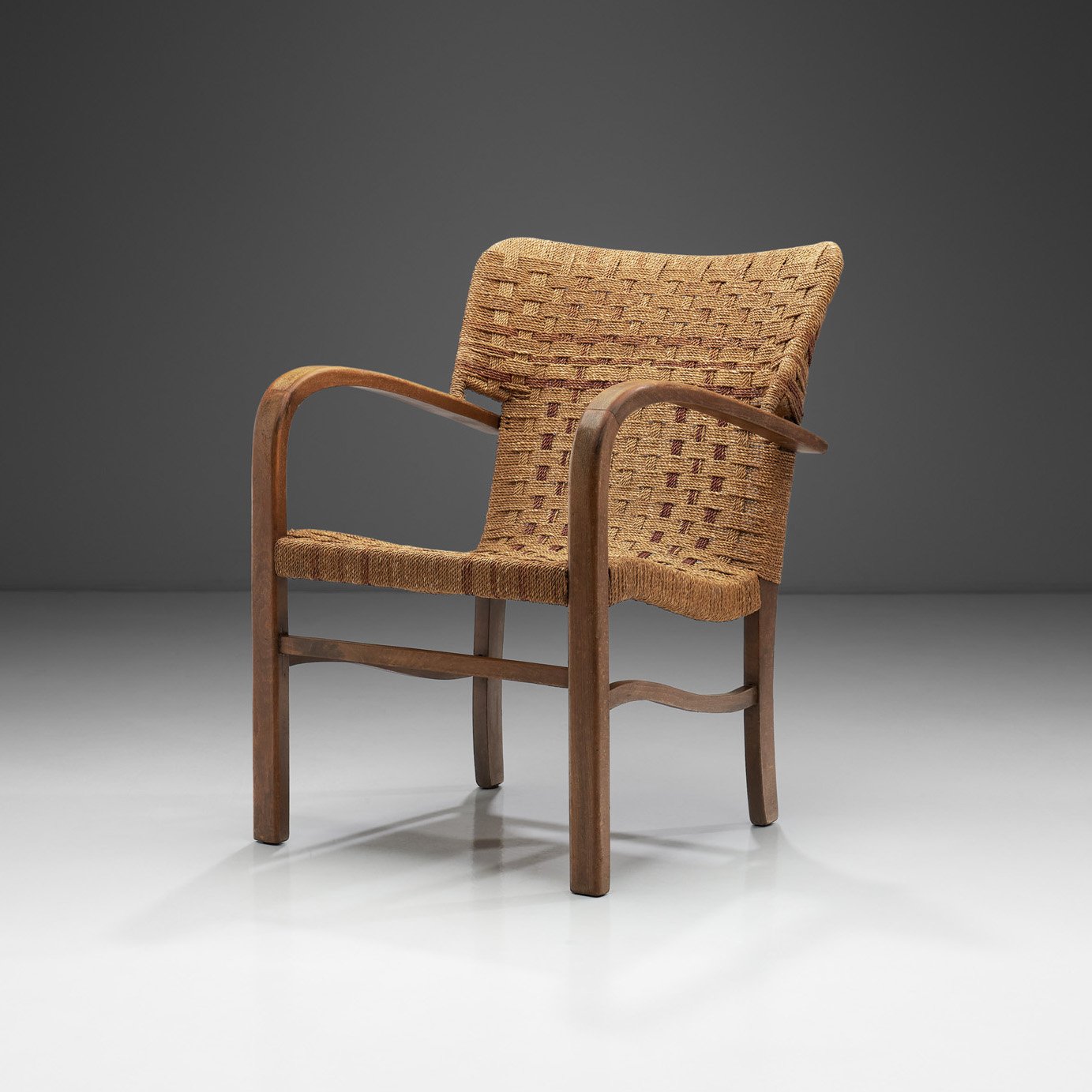
This armchair, recalling the Bauhaus, is made of wood and woven rope, and brings to mind iconic designs of the early 20th century. Erich Dieckmann’s furniture models are often characterized by quality hardwoods, cane matting and geometric frames that link the armrests and legs, creating a unique runner construction. This model is visually reminiscent of Dieckmann’s work thanks to the curved armrests and quality materials.
The wooden structure of this chair was a technical innovation in its time as it was created by steam bending the wood. During the process, the wood is exposed to steam to make it pliable. The steam bending is most apparent in the armrests, where the curvature flows down to form the front legs, and in the stretchers where there is a wavy look - these elements allow the otherwise simple design to stand out and become a work of art in its own right. The frame is complemented by the elegant rope seat and backrest woven tightly around the wood, with the woven seating giving it a warm and cosy feel all while staying very functional. The chair’s simplicity and honest elegance makes it an exceptional piece of furniture. This chair is defined by it’s materials, steam bent wood and woven rope. Both techniques require expert skill, which the craftsman and the manufacturer evidently both possessed.
Unlike designs from outside the continent, European designers’ products weren’t flashy but instead focused on being well-made and to fit a warm, comfortable and welcoming home. As this chair exemplifies, blending functionality, good quality natural materials and organic colours with excellent craftsmanship is the key to the success of this design period.
Condition:
In vintage condition. Wear consistent with age and use.
Dimensions:
23.23 in W x 26.38 in D x 31.5 in H; Seat height 16.53 in; Seat depth 16.92 in; Arm height 24.8 in
59 cm W x 67 cm D x 80 H; Seat height 42 cm; Seat depth 43 cm; Arm height 63 cm
REQUEST PRICE HERE
Price category: 2,500 - 5,000 usd / eur
Bas van Pelt was an iconic Dutch furniture designer known for his innovative pieces and style. He renamed “Firma Corn. van der Sluys” into the new “My Home” and opened new branches in different cities. His work was exclusive, a fact which explains the limited numbers of surviving models of his creations.
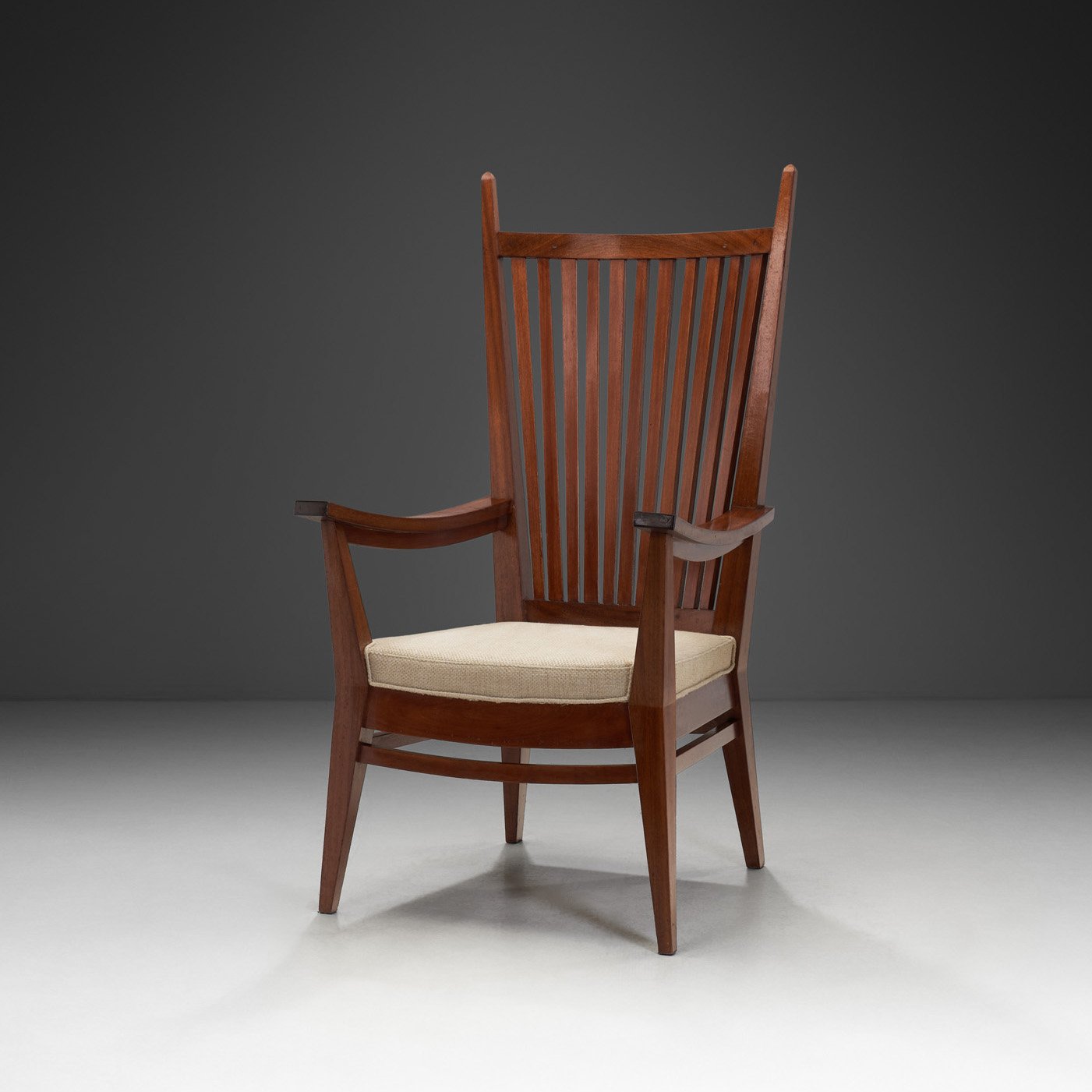
While Bas Van Pelt's creative work was primarily influenced by the straight lines dominated by The Hague School, this armchair is the result of his more mature design era, which was primarily dominated by natural materials and curvature. The main visual element of this piece is the backrest with eleven wooden spindles that creates an almost throne-like appearance. The spindles are set in the rich dark wood frame which creates the structure of this piece. The natural beauty of oak and its versatile grain is beautifully displayed throughout the chair, especially in the backrest. Not only this, but the upholstered seat transforms this piece into more than an average wooden chair, increasing both its aesthetic qualities and its comfort. The legs and stretchers combine straight and bent lines, creating a sculptural look that is interesting from all angles.
This armchair shows why Bas van Pelt is widely regarded as a Dutch design icon. From the handcrafted wooden frame to the numerous spindles and tapered legs, the chair showcases both the quality materials utilized and expert craftsmanship.
Condition:
In good vintage condition. Wear consistent with age and use. The chair has been reupholstered recently in premium fabric. Each of our items can be re-upholstered by our in-house atelier in a fabric of choice. Please reach out for more information.
Dimensions:
28.34 in W x 29.52 in D x 50.78 in H; Seat height 18.7 in; Seat depth 21.85 in; Arm height 28.34 in
67 cm W x 75 cm D x 129 cm H; Seat height 47.5 cm; Seat depth 55.5 cm; Arm height 72 cm
About the Designer:
Bas Van Pelt (1900 Dordrecht (NL) - 1945 Sandbostel (DE) was a well-known Dutch interior and furniture designer, known for the clarity and quality of his designs. His works created in the 1930s and 1940s are regarded for their progressive design and quality.
While he is most well-known for his chair designs, van Pelt was also active as an interior designer. He also designed fabrics for window coverings, rugs and carpets, seating and tables, as well as lighting crafted by the best craftsmen in the Netherlands. He worked with multiple manufacturers, including his own firm, Bas van Pelt / My Home and Verto Verenigde Touwfabrikien, where his tubular metal designs were produced. In the window of the shop, in the lively centre of The Hague, there was one large window placed so that everyone could look inside and see how things were made, and could be done differently; in his view, modern furniture at the time was light and airy, transparent, made of tubular steel frame, combined with wood. This view was very progressive for the 1930s, when the influence of The Hague School was still dominating most designers.
Unfortunately, in 1940 WWII changed the life of Bas van Pelt as well, who was on the board of the Haagse Kunstkring, where discussions about reconstruction after the war took place. Sadly, Bas van Pelt did not live to see it. He was deported because he gave people in hiding a safe place, saving many lives. While there is very limited information about his life and work, his furniture designs have become collectibles in the past decades that are also found in Dutch museums. Bas van Pelt is remembered as a progressive designer and as a man who saved lives.
REQUEST PRICE HERE
Price category: 2,500 - 5,000 usd / eur
The 1970s witnessed the emergence of eccentric furniture pieces that seamlessly blended the avant-garde with practicality. Crafted in the Netherlands, this distinctive lounge chair bears the mark of Dutch ingenuity and artistry, reflecting an era where experimentation in design was the norm. What set this chair apart was not just its striking appearance but the innovative use of Zebrano plywood.
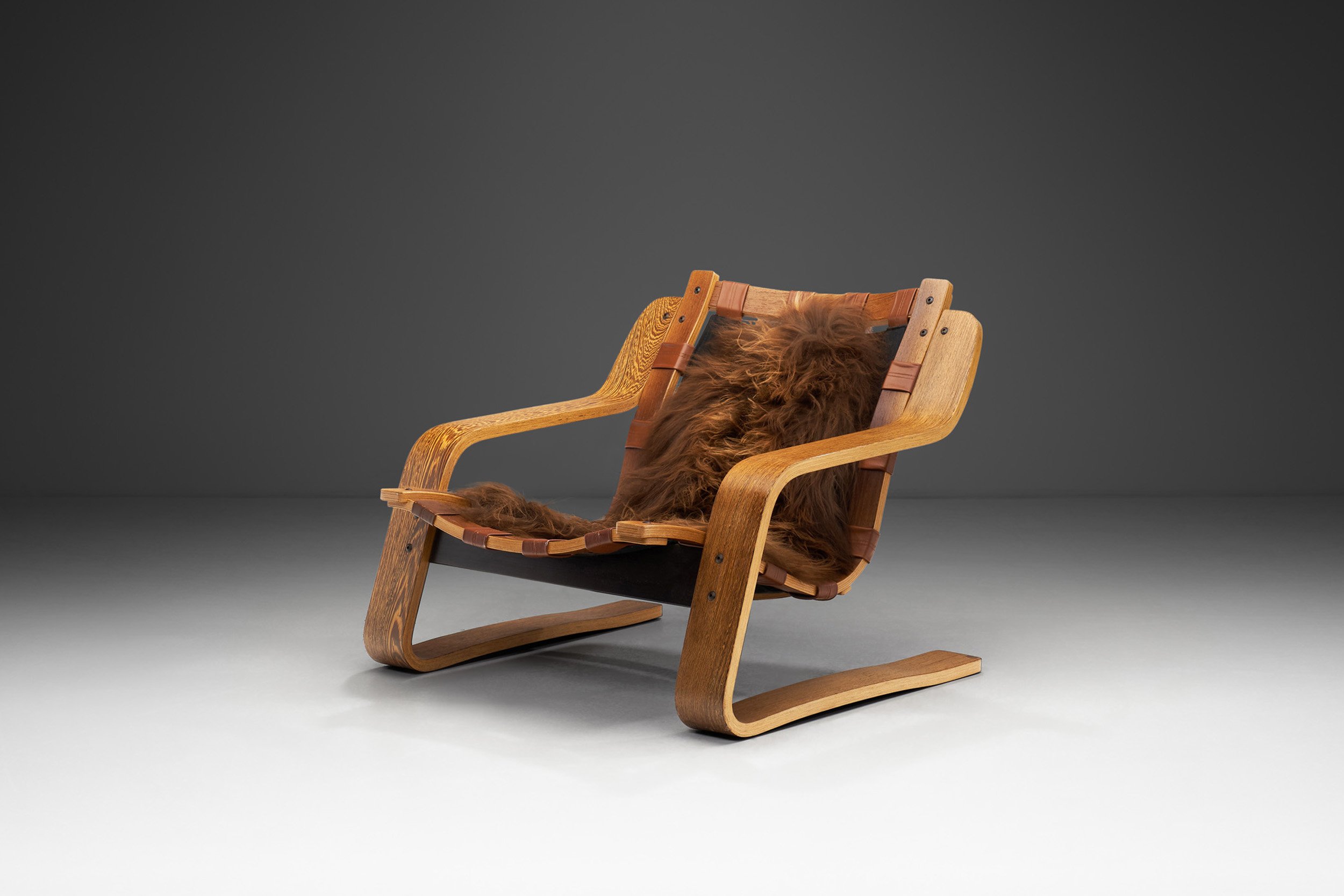
The so-called “Zebrano” wood -derived from tropical trees in America, Asia, and Africa, yielding striped hardwood used in cabinetwork - is known for its distinctive dark stripes reminiscent of a zebra's markings, hence the name. In this chair, the zebrano plywood structure takes centre stage, recalling designers Ingmar Relling from Norway because of the wood, and the bentwood designs of Alvar Aalto. Showcasing the wood's natural beauty and unique patterns, the chair's use of Zebrano plywood not only enhances its aesthetic appeal but also speaks volumes of the craftsmanship inherent in Dutch design of the era. Plywood, a versatile material, played a pivotal role in the creation of this extraordinary lounge chair. Unlike solid wood, plywood is composed of layers of wood veneer bonded together, making it sturdy and flexible. This flexibility allows for the creation of sculptural, bent wood shapes, which is also the main visual hallmark of this chair's design. The cantilevered structure, with visible screws holding the distinct pieces together, showcases the prowess of Dutch craftsmanship and design. The ingenuity of the Dutch designer is evident in the chair's cantilever design. The back and seat are supported only by the front legs, creating an elegant curve that defies not just traditional expectations but, seemingly, also gravity. The use of plywood allows for this daring structure, showcasing the designer's willingness to push the boundaries of conventional furniture shapes and forms. What truly sets this lounge chair apart is without a doubt is its plywood frame, however the seat also deserves attention: carefully stretched between the sides of the back frame via faux leather straps, the canvas seat assures great ergonomic comfort. Additionally, the brown sheepskin throw is a small, but important visual addition that softens the overall impression. This cosy addition not only enhances the chair's visual appeal but also contributes to its visual and practical comfort. The deliberate visibility of screws adds an industrial touch, embracing the raw aesthetic that contrasts nicely with the organic zebrano wood and fabric.
In essence, this Dutch-made cantilever lounge chair from the 1970s is in many ways a testament to the era's spirit of exploration and innovation. It showcases the marriage of unconventional materials like Zebrano plywood with groundbreaking design, leaving an indelible mark on the landscape of furniture craftsmanship. The chair also exemplifies the era's commitment to pushing boundaries, making it a rare and individual example of Dutch design brilliance.
Condition:
In good vintage condition. Wear consistent with age and use. The chair’s brown sheepskin throw is newly produced. Each of our items can be re-upholstered by our in-house atelier in a fabric of choice. Please reach out for more information.
Dimensions:
31.88 in W x 34.44 in D x 26.57 in H; Seat height 11.22 in; Arm height 16.92 in
81 cm W x 87.5 cm D x 67.5 cm H); Seat height 28.5 cm; Arm height 43 cm
REQUEST PRICE HERE
Price category: 2,500 - 5,000 usd / eur
This elegant armchair by Dutch designer, Bas Van Pelt is a classically luxe model with a level of craftsmanship that’s immediately visible to any eye. The construction of this rare 1940s design is simple at its core, but thanks to the details, it is a unique representation of early Dutch modernism.
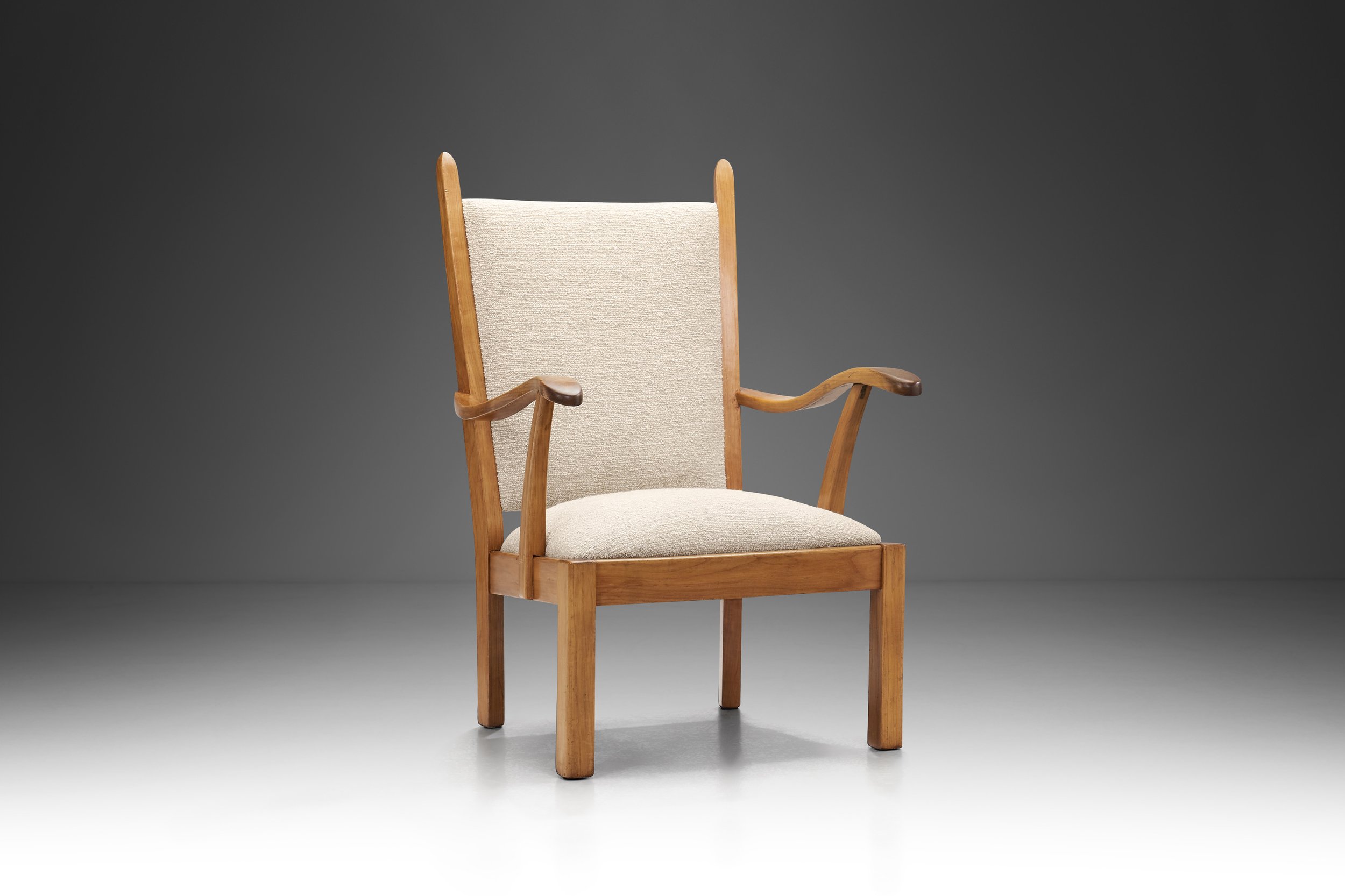
While Bas Van Pelt's creative work was primarily influenced by the 1920s straight lines dominated by The Hague School, this armchair is the result of his more mature design era, which was primarily dominated by natural materials and more curvature. While made of solid wood, this armchair has an open feel to it thanks to the airy arrangement of the arms and legs. The curved lines of the armrests are beautifully crafted and follow the raised seat’s angle. The curves nicely contrast with the straight lines of the frame, keeping it from appearing too strict. Apart from the expert woodwork, the upholstered seat and back stand out as well. The light bouclé fabric is tightly fitted around the frame, and the seat’s thick shape is an especially pleasing element that offers plenty of comfort both figuratively and literally. The overreaching backs further enhance the back’s widening shape and thus allow the individual loops of the yarn to stand out. The block legs blend seamlessly into the back and form a gentle angle. Thanks to the well-chosen proportions and the luxurious upholstery, this armchair provides great comfort. This model can be easily used as an accent chair thanks to its characteristic details, but can also complement a wide variety of interior styles with it refined and elegant style.
Bas van Pelt’s progressive designs were, in many ways, ahead of his era. The Dordrecht-born designer’s furniture models are quite rare, a few are preserved in the Stedelijk Museum Amsterdam for modern art, contemporary art, and design.
Condition:
In good vintage condition. Wear consistent with age and use. The chair has been reupholstered recently in a premium bouclé fabric. Each of our items can be re-upholstered by our in-house atelier in a fabric of choice. Please reach out for more information.
Dimensions:
24.6 in W x 24.4 in D x 37 in H; Seat height 15.35 in; Arm height 23.22 in
62.5 cm W x 62 cm D x 94 cm H; Seat height 39 cm; Arm height 59 cm
About the Designer:
Bas Van Pelt (1900 Dordrecht (NL) - 1945 Sandbostel (DE) was a well-known Dutch interior and furniture designer, known for the clarity and quality of his designs. His works created in the 1930s and 1940s are regarded for their progressive design and quality.
While he is most well-known for his chair designs, van Pelt was also active as an interior designer. He also designed fabrics for window coverings, rugs and carpets, seating and tables, as well as lighting crafted by the best craftsmen in the Netherlands. He worked with multiple manufacturers, including his own firm, Bas van Pelt / My Home and Verto Verenigde Touwfabrikien, where his tubular metal designs were produced. Furthermore, he opened ‘My Home’ in 1931, just before the onset of the great crisis in the midst of major changes in the last century. In the façade of the shop, in the lively centre of The Hague, there was one large window placed so that everyone could look inside and see how things were made, and could be done differently; in his view, modern furniture at the time was light and airy, transparent, made of tubular steel frame, combined with wood. This view was very progressive for the 1930s, when the influence of The Hague School was still dominating most designers.
Unfortunately, in 1940 WWII changed the life of Bas van Pelt as well, who was on the board of the Haagse Kunstkring, where discussions about reconstruction after the war took place. Sadly, Bas van Pelt did not live to see it. He was deported because he gave people in hiding a safe place, saving many lives. While there is very limited information about his life and work, his furniture designs have become collectibles in the past decades that are also found in Dutch museums. Bas van Pelt is remembered as a progressive designer and as a man who saved lives. ~H.
REQUEST PRICE HERE
Price category: 2,500 - 5,000 usd / eur
The uniqueness of this mid-century Dutch chair is beyond question. With a peculiar shape and history, every aspect of this chair is one-of-a-kind. Seriously minimal and highly functional, this chair is out of the ordinary.
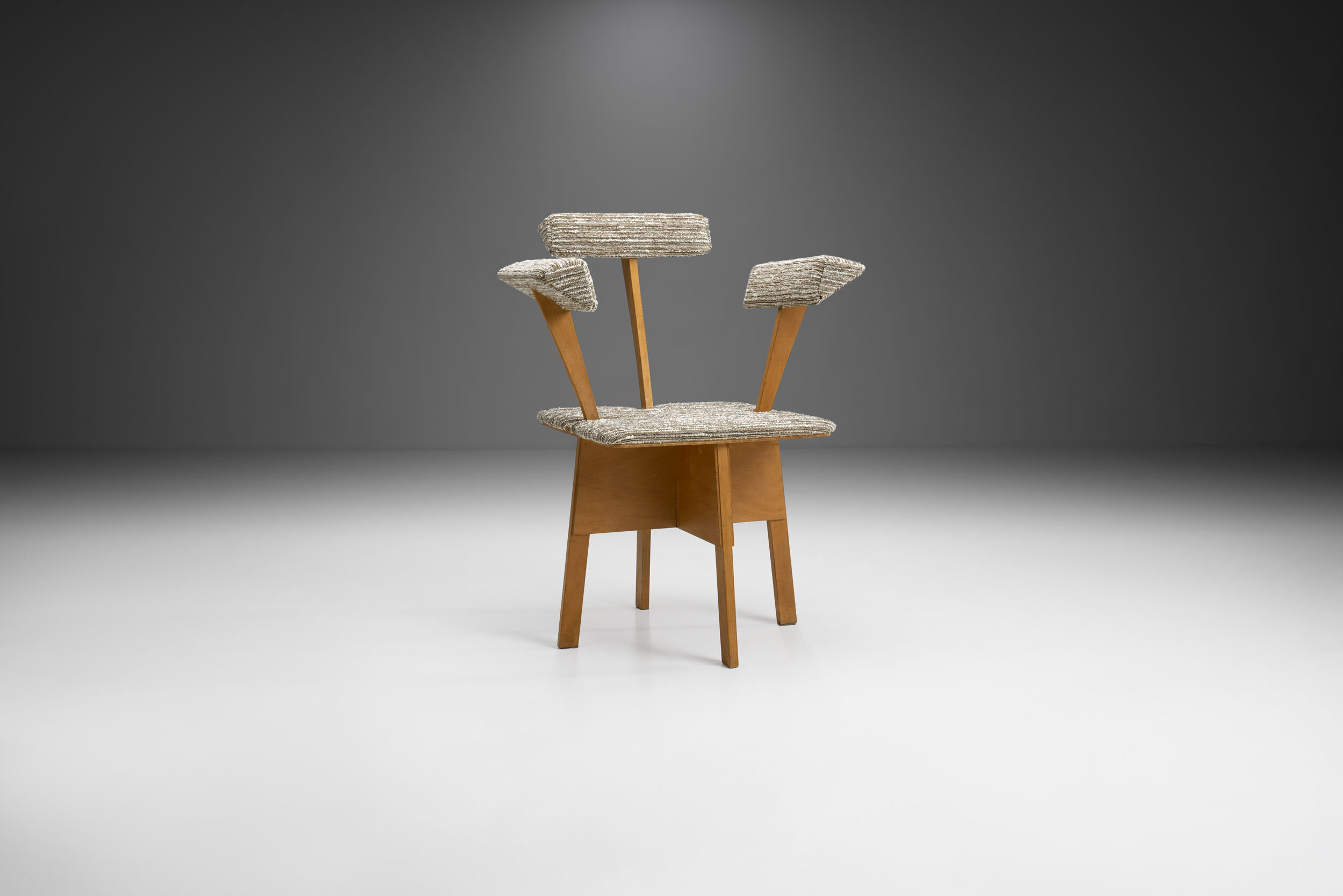
Dutch mid-century furniture is defined by characteristics of simplicity and functionality in the context of industrial production, and a preoccupation with geometry. Dutch furniture makers aspired to affect lives with good functional design, which, in this case was taken quite literally. Visually this chair does not quite fit into any traditional chair category, which is explained by its historical purpose. In the 1940s, this model was known as a UKG (ultra-short wave) chair, as it was used in facilities where high frequency electrotherapeutic treatments were available. Accordingly, this chair contains a piece of history in its shape and materials alike. The chair is completely metal-free and features removable armrests. The slim arms and back appear to be emerging from the seat, ending in the upholstered back- and armrests. The fabric is by by the world famous French atelier, Toyine Sellers, who created this fabric that can be considered art in itself.
While this chair was not created to strictly conform to the principles of the era, it is interesting to see how it nevertheless reflects many of the characteristics of mid-century design. The plywood is light with geometrical lines without any ornamentation. Compressed plywood is in fact typical of the Dutch modernist aesthetic. Dutch mid-century furniture designers were not concerned with organic forms and the natural world in the way that Scandinavian designers were, rather, they presented true Modernism, ultimately traceable back to the legacy of the Bauhaus.
Condition:
In good vintage condition. Wear consistent with age and use. The chair has been reupholstered recently in premium bouclé fabric by Toyine Sellers. Each of our items can be re-upholstered by our in-house atelier in a fabric of choice. Please reach out for more information.
Dimensions:
28.74 in W x 26.37 in D x 37 in H; Seat height 19.68 in
73 cm W x 67 cm D x 94 cm H; Seat height 50 cm

REQUEST PRICE HERE
Price category: 2,500 - 5,000 usd / eur
This armchair is an early and rare piece representing Dutch Modernism. Slanting, oblique lines characterize the frame, which gives this chair a distinctive shape. Jan den Drijver designed this model in 1948.
Dutch mid-century furniture, such as this high back chair, is defined by characteristics of simplicity and functionality and a preoccupation with geometry. This unique Dutch modern armchair has a distinctive shape with a low seat and a high backrest inclined just in the right angle to offer a comfortable sitting position. The curved lines of the solid wooden frame continue in the armrests and legs, giving this chair an overall soft feeling. The elongated backrest is supported by nine horizontal wooden spindles, to which the tufted back cushion is tied to in a decorative manner to ensure its position. The seat features wide bands upon which the cushion sits, further guaranteeing sitting comfort.
Both the back and seat cushion have been reupholstered in a light premium fabric, complimenting the beautiful colour of the wood. Jan den Drijver designed this model for furniture store "De Stijl", which was once synonymous with the word “design” in The Hague.
Condition:
In good vintage condition. Wear consistent with age and use. The chair has been reupholstered recently in premium linen fabric. Small scratches on the wood. Each of our items can be re-upholstered by our in-house atelier in a fabric of choice. Please reach out for more information.
Dimensions:
23.62 in W x 28.54 in D x 39.76 in H; Seat height 16.54 in; Arm height 21.26 in
60 cm W x 72.5 cm D x 101 cm H; Seat height 42 cm; Arm height 54 cm
About the designer:
While Jan den Drijver (Johannes Hendrik Bastiaan den Drijver) (1903-1993) is a very well-known figure in the history of Dutch design, not a lot is known about his life from before establishing “De Stijl” in The Hague.
Although a designer of paramount importance, den Drijver remains mostly known for his chair designs for De Ster Gelderland and his own company, De Stijl. A furniture maker, furniture designer and interior designer, den Drijver still mystifies. The author, R. Boes wrote an unpublished article titled “An investigation into the cabinetmaker, furniture designer and interior designer Jan den Drijver”, which shows that the interest in the designer’s work and life is not only alive, but a subject to still ongoing research as well.
What we do know is that the store “The Stijl” was once housed at Laan van Meerdervoort 864 in The Hague between 1933-1936, which was confirmed by the RKD (Netherlands Institute for Art History) as well. The RKD confirms the address as a showroom and workshop of 'Woninginrichting De Stijl' for the years, after moving from the Thomsonlaan 99. We are excited to find out more about this outstanding Dutch designer, whose work speaks on his behalf for now. ~H.

REQUEST PRICE HERE
Price category: 2,500 - 5,000 usd / eur
This armchair, like its high back kin, is an early and rare piece by Dutch furniture and interior designer, Jan den Drijver, representing Dutch Modernism. Slanting, oblique lines characterize the frame, which gives this chair a distinctive shape.
Dutch mid-century furniture, such as this back chair, is defined by characteristics of simplicity and functionality and a preoccupation with geometry. This unique Dutch modern armchair has a distinctive shape with a low seat and a backrest inclined just in the right angle to offer a comfortable lounging position. The curved lines of the solid wooden frame continue in the armrests and legs, giving this chair an overall soft and open feeling. The backrest is supported by six horizontal wooden spindles, to which the tufted back cushion is tied to in a decorative manner to ensure its position. The seat features the original stretched out springs upon which the cushion sits, further guaranteeing sitting comfort.
Both the back and seat cushion has been reupholstered in a light premium fabric, complimenting the beautiful colour of the wood. Thanks to its upholstery and visually arresting design, this armchair is appealing from every angle.
Condition:
In good vintage condition. Wear consistent with age and use. The chair has been reupholstered recently in premium fabric.
Dimensions:
22.44 in W x 28.74 in D x 28.74 in H; Seat height 16.92 in
57 cm W x 73 cm D x 73 cm H; Seat height 43 cm
About the designer:
While Jan den Drijver (Johannes Hendrik Bastiaan den Drijver) (1903-1993) is a very well-known figure in the history of Dutch design, not a lot is known about his life from before establishing “De Stijl” in The Hague.
Although a designer of paramount importance, den Drijver remains mostly known for his chair designs for De Ster Gelderland and his own company, De Stijl. A furniture maker, furniture designer and interior designer, den Drijver still mystifies. The author, R. Boes wrote an unpublished article titled “An investigation into the cabinetmaker, furniture designer and interior designer Jan den Drijver”, which shows that the interest in the designer’s work and life is not only alive, but a subject to still ongoing research as well.
What we do know is that the store “The Stijl” was once housed at Laan van Meerdervoort 864 in The Hague between 1933-1936, which was confirmed by the RKD (Netherlands Institute for Art History) as well. The RKD confirms the address as a showroom and workshop of 'Woninginrichting De Stijl' for the years, after moving from the Thomsonlaan 99. We are excited to find out more about this outstanding Dutch designer, whose work speaks on his behalf for now. ~H.
REQUEST PRICE HERE
Price category: 2,500 - 5,000 usd / eur
Bas van Pelt was one of the key figures in early Dutch modernist design, active during the 1930s and 1940s through his firm “My Home.” His work is recognised for its clarity of construction, careful proportions, and thoughtful integration of natural materials. Van Pelt focused on creating furniture that balanced function and craftsmanship, often incorporating elements such as wicker, rattan, and solid wood to introduce both durability and texture.
This high-back chair by Bas van Pelt combines of strong verticality and refined material contrast. The solid wooden frame establishes a clear architectural outline, with the elongated tall back defining the silhouette. The back is composed by ladder-like horizontal slats that introduce a sense of rhythm while maintaining the openness of the design. The seat is crafted from woven wicker, a material valued for its strength and breathability, which adds a tactile, organic quality to the otherwise linear construction. This contrast between the smoothness of the frame and the texture of the woven surface is central to the chair’s character. The armrests are gently shaped, introducing a subtle curvature that softens the overall form. Below, the legs are connected by stretchers that reinforce the structure and ensure stability. The craftsmanship is evident in the precision of the joinery which contribute to the overall sense of durability and refinement.
This armchair shows why Bas van Pelt is widely regarded as a Dutch design icon. From the handcrafted frame to the beautiful woven element, the chair remains of hifh quality and ideally suited for everyday use.
Condition:
In good vintage condition. Wear consistent with age and use. The chair has recently been reconditioned. Some chips and dents are present. Due to the nature and age of the materials, the item may have some marks, scratches, and discolouration.
Dimensions:
25.20 in W x 28.35 in D x 40.95 in H; Seat height 13.39 in; Seat depth 20.08 in; Arm height 23.82 in
64 cm W x 72 cm D x 104 cm H; Seat height 34 cm; Seat depth 51 cm; Arm height 60.5 cm